What is Critical Thinking ?
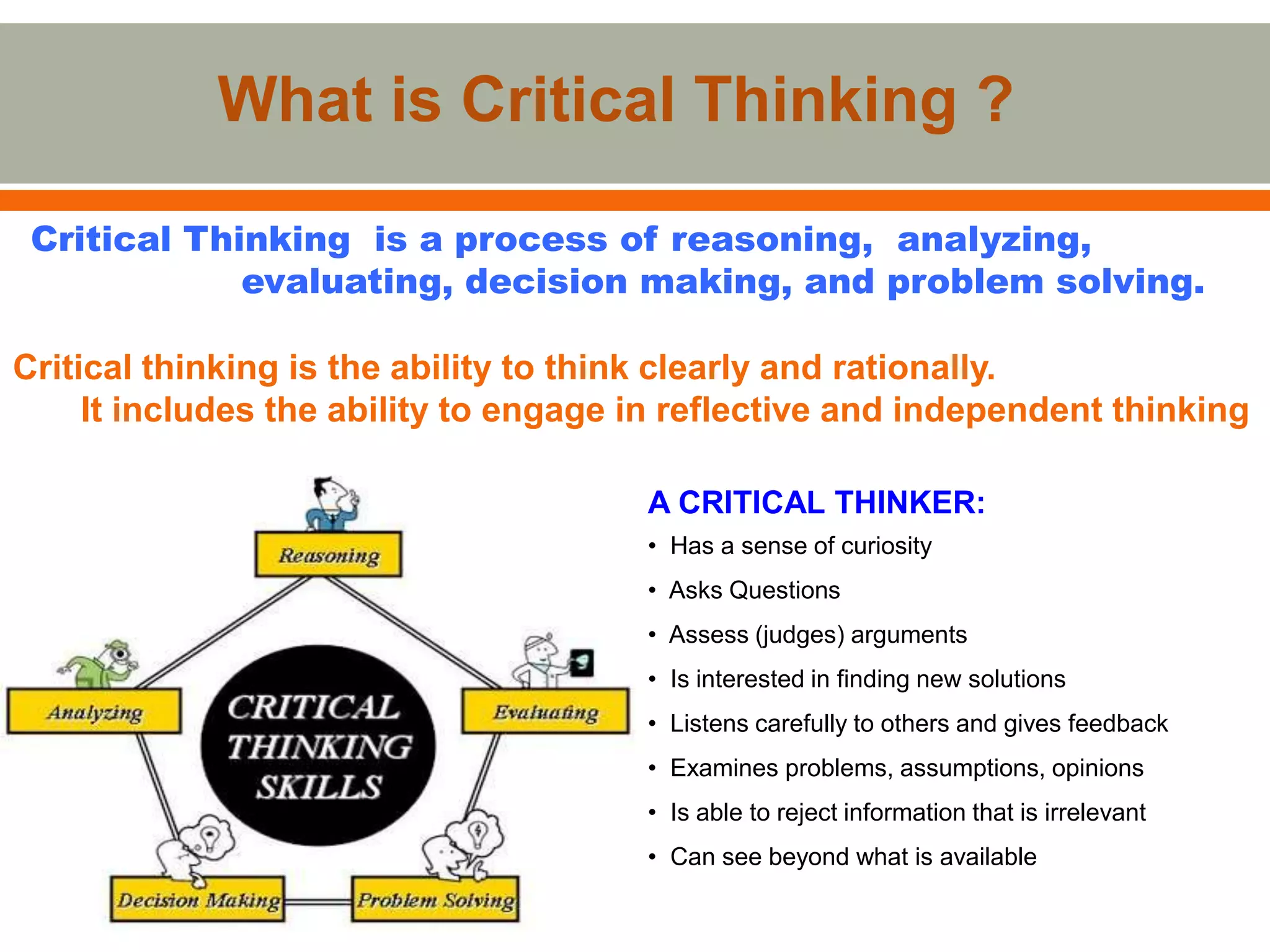
Critical Thinking is a process of reasoning, analyzing,
evaluating, decision making, and problem solving.
A CRITICAL THINKER:
• Has a sense of curiosity
• Asks Questions
• Assess (judges) arguments
• Is interested in finding new solutions
• Listens carefully to others and gives feedback
• Examines problems, assumptions, opinions
• Is able to reject information that is irrelevant
• Can see beyond what is available
Critical thinking is the ability to think clearly and rationally.
It includes the ability to engage in reflective and independent thinking
The roots go back to the teaching practice and vision of Socrates 2,500 years ago.
Socrates:
o demonstrated that people may have power and high position and yet be deeply confused
and irrational
o established the importance of asking deep questions that probe profoundly into thinking
before we accept ideas as worthy of belief
o established the importance of seeking evidence, examining and reasoning the assumptions
o highlighted the need in thinking for clarity and logical consistency
His method of questioning is known as "Socratic Questioning”
and is the best known critical thinking teaching strategy.
 In the Middle Ages, Critical Thinking was embodied in
the writings and teachings of Thomas Aquinas.
 During the Renaissance (15th and 16th Centuries),
scholars in Europe began to think critically about religion,
art, society, human nature, law, and freedom.
 1st book: Francis Bacon, in England, The Advancement of
Learning, he argued for the importance of studying the world
empirically.
 2nd text: in France, Descartes in Rules For the Direction of
the Mind argued for the need for a special systematic
disciplining of the mind to guide it in thinking.
 3rd: Sir Thomas Moore developed a model of a new social
order, Utopia, in which every domain of the present world was
subject to critique.
 In the Italian Renaissance, Machiavelli in his The Prince
critically assessed the politics of the day, and laid the
foundation for modern critical political thought.
John Dewey- the “father” of the modern critical thinking tradition
Dewey, an American philosopher and educator, called critical thinking process a
“reflective thinking” and defined it as “Active, persistent, and careful consideration of a belief or supposed
form of knowledge in the light of the grounds which support it and the further conclusions to which it tends
(Dewey, 1909, p.9).
Robert Ennis- the most popular definition
Ennis’s definition of critical thinking (1989) has become the most popular and widely used definition.
“Critical thinking is reasonable, reflective thinking that is focused on deciding what to believe or do.”
Richard Paul- introduced the idea of “thinking about your thinking”- the metacognition
Pauls’ definition of critical thinking is well known and used in academia; teachers and researchers in the
academic field regard his definition to be the best one as it inspires self-assessment and leads to
improvements.
“Critical thinking is that mode of thinking-about any subject, content or problem-in which the thinker
improves
the quality of his or her thinking by skillfully taking charge of the structures inherent in the thinking and
imposing
intellectual standards upon them” (Paul, Fisher and Nosich, 1993, p 4).
Michael Scriven- a learned academic competency
In 1997 Michael Scriven defined critical thinking as a learned academic competency like reading and
writing,
and claimed that it should be taught in elementary and high schools.
Watson-Glaser Critical Thinking Appraisal is a test to choose
managers and leaders
 Watson-Glaser’s Appraisal is the most widely used tool for
selecting great managers and developing future leaders. In
1925 Edward Glaser and Goodwin Watson developed a test
which today is the primary means for evaluating the cognitive
ability of professionals.
 Watson-Glaser is considered the gold standard as “it precisely
measures critical thinking ability—one of the strongest
predictors of job success. Nothing is more important than how
employees question, analyze and make decisions under
pressure” (thinkwatson).
BIG 5 TO OVERCOME:
• an over-reliance / absolute acceptance
• narrow-mindedness or close-mindedness
• lack of relevant background information or ignorance
• peer pressure
• fear of change or an unwillingness to change
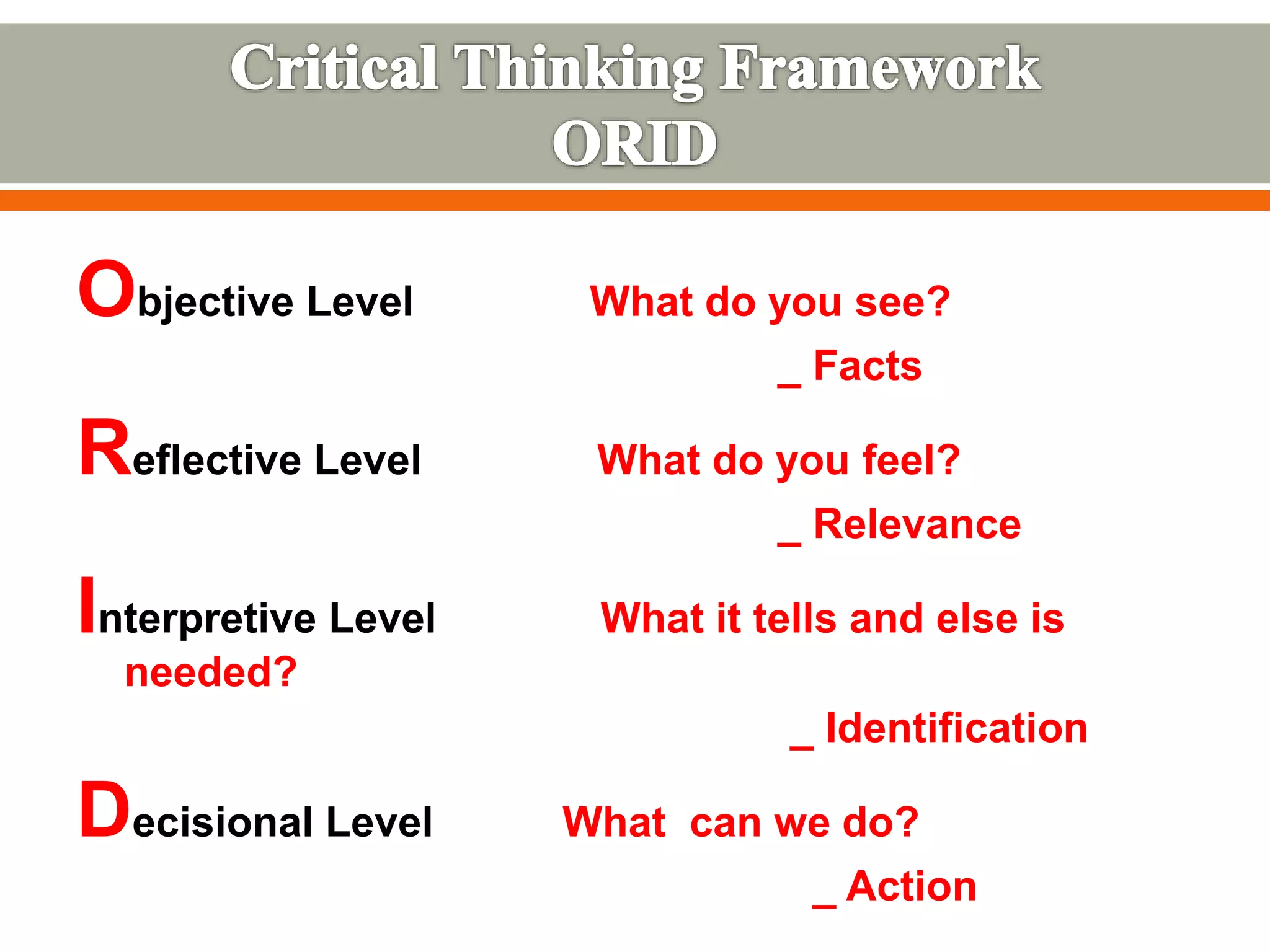
Objective Level What do you see?
_ Facts
Reflective Level What do you feel?
_ Relevance
Interpretive Level What it tells and else is
needed?
_ Identification
Decisional Level What can we do?
_ Action
DUALISM:
“There are [always] right and wrong answers…”
MULTIPLICITY
“There are conflicting answers, or maybe no answers;
therefore, one opinion is as good as another, and
EVERYONE HAS THE RIGHT TO THEIR OPINION”
RELATIVISM
“It all depends, so we must learn to evaluate
solutions.”

Critical thinking power point k. yegoryan

  • 2.
    What is CriticalThinking ? Critical Thinking is a process of reasoning, analyzing, evaluating, decision making, and problem solving. A CRITICAL THINKER: • Has a sense of curiosity • Asks Questions • Assess (judges) arguments • Is interested in finding new solutions • Listens carefully to others and gives feedback • Examines problems, assumptions, opinions • Is able to reject information that is irrelevant • Can see beyond what is available Critical thinking is the ability to think clearly and rationally. It includes the ability to engage in reflective and independent thinking
  • 3.
    The roots goback to the teaching practice and vision of Socrates 2,500 years ago. Socrates: o demonstrated that people may have power and high position and yet be deeply confused and irrational o established the importance of asking deep questions that probe profoundly into thinking before we accept ideas as worthy of belief o established the importance of seeking evidence, examining and reasoning the assumptions o highlighted the need in thinking for clarity and logical consistency His method of questioning is known as "Socratic Questioning” and is the best known critical thinking teaching strategy.
  • 4.
     In theMiddle Ages, Critical Thinking was embodied in the writings and teachings of Thomas Aquinas.  During the Renaissance (15th and 16th Centuries), scholars in Europe began to think critically about religion, art, society, human nature, law, and freedom.
  • 5.
     1st book:Francis Bacon, in England, The Advancement of Learning, he argued for the importance of studying the world empirically.  2nd text: in France, Descartes in Rules For the Direction of the Mind argued for the need for a special systematic disciplining of the mind to guide it in thinking.  3rd: Sir Thomas Moore developed a model of a new social order, Utopia, in which every domain of the present world was subject to critique.  In the Italian Renaissance, Machiavelli in his The Prince critically assessed the politics of the day, and laid the foundation for modern critical political thought.
  • 6.
    John Dewey- the“father” of the modern critical thinking tradition Dewey, an American philosopher and educator, called critical thinking process a “reflective thinking” and defined it as “Active, persistent, and careful consideration of a belief or supposed form of knowledge in the light of the grounds which support it and the further conclusions to which it tends (Dewey, 1909, p.9). Robert Ennis- the most popular definition Ennis’s definition of critical thinking (1989) has become the most popular and widely used definition. “Critical thinking is reasonable, reflective thinking that is focused on deciding what to believe or do.” Richard Paul- introduced the idea of “thinking about your thinking”- the metacognition Pauls’ definition of critical thinking is well known and used in academia; teachers and researchers in the academic field regard his definition to be the best one as it inspires self-assessment and leads to improvements. “Critical thinking is that mode of thinking-about any subject, content or problem-in which the thinker improves the quality of his or her thinking by skillfully taking charge of the structures inherent in the thinking and imposing intellectual standards upon them” (Paul, Fisher and Nosich, 1993, p 4). Michael Scriven- a learned academic competency In 1997 Michael Scriven defined critical thinking as a learned academic competency like reading and writing, and claimed that it should be taught in elementary and high schools.
  • 7.
    Watson-Glaser Critical ThinkingAppraisal is a test to choose managers and leaders  Watson-Glaser’s Appraisal is the most widely used tool for selecting great managers and developing future leaders. In 1925 Edward Glaser and Goodwin Watson developed a test which today is the primary means for evaluating the cognitive ability of professionals.  Watson-Glaser is considered the gold standard as “it precisely measures critical thinking ability—one of the strongest predictors of job success. Nothing is more important than how employees question, analyze and make decisions under pressure” (thinkwatson).
  • 8.
    BIG 5 TOOVERCOME: • an over-reliance / absolute acceptance • narrow-mindedness or close-mindedness • lack of relevant background information or ignorance • peer pressure • fear of change or an unwillingness to change
  • 9.
    Objective Level Whatdo you see? _ Facts Reflective Level What do you feel? _ Relevance Interpretive Level What it tells and else is needed? _ Identification Decisional Level What can we do? _ Action
  • 10.
    DUALISM: “There are [always]right and wrong answers…” MULTIPLICITY “There are conflicting answers, or maybe no answers; therefore, one opinion is as good as another, and EVERYONE HAS THE RIGHT TO THEIR OPINION” RELATIVISM “It all depends, so we must learn to evaluate solutions.”