CRITICAL
THINKING
“During times of universal deceit,
telling the truth becomes a
revolutionary act.”
   ~ George Orwell
What is Critical Thinking
 Critical thinking is reflective reasoning
about beliefs and actions. It is a way of
deciding whether a claim is always true,
sometimes true, partly true, or false.
Critical thinking can be traced in Western
thought to the Socratic method of
Ancient Greece.
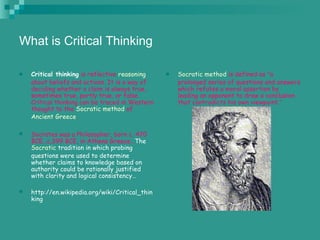
 Socrates was a Philosopher, born c. 470
BCE…c.399 BCE, in Athens Greece…The
Socratic tradition in which probing
questions were used to determine
whether claims to knowledge based on
authority could be rationally justified
with clarity and logical consistency…
 http://en.wikipedia.org/wiki/Critical_thin
king
 Socratic method is defined as "a
prolonged series of questions and answers
which refutes a moral assertion by
leading an opponent to draw a conclusion
that contradicts his own viewpoint.”
Sumner's Definition of Critical Thinking
What is Critical Thinking?
(William Graham Sumner — 1906)
 “[Critical thinking is] . . . the examination and test of propositions of any kind
which are offered for acceptance, in order to find out whether they correspond
to reality or not. The critical faculty is a product of education and training. It is
a mental habit and power. It is a prime condition of human welfare that men and
women should be trained in it. It is our only guarantee against delusion,
deception, superstition, and misapprehension of ourselves and our earthly
circumstances.”

{Sumner, W. G. (1940). Folkways: A Study of the Sociological Importance of
Usages, Manners, Customs, Mores, and Morals, New York: Ginn and Co., pp. 632,
633.}
Consequential Validity: Using Assessment to Drive Instruction
 Critical thinking is that mode of
thinking—about any subject,
content, or problem—in which the
thinker
improves the quality of his or her
thinking by skillfully analyzing,
assessing, and reconstructing it.
 Critical thinking is self-directed,
self-disciplined, self-monitored, and
self-corrective thinking. It
presupposes assent to rigorous
standards of excellence and mindful
command of their use.
 Critical thinking is the disciplined
art of ensuring that
 you use the best thinking you are
capable of in any set of
 circumstances.
 When we think critically, we realize
that in every
 domain of human thought, it is
possible and important
 to question the parts of thinking,
and the standards for
 thought.
 http://www.criticalthinking.org/pages/consequential-
validity-using-assessment-to-drive-instruction/790
“The great masses of the people…will more
easily fall victims to a big lie than to a small
one.”
   ~ Adolf Hitler, Mein Kampf, 1933
We learn from history that we do not learn from history.
   ~ George Wilhelm Hegel
Definitions
 Different sources define critical thinking variously as:
 "reasonable reflective thinking focused on deciding what to believe or do"[2]
 "the intellectually disciplined process of actively and skillfully conceptualizing, applying,
analyzing, synthesizing, or evaluating information gathered from, or generated by,
observation, experience, reflection, reasoning, or communication, as a guide to belief and
action"[4][page needed]
 "purposeful, self-regulatory judgment which results in interpretation, analysis, evaluation,
and inference, as well as explanation of the evidential, conceptual, methodological,
criteriological, or contextual considerations upon which that judgment is based"[5]

 "includes a commitment to using reason in the formulation of our beliefs"[6]
Cites from previous page of Definitians
 2) Ennis, Robert (20 June 2002).
"A Super-Streamlined Conception of Critical Thinking".
faculty.education.illinois.edu. Retrieved January 18, 2013.
 4) Scriven, M., and Paul, R.W.,
Critical Thinking as Defined by the National Council for Excellence in Critical Thinking
(1987)
 5) Facione, Peter A. Critical Thinking: What It is and Why It Counts,
Insightassessment.com, 20011, p. 26

 6) Mulnix, J. W. (2010). Thinking critically about critical thinking. Educational
Philosophy and Theory. doi: 10.1111/j.1469-5812.2010.00673.x, p. 471
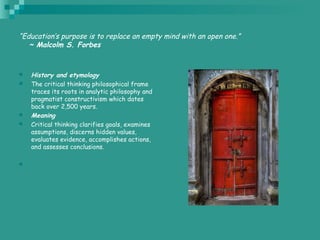
“Education’s purpose is to replace an empty mind with an open one.”
   ~ Malcolm S. Forbes
 History and etymology
 The critical thinking philosophical frame
traces its roots in analytic philosophy and
pragmatist constructivism which dates
back over 2,500 years.
 Meaning
 Critical thinking clarifies goals, examines
assumptions, discerns hidden values,
evaluates evidence, accomplishes actions,
and assesses conclusions.

Skills
 The list of core critical thinking
skills includes observation,
interpretation, analysis, inference,
evaluation, explanation, and meta-
cognition. There is a reasonable level
of consensus among experts that an
individual or group engaged in strong
critical thinking gives due
consideration to establish:
 In addition to possessing strong
critical-thinking skills, one must be
disposed to engage problems and
decisions using those skills. Critical
thinking employs not only logic but
broad intellectual criteria such as
clarity, credibility, accuracy,
precision, relevance, depth, breadth,
significance, and fairness.
 Evidence through observation
 Context skills
 Relevant criteria for making the
judgment well
 Applicable methods or techniques
for forming the judgment
 Applicable theoretical constructs
for understanding the problem and
the question at hand
Procedure
 Critical thinking calls for the
ability to:
 Recognize problems, to find
workable means for meeting those
problems
 Understand the importance of
prioritization and order of
precedence in problem solving
 Gather and marshal pertinent
(relevant) information
 Recognize unstated assumptions and
values
 Comprehend and use language with
accuracy, clarity, and discernment
 Interpret data, to appraise evidence
and evaluate arguments
 Recognize the existence (or non-
existence) of logical relationships
between propositions
 Draw warranted conclusions and
generalizations
 Put to test the conclusions and
generalizations at which one arrives
 Reconstruct one's patterns of
beliefs on the basis of wider
experience
 Render accurate judgments about
specific things and qualities in
everyday life
“Any formal attack on ignorance is bound to fail because the masses are always
ready to defend their most precious possession – their ignorance.”
   ~ Hendrik Van Loon
 In sum:
 "A persistent effort to examine any
belief or supposed form of knowledge in
the light of the evidence that supports it
and the further conclusions to which it
tends.”( b Edward M. Glaser (1941). An
Experiment in the Development of Critical
Thinking. New York, Bureau of
Publications, Teachers College, Columbia
University. ISBN 0-404-55843-7.)
Habits or traits of mind
 The habits of mind that
characterize a person strongly
disposed toward critical thinking
include a desire to follow reason and
evidence wherever they may lead, a
systematic approach to problem
solving, inquisitiveness, even-
handedness, and confidence in
reasoning.[16] When individuals
possess intellectual skills alone,
without the intellectual traits of
mind, weak sense critical thinking
results. Fair-minded or strong sense
critical thinking requires intellectual
humility, empathy, integrity,
perseverance, courage, autonomy,
confidence in reason, and other
intellectual traits. Thus, critical
thinking without essential
intellectual traits often results in
clever, but manipulative and often
unethical or subjective thought.
“Men become civilized, not in proportion to their willingness to believe, but in their
readiness to doubt.”   ~ H. L. Mencken
 16) The National Assessment
of College Student Learning:
Identification of the Skills to
be Taught, Learned, and
Assessed, NCES 94–286, US
Dept of Education, Addison
Greenwod (Ed), Sal Carrallo (PI).
See also, Critical thinking: A
statement of expert consensus
for purposes of educational
assessment and instruction.
ERIC Document No. ED 315–423
Example thinker
 raises important questions and problems, formulating them clearly
and precisely
 gathers and assesses relevant information, using abstract ideas to
interpret it effectively
 comes to well-reasoned conclusions and solutions, testing them
against relevant criteria and standards
 thinks open-mindedly within alternative systems of thought,
recognizing and assessing, as need be, their assumptions,
implications, and practical consequences
 communicates effectively with others in figuring out solutions to
complex problems, without being unduly influenced by others'
thinking on the topic.
Critical Thinking as Defined by the National Council for
Excellence in Critical Thinking, 1987
 A statement by Michael Scriven & Richard Paul, presented at the 8th Annual
International Conference on Critical Thinking and Education Reform, Summer
1987.
 Critical thinking is the intellectually disciplined process of actively and skillfully
conceptualizing, applying, analyzing, synthesizing, and/or evaluating information
gathered from, or generated by, observation, experience, reflection, reasoning,
or communication, as a guide to belief and action. In its exemplary form, it is
based on universal intellectual values that transcend subject matter divisions:
clarity, accuracy, precision, consistency, relevance, sound evidence, good reasons,
depth, breadth, and fairness. It entails the examination of those structures or
elements of thought implicit in all reasoning: purpose, problem, or question-at-
issue; assumptions; concepts; empirical grounding; reasoning leading to
conclusions; implications and consequences; objections from alternative
viewpoints; and frame of reference. Critical thinking — in being responsive to
variable subject matter, issues, and purposes — is incorporated in a family of
interwoven modes of thinking, among them: scientific thinking, mathematical
thinking, historical thinking, anthropological thinking, economic thinking, moral
thinking, and philosophical thinking.
http://www.criticalthinking.org/pages/defining-critical-thinking/766

Critical Thinking

  • 1.
    CRITICAL THINKING “During times ofuniversal deceit, telling the truth becomes a revolutionary act.”    ~ George Orwell
  • 2.
    What is CriticalThinking  Critical thinking is reflective reasoning about beliefs and actions. It is a way of deciding whether a claim is always true, sometimes true, partly true, or false. Critical thinking can be traced in Western thought to the Socratic method of Ancient Greece.  Socrates was a Philosopher, born c. 470 BCE…c.399 BCE, in Athens Greece…The Socratic tradition in which probing questions were used to determine whether claims to knowledge based on authority could be rationally justified with clarity and logical consistency…  http://en.wikipedia.org/wiki/Critical_thin king  Socratic method is defined as "a prolonged series of questions and answers which refutes a moral assertion by leading an opponent to draw a conclusion that contradicts his own viewpoint.”
  • 3.
    Sumner's Definition ofCritical Thinking What is Critical Thinking? (William Graham Sumner — 1906)  “[Critical thinking is] . . . the examination and test of propositions of any kind which are offered for acceptance, in order to find out whether they correspond to reality or not. The critical faculty is a product of education and training. It is a mental habit and power. It is a prime condition of human welfare that men and women should be trained in it. It is our only guarantee against delusion, deception, superstition, and misapprehension of ourselves and our earthly circumstances.”  {Sumner, W. G. (1940). Folkways: A Study of the Sociological Importance of Usages, Manners, Customs, Mores, and Morals, New York: Ginn and Co., pp. 632, 633.}
  • 4.
    Consequential Validity: UsingAssessment to Drive Instruction  Critical thinking is that mode of thinking—about any subject, content, or problem—in which the thinker improves the quality of his or her thinking by skillfully analyzing, assessing, and reconstructing it.  Critical thinking is self-directed, self-disciplined, self-monitored, and self-corrective thinking. It presupposes assent to rigorous standards of excellence and mindful command of their use.  Critical thinking is the disciplined art of ensuring that  you use the best thinking you are capable of in any set of  circumstances.  When we think critically, we realize that in every  domain of human thought, it is possible and important  to question the parts of thinking, and the standards for  thought.  http://www.criticalthinking.org/pages/consequential- validity-using-assessment-to-drive-instruction/790
  • 5.
    “The great massesof the people…will more easily fall victims to a big lie than to a small one.”    ~ Adolf Hitler, Mein Kampf, 1933 We learn from history that we do not learn from history.    ~ George Wilhelm Hegel
  • 6.
    Definitions  Different sourcesdefine critical thinking variously as:  "reasonable reflective thinking focused on deciding what to believe or do"[2]  "the intellectually disciplined process of actively and skillfully conceptualizing, applying, analyzing, synthesizing, or evaluating information gathered from, or generated by, observation, experience, reflection, reasoning, or communication, as a guide to belief and action"[4][page needed]  "purposeful, self-regulatory judgment which results in interpretation, analysis, evaluation, and inference, as well as explanation of the evidential, conceptual, methodological, criteriological, or contextual considerations upon which that judgment is based"[5]   "includes a commitment to using reason in the formulation of our beliefs"[6]
  • 7.
    Cites from previouspage of Definitians  2) Ennis, Robert (20 June 2002). "A Super-Streamlined Conception of Critical Thinking". faculty.education.illinois.edu. Retrieved January 18, 2013.  4) Scriven, M., and Paul, R.W., Critical Thinking as Defined by the National Council for Excellence in Critical Thinking (1987)  5) Facione, Peter A. Critical Thinking: What It is and Why It Counts, Insightassessment.com, 20011, p. 26   6) Mulnix, J. W. (2010). Thinking critically about critical thinking. Educational Philosophy and Theory. doi: 10.1111/j.1469-5812.2010.00673.x, p. 471
  • 8.
    “Education’s purpose isto replace an empty mind with an open one.”    ~ Malcolm S. Forbes  History and etymology  The critical thinking philosophical frame traces its roots in analytic philosophy and pragmatist constructivism which dates back over 2,500 years.  Meaning  Critical thinking clarifies goals, examines assumptions, discerns hidden values, evaluates evidence, accomplishes actions, and assesses conclusions. 
  • 9.
    Skills  The listof core critical thinking skills includes observation, interpretation, analysis, inference, evaluation, explanation, and meta- cognition. There is a reasonable level of consensus among experts that an individual or group engaged in strong critical thinking gives due consideration to establish:  In addition to possessing strong critical-thinking skills, one must be disposed to engage problems and decisions using those skills. Critical thinking employs not only logic but broad intellectual criteria such as clarity, credibility, accuracy, precision, relevance, depth, breadth, significance, and fairness.  Evidence through observation  Context skills  Relevant criteria for making the judgment well  Applicable methods or techniques for forming the judgment  Applicable theoretical constructs for understanding the problem and the question at hand
  • 10.
    Procedure  Critical thinkingcalls for the ability to:  Recognize problems, to find workable means for meeting those problems  Understand the importance of prioritization and order of precedence in problem solving  Gather and marshal pertinent (relevant) information  Recognize unstated assumptions and values  Comprehend and use language with accuracy, clarity, and discernment  Interpret data, to appraise evidence and evaluate arguments  Recognize the existence (or non- existence) of logical relationships between propositions  Draw warranted conclusions and generalizations  Put to test the conclusions and generalizations at which one arrives  Reconstruct one's patterns of beliefs on the basis of wider experience  Render accurate judgments about specific things and qualities in everyday life
  • 11.
    “Any formal attackon ignorance is bound to fail because the masses are always ready to defend their most precious possession – their ignorance.”    ~ Hendrik Van Loon  In sum:  "A persistent effort to examine any belief or supposed form of knowledge in the light of the evidence that supports it and the further conclusions to which it tends.”( b Edward M. Glaser (1941). An Experiment in the Development of Critical Thinking. New York, Bureau of Publications, Teachers College, Columbia University. ISBN 0-404-55843-7.)
  • 12.
    Habits or traitsof mind  The habits of mind that characterize a person strongly disposed toward critical thinking include a desire to follow reason and evidence wherever they may lead, a systematic approach to problem solving, inquisitiveness, even- handedness, and confidence in reasoning.[16] When individuals possess intellectual skills alone, without the intellectual traits of mind, weak sense critical thinking results. Fair-minded or strong sense critical thinking requires intellectual humility, empathy, integrity, perseverance, courage, autonomy, confidence in reason, and other intellectual traits. Thus, critical thinking without essential intellectual traits often results in clever, but manipulative and often unethical or subjective thought.
  • 13.
    “Men become civilized,not in proportion to their willingness to believe, but in their readiness to doubt.”   ~ H. L. Mencken  16) The National Assessment of College Student Learning: Identification of the Skills to be Taught, Learned, and Assessed, NCES 94–286, US Dept of Education, Addison Greenwod (Ed), Sal Carrallo (PI). See also, Critical thinking: A statement of expert consensus for purposes of educational assessment and instruction. ERIC Document No. ED 315–423
  • 14.
    Example thinker  raisesimportant questions and problems, formulating them clearly and precisely  gathers and assesses relevant information, using abstract ideas to interpret it effectively  comes to well-reasoned conclusions and solutions, testing them against relevant criteria and standards  thinks open-mindedly within alternative systems of thought, recognizing and assessing, as need be, their assumptions, implications, and practical consequences  communicates effectively with others in figuring out solutions to complex problems, without being unduly influenced by others' thinking on the topic.
  • 15.
    Critical Thinking asDefined by the National Council for Excellence in Critical Thinking, 1987  A statement by Michael Scriven & Richard Paul, presented at the 8th Annual International Conference on Critical Thinking and Education Reform, Summer 1987.  Critical thinking is the intellectually disciplined process of actively and skillfully conceptualizing, applying, analyzing, synthesizing, and/or evaluating information gathered from, or generated by, observation, experience, reflection, reasoning, or communication, as a guide to belief and action. In its exemplary form, it is based on universal intellectual values that transcend subject matter divisions: clarity, accuracy, precision, consistency, relevance, sound evidence, good reasons, depth, breadth, and fairness. It entails the examination of those structures or elements of thought implicit in all reasoning: purpose, problem, or question-at- issue; assumptions; concepts; empirical grounding; reasoning leading to conclusions; implications and consequences; objections from alternative viewpoints; and frame of reference. Critical thinking — in being responsive to variable subject matter, issues, and purposes — is incorporated in a family of interwoven modes of thinking, among them: scientific thinking, mathematical thinking, historical thinking, anthropological thinking, economic thinking, moral thinking, and philosophical thinking.
  • 16.