


CRITICAL THINKING
OBJECTIVE :
• HISTORY OF CRITICAL THINKING
• DEFINITION OF CRITICAL THINKING
• WHAT IS CRITICAL THINKING
• HOW DO WE THINK CRITICALLY
• WHY CRITICAL THINKING
HISTORY :
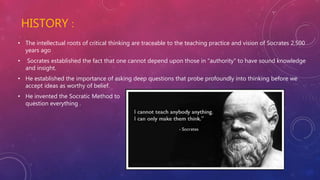
• The intellectual roots of critical thinking are traceable to the teaching practice and vision of Socrates 2,500
years ago
• Socrates established the fact that one cannot depend upon those in "authority" to have sound knowledge
and insight.
• He established the importance of asking deep questions that probe profoundly into thinking before we
accept ideas as worthy of belief.
• He invented the Socratic Method to
question everything .
SOCRATES DEATH :
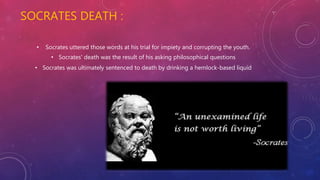
• Socrates uttered those words at his trial for impiety and corrupting the youth.
• Socrates' death was the result of his asking philosophical questions
• Socrates was ultimately sentenced to death by drinking a hemlock-based liquid
SOCRATES DEATH : JACQUES-LOUIS DAVID
DEFINITION :
• A statement by Michael Scriven & Richard Paul, presented at the 8th Annual International Conference
on Critical Thinking and Education Reform, Summer 1987. :
“Critical thinking is the intellectually disciplined process of actively and skillfully, applying, analyzing,
synthesizing, and/or evaluating information gathered from, or generated by, observation, experience,
reflection, reasoning, or communication, as a guide to belief and action.”
WHAT IS CRITICAL THINKING ?
• A purposeful, organized, mental process that we use to understand the world and make
informed decisions.
• Critical Thinking involves asking questions to come up with potential solutions to different
problems.
• Critical thinking, from the beginning, included not only examination of the words and actions of
others but also the examination of one’s own thoughts and actions, a constant cognitive
monitoring intended to make ones thinking self-correcting
WHAT IS CRITICAL THINKING ?
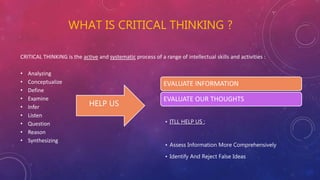
CRITICAL THINKING is the active and systematic process of a range of intellectual skills and activities :
• Analyzing
• Conceptualize
• Define
• Examine
• Infer
• Listen
• Question
• Reason
• Synthesizing
HELP US
EVALUATE INFORMATION
EVALUATE OUR THOUGHTS
• ITLL HELP US :
• Assess Information More Comprehensively
• Identify And Reject False Ideas
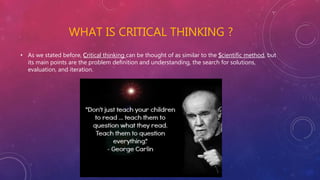
WHAT IS CRITICAL THINKING ?
• As we stated before, Critical thinking can be thought of as similar to the Scientific method, but
its main points are the problem definition and understanding, the search for solutions,
evaluation, and iteration.
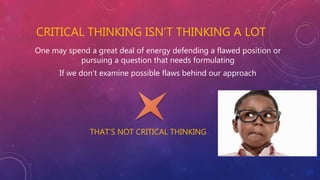
CRITICAL THINKING ISN’T THINKING A LOT
One may spend a great deal of energy defending a flawed position or
pursuing a question that needs formulating
If we don’t examine possible flaws behind our approach
THAT’S NOT CRITICAL THINKING
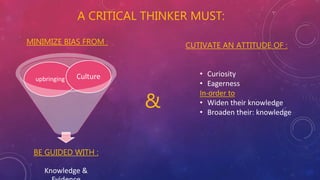
A CRITICAL THINKER MUST:
BE GUIDED WITH :
Knowledge &
upbringing Culture
&
MINIMIZE BIAS FROM :
CUTIVATE AN ATTITUDE OF :
• Curiosity
• Eagerness
In-order to
• Widen their knowledge
• Broaden their: knowledge
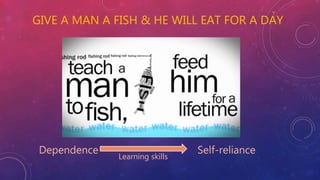
Dependence Self-reliance
Learning skills
GIVE A MAN A FISH & HE WILL EAT FOR A DAY
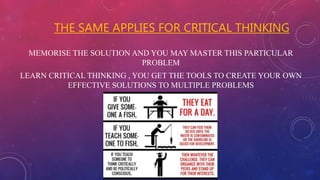
THE SAME APPLIES FOR CRITICAL THINKING
MEMORISE THE SOLUTION AND YOU MAY MASTER THIS PARTICULAR
PROBLEM
LEARN CRITICAL THINKING , YOU GET THE TOOLS TO CREATE YOUR OWN
EFFECTIVE SOLUTIONS TO MULTIPLE PROBLEMS
HOW ?
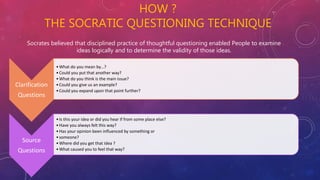
THE SOCRATIC QUESTIONING TECHNIQUE
Socrates believed that disciplined practice of thoughtful questioning enabled People to examine
ideas logically and to determine the validity of those ideas.
Clarification
Questions
•What do you mean by…?
•Could you put that another way?
•What do you think is the main issue?
•Could you give us an example?
•Could you expand upon that point further?
Source
Questions
•Is this your idea or did you hear if from some place else?
•Have you always felt this way?
•Has your opinion been influenced by something or
•someone?
•Where did you get that idea ?
•What caused you to feel that way?
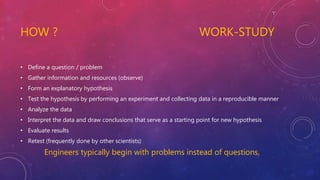
HOW ? WORK-STUDY
• Define a question / problem
• Gather information and resources (observe)
• Form an explanatory hypothesis
• Test the hypothesis by performing an experiment and collecting data in a reproducible manner
• Analyze the data
• Interpret the data and draw conclusions that serve as a starting point for new hypothesis
• Evaluate results
• Retest (frequently done by other scientists)
Engineers typically begin with problems instead of questions,
8.03
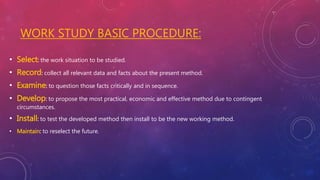
WORK STUDY BASIC PROCEDURE:
• Select: the work situation to be studied.
• Record: collect all relevant data and facts about the present method.
• Examine: to question those facts critically and in sequence.
• Develop: to propose the most practical, economic and effective method due to contingent
circumstances.
• Install: to test the developed method then install to be the new working method.
• Maintain: to reselect the future.
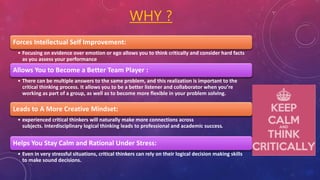
WHY ?
Forces Intellectual Self Improvement:
• Focusing on evidence over emotion or ego allows you to think critically and consider hard facts
as you assess your performance
Allows You to Become a Better Team Player :
• There can be multiple answers to the same problem, and this realization is important to the
critical thinking process. It allows you to be a better listener and collaborator when you’re
working as part of a group, as well as to become more flexible in your problem solving.
Leads to A More Creative Mindset:
• experienced critical thinkers will naturally make more connections across
subjects. Interdisciplinary logical thinking leads to professional and academic success.
Helps You Stay Calm and Rational Under Stress:
• Even in very stressful situations, critical thinkers can rely on their logical decision making skills
to make sound decisions.
ASSESSMENT TIME 
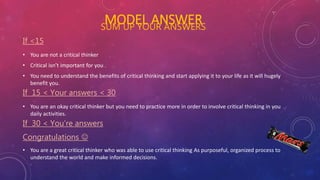
MODEL ANSWERSUM UP YOUR ANSWERS
If <15
• You are not a critical thinker
• Critical isn’t important for you .
• You need to understand the benefits of critical thinking and start applying it to your life as it will hugely
benefit you.
If 15 < Your answers < 30
• You are an okay critical thinker but you need to practice more in order to involve critical thinking in you
daily activities.
If 30 < You’re answers
Congratulations 
• You are a great critical thinker who was able to use critical thinking As purposeful, organized process to
understand the world and make informed decisions.
THANK YOU

Critical thinking & Its history

  • 1.
  • 2.
    OBJECTIVE : • HISTORYOF CRITICAL THINKING • DEFINITION OF CRITICAL THINKING • WHAT IS CRITICAL THINKING • HOW DO WE THINK CRITICALLY • WHY CRITICAL THINKING
  • 3.
    HISTORY : • Theintellectual roots of critical thinking are traceable to the teaching practice and vision of Socrates 2,500 years ago • Socrates established the fact that one cannot depend upon those in "authority" to have sound knowledge and insight. • He established the importance of asking deep questions that probe profoundly into thinking before we accept ideas as worthy of belief. • He invented the Socratic Method to question everything .
  • 4.
    SOCRATES DEATH : •Socrates uttered those words at his trial for impiety and corrupting the youth. • Socrates' death was the result of his asking philosophical questions • Socrates was ultimately sentenced to death by drinking a hemlock-based liquid
  • 5.
    SOCRATES DEATH :JACQUES-LOUIS DAVID
  • 6.
    DEFINITION : • Astatement by Michael Scriven & Richard Paul, presented at the 8th Annual International Conference on Critical Thinking and Education Reform, Summer 1987. : “Critical thinking is the intellectually disciplined process of actively and skillfully, applying, analyzing, synthesizing, and/or evaluating information gathered from, or generated by, observation, experience, reflection, reasoning, or communication, as a guide to belief and action.”
  • 7.
    WHAT IS CRITICALTHINKING ? • A purposeful, organized, mental process that we use to understand the world and make informed decisions. • Critical Thinking involves asking questions to come up with potential solutions to different problems. • Critical thinking, from the beginning, included not only examination of the words and actions of others but also the examination of one’s own thoughts and actions, a constant cognitive monitoring intended to make ones thinking self-correcting
  • 8.
    WHAT IS CRITICALTHINKING ? CRITICAL THINKING is the active and systematic process of a range of intellectual skills and activities : • Analyzing • Conceptualize • Define • Examine • Infer • Listen • Question • Reason • Synthesizing HELP US EVALUATE INFORMATION EVALUATE OUR THOUGHTS • ITLL HELP US : • Assess Information More Comprehensively • Identify And Reject False Ideas
  • 9.
    WHAT IS CRITICALTHINKING ? • As we stated before, Critical thinking can be thought of as similar to the Scientific method, but its main points are the problem definition and understanding, the search for solutions, evaluation, and iteration.
  • 10.
    CRITICAL THINKING ISN’TTHINKING A LOT One may spend a great deal of energy defending a flawed position or pursuing a question that needs formulating If we don’t examine possible flaws behind our approach THAT’S NOT CRITICAL THINKING
  • 11.
    A CRITICAL THINKERMUST: BE GUIDED WITH : Knowledge & upbringing Culture & MINIMIZE BIAS FROM : CUTIVATE AN ATTITUDE OF : • Curiosity • Eagerness In-order to • Widen their knowledge • Broaden their: knowledge
  • 12.
    Dependence Self-reliance Learning skills GIVEA MAN A FISH & HE WILL EAT FOR A DAY
  • 13.
    THE SAME APPLIESFOR CRITICAL THINKING MEMORISE THE SOLUTION AND YOU MAY MASTER THIS PARTICULAR PROBLEM LEARN CRITICAL THINKING , YOU GET THE TOOLS TO CREATE YOUR OWN EFFECTIVE SOLUTIONS TO MULTIPLE PROBLEMS
  • 14.
    HOW ? THE SOCRATICQUESTIONING TECHNIQUE Socrates believed that disciplined practice of thoughtful questioning enabled People to examine ideas logically and to determine the validity of those ideas. Clarification Questions •What do you mean by…? •Could you put that another way? •What do you think is the main issue? •Could you give us an example? •Could you expand upon that point further? Source Questions •Is this your idea or did you hear if from some place else? •Have you always felt this way? •Has your opinion been influenced by something or •someone? •Where did you get that idea ? •What caused you to feel that way?
  • 15.
    HOW ? WORK-STUDY •Define a question / problem • Gather information and resources (observe) • Form an explanatory hypothesis • Test the hypothesis by performing an experiment and collecting data in a reproducible manner • Analyze the data • Interpret the data and draw conclusions that serve as a starting point for new hypothesis • Evaluate results • Retest (frequently done by other scientists) Engineers typically begin with problems instead of questions,
  • 16.
  • 17.
    WORK STUDY BASICPROCEDURE: • Select: the work situation to be studied. • Record: collect all relevant data and facts about the present method. • Examine: to question those facts critically and in sequence. • Develop: to propose the most practical, economic and effective method due to contingent circumstances. • Install: to test the developed method then install to be the new working method. • Maintain: to reselect the future.
  • 18.
    WHY ? Forces IntellectualSelf Improvement: • Focusing on evidence over emotion or ego allows you to think critically and consider hard facts as you assess your performance Allows You to Become a Better Team Player : • There can be multiple answers to the same problem, and this realization is important to the critical thinking process. It allows you to be a better listener and collaborator when you’re working as part of a group, as well as to become more flexible in your problem solving. Leads to A More Creative Mindset: • experienced critical thinkers will naturally make more connections across subjects. Interdisciplinary logical thinking leads to professional and academic success. Helps You Stay Calm and Rational Under Stress: • Even in very stressful situations, critical thinkers can rely on their logical decision making skills to make sound decisions.
  • 19.
  • 20.
    MODEL ANSWERSUM UPYOUR ANSWERS If <15 • You are not a critical thinker • Critical isn’t important for you . • You need to understand the benefits of critical thinking and start applying it to your life as it will hugely benefit you. If 15 < Your answers < 30 • You are an okay critical thinker but you need to practice more in order to involve critical thinking in you daily activities. If 30 < You’re answers Congratulations  • You are a great critical thinker who was able to use critical thinking As purposeful, organized process to understand the world and make informed decisions.
  • 21.