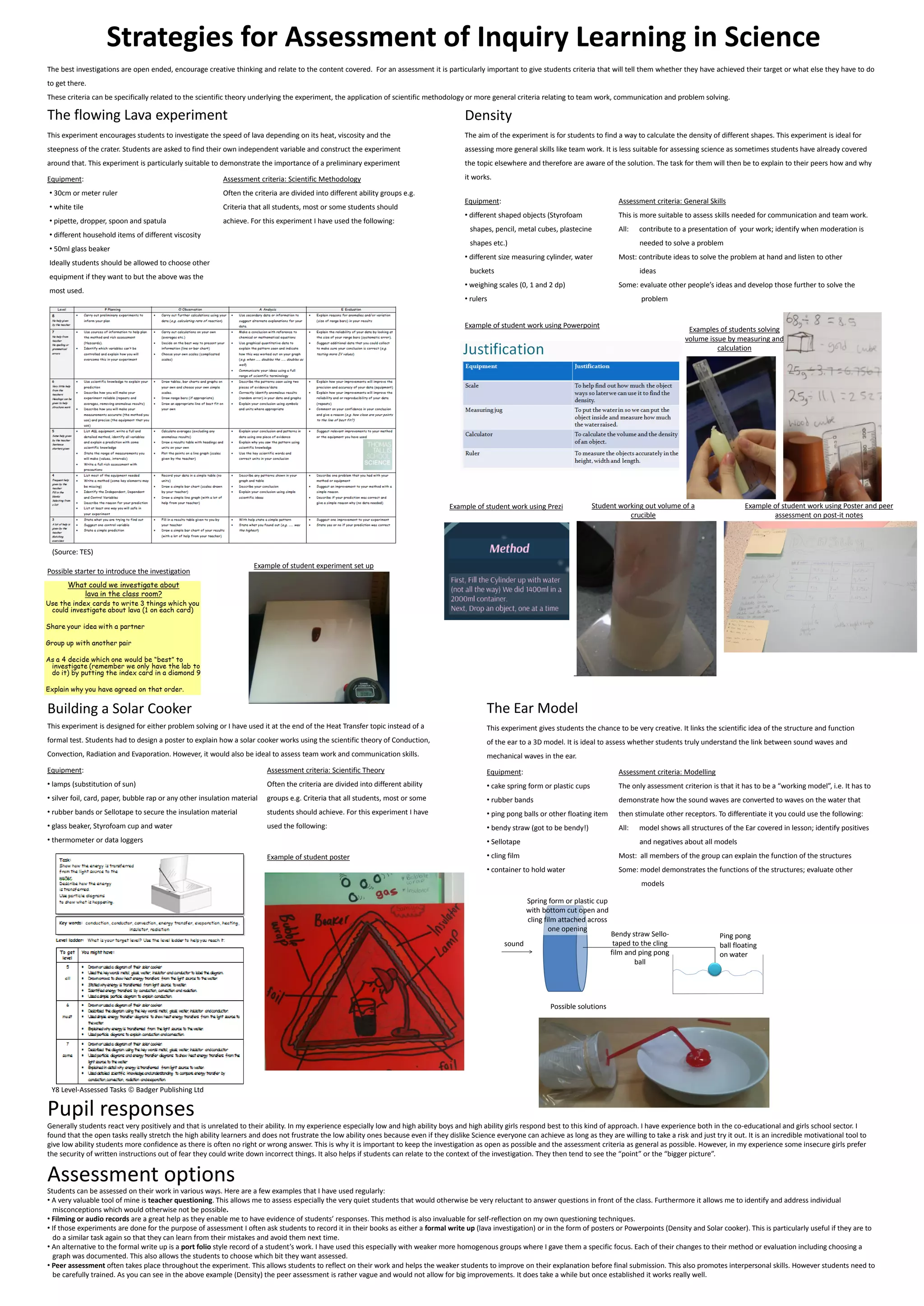
Strategies for Assessment of Inquiry Learning in Science 
Thebestinvestigationsareopenended,encouragecreativethinkingandrelatetothecontentcovered.Foranassessmentitisparticularlyimportanttogivestudentscriteriathatwilltellthemwhethertheyhaveachievedtheirtargetorwhatelsetheyhavetodotogetthere. 
Thesecriteriacanbespecificallyrelatedtothescientifictheoryunderlyingtheexperiment,theapplicationofscientificmethodologyormoregeneralcriteriarelatingtoteamwork,communicationandproblemsolving. 
The flowing Lava experiment 
Equipment: 
•30cm or meter ruler 
•white tile 
•pipette, dropper, spoon and spatula 
•different household items of different viscosity 
•50ml glass beaker 
Ideally students should be allowed to choose other equipment if they want to but the above was the most used. 
Assessment criteria: Scientific Methodology 
Often the criteria are divided into different ability groups e.g. Criteria that all students, most or some students should achieve. For this experiment I have used the following: 
(Source: TES) 
This experiment encourages students to investigate the speed of lava depending on its heat, viscosity and the steepness of the crater. Students are asked to find their own independent variable and construct the experiment around that. This experiment is particularly suitable to demonstrate the importance of a preliminary experiment 
Building a Solar Cooker 
Equipment: 
•lamps (substitution of sun) 
•silver foil, card, paper, bubble rap or any other insulation material 
•rubber bands or Sellotapeto secure the insulation material 
•glass beaker, Styrofoam cup and water 
•thermometer or data loggers 
This experiment is designed for either problem solving or I have used it at the end of the Heat Transfer topic instead of a formal test. Students had to design a poster to explain how a solar cooker works using the scientific theory of Conduction, Convection, Radiation and Evaporation. However, it would also be ideal to assess team work and communication skills. 
Assessment criteria: Scientific Theory 
Often the criteria are divided into different ability groups e.g. Criteria that all students, most or some students should achieve. For this experiment I have used the following: 
Y8 Level-Assessed Tasks Badger Publishing Ltd 
The Ear Model 
This experiment gives students the chance to be very creative. It links the scientific idea of the structure and function of the ear to a 3D model. It is ideal to assess whether students truly understand the link between sound waves and mechanical waves in the ear. 
Equipment: 
•cake spring form or plastic cups 
•rubber bands 
•ping pong balls or other floating item 
•bendy straw (got to be bendy!) 
•Sellotape 
•cling film 
•container to hold water 
Assessment criteria: Modelling 
The only assessment criterion is that it has to be a “working model”, i.e. It has to demonstrate how the sound waves are converted to waves on the water that then stimulate other receptors. To differentiate it you could use the following: 
All: model shows all structures of the Ear covered in lesson; identify positives 
and negatives about all models 
Most: all members of the group can explain the function of the structures 
Some: model demonstrates the functions of the structures; evaluate other 
models 
Possible solutions 
Spring form or plastic cup with bottom cut open and cling film attached across one opening 
Bendy straw Sello- taped to the cling film and ping pong ball 
Ping pong ball floating on water 
sound 
Pupil responses 
Generally students react very positively and that is unrelated to their ability. In my experience especially low and high ability boys and high ability girls respond best to this kind of approach. I have experience both in the co-educational and girls school sector. I found that the open tasks really stretch the high ability learners and does not frustrate the low ability ones because even if they dislike Science everyone can achieve as long as they are willing to take a risk and just try it out. It is an incredible motivational tool to give low ability students more confidence as there is often no right or wrong answer. This is why it is important to keep theinvestigation as open as possible and the assessment criteria as general as possible. However, in my experience some insecure girls prefer the security of written instructions out of fear they could write down incorrect things. It also helps if students can relatetothe context of the investigation. They then tend to see the “point” or the “bigger picture”. 
Density 
The aim of the experiment is for students to find a way to calculate the density of different shapes. This experiment is ideal for assessing more general skills like team work. It is less suitable for assessing science as sometimes students have already covered the topic elsewhere and therefore are aware of the solution. The task for them will then be to explain to their peers how andwhy it works. 
Equipment: 
•different shaped objects (Styrofoam 
shapes, pencil, metal cubes, plastecine 
shapes etc.) 
•different size measuring cylinder, water 
buckets 
•weighing scales (0, 1 and 2 dp) 
•rulers 
Assessment criteria: General Skills 
This is more suitable to assess skills needed for communication and team work. 
All: contribute to a presentation of your work; identify when moderation is 
needed to solve a problem 
Most: contribute ideas to solve the problem at hand and listen to other 
ideas 
Some: evaluate other people’s ideas and develop those further to solve the 
problem 
Example of student work using Powerpoint 
Example of student work using PreziExample of student work using Poster and peer assessment on post-it notesStudent working out volume of a crucibleExamples of students solving volume issue by measuring and calculation 
Assessment options 
Students can be assessed on their work in various ways. Here are a few examples that I have used regularly: 
•A very valuable tool of mine is teacher questioning. This allows me to assess especially the very quiet students that would otherwise be very reluctant to answer questions in front of the class. Furthermore it allows me to identify and address individual 
misconceptions which would otherwise not be possible. 
•Filming or audio records are a great help as they enable me to have evidence of students’ responses. This method is also invaluable for self-reflection on my own questioning techniques. 
•If those experiments are done for the purpose of assessment I often ask students to record it in their books as either a formal write up (lava investigation) or in the form of posters or Powerpoints(Density and Solar cooker). This is particularly useful if they are to 
do a similar task again so that they can learn from their mistakes and avoid them next time. 
•An alternative to the formal write up is a port folio style record of a student’s work. I have used this especially with weaker more homogenous groups where I gave them a specificfocus. Each of their changes to their method or evaluation including choosing a 
graph was documented. This also allows the students to choose which bit they want assessed. 
•Peer assessment oftentakes place throughout the experiment. This allows students to reflect on their work and helps the weaker students to improveontheir explanation before final submission. This also promotes interpersonal skills. However students need to 
be carefully trained. As you can see in the above example (Density) the peer assessment is rather vague and would not allow for big improvements. It does take a while but once established it works really well. 
Possible starter to introduce the investigation 
Example of student poster 
Example of student experiment set up

Anja Luther - Strategies for assessment of inquiry learning in science

  • 1.
    Strategies for Assessmentof Inquiry Learning in Science Thebestinvestigationsareopenended,encouragecreativethinkingandrelatetothecontentcovered.Foranassessmentitisparticularlyimportanttogivestudentscriteriathatwilltellthemwhethertheyhaveachievedtheirtargetorwhatelsetheyhavetodotogetthere. Thesecriteriacanbespecificallyrelatedtothescientifictheoryunderlyingtheexperiment,theapplicationofscientificmethodologyormoregeneralcriteriarelatingtoteamwork,communicationandproblemsolving. The flowing Lava experiment Equipment: •30cm or meter ruler •white tile •pipette, dropper, spoon and spatula •different household items of different viscosity •50ml glass beaker Ideally students should be allowed to choose other equipment if they want to but the above was the most used. Assessment criteria: Scientific Methodology Often the criteria are divided into different ability groups e.g. Criteria that all students, most or some students should achieve. For this experiment I have used the following: (Source: TES) This experiment encourages students to investigate the speed of lava depending on its heat, viscosity and the steepness of the crater. Students are asked to find their own independent variable and construct the experiment around that. This experiment is particularly suitable to demonstrate the importance of a preliminary experiment Building a Solar Cooker Equipment: •lamps (substitution of sun) •silver foil, card, paper, bubble rap or any other insulation material •rubber bands or Sellotapeto secure the insulation material •glass beaker, Styrofoam cup and water •thermometer or data loggers This experiment is designed for either problem solving or I have used it at the end of the Heat Transfer topic instead of a formal test. Students had to design a poster to explain how a solar cooker works using the scientific theory of Conduction, Convection, Radiation and Evaporation. However, it would also be ideal to assess team work and communication skills. Assessment criteria: Scientific Theory Often the criteria are divided into different ability groups e.g. Criteria that all students, most or some students should achieve. For this experiment I have used the following: Y8 Level-Assessed Tasks Badger Publishing Ltd The Ear Model This experiment gives students the chance to be very creative. It links the scientific idea of the structure and function of the ear to a 3D model. It is ideal to assess whether students truly understand the link between sound waves and mechanical waves in the ear. Equipment: •cake spring form or plastic cups •rubber bands •ping pong balls or other floating item •bendy straw (got to be bendy!) •Sellotape •cling film •container to hold water Assessment criteria: Modelling The only assessment criterion is that it has to be a “working model”, i.e. It has to demonstrate how the sound waves are converted to waves on the water that then stimulate other receptors. To differentiate it you could use the following: All: model shows all structures of the Ear covered in lesson; identify positives and negatives about all models Most: all members of the group can explain the function of the structures Some: model demonstrates the functions of the structures; evaluate other models Possible solutions Spring form or plastic cup with bottom cut open and cling film attached across one opening Bendy straw Sello- taped to the cling film and ping pong ball Ping pong ball floating on water sound Pupil responses Generally students react very positively and that is unrelated to their ability. In my experience especially low and high ability boys and high ability girls respond best to this kind of approach. I have experience both in the co-educational and girls school sector. I found that the open tasks really stretch the high ability learners and does not frustrate the low ability ones because even if they dislike Science everyone can achieve as long as they are willing to take a risk and just try it out. It is an incredible motivational tool to give low ability students more confidence as there is often no right or wrong answer. This is why it is important to keep theinvestigation as open as possible and the assessment criteria as general as possible. However, in my experience some insecure girls prefer the security of written instructions out of fear they could write down incorrect things. It also helps if students can relatetothe context of the investigation. They then tend to see the “point” or the “bigger picture”. Density The aim of the experiment is for students to find a way to calculate the density of different shapes. This experiment is ideal for assessing more general skills like team work. It is less suitable for assessing science as sometimes students have already covered the topic elsewhere and therefore are aware of the solution. The task for them will then be to explain to their peers how andwhy it works. Equipment: •different shaped objects (Styrofoam shapes, pencil, metal cubes, plastecine shapes etc.) •different size measuring cylinder, water buckets •weighing scales (0, 1 and 2 dp) •rulers Assessment criteria: General Skills This is more suitable to assess skills needed for communication and team work. All: contribute to a presentation of your work; identify when moderation is needed to solve a problem Most: contribute ideas to solve the problem at hand and listen to other ideas Some: evaluate other people’s ideas and develop those further to solve the problem Example of student work using Powerpoint Example of student work using PreziExample of student work using Poster and peer assessment on post-it notesStudent working out volume of a crucibleExamples of students solving volume issue by measuring and calculation Assessment options Students can be assessed on their work in various ways. Here are a few examples that I have used regularly: •A very valuable tool of mine is teacher questioning. This allows me to assess especially the very quiet students that would otherwise be very reluctant to answer questions in front of the class. Furthermore it allows me to identify and address individual misconceptions which would otherwise not be possible. •Filming or audio records are a great help as they enable me to have evidence of students’ responses. This method is also invaluable for self-reflection on my own questioning techniques. •If those experiments are done for the purpose of assessment I often ask students to record it in their books as either a formal write up (lava investigation) or in the form of posters or Powerpoints(Density and Solar cooker). This is particularly useful if they are to do a similar task again so that they can learn from their mistakes and avoid them next time. •An alternative to the formal write up is a port folio style record of a student’s work. I have used this especially with weaker more homogenous groups where I gave them a specificfocus. Each of their changes to their method or evaluation including choosing a graph was documented. This also allows the students to choose which bit they want assessed. •Peer assessment oftentakes place throughout the experiment. This allows students to reflect on their work and helps the weaker students to improveontheir explanation before final submission. This also promotes interpersonal skills. However students need to be carefully trained. As you can see in the above example (Density) the peer assessment is rather vague and would not allow for big improvements. It does take a while but once established it works really well. Possible starter to introduce the investigation Example of student poster Example of student experiment set up