CRITICAL
COMMENTS
DR MAHADEV DEUJA
ENT-HNS RESIDENT 1ST YEAR
TUTH, IOM
2078/3/29, TUESDAY
About journal
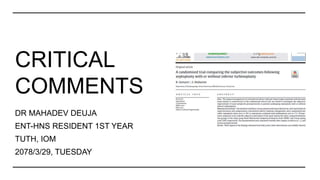
• EuropeanAnnals of Otorhinolaryngology
Head and Neck diseases
• Oldest otorhynology journal of Europe.
• 2020
• https://doi.org/10.1016/j.anorl.2020.01.02
4
• Impact factor- 2.080
Published
in a reputed
journal
“About 60% of reviewers criticisms pertain to
the quality of the writing or tables and graphs;
and about 40% pertain to the quality of the
scientific work.”
Robert Iles. Guidebook to better medical
writing.
TITLE
• Clear , concise and self explainatory
• 14 words with strong verbs
• Well defined terms
• No use abbrevations
ALTERNATE
TITLE
• Randomized control trial to compare subjective outcomes of
septoplasty with or without turbinoplasty.
About author
• Authors address and email of
correspondence- included
• Email address- only of R.Samerei
• ∗Corresponding author at: Department
of Otolaryngology, Urmia University of
Medical Sciences, Urmia, 57147-83734, Iran.
• E-mail address: reza.samarei@gmail.com
(R. Samarei).
About author • Better if included both- reviewer, editor
and readers would have easy access
• ∗Corresponding author at: Department
of Otolaryngology, Urmia University of
Medical Sciences, Urmia, 57147-83734, Iran.
• E-mail address: reza.samarei@gmail.com
(R. Samarei).
Abstract
Scanning
Abstract
Well structured- 4 sub headings
• Backgrounds and aims
• Quick summary of key
materials and methods
• Key results with supporting
data
• Conclusion- specific
Abstract
• Concise
• 241 words
(recommended: 100-300
words)
• Easy to read
Key words
5 key words (recommended:
3-5 words)
Reviewing the
table
Table- Foundation of study.
Contains – 2 table- 2 sets of
information.
Table 1 title
• Presented professionally-
• 3 horizontal lines: 1 above and 1 below
the column headings, and 1 below the
data.
• Without grid line.
Table 1 title
• Variables -put on straight lines.
• Looks self explanatory-
• Groups are comparable.
• Abrevatation full form – mentioned at foot
note
Table 1 title
• Loose terms- baseline
• Better to use same key word both in table
title and text.
Table 1 title
• Better table 1 title
• Preoperative clinical and demographic
characteristics of study arms.
Table 1 title
• Sentence level editing
• Demographic characteristics,
preoperative nasal symptoms, and
baseline subjective scores between two
groups were comparable. (15 word)
Avoid negatives
(20 words)
Table-1
• Age – months / years
• Better to use units
Tables should stand alone
Scanning
through table 2
Scanning
through
table 2
Shows study period NOSE
and VAS score of two
groups.
Figure -2
Tells the same story as of
table-2
Could have used either
table 2 or this bar diagram
Better to avoid repetition
Line graph
Same data (table2 and fig2)
can be presented in a better
way.
NOSE: Nasal Obstruction Symptom Evaluation; VAS: Visual analog scale.
Study flow
chart
• Contains brief title and study details
• Beautifully placed.
Cont..
• Study design – nicely
presented
Cont.. • Duration of follow up- nicely
shown
Cont..
• Better and self sufficient
• Readers don't have to go through the
all the methodology section to find out
this small information
Outcomes measured
using NOSE and
VAS score
Introduction
• Brief
• Two paragraph (recommended :
2-5)
Introduction
• Followed the standard format of :
known-->unknown-->study
purpose?
• Gaps in the literature – clearly
mentioned.
Materials
and methods
Written in 5 sub headings
Study period
Study design
Study place
Inclusion criteria
Materials
and method
Exclusion criteria- clearly
mentioned
Materials
and method
Ethical consideration-
informed consent taken
Approval taken
Materials
and method
• Diagnosis -By
otorhinolaryngologist
• Tools - Anterior rhinoscopy +
CT imaging
• 3 grades of turbinate
hypertrophy - only 2 and 3
included.
Materials
and method
• Randomized – 2 groups
• Septoplasty (group A) –
elaborated
Materials
and method
Turbinoplasty (group B)-
well elaborated
Materials
and method
Post operative assessment
- 6 , 12, 24 and 48 months
Materials
and method
Nasal symptoms evaluated
-NOSE
-VAS
Questionnaire were used
Materials
and method
• Statistical method of
analysis
• Student t-test, paired
t- test, chi-square
test.
Results
• Summarizes the raw data
• Cite figure and table supporting
the data.
Discussions
• Finding- clearly written in first
paragraph.
• Writing is clear and to the point.
• Addressed the limitations clearly.
Discussions
• Addresses the objective
• Compared results to other major studies – Gandomi et al studies., deveseren et
al studies.
• Both having similar and contrasting findings.
• Logical reasoning for contrasting results – given.
• Strength of study- mentioned ( exclusion criteria, prospective
study design, long follow up periods, triple blinding...)
• Limitations of study- mentioned ( single surgeon, single center)
Conclusions
•Very concise
•Stated the finding clearly
Turbinate reduction surgery should be
conducted along with septoplasty to
achieve better results in cases
suffering from deviated nasal septum
with hypertrophied inferior turbinate.
Refrences
Vancouver system
44Journal articles
Literature
review
Title
• Published in indian journal of otolaryngology and
head and neck surgery.
• On : 15 December 2015
• DOI 10.1007/s12070-015-0928-2
• Impact factor- ?
Similarities
• Aims and objective
• To compare symptomatic improvement following septoplasty with or without
turbinoplasty.
• Prospective study design
• Study center- single center
• Inclusion criteria- ≥ 18 years old + chronic nasal obstruction due to unilateral
DNS with a contralateral hypertrophied inferior turbinate.
Similarities
• Grading of inferior turbinate hypertrophy
• Randomization
• Operative intervention
• Blinding-Findings-septoplasty with inferior turbinoplasty has the better
results.
Differences
• Sample size- smaller (60)
• Inclusion criteria- all grade of inferior turbinate hypertrophy
• Operative intervention- different surgeons, in detail
• Symptom assessment- only with NOSE.
Differences
• Symptom wise NOSE score
was studied.
• Nasal congestion
• Nasal blockage
• Trouble breathing
• Obstruction during
exertion
References
1. Main article
Samarei R, Mabarian S. A randomised trial comparing the subjective outcomes following septoplasty with or without
inferior turbinoplasty. European Annals of Otorhinolaryngology, Head and Neck Diseases. 2020;137(4):277-283.
doi:10.1016/j.anorl.2020.01.024
2. Literature review
Dinesh Kumar R, Rajashekar M. Comparative Study of Improvement of Nasal Symptoms Following Septoplasty with
Partial Inferior Turbinectomy Versus Septoplasty Alone in Adults by NOSE Scale: A Prospective Study. Indian Journal of
Otolaryngology and Head & Neck Surgery. 2015;68(3):275-284. doi:10.1007/s12070-015-0928-2
Thank you

Critical comment

  • 1.
    CRITICAL COMMENTS DR MAHADEV DEUJA ENT-HNSRESIDENT 1ST YEAR TUTH, IOM 2078/3/29, TUESDAY
  • 2.
    About journal • EuropeanAnnalsof Otorhinolaryngology Head and Neck diseases • Oldest otorhynology journal of Europe. • 2020 • https://doi.org/10.1016/j.anorl.2020.01.02 4 • Impact factor- 2.080 Published in a reputed journal
  • 3.
    “About 60% ofreviewers criticisms pertain to the quality of the writing or tables and graphs; and about 40% pertain to the quality of the scientific work.” Robert Iles. Guidebook to better medical writing.
  • 4.
    TITLE • Clear ,concise and self explainatory • 14 words with strong verbs • Well defined terms • No use abbrevations
  • 5.
    ALTERNATE TITLE • Randomized controltrial to compare subjective outcomes of septoplasty with or without turbinoplasty.
  • 6.
    About author • Authorsaddress and email of correspondence- included • Email address- only of R.Samerei • ∗Corresponding author at: Department of Otolaryngology, Urmia University of Medical Sciences, Urmia, 57147-83734, Iran. • E-mail address: reza.samarei@gmail.com (R. Samarei).
  • 7.
    About author •Better if included both- reviewer, editor and readers would have easy access • ∗Corresponding author at: Department of Otolaryngology, Urmia University of Medical Sciences, Urmia, 57147-83734, Iran. • E-mail address: reza.samarei@gmail.com (R. Samarei).
  • 8.
  • 9.
    Abstract Well structured- 4sub headings • Backgrounds and aims • Quick summary of key materials and methods • Key results with supporting data • Conclusion- specific
  • 10.
    Abstract • Concise • 241words (recommended: 100-300 words) • Easy to read
  • 11.
    Key words 5 keywords (recommended: 3-5 words)
  • 12.
    Reviewing the table Table- Foundationof study. Contains – 2 table- 2 sets of information.
  • 13.
    Table 1 title •Presented professionally- • 3 horizontal lines: 1 above and 1 below the column headings, and 1 below the data. • Without grid line.
  • 14.
    Table 1 title •Variables -put on straight lines. • Looks self explanatory- • Groups are comparable. • Abrevatation full form – mentioned at foot note
  • 15.
    Table 1 title •Loose terms- baseline • Better to use same key word both in table title and text.
  • 16.
    Table 1 title •Better table 1 title • Preoperative clinical and demographic characteristics of study arms.
  • 17.
    Table 1 title •Sentence level editing • Demographic characteristics, preoperative nasal symptoms, and baseline subjective scores between two groups were comparable. (15 word) Avoid negatives (20 words)
  • 18.
    Table-1 • Age –months / years • Better to use units Tables should stand alone
  • 19.
  • 20.
    Scanning through table 2 Shows studyperiod NOSE and VAS score of two groups.
  • 21.
    Figure -2 Tells thesame story as of table-2 Could have used either table 2 or this bar diagram Better to avoid repetition
  • 22.
    Line graph Same data(table2 and fig2) can be presented in a better way. NOSE: Nasal Obstruction Symptom Evaluation; VAS: Visual analog scale.
  • 23.
    Study flow chart • Containsbrief title and study details • Beautifully placed.
  • 24.
    Cont.. • Study design– nicely presented
  • 25.
    Cont.. • Durationof follow up- nicely shown
  • 26.
    Cont.. • Better andself sufficient • Readers don't have to go through the all the methodology section to find out this small information Outcomes measured using NOSE and VAS score
  • 27.
    Introduction • Brief • Twoparagraph (recommended : 2-5)
  • 28.
    Introduction • Followed thestandard format of : known-->unknown-->study purpose? • Gaps in the literature – clearly mentioned.
  • 29.
    Materials and methods Written in5 sub headings Study period Study design Study place Inclusion criteria
  • 30.
  • 31.
  • 32.
    Materials and method • Diagnosis-By otorhinolaryngologist • Tools - Anterior rhinoscopy + CT imaging • 3 grades of turbinate hypertrophy - only 2 and 3 included.
  • 33.
    Materials and method • Randomized– 2 groups • Septoplasty (group A) – elaborated
  • 34.
  • 35.
    Materials and method Post operativeassessment - 6 , 12, 24 and 48 months
  • 36.
    Materials and method Nasal symptomsevaluated -NOSE -VAS Questionnaire were used
  • 37.
    Materials and method • Statisticalmethod of analysis • Student t-test, paired t- test, chi-square test.
  • 38.
    Results • Summarizes theraw data • Cite figure and table supporting the data.
  • 39.
    Discussions • Finding- clearlywritten in first paragraph. • Writing is clear and to the point. • Addressed the limitations clearly.
  • 40.
    Discussions • Addresses theobjective • Compared results to other major studies – Gandomi et al studies., deveseren et al studies. • Both having similar and contrasting findings. • Logical reasoning for contrasting results – given. • Strength of study- mentioned ( exclusion criteria, prospective study design, long follow up periods, triple blinding...) • Limitations of study- mentioned ( single surgeon, single center)
  • 41.
    Conclusions •Very concise •Stated thefinding clearly Turbinate reduction surgery should be conducted along with septoplasty to achieve better results in cases suffering from deviated nasal septum with hypertrophied inferior turbinate.
  • 42.
  • 43.
  • 44.
  • 45.
    • Published inindian journal of otolaryngology and head and neck surgery. • On : 15 December 2015 • DOI 10.1007/s12070-015-0928-2 • Impact factor- ?
  • 46.
    Similarities • Aims andobjective • To compare symptomatic improvement following septoplasty with or without turbinoplasty. • Prospective study design • Study center- single center • Inclusion criteria- ≥ 18 years old + chronic nasal obstruction due to unilateral DNS with a contralateral hypertrophied inferior turbinate.
  • 47.
    Similarities • Grading ofinferior turbinate hypertrophy • Randomization • Operative intervention • Blinding-Findings-septoplasty with inferior turbinoplasty has the better results.
  • 48.
    Differences • Sample size-smaller (60) • Inclusion criteria- all grade of inferior turbinate hypertrophy • Operative intervention- different surgeons, in detail • Symptom assessment- only with NOSE.
  • 49.
    Differences • Symptom wiseNOSE score was studied. • Nasal congestion • Nasal blockage • Trouble breathing • Obstruction during exertion
  • 50.
    References 1. Main article SamareiR, Mabarian S. A randomised trial comparing the subjective outcomes following septoplasty with or without inferior turbinoplasty. European Annals of Otorhinolaryngology, Head and Neck Diseases. 2020;137(4):277-283. doi:10.1016/j.anorl.2020.01.024 2. Literature review Dinesh Kumar R, Rajashekar M. Comparative Study of Improvement of Nasal Symptoms Following Septoplasty with Partial Inferior Turbinectomy Versus Septoplasty Alone in Adults by NOSE Scale: A Prospective Study. Indian Journal of Otolaryngology and Head & Neck Surgery. 2015;68(3):275-284. doi:10.1007/s12070-015-0928-2
  • 51.