Septal Deviation
(Operate or not)
Lecturer of ORL
Al Azhar Univ.
by
Mohammed El Sharkawy
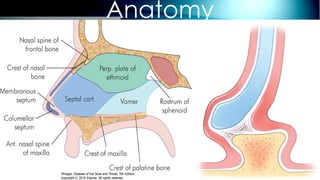
Anatomy
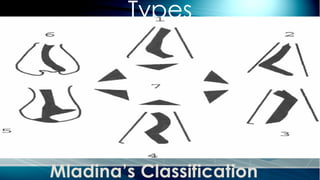
Types
Mladina’s Classification
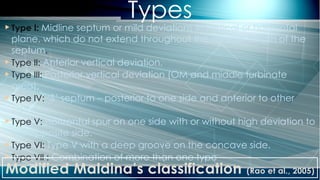
 Type I: Midline septum or mild deviations in vertical or horizontal
plane, which do not extend throughout the vertical length of the
septum.
 Type II: Anterior vertical deviation.
 Type III: Posterior vertical deviation (OM and middle turbinate
area).
 Type IV: ‘S’ septum – posterior to one side and anterior to other
side.
 Type V: Horizontal spur on one side with or without high deviation to
the opposite side.
 Type VI: Type V with a deep groove on the concave side.
 Type VII : Combination of more than one type
Types
Modified Maldina’s classification (Rao et al., 2005)
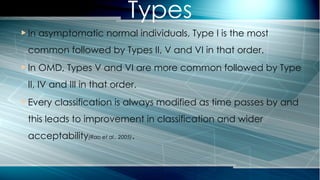
 In asymptomatic normal individuals, Type I is the most
common followed by Types II, V and VI in that order.
 In OMD, Types V and VI are more common followed by Type
II, IV and III in that order.
 Every classification is always modified as time passes by and
this leads to improvement in classification and wider
acceptability(Rao et al., 2005).
Types
Symptoms
Signs
Clinical features
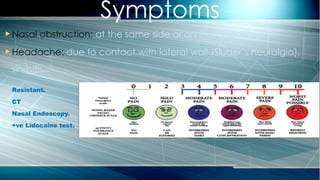
 Nasal obstruction: at the same side or on the opposite side.
 Headache: due to contact with lateral wall (Sluder’s neuralgia),
sinusitis.
 Resistant.
 CT
 Nasal Endoscopy.
 +ve Lidocaine test.
Symptoms
 Epistaxis: stretched mucosa on DNS, dry crusting & stretched
blood vessels over spur.
 Hyposmia: seen in high D.N.S.
 External nasal deformity.
 Symptoms of associated sinusitis.
Symptoms
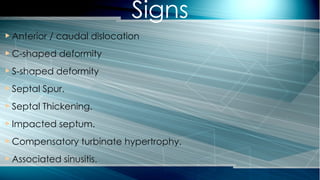
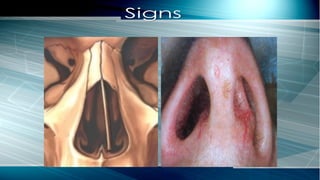
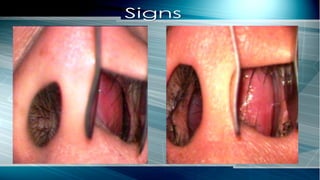
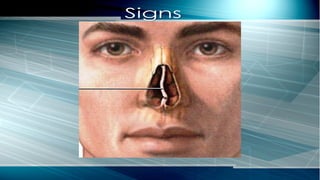
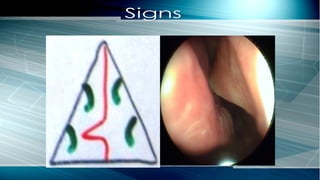
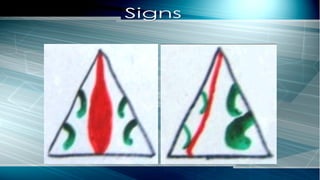
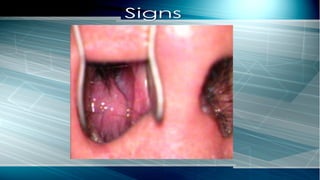
 Anterior / caudal dislocation
 C-shaped deformity
 S-shaped deformity
 Septal Spur.
 Septal Thickening.
 Impacted septum.
 Compensatory turbinate hypertrophy.
 Associated sinusitis.
Signs
Operate
Not
OR
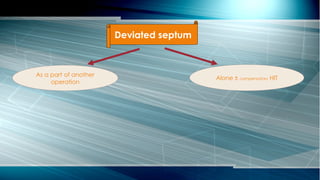
Alone ± compensatory HIT
Deviated septum
As a part of another
operation
As a part of another
operation
 Limiting access during ESS.
 As a part of septorhinoplasy (esp. in the caudal deviation).
 As a step of skull base surgery.
 As a source of cartilage, bone, or mucosal grafts in patients
undergoing endoscopic skull base surgery.
Alone ±
compensatory HIT
 Age
 Clinical features
 There is persistent controversies about septoplasty in children.
 The growth of septal cartilage ends at 5–6 years of age.
 The vomer and perpendicular lamina grow until adolescence.
 Removal before growth may lead to removal of active growing foci and the
consequent alterations of nasofacial development (D’Ascanio & Manzini, 2009).
 Chronic nasal obstruction and mouth breathing in children may lead to airway
infection & dentofacial mal-development.
 The septoplasty in children should be avoided (e.g. by using END)but if necessary
it should be minimal & conservative as much as possible (Yilmaz et al., 2014).
Age
 The absolute indication is OSA (D’Ascanio et al., 2010).
 Chronic nasal obstruction is a relative indication managed
according to the severity of SD(Yilmaz et al., 2014).
 Septoplasty in children should be carried out by removing
deviations of the septal cartilage.
 Bony crests should be only trimmed and re-fractured to the medial
position without any removal of the bony septum (Huizing et al., 2003).
Age
Age
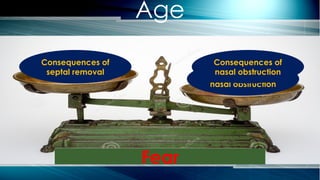
Consequences of
nasal obstruction
Fear
Consequences of
septal removal
Consequences of
nasal obstruction
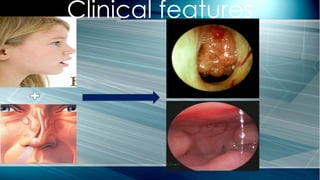
Clinical features
Symptoms Signs
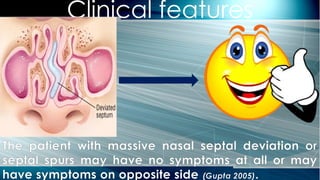
Clinical features
The patient with massive nasal septal deviation or
septal spurs may have no symptoms at all or may
have symptoms on opposite side (Gupta 2005).
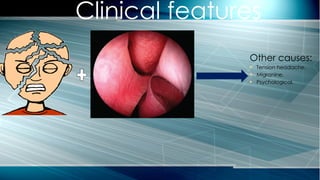
Other causes:
 Tension headache.
 Migranine.
 Psychological.
Clinical features
Clinical features
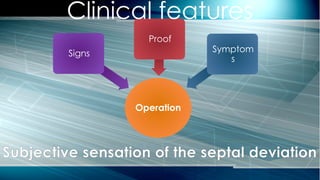
Subjective sensation of the septal deviation
Operation
Proof
Signs Symptom
s
Clinical features
Technique
Endoscopic septoplasty
 Better Illumination & improved visualization.(bleeding points)
 Less manipulation and fewer complications (Huang et al., 2006).(incision ,
mucosal dissection & the removed part)
 Limited septolplasty.(repair of a specific & confined SD directly opposite to
the surgical area)
 Useful in dealing with spurs, high deviation, posterior deviation &
contact points.
 It is not useful in caudally located septal deviation.
Endoscopic septoplasty
 Useful in Revision cases.
 Allows for a smooth transition into ESS.
 Can treat other abnormalities of the lateral nasal wall.
 Video monitors enhance the ability to teach septal surgical
techniques (Chung et al., 2007).
 May give the same or slightly better functional outcome than the
controversial method (Sathyaki et al., 2014).
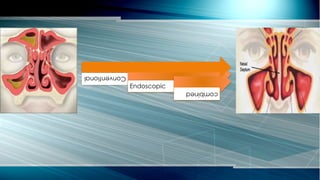
Conventional
Endoscopic
combined
Packs & Splints
 The use of nasal packing & splints has been proposed to minimize
postoperative complications such as hemorrhage, formation of synechiae
and septal hematoma.
 The use of septal splints is also associated with increased postoperative
pain.
 Nasal packing has also been shown to cause major pain, discomfort, sleep
disturbance, headache and even sleep apnea syndrome (Turhan et al., 2013).
 Nasal packing does not appear to be warranted since it seems to increase
the number of complications without guaranteeing any important
advantages (Gioacchini et al., 2014).
Packs & Splints
 The routine use of septal splint or any nasal packs does not appear
to decrease postoperative complications or improve surgical
outcomes when compared less morbid techniques, such as pack
free septoplasty (Dubin &Pletcher 2009).
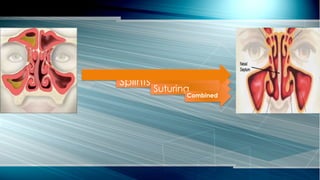
 pack-free and trans-septal suturing technique is recommended in
septoplasty. Generally this technique does not cause any problem,
if the patients are followed well (Yilmaz 2014).
Packs
Splints
Suturing
Combined
Intra-Operative AB
 The efficacy of antibiotic prophylaxis and the need for this
procedure in rhinological surgical treatments are controversial (Ricci &
Ascanio 2012).
 Bacteremia, which occurs during septoplasty, is always transient
and generally does not lead to severe outcomes (Koc et al., 2012).
 It could be reserved only for selected cases (cardiac valvulopathy)
(Gioacchini et al., 2014) .
Epiniphrine Infiltration
 the use of epinephrine does not offer additional benefit with regard
to subjective (field) or objective measures (blood loss). So, the use
of epinephrine infiltration during septal surgery is unnecessary and
may subject the patient to the risk of arrhythmogenic side-effects of
systemic absorption.
Conclusion
 Don’t rush to operate a deviated septum except after full history
taking & thorough clinical examination.
 The septal surgery has obviously developed in the past years.
 The septoplasty has a lot of controversial issues which need more
studies to be conducted.
 Whatever the technique, the target in septoplasty is to correct a
deviated septum with a maximal efficacy & minimal complications.
38
Thank
You

Deviated nasal septum. operate or not.pptx

  • 1.
    Septal Deviation (Operate ornot) Lecturer of ORL Al Azhar Univ. by Mohammed El Sharkawy
  • 2.
  • 3.
  • 4.
     Type I:Midline septum or mild deviations in vertical or horizontal plane, which do not extend throughout the vertical length of the septum.  Type II: Anterior vertical deviation.  Type III: Posterior vertical deviation (OM and middle turbinate area).  Type IV: ‘S’ septum – posterior to one side and anterior to other side.  Type V: Horizontal spur on one side with or without high deviation to the opposite side.  Type VI: Type V with a deep groove on the concave side.  Type VII : Combination of more than one type Types Modified Maldina’s classification (Rao et al., 2005)
  • 5.
     In asymptomaticnormal individuals, Type I is the most common followed by Types II, V and VI in that order.  In OMD, Types V and VI are more common followed by Type II, IV and III in that order.  Every classification is always modified as time passes by and this leads to improvement in classification and wider acceptability(Rao et al., 2005). Types
  • 6.
  • 7.
     Nasal obstruction:at the same side or on the opposite side.  Headache: due to contact with lateral wall (Sluder’s neuralgia), sinusitis.  Resistant.  CT  Nasal Endoscopy.  +ve Lidocaine test. Symptoms
  • 8.
     Epistaxis: stretchedmucosa on DNS, dry crusting & stretched blood vessels over spur.  Hyposmia: seen in high D.N.S.  External nasal deformity.  Symptoms of associated sinusitis. Symptoms
  • 9.
     Anterior /caudal dislocation  C-shaped deformity  S-shaped deformity  Septal Spur.  Septal Thickening.  Impacted septum.  Compensatory turbinate hypertrophy.  Associated sinusitis. Signs
  • 16.
  • 17.
    Alone ± compensatoryHIT Deviated septum As a part of another operation
  • 18.
    As a partof another operation  Limiting access during ESS.  As a part of septorhinoplasy (esp. in the caudal deviation).  As a step of skull base surgery.  As a source of cartilage, bone, or mucosal grafts in patients undergoing endoscopic skull base surgery.
  • 19.
    Alone ± compensatory HIT Age  Clinical features
  • 20.
     There ispersistent controversies about septoplasty in children.  The growth of septal cartilage ends at 5–6 years of age.  The vomer and perpendicular lamina grow until adolescence.  Removal before growth may lead to removal of active growing foci and the consequent alterations of nasofacial development (D’Ascanio & Manzini, 2009).  Chronic nasal obstruction and mouth breathing in children may lead to airway infection & dentofacial mal-development.  The septoplasty in children should be avoided (e.g. by using END)but if necessary it should be minimal & conservative as much as possible (Yilmaz et al., 2014). Age
  • 21.
     The absoluteindication is OSA (D’Ascanio et al., 2010).  Chronic nasal obstruction is a relative indication managed according to the severity of SD(Yilmaz et al., 2014).  Septoplasty in children should be carried out by removing deviations of the septal cartilage.  Bony crests should be only trimmed and re-fractured to the medial position without any removal of the bony septum (Huizing et al., 2003). Age
  • 22.
    Age Consequences of nasal obstruction Fear Consequencesof septal removal Consequences of nasal obstruction
  • 23.
  • 24.
    Clinical features The patientwith massive nasal septal deviation or septal spurs may have no symptoms at all or may have symptoms on opposite side (Gupta 2005).
  • 25.
    Other causes:  Tensionheadache.  Migranine.  Psychological. Clinical features
  • 26.
  • 27.
    Subjective sensation ofthe septal deviation Operation Proof Signs Symptom s Clinical features
  • 28.
  • 29.
    Endoscopic septoplasty  BetterIllumination & improved visualization.(bleeding points)  Less manipulation and fewer complications (Huang et al., 2006).(incision , mucosal dissection & the removed part)  Limited septolplasty.(repair of a specific & confined SD directly opposite to the surgical area)  Useful in dealing with spurs, high deviation, posterior deviation & contact points.  It is not useful in caudally located septal deviation.
  • 30.
    Endoscopic septoplasty  Usefulin Revision cases.  Allows for a smooth transition into ESS.  Can treat other abnormalities of the lateral nasal wall.  Video monitors enhance the ability to teach septal surgical techniques (Chung et al., 2007).  May give the same or slightly better functional outcome than the controversial method (Sathyaki et al., 2014).
  • 31.
  • 32.
    Packs & Splints The use of nasal packing & splints has been proposed to minimize postoperative complications such as hemorrhage, formation of synechiae and septal hematoma.  The use of septal splints is also associated with increased postoperative pain.  Nasal packing has also been shown to cause major pain, discomfort, sleep disturbance, headache and even sleep apnea syndrome (Turhan et al., 2013).  Nasal packing does not appear to be warranted since it seems to increase the number of complications without guaranteeing any important advantages (Gioacchini et al., 2014).
  • 33.
    Packs & Splints The routine use of septal splint or any nasal packs does not appear to decrease postoperative complications or improve surgical outcomes when compared less morbid techniques, such as pack free septoplasty (Dubin &Pletcher 2009).  pack-free and trans-septal suturing technique is recommended in septoplasty. Generally this technique does not cause any problem, if the patients are followed well (Yilmaz 2014).
  • 34.
  • 35.
    Intra-Operative AB  Theefficacy of antibiotic prophylaxis and the need for this procedure in rhinological surgical treatments are controversial (Ricci & Ascanio 2012).  Bacteremia, which occurs during septoplasty, is always transient and generally does not lead to severe outcomes (Koc et al., 2012).  It could be reserved only for selected cases (cardiac valvulopathy) (Gioacchini et al., 2014) .
  • 36.
    Epiniphrine Infiltration  theuse of epinephrine does not offer additional benefit with regard to subjective (field) or objective measures (blood loss). So, the use of epinephrine infiltration during septal surgery is unnecessary and may subject the patient to the risk of arrhythmogenic side-effects of systemic absorption.
  • 37.
    Conclusion  Don’t rushto operate a deviated septum except after full history taking & thorough clinical examination.  The septal surgery has obviously developed in the past years.  The septoplasty has a lot of controversial issues which need more studies to be conducted.  Whatever the technique, the target in septoplasty is to correct a deviated septum with a maximal efficacy & minimal complications.
  • 38.