Why bother with
Evidence-Based Practice?
Professor Paul Glasziou
Bond University
www.crebp.net.au/
www.testingtreatments.org
Free pdf: Ch 5, 6, 7
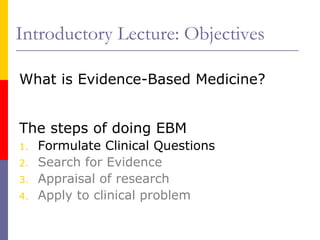
Introductory Lecture: Objectives
What is Evidence-Based Medicine?
The steps of doing EBM
1. Formulate Clinical Questions
2. Search for Evidence
3. Appraisal of research
4. Apply to clinical problem
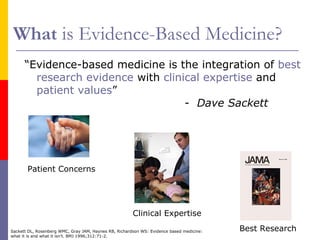
What is Evidence-Based Medicine?
“Evidence-based medicine is the integration of best
research evidence with clinical expertise and
patient values”
- Dave Sackett
Patient Concerns
Clinical Expertise
Best ResearchSackett DL, Rosenberg WMC, Gray JAM, Haynes RB, Richardson WS: Evidence based medicine:
what it is and what it isn’t. BMJ 1996;312:71-2.
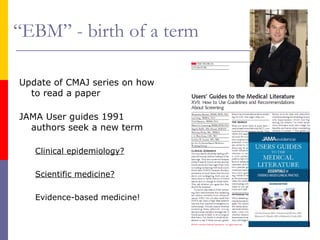
“EBM” - birth of a term
Update of CMAJ series on how
to read a paper
JAMA User guides 1991
authors seek a new term
Clinical epidemiology?
Scientific medicine?
Evidence-based medicine!
The need for Evidence
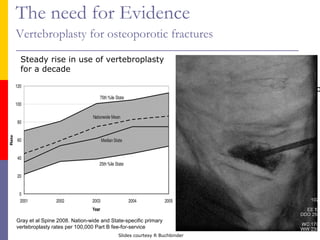
Vertebroplasty for osteoporotic fractures
Gray et al Spine 2008. Nation-wide and State-specific primary
vertebroplasty rates per 100,000 Part B fee-for-service
Steady rise in use of vertebroplasty
for a decade
2009: two large trials publish
showing no effect over placebo
Slides courtesy R Buchbinder
Unnecessary Procedures
http://www.cbsnews.com/8301-18563_162-5217954.html
Please click on the black screen to view the video
that did not work
 Vertebroplasty for osteoporotic fractures (NEJM,
2010)
 Arthoscopic knee lavage (Moseley, NEJM, 2002)
 Blood glucose monitoring for non-insulin
dependent diabetes (DiGEM trial, BMJ 2007)
 Tight control of diabetes (ACCORD, NEJM, 2010)
 Prostate cancer screening (Djulbegovic, BMJ
2010)
 Ovarian cancer screening (JAMA, 2011)
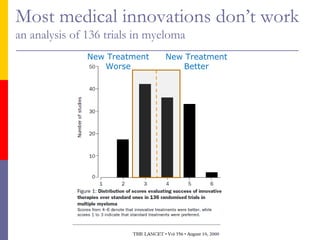
Most medical innovations don’t work
an analysis of 136 trials in myeloma
New Treatment
Better
New Treatment
Worse
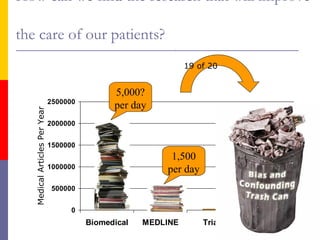
How can we find the research that will improve
the care of our patients?
0
500000
1000000
1500000
2000000
2500000
Biomedical MEDLINE Trials Diagnostic?
MedicalArticlesperYear
5,000?
per day
1,500
per day
95 per
day
MedicalArticlesPerYear
19 of 20
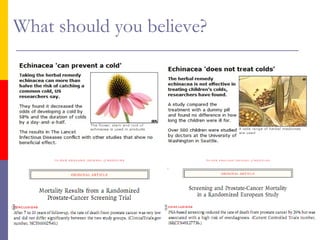
What should you believe?
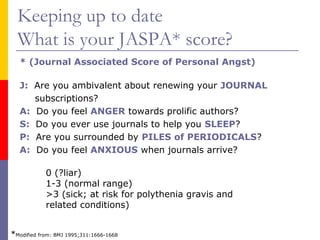
Keeping up to date
What is your JASPA* score?
* (Journal Associated Score of Personal Angst)
J: Are you ambivalent about renewing your JOURNAL
subscriptions?
A: Do you feel ANGER towards prolific authors?
S: Do you ever use journals to help you SLEEP?
P: Are you surrounded by PILES of PERIODICALS?
A: Do you feel ANXIOUS when journals arrive?
*Modified from: BMJ 1995;311:1666-1668
0 (?liar)
1-3 (normal range)
>3 (sick; at risk for polythenia gravis and
related conditions)
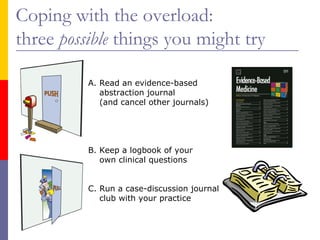
Coping with the overload:
three possible things you might try
A. Read an evidence-based
abstraction journal
(and cancel other journals)
B. Keep a logbook of your
own clinical questions
C. Run a case-discussion journal
club with your practice
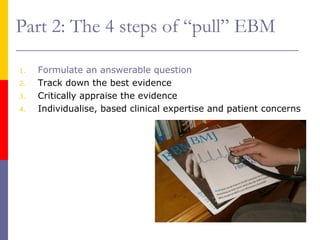
Part 2: The 4 steps of “pull” EBM
1. Formulate an answerable question
2. Track down the best evidence
3. Critically appraise the evidence
4. Individualise, based clinical expertise and patient concerns
Step 1
Formulate an answerable clinical question
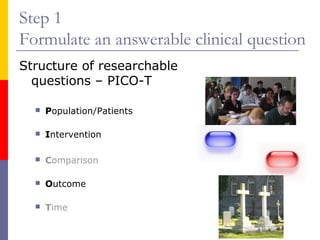
Structure of researchable
questions – PICO-T
 Population/Patients
 Intervention
 Comparison
 Outcome
 Time
Formulating answerable clinical
questions
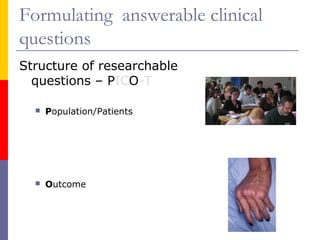
Structure of researchable
questions – PICO-T
 Population/Patients
 Outcome
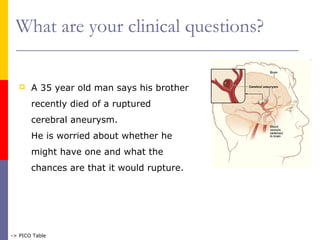
What are your clinical questions?
 A 35 year old man says his brother
recently died of a ruptured
cerebral aneurysm.
He is worried about whether he
might have one and what the
chances are that it would rupture.
-> PICO Table
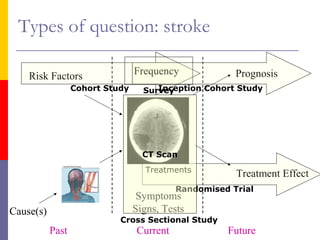
Risk Factors
Cause(s)
Symptoms
Signs, Tests
Prognosis
Treatment Effect
Past Current Future
Types of question: stroke
Frequency
Cohort Study SurveyInception Cohort Study
Treatments
Randomised Trial
CT Scan
Cross Sectional Study
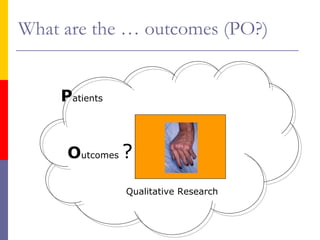
What are the … outcomes (PO?)
Outcomes ?
Patients
Qualitative Research
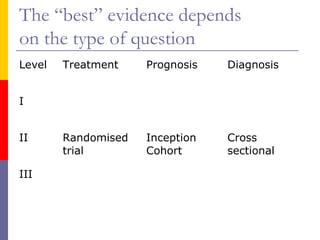
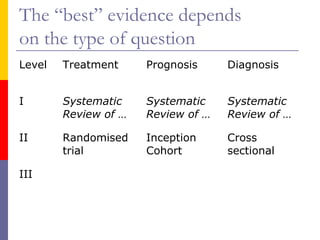
The “best” evidence depends
on the type of question
Level Treatment Prognosis Diagnosis
I
II Randomised
trial
Inception
Cohort
Cross
sectional
III
Level Treatment Prognosis Diagnosis
I Systematic
Review of …
Systematic
Review of …
Systematic
Review of …
II Randomised
trial
Inception
Cohort
Cross
sectional
III
The “best” evidence depends
on the type of question
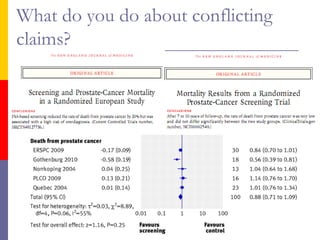
What do you do about conflicting
claims?
2. Searching: finding good answers?
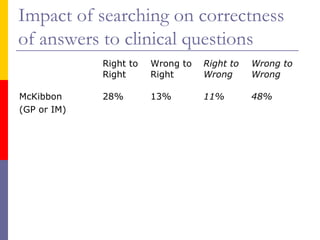
Impact of searching on correctness
of answers to clinical questions
Right to
Right
Wrong to
Right
Right to
Wrong
Wrong to
Wrong
McKibbon
(GP or IM)
28% 13% 11% 48%
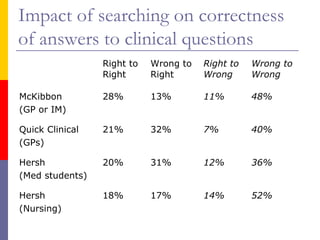
Impact of searching on correctness
of answers to clinical questions
Right to
Right
Wrong to
Right
Right to
Wrong
Wrong to
Wrong
McKibbon
(GP or IM)
28% 13% 11% 48%
Quick Clinical
(GPs)
21% 32% 7% 40%
Hersh
(Med students)
20% 31% 12% 36%
Hersh
(Nursing)
18% 17% 14% 52%
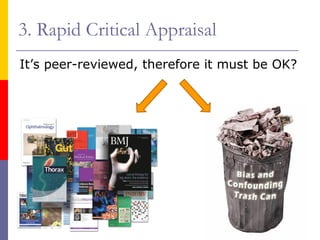
3. Rapid Critical Appraisal
It’s peer-reviewed, therefore it must be OK?
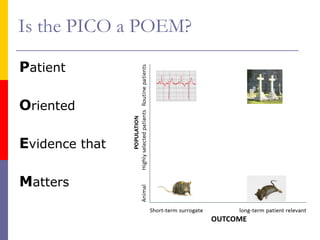
Is the PICO a POEM?
Patient
Oriented
Evidence that
Matters
Critical Appraisal Steps
Did you find good quality studies?
Two steps
1.What is the PICO (Question)
2.Is the potential bias low?
• “RAMMbo” (Valid Study?)
• “FAITH” (Valid Review?)
Use the RAMMbo to check validity
Was the Study valid?
1. Representativeness
 Who did the subjects represent?
1. Allocation
 Was the assignment to treatments
randomised?
1. Maintainence
 Were the groups treated equally?
1. Measurements blinded OR
objective
 Were patients and clinicians
“blinded” to treatment? OR
 Were measurements objective &
standardised?
Modified from: User Guide. JAMA, 1993
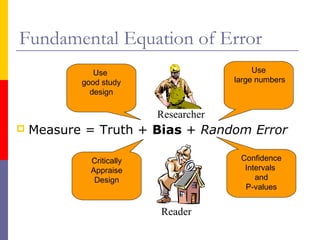
Fundamental Equation of Error
 Measure = Truth + Bias + Random Error
Use
good study
design
Use
large numbers
Researcher
Critically
Appraise
Design
Confidence
Intervals
and
P-values
Reader
Two methods of assessing the role
of chance
 P-values (Hypothesis Testing)
 use statistical test to examine the ‘null’
hypothesis
 associated with “p values” - if p<0.05 then
result is statistically significant
 Confidence Intervals (Estimation)
 estimates the range of values that is likely to
include the true value
Relationship between p-values and confidence intervals - if the
value corresponding to ‘no effect’ (RR of 1 or treatment difference of
0) falls outside the CI then the result is statistically significant
Step 4: Applying to the individual
 What do the results mean on average?
 What do they mean for this individual?
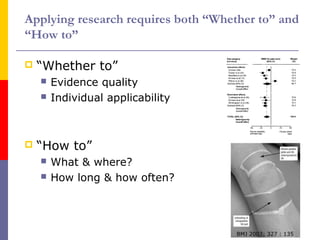
Applying research requires both “Whether to” and
“How to”
 “Whether to”
 Evidence quality
 Individual applicability
 “How to”
 What & where?
 How long & how often?
BMJ 2003; 327 : 135

Why bother with evidence-based practice?

  • 1.
    Why bother with Evidence-BasedPractice? Professor Paul Glasziou Bond University www.crebp.net.au/ www.testingtreatments.org Free pdf: Ch 5, 6, 7
  • 2.
    Introductory Lecture: Objectives Whatis Evidence-Based Medicine? The steps of doing EBM 1. Formulate Clinical Questions 2. Search for Evidence 3. Appraisal of research 4. Apply to clinical problem
  • 3.
    What is Evidence-BasedMedicine? “Evidence-based medicine is the integration of best research evidence with clinical expertise and patient values” - Dave Sackett Patient Concerns Clinical Expertise Best ResearchSackett DL, Rosenberg WMC, Gray JAM, Haynes RB, Richardson WS: Evidence based medicine: what it is and what it isn’t. BMJ 1996;312:71-2.
  • 4.
    “EBM” - birthof a term Update of CMAJ series on how to read a paper JAMA User guides 1991 authors seek a new term Clinical epidemiology? Scientific medicine? Evidence-based medicine!
  • 5.
    The need forEvidence Vertebroplasty for osteoporotic fractures Gray et al Spine 2008. Nation-wide and State-specific primary vertebroplasty rates per 100,000 Part B fee-for-service Steady rise in use of vertebroplasty for a decade 2009: two large trials publish showing no effect over placebo Slides courtesy R Buchbinder
  • 6.
  • 7.
    that did notwork  Vertebroplasty for osteoporotic fractures (NEJM, 2010)  Arthoscopic knee lavage (Moseley, NEJM, 2002)  Blood glucose monitoring for non-insulin dependent diabetes (DiGEM trial, BMJ 2007)  Tight control of diabetes (ACCORD, NEJM, 2010)  Prostate cancer screening (Djulbegovic, BMJ 2010)  Ovarian cancer screening (JAMA, 2011)
  • 8.
    Most medical innovationsdon’t work an analysis of 136 trials in myeloma New Treatment Better New Treatment Worse
  • 9.
    How can wefind the research that will improve the care of our patients? 0 500000 1000000 1500000 2000000 2500000 Biomedical MEDLINE Trials Diagnostic? MedicalArticlesperYear 5,000? per day 1,500 per day 95 per day MedicalArticlesPerYear 19 of 20
  • 10.
  • 11.
    Keeping up todate What is your JASPA* score? * (Journal Associated Score of Personal Angst) J: Are you ambivalent about renewing your JOURNAL subscriptions? A: Do you feel ANGER towards prolific authors? S: Do you ever use journals to help you SLEEP? P: Are you surrounded by PILES of PERIODICALS? A: Do you feel ANXIOUS when journals arrive? *Modified from: BMJ 1995;311:1666-1668 0 (?liar) 1-3 (normal range) >3 (sick; at risk for polythenia gravis and related conditions)
  • 12.
    Coping with theoverload: three possible things you might try A. Read an evidence-based abstraction journal (and cancel other journals) B. Keep a logbook of your own clinical questions C. Run a case-discussion journal club with your practice
  • 13.
    Part 2: The4 steps of “pull” EBM 1. Formulate an answerable question 2. Track down the best evidence 3. Critically appraise the evidence 4. Individualise, based clinical expertise and patient concerns
  • 14.
    Step 1 Formulate ananswerable clinical question Structure of researchable questions – PICO-T  Population/Patients  Intervention  Comparison  Outcome  Time
  • 15.
    Formulating answerable clinical questions Structureof researchable questions – PICO-T  Population/Patients  Outcome
  • 16.
    What are yourclinical questions?  A 35 year old man says his brother recently died of a ruptured cerebral aneurysm. He is worried about whether he might have one and what the chances are that it would rupture. -> PICO Table
  • 17.
    Risk Factors Cause(s) Symptoms Signs, Tests Prognosis TreatmentEffect Past Current Future Types of question: stroke Frequency Cohort Study SurveyInception Cohort Study Treatments Randomised Trial CT Scan Cross Sectional Study
  • 18.
    What are the… outcomes (PO?) Outcomes ? Patients Qualitative Research
  • 19.
    The “best” evidencedepends on the type of question Level Treatment Prognosis Diagnosis I II Randomised trial Inception Cohort Cross sectional III
  • 20.
    Level Treatment PrognosisDiagnosis I Systematic Review of … Systematic Review of … Systematic Review of … II Randomised trial Inception Cohort Cross sectional III The “best” evidence depends on the type of question
  • 21.
    What do youdo about conflicting claims?
  • 22.
    2. Searching: findinggood answers?
  • 23.
    Impact of searchingon correctness of answers to clinical questions Right to Right Wrong to Right Right to Wrong Wrong to Wrong McKibbon (GP or IM) 28% 13% 11% 48%
  • 24.
    Impact of searchingon correctness of answers to clinical questions Right to Right Wrong to Right Right to Wrong Wrong to Wrong McKibbon (GP or IM) 28% 13% 11% 48% Quick Clinical (GPs) 21% 32% 7% 40% Hersh (Med students) 20% 31% 12% 36% Hersh (Nursing) 18% 17% 14% 52%
  • 25.
    3. Rapid CriticalAppraisal It’s peer-reviewed, therefore it must be OK?
  • 26.
    Is the PICOa POEM? Patient Oriented Evidence that Matters
  • 27.
    Critical Appraisal Steps Didyou find good quality studies? Two steps 1.What is the PICO (Question) 2.Is the potential bias low? • “RAMMbo” (Valid Study?) • “FAITH” (Valid Review?)
  • 28.
    Use the RAMMboto check validity Was the Study valid? 1. Representativeness  Who did the subjects represent? 1. Allocation  Was the assignment to treatments randomised? 1. Maintainence  Were the groups treated equally? 1. Measurements blinded OR objective  Were patients and clinicians “blinded” to treatment? OR  Were measurements objective & standardised? Modified from: User Guide. JAMA, 1993
  • 29.
    Fundamental Equation ofError  Measure = Truth + Bias + Random Error Use good study design Use large numbers Researcher Critically Appraise Design Confidence Intervals and P-values Reader
  • 30.
    Two methods ofassessing the role of chance  P-values (Hypothesis Testing)  use statistical test to examine the ‘null’ hypothesis  associated with “p values” - if p<0.05 then result is statistically significant  Confidence Intervals (Estimation)  estimates the range of values that is likely to include the true value Relationship between p-values and confidence intervals - if the value corresponding to ‘no effect’ (RR of 1 or treatment difference of 0) falls outside the CI then the result is statistically significant
  • 31.
    Step 4: Applyingto the individual  What do the results mean on average?  What do they mean for this individual?
  • 32.
    Applying research requiresboth “Whether to” and “How to”  “Whether to”  Evidence quality  Individual applicability  “How to”  What & where?  How long & how often? BMJ 2003; 327 : 135

Editor's Notes

  • #2 PRESENTATION ONE 05/08/13 Introduction to Evidence-Based Practice
  • #3 PRESENTATION ONE 05/08/13 Introduction to Evidence-Based Practice
  • #4 Sackett DL, Rosenberg WMC, Gray JAM, Haynes RB, Richardson WS: Evidence based medicine: what it is and what it isn’t. BMJ 1996;312:71-2. This definition of what EBM is and isn’t has gained wide acceptance and made it easier for us to get our points across.
  • #6 G:\CREBP\Training\EBM Workshops\Unnecessary Procedures.mp4 PRESENTATION ONE 05/08/13 Introduction to Evidence-Based Practice
  • #10 PRESENTATION ONE 05/08/13 Introduction to Evidence-Based Practice
  • #12 PRESENTATION ONE 05/08/13 Introduction to Evidence-Based Practice
  • #13 PRESENTATION ONE 05/08/13 Introduction to Evidence-Based Practice
  • #14 PRESENTATION ONE 05/08/13 Introduction to Evidence-Based Practice
  • #15 PRESENTATION ONE 05/08/13 Introduction to Evidence-Based Practice
  • #16 PRESENTATION ONE 05/08/13 Introduction to Evidence-Based Practice
  • #17 PRESENTATION ONE 05/08/13 Introduction to Evidence-Based Practice
  • #18 PRESENTATION ONE 05/08/13 Introduction to Evidence-Based Practice
  • #19 PRESENTATION ONE 05/08/13 Introduction to Evidence-Based Practice
  • #20 PRESENTATION ONE 05/08/13 Introduction to Evidence-Based Practice
  • #21 PRESENTATION ONE 05/08/13 Introduction to Evidence-Based Practice
  • #23 PRESENTATION ONE 05/08/13 Introduction to Evidence-Based Practice
  • #24 PRESENTATION ONE 05/08/13 Introduction to Evidence-Based Practice An ideal information system would be able to answer – or tell us there is no answer – to any clinical question arising in practice. Studies of doctors and students performance on searching tasks suggest there is considerable room for improvement. Table 1 summarises 3 studies that assessed subjects answers both before and after searching. Overall answers improved but in 7 to 14% of cases answers went from right to wrong, that is, the search mislead subjects. And in 36 to 48% of cases wrong answers were not improved. The problem is one of both the information systems and the system user. Most clinicians are poorly trained in structuring questions and searching. An examination of the search terms used by the TRIP search engine showed most searches used a single term and rarely used explicit Boolean connectors.
  • #25 PRESENTATION ONE 05/08/13 Introduction to Evidence-Based Practice An ideal information system would be able to answer – or tell us there is no answer – to any clinical question arising in practice. Studies of doctors and students performance on searching tasks suggest there is considerable room for improvement. Table 1 summarises 3 studies that assessed subjects answers both before and after searching. Overall answers improved but in 7 to 14% of cases answers went from right to wrong, that is, the search mislead subjects. And in 36 to 48% of cases wrong answers were not improved. The problem is one of both the information systems and the system user. Most clinicians are poorly trained in structuring questions and searching. An examination of the search terms used by the TRIP search engine showed most searches used a single term and rarely used explicit Boolean connectors.
  • #26 PRESENTATION ONE 05/08/13 Introduction to Evidence-Based Practice
  • #28 PRESENTATION ONE 05/08/13 Introduction to Evidence-Based Practice
  • #32 PRESENTATION ONE 05/08/13 Introduction to Evidence-Based Practice