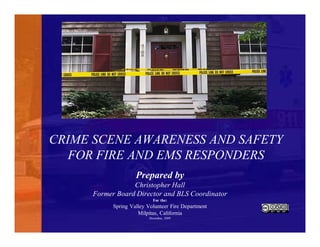
CRIME SCENE AWARENESS AND SAFETY
FOR FIRE AND EMS RESPONDERS
Prepared by
Christopher Hall
Former Board Director and BLS Coordinator
For the:
Spring Valley Volunteer Fire Department
Milpitas, California
December, 2009
Topics
• R. E .S. P. O .N. D .
• Evidence Considerations at Crime
Scenes
• Personal Risk Reduction
• Handling Violent Situations
• Personal Safety Techniques
Crime Scenes
R-E-S-P-O-N-D
• R RESPOND
• E EVALUATE
• S SECURE
• P PROTECT
• O OBSERVE
• N NOTIFY
• D DOCUMENT
R espond
• General Observations on way to
scene
• Mental Notes
– Anything out of place ?
• Firefighter Safety is #1
consideration
E valuate
• Firefighter Safety
Calls In Progress
• FACTORS:
– Suspect(s), witness, victims
– BLS, Bio/Chem hazards, SWAT
– Weapons
– Wires Down
– Fire, Gas, Electric
E valuate
• Call - Not In Progress, already at scene.
– Ask for assistance
– Limit access, one way in/out
• People AND Vehicles
– Gloves and other PPE
– Take Notes
• Who, what, when, where, time
S ecure
• Establish Perimeter
– Tape/rope
– For a Large perimeter- use rope
– Outer/inner perimeters
– Be aware of…
• Footprints
• Tire prints
• Pavement gouging
• Physical evidence (ie: blood)
• Suspect escape route
S ecure
• Establish Attendance Log and a PAR
– Begin with yourself and anyone past/present
– Maintain until Law Enforcement arrives, then turn
over to Law Enforcement.
– Include in log
• Names
• Dates
• Agency
• Time entered
• Time exited
• Reason entered
P rotect
• Safeguard scene until Law Enforcement
Arrives from:
– Weather
– Animals
– Traffic (people and vehicles)
P rotect
• Safeguard items within scene
– Room in which the patient was treated
– Vehicles
– Patient’s Cell phone
– ID’s, wallets, personal items
– No movement of body until authorized by
Coroner in case of deceased patient
O bserve
• Basic factors
– Time of call, arrival
– Weather/Temperature
– Doors open or locked
– Lights on or off
– Position of patients and vehicles
N otifications
• Supervisor
• Dispatch
– Who will then notify Law
Enforcement
D ocument
• Attendance Log
• Call times, arrival times
• Initial Patient Contact Time
• Patient Contact Report (ePCR)
• Sketch if requested by Law
Enforcement
• NFIRS Number of Incident
EMS at Crime Scenes
• The goal of performing EMS at crime scenes is to
provide high-quality patient care while preserving
evidence.
• NEVER jeopardize patient care for the sake of
evidence. However, do not perform patient care with
disregard for the criminal investigation that will follow.
• Be aware you may have to justify your actions to Law
Enforcement and the District Attorney after the fact.
What is a Crime Scene ?
• MVA involving injury or death
• FIRES
– Treat all fires as a crime scene and try to preserve the
point of origin
• Homicide
• Altercation (fight)
• Drug Labs
• Drug Grow Operations
• Hazmat
• Terrorism
Evidence
• Be aware that anything on or around the patient
may be considered evidence.
• Whenever in doubt, save or treat an object as
evidence.
• Develop an awareness of evidence.
• Pick a single path to and from the patient if a
crime scene is suspected, and maintain it.
• Decontaminate equipment AWAY from the
crime scene
– Remember Bleach + DNA do not mix
Types of Evidence
• Prints
• Blood and body fluids
• Particulate (or microscopic) evidence
• Chemicals, drug apparatus
• On-scene observation of scene details and
people
• Skid Marks, gouging, damage to poles or trees,
fencing- in the case of vehicular homicides
Firefighter Safety at Potential
Crime Scene Calls
Approaching the Scene
• Your safety strategy begins as soon as
you are dispatched on a call.
• Never follow police units to a known
crime scene.
• Rather than risk becoming injured or
killed, err on the side of safety.
• Stage well away until approved to enter
the scene by Law Enforcement.
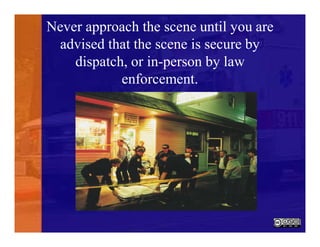
Never approach the scene until you are
advised that the scene is secure by
dispatch, or in-person by law
enforcement.
There is no such
thing as a dead hero!
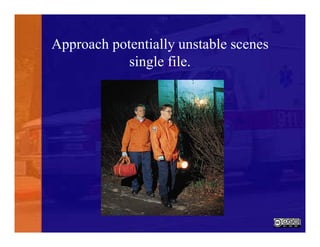
Approach potentially unstable scenes
single file.
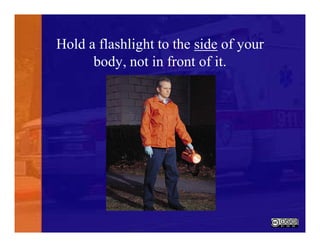
Hold a flashlight to the side of your
body, not in front of it.
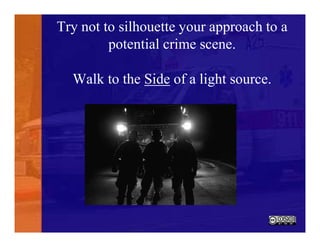
Try not to silhouette your approach to a
potential crime scene.
Walk to the Side of a light source.
Potentially Dangerous Situations
• Un-dispatched Sudden Roadway encounters
– Think Marijuana Grow Operations and their gardeners/security
• Calls involving Mentally Unstable Individuals
• Murders, assaults, robberies
• Dangerous crowds
• Known Gang Residence
• Drug-related crimes
• Clandestine drug labs
• Domestic violence
• Calls of “unknown medical”
Dangerous Crowds and Bystanders
– Shouts or increasingly loud voices
– Pushing or shoving
– Hostilities toward anyone
– Rapid increase in the crowd size
– Inability of law enforcement to control
bystanders
– Circling or crowding of First Responders
– Can be as few in number as a single family unit
Street Gangs
• No Fire unit is totally immune from gang
activity.
• Commonly observed gang characteristics
include appearance, graffiti, tattoos, hand
signals.
Drug Related Crimes
• The manufacture and sale of drugs goes hand-in-hand with
violence.
• High cash flow, addiction, and weapons are a dangerous
combination.
• Signs of drug involvement include:
– Prior history of drugs in the area
– Clandestine Drug Lab equipment/smells visible on approach
– Clinical evidence that the patient has used drugs
• Track marks, etc.
– Drug-related comments by bystanders
– Drug paraphernalia on the scene
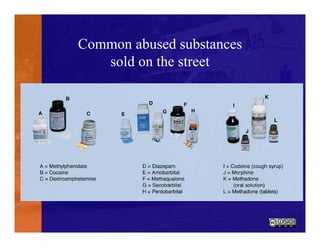
Common abused substances
sold on the street
Clandestine Drug Labs
• Drug dealers often set up laboratories to
manufacture controlled substances in rural
areas to avoid detection.
• Commonly manufactured drugs include
methamphetamine, LSD, crack, and more.
• Drug raids on clandestine labs frequently
turn into hazmat operations.
• Labs can be found anywhere, even in
utility trailers driving down the interstate.
If you ever come upon a clandestine
drug lab, take these actions:
• Leave the area immediately.
• Do not touch anything.
• Never stop any chemical reactions already
in progress !
• Notify dispatch/police.
• Initiate ICS and hazmat procedures.
• Consider evacuation of the area.
• No open flame or sparks
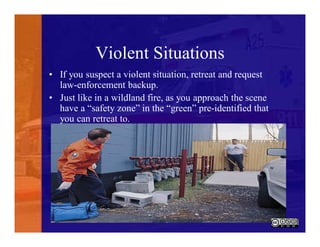
Violent Situations
• If you suspect a violent situation, retreat and request
law-enforcement backup.
• Just like in a wildland fire, as you approach the scene
have a “safety zone” in the “green” pre-identified that
you can retreat to.
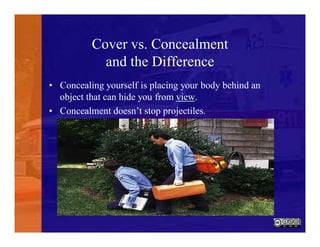
Cover vs. Concealment
and the Difference
• Concealing yourself is placing your body behind an
object that can hide you from view.
• Concealment doesn’t stop projectiles.
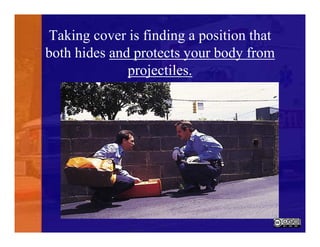
Taking cover is finding a position that
both hides and protects your body from
projectiles.
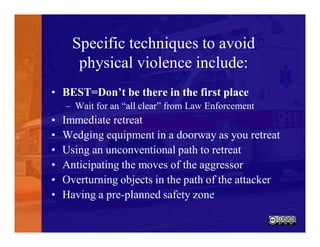
Specific techniques to avoid
physical violence include:
• BEST=Don’t be there in the first place
– Wait for an “all clear” from Law Enforcement
• Immediate retreat
• Wedging equipment in a doorway as you retreat
• Using an unconventional path to retreat
• Anticipating the moves of the aggressor
• Overturning objects in the path of the attacker
• Having a pre-planned safety zone
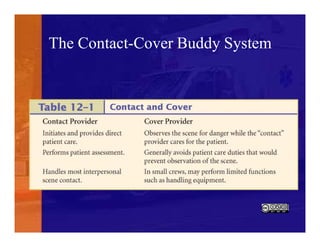
The Contact-Cover Buddy System
Communicating Warning Signs
Every team should develop methods of
alerting other providers to danger
without alerting the aggressor.
Summary
• Evidence Considerations
• Personal Risk Reduction at Scene
• Violent Encounters
• Personal Protective Strategies
– Contact/Cover
– Concealment vs. Cover
Q and A
Open Question and Answer
Review and Test
Licensed Under Creative
Commmons
• This work is licensed under the Creative
Commons licensing system. Some rights
reserved.
• Reproduction/Modification of this work
is permitted as long as proper attribution
is given.

Crime scene awareness

  • 1.
    CRIME SCENE AWARENESSAND SAFETY FOR FIRE AND EMS RESPONDERS Prepared by Christopher Hall Former Board Director and BLS Coordinator For the: Spring Valley Volunteer Fire Department Milpitas, California December, 2009
  • 2.
    Topics • R. E.S. P. O .N. D . • Evidence Considerations at Crime Scenes • Personal Risk Reduction • Handling Violent Situations • Personal Safety Techniques
  • 3.
    Crime Scenes R-E-S-P-O-N-D • RRESPOND • E EVALUATE • S SECURE • P PROTECT • O OBSERVE • N NOTIFY • D DOCUMENT
  • 4.
    R espond • GeneralObservations on way to scene • Mental Notes – Anything out of place ? • Firefighter Safety is #1 consideration
  • 5.
    E valuate • FirefighterSafety Calls In Progress • FACTORS: – Suspect(s), witness, victims – BLS, Bio/Chem hazards, SWAT – Weapons – Wires Down – Fire, Gas, Electric
  • 6.
    E valuate • Call- Not In Progress, already at scene. – Ask for assistance – Limit access, one way in/out • People AND Vehicles – Gloves and other PPE – Take Notes • Who, what, when, where, time
  • 7.
    S ecure • EstablishPerimeter – Tape/rope – For a Large perimeter- use rope – Outer/inner perimeters – Be aware of… • Footprints • Tire prints • Pavement gouging • Physical evidence (ie: blood) • Suspect escape route
  • 8.
    S ecure • EstablishAttendance Log and a PAR – Begin with yourself and anyone past/present – Maintain until Law Enforcement arrives, then turn over to Law Enforcement. – Include in log • Names • Dates • Agency • Time entered • Time exited • Reason entered
  • 9.
    P rotect • Safeguardscene until Law Enforcement Arrives from: – Weather – Animals – Traffic (people and vehicles)
  • 10.
    P rotect • Safeguarditems within scene – Room in which the patient was treated – Vehicles – Patient’s Cell phone – ID’s, wallets, personal items – No movement of body until authorized by Coroner in case of deceased patient
  • 11.
    O bserve • Basicfactors – Time of call, arrival – Weather/Temperature – Doors open or locked – Lights on or off – Position of patients and vehicles
  • 12.
    N otifications • Supervisor •Dispatch – Who will then notify Law Enforcement
  • 13.
    D ocument • AttendanceLog • Call times, arrival times • Initial Patient Contact Time • Patient Contact Report (ePCR) • Sketch if requested by Law Enforcement • NFIRS Number of Incident
  • 14.
    EMS at CrimeScenes • The goal of performing EMS at crime scenes is to provide high-quality patient care while preserving evidence. • NEVER jeopardize patient care for the sake of evidence. However, do not perform patient care with disregard for the criminal investigation that will follow. • Be aware you may have to justify your actions to Law Enforcement and the District Attorney after the fact.
  • 15.
    What is aCrime Scene ? • MVA involving injury or death • FIRES – Treat all fires as a crime scene and try to preserve the point of origin • Homicide • Altercation (fight) • Drug Labs • Drug Grow Operations • Hazmat • Terrorism
  • 16.
    Evidence • Be awarethat anything on or around the patient may be considered evidence. • Whenever in doubt, save or treat an object as evidence. • Develop an awareness of evidence. • Pick a single path to and from the patient if a crime scene is suspected, and maintain it. • Decontaminate equipment AWAY from the crime scene – Remember Bleach + DNA do not mix
  • 17.
    Types of Evidence •Prints • Blood and body fluids • Particulate (or microscopic) evidence • Chemicals, drug apparatus • On-scene observation of scene details and people • Skid Marks, gouging, damage to poles or trees, fencing- in the case of vehicular homicides
  • 18.
    Firefighter Safety atPotential Crime Scene Calls
  • 19.
    Approaching the Scene •Your safety strategy begins as soon as you are dispatched on a call. • Never follow police units to a known crime scene. • Rather than risk becoming injured or killed, err on the side of safety. • Stage well away until approved to enter the scene by Law Enforcement.
  • 20.
    Never approach thescene until you are advised that the scene is secure by dispatch, or in-person by law enforcement.
  • 21.
    There is nosuch thing as a dead hero!
  • 22.
    Approach potentially unstablescenes single file.
  • 23.
    Hold a flashlightto the side of your body, not in front of it.
  • 24.
    Try not tosilhouette your approach to a potential crime scene. Walk to the Side of a light source.
  • 25.
    Potentially Dangerous Situations •Un-dispatched Sudden Roadway encounters – Think Marijuana Grow Operations and their gardeners/security • Calls involving Mentally Unstable Individuals • Murders, assaults, robberies • Dangerous crowds • Known Gang Residence • Drug-related crimes • Clandestine drug labs • Domestic violence • Calls of “unknown medical”
  • 26.
    Dangerous Crowds andBystanders – Shouts or increasingly loud voices – Pushing or shoving – Hostilities toward anyone – Rapid increase in the crowd size – Inability of law enforcement to control bystanders – Circling or crowding of First Responders – Can be as few in number as a single family unit
  • 27.
    Street Gangs • NoFire unit is totally immune from gang activity. • Commonly observed gang characteristics include appearance, graffiti, tattoos, hand signals.
  • 28.
    Drug Related Crimes •The manufacture and sale of drugs goes hand-in-hand with violence. • High cash flow, addiction, and weapons are a dangerous combination. • Signs of drug involvement include: – Prior history of drugs in the area – Clandestine Drug Lab equipment/smells visible on approach – Clinical evidence that the patient has used drugs • Track marks, etc. – Drug-related comments by bystanders – Drug paraphernalia on the scene
  • 29.
  • 30.
    Clandestine Drug Labs •Drug dealers often set up laboratories to manufacture controlled substances in rural areas to avoid detection. • Commonly manufactured drugs include methamphetamine, LSD, crack, and more. • Drug raids on clandestine labs frequently turn into hazmat operations. • Labs can be found anywhere, even in utility trailers driving down the interstate.
  • 31.
    If you evercome upon a clandestine drug lab, take these actions: • Leave the area immediately. • Do not touch anything. • Never stop any chemical reactions already in progress ! • Notify dispatch/police. • Initiate ICS and hazmat procedures. • Consider evacuation of the area. • No open flame or sparks
  • 32.
    Violent Situations • Ifyou suspect a violent situation, retreat and request law-enforcement backup. • Just like in a wildland fire, as you approach the scene have a “safety zone” in the “green” pre-identified that you can retreat to.
  • 33.
    Cover vs. Concealment andthe Difference • Concealing yourself is placing your body behind an object that can hide you from view. • Concealment doesn’t stop projectiles.
  • 34.
    Taking cover isfinding a position that both hides and protects your body from projectiles.
  • 35.
    Specific techniques toavoid physical violence include: • BEST=Don’t be there in the first place – Wait for an “all clear” from Law Enforcement • Immediate retreat • Wedging equipment in a doorway as you retreat • Using an unconventional path to retreat • Anticipating the moves of the aggressor • Overturning objects in the path of the attacker • Having a pre-planned safety zone
  • 36.
  • 37.
    Communicating Warning Signs Everyteam should develop methods of alerting other providers to danger without alerting the aggressor.
  • 38.
    Summary • Evidence Considerations •Personal Risk Reduction at Scene • Violent Encounters • Personal Protective Strategies – Contact/Cover – Concealment vs. Cover
  • 39.
    Q and A OpenQuestion and Answer
  • 40.
  • 41.
    Licensed Under Creative Commmons •This work is licensed under the Creative Commons licensing system. Some rights reserved. • Reproduction/Modification of this work is permitted as long as proper attribution is given.