Training Division
Officer Development
Situational Awareness at Crime Scenes
• Please review this PowerPoint about situational awareness at crime scenes
and discuss as a crew.
• There has been a recent spike in homicides in Colorado Springs. In 2019
the CSPD investigated 24 homicides. There have been 15 homicides
already for 2020. At this time in 2019, there were 3.
• Assaults, violent crimes, and domestic violence are also on the rise.
• There have been several homicides that occurred at one location, and
bodies were then dumped at a different location. Be suspicious of all
“person down” alarms.
• Maintain situational awareness at all potential/suspected crime scenes and
report all findings to law enforcement.
Training Division
Officer Development
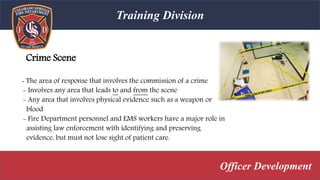
Crime Scene
- The area of response that involves the commission of a crime
- Involves any area that leads to and from the scene
- Any area that involves physical evidence such as a weapon or
blood
- Fire Department personnel and EMS workers have a major role in
assisting law enforcement with identifying and preserving
evidence, but must not lose sight of patient care.
Training Division
Officer Development
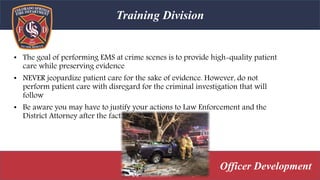
• The goal of performing EMS at crime scenes is to provide high-quality patient
care while preserving evidence
• NEVER jeopardize patient care for the sake of evidence. However, do not
perform patient care with disregard for the criminal investigation that will
follow
• Be aware you may have to justify your actions to Law Enforcement and the
District Attorney after the fact
Training Division
Officer Development
Training Division
Officer Development
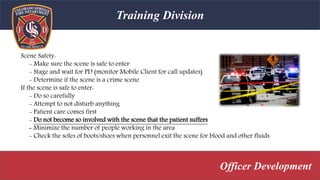
Scene Safety:
- Make sure the scene is safe to enter
- Stage and wait for PD (monitor Mobile Client for call updates)
- Determine if the scene is a crime scene
If the scene is safe to enter:
- Do so carefully
- Attempt to not disturb anything
- Patient care comes first
- Do not become so involved with the scene that the patient suffers
- Minimize the number of people working in the area
- Check the soles of boots/shoes when personnel exit the scene for blood and other fluids
Training Division
Officer Development
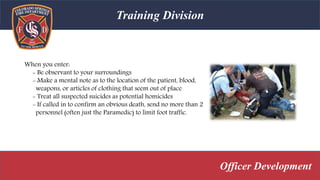
When you enter:
- Be observant to your surroundings
- Make a mental note as to the location of the patient, blood,
weapons, or articles of clothing that seem out of place
- Treat all suspected suicides as potential homicides
- If called in to confirm an obvious death, send no more than 2
personnel (often just the Paramedic) to limit foot traffic.
Training Division
Officer Development
Crime Scene Documentation
At times it may be necessary to move furniture to gain access to the
patient:
- Note where the furniture was and where it was moved to
- Any physical evidence moved and who moved it
Describe EMS observations of the scene:
- Patient position
- Injuries
- Conditions at scene
- Lights
- Curtains
- Signs of forced entry
- Statements of persons at scene
- Statements of patient
Training Division
Officer Development
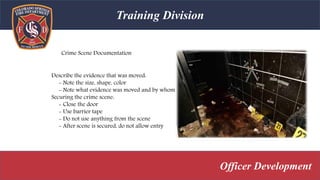
Crime Scene Documentation
Describe the evidence that was moved:
- Note the size, shape, color
- Note what evidence was moved and by whom
Securing the crime scene:
- Close the door
- Use barrier tape
- Do not use anything from the scene
- After scene is secured, do not allow entry
Training Division
Officer Development
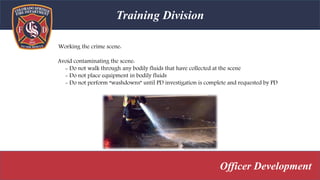
Working the crime scene:
Avoid contaminating the scene:
- Do not walk through any bodily fluids that have collected at the scene
- Do not place equipment in bodily fluids
- Do not perform “washdowns” until PD investigation is complete and requested by PD
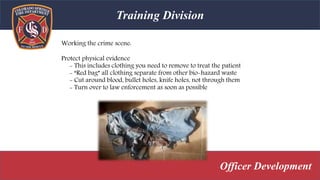
Protect physical evidence
- This includes clothing you need to remove to treat the patient
- “Red bag” all clothing separate from other bio-hazard waste
- Cut around blood, bullet holes, knife holes, not through them
- Turn over to law enforcement as soon as possible
Training Division
Officer Development
Working the crime scene:
Thank You!
Training Division
Officer Development
Stay safe and let’s help our local law
enforcement by maintaining situational
awareness at crime scenes.

Situational awareness crime scenes

  • 1.
  • 2.
    • Please reviewthis PowerPoint about situational awareness at crime scenes and discuss as a crew. • There has been a recent spike in homicides in Colorado Springs. In 2019 the CSPD investigated 24 homicides. There have been 15 homicides already for 2020. At this time in 2019, there were 3. • Assaults, violent crimes, and domestic violence are also on the rise. • There have been several homicides that occurred at one location, and bodies were then dumped at a different location. Be suspicious of all “person down” alarms. • Maintain situational awareness at all potential/suspected crime scenes and report all findings to law enforcement. Training Division Officer Development
  • 3.
    Crime Scene - Thearea of response that involves the commission of a crime - Involves any area that leads to and from the scene - Any area that involves physical evidence such as a weapon or blood - Fire Department personnel and EMS workers have a major role in assisting law enforcement with identifying and preserving evidence, but must not lose sight of patient care. Training Division Officer Development
  • 4.
    • The goalof performing EMS at crime scenes is to provide high-quality patient care while preserving evidence • NEVER jeopardize patient care for the sake of evidence. However, do not perform patient care with disregard for the criminal investigation that will follow • Be aware you may have to justify your actions to Law Enforcement and the District Attorney after the fact Training Division Officer Development
  • 5.
    Training Division Officer Development SceneSafety: - Make sure the scene is safe to enter - Stage and wait for PD (monitor Mobile Client for call updates) - Determine if the scene is a crime scene If the scene is safe to enter: - Do so carefully - Attempt to not disturb anything - Patient care comes first - Do not become so involved with the scene that the patient suffers - Minimize the number of people working in the area - Check the soles of boots/shoes when personnel exit the scene for blood and other fluids
  • 6.
    Training Division Officer Development Whenyou enter: - Be observant to your surroundings - Make a mental note as to the location of the patient, blood, weapons, or articles of clothing that seem out of place - Treat all suspected suicides as potential homicides - If called in to confirm an obvious death, send no more than 2 personnel (often just the Paramedic) to limit foot traffic.
  • 7.
    Training Division Officer Development CrimeScene Documentation At times it may be necessary to move furniture to gain access to the patient: - Note where the furniture was and where it was moved to - Any physical evidence moved and who moved it Describe EMS observations of the scene: - Patient position - Injuries - Conditions at scene - Lights - Curtains - Signs of forced entry - Statements of persons at scene - Statements of patient
  • 8.
    Training Division Officer Development CrimeScene Documentation Describe the evidence that was moved: - Note the size, shape, color - Note what evidence was moved and by whom Securing the crime scene: - Close the door - Use barrier tape - Do not use anything from the scene - After scene is secured, do not allow entry
  • 9.
    Training Division Officer Development Workingthe crime scene: Avoid contaminating the scene: - Do not walk through any bodily fluids that have collected at the scene - Do not place equipment in bodily fluids - Do not perform “washdowns” until PD investigation is complete and requested by PD
  • 10.
    Protect physical evidence -This includes clothing you need to remove to treat the patient - “Red bag” all clothing separate from other bio-hazard waste - Cut around blood, bullet holes, knife holes, not through them - Turn over to law enforcement as soon as possible Training Division Officer Development Working the crime scene:
  • 11.
    Thank You! Training Division OfficerDevelopment Stay safe and let’s help our local law enforcement by maintaining situational awareness at crime scenes.