



CREDIT RATING
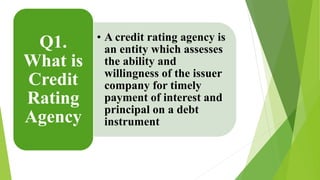
• A credit rating agency is 
an entity which assesses 
the ability and 
willingness of the issuer 
company for timely 
payment of interest and 
principal on a debt 
instrument 
Q1. 
What is 
Credit 
Rating 
Agency
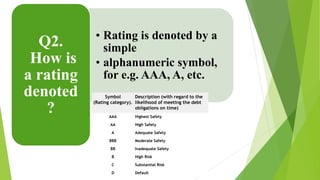
• Rating is denoted by a 
simple 
• alphanumeric symbol, 
for e.g. AAA, A, etc. 
Q2. 
How is 
a rating 
denoted 
? 
Symbol 
(Rating category). 
Description (with regard to the 
likelihood of meeting the debt 
obligations on time) 
AAA Highest Safety 
AA High Safety 
A Adequate Safety 
BBB Moderate Safety 
BB Inadequate Safety 
B High Risk 
C Substantial Risk 
D Default
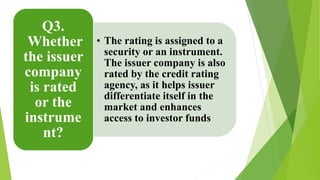
• The rating is assigned to a 
security or an instrument. 
The issuer company is also 
rated by the credit rating 
agency, as it helps issuer 
differentiate itself in the 
market and enhances 
access to investor funds 
Q3. 
Whether 
the issuer 
company 
is rated 
or the 
instrume 
nt?
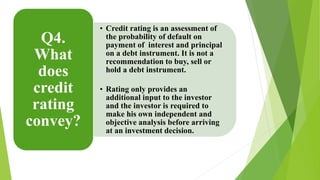
• Credit rating is an assessment of 
the probability of default on 
payment of interest and principal 
on a debt instrument. It is not a 
recommendation to buy, sell or 
hold a debt instrument. 
• Rating only provides an 
additional input to the investor 
and the investor is required to 
make his own independent and 
objective analysis before arriving 
at an investment decision. 
Q4. 
What 
does 
credit 
rating 
convey?
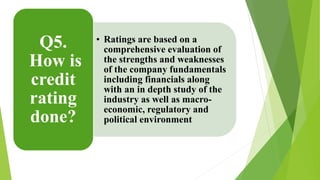
• Ratings are based on a 
comprehensive evaluation of 
the strengths and weaknesses 
of the company fundamentals 
including financials along 
with an in depth study of the 
industry as well as macro-economic, 
regulatory and 
political environment 
Q5. 
How is 
credit 
rating 
done?
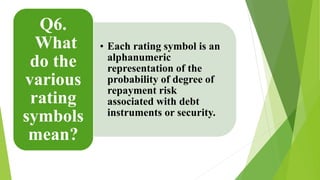
• Each rating symbol is an 
alphanumeric 
representation of the 
probability of degree of 
repayment risk 
associated with debt 
instruments or security. 
Q6. 
What 
do the 
various 
rating 
symbols 
mean?
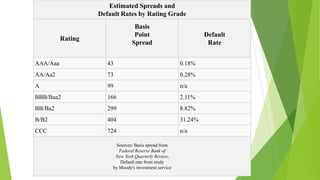
Estimated Spreads and 
Default Rates by Rating Grade 
Rating 
Basis 
Point 
Spread 
Default 
Rate 
AAA/Aaa 43 0.18% 
AA/Aa2 73 0.28% 
A 99 n/a 
BBB/Baa2 166 2.11% 
BB/Ba2 299 8.82% 
B/B2 404 31.24% 
CCC 724 n/a 
Sources: Basis spread from 
Federal Reserve Bank of 
New York Quarterly Review, 
Default rate from study 
by Moody's investment service
• No. Rating symbols may 
vary depending on the 
type of debt instrument 
• For Example….. 
Q7. 
Are rating 
symbols the 
same across 
all types of 
debt 
instruments 
?
Moody's S&P Fitch 
Long- Short-term 
Long-term 
Short-term 
Long-term 
Short-term 
rating description 
term 
Aaa 
P-1 
AAA 
A-1+ 
AAA 
F1+ 
Prime 
Aa1 AA+ AA+ 
High 
grade 
Aa2 AA AA 
Aa3 AA- AA-A1 
A+ 
A-1 
A+ 
F1 Upper 
medium 
grade 
A2 A A 
A3 
P-2 
A-A- 
2 
A-F2 
Baa1 BBB+ BBB+ Lower 
medium 
Baa2 P-3 BBB A-3 BBB F grade
• Plus and minus symbols are 
used to indicate finer 
distinctions within a rating 
category. The minus symbol 
associated with ratings has no 
negative connotations. In fact, 
ratings in a higher rating 
category such as ‘AA-‘ are 
stronger than ratings in a lower 
rating category such as ‘A+‘. 
Q8. 
What do 
the “+” 
and “- 
”sign 
indicate 
in a 
rating?
• In the Indian context, debt instruments rated 
'BBB' and above are classified as investment 
grade ratings. An investment grade rating 
signifies the rating agency’s belief that the 
rated instrument is likely to meet its payment 
obligations. 
• Instruments that are rated ‘BB‘ and below are 
classified as speculative grade category ratings 
in which case the ability to meet the payment 
obligations is considered to be “speculative”. 
Instruments rated in the speculative grade are 
considered to carry materially higher risk and 
a higher probability of default compared to 
instruments rated in the investment grade. 
Q9. 
What are 
investment 
and 
speculative 
grade 
ratings?
• In India, the issuer 
company pays for 
the credit rating. 
Q10. 
Who 
pays 
for the 
credit 
rating?
• The capital market regulators regulates 
rating agencies in most regions. In India, the 
capital market regulator, the Securities and 
Exchange Board of India (SEBI ) regulates 
credit rating agencies under Credit 
Information Companies (Regulation) Act, 
2005. 
• It provide for eligibility criteria for 
registration of credit rating agencies, 
monitoring and review of ratings, 
requirements for a proper rating process, 
avoidance of conflict of interest and 
inspection of rating agencies by SEBI, 
amongst other things. 
Q11. 
Who 
regulates 
rating 
agencies 
?
• No. SEBI does not play 
any role in the 
assessment made by the 
rating agency. The rating 
is intended to be an 
independent, unbiased 
and professional opinion 
of the rating agency. 
Q12. 
Does 
SEBI 
have a 
role in 
the 
rating 
exercise ?
• No. To protect the interest of 
investors, SEBI has mandated 
that every credit rating agency 
shall, during the lifetime of the 
securities rated by it, 
continuously monitor the 
rating of such securities and 
carry out periodic reviews of 
all published ratings 
Q13. 
Is rating 
a One 
time 
Exercise 
?
• Rating is an opinion based on 
information available at a point in 
time with the rating agency and 
expectations made on the basis of 
such information by the agency. 
• However, information can change 
significantly over time causing the 
rated instruments performance to 
deviate from the earlier 
expectations thereby affecting the 
future repayment abilities and 
thus, requiring the rating to be 
altered. 
Q14. 
Why do 
ratings 
change 
?
• Rating is monitored 
throughout the life of the 
instrument. A downgrade 
in the rating indicates that 
the risk of default of the 
instrument is higher than 
what was earlier predicted 
Q15. 
What does 
a rating 
downgrade 
indicate?
• A credit rating is a professional 
opinion given after studying all 
available information at a 
particular point of time. 
Nevertheless, such opinions 
may prove wrong in the context 
of subsequent events. 
• There is no contract between an 
investor and a rating agency 
and the investor is free to 
accept or reject the opinion of 
the agency. 
Q16. 
What kind of 
responsibility or 
accountability 
will attach to a 
rating agency if 
an investor, who 
makes his 
investment 
decision on the 
basis of its 
rating, incurs a 
loss on the 
investment?
• Yes, SEBI regulates all the credit 
rating agencies rating mutual 
funds, banks, non banking 
financial institutions, 
infrastructure entities etc. 
Q17. 
Do agencies 
rating small and 
medium 
enterprises, 
mutual funds, 
banks, non-banking 
financial 
institutions, 
insurance 
providers, 
infrastructure 
entities, etc. also 
fall under the 
regulatory 
purview of SEBI?
• Credit ratings assigned by the 
credit rating agencies to 
various instruments are made 
available by the agencies 
through press releases and on 
their respective websites. The 
same are also available in the 
prospectus or the offer 
document of the issuer 
company and in media 
advertisements. 
Q18. 
From 
where can 
the credit 
ratings of 
instruments 
be 
obtained?
• Each credit rating agency may 
have its own set of criteria and 
different weightage for each 
component for assigning the 
ratings. Some of the common 
factors that may be taken into 
consideration for credit rating are 
Issuer Company’s operational 
efficiency, level of technological 
development, financials, 
competence and effectiveness of 
management, past record of debt 
servicing, etc 
Q19. 
What are 
the common 
factors that 
are taken 
into account 
while 
awarding 
the credit 
rating?
• The credit rating agencies are 
required to continuously 
monitor the ratings assigned by 
them to a particular 
instrument. In case of any 
changes in the ratings so 
assigned, the agencies are 
required to disclose the same 
through press releases and on 
their respective websites. 
Q20. 
How can 
an investor 
know if a 
credit 
rating 
agency has 
changed its 
rating?
• SEBI has, from time to time, 
taken several steps to strength 
the process of credit rating. 
SEBI directives require the 
credit rating agencies to be 
transparent and disclose to the 
public the information which 
may have a material bearing on 
the ratings, any sources of 
conflicts of interest while 
undertaking the rating 
exercise, rating methodology, 
rationale of the ratings, etc. 
Q21. 
What are 
the 
measures 
taken by 
SEBI in 
strengtheni 
ng credit 
rating?
• The credit rating agencies do 
not have common symbols 
because they use different 
rating methodologies and 
have different factors 
bearing different weightage. 
Q22. 
Why there 
are not 
common 
symbols 
for credit 
ratings of 
all 
agencies?
• CARE Limited 
• ICRA Limited 
• CRISIL Limited 
• Fitch Ratings India Private 
Limited 
• Brickwork Ratings India Private 
Limited 
Q23. 
Which are 
the Credit 
rating 
agencies 
registered 
with 
SEBI?
Credit rating

Credit rating

  • 1.
  • 2.
    • A creditrating agency is an entity which assesses the ability and willingness of the issuer company for timely payment of interest and principal on a debt instrument Q1. What is Credit Rating Agency
  • 3.
    • Rating isdenoted by a simple • alphanumeric symbol, for e.g. AAA, A, etc. Q2. How is a rating denoted ? Symbol (Rating category). Description (with regard to the likelihood of meeting the debt obligations on time) AAA Highest Safety AA High Safety A Adequate Safety BBB Moderate Safety BB Inadequate Safety B High Risk C Substantial Risk D Default
  • 4.
    • The ratingis assigned to a security or an instrument. The issuer company is also rated by the credit rating agency, as it helps issuer differentiate itself in the market and enhances access to investor funds Q3. Whether the issuer company is rated or the instrume nt?
  • 5.
    • Credit ratingis an assessment of the probability of default on payment of interest and principal on a debt instrument. It is not a recommendation to buy, sell or hold a debt instrument. • Rating only provides an additional input to the investor and the investor is required to make his own independent and objective analysis before arriving at an investment decision. Q4. What does credit rating convey?
  • 6.
    • Ratings arebased on a comprehensive evaluation of the strengths and weaknesses of the company fundamentals including financials along with an in depth study of the industry as well as macro-economic, regulatory and political environment Q5. How is credit rating done?
  • 7.
    • Each ratingsymbol is an alphanumeric representation of the probability of degree of repayment risk associated with debt instruments or security. Q6. What do the various rating symbols mean?
  • 8.
    Estimated Spreads and Default Rates by Rating Grade Rating Basis Point Spread Default Rate AAA/Aaa 43 0.18% AA/Aa2 73 0.28% A 99 n/a BBB/Baa2 166 2.11% BB/Ba2 299 8.82% B/B2 404 31.24% CCC 724 n/a Sources: Basis spread from Federal Reserve Bank of New York Quarterly Review, Default rate from study by Moody's investment service
  • 9.
    • No. Ratingsymbols may vary depending on the type of debt instrument • For Example….. Q7. Are rating symbols the same across all types of debt instruments ?
  • 10.
    Moody's S&P Fitch Long- Short-term Long-term Short-term Long-term Short-term rating description term Aaa P-1 AAA A-1+ AAA F1+ Prime Aa1 AA+ AA+ High grade Aa2 AA AA Aa3 AA- AA-A1 A+ A-1 A+ F1 Upper medium grade A2 A A A3 P-2 A-A- 2 A-F2 Baa1 BBB+ BBB+ Lower medium Baa2 P-3 BBB A-3 BBB F grade
  • 11.
    • Plus andminus symbols are used to indicate finer distinctions within a rating category. The minus symbol associated with ratings has no negative connotations. In fact, ratings in a higher rating category such as ‘AA-‘ are stronger than ratings in a lower rating category such as ‘A+‘. Q8. What do the “+” and “- ”sign indicate in a rating?
  • 12.
    • In theIndian context, debt instruments rated 'BBB' and above are classified as investment grade ratings. An investment grade rating signifies the rating agency’s belief that the rated instrument is likely to meet its payment obligations. • Instruments that are rated ‘BB‘ and below are classified as speculative grade category ratings in which case the ability to meet the payment obligations is considered to be “speculative”. Instruments rated in the speculative grade are considered to carry materially higher risk and a higher probability of default compared to instruments rated in the investment grade. Q9. What are investment and speculative grade ratings?
  • 13.
    • In India,the issuer company pays for the credit rating. Q10. Who pays for the credit rating?
  • 14.
    • The capitalmarket regulators regulates rating agencies in most regions. In India, the capital market regulator, the Securities and Exchange Board of India (SEBI ) regulates credit rating agencies under Credit Information Companies (Regulation) Act, 2005. • It provide for eligibility criteria for registration of credit rating agencies, monitoring and review of ratings, requirements for a proper rating process, avoidance of conflict of interest and inspection of rating agencies by SEBI, amongst other things. Q11. Who regulates rating agencies ?
  • 15.
    • No. SEBIdoes not play any role in the assessment made by the rating agency. The rating is intended to be an independent, unbiased and professional opinion of the rating agency. Q12. Does SEBI have a role in the rating exercise ?
  • 16.
    • No. Toprotect the interest of investors, SEBI has mandated that every credit rating agency shall, during the lifetime of the securities rated by it, continuously monitor the rating of such securities and carry out periodic reviews of all published ratings Q13. Is rating a One time Exercise ?
  • 17.
    • Rating isan opinion based on information available at a point in time with the rating agency and expectations made on the basis of such information by the agency. • However, information can change significantly over time causing the rated instruments performance to deviate from the earlier expectations thereby affecting the future repayment abilities and thus, requiring the rating to be altered. Q14. Why do ratings change ?
  • 18.
    • Rating ismonitored throughout the life of the instrument. A downgrade in the rating indicates that the risk of default of the instrument is higher than what was earlier predicted Q15. What does a rating downgrade indicate?
  • 19.
    • A creditrating is a professional opinion given after studying all available information at a particular point of time. Nevertheless, such opinions may prove wrong in the context of subsequent events. • There is no contract between an investor and a rating agency and the investor is free to accept or reject the opinion of the agency. Q16. What kind of responsibility or accountability will attach to a rating agency if an investor, who makes his investment decision on the basis of its rating, incurs a loss on the investment?
  • 20.
    • Yes, SEBIregulates all the credit rating agencies rating mutual funds, banks, non banking financial institutions, infrastructure entities etc. Q17. Do agencies rating small and medium enterprises, mutual funds, banks, non-banking financial institutions, insurance providers, infrastructure entities, etc. also fall under the regulatory purview of SEBI?
  • 21.
    • Credit ratingsassigned by the credit rating agencies to various instruments are made available by the agencies through press releases and on their respective websites. The same are also available in the prospectus or the offer document of the issuer company and in media advertisements. Q18. From where can the credit ratings of instruments be obtained?
  • 22.
    • Each creditrating agency may have its own set of criteria and different weightage for each component for assigning the ratings. Some of the common factors that may be taken into consideration for credit rating are Issuer Company’s operational efficiency, level of technological development, financials, competence and effectiveness of management, past record of debt servicing, etc Q19. What are the common factors that are taken into account while awarding the credit rating?
  • 23.
    • The creditrating agencies are required to continuously monitor the ratings assigned by them to a particular instrument. In case of any changes in the ratings so assigned, the agencies are required to disclose the same through press releases and on their respective websites. Q20. How can an investor know if a credit rating agency has changed its rating?
  • 24.
    • SEBI has,from time to time, taken several steps to strength the process of credit rating. SEBI directives require the credit rating agencies to be transparent and disclose to the public the information which may have a material bearing on the ratings, any sources of conflicts of interest while undertaking the rating exercise, rating methodology, rationale of the ratings, etc. Q21. What are the measures taken by SEBI in strengtheni ng credit rating?
  • 25.
    • The creditrating agencies do not have common symbols because they use different rating methodologies and have different factors bearing different weightage. Q22. Why there are not common symbols for credit ratings of all agencies?
  • 26.
    • CARE Limited • ICRA Limited • CRISIL Limited • Fitch Ratings India Private Limited • Brickwork Ratings India Private Limited Q23. Which are the Credit rating agencies registered with SEBI?