Commonwealth Educational
Media Centre for Asia
Copyright and Open
Licensing
Sanjaya Mishra
Education Specialist, eLearning, COL
Principal Investigator, ROER4D
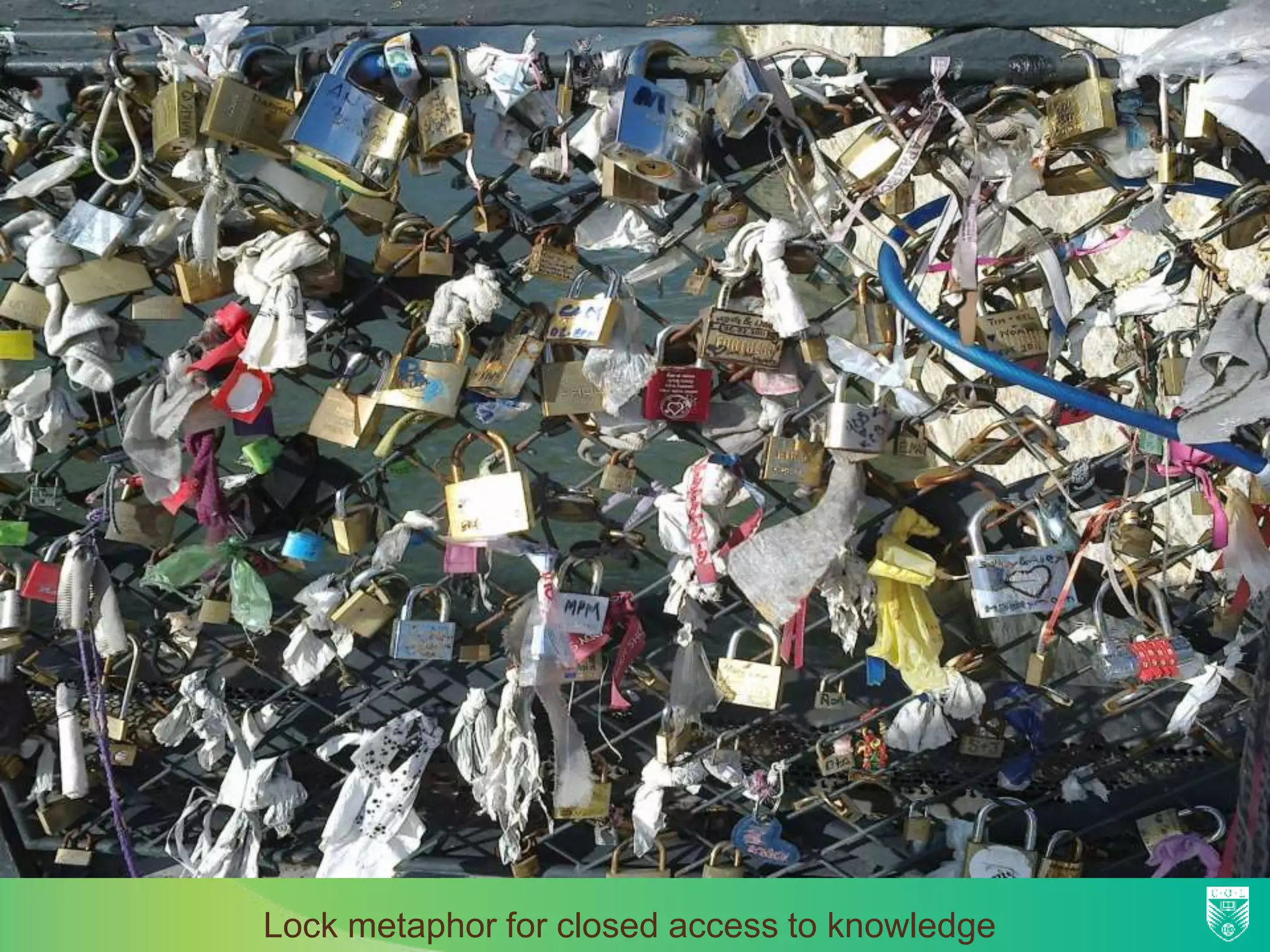
Lock metaphor for closed access to knowledge
Meaning of Terms
 Author/Creator: is the originator of any
written work
 Copyright: exclusive right given by law to the
author/creator of a work
 What can be copyrighted? – Any work which is
not an exact copy of someone else’s work
 Can ideas be copyrighted? No… only
expression of ideas are copyrighted...
 Can copyright be transferred? Yes, an author
can assign copyright to another person, as in
the case of property
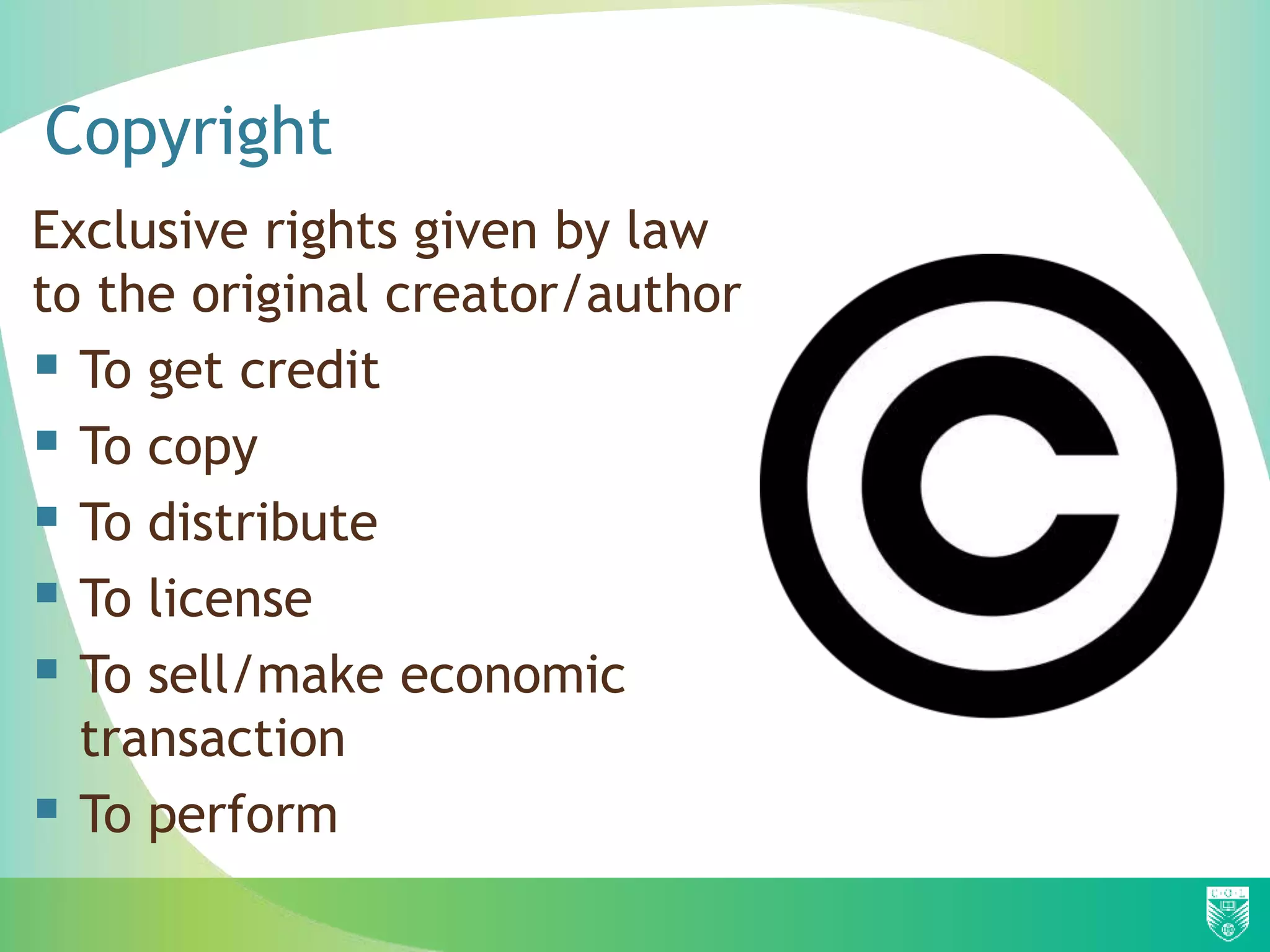
Copyright
Exclusive rights given by law
to the original creator/author
 To get credit
 To copy
 To distribute
 To license
 To sell/make economic
transaction
 To perform
Further Copyright…
 Prohibits unauthorized use,
distribution, performance,
adaptation, sell, etc.
 Requires permission of the
Copyright holder for creating any
derivative works
 Fair use or fair dealing is though
permitted
 Fair use covers Examples of fair
use include commentary, search
engines, criticism, news reporting,
research, teaching, library
archiving and scholarship.
Why consider licensing?
 Copyright law allows licensing of works
 Licensing enables others to use a copyrighted
work in lawful manner
 Licensing can be for economic considerations
to free
 It eases the process of greater use and
distribution of a work
Creative Commons licences
 CC licences are not an alternative to
copyright. They enable creators to distribute
their content to a wide audience and specify
the manner in which the work can be used
while still maintaining their copyright.
 CC aims to make copyright content more
‘active’ by ensuring that content can be
redeveloped easily.
Creative Commons licences
 All CC licences have common features:
– Help creators/licensors retain copyright while
allowing others to copy, distribute, and make some
uses of their work — at least non-commercially.
– Ensure licensors get the credit for their work.
– Work around the world and last as long as applicable
copyright lasts (because they are built on copyright).
 These common features serve as the baseline,
on top of which licensors can choose to grant
additional permissions when deciding how they
want their work to be used.
Why Creative Commons
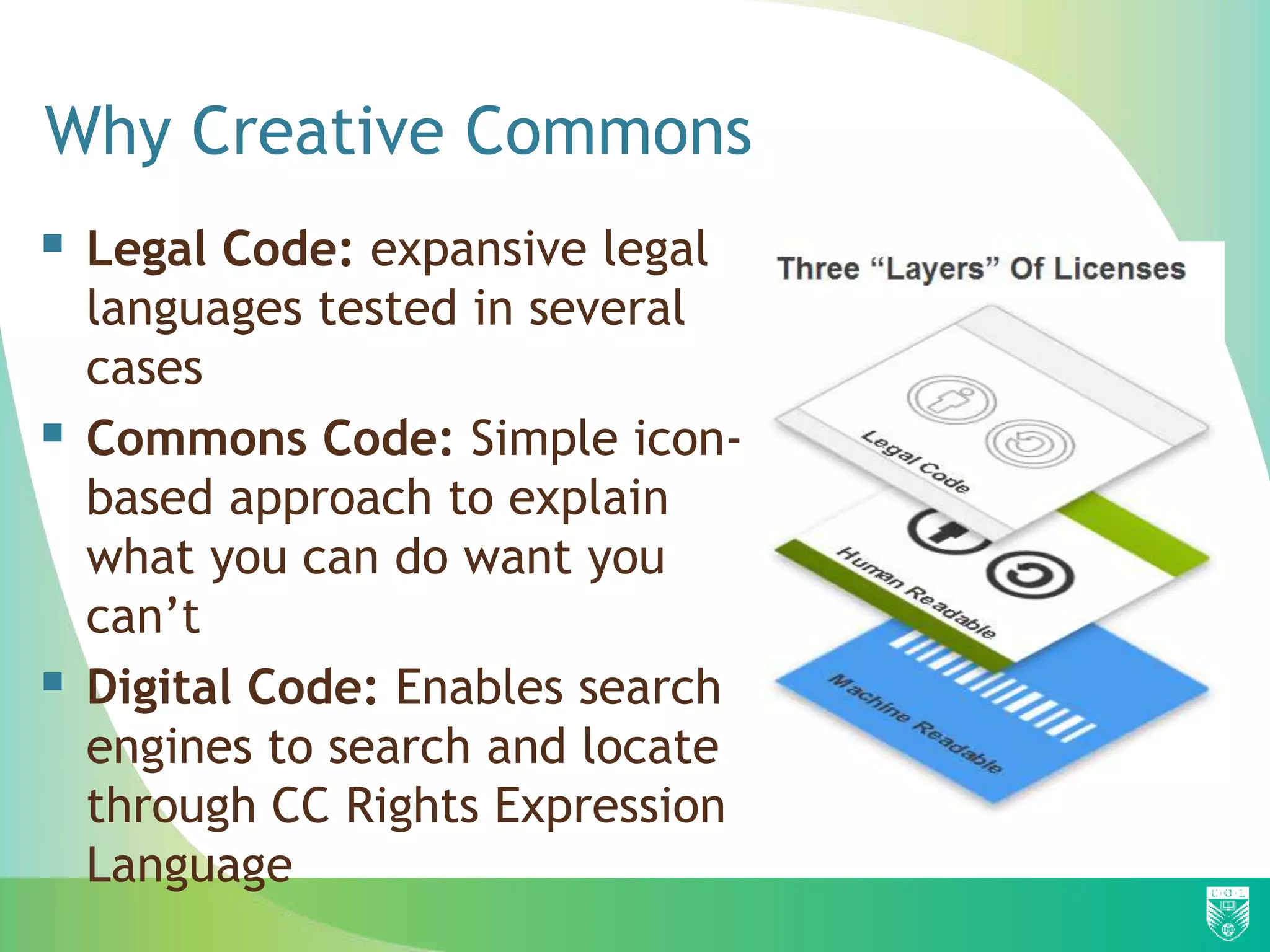
 Legal Code: expansive legal
languages tested in several
cases
 Commons Code: Simple icon-
based approach to explain
what you can do want you
can’t
 Digital Code: Enables search
engines to search and locate
through CC Rights Expression
Language
Open Licenses
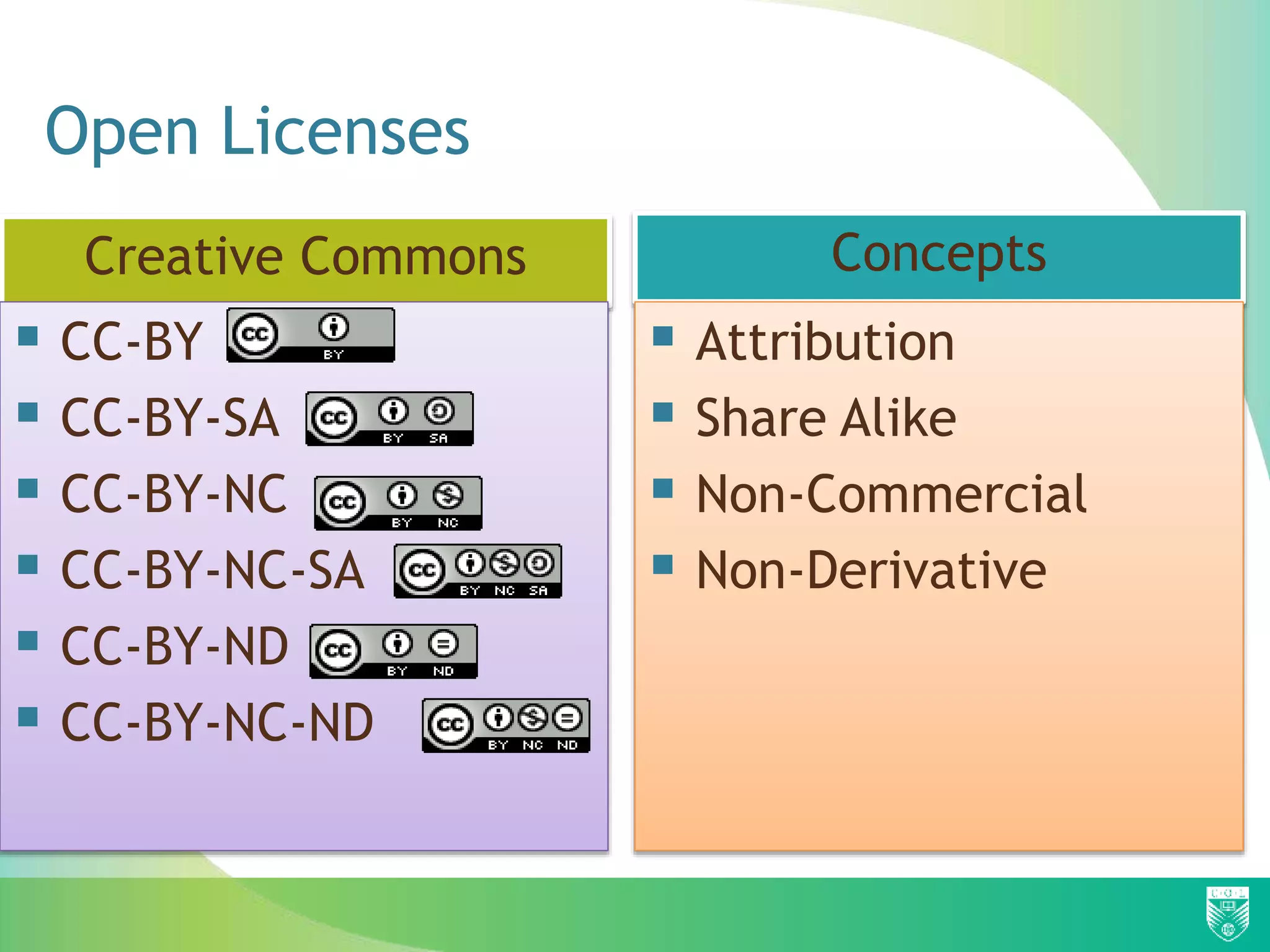
Creative Commons
 CC-BY
 CC-BY-SA
 CC-BY-NC
 CC-BY-NC-SA
 CC-BY-ND
 CC-BY-NC-ND
Concepts
 Attribution
 Share Alike
 Non-Commercial
 Non-Derivative
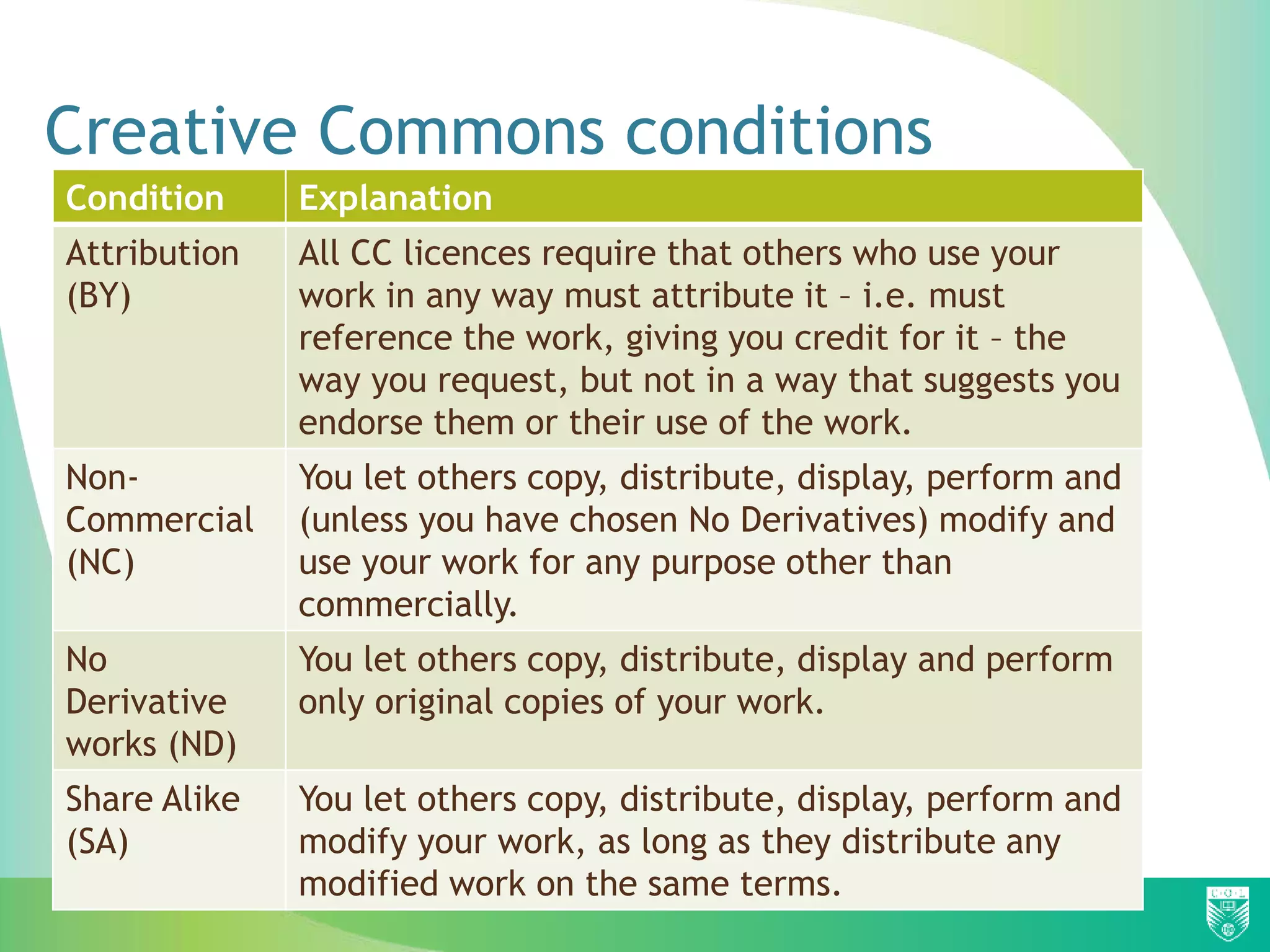
Creative Commons conditions
Condition Explanation
Attribution
(BY)
All CC licences require that others who use your
work in any way must attribute it – i.e. must
reference the work, giving you credit for it – the
way you request, but not in a way that suggests you
endorse them or their use of the work.
Non-
Commercial
(NC)
You let others copy, distribute, display, perform and
(unless you have chosen No Derivatives) modify and
use your work for any purpose other than
commercially.
No
Derivative
works (ND)
You let others copy, distribute, display and perform
only original copies of your work.
Share Alike
(SA)
You let others copy, distribute, display, perform and
modify your work, as long as they distribute any
modified work on the same terms.
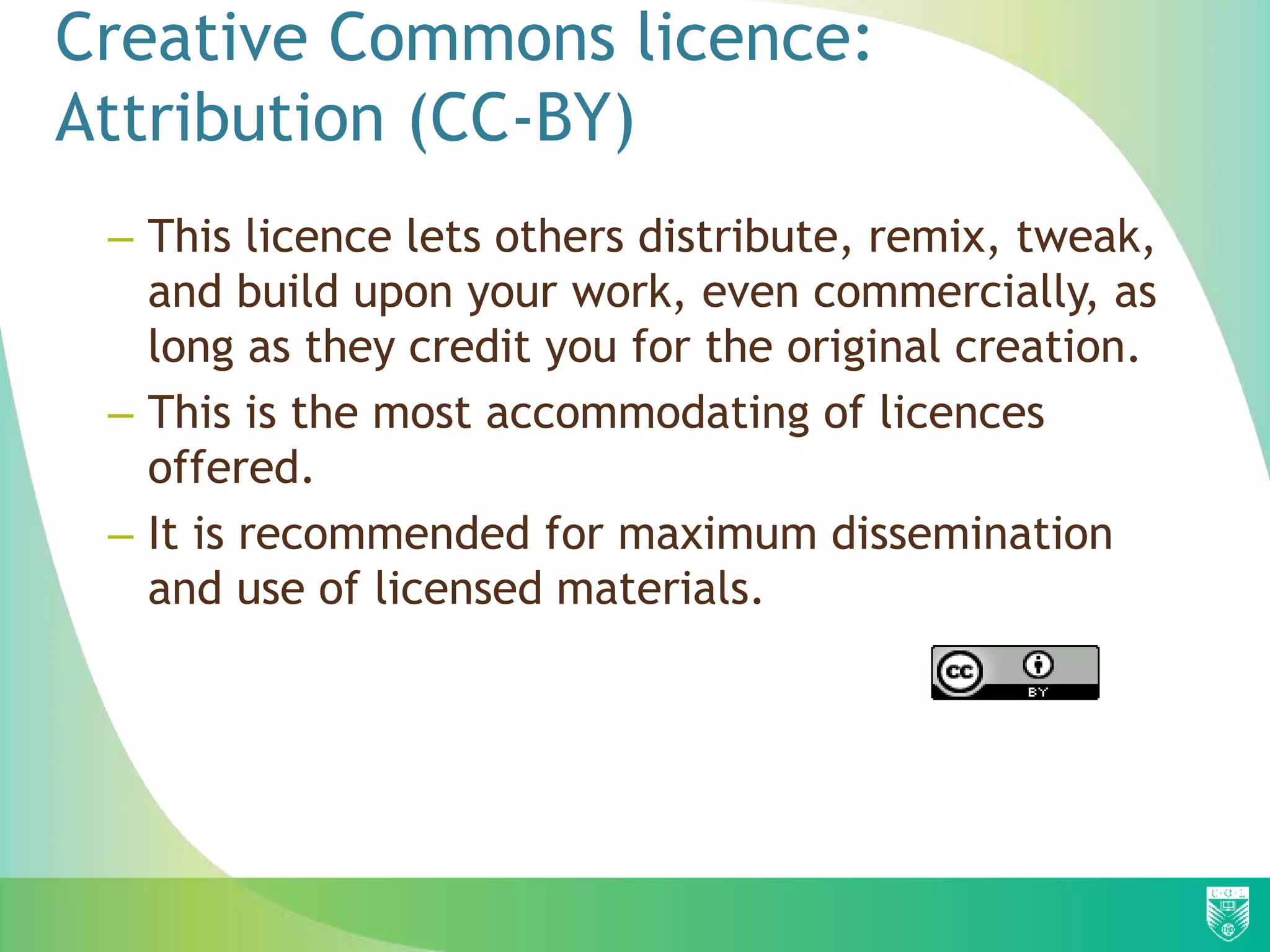
Creative Commons licence:
Attribution (CC-BY)
– This licence lets others distribute, remix, tweak,
and build upon your work, even commercially, as
long as they credit you for the original creation.
– This is the most accommodating of licences
offered.
– It is recommended for maximum dissemination
and use of licensed materials.
Creative Commons licence:
Attribution-ShareAlike (CC BY-SA)
– This licence lets others remix, tweak, and build
upon your work even for commercial purposes, as
long as they credit you and license their new
creations under the identical terms.
– Often compared to “copyleft” free and open
source software licences.
– All new works based on yours will carry the same
licence, so any derivatives will also allow
commercial use. This is the licence used by
Wikipedia.
Creative Commons licence:
Attribution-NonCommercial-
ShareAlike (CC BY-NC-SA)
– This licence lets others remix, tweak, and build
upon your work non-commercially, as long as they
credit you and license their new creations under
the identical terms.
Creative Commons licence:
Attribution-NonCommercial-NoDerivs
(CC BY-NC-ND)
– This licence is the most restrictive, only allowing
others to download your works and share them
with others as long as they credit you, but they
can’t change them in any way or use them
commercially.
Creative Commons licence:
Attribution-NonCommercial
(CC BY-NC)
– This license lets others remix, tweak, and build
upon your work non-commercially, and although
their new works must also acknowledge you and
be non-commercial, they don’t have to license
their derivative works on the same terms.
Creative Commons licence:
Attribution-NoDerivs
(CC BY-ND)
– This license allows for redistribution, commercial
and non-commercial, as long as it is passed along
unchanged and in whole, with credit to you.
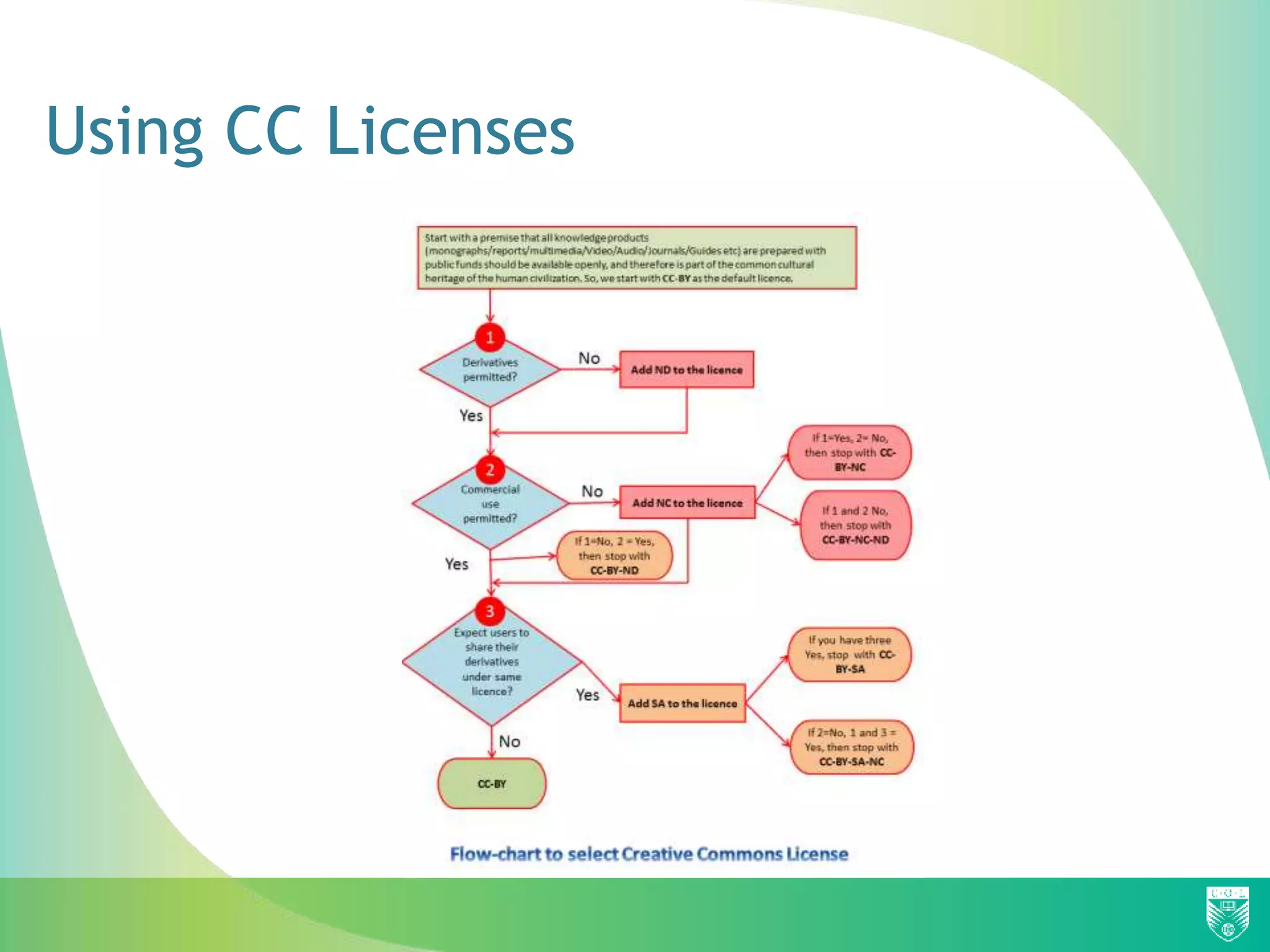
Using CC Licenses
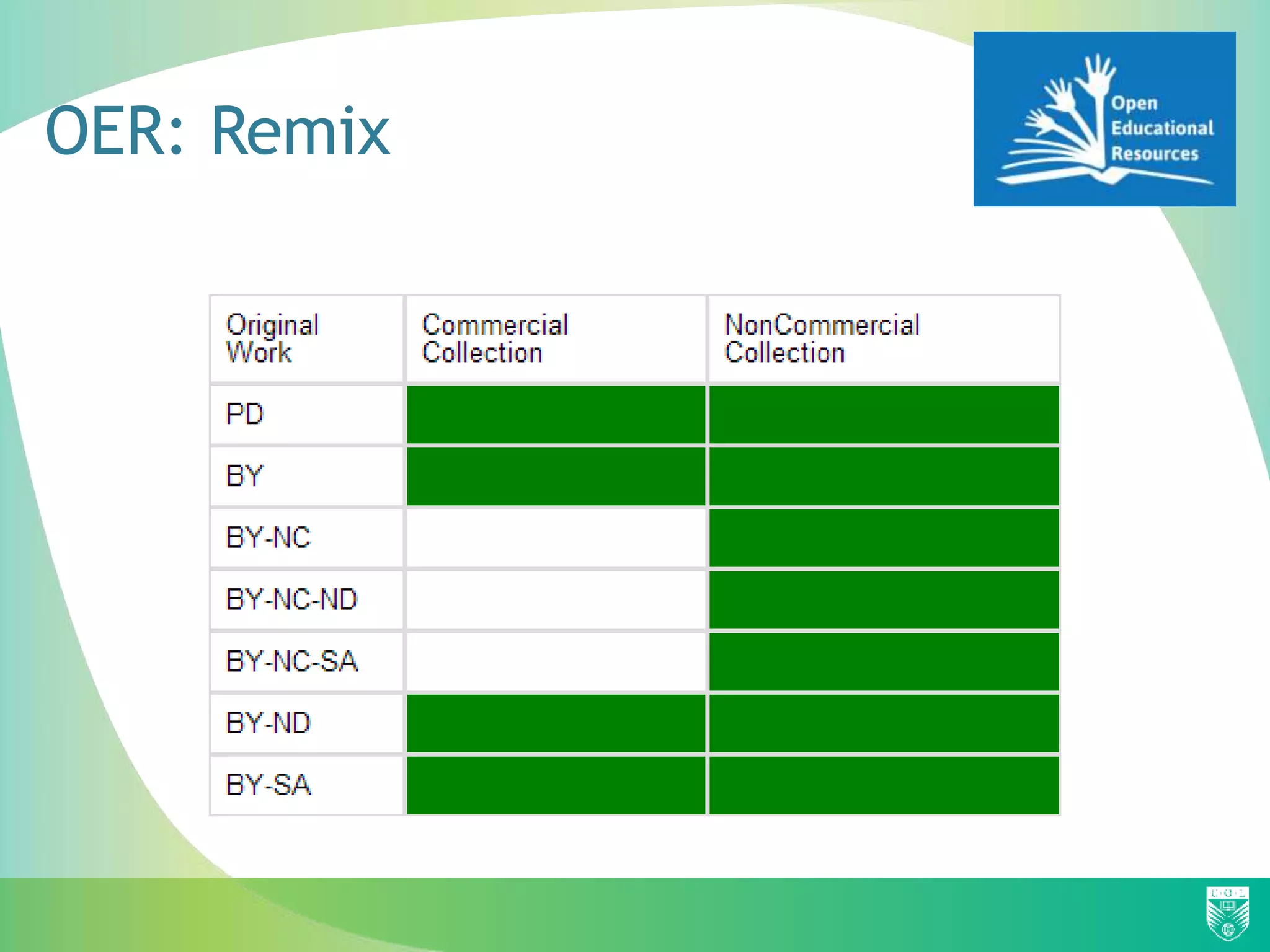
OER: Remix
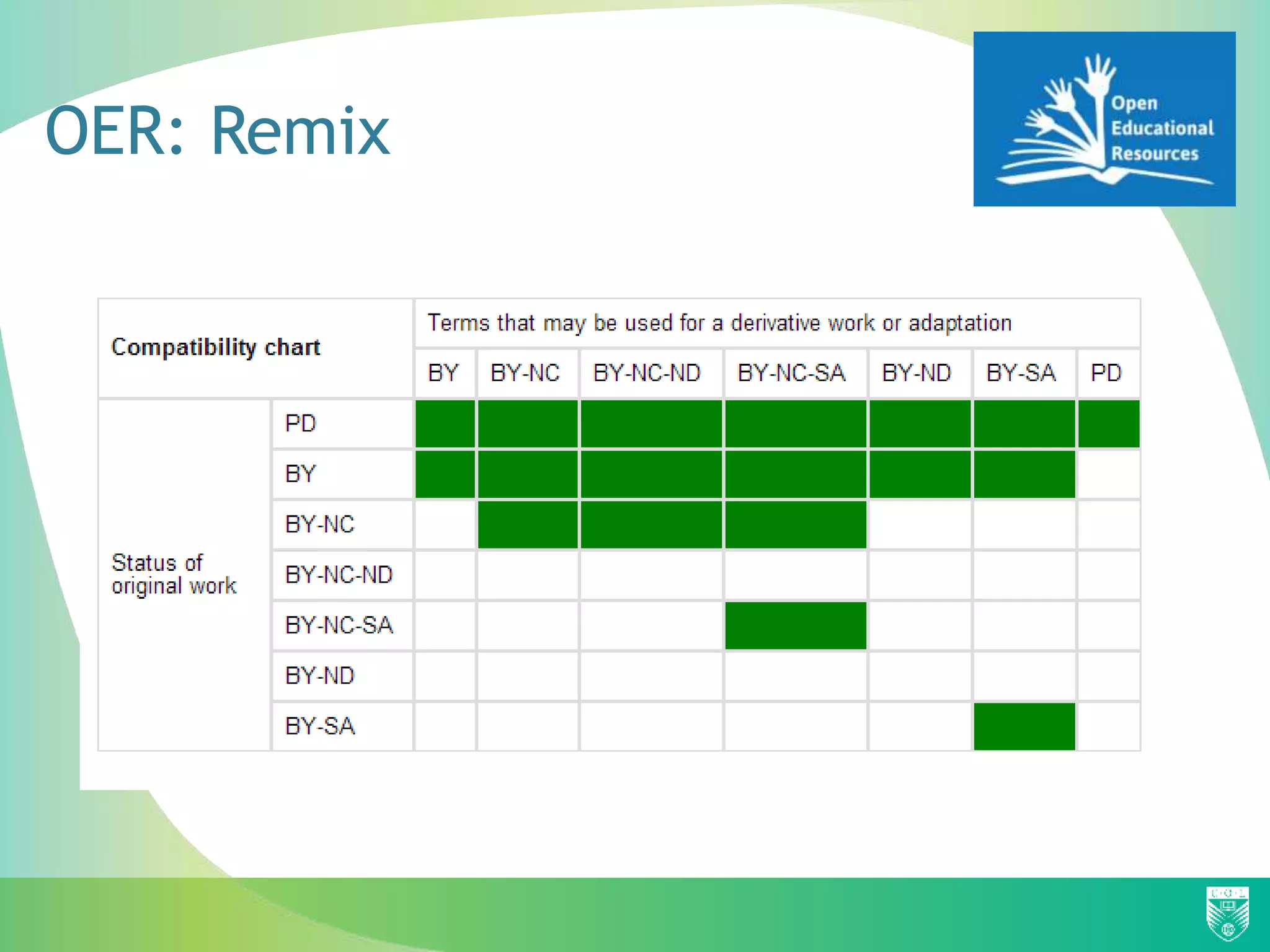
OER: Remix
Issues to note
 There is no registration required to license your work. All
you need to do is select a Creative Commons licence and
then display the licence information on your work.
 It may be worthwhile to clearly spell out rights in terms of
the materials that third parties produce, including the
possibility of subsequent use and reuse by third parties.
Policies may stipulate the avoidance of third party,
copyrighted material embedded in the material that would
otherwise limit its ability to be shared.
 If your work contains third-party (i.e. not created by you)
content (e.g. images, text, charts) and you wish to
distribute your work widely as an OER – whether in person,
or electronically or online – then you must undergo
copyright clearance to obtain permission for third-party
content.
THANK YOU

Copyright and Open Licensing

  • 1.
    Commonwealth Educational Media Centrefor Asia Copyright and Open Licensing Sanjaya Mishra Education Specialist, eLearning, COL Principal Investigator, ROER4D
  • 2.
    Lock metaphor forclosed access to knowledge
  • 3.
    Meaning of Terms Author/Creator: is the originator of any written work  Copyright: exclusive right given by law to the author/creator of a work  What can be copyrighted? – Any work which is not an exact copy of someone else’s work  Can ideas be copyrighted? No… only expression of ideas are copyrighted...  Can copyright be transferred? Yes, an author can assign copyright to another person, as in the case of property
  • 4.
    Copyright Exclusive rights givenby law to the original creator/author  To get credit  To copy  To distribute  To license  To sell/make economic transaction  To perform
  • 5.
    Further Copyright…  Prohibitsunauthorized use, distribution, performance, adaptation, sell, etc.  Requires permission of the Copyright holder for creating any derivative works  Fair use or fair dealing is though permitted  Fair use covers Examples of fair use include commentary, search engines, criticism, news reporting, research, teaching, library archiving and scholarship.
  • 6.
    Why consider licensing? Copyright law allows licensing of works  Licensing enables others to use a copyrighted work in lawful manner  Licensing can be for economic considerations to free  It eases the process of greater use and distribution of a work
  • 7.
    Creative Commons licences CC licences are not an alternative to copyright. They enable creators to distribute their content to a wide audience and specify the manner in which the work can be used while still maintaining their copyright.  CC aims to make copyright content more ‘active’ by ensuring that content can be redeveloped easily.
  • 8.
    Creative Commons licences All CC licences have common features: – Help creators/licensors retain copyright while allowing others to copy, distribute, and make some uses of their work — at least non-commercially. – Ensure licensors get the credit for their work. – Work around the world and last as long as applicable copyright lasts (because they are built on copyright).  These common features serve as the baseline, on top of which licensors can choose to grant additional permissions when deciding how they want their work to be used.
  • 9.
    Why Creative Commons Legal Code: expansive legal languages tested in several cases  Commons Code: Simple icon- based approach to explain what you can do want you can’t  Digital Code: Enables search engines to search and locate through CC Rights Expression Language
  • 10.
    Open Licenses Creative Commons CC-BY  CC-BY-SA  CC-BY-NC  CC-BY-NC-SA  CC-BY-ND  CC-BY-NC-ND Concepts  Attribution  Share Alike  Non-Commercial  Non-Derivative
  • 11.
    Creative Commons conditions ConditionExplanation Attribution (BY) All CC licences require that others who use your work in any way must attribute it – i.e. must reference the work, giving you credit for it – the way you request, but not in a way that suggests you endorse them or their use of the work. Non- Commercial (NC) You let others copy, distribute, display, perform and (unless you have chosen No Derivatives) modify and use your work for any purpose other than commercially. No Derivative works (ND) You let others copy, distribute, display and perform only original copies of your work. Share Alike (SA) You let others copy, distribute, display, perform and modify your work, as long as they distribute any modified work on the same terms.
  • 12.
    Creative Commons licence: Attribution(CC-BY) – This licence lets others distribute, remix, tweak, and build upon your work, even commercially, as long as they credit you for the original creation. – This is the most accommodating of licences offered. – It is recommended for maximum dissemination and use of licensed materials.
  • 13.
    Creative Commons licence: Attribution-ShareAlike(CC BY-SA) – This licence lets others remix, tweak, and build upon your work even for commercial purposes, as long as they credit you and license their new creations under the identical terms. – Often compared to “copyleft” free and open source software licences. – All new works based on yours will carry the same licence, so any derivatives will also allow commercial use. This is the licence used by Wikipedia.
  • 14.
    Creative Commons licence: Attribution-NonCommercial- ShareAlike(CC BY-NC-SA) – This licence lets others remix, tweak, and build upon your work non-commercially, as long as they credit you and license their new creations under the identical terms.
  • 15.
    Creative Commons licence: Attribution-NonCommercial-NoDerivs (CCBY-NC-ND) – This licence is the most restrictive, only allowing others to download your works and share them with others as long as they credit you, but they can’t change them in any way or use them commercially.
  • 16.
    Creative Commons licence: Attribution-NonCommercial (CCBY-NC) – This license lets others remix, tweak, and build upon your work non-commercially, and although their new works must also acknowledge you and be non-commercial, they don’t have to license their derivative works on the same terms.
  • 17.
    Creative Commons licence: Attribution-NoDerivs (CCBY-ND) – This license allows for redistribution, commercial and non-commercial, as long as it is passed along unchanged and in whole, with credit to you.
  • 18.
  • 19.
  • 20.
  • 21.
    Issues to note There is no registration required to license your work. All you need to do is select a Creative Commons licence and then display the licence information on your work.  It may be worthwhile to clearly spell out rights in terms of the materials that third parties produce, including the possibility of subsequent use and reuse by third parties. Policies may stipulate the avoidance of third party, copyrighted material embedded in the material that would otherwise limit its ability to be shared.  If your work contains third-party (i.e. not created by you) content (e.g. images, text, charts) and you wish to distribute your work widely as an OER – whether in person, or electronically or online – then you must undergo copyright clearance to obtain permission for third-party content.
  • 22.