…  and everything in between… Creative Commons & Open Resources LIASA / FAIFE workshop 28 September 2009 Tobias Schonwetter
(1) copyright - recap
“ Only one thing is impossible for God: To find any sense in any copyright law on the planet.”
“ Copyright is the exclusive right in relation to work embodying intellectual content to do or to authorize to do certain acts in relation to that work.”  (O.H. Dean)
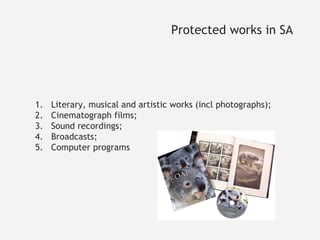
Protected works in SA Literary, musical and artistic works (incl photographs); Cinematograph films; Sound recordings; Broadcasts; Computer programs
Exclusive rights reproduce make adaptations broadcast distribute perform display in public cause a work to be transmitted in a diffusion service
Basic requirements for copyright protection   Originality Material form Qualified person no registration necessary  the idea itself is NOT protected
Fair balance between the interests of right owners and public/users
By default: a utomatic  All Rights Reserved  situation
Permission is required for most uses of most works!
Copyright exception and limitation Unless a copyright exception and limitation applies. Such as:    F air dealing (for purposes of study, research, private use)    Quotation    Illustrations for teaching    Specific library and archive exceptions
Copyright exceptions and limitations Library and archive exceptions: - (only for library and archives) For non-commercial purposes only Institution must be open to the public Reproduction must incorporate copyright warning For purposes of preservation of unpublished and replacement of published works only Or, on request of user, for purposes of private study or personal or private use But not more than one copy (or isolated and unrelated reproduction) of a reasonable portion of the work & “no conflict with normal exploitation of the work” Problem: Clearly not drafted with digitisation in mind
(2)  selected problematic issues: copyright term, the public domain, orphan works, digitisation
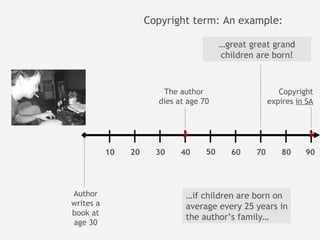
Copyright term: An example:  10 20 30 40 50 60 70 80 X 90 X Author writes a book at age 30 The author dies at age 70 Copyright expires  in SA … if children are born on average every 25 years in the author’s family… … great great grand children are born!
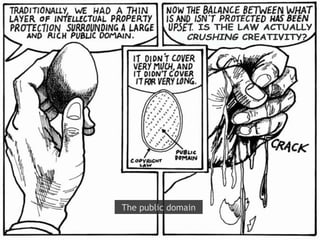
The public domain
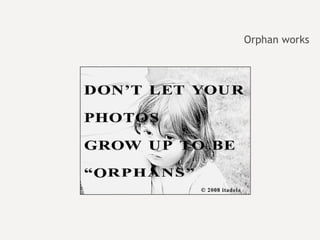
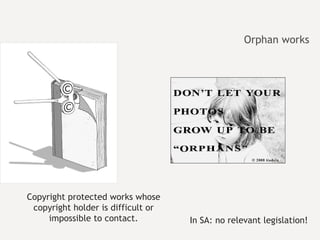
Orphan works
Orphan works Copyright protected works whose copyright holder is difficult or impossible to contact. In SA: no relevant legislation!
A nd then, of course,  … the issue of digitising
unlimited number of copies virtually instantaneously no loss of quality distribution of copies around the world in seconds
copyright laws were originally designed for analog technologies of reproduction (“hardcopy rules in a softcopy world”) (2) new categories of multi-media works do not always fall neatly under the present definitions (3) history of copyright indicates that it is a right to be exercised by and against professionals (not end-users!) General changes
S12 General exceptions from protection of literary and musical works (1) Copyright shall not be infringed by any fair dealing with a literary or musical work- (a)  for the purposes of research or private study by, or the personal or private use of, the person using the work ; (b) for the purposes of criticism or review of that work or of another work; or (c) for the purpose of reporting current events- […] S17 General exceptions regarding protection of sound recordings The provisions of section 12 (1) (b) and (c), (2), (3), (4), (5), (12) and (13) shall mutatis mutandis apply with reference to sound recordings.
Also:  the new international dimension (which court has jurisdiction, what law is applicable in cross-border infringement cases (P2P) etc.) conflicts with the traditional principle of territoriality on which copyright law is based.
A nd  what does all this mean for copyright law?
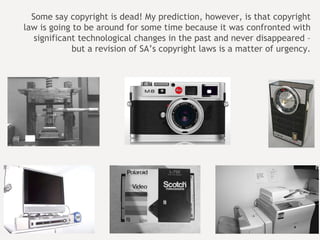
Third-party liability of ISPs and P2P service provider?   Some say copyright is dead! My prediction, however, is that copyright law is going to be around for some time because it was confronted with significant technological changes in the past and never disappeared – but a revision of SA’s copyright laws is a matter of urgency.
(3)  Copyleft /  the public domain
(4)   and Open Resources
 
How can we make copyright protected material more accessible?
1. Availability and accessibility of copyright protected material often is in the public interest, particularly in relation to educational materials 2. Automatic and strict statutory copyright protection is often NOT in the interest of creator/ rights holder
 
Open educational resources are educational materials and resources offered freely and openly for anyone to use under open licenses to re-mix, improve and redistribute. Main aim: Furtherance of Education (especially for those who otherwise could not afford text books etc, particularly but not exclusively in developing countries  - California example)
As a matter of fact, not only OER but the entire Open Access movement builds upon open licences because open-access material is, by definition, digital, online,  free of charge, and free of most copyright and licensing restrictions.
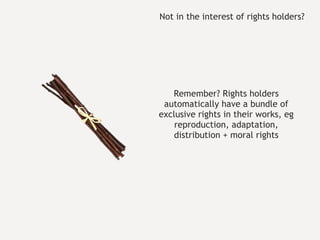
Remember? Rights holders automatically have a bundle of exclusive rights in their works, eg reproduction, adaptation, distribution + moral rights Not in the interest of rights holders?
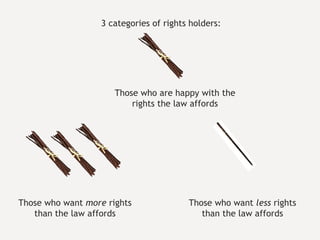
3 categories of rights holders: Those who want  more  rights than the law affords Those who want  less  rights than the law affords Those who are happy with the rights the law affords
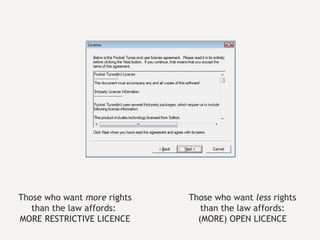
Those who want  more  rights than the law affords:  MORE RESTRICTIVE LICENCE Those who want  less  rights than the law affords: (MORE) OPEN LICENCE
(MORE) OPEN LICENCES / Copyleft licences
Non-profit organisation Founded in 2001 by Stanford law Professor Lawrence Lessig and others Licences ported to over 50 international jurisdictions, incl SA (UCT) More than 130 million CC licensed works by 2008 Latest CC licence version: 3.0 (2.5 in SA)
 
Key features of CC licences…
“ some rights reserved”- principle (as apposed to the “all rights reserved”- principle on which copyright law is based)
Open to anyone Accompany the work Non-exclusive Allowing use/modification Royalty-free Perpetual
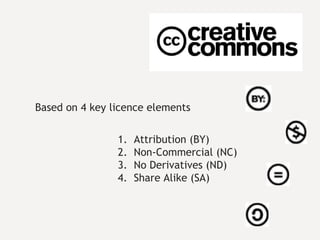
Based on 4 key licence elements Attribution (BY) Non-Commercial (NC) No Derivatives (ND) Share Alike (SA)
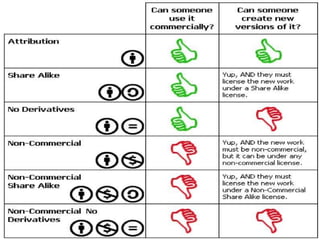
6 licences to choose from …
 
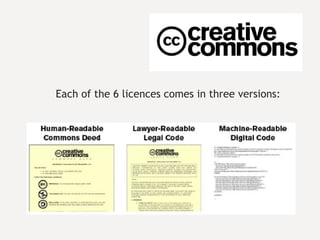
Each of the 6 licences comes in three versions:
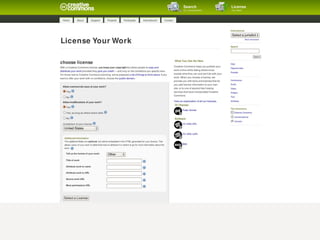
How does it actually work?
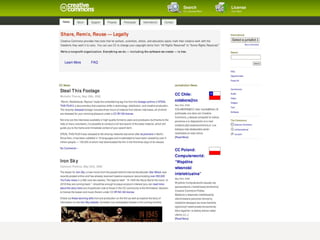
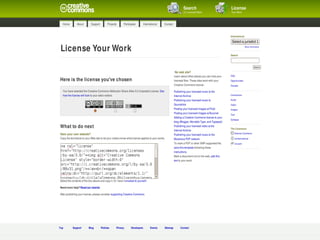
Go to  www.creativecommons.org  …


One last thing…
Creative Commons as such is providing the tool (the licence) but does not become part of the relationship between rights holder and user! Nor is it a law firm.
Do if you need help implementing CC licences, call a lawyer!
Thank you! My contact details are: Tobias Schonwetter [email_address] [email_address]
Creative Commons Licence This presentation is the work of Tobias Schonwetter. The work is available under a Creative Commons Attribution Share Alike South Africa 2.5 licence. E-mail:  [email_address]
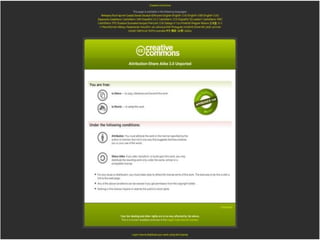
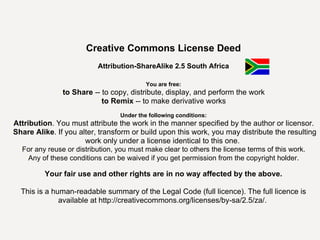
Creative Commons License Deed Attribution-ShareAlike 2.5 South Africa You are free: to Share  -- to copy, distribute, display, and perform the work  to Remix  -- to make derivative works  Under the following conditions: Attribution . You must attribute the work in the manner specified by the author or licensor.  Share Alike . If you alter, transform or build upon this work, you may distribute the resulting work only under a license identical to this one.  For any reuse or distribution, you must make clear to others the license terms of this work.  Any of these conditions can be waived if you get permission from the copyright holder .  Your fair use and other rights are in no way affected by the above. This is a human-readable summary of the Legal Code (full licence). The full licence is available at  http://creativecommons.org/licenses/by-sa/2.5/za/ .

Liasa Faife Seminar 280909

  • 1.
    … andeverything in between… Creative Commons & Open Resources LIASA / FAIFE workshop 28 September 2009 Tobias Schonwetter
  • 2.
  • 3.
    “ Only onething is impossible for God: To find any sense in any copyright law on the planet.”
  • 4.
    “ Copyright isthe exclusive right in relation to work embodying intellectual content to do or to authorize to do certain acts in relation to that work.” (O.H. Dean)
  • 5.
    Protected works inSA Literary, musical and artistic works (incl photographs); Cinematograph films; Sound recordings; Broadcasts; Computer programs
  • 6.
    Exclusive rights reproducemake adaptations broadcast distribute perform display in public cause a work to be transmitted in a diffusion service
  • 7.
    Basic requirements forcopyright protection Originality Material form Qualified person no registration necessary the idea itself is NOT protected
  • 8.
    Fair balance betweenthe interests of right owners and public/users
  • 9.
    By default: automatic All Rights Reserved situation
  • 10.
    Permission is requiredfor most uses of most works!
  • 11.
    Copyright exception andlimitation Unless a copyright exception and limitation applies. Such as:  F air dealing (for purposes of study, research, private use)  Quotation  Illustrations for teaching  Specific library and archive exceptions
  • 12.
    Copyright exceptions andlimitations Library and archive exceptions: - (only for library and archives) For non-commercial purposes only Institution must be open to the public Reproduction must incorporate copyright warning For purposes of preservation of unpublished and replacement of published works only Or, on request of user, for purposes of private study or personal or private use But not more than one copy (or isolated and unrelated reproduction) of a reasonable portion of the work & “no conflict with normal exploitation of the work” Problem: Clearly not drafted with digitisation in mind
  • 13.
    (2) selectedproblematic issues: copyright term, the public domain, orphan works, digitisation
  • 14.
    Copyright term: Anexample: 10 20 30 40 50 60 70 80 X 90 X Author writes a book at age 30 The author dies at age 70 Copyright expires in SA … if children are born on average every 25 years in the author’s family… … great great grand children are born!
  • 15.
  • 16.
  • 17.
    Orphan works Copyrightprotected works whose copyright holder is difficult or impossible to contact. In SA: no relevant legislation!
  • 18.
    A nd then,of course, … the issue of digitising
  • 19.
    unlimited number ofcopies virtually instantaneously no loss of quality distribution of copies around the world in seconds
  • 20.
    copyright laws wereoriginally designed for analog technologies of reproduction (“hardcopy rules in a softcopy world”) (2) new categories of multi-media works do not always fall neatly under the present definitions (3) history of copyright indicates that it is a right to be exercised by and against professionals (not end-users!) General changes
  • 21.
    S12 General exceptionsfrom protection of literary and musical works (1) Copyright shall not be infringed by any fair dealing with a literary or musical work- (a) for the purposes of research or private study by, or the personal or private use of, the person using the work ; (b) for the purposes of criticism or review of that work or of another work; or (c) for the purpose of reporting current events- […] S17 General exceptions regarding protection of sound recordings The provisions of section 12 (1) (b) and (c), (2), (3), (4), (5), (12) and (13) shall mutatis mutandis apply with reference to sound recordings.
  • 22.
    Also: thenew international dimension (which court has jurisdiction, what law is applicable in cross-border infringement cases (P2P) etc.) conflicts with the traditional principle of territoriality on which copyright law is based.
  • 23.
    A nd what does all this mean for copyright law?
  • 24.
    Third-party liability ofISPs and P2P service provider? Some say copyright is dead! My prediction, however, is that copyright law is going to be around for some time because it was confronted with significant technological changes in the past and never disappeared – but a revision of SA’s copyright laws is a matter of urgency.
  • 25.
    (3) Copyleft/ the public domain
  • 26.
    (4) and Open Resources
  • 27.
  • 28.
    How can wemake copyright protected material more accessible?
  • 29.
    1. Availability andaccessibility of copyright protected material often is in the public interest, particularly in relation to educational materials 2. Automatic and strict statutory copyright protection is often NOT in the interest of creator/ rights holder
  • 30.
  • 31.
    Open educational resourcesare educational materials and resources offered freely and openly for anyone to use under open licenses to re-mix, improve and redistribute. Main aim: Furtherance of Education (especially for those who otherwise could not afford text books etc, particularly but not exclusively in developing countries - California example)
  • 32.
    As a matterof fact, not only OER but the entire Open Access movement builds upon open licences because open-access material is, by definition, digital, online, free of charge, and free of most copyright and licensing restrictions.
  • 33.
    Remember? Rights holdersautomatically have a bundle of exclusive rights in their works, eg reproduction, adaptation, distribution + moral rights Not in the interest of rights holders?
  • 34.
    3 categories ofrights holders: Those who want more rights than the law affords Those who want less rights than the law affords Those who are happy with the rights the law affords
  • 35.
    Those who want more rights than the law affords: MORE RESTRICTIVE LICENCE Those who want less rights than the law affords: (MORE) OPEN LICENCE
  • 36.
    (MORE) OPEN LICENCES/ Copyleft licences
  • 37.
    Non-profit organisation Foundedin 2001 by Stanford law Professor Lawrence Lessig and others Licences ported to over 50 international jurisdictions, incl SA (UCT) More than 130 million CC licensed works by 2008 Latest CC licence version: 3.0 (2.5 in SA)
  • 38.
  • 39.
    Key features ofCC licences…
  • 40.
    “ some rightsreserved”- principle (as apposed to the “all rights reserved”- principle on which copyright law is based)
  • 41.
    Open to anyoneAccompany the work Non-exclusive Allowing use/modification Royalty-free Perpetual
  • 42.
    Based on 4key licence elements Attribution (BY) Non-Commercial (NC) No Derivatives (ND) Share Alike (SA)
  • 43.
    6 licences tochoose from …
  • 44.
  • 45.
    Each of the6 licences comes in three versions:
  • 46.
    How does itactually work?
  • 47.
    Go to www.creativecommons.org …
  • 48.
  • 49.
  • 50.
  • 51.
  • 52.
  • 53.
    Creative Commons assuch is providing the tool (the licence) but does not become part of the relationship between rights holder and user! Nor is it a law firm.
  • 54.
    Do if youneed help implementing CC licences, call a lawyer!
  • 55.
    Thank you! Mycontact details are: Tobias Schonwetter [email_address] [email_address]
  • 56.
    Creative Commons LicenceThis presentation is the work of Tobias Schonwetter. The work is available under a Creative Commons Attribution Share Alike South Africa 2.5 licence. E-mail: [email_address]
  • 57.
    Creative Commons LicenseDeed Attribution-ShareAlike 2.5 South Africa You are free: to Share -- to copy, distribute, display, and perform the work to Remix -- to make derivative works Under the following conditions: Attribution . You must attribute the work in the manner specified by the author or licensor. Share Alike . If you alter, transform or build upon this work, you may distribute the resulting work only under a license identical to this one. For any reuse or distribution, you must make clear to others the license terms of this work. Any of these conditions can be waived if you get permission from the copyright holder . Your fair use and other rights are in no way affected by the above. This is a human-readable summary of the Legal Code (full licence). The full licence is available at http://creativecommons.org/licenses/by-sa/2.5/za/ .

Editor's Notes

  • #30 Librarians are access enablers to their collections – therefore, you should be aware of potential restrictions caused by copyright laws, eg when digitising your collection – and you should be aware of strategies to circumvent those restrictions, incl Creative Commons licencing