This Photo by Unknown Author is licensed under CC BY
COPYRIGHT AND
CREATIVE COMMONS
LICENSING
Copyright, Creative
Commons, Fair Use and
the Public Domain
BETHSHEBA KIAP FYG1 2021 WPU
COPYRIGHT & COPYRIGHT LAW
• Copyright is all rights reserved.
• Copyright Law insures that people who create the work (
written work, musical work, work of art, digitized work
ect.,) can own control and be paid for their effort.
• Protection is automatically applied as soon as the work is
done.
• Copyright law covers both published and unpublished
works, regardless of the nationality.
• Copyright does not protect ideas, nor does it protect facts.
It protects only the form in which ideas or facts are
expressed.
COPYRIGHT AND COPYRIGHT LAW
• Copyright grants the creator a set of rights to protect their
work:
oThe right to PRODUCE the work
oThe right to REPRODUCE the work
oThe right to PERFORM the work publicly
oThe right to DISPLAY the work
oThe right to BROADCAST the work digitally
• Copyright Law also protects the creator and others who might
be doing the same without payment, attribution or
permission.
• Violating copyright law is known as Infringement.
This Photo by Unknown Author is licensed under CC BY-SA
CREATIVE COMMONS
•Creative Commons some rights are reserved
•Creative Commons (CC) is an internationally active non-
profit organization that provides free licenses for
creators to use when making their work available to the
public.
•These licenses give permission to others to use the
creators work but under certain conditions
•Can be used to change your copyright terms from “all
rights reserved” to “ some rights reserved.”
CREATIVE COMMONS LICENSE CONDITIONS
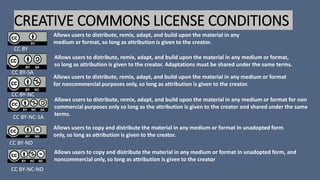
Allows users to distribute, remix, adapt, and build upon the material in any
medium or format, so long as attribution is given to the creator.
Allows users to distribute, remix, adapt, and build upon the material in any medium or format,
so long as attribution is given to the creator. Adaptations must be shared under the same terms.
CC BY
CC BY-SA
Allows users to distribute, remix, adapt, and build upon the material in any medium or format
for noncommercial purposes only, so long as attribution is given to the creator.
CC BY-NC
Allows users to distribute, remix, adapt, and build upon the material in any medium or format for non
commercial purposes only so long as the attribution is given to the creator and shared under the same
terms.
CC BY-NC-SA
Allows users to copy and distribute the material in any medium or format in unadopted form, and
noncommercial only, so long as attribution is given to the creator
CC BY-NC-ND
Allows users to copy and distribute the material in any medium or format in unadopted form
only, so long as attribution is given to the creator.
CC BY-ND
FAIR USE
• Fair Use is any copying of copyrighted material done for a limited
and transformative purpose.
• For purposes such as criticism, comment, news reporting, teaching
(including multiple copies for classroom use, scholarship, or
research) is not an infringement of copyright.
• Fair Use is a guideline whereas, Copyright is a law.
• Fair Use is flexible, Copyright law does not specify how it should be
applied.
• Fair Use is a defense against a claim of copyright infringement.
DETERMINING FAIR USE
When deciding whether an unlicensed use of copyrighted
material is fair, courts consider the following guidelines and
best practices:
What is the purpose and character of the use?
What is the nature of the copyrighted work?
What is the amount of the portion used?
What is the effect of the use upon the potential market for,
or the value of, the copyrighted work?
Did the unlicensed use “transform” the material by using it
for a different purpose than that of the original, or did it
just repeat the work for the same intent and value as the
original?
This Photo by Unknown Author is licensed under CC BY-SA
PUBLIC DOMAIN
• Public domain, refers to creative materials that are
not protected by intellectual property law such as
copyright, trademark, or patent laws.
• The public owns this work not an individual author
or artist.
• Anyone can use a public domain without obtaining
permission, but no one can ever own it.
PUBLIC DOMAIN
• Collections of public domain material may be protected by the
“collective works” copyright. For example, you may use
individual images within a collection without permission but
not the entire collection.
• Works arrive in the public domain in four ways:
1) Expiration of copyright
2) Failure to renew copyright
3) Dedication (the owner deliberately places the work in the
public domain)
4) No copyright protection is available for the type of work.
REFERENCES
 Creative Commons. 2021. Licenses. Retrieved 28/5/21 from Creative Commons — Attribution-
NonCommercial-NoDerivatives 4.0 International — CC BY-NC-ND 4.0
 Copyright. 2013. Intellectual Property Right in Papua New Guinea. Retrieved 28/5/21 form
https://www.jstor.org/stable/j.ctt2tt1dw.8?seq=1#metadata_info_tab_contents
 Google Images. 2021. Copyright and Creative Commons Images. Retrieved from
https://www.google.com/search?q=copyright&rlz=1C1GEWG_en-
GBPG944PG944&source=lnms&tbm=isch&sa=X&ved=2ahUKEwiqt7LhhOzwAhXZyjgGHYq7CSEQ_AUoAXoEC
AEQAw&biw=867&bih=560
 Creative Commons. 2021 . What is Creative Commons? Retrieved 28/5/21 from
https://creativecommons.org/about
 Google Images. 2021. Fair Use. Retrieved from https://www.google.com/search?q=fair+use%5C&rlz=1C1GEWG_en-
GBPG944PG944&source=lnms&tbm=isch&sa=X&ved=2ahUKEwiNxLSwrvPwAhVu8HMBHWWWCZwQ_AUoAXoECAEQA
w&biw=882&bih=615#imgrc=8FZqTFtw-yk7QM
 Copyright and Fair Use. 2016. What is Fair Use? Rich Stim. Retrieved from https://fairuse.stanford.edu/overview/fair-
use/what-is-fair-use/
 Google Images. 2021. Public Domain Images. Retrieved from
https://www.google.com/search?sourceid=navclient&rlz=1T4ADBF_en___US331&q=public+domain&um=1&ie=UTF-
8&sa=N&hl=en&tab=wi&tbm=isch
 Stanford University Libraries. 2021. The Public Domain. In Copyright and Fair Use Overview, ( Chapter 8.) Retrieved from
https://fairuse.stanford.edu/overview/public-domain/

Copyright and creative commons licensing

  • 1.
    This Photo byUnknown Author is licensed under CC BY This Photo by Unknown Author is licensed under CC BY COPYRIGHT AND CREATIVE COMMONS LICENSING Copyright, Creative Commons, Fair Use and the Public Domain BETHSHEBA KIAP FYG1 2021 WPU
  • 2.
    COPYRIGHT & COPYRIGHTLAW • Copyright is all rights reserved. • Copyright Law insures that people who create the work ( written work, musical work, work of art, digitized work ect.,) can own control and be paid for their effort. • Protection is automatically applied as soon as the work is done. • Copyright law covers both published and unpublished works, regardless of the nationality. • Copyright does not protect ideas, nor does it protect facts. It protects only the form in which ideas or facts are expressed.
  • 3.
    COPYRIGHT AND COPYRIGHTLAW • Copyright grants the creator a set of rights to protect their work: oThe right to PRODUCE the work oThe right to REPRODUCE the work oThe right to PERFORM the work publicly oThe right to DISPLAY the work oThe right to BROADCAST the work digitally • Copyright Law also protects the creator and others who might be doing the same without payment, attribution or permission. • Violating copyright law is known as Infringement.
  • 4.
    This Photo byUnknown Author is licensed under CC BY-SA CREATIVE COMMONS •Creative Commons some rights are reserved •Creative Commons (CC) is an internationally active non- profit organization that provides free licenses for creators to use when making their work available to the public. •These licenses give permission to others to use the creators work but under certain conditions •Can be used to change your copyright terms from “all rights reserved” to “ some rights reserved.”
  • 5.
    CREATIVE COMMONS LICENSECONDITIONS Allows users to distribute, remix, adapt, and build upon the material in any medium or format, so long as attribution is given to the creator. Allows users to distribute, remix, adapt, and build upon the material in any medium or format, so long as attribution is given to the creator. Adaptations must be shared under the same terms. CC BY CC BY-SA Allows users to distribute, remix, adapt, and build upon the material in any medium or format for noncommercial purposes only, so long as attribution is given to the creator. CC BY-NC Allows users to distribute, remix, adapt, and build upon the material in any medium or format for non commercial purposes only so long as the attribution is given to the creator and shared under the same terms. CC BY-NC-SA Allows users to copy and distribute the material in any medium or format in unadopted form, and noncommercial only, so long as attribution is given to the creator CC BY-NC-ND Allows users to copy and distribute the material in any medium or format in unadopted form only, so long as attribution is given to the creator. CC BY-ND
  • 6.
    FAIR USE • FairUse is any copying of copyrighted material done for a limited and transformative purpose. • For purposes such as criticism, comment, news reporting, teaching (including multiple copies for classroom use, scholarship, or research) is not an infringement of copyright. • Fair Use is a guideline whereas, Copyright is a law. • Fair Use is flexible, Copyright law does not specify how it should be applied. • Fair Use is a defense against a claim of copyright infringement.
  • 7.
    DETERMINING FAIR USE Whendeciding whether an unlicensed use of copyrighted material is fair, courts consider the following guidelines and best practices: What is the purpose and character of the use? What is the nature of the copyrighted work? What is the amount of the portion used? What is the effect of the use upon the potential market for, or the value of, the copyrighted work? Did the unlicensed use “transform” the material by using it for a different purpose than that of the original, or did it just repeat the work for the same intent and value as the original?
  • 8.
    This Photo byUnknown Author is licensed under CC BY-SA PUBLIC DOMAIN • Public domain, refers to creative materials that are not protected by intellectual property law such as copyright, trademark, or patent laws. • The public owns this work not an individual author or artist. • Anyone can use a public domain without obtaining permission, but no one can ever own it.
  • 9.
    PUBLIC DOMAIN • Collectionsof public domain material may be protected by the “collective works” copyright. For example, you may use individual images within a collection without permission but not the entire collection. • Works arrive in the public domain in four ways: 1) Expiration of copyright 2) Failure to renew copyright 3) Dedication (the owner deliberately places the work in the public domain) 4) No copyright protection is available for the type of work.
  • 10.
    REFERENCES  Creative Commons.2021. Licenses. Retrieved 28/5/21 from Creative Commons — Attribution- NonCommercial-NoDerivatives 4.0 International — CC BY-NC-ND 4.0  Copyright. 2013. Intellectual Property Right in Papua New Guinea. Retrieved 28/5/21 form https://www.jstor.org/stable/j.ctt2tt1dw.8?seq=1#metadata_info_tab_contents  Google Images. 2021. Copyright and Creative Commons Images. Retrieved from https://www.google.com/search?q=copyright&rlz=1C1GEWG_en- GBPG944PG944&source=lnms&tbm=isch&sa=X&ved=2ahUKEwiqt7LhhOzwAhXZyjgGHYq7CSEQ_AUoAXoEC AEQAw&biw=867&bih=560  Creative Commons. 2021 . What is Creative Commons? Retrieved 28/5/21 from https://creativecommons.org/about  Google Images. 2021. Fair Use. Retrieved from https://www.google.com/search?q=fair+use%5C&rlz=1C1GEWG_en- GBPG944PG944&source=lnms&tbm=isch&sa=X&ved=2ahUKEwiNxLSwrvPwAhVu8HMBHWWWCZwQ_AUoAXoECAEQA w&biw=882&bih=615#imgrc=8FZqTFtw-yk7QM  Copyright and Fair Use. 2016. What is Fair Use? Rich Stim. Retrieved from https://fairuse.stanford.edu/overview/fair- use/what-is-fair-use/  Google Images. 2021. Public Domain Images. Retrieved from https://www.google.com/search?sourceid=navclient&rlz=1T4ADBF_en___US331&q=public+domain&um=1&ie=UTF- 8&sa=N&hl=en&tab=wi&tbm=isch  Stanford University Libraries. 2021. The Public Domain. In Copyright and Fair Use Overview, ( Chapter 8.) Retrieved from https://fairuse.stanford.edu/overview/public-domain/