Patrick Fulton & Sara Nodine
Warren D.Allen Music Library
Do you…
• Want to let people share and use your photographs, but not allow
companies to sell them?
• Want to find access to course materials from the world’s top universities?
• Want to encourage readers to re-publish your blog posts, as long as they
give you credit?
• Want to find songs that you can use and remix, royalty-free?
Source: creativecommons.org
Use the Creative Commons!
“A nonprofit organization that enables the sharing and use of creativity and
knowledge through free legal tools.”
Mission: “Creative Commons develops, supports, and stewards legal and
technical infrastructure that maximizes digital creativity, sharing, and
innovation.”
Vision: “Our vision is nothing less than realizing the full potential of the
Internet – universal access to research and education, full participation in
culture – to drive a new era of development, growth, and productivity.”
Source: creativecommons.org
History of CC
• Founded in 2001
• Supported by the Center for the Study of the Public Domain (Duke
University)
• First licenses released in 2002 free to the public
• Dedicated projects in education launched in 2007
• 2008: the new Nine Inch Nails album was released under CC
• In its first 7 years – estimated 350 million CC licensed works
• October 2013 – CCWorkshop with musicians in Melanesia
Who is using CC?
Before licensing…
•Irrevocability
•Appropriateness of the material
•Nature and adequacy of rights
•Type of license
•Additional provisions
Considerations for licensees
• Understand the license
• Legal code – not just human-readable deed
• Permission granted for what you want to do
• Version of the license
• Scope of the license
• What exactly is being licensed
• Clear rights with any third parties
• Know your obligations
• Provide attribution
• Do not restrict others from exercising rights
• Determine what you can do with adaptations
• Termination is automatic when you fail to comply
The Licenses
• Three “layers”
• Legal Code
• Human-Readable – “The Common Deed”
• Machine-Readable
• Six different licenses
• Attribution
• Attribution-NoDerivs
• Attribution-ShareAlike
• Attribution-NonCommerical-ShareAlike
• Attribution-NonCommercial
• Attribution-NonCommercial-NoDerivs
Attribution
(CC BY)
• Allows others to:
• Distribute
• Remix
• Tweak
• Build upon
• Benefit commercially even
• As long as…
• Credit the creator
Attribution-NoDerivs
(CC BY-ND)
• Allows others to:
• Commercial redistribute
• Non-commercial redistribute
• As long as…
• Unchanged
• Complete
• Credits the creator
Attribution-NonCommercial-ShareAlike
(CC BY-NC-SA)
• Allows others to non-commercially:
• Remix
• Tweak
• Build upon
• As long as…
• Credit the creator
• License the new creation under identical terms
Attribution-ShareAlike
(CC BY-SA)
• Allows others to:
• Remix
• Tweak
• Build upon
• Benefit commercially even
• As long as…
• Credit the creator
• License the new creation under identical terms
Attribution-NonCommerical
(CC BY-NC)
• Allows others to non-commercially:
• Remix
• Tweak
• Build upon
• As long as…
• Credit the creator
Attribution-NonCommerical-NoDerivs
(CC BY-NC-ND)
• Allows others to:
• Download
• Share
• As long as…
• Credit the creator
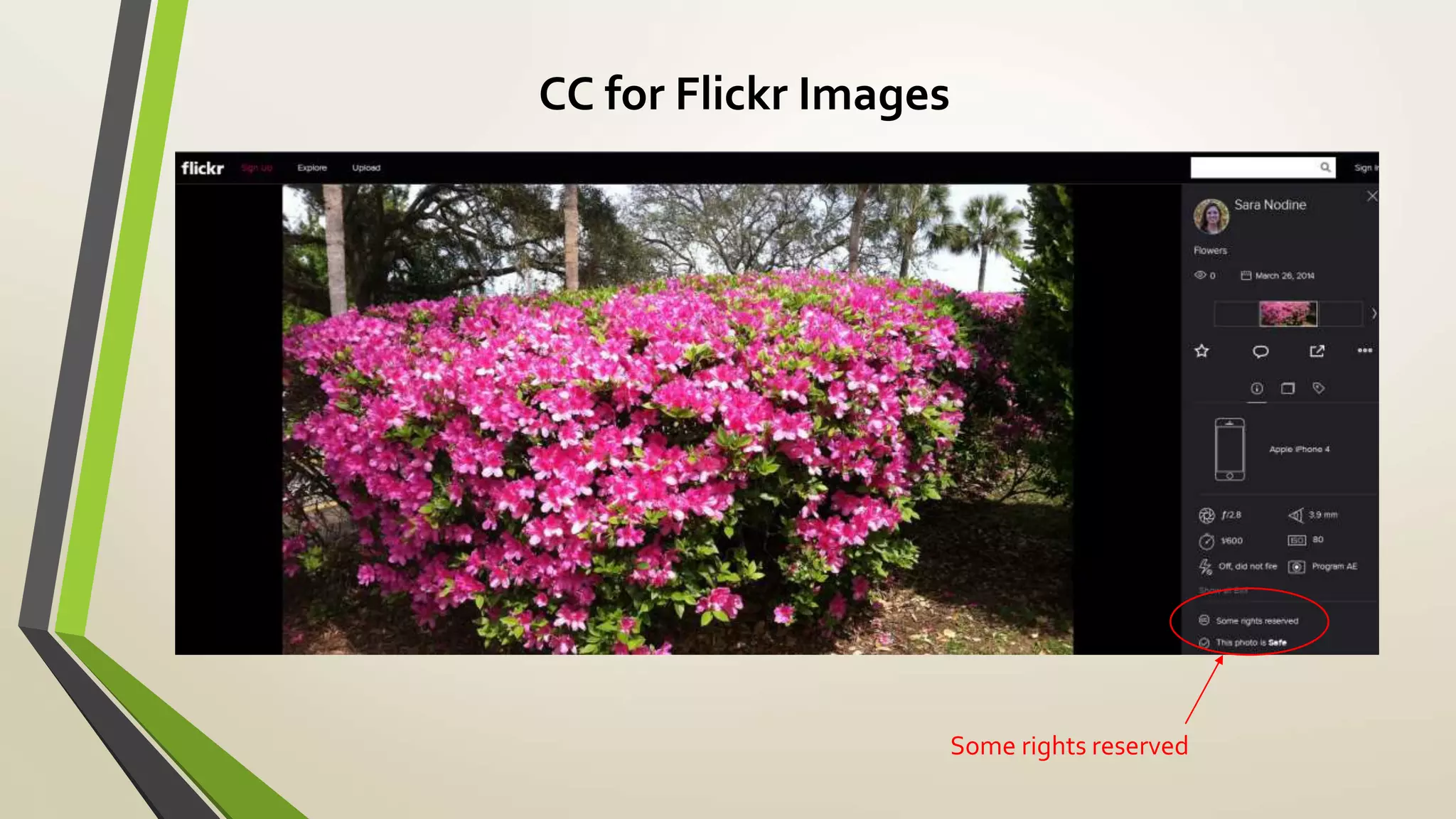
Some rights reserved
CC for Flickr Images
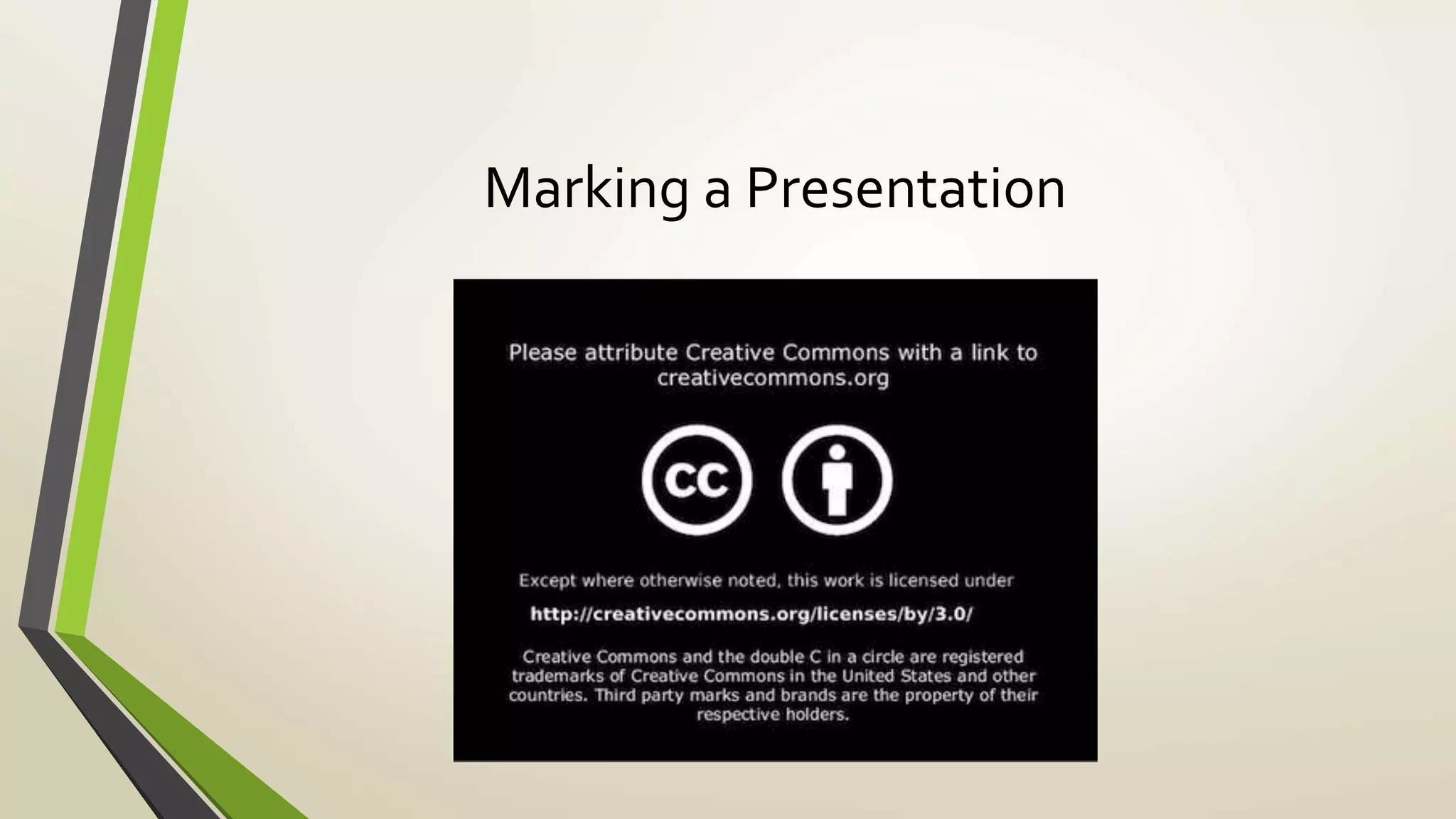
Marking a Presentation
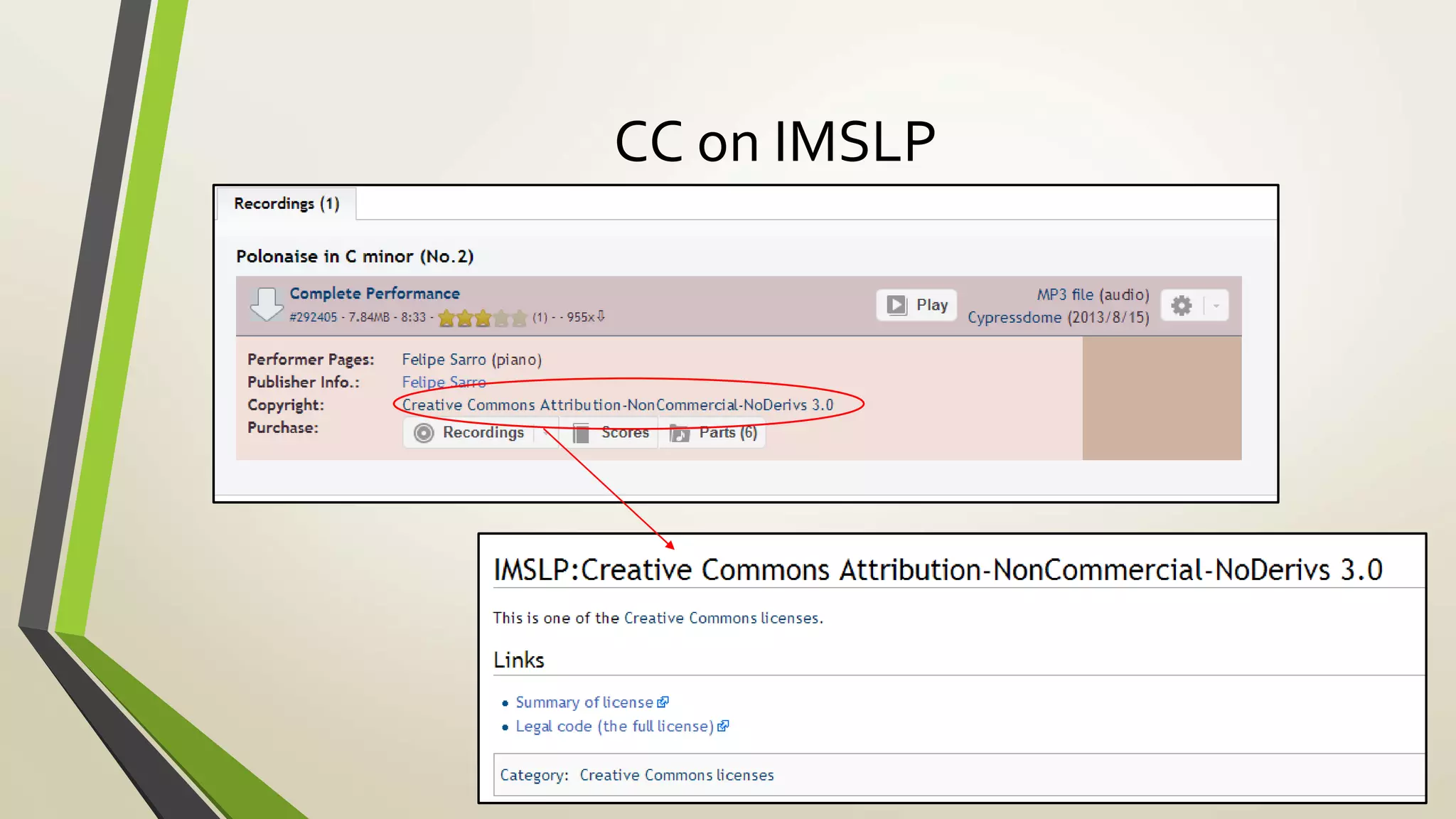
CC on IMSLP
Questions?
Licensed by: Creative Commons
Attribution-NonCommercial-ShareAlike 4.0 International
Created by:
Patrick Fulton & Sara Nodine
Warren D. Allen Music Library

Creative Commons

  • 1.
    Patrick Fulton &Sara Nodine Warren D.Allen Music Library
  • 2.
    Do you… • Wantto let people share and use your photographs, but not allow companies to sell them? • Want to find access to course materials from the world’s top universities? • Want to encourage readers to re-publish your blog posts, as long as they give you credit? • Want to find songs that you can use and remix, royalty-free? Source: creativecommons.org
  • 3.
    Use the CreativeCommons! “A nonprofit organization that enables the sharing and use of creativity and knowledge through free legal tools.” Mission: “Creative Commons develops, supports, and stewards legal and technical infrastructure that maximizes digital creativity, sharing, and innovation.” Vision: “Our vision is nothing less than realizing the full potential of the Internet – universal access to research and education, full participation in culture – to drive a new era of development, growth, and productivity.” Source: creativecommons.org
  • 4.
    History of CC •Founded in 2001 • Supported by the Center for the Study of the Public Domain (Duke University) • First licenses released in 2002 free to the public • Dedicated projects in education launched in 2007 • 2008: the new Nine Inch Nails album was released under CC • In its first 7 years – estimated 350 million CC licensed works • October 2013 – CCWorkshop with musicians in Melanesia
  • 5.
  • 6.
    Before licensing… •Irrevocability •Appropriateness ofthe material •Nature and adequacy of rights •Type of license •Additional provisions
  • 7.
    Considerations for licensees •Understand the license • Legal code – not just human-readable deed • Permission granted for what you want to do • Version of the license • Scope of the license • What exactly is being licensed • Clear rights with any third parties • Know your obligations • Provide attribution • Do not restrict others from exercising rights • Determine what you can do with adaptations • Termination is automatic when you fail to comply
  • 8.
    The Licenses • Three“layers” • Legal Code • Human-Readable – “The Common Deed” • Machine-Readable • Six different licenses • Attribution • Attribution-NoDerivs • Attribution-ShareAlike • Attribution-NonCommerical-ShareAlike • Attribution-NonCommercial • Attribution-NonCommercial-NoDerivs
  • 9.
    Attribution (CC BY) • Allowsothers to: • Distribute • Remix • Tweak • Build upon • Benefit commercially even • As long as… • Credit the creator
  • 10.
    Attribution-NoDerivs (CC BY-ND) • Allowsothers to: • Commercial redistribute • Non-commercial redistribute • As long as… • Unchanged • Complete • Credits the creator
  • 11.
    Attribution-NonCommercial-ShareAlike (CC BY-NC-SA) • Allowsothers to non-commercially: • Remix • Tweak • Build upon • As long as… • Credit the creator • License the new creation under identical terms
  • 12.
    Attribution-ShareAlike (CC BY-SA) • Allowsothers to: • Remix • Tweak • Build upon • Benefit commercially even • As long as… • Credit the creator • License the new creation under identical terms
  • 13.
    Attribution-NonCommerical (CC BY-NC) • Allowsothers to non-commercially: • Remix • Tweak • Build upon • As long as… • Credit the creator
  • 14.
    Attribution-NonCommerical-NoDerivs (CC BY-NC-ND) • Allowsothers to: • Download • Share • As long as… • Credit the creator
  • 15.
    Some rights reserved CCfor Flickr Images
  • 17.
  • 18.
  • 19.
    Questions? Licensed by: CreativeCommons Attribution-NonCommercial-ShareAlike 4.0 International Created by: Patrick Fulton & Sara Nodine Warren D. Allen Music Library

Editor's Notes

  • #3 These are some potential questions to ask in order to get people thinking about the role of Creative Commons and the possibilities it affords.
  • #4 A way to give the public permission to share and use your creative works – on conditions of your choice. Allows you to change your copyright terms from “all rights reserved” to “some rights reserved” Not an alternative to copyright – works alongside it and allows you to adjust according to your needs. Protects the people who use your work, so they don’t have to worry about copyright infringement, as long as they abide by the conditions you have specified. Universal access to information via the Internet is wonderful, but our legal and social systems restrict how we can use that information to continue developing ideas Makes a person’s creative, educational, and scientific content instantly more compatible with the full potential of the Internet
  • #6 You can search the Commons and these sites to find materials you can share and use in various ways.
  • #7 Irrevocability – once you apply a CC license it is in effect until the material is no longer protected by copyright Appropriateness of the material – no hardware or software & make sure you clearly mark/indicate in a notice which of the parts are covered by the license (i.e. text, images, music, etc.) Nature and adequacy of rights – CC license only operative where copyright comes into play – if it involves others be sure to get permission Type of license – how you want the work used and if you have any obligations that would affect the license (requirements from a funding source, employment agreement, etc.) Additional provisions – be sure to check if there are additional provisions set by others involved in the creation of the work
  • #8 Understand the license Read the legal code, not just the human-readable deed. Make sure the license grants permission for what you want to do Take note of the particular version of the license Scope of the license Pay attention to exactly what is being licensed Consider clearing rights of a third party if you are concerned Some uses of licensed material do not require permission under the license Know your obligations Provide attribution Do not restrict others from exercising rights under the license Determine what, if anything, you can do with adaptations you make Termination is automatic with failure to comply
  • #10 Most accommodating license Recommended for maximum dissemination and use of licensed materials
  • #13 Compared to “copyleft” (a similar “some rights reserved” idea) All new works based on yours will carry the same license, so any derivatives will also allow commercial use. This is the license used by Wikipedia, and is recommended for materials that would benefit from incorporating content from Wikipedia and similarly licensed projects.
  • #14 Though the creator must be acknowledged, the derivative work does not have to be licensed under the same terms.
  • #15 The most restrictive license. Cannot change the work in any way or use it commercially.
  • #16 This Flickr image shows the “some rights reserved” notice. You can set your account to automatically place CC licenses on your images when you add them. Clicking on the link will allow you to see more information on the license [displays on next slide].
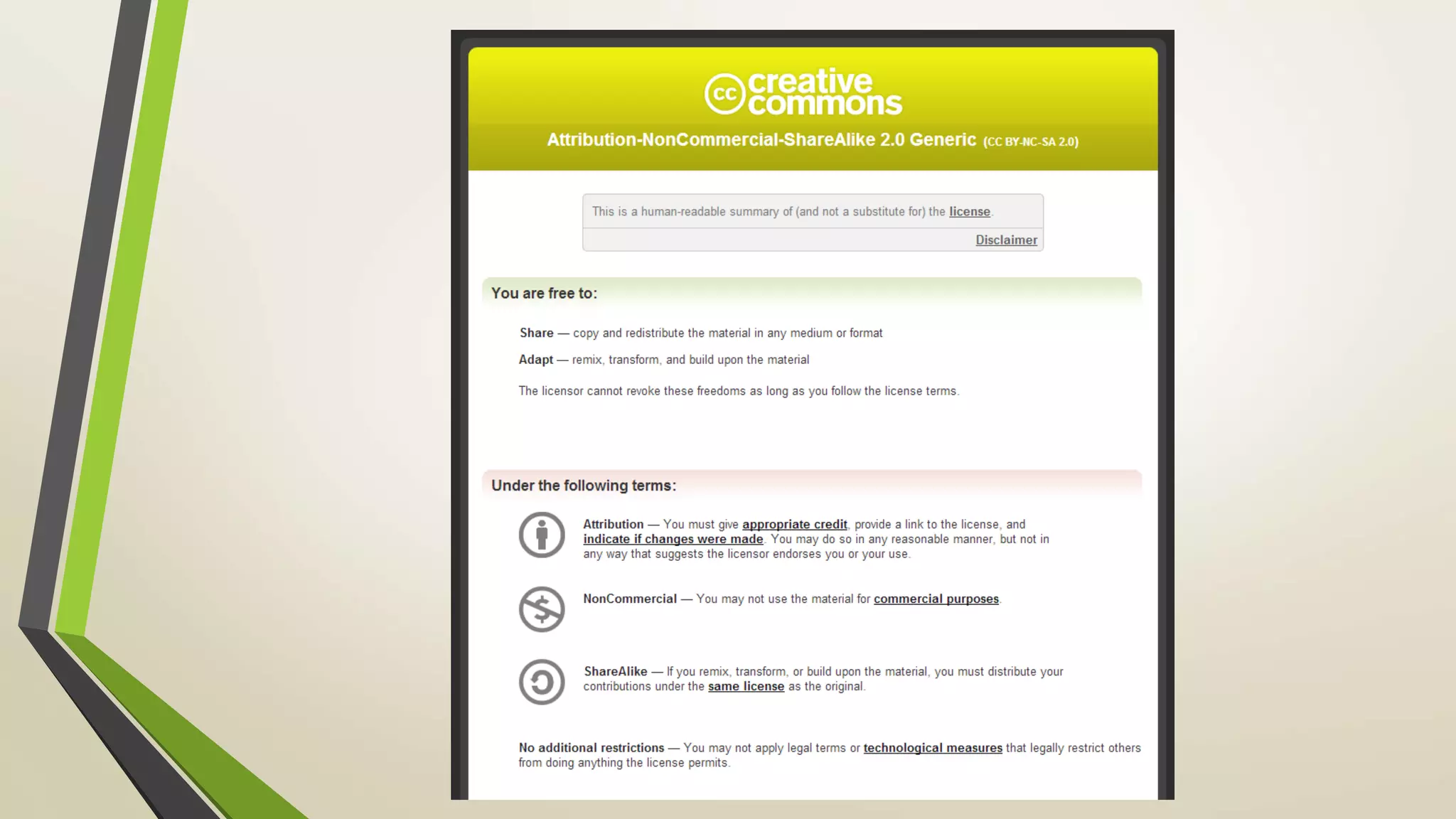
  • #17 When you click on the link out to the information on the license this is the page provided.
  • #18 When creating a presentation you need to display the license icon (as you will see at the end of this presentation). This is an example of one way to display the rights statement at the end of a presentation. Other options are provided on the license assignment page, showing how to embed into a website and other possibilities. Choose which one is most appropriate for your project.
  • #19 One example of sound recordings using Creative Commons licensing can be found when searching IMSLP. This shows the level of exposure a project you create and share can have, as this is becoming a major resource for musicians to search for musical scores online.
  • #20 If participants do not have any questions, a live demo searching the Creative Commons is not a bad idea if time permits. http://search.creativecommons.org/ Ask how participants might see themselves using Creative Commons in their own work. Mention the value of sharing presentations via Creative Commons, like this one!