COPYRIGHT AND CREATIVE COMMONS
BY METHUSELAH NIYE
This work is available
under, CC BY-NC-SA
COPYRIGHT
CREATIVE COMMONS
WHAT IS COPYRIGHT?
COPYRIGHT LAW
• Copyright law insures that the people who create “Intellectual Property” can
own, control and be paid for their efforts.
• While copyright law is intended to serve the purpose of enriching the
general public through access to creative works, it’s important to
understand that it imposes no obligation upon creators to make their
copyrighted works available.
• There are three basic requirements that a work must meet to be protected
by copyright. The work must be:
• Original
• A Work of Authorship
• Fixed
WHAT IS A PUBLIC DOMAIN AND FAIR USE?
1. Public domain
 refers to creative materials that are not protected by intellectual property laws such as copyright, trademark, or
patent laws.
 The public owns these works, not an individual author or artist.
 Anyone can use a public domain work without obtaining permission, but no one can ever own it
• There are four common ways that works arrive in the public domain:
• the copyright has expired
• the copyright owner failed to follow copyright renewal rules
• the copyright owner deliberately places it in the public domain, known as “dedication,” or
• copyright law does not protect this type of work.
2. Fair use
 A Fair use is any copying of copyrighted material done for a limited and “transformative” purpose, such as to
comment upon, criticize, or parody a copyrighted work. Such uses can be done without permission from the
copyright owner.
 Fair use allows the use of portion of copyright works & material for education purposes. Copyright is a Law and
Fair use is a guideline
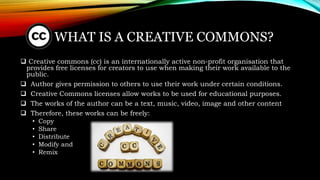
WHAT IS A CREATIVE COMMONS?
 Creative commons (cc) is an internationally active non-profit organisation that
provides free licenses for creators to use when making their work available to the
public.
 Author gives permission to others to use their work under certain conditions.
 Creative Commons licenses allow works to be used for educational purposes.
 The works of the author can be a text, music, video, image and other content
 Therefore, these works can be freely:
• Copy
• Share
• Distribute
• Modify and
• Remix
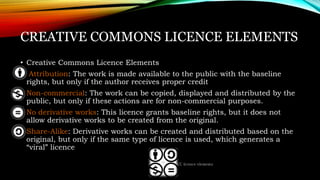
CREATIVE COMMONS LICENCE ELEMENTS
• Creative Commons Licence Elements
• Attribution: The work is made available to the public with the baseline
rights, but only if the author receives proper credit
• Non-commercial: The work can be copied, displayed and distributed by the
public, but only if these actions are for non-commercial purposes.
• No derivative works: This licence grants baseline rights, but it does not
allow derivative works to be created from the original.
• Share-Alike: Derivative works can be created and distributed based on the
original, but only if the same type of licence is used, which generates a
“viral” licence
CC licence elements
WHAT ARE THE SIX DIFFERENT
CREATIVE COMMONS LICENSES?
WHAT ARE THE SIX DIFFERENT
CREATIVE COMMONS LICENSES?
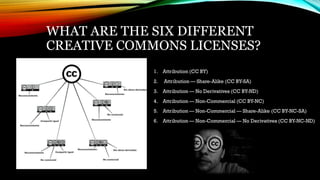
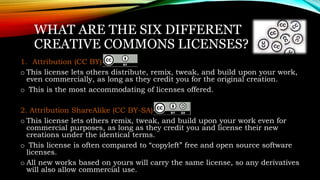
1. Attribution (CC BY)
o This license lets others distribute, remix, tweak, and build upon your work,
even commercially, as long as they credit you for the original creation.
o This is the most accommodating of licenses offered.
2. Attribution ShareAlike (CC BY-SA)
o This license lets others remix, tweak, and build upon your work even for
commercial purposes, as long as they credit you and license their new
creations under the identical terms.
o This license is often compared to “copyleft” free and open source software
licenses.
o All new works based on yours will carry the same license, so any derivatives
will also allow commercial use.
WHAT ARE THE SIX DIFFERENT
CREATIVE COMMONS LICENSES?
(CON)
3. Attribution NonDerivatives (CC BY-ND)
o This license allows for redistribution, commercial and non-commercial, as
long as it is passed along unchanged and in whole, with credit to you.
o Your work can be included in compendiums, but may not be translated or
modified without your permission.
4. Attribution NonCommercial (CC BY-NC)
o This license lets others remix, tweak, and build upon your work non-
commercially, and although their new works must also acknowledge you
and be non-commercial, they don’t have to license their derivative works on
the same terms.
WHAT ARE THE SIX DIFFERENT
CREATIVE COMMONS LICENSES?
(CON)
5. Attribution NonCommercial-ShareAlike (CC BY-NC-SA)
o This license lets others remix, tweak, and build upon your work non-
commercially, as long as they credit you and license their new creations
under the identical terms.
6. Attribution NonCommercial-NonDerivatives (CC BY-NC-ND)
o This license is the most restrictive of the six main licenses, only allowing
others to download your works and share them with others as long as they
credit you, but they can’t change them in any way or use them
commercially.
SUMMARY
1. COPYRIGHT
• Copyright all right reserved
• Gives the owner the exclusive right to publish, distribute, and even sell
• These include the copy right work such as:
• Music
• Artistic and
• Literary
• Someone else cannot use or publish the work of the author without authorization.
• When a creative work is created the copyright is automatically applied.
2. CREATIVE COMMONS
• Some rights reserved
• Author gives permission to others to use their work under certain conditions.
• The works of the author can be a text, music, video, image and other content
• Therefore, these works can be freely:
• Copy
• Share
• Distribute
• Modify and
• Remix
CITED SOURCES
• Attorney at law, Nolo author, LinkedIn Learning Instructor, Blogger — Dear Rich: A Patent, Copyright
and Trademark Blog. https://fairuse.stanford.edu/overview/public-
domain/welcome/#:~:text=The%20term%20%E2%80%9Cpublic%20domain%E2%80%9D%20refers,one
%20can%20ever%20own%20it.
• Attorney at law, Nolo author, LinkedIn Learning Instructor, Blogger — Dear Rich: A Patent, Copyright
and Trademark Blog. https://fairuse.stanford.edu/overview/fair-use/what-is-fair-use/
• copyright alliance, Washington, dc | 202-540-2243 | copyrightalliance.org
© 2021 Copyright Alliance. https://copyrightalliance.org/faqs/what-is-copyright/
• National Copyright Unit. Level 7, 105 Phillip St, Parramatta. Tel: 02 7814 3855. Email:
smartcopying@det.nsw.edu.au. https://smartcopying.edu.au/what-is-creative-commons/

Copyright and creative commons

  • 1.
    COPYRIGHT AND CREATIVECOMMONS BY METHUSELAH NIYE This work is available under, CC BY-NC-SA COPYRIGHT CREATIVE COMMONS
  • 2.
  • 3.
    COPYRIGHT LAW • Copyrightlaw insures that the people who create “Intellectual Property” can own, control and be paid for their efforts. • While copyright law is intended to serve the purpose of enriching the general public through access to creative works, it’s important to understand that it imposes no obligation upon creators to make their copyrighted works available. • There are three basic requirements that a work must meet to be protected by copyright. The work must be: • Original • A Work of Authorship • Fixed
  • 4.
    WHAT IS APUBLIC DOMAIN AND FAIR USE? 1. Public domain  refers to creative materials that are not protected by intellectual property laws such as copyright, trademark, or patent laws.  The public owns these works, not an individual author or artist.  Anyone can use a public domain work without obtaining permission, but no one can ever own it • There are four common ways that works arrive in the public domain: • the copyright has expired • the copyright owner failed to follow copyright renewal rules • the copyright owner deliberately places it in the public domain, known as “dedication,” or • copyright law does not protect this type of work. 2. Fair use  A Fair use is any copying of copyrighted material done for a limited and “transformative” purpose, such as to comment upon, criticize, or parody a copyrighted work. Such uses can be done without permission from the copyright owner.  Fair use allows the use of portion of copyright works & material for education purposes. Copyright is a Law and Fair use is a guideline
  • 5.
    WHAT IS ACREATIVE COMMONS?  Creative commons (cc) is an internationally active non-profit organisation that provides free licenses for creators to use when making their work available to the public.  Author gives permission to others to use their work under certain conditions.  Creative Commons licenses allow works to be used for educational purposes.  The works of the author can be a text, music, video, image and other content  Therefore, these works can be freely: • Copy • Share • Distribute • Modify and • Remix
  • 6.
    CREATIVE COMMONS LICENCEELEMENTS • Creative Commons Licence Elements • Attribution: The work is made available to the public with the baseline rights, but only if the author receives proper credit • Non-commercial: The work can be copied, displayed and distributed by the public, but only if these actions are for non-commercial purposes. • No derivative works: This licence grants baseline rights, but it does not allow derivative works to be created from the original. • Share-Alike: Derivative works can be created and distributed based on the original, but only if the same type of licence is used, which generates a “viral” licence CC licence elements
  • 7.
    WHAT ARE THESIX DIFFERENT CREATIVE COMMONS LICENSES?
  • 8.
    WHAT ARE THESIX DIFFERENT CREATIVE COMMONS LICENSES? 1. Attribution (CC BY) o This license lets others distribute, remix, tweak, and build upon your work, even commercially, as long as they credit you for the original creation. o This is the most accommodating of licenses offered. 2. Attribution ShareAlike (CC BY-SA) o This license lets others remix, tweak, and build upon your work even for commercial purposes, as long as they credit you and license their new creations under the identical terms. o This license is often compared to “copyleft” free and open source software licenses. o All new works based on yours will carry the same license, so any derivatives will also allow commercial use.
  • 9.
    WHAT ARE THESIX DIFFERENT CREATIVE COMMONS LICENSES? (CON) 3. Attribution NonDerivatives (CC BY-ND) o This license allows for redistribution, commercial and non-commercial, as long as it is passed along unchanged and in whole, with credit to you. o Your work can be included in compendiums, but may not be translated or modified without your permission. 4. Attribution NonCommercial (CC BY-NC) o This license lets others remix, tweak, and build upon your work non- commercially, and although their new works must also acknowledge you and be non-commercial, they don’t have to license their derivative works on the same terms.
  • 10.
    WHAT ARE THESIX DIFFERENT CREATIVE COMMONS LICENSES? (CON) 5. Attribution NonCommercial-ShareAlike (CC BY-NC-SA) o This license lets others remix, tweak, and build upon your work non- commercially, as long as they credit you and license their new creations under the identical terms. 6. Attribution NonCommercial-NonDerivatives (CC BY-NC-ND) o This license is the most restrictive of the six main licenses, only allowing others to download your works and share them with others as long as they credit you, but they can’t change them in any way or use them commercially.
  • 11.
    SUMMARY 1. COPYRIGHT • Copyrightall right reserved • Gives the owner the exclusive right to publish, distribute, and even sell • These include the copy right work such as: • Music • Artistic and • Literary • Someone else cannot use or publish the work of the author without authorization. • When a creative work is created the copyright is automatically applied. 2. CREATIVE COMMONS • Some rights reserved • Author gives permission to others to use their work under certain conditions. • The works of the author can be a text, music, video, image and other content • Therefore, these works can be freely: • Copy • Share • Distribute • Modify and • Remix
  • 12.
    CITED SOURCES • Attorneyat law, Nolo author, LinkedIn Learning Instructor, Blogger — Dear Rich: A Patent, Copyright and Trademark Blog. https://fairuse.stanford.edu/overview/public- domain/welcome/#:~:text=The%20term%20%E2%80%9Cpublic%20domain%E2%80%9D%20refers,one %20can%20ever%20own%20it. • Attorney at law, Nolo author, LinkedIn Learning Instructor, Blogger — Dear Rich: A Patent, Copyright and Trademark Blog. https://fairuse.stanford.edu/overview/fair-use/what-is-fair-use/ • copyright alliance, Washington, dc | 202-540-2243 | copyrightalliance.org © 2021 Copyright Alliance. https://copyrightalliance.org/faqs/what-is-copyright/ • National Copyright Unit. Level 7, 105 Phillip St, Parramatta. Tel: 02 7814 3855. Email: smartcopying@det.nsw.edu.au. https://smartcopying.edu.au/what-is-creative-commons/