Creating Large-Scale Software
Platforms with OSGi and
an Extension Point Model
Introducing Eclipse Content Repository

Bogdan Stefanescu, Lead Architect at Nuxeo

2011-03-23


                                             1
Nuxeo, Who Are We?
●
    Vendor of an open source software platform in the
    feld of Enterprise Content Management
●
    Love to create great software, fond of modularity,
    started to use OSGi 4 years ago to create server-side
    enterprise software
●
    10 years old, 500+ customers, 5000+ installations
●
    Sells support & maintenance subscription and
    added value software provided as a service
●
    Dual HQ Paris & Boston, offces in San Francisco
●
    http://www.nuxeo.com

                                                            2
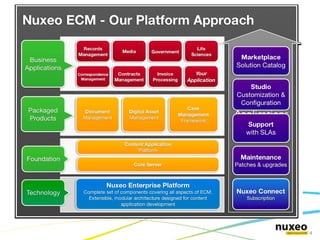
Nuxeo Enterprise Platform
●
    The software we develop is an Open Source ECM
    platform known as Nuxeo Enterprise Platform (EP)
    ●
        A platform because you can use Nuxeo EP to develop
        your own customized ECM application
    ●
        We also provide turn-key pre-built applications based
        on Nuxeo EP already customized for different scopes:
        –   Document Management (DM)
        –   Digital Asset Management (DAM)
        –   Case Management Framework (CMF)
        –   or simply Content Application Platform (CAP) for developers


                                                                          3
4
Why Are We Here Today?

●
    To share our experience in building an enterprise
    application using OSGi and an extension point
    model
●
    To discuss and participate into spreading
    Equinox on the server side as well
●
    To grab your feedback and ideas!
●
    And, why not... to do some marketing too ;-)


                                                        5
What Have We Achieved For Now?
●
    A complex software platform made of
    ●
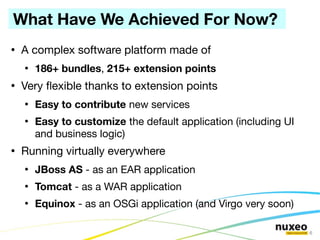
        186+ bundles, 215+ extension points
●
    Very fexible thanks to extension points
    ●
        Easy to contribute new services
    ●
        Easy to customize the default application (including UI
        and business logic)
●
    Running virtually everywhere
    ●
        JBoss AS - as an EAR application
    ●
        Tomcat - as a WAR application
    ●
        Equinox - as an OSGi application (and Virgo very soon)

                                                                  6
A Bit of History...
●
    We have been developing this ECM platform for 8
    years
    ●
        We started in Python
    ●
        5 years ago we switched to Java
●
    We needed a great model suitable for
    ●
        Modularity – split functionality in modules
    ●
        Flexibility – be able to easily confgure the application
●
    Constraints (requested by customers)
    ●
        Must deploy as an EAR or WAR application

                                                                   7
Choosing the Framework
●
    What were the choices?
    ●
        Java SE – nothing proposed
        –   No bundle life cycle, no modularity, no extension system
    ●
        Java EE – not modular at all
        –   All is packaged as one big application (EAR or WAR)
        –   To update or add a feature you need to recompile the entire
            application
    ●
        OSGi – great specifcation – love at frst sight
        –   But not compatible with J2EE
        –   No real OSGi enterprise framework implementations at that
            moment

                                                                          8
Let's Give OSGi a Try...
●
    OSGi was best suited for our dreams… but...
●
    How to achieve fexibility?
    ●
        Eclipse already had the answer: extension points
        –   Thanks Eclipse!
●
    How to integrate with J2EE Application Servers?
    ●
        J2EE applications are monolithic – there is no notion
        of modularity inside an application; the application is
        the unit
    ●
        But our application is supposed to be a platform
        made from tens or hundreds of units!

                                                                  9
An Extension Point Model ...
●
    So Eclipse already provided an extension point
    model – which is very good but ...
    ●
        It is based on EXSD descriptors
    ●
        Diffcult to manage EXSD fles outside PDE IDE
    ●
        PDE is very related to Eclipse plugin development
    ●
        PDE was not friendly with server side development
        –   Remember we are in 2006
    ●
        PDE was not friendly with other build systems
        –   We were using Maven as our build system


                                                            10
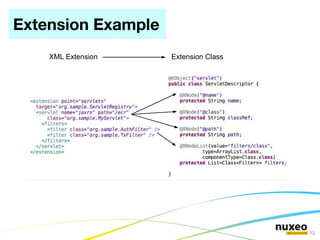
Nuxeo Extension Point Model
●
    So we decided to achieve something similar but
    in a more fexible way:
    ●
        No intermediate object model between services and
        contributed extensions
    ●
        Write your extension class and map it to XML using
        Java annotations
    ●
        Very easy to write for developers
    ●
        No specifc IDE needed to code extension points.
    ●
        Write a Java class, put the right annotations and the
        extension XML will be correctly injected into the Java
        object
                                                                 11
Extension Example
    XML Extension   Extension Class


                                      12
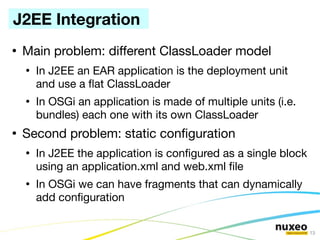
J2EE Integration
●
    Main problem: different ClassLoader model
    ●
        In J2EE an EAR application is the deployment unit
        and use a fat ClassLoader
    ●
        In OSGi an application is made of multiple units (i.e.
        bundles) each one with its own ClassLoader
●
    Second problem: static confguration
    ●
        In J2EE the application is confgured as a single block
        using an application.xml and web.xml fle
    ●
        In OSGi we can have fragments that can dynamically
        add confguration

                                                                 13
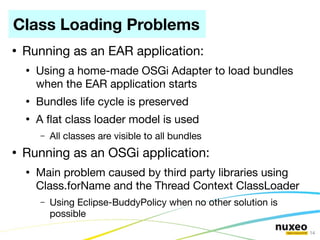
Class Loading Problems
●
    Running as an EAR application:
    ●
        Using a home-made OSGi Adapter to load bundles
        when the EAR application starts
    ●
        Bundles life cycle is preserved
    ●
        A fat class loader model is used
        –   All classes are visible to all bundles
●
    Running as an OSGi application:
    ●
        Main problem caused by third party libraries using
        Class.forName and the Thread Context ClassLoader
        –   Using Eclipse-BuddyPolicy when no other solution is
            possible
                                                                  14
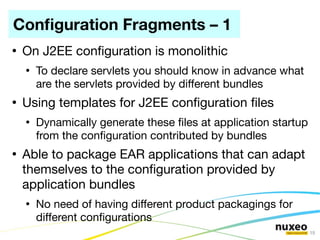
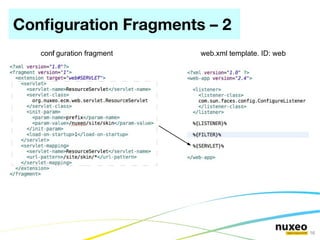
Confguration Fragments – 1
●
    On J2EE confguration is monolithic
    ●
        To declare servlets you should know in advance what
        are the servlets provided by different bundles
●
    Using templates for J2EE confguration fles
    ●
        Dynamically generate these fles at application startup
        from the confguration contributed by bundles
●
    Able to package EAR applications that can adapt
    themselves to the confguration provided by
    application bundles
    ●
        No need of having different product packagings for
        different confgurations
                                                                 15
Confguration Fragments – 2
   conf guration fragment
      i                     web.xml template. ID: web


                                                        16
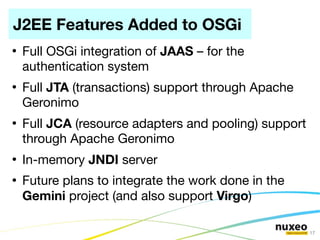
J2EE Features Added to OSGi
●
    Full OSGi integration of JAAS – for the
    authentication system
●
    Full JTA (transactions) support through Apache
    Geronimo
●
    Full JCA (resource adapters and pooling) support
    through Apache Geronimo
●
    In-memory JNDI server
●
    Future plans to integrate the work done in the
    Gemini project (and also support Virgo)

                                                       17
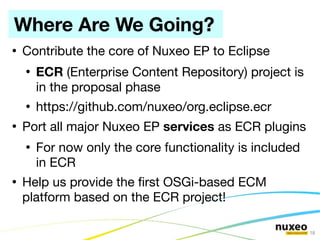
Where Are We Going?
●
    Contribute the core of Nuxeo EP to Eclipse
    ●
        ECR (Enterprise Content Repository) project is
        in the proposal phase
    ●
        https://github.com/nuxeo/org.eclipse.ecr
●
    Port all major Nuxeo EP services as ECR plugins
    ●
        For now only the core functionality is included
        in ECR
●
    Help us provide the frst OSGi-based ECM
    platform based on the ECR project!

                                                          18
Questions?
             Start Hacking ECR:
  https://github.com/nuxeo/org.eclipse.ecr
                Get Involved:
             ECR Proposal Forum

               Read more:
          Eclipse ECR Proposal
    Nuxeo EP Reference Documentation

             Contact me/us:
Bogdan Stefanescu - bstefanescu@nuxeo.com
          http://www.nuxeo.com

                                             19

Creating Large Scale Software Platforms with OSGi and an Extension Point Model (EclipseCon)

  • 1.
    Creating Large-Scale Software Platformswith OSGi and an Extension Point Model Introducing Eclipse Content Repository Bogdan Stefanescu, Lead Architect at Nuxeo 2011-03-23 1
  • 2.
    Nuxeo, Who AreWe? ● Vendor of an open source software platform in the feld of Enterprise Content Management ● Love to create great software, fond of modularity, started to use OSGi 4 years ago to create server-side enterprise software ● 10 years old, 500+ customers, 5000+ installations ● Sells support & maintenance subscription and added value software provided as a service ● Dual HQ Paris & Boston, offces in San Francisco ● http://www.nuxeo.com 2
  • 3.
    Nuxeo Enterprise Platform ● The software we develop is an Open Source ECM platform known as Nuxeo Enterprise Platform (EP) ● A platform because you can use Nuxeo EP to develop your own customized ECM application ● We also provide turn-key pre-built applications based on Nuxeo EP already customized for different scopes: – Document Management (DM) – Digital Asset Management (DAM) – Case Management Framework (CMF) – or simply Content Application Platform (CAP) for developers 3
  • 4.
  • 5.
    Why Are WeHere Today? ● To share our experience in building an enterprise application using OSGi and an extension point model ● To discuss and participate into spreading Equinox on the server side as well ● To grab your feedback and ideas! ● And, why not... to do some marketing too ;-) 5
  • 6.
    What Have WeAchieved For Now? ● A complex software platform made of ● 186+ bundles, 215+ extension points ● Very fexible thanks to extension points ● Easy to contribute new services ● Easy to customize the default application (including UI and business logic) ● Running virtually everywhere ● JBoss AS - as an EAR application ● Tomcat - as a WAR application ● Equinox - as an OSGi application (and Virgo very soon) 6
  • 7.
    A Bit ofHistory... ● We have been developing this ECM platform for 8 years ● We started in Python ● 5 years ago we switched to Java ● We needed a great model suitable for ● Modularity – split functionality in modules ● Flexibility – be able to easily confgure the application ● Constraints (requested by customers) ● Must deploy as an EAR or WAR application 7
  • 8.
    Choosing the Framework ● What were the choices? ● Java SE – nothing proposed – No bundle life cycle, no modularity, no extension system ● Java EE – not modular at all – All is packaged as one big application (EAR or WAR) – To update or add a feature you need to recompile the entire application ● OSGi – great specifcation – love at frst sight – But not compatible with J2EE – No real OSGi enterprise framework implementations at that moment 8
  • 9.
    Let's Give OSGia Try... ● OSGi was best suited for our dreams… but... ● How to achieve fexibility? ● Eclipse already had the answer: extension points – Thanks Eclipse! ● How to integrate with J2EE Application Servers? ● J2EE applications are monolithic – there is no notion of modularity inside an application; the application is the unit ● But our application is supposed to be a platform made from tens or hundreds of units! 9
  • 10.
    An Extension PointModel ... ● So Eclipse already provided an extension point model – which is very good but ... ● It is based on EXSD descriptors ● Diffcult to manage EXSD fles outside PDE IDE ● PDE is very related to Eclipse plugin development ● PDE was not friendly with server side development – Remember we are in 2006 ● PDE was not friendly with other build systems – We were using Maven as our build system 10
  • 11.
    Nuxeo Extension PointModel ● So we decided to achieve something similar but in a more fexible way: ● No intermediate object model between services and contributed extensions ● Write your extension class and map it to XML using Java annotations ● Very easy to write for developers ● No specifc IDE needed to code extension points. ● Write a Java class, put the right annotations and the extension XML will be correctly injected into the Java object 11
  • 12.
    Extension Example XML Extension Extension Class 12
  • 13.
    J2EE Integration ● Main problem: different ClassLoader model ● In J2EE an EAR application is the deployment unit and use a fat ClassLoader ● In OSGi an application is made of multiple units (i.e. bundles) each one with its own ClassLoader ● Second problem: static confguration ● In J2EE the application is confgured as a single block using an application.xml and web.xml fle ● In OSGi we can have fragments that can dynamically add confguration 13
  • 14.
    Class Loading Problems ● Running as an EAR application: ● Using a home-made OSGi Adapter to load bundles when the EAR application starts ● Bundles life cycle is preserved ● A fat class loader model is used – All classes are visible to all bundles ● Running as an OSGi application: ● Main problem caused by third party libraries using Class.forName and the Thread Context ClassLoader – Using Eclipse-BuddyPolicy when no other solution is possible 14
  • 15.
    Confguration Fragments –1 ● On J2EE confguration is monolithic ● To declare servlets you should know in advance what are the servlets provided by different bundles ● Using templates for J2EE confguration fles ● Dynamically generate these fles at application startup from the confguration contributed by bundles ● Able to package EAR applications that can adapt themselves to the confguration provided by application bundles ● No need of having different product packagings for different confgurations 15
  • 16.
    Confguration Fragments –2 conf guration fragment i web.xml template. ID: web 16
  • 17.
    J2EE Features Addedto OSGi ● Full OSGi integration of JAAS – for the authentication system ● Full JTA (transactions) support through Apache Geronimo ● Full JCA (resource adapters and pooling) support through Apache Geronimo ● In-memory JNDI server ● Future plans to integrate the work done in the Gemini project (and also support Virgo) 17
  • 18.
    Where Are WeGoing? ● Contribute the core of Nuxeo EP to Eclipse ● ECR (Enterprise Content Repository) project is in the proposal phase ● https://github.com/nuxeo/org.eclipse.ecr ● Port all major Nuxeo EP services as ECR plugins ● For now only the core functionality is included in ECR ● Help us provide the frst OSGi-based ECM platform based on the ECR project! 18
  • 19.
    Questions? Start Hacking ECR: https://github.com/nuxeo/org.eclipse.ecr Get Involved: ECR Proposal Forum Read more: Eclipse ECR Proposal Nuxeo EP Reference Documentation Contact me/us: Bogdan Stefanescu - bstefanescu@nuxeo.com http://www.nuxeo.com 19