

JSX Optimizer
    DeNA Co., Ltd.
     Kazuho Oku
The Basic Idea of the JSX Optimizer


    perform optimizations that JavaScript VMs
                     cannot


Jul 19 2012             JSX Optimizer       2
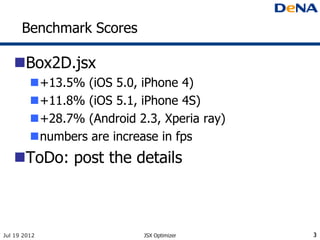
Benchmark Scores

   Box2D.jsx
         +13.5% (iOS 5.0, iPhone 4)
         +11.8% (iOS 5.1, iPhone 4S)
         +28.7% (Android 2.3, Xperia ray)
         numbers are increase in fps
   ToDo: post the details


Jul 19 2012                 JSX Optimizer    3
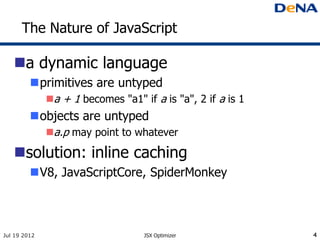
The Nature of JavaScript

   a dynamic language
         primitives are untyped
              a + 1 becomes "a1" if a is "a", 2 if a is 1
         objects are untyped
              a.p may point to whatever

   solution: inline caching
         V8, JavaScriptCore, SpiderMonkey


Jul 19 2012                        JSX Optimizer             4
Inline Caching

   The idea:
         most of the code will be called with the same
          types of arguments
         cache the expectation at the call site
   Example: point.x
         type of point will be { x: ?, y: ? }
         thus if the expectation succeeded, point.x will be:
              load point_addr[offset_of_x]


Jul 19 2012                     JSX Optimizer                   5
Guards in Inline Caching

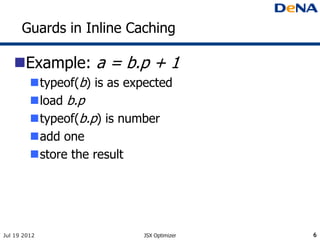
   Example: a = b.p + 1
         typeof(b) is as expected
         load b.p
         typeof(b.p) is number
         add one
         store the result


Jul 19 2012                 JSX Optimizer   6
Guards in Inline Caching (cont'd)

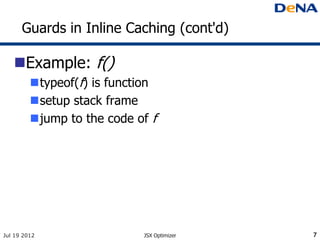
   Example: f()
         typeof(f) is function
         setup stack frame
         jump to the code of f


Jul 19 2012                 JSX Optimizer   7
Guards in Inline Caching (cont'd)

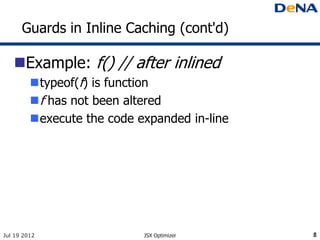
   Example: f() // after inlined
         typeof(f) is function
          f has not been altered
         execute the code expanded in-line


Jul 19 2012                 JSX Optimizer     8
Guards in Inline Caching (cont'd)

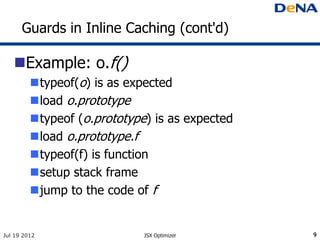
   Example: o.f()
         typeof(o) is as expected
         load o.prototype
         typeof (o.prototype) is as expected
         load o.prototype.f
         typeof(f) is function
         setup stack frame
         jump to the code of f


Jul 19 2012                  JSX Optimizer      9
Guards in Inline Caching (cont'd)

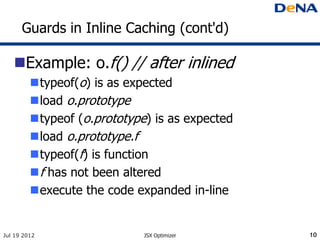
   Example: o.f() // after inlined
         typeof(o) is as expected
         load o.prototype
         typeof (o.prototype) is as expected
         load o.prototype.f
         typeof(f) is function
          f has not been altered
         execute the code expanded in-line


Jul 19 2012                  JSX Optimizer      10
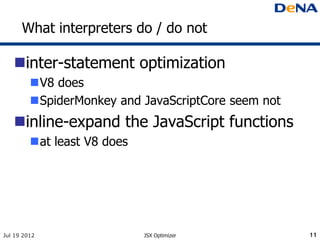
What interpreters do / do not

   inter-statement optimization
         V8 does
         SpiderMonkey and JavaScriptCore seem not
   inline-expand the JavaScript functions
         at least V8 does


Jul 19 2012                  JSX Optimizer           11
JSX optimizer

   minimizes the need for IC
         caches property access
              JSX does not have accessors (Object.defineProperty)
         inline-expands the functions
         converts member methods to static functions
   generates IC-friendly code
         always initializes the properties in same order
              Note: { x: 0, y: 0 } and { y: 1, x: 1 } are different
               types

Jul 19 2012                        JSX Optimizer                       12
JSX optimizer

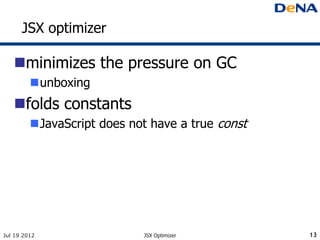
   minimizes the pressure on GC
         unboxing
   folds constants
         JavaScript does not have a true const


Jul 19 2012                 JSX Optimizer         13
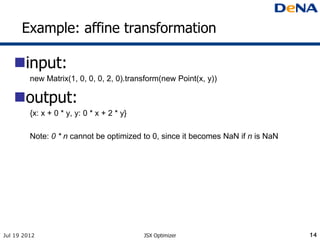
Example: affine transformation

   input:
         new Matrix(1, 0, 0, 0, 2, 0).transform(new Point(x, y))

   output:
         {x: x + 0 * y, y: 0 * x + 2 * y}

         Note: 0 * n cannot be optimized to 0, since it becomes NaN if n is NaN


Jul 19 2012                                 JSX Optimizer                         14
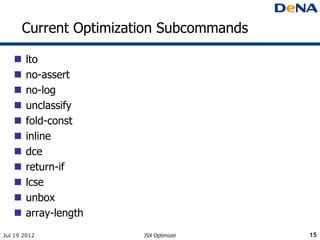
Current Optimization Subcommands

      lto
      no-assert
      no-log
      unclassify
      fold-const
      inline
      dce
      return-if
      lcse
      unbox
      array-length
Jul 19 2012             JSX Optimizer     15
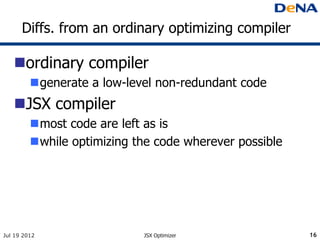
Diffs. from an ordinary optimizing compiler

   ordinary compiler
         generate a low-level non-redundant code
   JSX compiler
         most code are left as is
         while optimizing the code wherever possible


Jul 19 2012                 JSX Optimizer               16
The Difficulties and Considerations

   switch to SSA-based code?
         might end-up in generating a very different code
          from source
              would be difficult to debug (by the users)
              may become slow (than the same-looking code in
               JavaScript); GCC has the problem
         it is troublesome to optimize the code while
          maintaining the original code structure
              example. support various kind of loops: do-while, for,
               for..in, while

Jul 19 2012                       JSX Optimizer                         17
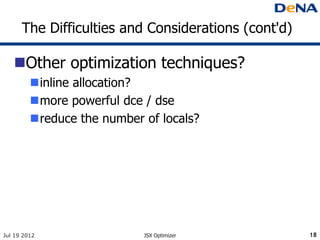
The Difficulties and Considerations (cont'd)

   Other optimization techniques?
         inline allocation?
         more powerful dce / dse
         reduce the number of locals?


Jul 19 2012                 JSX Optimizer            18
Some Microbenchmarks
   http://jsperf.com/local-vs-member/2
   http://jsperf.com/construct-object-vs-array/3
   http://jsperf.com/inherit-object-vs-array-set
   http://jsperf.com/vars-in-nested-closure


Jul 19 2012                            JSX Optimizer   19

JSX Optimizer

  • 1.
    JSX Optimizer DeNA Co., Ltd. Kazuho Oku
  • 2.
    The Basic Ideaof the JSX Optimizer perform optimizations that JavaScript VMs cannot Jul 19 2012 JSX Optimizer 2
  • 3.
    Benchmark Scores Box2D.jsx +13.5% (iOS 5.0, iPhone 4) +11.8% (iOS 5.1, iPhone 4S) +28.7% (Android 2.3, Xperia ray) numbers are increase in fps ToDo: post the details Jul 19 2012 JSX Optimizer 3
  • 4.
    The Nature ofJavaScript a dynamic language primitives are untyped a + 1 becomes "a1" if a is "a", 2 if a is 1 objects are untyped a.p may point to whatever solution: inline caching V8, JavaScriptCore, SpiderMonkey Jul 19 2012 JSX Optimizer 4
  • 5.
    Inline Caching The idea: most of the code will be called with the same types of arguments cache the expectation at the call site Example: point.x type of point will be { x: ?, y: ? } thus if the expectation succeeded, point.x will be: load point_addr[offset_of_x] Jul 19 2012 JSX Optimizer 5
  • 6.
    Guards in InlineCaching Example: a = b.p + 1 typeof(b) is as expected load b.p typeof(b.p) is number add one store the result Jul 19 2012 JSX Optimizer 6
  • 7.
    Guards in InlineCaching (cont'd) Example: f() typeof(f) is function setup stack frame jump to the code of f Jul 19 2012 JSX Optimizer 7
  • 8.
    Guards in InlineCaching (cont'd) Example: f() // after inlined typeof(f) is function  f has not been altered execute the code expanded in-line Jul 19 2012 JSX Optimizer 8
  • 9.
    Guards in InlineCaching (cont'd) Example: o.f() typeof(o) is as expected load o.prototype typeof (o.prototype) is as expected load o.prototype.f typeof(f) is function setup stack frame jump to the code of f Jul 19 2012 JSX Optimizer 9
  • 10.
    Guards in InlineCaching (cont'd) Example: o.f() // after inlined typeof(o) is as expected load o.prototype typeof (o.prototype) is as expected load o.prototype.f typeof(f) is function  f has not been altered execute the code expanded in-line Jul 19 2012 JSX Optimizer 10
  • 11.
    What interpreters do/ do not inter-statement optimization V8 does SpiderMonkey and JavaScriptCore seem not inline-expand the JavaScript functions at least V8 does Jul 19 2012 JSX Optimizer 11
  • 12.
    JSX optimizer minimizes the need for IC caches property access JSX does not have accessors (Object.defineProperty) inline-expands the functions converts member methods to static functions generates IC-friendly code always initializes the properties in same order Note: { x: 0, y: 0 } and { y: 1, x: 1 } are different types Jul 19 2012 JSX Optimizer 12
  • 13.
    JSX optimizer minimizes the pressure on GC unboxing folds constants JavaScript does not have a true const Jul 19 2012 JSX Optimizer 13
  • 14.
    Example: affine transformation input: new Matrix(1, 0, 0, 0, 2, 0).transform(new Point(x, y)) output: {x: x + 0 * y, y: 0 * x + 2 * y} Note: 0 * n cannot be optimized to 0, since it becomes NaN if n is NaN Jul 19 2012 JSX Optimizer 14
  • 15.
    Current Optimization Subcommands  lto  no-assert  no-log  unclassify  fold-const  inline  dce  return-if  lcse  unbox  array-length Jul 19 2012 JSX Optimizer 15
  • 16.
    Diffs. from anordinary optimizing compiler ordinary compiler generate a low-level non-redundant code JSX compiler most code are left as is while optimizing the code wherever possible Jul 19 2012 JSX Optimizer 16
  • 17.
    The Difficulties andConsiderations switch to SSA-based code? might end-up in generating a very different code from source would be difficult to debug (by the users) may become slow (than the same-looking code in JavaScript); GCC has the problem it is troublesome to optimize the code while maintaining the original code structure example. support various kind of loops: do-while, for, for..in, while Jul 19 2012 JSX Optimizer 17
  • 18.
    The Difficulties andConsiderations (cont'd) Other optimization techniques? inline allocation? more powerful dce / dse reduce the number of locals? Jul 19 2012 JSX Optimizer 18
  • 19.
    Some Microbenchmarks http://jsperf.com/local-vs-member/2 http://jsperf.com/construct-object-vs-array/3 http://jsperf.com/inherit-object-vs-array-set http://jsperf.com/vars-in-nested-closure Jul 19 2012 JSX Optimizer 19