CREATING A RESOURCE
DEVELOPMENT PLAN
Emily Davis, MNM
Emily Davis Consulting
April 23, 2014
•  Why plan?
•  Who gets involved?
•  What are the activities?
•  Why is assessment important?
•  What inventory do you need?
•  How will we know success?
GETTING STARTED
•  Clear road map
•  Lay foundation
•  Share & increase investment
•  Analyze capacity & leadership
•  Research opportunities
•  Set goals for measurement
•  Increase revenue from
diverse resources
•  Increase return on investment
(ROI)
WHY PLAN
•  Development Team
•  Staff Leadership
•  Program Team
•  Marketing Staff
•  Committee Members
•  Board Members
•  Volunteers
•  Consultant(s)
WHO GETS INVOLVED
1.  Fundraising goals
2.  Assessment of resources
3.  Funding categories
4.  Funding strategies
5.  Positioning
6.  Implementation
7.  Evaluation
8.  Appendices
PLANNING ACTIVITIES
ORGANIZATIONAL ASSESSMENT
•  Planning
•  Leadership
•  Volunteers
•  Development staff
•  Financial resources
•  Donor research
•  Situational analysis
•  Environmental scan
•  Competitive
advantage
•  Fundraising
strategies
•  Communications &
outreach
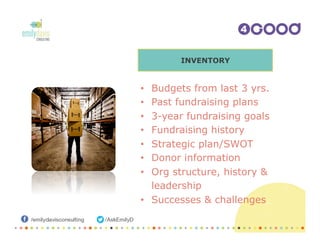
•  Budgets from last 3 yrs.
•  Past fundraising plans
•  3-year fundraising goals
•  Fundraising history
•  Strategic plan/SWOT
•  Donor information
•  Org structure, history &
leadership
•  Successes & challenges
INVENTORY
•  Grow org’s visibility &
capacity
•  Expand funding base
•  Measure success &
challenges
•  Unified strategy
•  Increase investment
•  Consistent core messaging
•  More ambassadors
SUCCESS!
“Vulnerability is the
birthplace of creativity,
innovation, and
change.”
~ Dr. Brene Brown
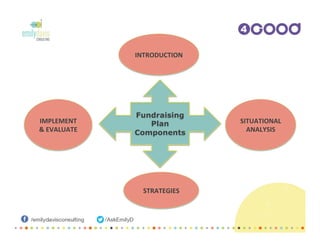
Fundraising
Plan
Components
INTRODUCTION	
  
STRATEGIES	
  
IMPLEMENT	
  
&	
  EVALUATE	
  
SITUATIONAL	
  
ANALYSIS	
  
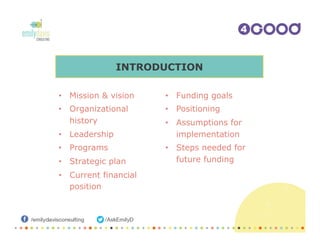
INTRODUCTION
•  Mission & vision
•  Organizational
history
•  Leadership
•  Programs
•  Strategic plan
•  Current financial
position
•  Funding goals
•  Positioning
•  Assumptions for
implementation
•  Steps needed for
future funding
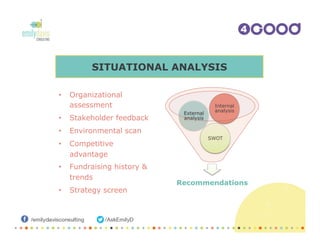
SITUATIONAL ANALYSIS
•  Organizational
assessment
•  Stakeholder feedback
•  Environmental scan
•  Competitive
advantage
•  Fundraising history &
trends
•  Strategy screen
Recommendations
SWOT
External
analysis
Internal
analysis
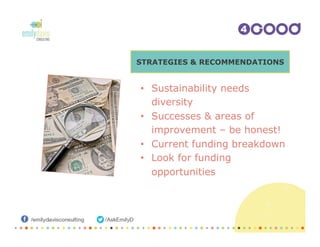
•  Sustainability needs
diversity
•  Successes & areas of
improvement – be honest!
•  Current funding breakdown
•  Look for funding
opportunities
STRATEGIES & RECOMMENDATIONS
FUNDING SOURCES
•  Government
•  Foundations
•  Corporate Giving
•  Board Giving
•  Individuals
•  Fees for Service
•  Social Enterprise/
Earned Income
•  Workplace Giving
•  Religious Community
•  Special Events
•  Service Clubs
•  Planned Giving
•  Endowments
•  Capital Campaigns
•  Other
•  What are the current
relationship(s) we have?
•  What are our successes?
•  What are our funding amounts?
•  How much will we increase funding
in yr 1, yr 2, yr 3?
•  What resources will we use?
•  What will our approach be?
•  Specific examples
ANSWER THESE QUESTIONS
•  Identity statement
•  Core messaging
•  Campaign messaging
•  Marketing
•  Outreach – analog & digital
•  Branding
•  Public relations
•  Implementation
POSITIONING
•  Key players (staff, volunteer,
etc.)
•  Leadership
•  Clear & organized donor
records
•  Capacity analysis
•  Realistic goals
•  Relationships with donors
•  Calendar
•  Evaluate!!
MAKING IT ALL HAPPEN
•  Case statement
•  Summary page
•  Calendar of activities
•  Organizational structure
•  Fundraising policies
•  Budget(s)
•  Professional development
•  Descriptions – committee,
volunteers, staff
DOCS
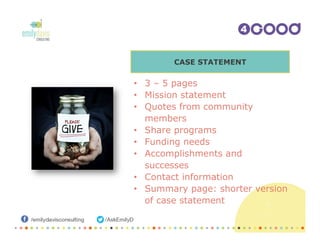
•  3 – 5 pages
•  Mission statement
•  Quotes from community
members
•  Share programs
•  Funding needs
•  Accomplishments and
successes
•  Contact information
•  Summary page: shorter version
of case statement
CASE STATEMENT
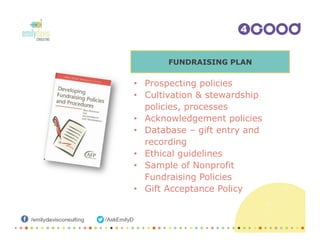
•  Prospecting policies
•  Cultivation & stewardship
policies, processes
•  Acknowledgement policies
•  Database – gift entry and
recording
•  Ethical guidelines
•  Sample of Nonprofit
Fundraising Policies
•  Gift Acceptance Policy
FUNDRAISING PLAN
•  Plan outline
•  Created internally vs.
consultant
•  Work across skills,
departments
•  Build into existing plans
•  Make your case internally
•  4Good
•  Association of Fundraising
Professionals
•  The Foundation Center
•  State Nonprofit Associations
•  Chronicle of Philanthropy
•  LinkedIn
RESOURCES
MORE RESOURCES
•  Basics in Developing Your Fundraising Plan
•  Elements of a Fundraising Plan, Richard Male
•  How to Develop a Fundraising Plan, Stonehill
Consulting Group, LLC
•  Fundraising Outline, Emily Davis Consulting
•  The Development Plan, Linda Lysakowski
•  The Complete Guide to Fundraising
Management, Stanley Weinstein
Emily Davis, MNM
Emily Davis Consulting
(720) 515-0581
emily@emilydavisconsulting.com
emilydavisconsulting.com
emilydavisconsulting.com/blog
Facebook.com/emilydavisconsulting
twitter.com/AskEmilyD
linkedin.com/in/emilylariedavis
Creating a Resource Development Plan

Creating a Resource Development Plan

  • 8.
    CREATING A RESOURCE DEVELOPMENTPLAN Emily Davis, MNM Emily Davis Consulting April 23, 2014
  • 9.
    •  Why plan? • Who gets involved? •  What are the activities? •  Why is assessment important? •  What inventory do you need? •  How will we know success? GETTING STARTED
  • 10.
    •  Clear roadmap •  Lay foundation •  Share & increase investment •  Analyze capacity & leadership •  Research opportunities •  Set goals for measurement •  Increase revenue from diverse resources •  Increase return on investment (ROI) WHY PLAN
  • 11.
    •  Development Team • Staff Leadership •  Program Team •  Marketing Staff •  Committee Members •  Board Members •  Volunteers •  Consultant(s) WHO GETS INVOLVED
  • 12.
    1.  Fundraising goals 2. Assessment of resources 3.  Funding categories 4.  Funding strategies 5.  Positioning 6.  Implementation 7.  Evaluation 8.  Appendices PLANNING ACTIVITIES
  • 13.
    ORGANIZATIONAL ASSESSMENT •  Planning • Leadership •  Volunteers •  Development staff •  Financial resources •  Donor research •  Situational analysis •  Environmental scan •  Competitive advantage •  Fundraising strategies •  Communications & outreach
  • 14.
    •  Budgets fromlast 3 yrs. •  Past fundraising plans •  3-year fundraising goals •  Fundraising history •  Strategic plan/SWOT •  Donor information •  Org structure, history & leadership •  Successes & challenges INVENTORY
  • 15.
    •  Grow org’svisibility & capacity •  Expand funding base •  Measure success & challenges •  Unified strategy •  Increase investment •  Consistent core messaging •  More ambassadors SUCCESS!
  • 16.
    “Vulnerability is the birthplaceof creativity, innovation, and change.” ~ Dr. Brene Brown
  • 17.
    Fundraising Plan Components INTRODUCTION   STRATEGIES   IMPLEMENT   &  EVALUATE   SITUATIONAL   ANALYSIS  
  • 18.
    INTRODUCTION •  Mission &vision •  Organizational history •  Leadership •  Programs •  Strategic plan •  Current financial position •  Funding goals •  Positioning •  Assumptions for implementation •  Steps needed for future funding
  • 19.
    SITUATIONAL ANALYSIS •  Organizational assessment • Stakeholder feedback •  Environmental scan •  Competitive advantage •  Fundraising history & trends •  Strategy screen Recommendations SWOT External analysis Internal analysis
  • 20.
    •  Sustainability needs diversity • Successes & areas of improvement – be honest! •  Current funding breakdown •  Look for funding opportunities STRATEGIES & RECOMMENDATIONS
  • 21.
    FUNDING SOURCES •  Government • Foundations •  Corporate Giving •  Board Giving •  Individuals •  Fees for Service •  Social Enterprise/ Earned Income •  Workplace Giving •  Religious Community •  Special Events •  Service Clubs •  Planned Giving •  Endowments •  Capital Campaigns •  Other
  • 22.
    •  What arethe current relationship(s) we have? •  What are our successes? •  What are our funding amounts? •  How much will we increase funding in yr 1, yr 2, yr 3? •  What resources will we use? •  What will our approach be? •  Specific examples ANSWER THESE QUESTIONS
  • 23.
    •  Identity statement • Core messaging •  Campaign messaging •  Marketing •  Outreach – analog & digital •  Branding •  Public relations •  Implementation POSITIONING
  • 24.
    •  Key players(staff, volunteer, etc.) •  Leadership •  Clear & organized donor records •  Capacity analysis •  Realistic goals •  Relationships with donors •  Calendar •  Evaluate!! MAKING IT ALL HAPPEN
  • 25.
    •  Case statement • Summary page •  Calendar of activities •  Organizational structure •  Fundraising policies •  Budget(s) •  Professional development •  Descriptions – committee, volunteers, staff DOCS
  • 26.
    •  3 –5 pages •  Mission statement •  Quotes from community members •  Share programs •  Funding needs •  Accomplishments and successes •  Contact information •  Summary page: shorter version of case statement CASE STATEMENT
  • 27.
    •  Prospecting policies • Cultivation & stewardship policies, processes •  Acknowledgement policies •  Database – gift entry and recording •  Ethical guidelines •  Sample of Nonprofit Fundraising Policies •  Gift Acceptance Policy FUNDRAISING PLAN
  • 28.
    •  Plan outline • Created internally vs. consultant •  Work across skills, departments •  Build into existing plans •  Make your case internally
  • 30.
    •  4Good •  Associationof Fundraising Professionals •  The Foundation Center •  State Nonprofit Associations •  Chronicle of Philanthropy •  LinkedIn RESOURCES
  • 31.
    MORE RESOURCES •  Basicsin Developing Your Fundraising Plan •  Elements of a Fundraising Plan, Richard Male •  How to Develop a Fundraising Plan, Stonehill Consulting Group, LLC •  Fundraising Outline, Emily Davis Consulting •  The Development Plan, Linda Lysakowski •  The Complete Guide to Fundraising Management, Stanley Weinstein
  • 32.
    Emily Davis, MNM EmilyDavis Consulting (720) 515-0581 emily@emilydavisconsulting.com emilydavisconsulting.com emilydavisconsulting.com/blog Facebook.com/emilydavisconsulting twitter.com/AskEmilyD linkedin.com/in/emilylariedavis