Fund Development forDEC CoordinatorsExploring Fundraising and Resource Generation
Key Learning ObjectivesRole of fund development for organizations and DEC grantees
Learn the various fund & resource development responsibilities
Learn the components of a development plan & how to formulate & implement strategies
Explore strategies for communicating your impactThe Need for Resources and SupportEconomic DownturnCompetition for fundingDEC grants and overall project costsUnderstanding and Implementing Fund Development
Fund Development ResponsibilitiesAccountabilityEthical PrinciplesOversightParticipation
AccountabilityAwareness & compliance with the intent of federal, state & local laws regulating charitable solicitationAttorney General’s Office
IRS
OtherEstablish & exercise adequate controls over fundraising activitiesAccuracy, integrity & accountability in all solicitation activities, materials, representations, etc.
Ethical PrinciplesMotivated by mission, merits & resource needsRespect for the privacy of donorsAdministrative & fundraising expenses should be fair, reasonable, documented & disclosed (reported on IRS Form 990)
Oversight	Establish an appropriate governance structureEnsure development efforts meet the budgetary needsEnsure resources are available to maximize returnsDevelop a development plan
ParticipationPersonal contributionInvolvementIdentifying and cultivating resourcesGovernment relationsSolicitation
Who’s on First?The Development CommitteePrepares Development Plan Models and encourages involvement in implementationMonitors and reports progressEvaluates efforts Revises plan
Why have a Plan?Challenges & replaces magical or wishful thinkingCoordinates people, fund raising & marketing efforts with the organizational strategic planGets “buy-in” from participants regarding:GoalsRolesPrioritiesAccountability
Why have a Plan? (cont’d)Helps to pace your annual effortsGreat orientation tool for partners, volunteers, Board and staffCreates understanding of everyone’s fund raising roles & responsibilitiesIs outcome-based & measurable which  helps you learn & measure your success
Strategic Questions to AskWhat are the real needs for the project	or organization?What are we raising money for?Would funds raised effect existing funding streams?Where have the resources come from in the past?What are our funding trends?Are the funding streams diversified?What would be the impact of a funding cut from any source?What are we good at?
What is a Development Plan?(or…taking the gamble out of fund development)A detailed plan that describes how you intend to secure donated resources.  It includes: The case for support
Fund Development environmental analysis
Goals & Objectives
Strategies
Human resource needs
Budget
Timelines
Accountability
EvaluationDeveloping Your Case for SupportWhat do you need money for?How much do you need?Why would someone want to contribute?Benefits to participants or audienceBenefits to the donorBenefits to the community
Analysis of Fund Development EnvironmentExternal Environment (Opportunities & Threats)Competitors
Community awareness & relationships
Perceptions of activities (quality & need)
EconomyAnalysis of Your Fund Development Environment (cont’d)Internal Environment (Strengths & Weaknesses)Evaluation of previous efforts
Staffing capacity & support
Financial management infrastructure & technology
Fundraising software
Budget available for development efforts
Volunteers’ commitment to fundraising
Marketing materialsIdentify Your FundraisingStrategiesOn-lineactivitySpecial eventsDirect mailRadio, television or print adsPhone-a-thons Face-to-face solicitationOther?
Each Strategy Serves a PurposeWhile it may not offer the greatest immediatefinancial return, it may:Establish credibility

Nysca dec fund dvlpment[1]

  • 1.
    Fund Development forDECCoordinatorsExploring Fundraising and Resource Generation
  • 2.
    Key Learning ObjectivesRoleof fund development for organizations and DEC grantees
  • 3.
    Learn the variousfund & resource development responsibilities
  • 4.
    Learn the componentsof a development plan & how to formulate & implement strategies
  • 5.
    Explore strategies forcommunicating your impactThe Need for Resources and SupportEconomic DownturnCompetition for fundingDEC grants and overall project costsUnderstanding and Implementing Fund Development
  • 6.
  • 7.
    AccountabilityAwareness & compliancewith the intent of federal, state & local laws regulating charitable solicitationAttorney General’s Office
  • 8.
  • 9.
    OtherEstablish & exerciseadequate controls over fundraising activitiesAccuracy, integrity & accountability in all solicitation activities, materials, representations, etc.
  • 10.
    Ethical PrinciplesMotivated bymission, merits & resource needsRespect for the privacy of donorsAdministrative & fundraising expenses should be fair, reasonable, documented & disclosed (reported on IRS Form 990)
  • 11.
    Oversight Establish an appropriategovernance structureEnsure development efforts meet the budgetary needsEnsure resources are available to maximize returnsDevelop a development plan
  • 12.
    ParticipationPersonal contributionInvolvementIdentifying andcultivating resourcesGovernment relationsSolicitation
  • 13.
    Who’s on First?TheDevelopment CommitteePrepares Development Plan Models and encourages involvement in implementationMonitors and reports progressEvaluates efforts Revises plan
  • 14.
    Why have aPlan?Challenges & replaces magical or wishful thinkingCoordinates people, fund raising & marketing efforts with the organizational strategic planGets “buy-in” from participants regarding:GoalsRolesPrioritiesAccountability
  • 15.
    Why have aPlan? (cont’d)Helps to pace your annual effortsGreat orientation tool for partners, volunteers, Board and staffCreates understanding of everyone’s fund raising roles & responsibilitiesIs outcome-based & measurable which helps you learn & measure your success
  • 16.
    Strategic Questions toAskWhat are the real needs for the project or organization?What are we raising money for?Would funds raised effect existing funding streams?Where have the resources come from in the past?What are our funding trends?Are the funding streams diversified?What would be the impact of a funding cut from any source?What are we good at?
  • 17.
    What is aDevelopment Plan?(or…taking the gamble out of fund development)A detailed plan that describes how you intend to secure donated resources. It includes: The case for support
  • 18.
  • 19.
  • 20.
  • 21.
  • 22.
  • 23.
  • 24.
  • 25.
    EvaluationDeveloping Your Casefor SupportWhat do you need money for?How much do you need?Why would someone want to contribute?Benefits to participants or audienceBenefits to the donorBenefits to the community
  • 26.
    Analysis of FundDevelopment EnvironmentExternal Environment (Opportunities & Threats)Competitors
  • 27.
  • 28.
  • 29.
    EconomyAnalysis of YourFund Development Environment (cont’d)Internal Environment (Strengths & Weaknesses)Evaluation of previous efforts
  • 30.
  • 31.
  • 32.
  • 33.
    Budget available fordevelopment efforts
  • 34.
  • 35.
    Marketing materialsIdentify YourFundraisingStrategiesOn-lineactivitySpecial eventsDirect mailRadio, television or print adsPhone-a-thons Face-to-face solicitationOther?
  • 36.
    Each Strategy Servesa PurposeWhile it may not offer the greatest immediatefinancial return, it may:Establish credibility
  • 37.
    Generate positive publicexposure for organization and increase public awareness
  • 38.
    Reach out topotential new donors
  • 39.
    “Set the table”for future gifts
  • 40.
    Involve new volunteers--yourbest ambassadors in the community
  • 41.
    Raise the profileof your cause or missionDevelop a Master BudgetIt takes money to raise money, but how much can you afford?Remember that time is money - if it takes time, there is a costEven volunteer-driven fund raising efforts require adequate staffing, space & technology to support volunteers Remember to include all costs (direct or hidden): Staff time Space and technology needs Marketing & advertising
  • 42.
    So How DidWe Do?Evaluating the PlanReview & fine-tune the plan annually
  • 43.
    Were costs reasonablecompared to income?
  • 44.
    Were targets &outcomes realistic?
  • 45.
    Consider the non-financialbenefits of each effort
  • 46.
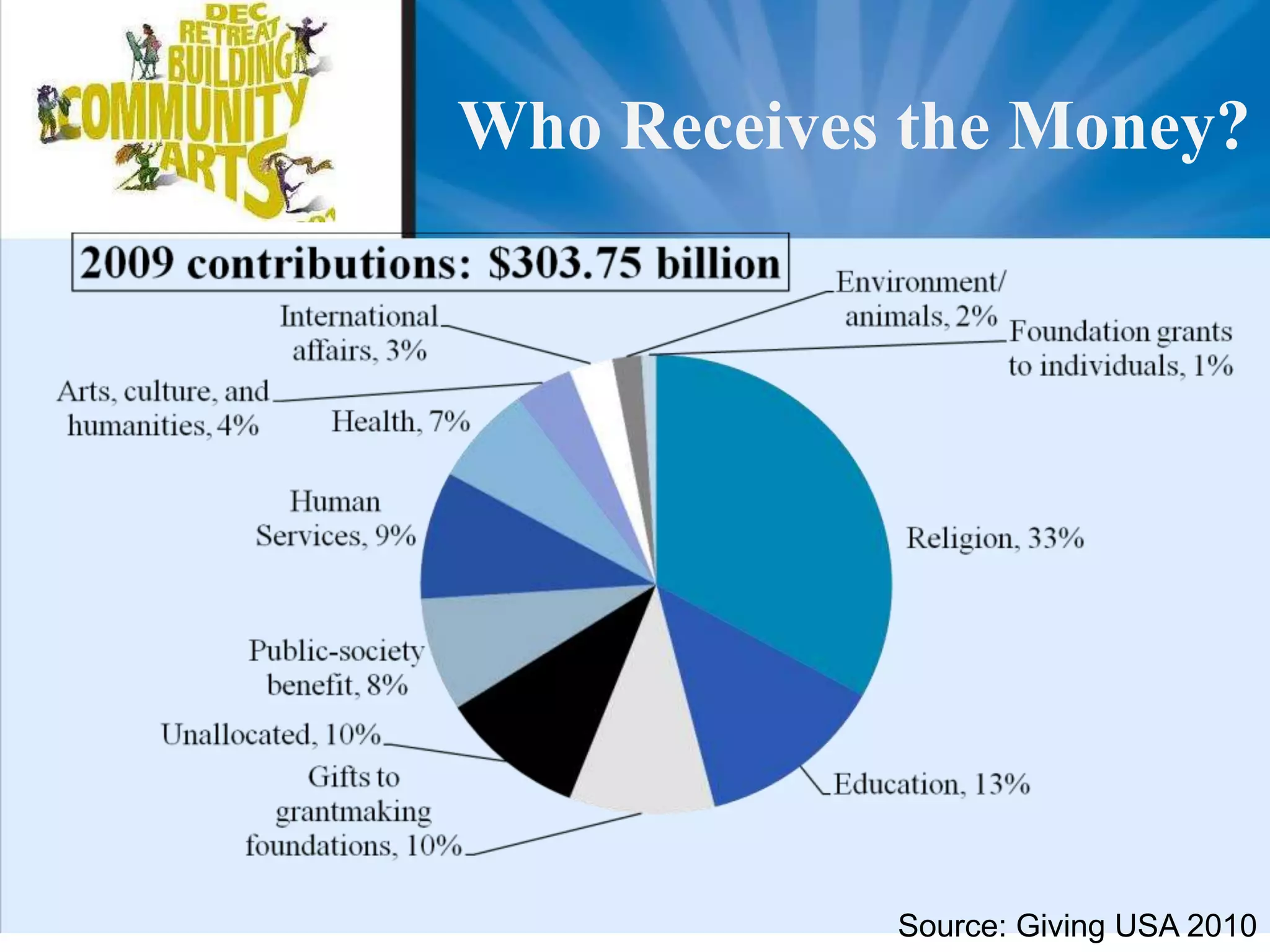
    Are you movingtoward your long-term goals? Who Receives the Money?Source: Giving USA 2010
  • 47.
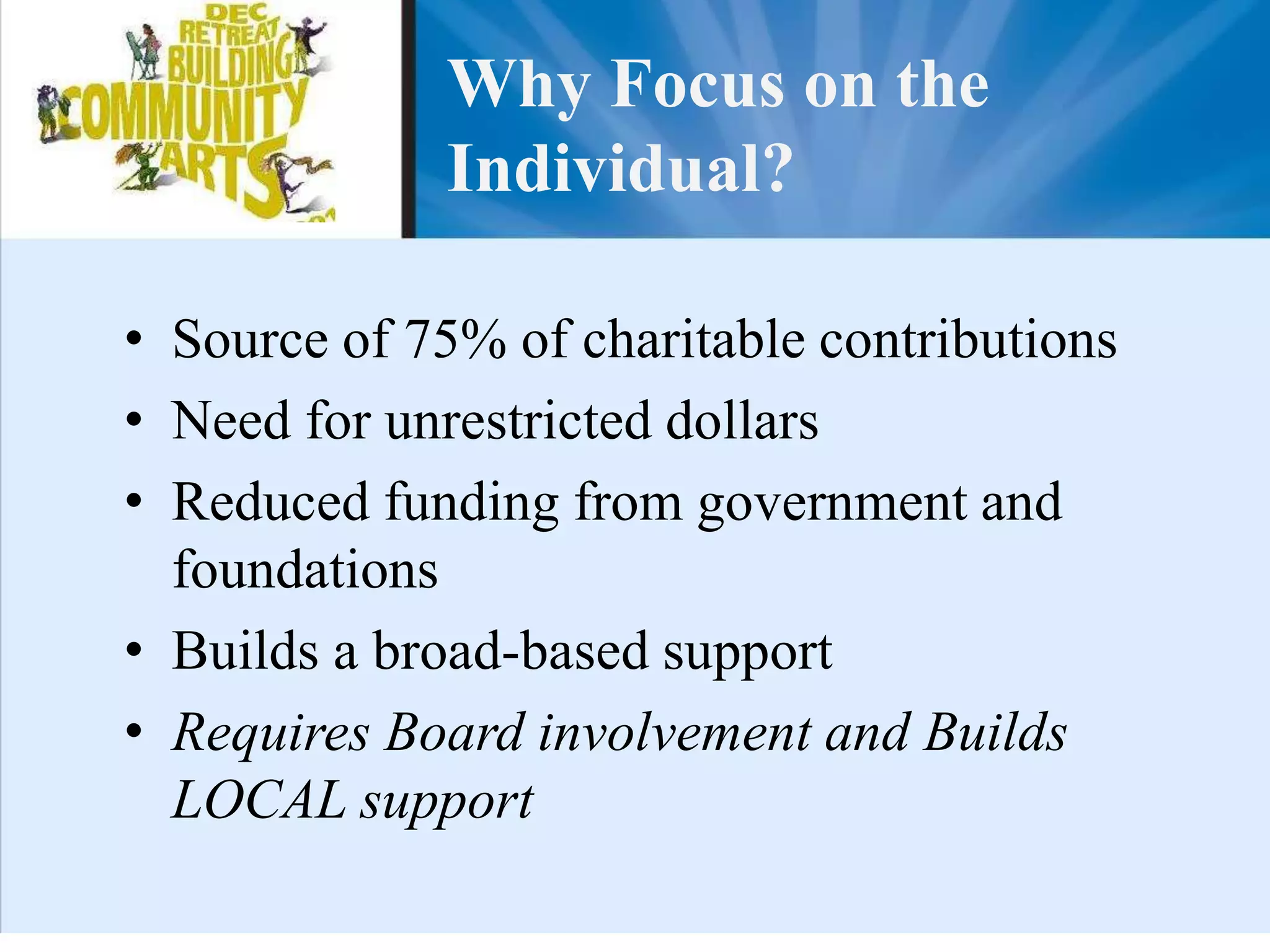
    Why Focus onthe Individual?Source of 75% of charitable contributionsNeed for unrestricted dollarsReduced funding from government and foundationsBuilds a broad-based support Requires Board involvement and Builds LOCAL support
  • 48.
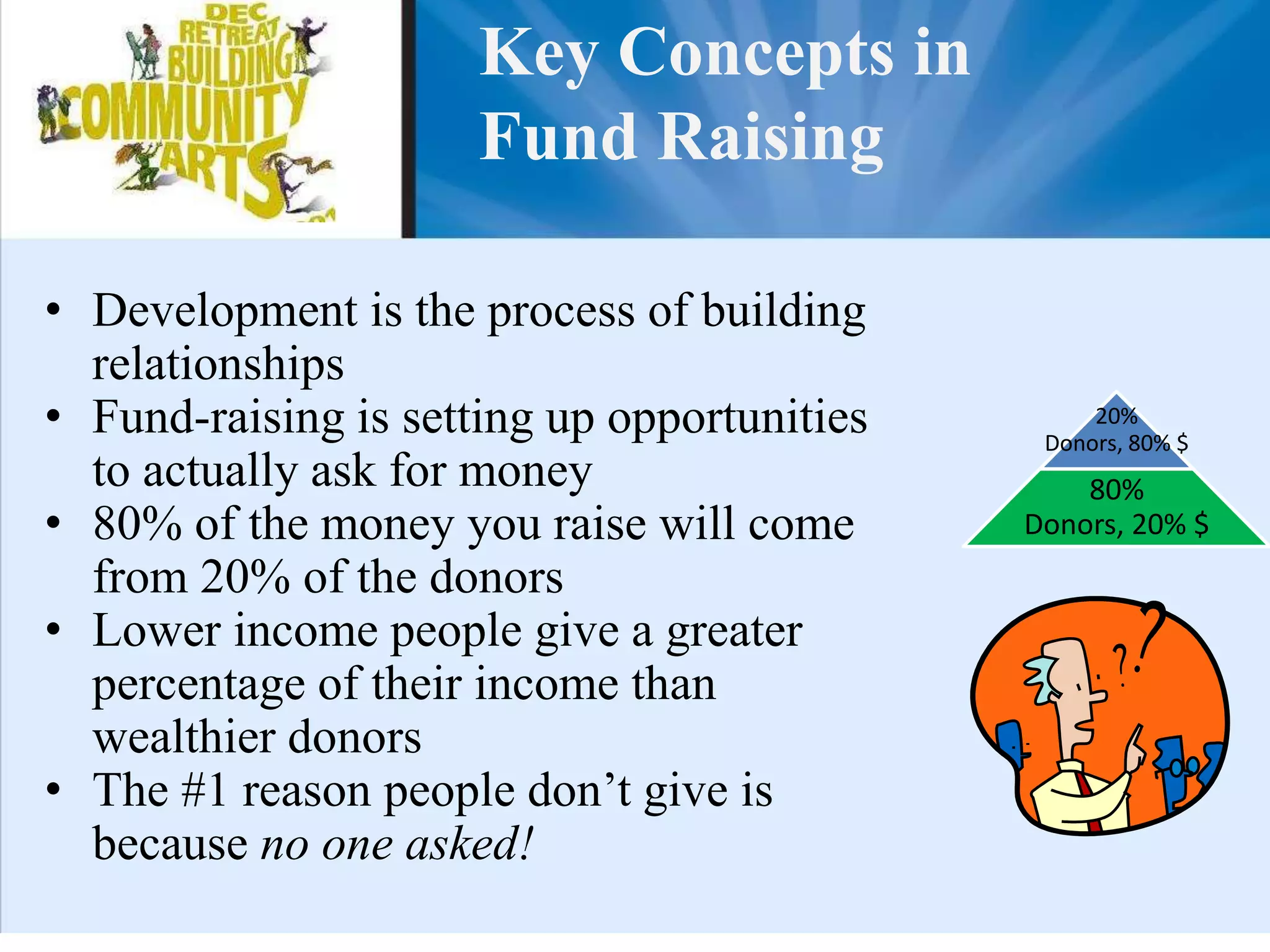
    Key Concepts inFund RaisingDevelopment is the process of building relationshipsFund-raising is setting up opportunities to actually ask for money80% of the money you raise will come from 20% of the donorsLower income people give a greater percentage of their income than wealthier donorsThe #1 reason people don’t give is because no one asked!
  • 49.
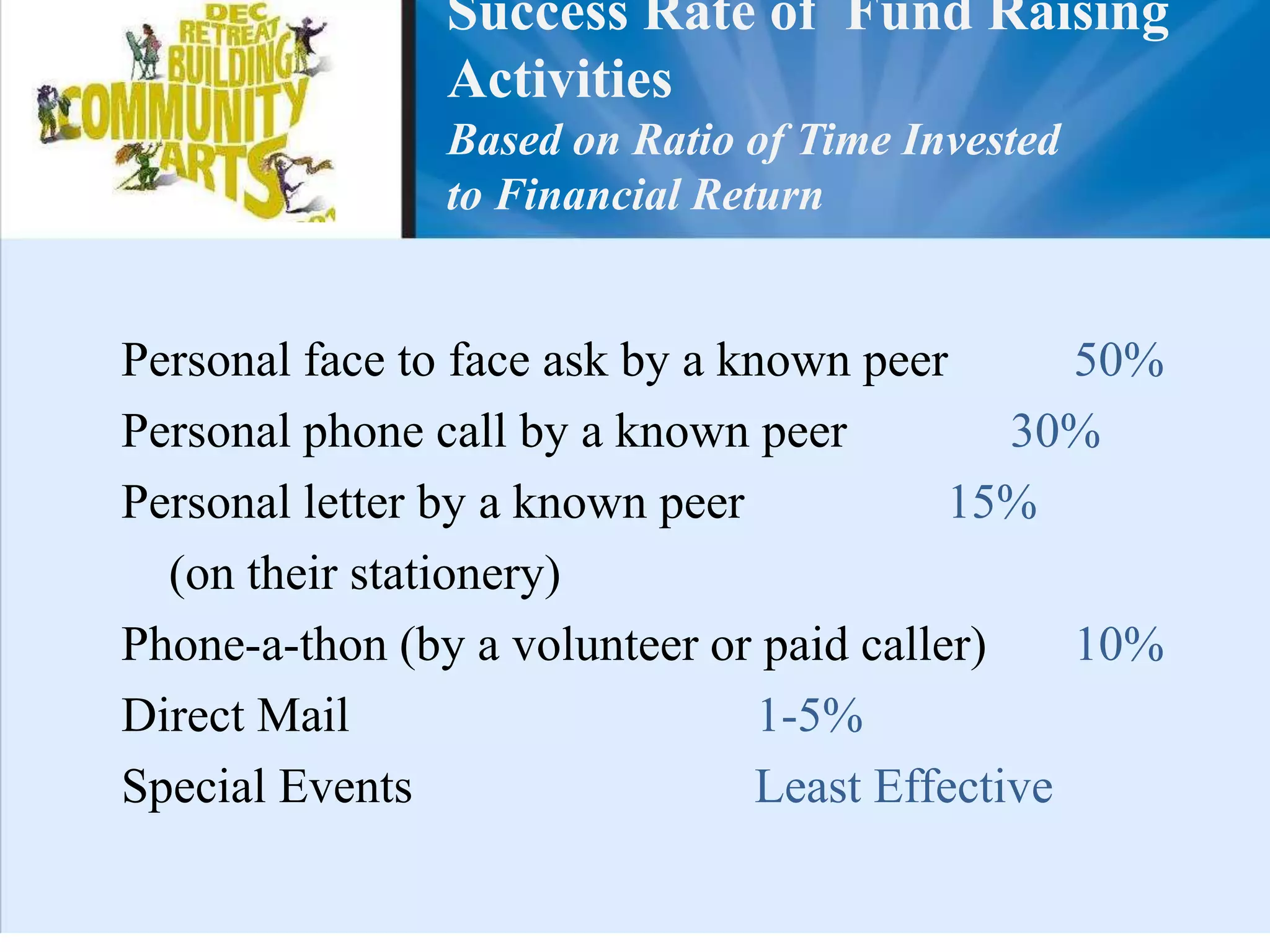
    Success Rate of Fund Raising ActivitiesBased on Ratio of Time Invested to Financial ReturnPersonal face to face ask by a known peer 50%Personal phone call by a known peer 30%Personal letter by a known peer 15% (on their stationery)Phone-a-thon (by a volunteer or paid caller) 10%Direct Mail 1-5%Special Events Least Effective
  • 50.
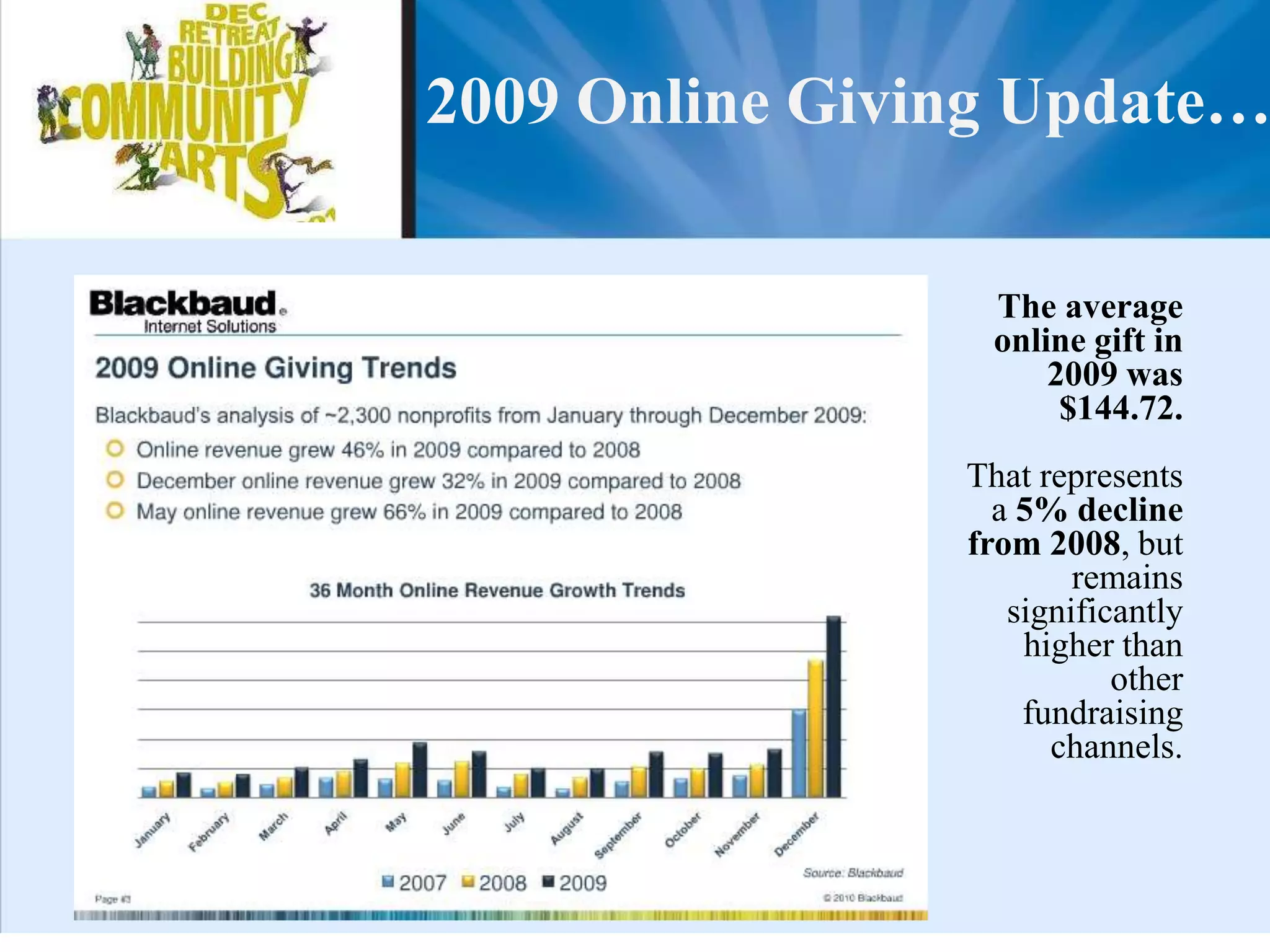
    2009 Online GivingUpdate…The average online gift in 2009 was $144.72. That represents a 5% decline from 2008, but remains significantly higher than other fundraising channels.
  • 51.
    Messages that ConnectIsit right for your audience?Keep it SimpleMake it memorableUnexpectedConcreteEmotional, tapping into positive or negative feelings
  • 52.
    Change Your Message…YourMessage Doesn’t Have to Be…TellingA Mission StatementThree paragraphs LongAn “About Us” Page Expensive
  • 53.
  • 54.
    “I love savingyou money.”(I know what you want)
  • 55.
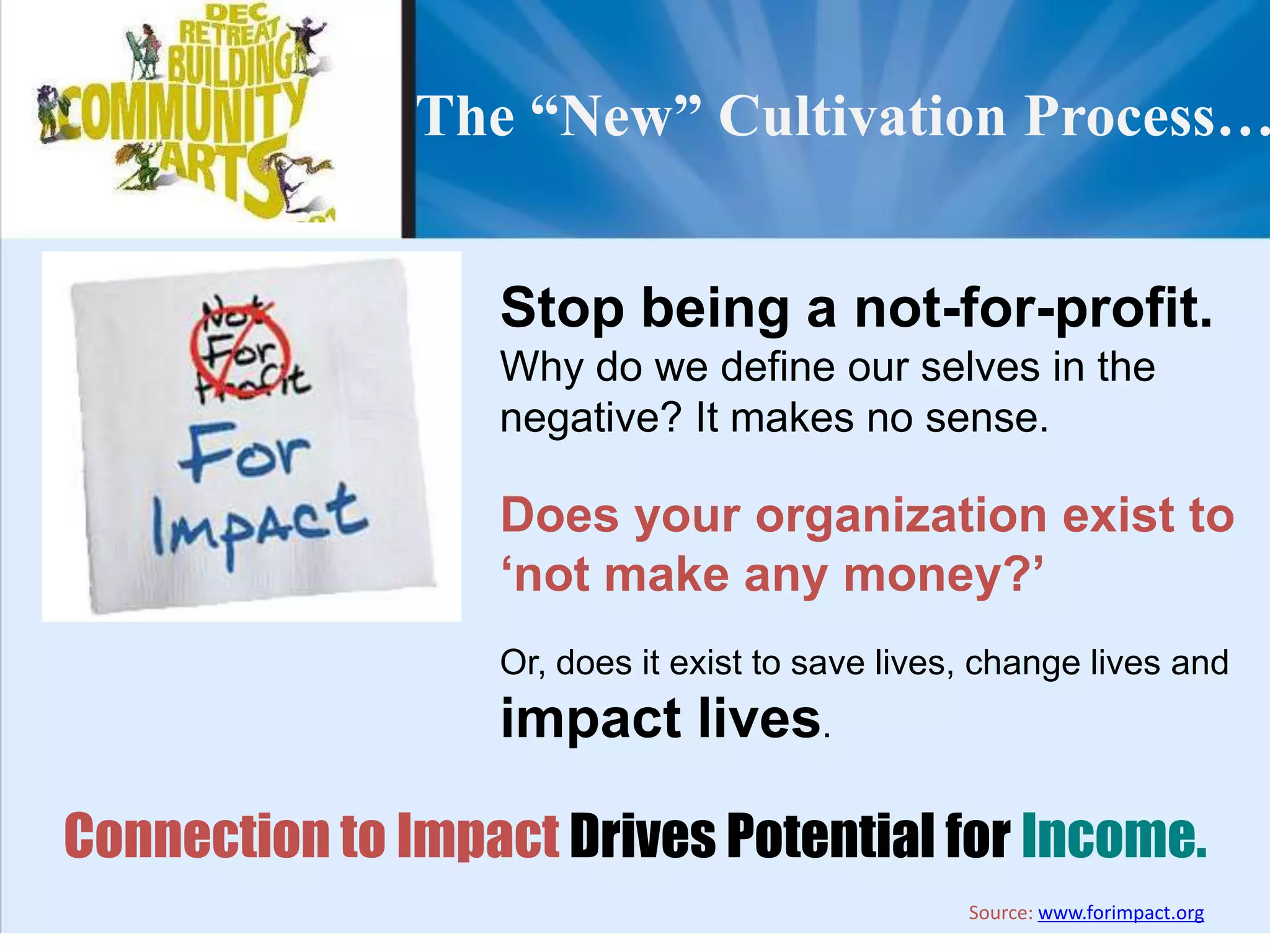
    The “New” CultivationProcess…Stop being a not-for-profit.Why do we define our selves in the negative? It makes no sense.Does your organization exist to ‘not make any money?’Or, does it exist to save lives, change lives and impact lives.Connection to Impact Drives Potential for Income.Source: www.forimpact.org
  • 56.
    Cultivate Plants… Relateto People…Old: The higher the ask the longer the “cultivation period.”
  • 57.
    New: The biggerconnection to impact the better the partnership
  • 58.
    Old: Major giftsare infrequently asked for or given and require a personalized cultivation plan and solicitation.
  • 59.
    New: Partnership opportunitiesare presented when good partners present themselves. Both parties bring value to the table and help each other reach their goals.
  • 60.
    Old: Nonprofit “charities”ask for donations. Giving is the ‘right thing to do.’
  • 61.
    New: Nonprofit businessesprovide opportunities to invest in your community, and see the return for the people, region, cause you care about.Remember Why People GiveShare goals the organization pursuesPersonal connections with staff, board, clients or volunteersPersonal gratitude toward the organizationInvolvement in the life of the organizationEnlightened self-interestBeing askedJoy
  • 62.
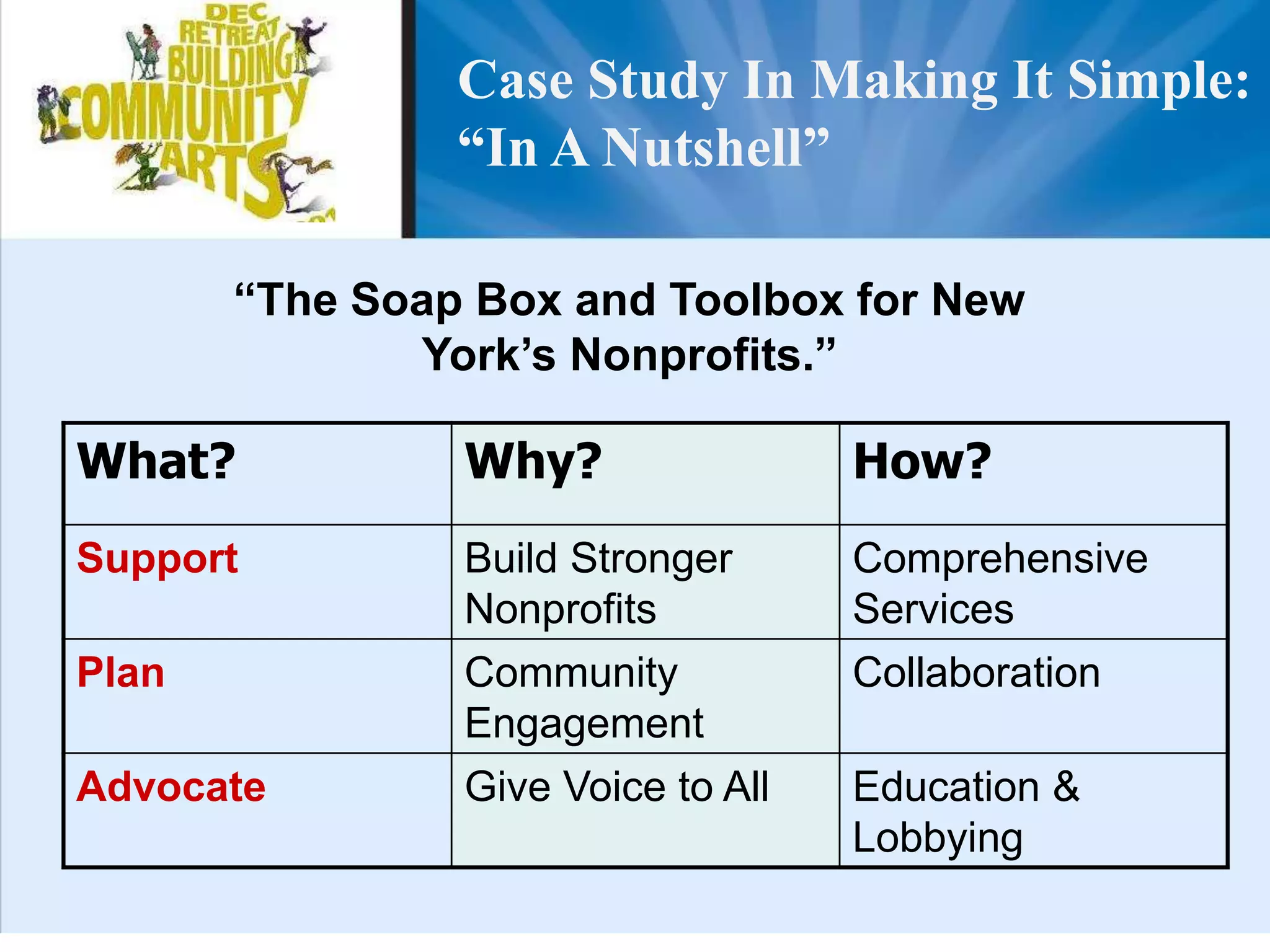
    Case Study InMaking It Simple: “In A Nutshell”“The Soap Box and Toolbox for New York’s Nonprofits.”
  • 63.
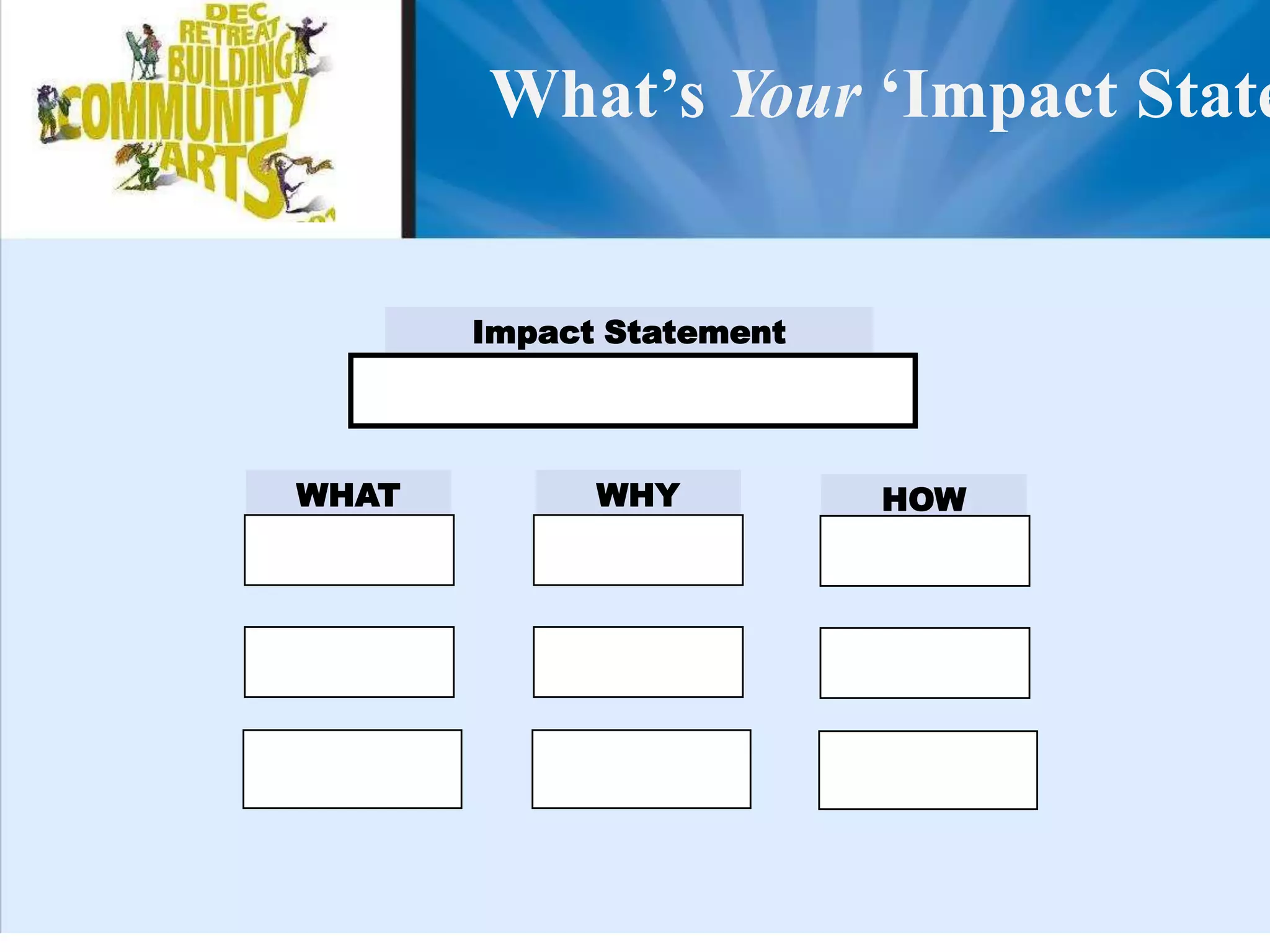
    What’s Your ‘ImpactStatement’?Impact StatementWHATWHYHOW
  • 64.
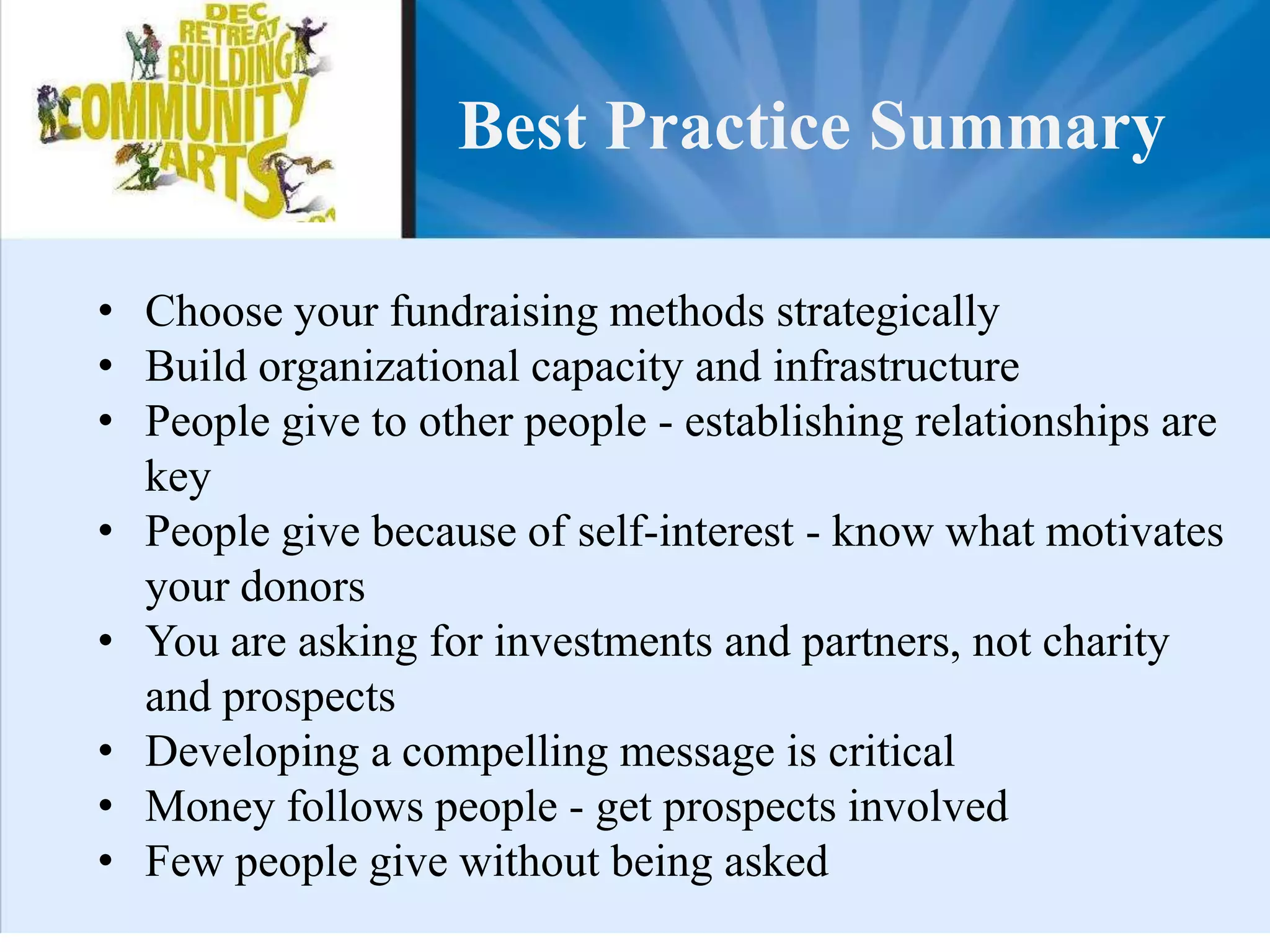
    Best Practice SummaryChooseyour fundraising methods strategicallyBuild organizational capacity and infrastructurePeople give to other people - establishing relationships are keyPeople give because of self-interest - know what motivates your donorsYou are asking for investments and partners, not charity and prospectsDeveloping a compelling message is criticalMoney follows people - get prospects involvedFew people give without being asked
  • 65.