
Organizing for Ambidexterity:
BREAKING FREE FROM PROCEDURES
AND CREATING THE ADAPTIVE SPACE
NEEDED TO GRASP HOLD OF NEW
OPPORTUNITIES
Elizabeth Solberg, Associate Professor
Dept of Leadership and Organizational Behaviour
The organization of the future: agile, adaptable,
innovative
 Workplaces today are characterized by a high pace of change and uncertainty,
exponentially enhanced by the service economy and demands to go digital
 One of the biggest challenges facing leaders today is the need to enable
organizations and the people in them to respond effectively to changing
business/work demands and to move quickly towards new opportunities
 However, organizations are generally designed to maximize efficiency and
effectiveness, not adaptability and innovation.
2017 Deloitte Global Human Capital Trends
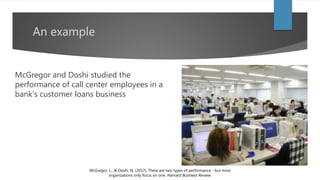
An example
McGregor and Doshi studied the
performance of call center employees in a
bank’s customer loans business
McGregor, L., & Doshi, N. (2017). There are two types of performance - but most
organizations only focus on one. Harvard Business Review.
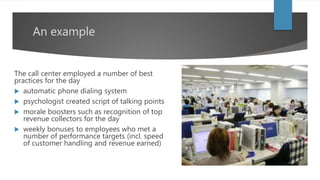
An example
The call center employed a number of best
practices for the day
 automatic phone dialing system
 psychologist created script of talking points
 morale boosters such as recognition of top
revenue collectors for the day
 weekly bonuses to employees who met a
number of performance targets (incl. speed
of customer handling and revenue earned)
An example
employee productivity declining
customer satisfaction at an all time low
Customer Loyalty Team Member
Stephanie Van Hasselt
TV shows
Pizza
Travel
Pets
WorkLife with Adam Grant I A TED Original Podcast: Faking your emotions at work, April 2018
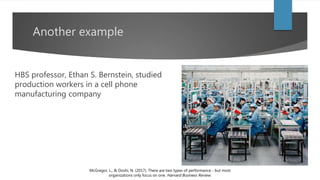
Another example
HBS professor, Ethan S. Bernstein, studied
production workers in a cell phone
manufacturing company
McGregor, L., & Doshi, N. (2017). There are two types of performance - but most
organizations only focus on one. Harvard Business Review.
Another example
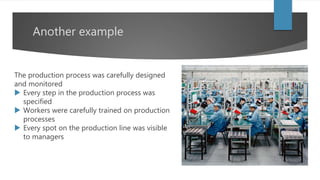
The production process was carefully designed
and monitored
 Every step in the production process was
specified
 Workers were carefully trained on production
processes
 Every spot on the production line was visible
to managers
Another example
Then the team of researchers hid a set of
production lines from managers’ view.
Another example
Production quantity and quality
increased
Own research
Solberg,E.,&Wong,S.I.(2016).Craftingone'sjobtotakechargeofroleoverload:When
proactivityrequiresadaptivityacrosslevels.TheLeadershipQuarterly,27(5):713-725.
Low
Self-InitiatedEffortstoImprove
WorkProductivity
Employees with HIGH perceived adaptability,
working for Leaders with a LOW Need for Structure
High
Role Overload
Employees with HIGH perceived adaptability,
working for Leaders with a HIGH Need for Structure
Employees with LOW perceived adaptability,
working for Leaders with a HIGH Need for Structure
Integrate new knowledge
Facilitate adaptability
and innovation
Maximizing efficiency
and effectiveness
Tension
Uhl-Bien, M., & Arena, M. (2018). Leadership for organizational adaptability: A theoretical synthesis and integrative framework. The Leadership
Quarterly, 29(1), 89-104. doi:https://doi.org/10.1016/j.leaqua.2017.12.009
Organizational ambidexterity
Organizational ambidexterity: key enabler of
organizational transformation
Anthony, S. and Schwartz, E.I. (2017) What the best transformational leaders do. Harvard Business Review, May 8.
Accessed from https://hbr.org/2017/05/what-the-best-transformational-leaders-do
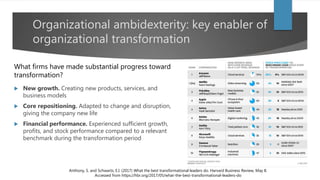
What firms have made substantial progress toward
transformation?
 New growth. Creating new products, services, and
business models
 Core repositioning. Adapted to change and disruption,
giving the company new life
 Financial performance. Experienced sufficient growth,
profits, and stock performance compared to a relevant
benchmark during the transformation period
Organizational ambidexterity: enabling
organizational transformation
Anthony, S. and Schwartz, E.I. (2017) What the best transformational leaders do. Harvard Business Review, May 8.
Accessed from https://hbr.org/2017/05/what-the-best-transformational-leaders-do
What characteristics are shared by these company’s
leaders (CEOs)?
 Outsiders, unafraid to challenge the status quo
 Create a culture for innovation by embodying the
innovative thinking needed
 Communicate powerful narratives about the future
 Realized the need to optimize the existing business
while simultaneously exploring new growth areas
Enabling organizational ambidexterity
Reduce structural constraints in order
to give individuals more discretion with
regards to how and where they focus
their energies
Uhl-Bien, M., & Arena, M. (2018). Leadership for organizational adaptability: A theoretical synthesis and integrative framework. The Leadership Quarterly,
29(1), 89-104. doi:https://doi.org/10.1016/j.leaqua.2017.12.009
1
Enabling organizational ambidexterity
Create the adaptive space needed to
transition from individual-level
adaptation/innovation to group-level
exploitation
Uhl-Bien, M., & Arena, M. (2018). Leadership for organizational adaptability: A theoretical synthesis and integrative framework. The Leadership Quarterly,
29(1), 89-104. doi:https://doi.org/10.1016/j.leaqua.2017.12.009
2
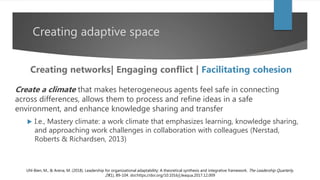
Creating adaptive space
Creating networks| Engaging conflict | Facilitating cohesion
Uhl-Bien, M., & Arena, M. (2018). Leadership for organizational adaptability: A theoretical synthesis and integrative framework. The Leadership Quarterly,
29(1), 89-104. doi:https://doi.org/10.1016/j.leaqua.2017.12.009
Creating adaptive space
Create a place/space for heterogeneous agents and ideas to come together:
E.g., physical work space arrangements, social networks, online communities,
meetings such as hackathons or design thinking sessions, dedicated free time
for innovation projects
Uhl-Bien, M., & Arena, M. (2018). Leadership for organizational adaptability: A theoretical synthesis and integrative framework. The Leadership Quarterly,
29(1), 89-104. doi:https://doi.org/10.1016/j.leaqua.2017.12.009
Creating networks| Engaging conflict | Facilitating cohesion
Creating adaptive space
Inject motivating tension into the system by challenging the process and
confronting old and outdated assumptions, traditions and processes
I.e., Intellectual stimulation: a dimension of transformational leadership that
stimulates followers to challenge the status quo and supports and promotes
followers as they try new approaches and develop innovative ways of dealing
with organizational issues
Uhl-Bien, M., & Arena, M. (2018). Leadership for organizational adaptability: A theoretical synthesis and integrative framework. The Leadership Quarterly,
29(1), 89-104. doi:https://doi.org/10.1016/j.leaqua.2017.12.009
Creating networks| Engaging conflict | Facilitating cohesion
Creating adaptive space
Create a climate that makes heterogeneous agents feel safe in connecting
across differences, allows them to process and refine ideas in a safe
environment, and enhance knowledge sharing and transfer
 I.e., Mastery climate: a work climate that emphasizes learning, knowledge sharing,
and approaching work challenges in collaboration with colleagues (Nerstad,
Roberts & Richardsen, 2013)
Uhl-Bien, M., & Arena, M. (2018). Leadership for organizational adaptability: A theoretical synthesis and integrative framework. The Leadership Quarterly,
29(1), 89-104. doi:https://doi.org/10.1016/j.leaqua.2017.12.009
Creating networks| Engaging conflict | Facilitating cohesion
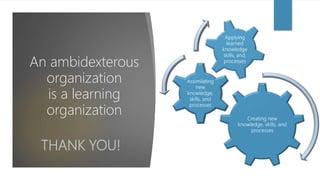
An ambidexterous
organization
is a learning
organization
THANK YOU!

Organizing for ambidexterity

  • 1.
    Organizing for Ambidexterity: BREAKINGFREE FROM PROCEDURES AND CREATING THE ADAPTIVE SPACE NEEDED TO GRASP HOLD OF NEW OPPORTUNITIES Elizabeth Solberg, Associate Professor Dept of Leadership and Organizational Behaviour
  • 2.
    The organization ofthe future: agile, adaptable, innovative  Workplaces today are characterized by a high pace of change and uncertainty, exponentially enhanced by the service economy and demands to go digital  One of the biggest challenges facing leaders today is the need to enable organizations and the people in them to respond effectively to changing business/work demands and to move quickly towards new opportunities  However, organizations are generally designed to maximize efficiency and effectiveness, not adaptability and innovation. 2017 Deloitte Global Human Capital Trends
  • 3.
    An example McGregor andDoshi studied the performance of call center employees in a bank’s customer loans business McGregor, L., & Doshi, N. (2017). There are two types of performance - but most organizations only focus on one. Harvard Business Review.
  • 4.
    An example The callcenter employed a number of best practices for the day  automatic phone dialing system  psychologist created script of talking points  morale boosters such as recognition of top revenue collectors for the day  weekly bonuses to employees who met a number of performance targets (incl. speed of customer handling and revenue earned)
  • 5.
    An example employee productivitydeclining customer satisfaction at an all time low
  • 6.
    Customer Loyalty TeamMember Stephanie Van Hasselt TV shows Pizza Travel Pets WorkLife with Adam Grant I A TED Original Podcast: Faking your emotions at work, April 2018
  • 7.
    Another example HBS professor,Ethan S. Bernstein, studied production workers in a cell phone manufacturing company McGregor, L., & Doshi, N. (2017). There are two types of performance - but most organizations only focus on one. Harvard Business Review.
  • 8.
    Another example The productionprocess was carefully designed and monitored  Every step in the production process was specified  Workers were carefully trained on production processes  Every spot on the production line was visible to managers
  • 9.
    Another example Then theteam of researchers hid a set of production lines from managers’ view.
  • 10.
  • 11.
    Own research Solberg,E.,&Wong,S.I.(2016).Craftingone'sjobtotakechargeofroleoverload:When proactivityrequiresadaptivityacrosslevels.TheLeadershipQuarterly,27(5):713-725. Low Self-InitiatedEffortstoImprove WorkProductivity Employees withHIGH perceived adaptability, working for Leaders with a LOW Need for Structure High Role Overload Employees with HIGH perceived adaptability, working for Leaders with a HIGH Need for Structure Employees with LOW perceived adaptability, working for Leaders with a HIGH Need for Structure
  • 12.
    Integrate new knowledge Facilitateadaptability and innovation Maximizing efficiency and effectiveness Tension Uhl-Bien, M., & Arena, M. (2018). Leadership for organizational adaptability: A theoretical synthesis and integrative framework. The Leadership Quarterly, 29(1), 89-104. doi:https://doi.org/10.1016/j.leaqua.2017.12.009 Organizational ambidexterity
  • 13.
    Organizational ambidexterity: keyenabler of organizational transformation Anthony, S. and Schwartz, E.I. (2017) What the best transformational leaders do. Harvard Business Review, May 8. Accessed from https://hbr.org/2017/05/what-the-best-transformational-leaders-do What firms have made substantial progress toward transformation?  New growth. Creating new products, services, and business models  Core repositioning. Adapted to change and disruption, giving the company new life  Financial performance. Experienced sufficient growth, profits, and stock performance compared to a relevant benchmark during the transformation period
  • 14.
    Organizational ambidexterity: enabling organizationaltransformation Anthony, S. and Schwartz, E.I. (2017) What the best transformational leaders do. Harvard Business Review, May 8. Accessed from https://hbr.org/2017/05/what-the-best-transformational-leaders-do What characteristics are shared by these company’s leaders (CEOs)?  Outsiders, unafraid to challenge the status quo  Create a culture for innovation by embodying the innovative thinking needed  Communicate powerful narratives about the future  Realized the need to optimize the existing business while simultaneously exploring new growth areas
  • 15.
    Enabling organizational ambidexterity Reducestructural constraints in order to give individuals more discretion with regards to how and where they focus their energies Uhl-Bien, M., & Arena, M. (2018). Leadership for organizational adaptability: A theoretical synthesis and integrative framework. The Leadership Quarterly, 29(1), 89-104. doi:https://doi.org/10.1016/j.leaqua.2017.12.009 1
  • 16.
    Enabling organizational ambidexterity Createthe adaptive space needed to transition from individual-level adaptation/innovation to group-level exploitation Uhl-Bien, M., & Arena, M. (2018). Leadership for organizational adaptability: A theoretical synthesis and integrative framework. The Leadership Quarterly, 29(1), 89-104. doi:https://doi.org/10.1016/j.leaqua.2017.12.009 2
  • 17.
    Creating adaptive space Creatingnetworks| Engaging conflict | Facilitating cohesion Uhl-Bien, M., & Arena, M. (2018). Leadership for organizational adaptability: A theoretical synthesis and integrative framework. The Leadership Quarterly, 29(1), 89-104. doi:https://doi.org/10.1016/j.leaqua.2017.12.009
  • 18.
    Creating adaptive space Createa place/space for heterogeneous agents and ideas to come together: E.g., physical work space arrangements, social networks, online communities, meetings such as hackathons or design thinking sessions, dedicated free time for innovation projects Uhl-Bien, M., & Arena, M. (2018). Leadership for organizational adaptability: A theoretical synthesis and integrative framework. The Leadership Quarterly, 29(1), 89-104. doi:https://doi.org/10.1016/j.leaqua.2017.12.009 Creating networks| Engaging conflict | Facilitating cohesion
  • 19.
    Creating adaptive space Injectmotivating tension into the system by challenging the process and confronting old and outdated assumptions, traditions and processes I.e., Intellectual stimulation: a dimension of transformational leadership that stimulates followers to challenge the status quo and supports and promotes followers as they try new approaches and develop innovative ways of dealing with organizational issues Uhl-Bien, M., & Arena, M. (2018). Leadership for organizational adaptability: A theoretical synthesis and integrative framework. The Leadership Quarterly, 29(1), 89-104. doi:https://doi.org/10.1016/j.leaqua.2017.12.009 Creating networks| Engaging conflict | Facilitating cohesion
  • 20.
    Creating adaptive space Createa climate that makes heterogeneous agents feel safe in connecting across differences, allows them to process and refine ideas in a safe environment, and enhance knowledge sharing and transfer  I.e., Mastery climate: a work climate that emphasizes learning, knowledge sharing, and approaching work challenges in collaboration with colleagues (Nerstad, Roberts & Richardsen, 2013) Uhl-Bien, M., & Arena, M. (2018). Leadership for organizational adaptability: A theoretical synthesis and integrative framework. The Leadership Quarterly, 29(1), 89-104. doi:https://doi.org/10.1016/j.leaqua.2017.12.009 Creating networks| Engaging conflict | Facilitating cohesion
  • 21.
    An ambidexterous organization is alearning organization THANK YOU!

Editor's Notes

  • #5 including a
  • #6 Despite having these systems in place, employee productivity was trending downward and customer satisfaction was at an all time low. The organization’s “Best Practices” – practices intended to maximize customer service reps efficiency and effectiveness – was actually hindering their ability to do their job
  • #7 Zappos.com is an online shoe and clothing shop based in Las Vegas, Nevada. In July 2009, the company announced that Amazon.com would acquire it in an all-stock deal worth about $1.2 billion. On average, Zappos employees answer 5,000 calls a month, and 1,200 e-mails a week (except in the holiday season, when call frequency increases significantly). Call center employees don't have scripts, and there are no limit on call times Zappos employees are encouraged to go above and beyond traditional customer service, and have the autonomy to do so. For example, a woman called Zappos to return a pair of boots for her husband because he died in a car accident. The next day, she received a flower delivery, which the Zappos call center rep had billed to the company without checking with her supervisor.
  • #11 And production quantity/quality increased.
  • #13 To maintain long term viability, organizations must be able to manage the tension between maximizing efficiency and effectiveness and facilitate adaptability and innovation Integrate new knowledge gained while adapting/innovating so that it can be later exploited
  • #18 enabling network structures to spark the emergence of novel ideas and then leveraging the natural benefits of cohesion that occur in the local, entrepreneurial context to foster idea development and sharing.
  • #19 Instead of hosting an annual meeting, new Microsoft CEO Satya Nadella hosted the company’s first global employee hackathon, an event in which thousands of employees from all different divisions of the company work on some 2,700 projects. They met in huge white tents laid out on a soccer field. Inside them, groups of employees, clustered at tables, sat working on their laptops and exchanging ideas.
  • #20 Instead of hosting an annual meeting, new Microsoft CEO Satya Nadella hosted the company’s first global employee hackathon, an event in which thousands of employees from all different divisions of the company work on some 2,700 projects. They met in huge white tents laid out on a soccer field. Inside them, groups of employees, clustered at tables, sat working on their laptops and exchanging ideas.
  • #21 Instead of hosting an annual meeting, new Microsoft CEO Satya Nadella hosted the company’s first global employee hackathon, an event in which thousands of employees from all different divisions of the company work on some 2,700 projects. They met in huge white tents laid out on a soccer field. Inside them, groups of employees, clustered at tables, sat working on their laptops and exchanging ideas.