Learning How to Build a Comprehensive
          Development Plan

                  Lisa C. Intagliata, CFRE
                  Director of Development
                  Sarasota Memorial Healthcare
                  Foundation, Inc.

                  April 17, 2012
Introductions

   Introduce yourself, title, organization
   Where you are in your development planning
    –   Beginning
    –   In the middle (maybe stalling)
    –   At the end
   What you hope to gain today-Your goals
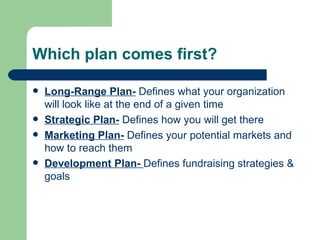
Which plan comes first?

   Long-Range Plan- Defines what your organization
    will look like at the end of a given time
   Strategic Plan- Defines how you will get there
   Marketing Plan- Defines your potential markets and
    how to reach them
   Development Plan- Defines fundraising strategies &
    goals
What is a Development Plan?

   Blueprint for raising funds
   Required to achieve goals stated in your
    strategic plan
   Board’s responsibility to direct staff to
    prepare a fundraising plan-or work w/
    consultant to do so
   Must determine strategies & set goals w/
    your fundraising committee-interfaces w/
    organization’s budgeting process (Exercise #2)
Why is it important?

   Gives a clear sense of who we are and how our
    mission relates to the community we serve
   Gives a clear sense of our organization’s direction,
    familiarity w/ its activities and how they relate to the
    community
   Directs us on how we plan to achieve the mission
   Gives us the knowledge of how much it will cost

                    Bottom Line
As an organization, we can NOT raise funds without it
Assessing Your Fundraising to Date
           (Step #1 in Your Plan)

•   Review all relevant written material
    - direct mail, case statements, annual reports, brochures, newsletters etc…
     (Exercise #1)

•   Review your fundraising programs success rate- Ways you asked & how
    much you received
    (Exercise # 3- Cost Effectiveness Formulas)

•   Review the gift potential of each market/constituency (upgrading &
    acquisition opportunities) (Exercise # 4)

•   Review the available investment resources (volunteers, staff, space,
    equipment, materials, budget etc…)
    (Exercise #6B)
Assessing Your Fundraising to Date
                          (Continued)


   Build understanding & ownership in your plan
    with volunteers & staff by involving them
   Interview 12-15 people close to your
    organization
    (Board members, volunteers, staff, alumni, parents etc…)
   What questions should you ask?
   Review Readiness Assessment
    Handout/Quiz
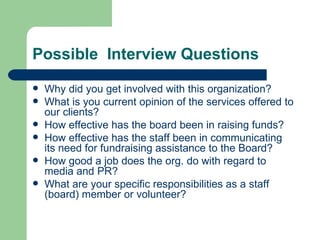
Possible Interview Questions
   Why did you get involved with this organization?
   What is you current opinion of the services offered to
    our clients?
   How effective has the board been in raising funds?
   How effective has the staff been in communicating
    its need for fundraising assistance to the Board?
   How good a job does the org. do with regard to
    media and PR?
   What are your specific responsibilities as a staff
    (board) member or volunteer?
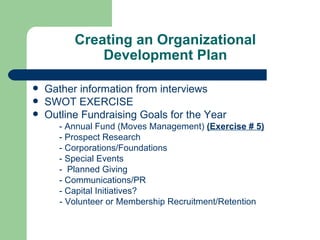
Creating an Organizational
              Development Plan

   Gather information from interviews
   SWOT EXERCISE
   Outline Fundraising Goals for the Year
       - Annual Fund (Moves Management) (Exercise # 5)
       - Prospect Research
       - Corporations/Foundations
       - Special Events
       - Planned Giving
       - Communications/PR
       - Capital Initiatives?
       - Volunteer or Membership Recruitment/Retention
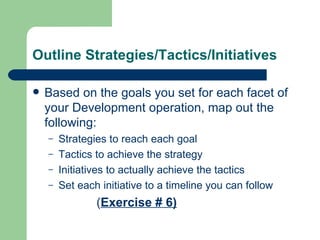
Outline Strategies/Tactics/Initiatives

   Based on the goals you set for each facet of
    your Development operation, map out the
    following:
    –   Strategies to reach each goal
    –   Tactics to achieve the strategy
    –   Initiatives to actually achieve the tactics
    –   Set each initiative to a timeline you can follow
                (Exercise # 6)
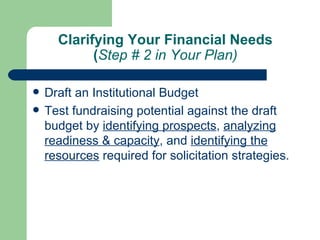
Clarifying Your Financial Needs
            (Step # 2 in Your Plan)

   Draft an Institutional Budget
   Test fundraising potential against the draft
    budget by identifying prospects, analyzing
    readiness & capacity, and identifying the
    resources required for solicitation strategies.
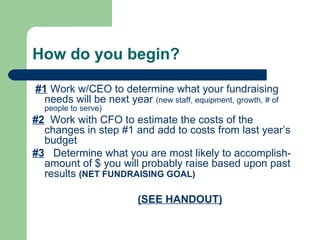
How do you begin?

#1 Work w/CEO to determine what your fundraising
  needs will be next year (new staff, equipment, growth, # of
  people to serve)
#2 Work with CFO to estimate the costs of the
  changes in step #1 and add to costs from last year’s
  budget
#3 Determine what you are most likely to accomplish-
  amount of $ you will probably raise based upon past
  results (NET FUNDRAISING GOAL)

                         (SEE HANDOUT)
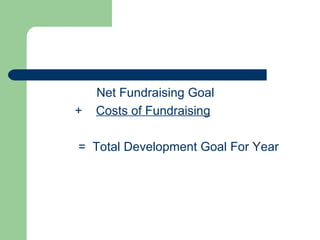
Net Fundraising Goal
+   Costs of Fundraising

= Total Development Goal For Year
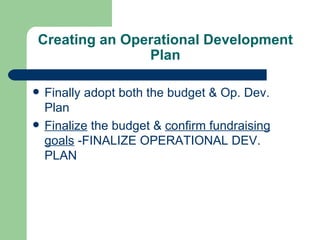
Creating an Operational Development
               Plan

   Finally adopt both the budget & Op. Dev.
    Plan
   Finalize the budget & confirm fundraising
    goals -FINALIZE OPERATIONAL DEV.
    PLAN
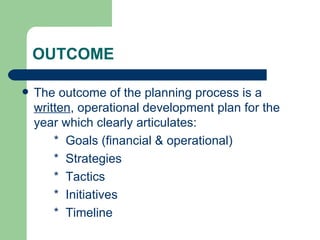
OUTCOME

   The outcome of the planning process is a
    written, operational development plan for the
    year which clearly articulates:
        * Goals (financial & operational)
        * Strategies
        * Tactics
        * Initiatives
        * Timeline
Other resources

   AFP International-- www.afpnet.org
   AFP Southwest FL Chapter
   Nonprofit Resource Center/Giving Partner
   Selby Library/Sarasota County Public Library
    System
THANK YOU!

                              Questions?

 Lisa C. Intagliata, CFRE
 Director of Development
 Sarasota Memorial Healthcare Foundation, Inc.
 1515 South Osprey Avenue
 Suite B-4
 Sarasota, FL 34239
 (941) 917-1286
 (941) 917-2270 Fax
 Lisa-intagliata@smh.com

Learning how to build a comprehensive development plan2012

  • 1.
    Learning How toBuild a Comprehensive Development Plan Lisa C. Intagliata, CFRE Director of Development Sarasota Memorial Healthcare Foundation, Inc. April 17, 2012
  • 2.
    Introductions  Introduce yourself, title, organization  Where you are in your development planning – Beginning – In the middle (maybe stalling) – At the end  What you hope to gain today-Your goals
  • 3.
    Which plan comesfirst?  Long-Range Plan- Defines what your organization will look like at the end of a given time  Strategic Plan- Defines how you will get there  Marketing Plan- Defines your potential markets and how to reach them  Development Plan- Defines fundraising strategies & goals
  • 4.
    What is aDevelopment Plan?  Blueprint for raising funds  Required to achieve goals stated in your strategic plan  Board’s responsibility to direct staff to prepare a fundraising plan-or work w/ consultant to do so  Must determine strategies & set goals w/ your fundraising committee-interfaces w/ organization’s budgeting process (Exercise #2)
  • 5.
    Why is itimportant?  Gives a clear sense of who we are and how our mission relates to the community we serve  Gives a clear sense of our organization’s direction, familiarity w/ its activities and how they relate to the community  Directs us on how we plan to achieve the mission  Gives us the knowledge of how much it will cost Bottom Line As an organization, we can NOT raise funds without it
  • 6.
    Assessing Your Fundraisingto Date (Step #1 in Your Plan) • Review all relevant written material - direct mail, case statements, annual reports, brochures, newsletters etc… (Exercise #1) • Review your fundraising programs success rate- Ways you asked & how much you received (Exercise # 3- Cost Effectiveness Formulas) • Review the gift potential of each market/constituency (upgrading & acquisition opportunities) (Exercise # 4) • Review the available investment resources (volunteers, staff, space, equipment, materials, budget etc…) (Exercise #6B)
  • 7.
    Assessing Your Fundraisingto Date (Continued)  Build understanding & ownership in your plan with volunteers & staff by involving them  Interview 12-15 people close to your organization (Board members, volunteers, staff, alumni, parents etc…)  What questions should you ask?  Review Readiness Assessment Handout/Quiz
  • 8.
    Possible Interview Questions  Why did you get involved with this organization?  What is you current opinion of the services offered to our clients?  How effective has the board been in raising funds?  How effective has the staff been in communicating its need for fundraising assistance to the Board?  How good a job does the org. do with regard to media and PR?  What are your specific responsibilities as a staff (board) member or volunteer?
  • 9.
    Creating an Organizational Development Plan  Gather information from interviews  SWOT EXERCISE  Outline Fundraising Goals for the Year - Annual Fund (Moves Management) (Exercise # 5) - Prospect Research - Corporations/Foundations - Special Events - Planned Giving - Communications/PR - Capital Initiatives? - Volunteer or Membership Recruitment/Retention
  • 10.
    Outline Strategies/Tactics/Initiatives  Based on the goals you set for each facet of your Development operation, map out the following: – Strategies to reach each goal – Tactics to achieve the strategy – Initiatives to actually achieve the tactics – Set each initiative to a timeline you can follow (Exercise # 6)
  • 11.
    Clarifying Your FinancialNeeds (Step # 2 in Your Plan)  Draft an Institutional Budget  Test fundraising potential against the draft budget by identifying prospects, analyzing readiness & capacity, and identifying the resources required for solicitation strategies.
  • 12.
    How do youbegin? #1 Work w/CEO to determine what your fundraising needs will be next year (new staff, equipment, growth, # of people to serve) #2 Work with CFO to estimate the costs of the changes in step #1 and add to costs from last year’s budget #3 Determine what you are most likely to accomplish- amount of $ you will probably raise based upon past results (NET FUNDRAISING GOAL) (SEE HANDOUT)
  • 13.
    Net Fundraising Goal + Costs of Fundraising = Total Development Goal For Year
  • 14.
    Creating an OperationalDevelopment Plan  Finally adopt both the budget & Op. Dev. Plan  Finalize the budget & confirm fundraising goals -FINALIZE OPERATIONAL DEV. PLAN
  • 15.
    OUTCOME  The outcome of the planning process is a written, operational development plan for the year which clearly articulates: * Goals (financial & operational) * Strategies * Tactics * Initiatives * Timeline
  • 16.
    Other resources  AFP International-- www.afpnet.org  AFP Southwest FL Chapter  Nonprofit Resource Center/Giving Partner  Selby Library/Sarasota County Public Library System
  • 17.
    THANK YOU! Questions? Lisa C. Intagliata, CFRE Director of Development Sarasota Memorial Healthcare Foundation, Inc. 1515 South Osprey Avenue Suite B-4 Sarasota, FL 34239 (941) 917-1286 (941) 917-2270 Fax Lisa-intagliata@smh.com