
Volunteer Management

  Presented by Jonathan Poisner
    For the State Environment
       Leadership Program


                                  October 2011
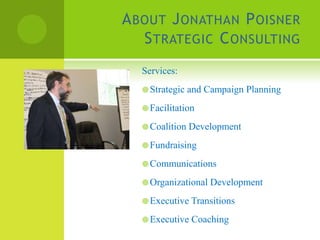
A BOUT J ONATHAN P OISNER
   S TRATEGIC C ONSULTING
  Services:
   Strategic   and Campaign Planning
   Facilitation

   Coalition   Development
   Fundraising

   Communications

   Organizational   Development
   Executive Transitions

   Executive   Coaching
M Y EXPERIENCE WITH
                              VOLUNTEERS

   Before I became an Executive Director, I was a
    grassroots organizer for the Sierra Club.

   When I became Executive Director at the Oregon
    League of Conservation Voters in 1997, we had
    maybe 50 volunteers, counting the board and
    others.

   By 2008, we had more than 1000 volunteers do
    some activity for OLCV in the calendar year.
       This took a sustained commitment to a volunteer
        program and we learned some things along the
        way that I’ll be sharing in this webinar.
W HAT WE ’ RE GOING
                            TO COVER

   Why Volunteers
   Recruiting Volunteers
   Managing Volunteers
W HY DO YOU WANT
                     VOLUNTEERS ?

   Important to know why since can
    influence what type of program you set
    up.
   Two important questions:
       What do you most want out of your
        volunteers?
       What level of volunteer do you need?
W HAT DO YOU M OST WANT
    OUT OF YOUR V OLUNTEERS

   My top potential reasons:
       To do the work staff just can’t get around
        to doing (either back-end or
        programmatic)
           62.8 million adults volunteering almost 8.1 billion
            hours in local and national organizations in
            2010, Source: VolunteeringinAmerica.gov.

       To be authentic voices
       As sources of local knowledge
       As sources of specialized expertise
W HAT LEVEL VOLUNTEER DO
               YOU NEED ?


   Level 1: Participants
   Level 2: Activity Leaders
   Level 3: Organizational Leaders
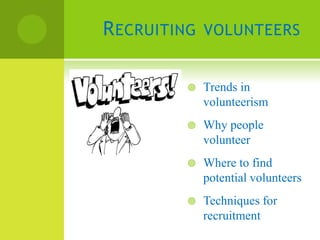
R ECRUITING   VOLUNTEERS


             Trends in
              volunteerism
             Why people
              volunteer
             Where to find
              potential volunteers
             Techniques for
              recruitment
T RENDS            IN    V OLUNTEERISM

   Participant volunteerism is up
   Organizational volunteerism is down
   Internships are up
       Bookmark interns as a special class of volunteers
        and talk about it at the end of the webinar


             Source: volunteeringinamerica.gov
W HY      PEOPLE VOLUNTEER


   Concern about the issue
       Ideological or
       More directly personal
   Social connection
   Learn a skill/network (technical or
    leadership)
   Personal connection to a staff member/other
    volunteer
W HERE DO YOU FIND
      POTENTIAL VOLUNTEERS ?

   People you meet and know
   List of supporters and donors
   Volunteer lists from allied or partner organizations
    or political campaigns
   Tabling or clip boarding at local community
    events or college campuses
   Online volunteer/community announcement web
    sites and email lists.
   Via partnerships (e.g. with a church social justice
    committee).
R ECRUITING               PARTICIPANTS

   Personal asks are the #1 key.

   Supplement personal asks with online asks that
    stress social benefits combined with urgency.

       The online is often priming the personal ask

       Or getting people at the right moment.

   Be specific. Potential volunteers respond better to
    being asked to do a specific task at a specific time
    for a specific purpose than a general “can you
    volunteer.”

   Role play – have a script and practice it, but sound
    authentic.
R ECRUITING                  PARTICIPANTS
                                                    continued


   Thank them right away – express gratitude.

   Ensure they understand what they need to. They should
    be able to answer the questions: What am I going to be
    doing? Where will I be doing it? When do I need to be
    there? How long will I be doing it for?

   Turn participants into recruiters – always ask them if
    they have two other friends who they can bring along.

   Do reminders. Day before at least an email. Better yet
    are reminder calls – which can also be a volunteer task.

   Plan for a flake factor – of up to half for large-scale
    volunteer activities, even with reminders.
R ECRUITING ACTIVITY LEADERS

   Personal asks from participants who show
    promise, preferably in-person
   Personal asks of those with specialized skills to
    be activity leaders.
   What happens in a leadership volunteer
    recruitment meeting
       Form a personal relationship.
       Find out the why
   Set clear expectations
R ECRUITING
ORGANIZATIONAL LEADERS

   Definitely in-person meetings
   Even more detail on the expectations
   More of a mutual decision than pure
    recruitment
   Don’t limit this to just board members
    – think about whether there are other
    long-term organizational roles for
    which a leader can be recruited.
M ANAGING           VOLUNTEERS

   Why do volunteers stay
   Best practices for managing volunteers
   Designing your volunteer program
   Systems that make volunteer
    management easier
W HY DO VOLUNTEERS STAY ?


Statistics show around 1/3 of all
   volunteers stop volunteering for a
   specific group in the following year.
Top two reasons people continue:
   They like you.
   They are getting what they most want
    out of the volunteering.
B EST PRACTICES FOR
        VOLUNTEER MANAGEMENT

   Recognition/Thanks
   Training
   Match to correct organizational activity
   Culture that welcomes new volunteers
   Allocate resources to support them
   Solicit their input sincerely
   Create opportunities for social
    networking
D ESIGNING YOUR P ROGRAM


   Don’t underestimate the staff time necessary
   Create a volunteer recruitment/management
    plan. Don’t do this ad hoc.
   Be conscious about moving people up to
    higher levels. Have opportunities at all three
    levels.
   Be creative in meeting organizational needs
    with activity leaders if you can’t find enough
    organizational volunteers.
Invest in Necessary Systems


   Databases matter
       Track potential volunteers and
        volunteer interests
       Track volunteer activity
           Lists of past participants MUCH more
            valuable than list of those potentially
            interested

       Link to online sign-up is a big plus.
S PECIAL TOPIC :
                     INTERNSHIPS

   Increasingly accepted by young
    professionals
   Recruit through college career
    placement, through college
    departments, and through job search
    websites.
   Commit time for personnel
    management of interns.
TO      CONTACT ME :


   www.poisner.com – for email newsletter signup

   Twitter.com/jpoisner

   Via phone: 503-490-1234

   Via email: jonathan@poisner.com

Volunteer Management

  • 1.
    Volunteer Management Presented by Jonathan Poisner For the State Environment Leadership Program October 2011
  • 2.
    A BOUT JONATHAN P OISNER S TRATEGIC C ONSULTING Services:  Strategic and Campaign Planning  Facilitation  Coalition Development  Fundraising  Communications  Organizational Development  Executive Transitions  Executive Coaching
  • 3.
    M Y EXPERIENCEWITH VOLUNTEERS  Before I became an Executive Director, I was a grassroots organizer for the Sierra Club.  When I became Executive Director at the Oregon League of Conservation Voters in 1997, we had maybe 50 volunteers, counting the board and others.  By 2008, we had more than 1000 volunteers do some activity for OLCV in the calendar year.  This took a sustained commitment to a volunteer program and we learned some things along the way that I’ll be sharing in this webinar.
  • 4.
    W HAT WE’ RE GOING TO COVER  Why Volunteers  Recruiting Volunteers  Managing Volunteers
  • 5.
    W HY DOYOU WANT VOLUNTEERS ?  Important to know why since can influence what type of program you set up.  Two important questions:  What do you most want out of your volunteers?  What level of volunteer do you need?
  • 6.
    W HAT DOYOU M OST WANT OUT OF YOUR V OLUNTEERS  My top potential reasons:  To do the work staff just can’t get around to doing (either back-end or programmatic)  62.8 million adults volunteering almost 8.1 billion hours in local and national organizations in 2010, Source: VolunteeringinAmerica.gov.  To be authentic voices  As sources of local knowledge  As sources of specialized expertise
  • 7.
    W HAT LEVELVOLUNTEER DO YOU NEED ?  Level 1: Participants  Level 2: Activity Leaders  Level 3: Organizational Leaders
  • 8.
    R ECRUITING VOLUNTEERS  Trends in volunteerism  Why people volunteer  Where to find potential volunteers  Techniques for recruitment
  • 9.
    T RENDS IN V OLUNTEERISM  Participant volunteerism is up  Organizational volunteerism is down  Internships are up  Bookmark interns as a special class of volunteers and talk about it at the end of the webinar Source: volunteeringinamerica.gov
  • 10.
    W HY PEOPLE VOLUNTEER  Concern about the issue  Ideological or  More directly personal  Social connection  Learn a skill/network (technical or leadership)  Personal connection to a staff member/other volunteer
  • 11.
    W HERE DOYOU FIND POTENTIAL VOLUNTEERS ?  People you meet and know  List of supporters and donors  Volunteer lists from allied or partner organizations or political campaigns  Tabling or clip boarding at local community events or college campuses  Online volunteer/community announcement web sites and email lists.  Via partnerships (e.g. with a church social justice committee).
  • 12.
    R ECRUITING PARTICIPANTS  Personal asks are the #1 key.  Supplement personal asks with online asks that stress social benefits combined with urgency.  The online is often priming the personal ask  Or getting people at the right moment.  Be specific. Potential volunteers respond better to being asked to do a specific task at a specific time for a specific purpose than a general “can you volunteer.”  Role play – have a script and practice it, but sound authentic.
  • 13.
    R ECRUITING PARTICIPANTS continued  Thank them right away – express gratitude.  Ensure they understand what they need to. They should be able to answer the questions: What am I going to be doing? Where will I be doing it? When do I need to be there? How long will I be doing it for?  Turn participants into recruiters – always ask them if they have two other friends who they can bring along.  Do reminders. Day before at least an email. Better yet are reminder calls – which can also be a volunteer task.  Plan for a flake factor – of up to half for large-scale volunteer activities, even with reminders.
  • 14.
    R ECRUITING ACTIVITYLEADERS  Personal asks from participants who show promise, preferably in-person  Personal asks of those with specialized skills to be activity leaders.  What happens in a leadership volunteer recruitment meeting  Form a personal relationship.  Find out the why  Set clear expectations
  • 15.
    R ECRUITING ORGANIZATIONAL LEADERS  Definitely in-person meetings  Even more detail on the expectations  More of a mutual decision than pure recruitment  Don’t limit this to just board members – think about whether there are other long-term organizational roles for which a leader can be recruited.
  • 16.
    M ANAGING VOLUNTEERS  Why do volunteers stay  Best practices for managing volunteers  Designing your volunteer program  Systems that make volunteer management easier
  • 17.
    W HY DOVOLUNTEERS STAY ? Statistics show around 1/3 of all volunteers stop volunteering for a specific group in the following year. Top two reasons people continue:  They like you.  They are getting what they most want out of the volunteering.
  • 18.
    B EST PRACTICESFOR VOLUNTEER MANAGEMENT  Recognition/Thanks  Training  Match to correct organizational activity  Culture that welcomes new volunteers  Allocate resources to support them  Solicit their input sincerely  Create opportunities for social networking
  • 19.
    D ESIGNING YOURP ROGRAM  Don’t underestimate the staff time necessary  Create a volunteer recruitment/management plan. Don’t do this ad hoc.  Be conscious about moving people up to higher levels. Have opportunities at all three levels.  Be creative in meeting organizational needs with activity leaders if you can’t find enough organizational volunteers.
  • 20.
    Invest in NecessarySystems  Databases matter  Track potential volunteers and volunteer interests  Track volunteer activity  Lists of past participants MUCH more valuable than list of those potentially interested  Link to online sign-up is a big plus.
  • 21.
    S PECIAL TOPIC: INTERNSHIPS  Increasingly accepted by young professionals  Recruit through college career placement, through college departments, and through job search websites.  Commit time for personnel management of interns.
  • 22.
    TO CONTACT ME :  www.poisner.com – for email newsletter signup  Twitter.com/jpoisner  Via phone: 503-490-1234  Via email: jonathan@poisner.com