Craftsman Style 101 A Builder’s Guide to Recreating Craftsman in SL
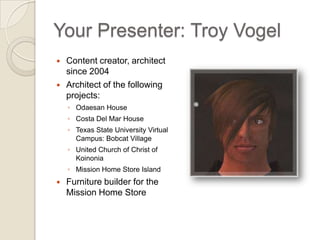
Your Presenter: Troy Vogel Content creator, architect since 2004 Architect of the following projects: Odaesan House   Costa Del Mar House Texas State University Virtual Campus:  Bobcat Village United Church of Christ of Koinonia Mission Home Store Island Furniture builder for the  Mission Home Store
Arts & Crafts in the UK Arts & Crafts movement began in 1860s England with the ideas of the philosopher John Ruskin and designer and poet William Morris. Rebellion against Victorian industrialized production, poor working conditions and lack of respect for workmanship. Classical and then current industrial designs were both disregarding function and needs of residents of the spaces. This required a return to a more human centric approach to design & architecture.  Advocated a return to the Gothic architectural style Good products, and fine craftsmanship should be available to all – especially the working class. This will help them regain the dignity they lost. Machines should not impose design rules, design rules should impose how machines are used – wisely: use machines for drudgery work and blend in handcrafting for fine work & finishing.
Craftsman Style in the US One school believes that Greene and Greene are the pioneers of Craftsman in the US while another believes that A&C came over to the US around 1890-1920s titled as Craftsman by Gustav Stickley. The movement later was also referred to as the Mission after an article published in a newspaper about Gustav where he referred to one of his designs “in a Spanish Mission in Southern California.” Spanish Mission at the time meant Spanish Colonial and the juxtaposition of the Mission name used for Craftsman created much confusion then and even now amongst collectors. Hand crafted furniture, vases, and goods but everything must have a function. NO Victorian clutter in the house! Quarter sawn oak and best natural materials used.  Embellishments and decorations are restrained and/or functional (contrast to Victorian). Elaborate wood joinery: mortise & tenons.
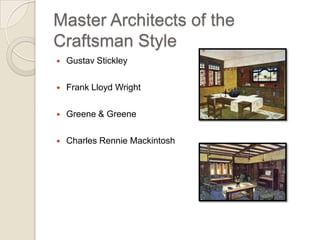
Master Architects of the  Craftsman Style Gustav Stickley Frank Lloyd Wright Greene & Greene Charles Rennie Mackintosh
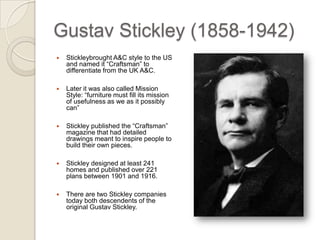
Gustav Stickley (1858-1942) Stickley brought A&C style to the US and named it “Craftsman” to differentiate from the UK A&C. Later it was also called Mission Style: “furniture must fill its mission of usefulness as we as it possibly can” Stickley published the “Craftsman” magazine that had detailed drawings meant to inspire people to build their own pieces. Stickley designed at least 241 homes and published over 221 plans between 1901 and 1916. There are two Stickley companies today both descendents of the original Gustav Stickley.
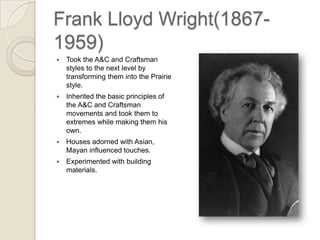
Frank Lloyd Wright (1867-1959) Took the A&C and Craftsman styles to the next level by transforming them into the Prairie style. Inherited the basic principles of the A&C and Craftsman movements and took them to extremes while making them his own. Houses adorned with Asian, Mayan influenced touches. Experimented with building materials.
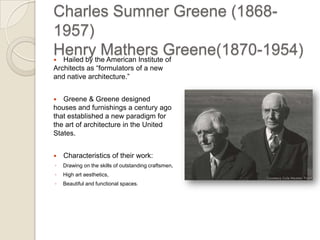
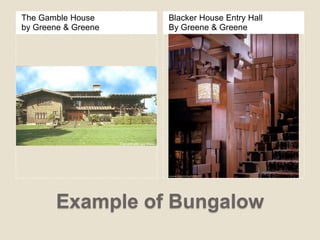
Charles Sumner Greene (1868-1957)  Henry Mathers Greene(1870-1954) Hailed by the American Institute of Architects as “formulators of a new and native architecture.”  Greene & Greene designed houses and furnishings a century ago that established a new paradigm for the art of architecture in the United States.  Characteristics of their work: Drawing on the skills of outstanding craftsmen, High art aesthetics,  Beautiful and functional spaces.
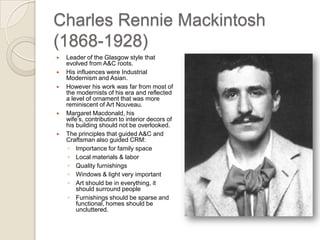
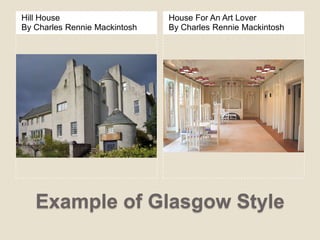
Charles Rennie Mackintosh (1868-1928) Leader of the Glasgow style that evolved from A&C roots. His influences were Industrial Modernism and Asian. However his work was far from most of the modernists of his era and reflected a level of ornament that was more reminiscent of Art Nouveau. Margaret Macdonald, his wife’s, contribution to interior decors of his building should not be overlooked. The principles that guided A&C and Craftsman also guided CRM: Importance for family space Local materials & labor Quality furnishings Windows & light very important Art should be in everything, it should surround people Furnishings should be sparse and functional, homes should be uncluttered.
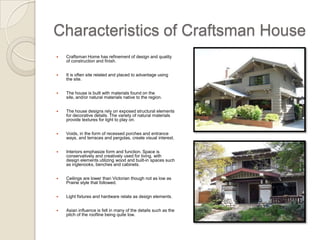
Characteristics of Craftsman House I Craftsman Home has refinement of design and quality of construction and finish. It is often site related and placed to advantage using the site. The house is built with materials found on the site, and/or natural materials native to the region. The house designs rely on exposed structural elements for decorative details. The variety of natural materials provide textures for light to play on . Voids, in the form of recessed porches and entrance ways, and terraces and pergolas, create visual interest.
Characteristics of Craftsman House II Interiors emphasize form and function. Space is conservatively and creatively used for living, with design elements utilizing wood and built-in spaces such as inglenooks, benches and cabinets. Ceilings are lower than Victorian though not as low as Prairie style that followed. Light fixtures and hardware relate as design elements. Asian influence is felt in many of the details such as the pitch of the roofline being quite low.
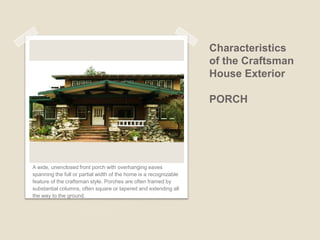
Characteristics of the Craftsman House Exterior PORCH A wide, unenclosed front porch with overhanging eaves spanning the full or partial width of the home is a recognizable feature of the craftsman style. Porches are often framed by substantial columns, often square or tapered and extending all the way to the ground.
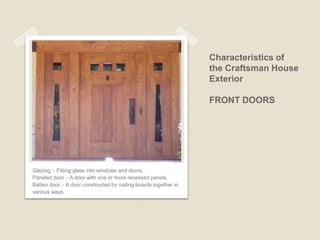
Characteristics of the Craftsman House Exterior FRONT DOORS Glazing – Fitting glass into windows and doors. Paneled door – A door with one or more recessed panels. Batten door – A door constructed by nailing boards together in various ways.
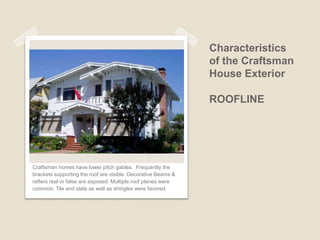
Characteristics of the Craftsman House Exterior ROOFLINE Craftsman homes have lower pitch gables.  Frequently the brackets supporting the roof are visible. Decorative Beams & rafters real or false are exposed. Multiple roof planes were common. Tile and slate as well as shingles were favored.
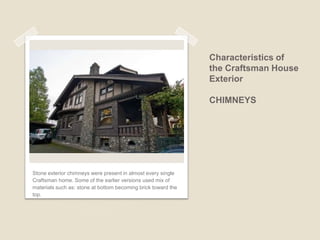
Characteristics of the Craftsman House Exterior CHIMNEYS Stone exterior chimneys were present in almost every single Craftsman home. Some of the earlier versions used mix of materials such as: stone at bottom becoming brick toward the top.
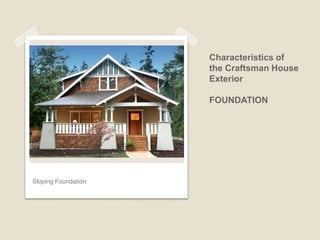
Characteristics of the Craftsman House Exterior FOUNDATION Sloping Foundation
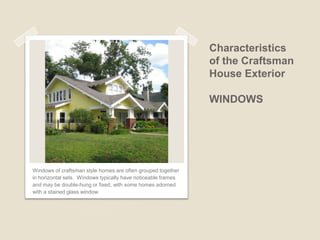
Characteristics of the Craftsman House Exterior WINDOWS Windows of craftsman style homes are often grouped together in horizontal sets.  Windows typically have noticeable frames and may be double-hung or fixed, with some homes adorned with a stained glass window.
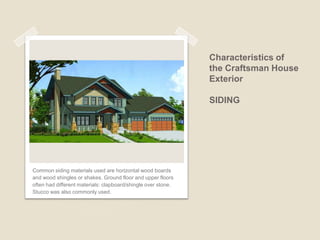
Characteristics of the Craftsman House Exterior SIDING Common siding materials used are horizontal wood boards and wood shingles or shakes. Ground floor and upper floors often had different materials: clapboard/shingle over stone. Stucco was also commonly used.
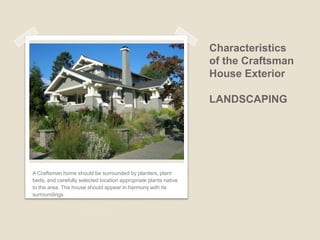
Characteristics of the Craftsman House Exterior LANDSCAPING A Craftsman home should be surrounded by planters, plant beds, and carefully selected location appropriate plants native to the area. The house should appear in harmony with its surroundings.
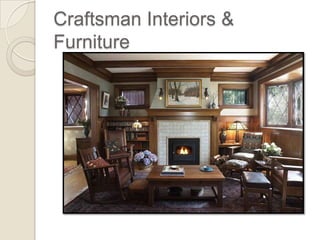
Craftsman Interiors & Furniture
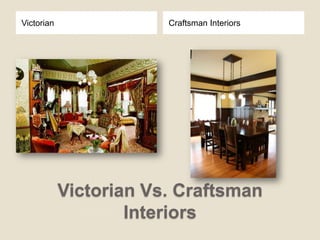
Victorian Vs. Craftsman Interiors Victorian Craftsman Interiors
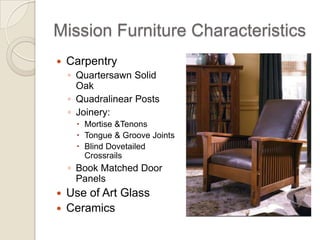
Mission Furniture Characteristics Carpentry Quartersawn Solid Oak Quadralinear Posts Joinery: Mortise & Tenons Tongue & Groove Joints Blind Dovetailed Crossrails Book Matched Door Panels Use of Art Glass Ceramics
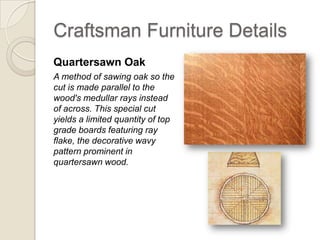
Craftsman Furniture Details Quartersawn Oak A method of sawing oak so the cut is made parallel to the wood's medullar rays instead of across. This special cut yields a limited quantity of top grade boards featuring ray flake, the decorative wavy pattern prominent in quartersawn wood.
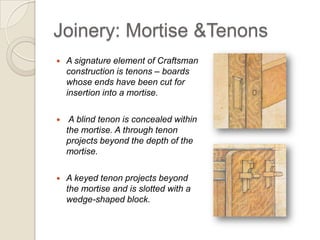
Joinery: Mortise & Tenons A signature element of Craftsman construction is tenons – boards whose ends have been cut for insertion into a mortise. A blind tenon is concealed within the mortise. A through tenon projects beyond the depth of the mortise. A keyed tenon projects beyond the mortise and is slotted with a wedge-shaped block.
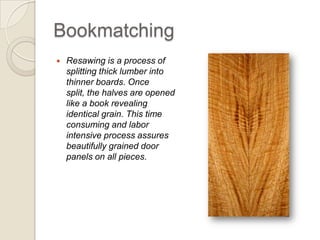
Bookmatching Resawing is a process of splitting thick lumber into thinner boards. Once split, the halves are opened like a book revealing identical grain. This time consuming and labor intensive process assures beautifully grained door panels on all pieces.
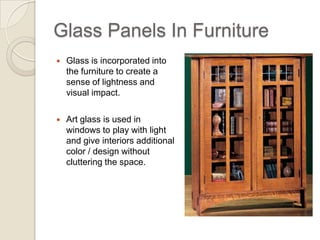
Glass Panels In Furniture Glass is incorporated into the furniture to create a sense of lightness and visual impact. Art glass is used in windows to play with light and give interiors additional color / design without cluttering the space.
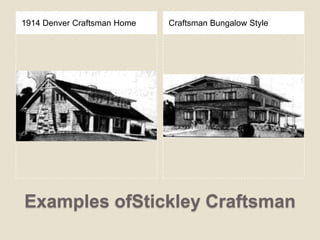
Examples of Stickley Craftsman 1914 Denver Craftsman Home Craftsman Bungalow Style
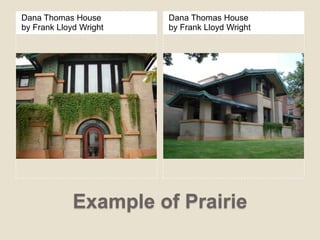
Example of Prairie Dana Thomas House by Frank Lloyd Wright Dana Thomas House by Frank Lloyd Wright
Example of Bungalow The Gamble House by Greene & Greene Blacker House Entry Hall By Greene & Greene
Example of Glasgow Style Hill House By Charles Rennie Mackintosh House For An Art Lover By Charles Rennie Mackintosh
References & Resources Online Resources Gustav Stickley and the Arts and Crafts Movement  Stickley Museum at Craftsman Farms Stickley Furniture Company Blog Post: What’s up with this Mission vs. Craftsman vs. Arts & Crafts Stuff? Excellent Mortise & Tenon Article on Wikipedia Craftsman Style Guide  (must read) Books Robert Rust and Kitty Turgeon,  Arts & Crafts , (New York, NY: Sterling Publishing, 1997) ISBN: 1-56799-363-X Robert W Lang,  Shop Drawing for Craftsman Interiors , (Bethel CT: Cambium Press, 2004) ISBN 1-892836-16-5 Robin Langley and David Rago,  The Arts & Crafts Movement , (New York,NY: Barnes & Noble) 2003 ISBN: 0-7607-4222-7

Craftsman 101

  • 1.
    Craftsman Style 101A Builder’s Guide to Recreating Craftsman in SL
  • 2.
    Your Presenter: TroyVogel Content creator, architect since 2004 Architect of the following projects: Odaesan House Costa Del Mar House Texas State University Virtual Campus: Bobcat Village United Church of Christ of Koinonia Mission Home Store Island Furniture builder for the Mission Home Store
  • 3.
    Arts & Craftsin the UK Arts & Crafts movement began in 1860s England with the ideas of the philosopher John Ruskin and designer and poet William Morris. Rebellion against Victorian industrialized production, poor working conditions and lack of respect for workmanship. Classical and then current industrial designs were both disregarding function and needs of residents of the spaces. This required a return to a more human centric approach to design & architecture. Advocated a return to the Gothic architectural style Good products, and fine craftsmanship should be available to all – especially the working class. This will help them regain the dignity they lost. Machines should not impose design rules, design rules should impose how machines are used – wisely: use machines for drudgery work and blend in handcrafting for fine work & finishing.
  • 4.
    Craftsman Style inthe US One school believes that Greene and Greene are the pioneers of Craftsman in the US while another believes that A&C came over to the US around 1890-1920s titled as Craftsman by Gustav Stickley. The movement later was also referred to as the Mission after an article published in a newspaper about Gustav where he referred to one of his designs “in a Spanish Mission in Southern California.” Spanish Mission at the time meant Spanish Colonial and the juxtaposition of the Mission name used for Craftsman created much confusion then and even now amongst collectors. Hand crafted furniture, vases, and goods but everything must have a function. NO Victorian clutter in the house! Quarter sawn oak and best natural materials used. Embellishments and decorations are restrained and/or functional (contrast to Victorian). Elaborate wood joinery: mortise & tenons.
  • 5.
    Master Architects ofthe Craftsman Style Gustav Stickley Frank Lloyd Wright Greene & Greene Charles Rennie Mackintosh
  • 6.
    Gustav Stickley (1858-1942)Stickley brought A&C style to the US and named it “Craftsman” to differentiate from the UK A&C. Later it was also called Mission Style: “furniture must fill its mission of usefulness as we as it possibly can” Stickley published the “Craftsman” magazine that had detailed drawings meant to inspire people to build their own pieces. Stickley designed at least 241 homes and published over 221 plans between 1901 and 1916. There are two Stickley companies today both descendents of the original Gustav Stickley.
  • 7.
    Frank Lloyd Wright(1867-1959) Took the A&C and Craftsman styles to the next level by transforming them into the Prairie style. Inherited the basic principles of the A&C and Craftsman movements and took them to extremes while making them his own. Houses adorned with Asian, Mayan influenced touches. Experimented with building materials.
  • 8.
    Charles Sumner Greene(1868-1957) Henry Mathers Greene(1870-1954) Hailed by the American Institute of Architects as “formulators of a new and native architecture.” Greene & Greene designed houses and furnishings a century ago that established a new paradigm for the art of architecture in the United States. Characteristics of their work: Drawing on the skills of outstanding craftsmen, High art aesthetics, Beautiful and functional spaces.
  • 9.
    Charles Rennie Mackintosh(1868-1928) Leader of the Glasgow style that evolved from A&C roots. His influences were Industrial Modernism and Asian. However his work was far from most of the modernists of his era and reflected a level of ornament that was more reminiscent of Art Nouveau. Margaret Macdonald, his wife’s, contribution to interior decors of his building should not be overlooked. The principles that guided A&C and Craftsman also guided CRM: Importance for family space Local materials & labor Quality furnishings Windows & light very important Art should be in everything, it should surround people Furnishings should be sparse and functional, homes should be uncluttered.
  • 10.
    Characteristics of CraftsmanHouse I Craftsman Home has refinement of design and quality of construction and finish. It is often site related and placed to advantage using the site. The house is built with materials found on the site, and/or natural materials native to the region. The house designs rely on exposed structural elements for decorative details. The variety of natural materials provide textures for light to play on . Voids, in the form of recessed porches and entrance ways, and terraces and pergolas, create visual interest.
  • 11.
    Characteristics of CraftsmanHouse II Interiors emphasize form and function. Space is conservatively and creatively used for living, with design elements utilizing wood and built-in spaces such as inglenooks, benches and cabinets. Ceilings are lower than Victorian though not as low as Prairie style that followed. Light fixtures and hardware relate as design elements. Asian influence is felt in many of the details such as the pitch of the roofline being quite low.
  • 12.
    Characteristics of theCraftsman House Exterior PORCH A wide, unenclosed front porch with overhanging eaves spanning the full or partial width of the home is a recognizable feature of the craftsman style. Porches are often framed by substantial columns, often square or tapered and extending all the way to the ground.
  • 13.
    Characteristics of theCraftsman House Exterior FRONT DOORS Glazing – Fitting glass into windows and doors. Paneled door – A door with one or more recessed panels. Batten door – A door constructed by nailing boards together in various ways.
  • 14.
    Characteristics of theCraftsman House Exterior ROOFLINE Craftsman homes have lower pitch gables. Frequently the brackets supporting the roof are visible. Decorative Beams & rafters real or false are exposed. Multiple roof planes were common. Tile and slate as well as shingles were favored.
  • 15.
    Characteristics of theCraftsman House Exterior CHIMNEYS Stone exterior chimneys were present in almost every single Craftsman home. Some of the earlier versions used mix of materials such as: stone at bottom becoming brick toward the top.
  • 16.
    Characteristics of theCraftsman House Exterior FOUNDATION Sloping Foundation
  • 17.
    Characteristics of theCraftsman House Exterior WINDOWS Windows of craftsman style homes are often grouped together in horizontal sets. Windows typically have noticeable frames and may be double-hung or fixed, with some homes adorned with a stained glass window.
  • 18.
    Characteristics of theCraftsman House Exterior SIDING Common siding materials used are horizontal wood boards and wood shingles or shakes. Ground floor and upper floors often had different materials: clapboard/shingle over stone. Stucco was also commonly used.
  • 19.
    Characteristics of theCraftsman House Exterior LANDSCAPING A Craftsman home should be surrounded by planters, plant beds, and carefully selected location appropriate plants native to the area. The house should appear in harmony with its surroundings.
  • 20.
  • 21.
    Victorian Vs. CraftsmanInteriors Victorian Craftsman Interiors
  • 22.
    Mission Furniture CharacteristicsCarpentry Quartersawn Solid Oak Quadralinear Posts Joinery: Mortise & Tenons Tongue & Groove Joints Blind Dovetailed Crossrails Book Matched Door Panels Use of Art Glass Ceramics
  • 23.
    Craftsman Furniture DetailsQuartersawn Oak A method of sawing oak so the cut is made parallel to the wood's medullar rays instead of across. This special cut yields a limited quantity of top grade boards featuring ray flake, the decorative wavy pattern prominent in quartersawn wood.
  • 24.
    Joinery: Mortise &Tenons A signature element of Craftsman construction is tenons – boards whose ends have been cut for insertion into a mortise. A blind tenon is concealed within the mortise. A through tenon projects beyond the depth of the mortise. A keyed tenon projects beyond the mortise and is slotted with a wedge-shaped block.
  • 25.
    Bookmatching Resawing isa process of splitting thick lumber into thinner boards. Once split, the halves are opened like a book revealing identical grain. This time consuming and labor intensive process assures beautifully grained door panels on all pieces.
  • 26.
    Glass Panels InFurniture Glass is incorporated into the furniture to create a sense of lightness and visual impact. Art glass is used in windows to play with light and give interiors additional color / design without cluttering the space.
  • 27.
    Examples of StickleyCraftsman 1914 Denver Craftsman Home Craftsman Bungalow Style
  • 28.
    Example of PrairieDana Thomas House by Frank Lloyd Wright Dana Thomas House by Frank Lloyd Wright
  • 29.
    Example of BungalowThe Gamble House by Greene & Greene Blacker House Entry Hall By Greene & Greene
  • 30.
    Example of GlasgowStyle Hill House By Charles Rennie Mackintosh House For An Art Lover By Charles Rennie Mackintosh
  • 31.
    References & ResourcesOnline Resources Gustav Stickley and the Arts and Crafts Movement Stickley Museum at Craftsman Farms Stickley Furniture Company Blog Post: What’s up with this Mission vs. Craftsman vs. Arts & Crafts Stuff? Excellent Mortise & Tenon Article on Wikipedia Craftsman Style Guide (must read) Books Robert Rust and Kitty Turgeon, Arts & Crafts , (New York, NY: Sterling Publishing, 1997) ISBN: 1-56799-363-X Robert W Lang, Shop Drawing for Craftsman Interiors , (Bethel CT: Cambium Press, 2004) ISBN 1-892836-16-5 Robin Langley and David Rago, The Arts & Crafts Movement , (New York,NY: Barnes & Noble) 2003 ISBN: 0-7607-4222-7