Infant and child Basic Life
Support
Infant Basic Life Support
• Ensure the safety of the rescuer and child
• Check the child’s responsiveness by gently stimulating the child and
asking loudly, ‘Are you all right?’
• Do not shake infants or children with suspected cervical spine
injuries.
Check for signs of a circulation (signs of life).
• take no more than 10 seconds to
check for signs of circulation such as
movement, coughing, or normal
breathing (but not agonal gasps)
• check the pulse but take no longer
than 10 seconds to do this.
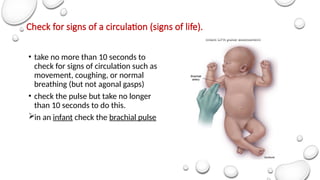
in an infant check the brachial pulse
Check for signs of a circulation (signs of life).
If there are no signs of life
• unless you are CERTAIN that you can feel a definite pulse of
greater than 60 beats per minute within 10 seconds, start chest
compression.
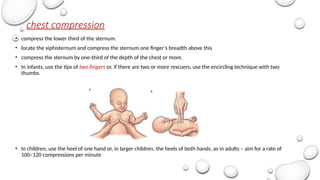
chest compression
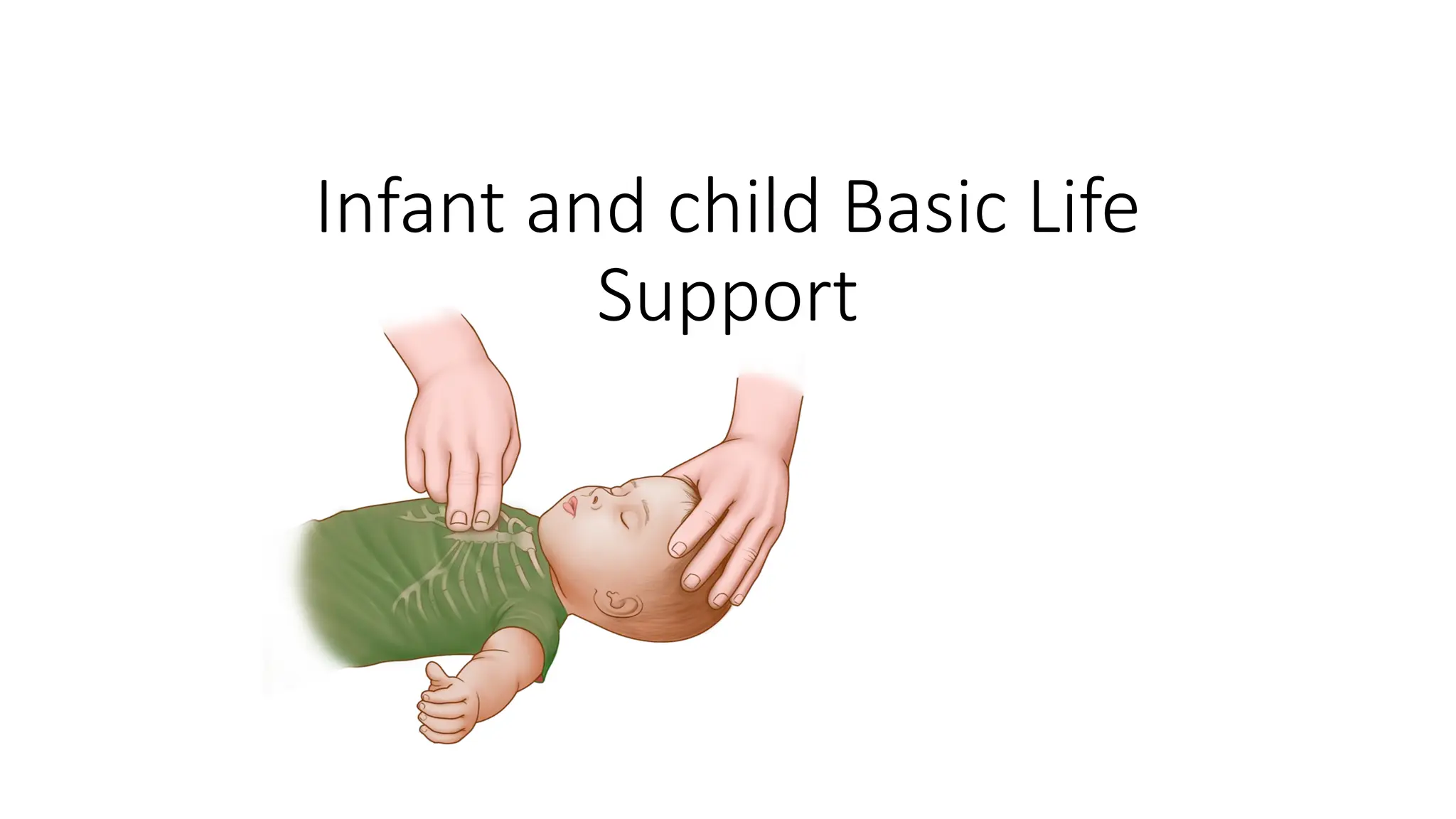
• compress the lower third of the sternum.
• locate the xiphisternum and compress the sternum one finger’s breadth above this
• compress the sternum by one-third of the depth of the chest or more.
• In infants, use the tips of two fingers or, if there are two or more rescuers, use the encircling technique with two
thumbs.
• In children, use the heel of one hand or, in larger children, the heels of both hands, as in adults – aim for a rate of
100–120 compressions per minute
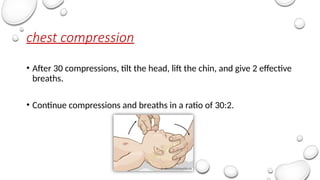
chest compression
• After 30 compressions, tilt the head, lift the chin, and give 2 effective
breaths.
• Continue compressions and breaths in a ratio of 30:2.
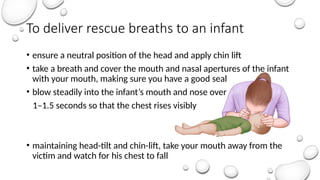
To deliver rescue breaths to an infant
• ensure a neutral position of the head and apply chin lift
• take a breath and cover the mouth and nasal apertures of the infant
with your mouth, making sure you have a good seal
• blow steadily into the infant’s mouth and nose over
1–1.5 seconds so that the chest rises visibly
• maintaining head-tilt and chin-lift, take your mouth away from the
victim and watch for his chest to fall
Check the child’s responsiveness
• For about two minutes, execute
CPR operations of about 30
compressions and two breaths
for five cycles. Check puls again
every 2 minutes.

CPR....pptx. . .

  • 1.
    Infant and childBasic Life Support
  • 2.
    Infant Basic LifeSupport • Ensure the safety of the rescuer and child • Check the child’s responsiveness by gently stimulating the child and asking loudly, ‘Are you all right?’ • Do not shake infants or children with suspected cervical spine injuries.
  • 3.
    Check for signsof a circulation (signs of life). • take no more than 10 seconds to check for signs of circulation such as movement, coughing, or normal breathing (but not agonal gasps) • check the pulse but take no longer than 10 seconds to do this. in an infant check the brachial pulse
  • 4.
    Check for signsof a circulation (signs of life). If there are no signs of life • unless you are CERTAIN that you can feel a definite pulse of greater than 60 beats per minute within 10 seconds, start chest compression.
  • 5.
    chest compression • compressthe lower third of the sternum. • locate the xiphisternum and compress the sternum one finger’s breadth above this • compress the sternum by one-third of the depth of the chest or more. • In infants, use the tips of two fingers or, if there are two or more rescuers, use the encircling technique with two thumbs. • In children, use the heel of one hand or, in larger children, the heels of both hands, as in adults – aim for a rate of 100–120 compressions per minute
  • 6.
    chest compression • After30 compressions, tilt the head, lift the chin, and give 2 effective breaths. • Continue compressions and breaths in a ratio of 30:2.
  • 7.
    To deliver rescuebreaths to an infant • ensure a neutral position of the head and apply chin lift • take a breath and cover the mouth and nasal apertures of the infant with your mouth, making sure you have a good seal • blow steadily into the infant’s mouth and nose over 1–1.5 seconds so that the chest rises visibly • maintaining head-tilt and chin-lift, take your mouth away from the victim and watch for his chest to fall
  • 8.
    Check the child’sresponsiveness • For about two minutes, execute CPR operations of about 30 compressions and two breaths for five cycles. Check puls again every 2 minutes.