STILLBIRTH
THARUN PONNUVEL KUMAR
DEFINITIONS
• Fetal death
• Death prior to the complete expulsion or extraction from its
mother of a product of human conception, irrespective of the
duration of pregnancy and which is not an induced
termination of pregnancy1
• Delivery of a fetus showing no signs of life
• Absence of breathing, heart beat, umbilical cord pulsations,
definitive voluntary movements
• Excludes
• Transient cardiac contractions
• Fleeting respiratory efforts (gasps)
DEFINITIONS
• Not all fetal deaths are stillbirths
• World Health Organization
• Fetal death late in pregnancy
• Allows each country to define gestational age at which
fetal death is considered stillbirth
• 16 to 28 weeks
• National Center for Health Statistics
• Most states use 20 weeks or a fetal weight of ≥ 350
g or ≥ 500 g
• 28 weeks (late stillbirth)
• Tennessee Code Annotated
• Fetal death ≥ 500 g or in the absence of weight, ≥ 22
completed weeks gestation
INCIDENCE
• > 3 million stillbirths each year worldwide
• 2005 rate of 6.2/1000 total births in US
• Rate of early stillbirth has remained stable
• Rate of late fetal loss has decreased by 29% since 1990
• African Americans have 2x stillbirth rate as Caucasians
• DM, HTN, abruption, PPROM
URBAN CHILD INSTITUTE
• July 2009 report
• Variation in 2006 Infant Mortality in Tennessee
• No universal method for calculating IMR
• Discrepancies in reports may be artificial
• Wide variation in reporting practices among counties
• Suggest Tennessee Office of Vital Records implement criteria to
differentiate fetal death vs live birth vs infant death
• American Academy of Pediatrics
• Threshold for live birth 400 gm or 23 weeks
ETIOLOGY
• Unknown in 25 – 60% of cases
• Identifiable causes can be attributed to
• Maternal conditions
• Fetal conditions
• Placental conditions
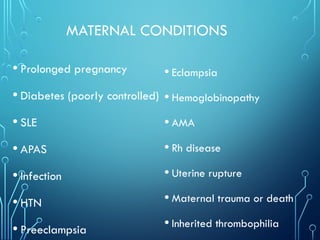
MATERNAL CONDITIONS
• Prolonged pregnancy
• Diabetes (poorly controlled)
• SLE
• APAS
• Infection
• HTN
• Preeclampsia
• Eclampsia
• Hemoglobinopathy
• AMA
• Rh disease
• Uterine rupture
• Maternal trauma or death
• Inherited thrombophilia
FETAL CONDITIONS
• Multiple gestation
• IUGR
• Congenital anomaly
• Genetic abnormality
• Infection
• Hydrops
PLACENTAL CONDITIONS
• Cord accident
• Abruption
• PROM
• Vasa previa
• Fetomaternal hemorrhage
• Placental insufficiency
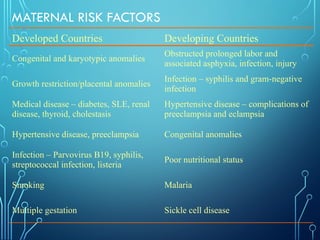
MATERNAL RISK FACTORS
Developed Countries Developing Countries
Congenital and karyotypic anomalies
Obstructed prolonged labor and
associated asphyxia, infection, injury
Growth restriction/placental anomalies
Infection – syphilis and gram-negative
infection
Medical disease – diabetes, SLE, renal
disease, thyroid, cholestasis
Hypertensive disease – complications of
preeclampsia and eclampsia
Hypertensive disease, preeclampsia Congenital anomalies
Infection – Parvovirus B19, syphilis,
streptococcal infection, listeria
Poor nutritional status
Smoking Malaria
Multiple gestation Sickle cell disease
RISK FACTORS IN DEVELOPED
COUNTRIES
• Non-Hispanic black race
• Nulliparity
• Advanced maternal age
• Obesity
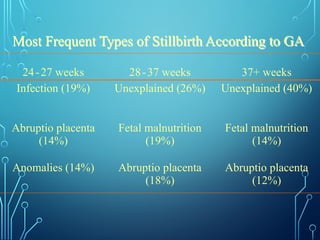
24-27 weeks 28-37 weeks 37+ weeks
Infection (19%) Unexplained (26%) Unexplained (40%)
Abruptio placenta
(14%)
Fetal malnutrition
(19%)
Fetal malnutrition
(14%)
Anomalies (14%) Abruptio placenta
(18%)
Abruptio placenta
(12%)
Most Frequent Types of Stillbirth According to GA
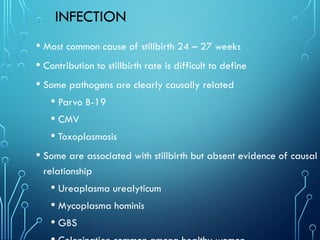
INFECTION
• Most common cause of stillbirth 24 – 27 weeks
• Contribution to stillbirth rate is difficult to define
• Some pathogens are clearly causally related
• Parvo B-19
• CMV
• Toxoplasmosis
• Some are associated with stillbirth but absent evidence of causal
relationship
• Ureaplasma urealyticum
• Mycoplasma hominis
• GBS
INFECTION
• Most stillbirths occur in premature fetuses
• 19% of stillbirths < 28 weeks
• 2% of stillbirths at term
• No change despite widespread use of antibiotics
• Viral pathogens are the most common source of
hematogenous infection of the placenta
• Fetal death resulting from maternal infection is rare
• Diagnostic criteria are not well defined
• High frequency of asymptomatic maternal colonizati
MULTIPLE GESTATIONS
• 19.6/1,000 stillbirth rate (4x singletons)
• Complications specific to multiple gestations
• TTTS
• Increased risk of common complications
• AMA
• Fetal anomalies
• Growth restriction
ADVANCED MATERNAL AGE
• Lethal congenital and chromosomal anomalies
• Medical complications associated with age
• Multiple gestations
• HTN
• DM
• AMA is an independent risk factor
• Unexplained fetal demise is the only type that is statistically more
common (late pregnancy)
ADVANCED MATERNAL AGE
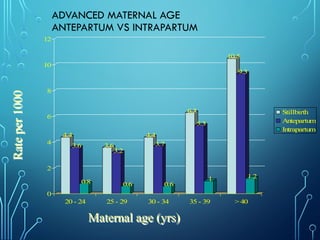
ANTEPARTUM VS INTRAPARTUM
4.4
3.6
0.8
3.6
3.2
0.6
4.4
3.7
0.6
6.3
5.3
1
10.5
9.3
1.2
0
2
4
6
8
10
12
20 - 24 25 - 29 30 - 34 35 - 39 >40
Stillbirth
Antepartum
Intrapartum
Maternal age (yrs)
Rate
per
1000
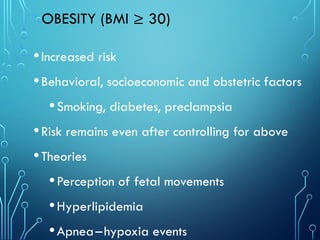
OBESITY (BMI ≥ 30)
•Increased risk
•Behavioral, socioeconomic and obstetric factors
•Smoking, diabetes, preclampsia
•Risk remains even after controlling for above
•Theories
•Perception of fetal movements
•Hyperlipidemia
•Apnea–hypoxia events
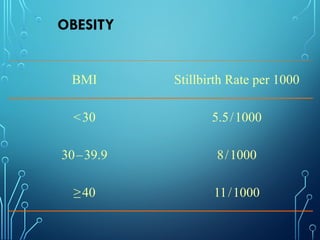
OBESITY
BMI Stillbirth Rate per 1000
<30 5.5/1000
30–39.9 8/1000
≥40 11/1000
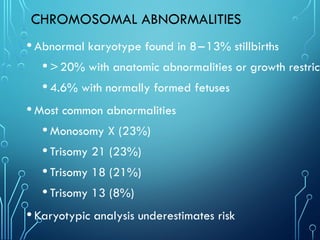
CHROMOSOMAL ABNORMALITIES
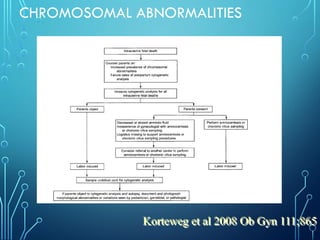
•Abnormal karyotype found in 8–13% stillbirths
•>20% with anatomic abnormalities or growth restrict
•4.6% with normally formed fetuses
•Most common abnormalities
•Monosomy X (23%)
•Trisomy 21 (23%)
•Trisomy 18 (21%)
•Trisomy 13 (8%)
•Karyotypic analysis underestimates risk
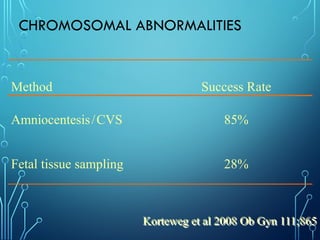
CHROMOSOMAL ABNORMALITIES
Method Success Rate
Amniocentesis/CVS 85%
Fetal tissue sampling 28%
Korteweg et al 2008 Ob Gyn 111;865
FETAL TISSUE
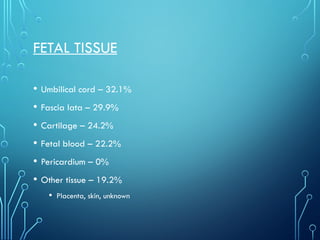
• Umbilical cord – 32.1%
• Fascia lata – 29.9%
• Cartilage – 24.2%
• Fetal blood – 22.2%
• Pericardium – 0%
• Other tissue – 19.2%
• Placenta, skin, unknown
CHROMOSOMAL ABNORMALITIES
Korteweg et al 2008 Ob Gyn 111;865
CORD ACCIDENTS
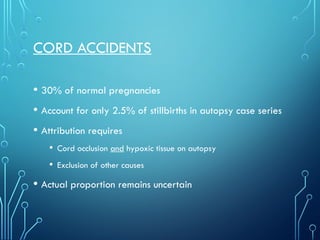
• 30% of normal pregnancies
• Account for only 2.5% of stillbirths in autopsy case series
• Attribution requires
• Cord occlusion and hypoxic tissue on autopsy
• Exclusion of other causes
• Actual proportion remains uncertain
THROMBOPHILIA
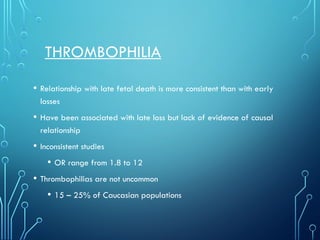
• Relationship with late fetal death is more consistent than with early
losses
• Have been associated with late loss but lack of evidence of causal
relationship
• Inconsistent studies
• OR range from 1.8 to 12
• Thrombophilias are not uncommon
• 15 – 25% of Caucasian populations
THROMBOPHILIA
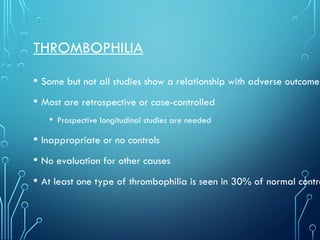
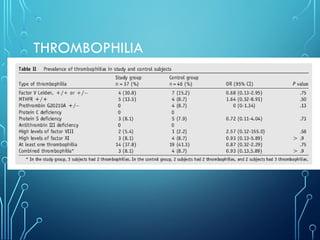
• Some but not all studies show a relationship with adverse outcomes
• Most are retrospective or case-controlled
• Prospective longitudinal studies are needed
• Inappropriate or no controls
• No evaluation for other causes
• At least one type of thrombophilia is seen in 30% of normal contro
THROMBOPHILIA
HEMATOLOGIC ETIOLOGY
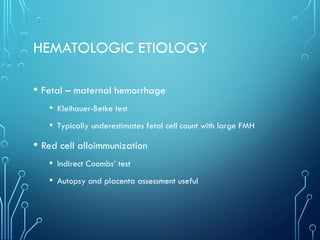
• Fetal – maternal hemorrhage
• Kleihauer-Betke test
• Typically underestimates fetal cell count with large FMH
• Red cell alloimmunization
• Indirect Coombs’ test
• Autopsy and placenta assessment useful
MEDICAL COMPLICATIONS
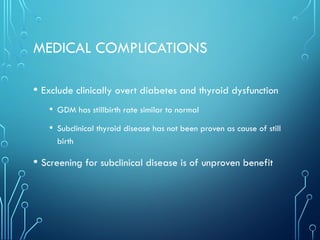
• Exclude clinically overt diabetes and thyroid dysfunction
• GDM has stillbirth rate similar to normal
• Subclinical thyroid disease has not been proven as cause of still
birth
• Screening for subclinical disease is of unproven benefit
ANTEPARTUM SURVEILLANCE
• Little evidence-based data to guide testing with previous
unexplained stillbirth
• 32 – 34 weeks
• 2 – 4 weeks before gestational age of previous still birth
• Most subsequent pregnancies have a favorable outcome
• Increased risk of iatrogenic prematurity
ANTEPARTUM SURVEILLANCE
• 300 women with previous stillbirth
• 49% unexplained
• 1 recurrent stillbirth despite reassuring testing
• Perinatal mortality 3.3/1000
• Earliest delivery associated with a positive test result was 32 weeks
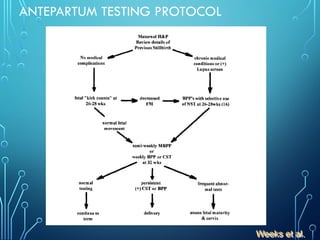
ANTEPARTUM TESTING PROTOCOL
Weeks et al.
ANTEPARTUM TESTING PROTOCOL
•Protocol may not be appropriate for all previous
stillbirths
•Nonrecurring conditions
•Perinatal infection
•Fetal anomalies
•Maternal trauma
•Stillbirths following OB complications that can
recur but cannot be predicted
•Abruption
•Prolapse
•Uterine rupture

stillbirth-pk final.pptx. .

  • 1.
  • 2.
    DEFINITIONS • Fetal death •Death prior to the complete expulsion or extraction from its mother of a product of human conception, irrespective of the duration of pregnancy and which is not an induced termination of pregnancy1 • Delivery of a fetus showing no signs of life • Absence of breathing, heart beat, umbilical cord pulsations, definitive voluntary movements • Excludes • Transient cardiac contractions • Fleeting respiratory efforts (gasps)
  • 3.
    DEFINITIONS • Not allfetal deaths are stillbirths • World Health Organization • Fetal death late in pregnancy • Allows each country to define gestational age at which fetal death is considered stillbirth • 16 to 28 weeks • National Center for Health Statistics • Most states use 20 weeks or a fetal weight of ≥ 350 g or ≥ 500 g • 28 weeks (late stillbirth) • Tennessee Code Annotated • Fetal death ≥ 500 g or in the absence of weight, ≥ 22 completed weeks gestation
  • 4.
    INCIDENCE • > 3million stillbirths each year worldwide • 2005 rate of 6.2/1000 total births in US • Rate of early stillbirth has remained stable • Rate of late fetal loss has decreased by 29% since 1990 • African Americans have 2x stillbirth rate as Caucasians • DM, HTN, abruption, PPROM
  • 5.
    URBAN CHILD INSTITUTE •July 2009 report • Variation in 2006 Infant Mortality in Tennessee • No universal method for calculating IMR • Discrepancies in reports may be artificial • Wide variation in reporting practices among counties • Suggest Tennessee Office of Vital Records implement criteria to differentiate fetal death vs live birth vs infant death • American Academy of Pediatrics • Threshold for live birth 400 gm or 23 weeks
  • 6.
    ETIOLOGY • Unknown in25 – 60% of cases • Identifiable causes can be attributed to • Maternal conditions • Fetal conditions • Placental conditions
  • 7.
    MATERNAL CONDITIONS • Prolongedpregnancy • Diabetes (poorly controlled) • SLE • APAS • Infection • HTN • Preeclampsia • Eclampsia • Hemoglobinopathy • AMA • Rh disease • Uterine rupture • Maternal trauma or death • Inherited thrombophilia
  • 8.
    FETAL CONDITIONS • Multiplegestation • IUGR • Congenital anomaly • Genetic abnormality • Infection • Hydrops
  • 9.
    PLACENTAL CONDITIONS • Cordaccident • Abruption • PROM • Vasa previa • Fetomaternal hemorrhage • Placental insufficiency
  • 10.
    MATERNAL RISK FACTORS DevelopedCountries Developing Countries Congenital and karyotypic anomalies Obstructed prolonged labor and associated asphyxia, infection, injury Growth restriction/placental anomalies Infection – syphilis and gram-negative infection Medical disease – diabetes, SLE, renal disease, thyroid, cholestasis Hypertensive disease – complications of preeclampsia and eclampsia Hypertensive disease, preeclampsia Congenital anomalies Infection – Parvovirus B19, syphilis, streptococcal infection, listeria Poor nutritional status Smoking Malaria Multiple gestation Sickle cell disease
  • 11.
    RISK FACTORS INDEVELOPED COUNTRIES • Non-Hispanic black race • Nulliparity • Advanced maternal age • Obesity
  • 12.
    24-27 weeks 28-37weeks 37+ weeks Infection (19%) Unexplained (26%) Unexplained (40%) Abruptio placenta (14%) Fetal malnutrition (19%) Fetal malnutrition (14%) Anomalies (14%) Abruptio placenta (18%) Abruptio placenta (12%) Most Frequent Types of Stillbirth According to GA
  • 13.
    INFECTION • Most commoncause of stillbirth 24 – 27 weeks • Contribution to stillbirth rate is difficult to define • Some pathogens are clearly causally related • Parvo B-19 • CMV • Toxoplasmosis • Some are associated with stillbirth but absent evidence of causal relationship • Ureaplasma urealyticum • Mycoplasma hominis • GBS
  • 14.
    INFECTION • Most stillbirthsoccur in premature fetuses • 19% of stillbirths < 28 weeks • 2% of stillbirths at term • No change despite widespread use of antibiotics • Viral pathogens are the most common source of hematogenous infection of the placenta • Fetal death resulting from maternal infection is rare • Diagnostic criteria are not well defined • High frequency of asymptomatic maternal colonizati
  • 15.
    MULTIPLE GESTATIONS • 19.6/1,000stillbirth rate (4x singletons) • Complications specific to multiple gestations • TTTS • Increased risk of common complications • AMA • Fetal anomalies • Growth restriction
  • 16.
    ADVANCED MATERNAL AGE •Lethal congenital and chromosomal anomalies • Medical complications associated with age • Multiple gestations • HTN • DM • AMA is an independent risk factor • Unexplained fetal demise is the only type that is statistically more common (late pregnancy)
  • 17.
    ADVANCED MATERNAL AGE ANTEPARTUMVS INTRAPARTUM 4.4 3.6 0.8 3.6 3.2 0.6 4.4 3.7 0.6 6.3 5.3 1 10.5 9.3 1.2 0 2 4 6 8 10 12 20 - 24 25 - 29 30 - 34 35 - 39 >40 Stillbirth Antepartum Intrapartum Maternal age (yrs) Rate per 1000
  • 18.
    OBESITY (BMI ≥30) •Increased risk •Behavioral, socioeconomic and obstetric factors •Smoking, diabetes, preclampsia •Risk remains even after controlling for above •Theories •Perception of fetal movements •Hyperlipidemia •Apnea–hypoxia events
  • 19.
    OBESITY BMI Stillbirth Rateper 1000 <30 5.5/1000 30–39.9 8/1000 ≥40 11/1000
  • 20.
    CHROMOSOMAL ABNORMALITIES •Abnormal karyotypefound in 8–13% stillbirths •>20% with anatomic abnormalities or growth restrict •4.6% with normally formed fetuses •Most common abnormalities •Monosomy X (23%) •Trisomy 21 (23%) •Trisomy 18 (21%) •Trisomy 13 (8%) •Karyotypic analysis underestimates risk
  • 21.
    CHROMOSOMAL ABNORMALITIES Method SuccessRate Amniocentesis/CVS 85% Fetal tissue sampling 28% Korteweg et al 2008 Ob Gyn 111;865
  • 22.
    FETAL TISSUE • Umbilicalcord – 32.1% • Fascia lata – 29.9% • Cartilage – 24.2% • Fetal blood – 22.2% • Pericardium – 0% • Other tissue – 19.2% • Placenta, skin, unknown
  • 23.
  • 24.
    CORD ACCIDENTS • 30%of normal pregnancies • Account for only 2.5% of stillbirths in autopsy case series • Attribution requires • Cord occlusion and hypoxic tissue on autopsy • Exclusion of other causes • Actual proportion remains uncertain
  • 25.
    THROMBOPHILIA • Relationship withlate fetal death is more consistent than with early losses • Have been associated with late loss but lack of evidence of causal relationship • Inconsistent studies • OR range from 1.8 to 12 • Thrombophilias are not uncommon • 15 – 25% of Caucasian populations
  • 26.
    THROMBOPHILIA • Some butnot all studies show a relationship with adverse outcomes • Most are retrospective or case-controlled • Prospective longitudinal studies are needed • Inappropriate or no controls • No evaluation for other causes • At least one type of thrombophilia is seen in 30% of normal contro
  • 27.
  • 28.
    HEMATOLOGIC ETIOLOGY • Fetal– maternal hemorrhage • Kleihauer-Betke test • Typically underestimates fetal cell count with large FMH • Red cell alloimmunization • Indirect Coombs’ test • Autopsy and placenta assessment useful
  • 29.
    MEDICAL COMPLICATIONS • Excludeclinically overt diabetes and thyroid dysfunction • GDM has stillbirth rate similar to normal • Subclinical thyroid disease has not been proven as cause of still birth • Screening for subclinical disease is of unproven benefit
  • 30.
    ANTEPARTUM SURVEILLANCE • Littleevidence-based data to guide testing with previous unexplained stillbirth • 32 – 34 weeks • 2 – 4 weeks before gestational age of previous still birth • Most subsequent pregnancies have a favorable outcome • Increased risk of iatrogenic prematurity
  • 31.
    ANTEPARTUM SURVEILLANCE • 300women with previous stillbirth • 49% unexplained • 1 recurrent stillbirth despite reassuring testing • Perinatal mortality 3.3/1000 • Earliest delivery associated with a positive test result was 32 weeks
  • 32.
  • 33.
    ANTEPARTUM TESTING PROTOCOL •Protocolmay not be appropriate for all previous stillbirths •Nonrecurring conditions •Perinatal infection •Fetal anomalies •Maternal trauma •Stillbirths following OB complications that can recur but cannot be predicted •Abruption •Prolapse •Uterine rupture

Editor's Notes

  • #3 WHO suggests live birth has birth weight 500 gm, gestational age of 22 weeks, and body length of 25 cm “any sign of life” criteria Fetal heart rate Breathing Movement of voluntary muscles 350 g is 50th percentile for 20 weeks gestation TCA Fetal death reported when ≥500 g or ≥22 weeks Birth and death certificates are not generated after miscarriage ability to call a fetal loss a stillbirth is important
  • #4 6.2/1000 live births and fetal deaths (total births = live births+fetal deaths) AA have 2x risk stillbirth Some of this increase can be attributed to access to and quality of medical care Even with adequate access , still have higher rate of stillbirth Higher rates diabetes, HTN, abruption, PPROM
  • #5 In July 2009 the Urban Child Institute in Memphis looked at the discrepancies in still births in Tennessee counties Concluded that differences were related to reporting different GA/weight
  • #8 Between 24-27 weeks, most common cause if stillbirth is infection (19%) Contribution of infection to stillbirth rate is difficult to define Some pathogens clearly causally associated with stillbirth Parvo CMV Toxo Other pathogens might be associated with increased risk of stillbirth but strong evidence of causal relation is absent Ureaplasma urealyticum Mycoplasma hominis GBS
  • #11 Nulliparity OR 1.2 – 1.4
  • #12 24-27 weeks, most common cause still birth Infection Stillbirth related to infection occur most frequently in fetuses <1000 g Abruption Anomalies 21% unexplained Stillbirth related to abruption has decreased over decades After 28 weeks, unexplained stillbirth increases Fetal death that is unexplained by fetal, placental, maternal, or obstetric factors represents 25-60% of all fetal deaths Diagnosis of exclusion Depends on rigorousness of stillbirth assessment
  • #14 Diagnostic criteria for determining if a fetal death is due to an infection are not well defined and complicated by high frequency of asymptomatic maternal vaginal colonization of some potential pathogens.
  • #15 Stillbirth rate 4x higher than singletons
  • #16 Childbearing increasing among older women Older women are at increased risk for adverse outcomes Low birth weight Preterm Fetal mortality Significant proportion of perinatal deaths in older women are related to lethal congenital and chromosomal abnormalities Increased risk of unexplained stillbirth late in pregnancy persists in older women even after controlling for risk factors such as HTN, DM, previa, multiple gestation AMA remains as independent risk factor after accounting for medical conditions that occur in older women Increased risk associated with anomalies has been reduced with prenatal diagnostic testing and availability of abortions Peak rise period in older mothers between 37-41 weeks but NO studies to examine differential risk antepartum vs intrapartum
  • #17  Mature gravidas at increased risk of various adverse outcomes Low birth weight Preterm SGA Stillbirth Link between advanced maternal age and stillbirth but little information on timing of in utero death Stillbirth defined In utero death > 20 weeks Excluded congenital malformations and chromosomal abnormalities Women 35-39 were more than 2-fold as likely to experience intrapartum stillbirth while those 40 or greater were 3x as likely Highest risk of stillbirth exhibited among mothers in oldest age group Higher levels of obstetric complications in older women could contribute to elevated risk for still birth Information on pregnancy complications not readily available in this data base Etiologic factors for antepartum and intrapartum stillbirth have been suggested to be different Preeclampsia, HTN, abnormal placental conditions are more likely to cause antepartum stillbirth Excess of these conditions in older women may explain 4-fold increment in occurrence of antepartum stillbirth among older women Intrapartum stillbirth more likely to result from fetal distress, obstructed labor Indication of access to and quality of care during delivery Different risk estimates for antepartum vs intrapartum stillbirth with maternal age may reflect dynamics in distribution and patterns of these etiologic factors as women age
  • #18 Thinner women may be better able to perceive fetal movement Hyperlipidemia Increased endothelial dysfunction Platelet aggregation Clinically significant atherosclerosis Sleep studies show obese women snore more and have increased apnea-hypoxia events Increased episodes oxygen destauration Snoring associated with pregnancy induced hypertension and growth restriction
  • #20 Karyotypic analysis underestimates genetic contribution to stillbirth 50% karyotype cell culture unsuccessful
  • #27 One of several studies which challenge association between thrombophilia and complications No difference in study and control group Findings are consistent with studies from Germany and Austria
  • #28 FMH common cause of stillbirth – screening advised KBT Fetal cells in maternal blood Elution of hemoglobin from adult cells Acid resistant fetal hemoglobin remains intact Statistical imprecision in quantifying FMH
  • #31 Recurrent stillbirth 2 unexplained previous stillbirths at 37 and 38 weeks 35 weeks gestation with decreased FM 3 days after negative CST D/C’d home after reactive NST Returned 16 hours later with no FM x 5 hrs IUFD confirmed
  • #33 Nonrecurring conditions Testing of limited value Affected mothers better served with screeening, education, counseling Recur but not predictable Unlikely to benefit from testing in subsequent pregnancies.