Rheumatoid
arthritis
Presentation by Tamar Partsvania – Doctor
Rheumatologist
17 July 2023
What is Rheumatoid arthritis (RA)?
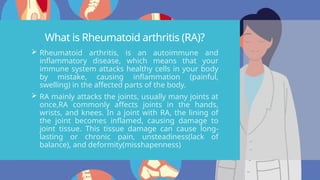
 Rheumatoid arthritis, is an autoimmune and
inflammatory disease, which means that your
immune system attacks healthy cells in your body
by mistake, causing inflammation (painful,
swelling) in the affected parts of the body.
 RA mainly attacks the joints, usually many joints at
once,RA commonly affects joints in the hands,
wrists, and knees. In a joint with RA, the lining of
the joint becomes inflamed, causing damage to
joint tissue. This tissue damage can cause long-
lasting or chronic pain, unsteadiness(lack of
balance), and deformity(misshapenness)
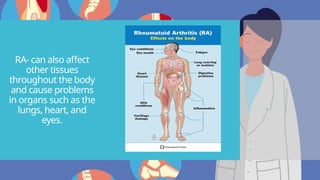
RA- can also affect
other tissues
throughout the body
and cause problems
in organs such as the
lungs, heart, and
eyes.
What are the Causes of Rheumatoid
Arthritis ?
The exact cause of rheumatoid arthritis is unknown. It is
believed to be due to a composition of genetic,
environmental and hormonal factors. However, the disease
sometimes develops due to an infection with a virus or
bacteria that may trigger it. Also, there are a variety of
factors that could affect the rate of arthritis and the most
major ones are:
 Smoking
 Alcohol consumption
 Obesity
 Injures
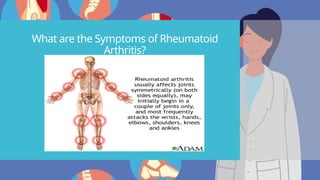
What are the Symptoms of Rheumatoid
Arthritis?
 Joint Stiffness >more than 1 hours, for 6 weeks,(that is usually
worse in the mornings and after inactivity)
 Joint Swelling-Swelling of wrists, MCP,PIPs joints for minimum 6
weeks
 Joint Pain(Tender)
 Fatigue, loss of appetite
 Minor Joint Swelling (Wrists, PIPs, MCP)
 Numbness & Tingling
 Fever
 Decrease in range of motion
What are the Symptoms of Rheumatoid
Arthritis?
How is rheumatoid arthritis diagnosed?
It can be difficult, and often takes time, to diagnose RA as the symptoms
can be similar to other types of arthritis. Rheumatologist will diagnose RA
from patient’s symptoms, a physical examination and various tests. These
can include:
 Blood Tests Used to Diagnose Rheumatoid Arthritis;
 CCP antibodies(Cyclic citrullinated peptide)
 rheumatoid factor (Testing negative for rheumatoid factor does’t prove
you don’t have RA. As many as two out of 10 people with RA will never
test positive for rheumatoid factor.
 C-reactive ptotein(CRP)
 Full blood count (CBC)
 ESR(Erythrocyte sedimentation rate)
 Antinuclear atntibody(ANA)
How is rheumatoid arthritis diagnosed?
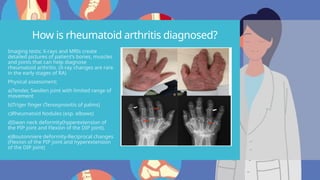
Imaging tests; X-rays and MRIs create
detailed pictures of patient’s bones, muscles
and joints that can help diagnose
rheumatoid arthritis. (X-ray changes are rare
in the early stages of RA)
Physical assessment;
a)Tender, Swollen joint with limited range of
movement
b)Triger finger (Tenosynovitis of palms)
c)Rheumatoid Nodules (esp. elbows)
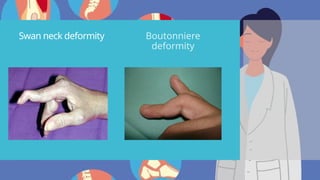
d)Swan neck deformity(hyperextension of
the PIP joint and Flexion of the DIP joint).
e)Boutonniere deformity-Reciprocal changes
(Flexion of the PIP joint and hyperextension
of the DIP joint)
Swan neck deformity Boutonniere
deformity
What is the basic treatment for
rheumatoid arthritis?
 Painkillers-such as paracetamol
 Non-steroidal anti-inflammatory drugs (NSAIDs) such as
naproxen or diclofenac
 Corticosteroids medicines or injections
 Disease-modifying anti-rheumatic drugs (DMARDs)such
as methotrexate, leflunomide, hydroxychloroquine,
sulfasalazine
 Biological DMARDs, such as tummour necrosis factor
(TNF) medicines (such as adalimumab, etanercept and
infliximab)
 JAK inhibitors- janus kinase inhibitors, they are approved
by the FDA to treat rheumatoid arthritis.
Complications:
The patient who has rheumatoid arthritis, has at a higher risk of
developing such as problems;
 lungs-inflammation of the lungs lining can lead to pulmonary
fibrosis, which can cause chest pain, a persistent cough and
shortness of breath
 Heart-inflammation of the tissue around the heart can lead to
pericarditis, which cause chest pain. Heart attack
 Eyes-inflammation of the eyes can lead to scleritis (can cause
eye redness and pain) or Sjogren’s syndtome(can cause dry eyes
 Blood vessels-inflammation of the blood vessels, known as
vasculitis. In serious cases, it can affect blood flow to your body’s
organs and tissues and can b e life threatening
 Joint damage-The most common surgeries are joint replacement
and synovectomy
Living With Rheumatoid Arthritis
Rheumatoid arthritis can be life changing.Here are some things
you can do to help;
 Self care-pe-ople who have a long-term condition, such as
rheumatoid arthritis, can benefit enormously from being
supported to care for themselves. They can live longer,have a
better of life,and be mor active and independent
 Take your medicine
 Regular reviews-As rheumatoid arthritis is a long-term
condition, you’ll be in contact with your healthcare team
regulary
 Keeping well- you may be advised to have a yearly Flu
vaccination
 Healthy eating and exercise
Thank You For Your
Attention !

Presentation1.pptx. .

  • 1.
    Rheumatoid arthritis Presentation by TamarPartsvania – Doctor Rheumatologist 17 July 2023
  • 2.
    What is Rheumatoidarthritis (RA)?  Rheumatoid arthritis, is an autoimmune and inflammatory disease, which means that your immune system attacks healthy cells in your body by mistake, causing inflammation (painful, swelling) in the affected parts of the body.  RA mainly attacks the joints, usually many joints at once,RA commonly affects joints in the hands, wrists, and knees. In a joint with RA, the lining of the joint becomes inflamed, causing damage to joint tissue. This tissue damage can cause long- lasting or chronic pain, unsteadiness(lack of balance), and deformity(misshapenness)
  • 3.
    RA- can alsoaffect other tissues throughout the body and cause problems in organs such as the lungs, heart, and eyes.
  • 4.
    What are theCauses of Rheumatoid Arthritis ? The exact cause of rheumatoid arthritis is unknown. It is believed to be due to a composition of genetic, environmental and hormonal factors. However, the disease sometimes develops due to an infection with a virus or bacteria that may trigger it. Also, there are a variety of factors that could affect the rate of arthritis and the most major ones are:  Smoking  Alcohol consumption  Obesity  Injures
  • 5.
    What are theSymptoms of Rheumatoid Arthritis?  Joint Stiffness >more than 1 hours, for 6 weeks,(that is usually worse in the mornings and after inactivity)  Joint Swelling-Swelling of wrists, MCP,PIPs joints for minimum 6 weeks  Joint Pain(Tender)  Fatigue, loss of appetite  Minor Joint Swelling (Wrists, PIPs, MCP)  Numbness & Tingling  Fever  Decrease in range of motion
  • 6.
    What are theSymptoms of Rheumatoid Arthritis?
  • 7.
    How is rheumatoidarthritis diagnosed? It can be difficult, and often takes time, to diagnose RA as the symptoms can be similar to other types of arthritis. Rheumatologist will diagnose RA from patient’s symptoms, a physical examination and various tests. These can include:  Blood Tests Used to Diagnose Rheumatoid Arthritis;  CCP antibodies(Cyclic citrullinated peptide)  rheumatoid factor (Testing negative for rheumatoid factor does’t prove you don’t have RA. As many as two out of 10 people with RA will never test positive for rheumatoid factor.  C-reactive ptotein(CRP)  Full blood count (CBC)  ESR(Erythrocyte sedimentation rate)  Antinuclear atntibody(ANA)
  • 9.
    How is rheumatoidarthritis diagnosed? Imaging tests; X-rays and MRIs create detailed pictures of patient’s bones, muscles and joints that can help diagnose rheumatoid arthritis. (X-ray changes are rare in the early stages of RA) Physical assessment; a)Tender, Swollen joint with limited range of movement b)Triger finger (Tenosynovitis of palms) c)Rheumatoid Nodules (esp. elbows) d)Swan neck deformity(hyperextension of the PIP joint and Flexion of the DIP joint). e)Boutonniere deformity-Reciprocal changes (Flexion of the PIP joint and hyperextension of the DIP joint)
  • 10.
    Swan neck deformityBoutonniere deformity
  • 11.
    What is thebasic treatment for rheumatoid arthritis?  Painkillers-such as paracetamol  Non-steroidal anti-inflammatory drugs (NSAIDs) such as naproxen or diclofenac  Corticosteroids medicines or injections  Disease-modifying anti-rheumatic drugs (DMARDs)such as methotrexate, leflunomide, hydroxychloroquine, sulfasalazine  Biological DMARDs, such as tummour necrosis factor (TNF) medicines (such as adalimumab, etanercept and infliximab)  JAK inhibitors- janus kinase inhibitors, they are approved by the FDA to treat rheumatoid arthritis.
  • 12.
    Complications: The patient whohas rheumatoid arthritis, has at a higher risk of developing such as problems;  lungs-inflammation of the lungs lining can lead to pulmonary fibrosis, which can cause chest pain, a persistent cough and shortness of breath  Heart-inflammation of the tissue around the heart can lead to pericarditis, which cause chest pain. Heart attack  Eyes-inflammation of the eyes can lead to scleritis (can cause eye redness and pain) or Sjogren’s syndtome(can cause dry eyes  Blood vessels-inflammation of the blood vessels, known as vasculitis. In serious cases, it can affect blood flow to your body’s organs and tissues and can b e life threatening  Joint damage-The most common surgeries are joint replacement and synovectomy
  • 14.
    Living With RheumatoidArthritis Rheumatoid arthritis can be life changing.Here are some things you can do to help;  Self care-pe-ople who have a long-term condition, such as rheumatoid arthritis, can benefit enormously from being supported to care for themselves. They can live longer,have a better of life,and be mor active and independent  Take your medicine  Regular reviews-As rheumatoid arthritis is a long-term condition, you’ll be in contact with your healthcare team regulary  Keeping well- you may be advised to have a yearly Flu vaccination  Healthy eating and exercise
  • 15.
    Thank You ForYour Attention !