COVID-19:
SUPPLY CHAIN MATTERS
Daniel Muir
Supply Chain Scotland
April 16th, 2020
CONTENT
 Supply Chain Risk
 Resilience
 Responding to the Crisis
 Future strategy
INTRODUCTION
 The Covid-19 crisis has thrown the importance –
and vulnerability – of Supply Chains into focus
 Started with concerns about the impact of
shutdowns in Chinese factories on global
automotive supply chains
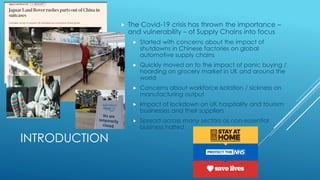
 Quickly moved on to the impact of panic buying /
hoarding on grocery market in UK and around the
world
 Concerns about workforce isolation / sickness on
manufacturing output
 Impact of lockdown on UK hospitality and tourism
businesses and their suppliers
 Spread across many sectors as non-essential
business halted
INTRODUCTION
 Even large, global supply chains have shown themselves to be
vulnerable
 Supplier failures where production shut down in other parts of the
world
 Logistics challenges as borders were closed
 Little buffer stock held across supply chain so any interruption
causes impact quickly
 Volatile demand impact on normally stable items
 “Bullwhip effect” amplifies demand back upstream causing
shortages
 Relatively small overall demand increases can lead to stock-outs
in retailers
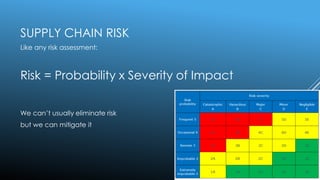
SUPPLY CHAIN RISK
Like any risk assessment:
Risk = Probability x Severity of Impact
We can’t usually eliminate risk
but we can mitigate it
SUPPLY CHAIN RISK
External (D)
Consumers
Customers
Logistics providers
Internal
Sales Team & C S
Planning
Production
Warehouse &
Despatch
External (S)
Suppliers
[and upstream
supply chain]
SUPPLY CHAIN RISK - EXTERNAL
 Demand (Customer) side – Extreme Demand Volatility
 Increase or Decrease
 Very difficult to predict
 Changes in range / route to market
 Customer Pressure
 Logistics Service
SUPPLY CHAIN RISK - EXTERNAL
 Supplier side - Failure to Supply
 Unable to produce (staffing / shutdown)
 Raw materials further up chain
 Logistics challenges
 Competition for resources
SUPPLY CHAIN RISK - INTERNAL
 Staff shortages (illness/furlough/lockdown)
 Operational output impact
 Business Process failure
 Inventory
 Cashflow
RESILIENCE
 Supply Chain Mapping exercise
 Assess risks across your entire supply chain
 Prioritise highest risk areas
 Identify mitigating strategies
 Apply or have them ready to activate
RESILIENCE
 Mitigating Strategies
 Inventory
 Spare Capacity
 Outsourcing / Insourcing
 Alternative Suppliers / dual sourcing
 There is some cost involved with most of these
 Assess cost/benefit analysis
 What is the cost of not doing anything?
RESPONDING TO THE CRISIS
 Before the crisis?
 When the crisis is happening
 Returning to Business as Usual
 Longer term
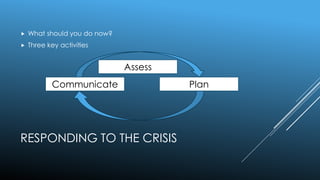
RESPONDING TO THE CRISIS
 What should you do now?
 Three key activities
Communicate Plan
Assess
COMMUNICATE
 Customers
 How is their business impacted?
 What changes in demand are they seeing?
 What does that mean for you?
 How can you help them?
 Provide reassurance
COMMUNICATE
 Suppliers
 Share your plans
 What is their current & future supply situation?
 What risks do they have in obtaining materials or maintaining
production?
 What demands you expect to place on them?
 How can you help them?
COMMUNICATE
 Internal teams & colleagues
 Keep your own team fully informed
 Provide reassurance
 Understand impacts across rest of business
 Resilience plans for coping with absence
 Prioritise activities
ASSESS
 Demand Side
 Increase – can you respond?
 Action plan
 Decrease
 Reduce/stop output?
 Any opportunity to recover
volume?
 Pivot to alternative products?
 Supply side
 Can suppliers meet needs?
 Are there alternatives?
 Is your own capacity affected?
 What are your options?
 Product range changes?
What did you find out?
PLAN
 Temptation not to plan because inputs are uncertain
 More important than ever!
 Create and share operational plan
 Observe changes and react to exceptions
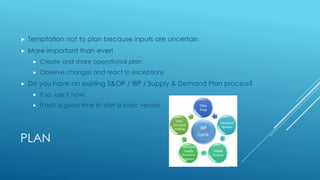
 Do you have an existing S&OP / IBP / Supply & Demand Plan process?
 If so, use it now!
 If not: a good time to start a basic version
PLAN
 Demand Planning
 Data-driven forecasting less relevant
 Customer engagement is key
 Consider changes in buying patterns
 Short term priority but try to keep longer term in mind
 Consider customer rationing as last resort if demand exceptional
 Create consensus
PLAN
 Supply Planning
 Take internal & external factors / risks into account
 Realistic production outputs
 If capacity is limited, consider consolidating on reduced range
 Stock deployment
 Communicate outputs clearly
PLAN
 S&OP / IBP Execution
 Senior management involved
 Review key assumptions and outputs
 Identify gaps and mitigating actions
 Assess impacts
 Approve plans or make decisions
 Communicate to all stakeholders
 Normally this process runs in a monthly cycle
 May need to increase frequency in short term
FUTURE STRATEGY
 This crisis will end!
 Demand patterns will change again as lockdown ends
 Keep communicating, keep planning
 When business as usual resumes
 Maintain good practice!
 Perform Supply Chain Mapping exercise
 Assess Supply Chain Risk
 Reassess procurement strategy
 Have a mitigation plan to build in Resilience
 Use S&OP / IBP process permanently
SUPPLY CHAIN MATTERS!
Remember….
Thank you.
Daniel@SupplyChainScotland.org
www.SupplyChainScotland.org

Covid-19 : Supply Chain Matters slide deck

  • 1.
    COVID-19: SUPPLY CHAIN MATTERS DanielMuir Supply Chain Scotland April 16th, 2020
  • 2.
    CONTENT  Supply ChainRisk  Resilience  Responding to the Crisis  Future strategy
  • 3.
    INTRODUCTION  The Covid-19crisis has thrown the importance – and vulnerability – of Supply Chains into focus  Started with concerns about the impact of shutdowns in Chinese factories on global automotive supply chains  Quickly moved on to the impact of panic buying / hoarding on grocery market in UK and around the world  Concerns about workforce isolation / sickness on manufacturing output  Impact of lockdown on UK hospitality and tourism businesses and their suppliers  Spread across many sectors as non-essential business halted
  • 4.
    INTRODUCTION  Even large,global supply chains have shown themselves to be vulnerable  Supplier failures where production shut down in other parts of the world  Logistics challenges as borders were closed  Little buffer stock held across supply chain so any interruption causes impact quickly  Volatile demand impact on normally stable items  “Bullwhip effect” amplifies demand back upstream causing shortages  Relatively small overall demand increases can lead to stock-outs in retailers
  • 5.
    SUPPLY CHAIN RISK Likeany risk assessment: Risk = Probability x Severity of Impact We can’t usually eliminate risk but we can mitigate it
  • 6.
    SUPPLY CHAIN RISK External(D) Consumers Customers Logistics providers Internal Sales Team & C S Planning Production Warehouse & Despatch External (S) Suppliers [and upstream supply chain]
  • 7.
    SUPPLY CHAIN RISK- EXTERNAL  Demand (Customer) side – Extreme Demand Volatility  Increase or Decrease  Very difficult to predict  Changes in range / route to market  Customer Pressure  Logistics Service
  • 8.
    SUPPLY CHAIN RISK- EXTERNAL  Supplier side - Failure to Supply  Unable to produce (staffing / shutdown)  Raw materials further up chain  Logistics challenges  Competition for resources
  • 9.
    SUPPLY CHAIN RISK- INTERNAL  Staff shortages (illness/furlough/lockdown)  Operational output impact  Business Process failure  Inventory  Cashflow
  • 10.
    RESILIENCE  Supply ChainMapping exercise  Assess risks across your entire supply chain  Prioritise highest risk areas  Identify mitigating strategies  Apply or have them ready to activate
  • 11.
    RESILIENCE  Mitigating Strategies Inventory  Spare Capacity  Outsourcing / Insourcing  Alternative Suppliers / dual sourcing  There is some cost involved with most of these  Assess cost/benefit analysis  What is the cost of not doing anything?
  • 12.
    RESPONDING TO THECRISIS  Before the crisis?  When the crisis is happening  Returning to Business as Usual  Longer term
  • 13.
    RESPONDING TO THECRISIS  What should you do now?  Three key activities Communicate Plan Assess
  • 14.
    COMMUNICATE  Customers  Howis their business impacted?  What changes in demand are they seeing?  What does that mean for you?  How can you help them?  Provide reassurance
  • 15.
    COMMUNICATE  Suppliers  Shareyour plans  What is their current & future supply situation?  What risks do they have in obtaining materials or maintaining production?  What demands you expect to place on them?  How can you help them?
  • 16.
    COMMUNICATE  Internal teams& colleagues  Keep your own team fully informed  Provide reassurance  Understand impacts across rest of business  Resilience plans for coping with absence  Prioritise activities
  • 17.
    ASSESS  Demand Side Increase – can you respond?  Action plan  Decrease  Reduce/stop output?  Any opportunity to recover volume?  Pivot to alternative products?  Supply side  Can suppliers meet needs?  Are there alternatives?  Is your own capacity affected?  What are your options?  Product range changes? What did you find out?
  • 18.
    PLAN  Temptation notto plan because inputs are uncertain  More important than ever!  Create and share operational plan  Observe changes and react to exceptions  Do you have an existing S&OP / IBP / Supply & Demand Plan process?  If so, use it now!  If not: a good time to start a basic version
  • 19.
    PLAN  Demand Planning Data-driven forecasting less relevant  Customer engagement is key  Consider changes in buying patterns  Short term priority but try to keep longer term in mind  Consider customer rationing as last resort if demand exceptional  Create consensus
  • 20.
    PLAN  Supply Planning Take internal & external factors / risks into account  Realistic production outputs  If capacity is limited, consider consolidating on reduced range  Stock deployment  Communicate outputs clearly
  • 21.
    PLAN  S&OP /IBP Execution  Senior management involved  Review key assumptions and outputs  Identify gaps and mitigating actions  Assess impacts  Approve plans or make decisions  Communicate to all stakeholders  Normally this process runs in a monthly cycle  May need to increase frequency in short term
  • 22.
    FUTURE STRATEGY  Thiscrisis will end!  Demand patterns will change again as lockdown ends  Keep communicating, keep planning  When business as usual resumes  Maintain good practice!  Perform Supply Chain Mapping exercise  Assess Supply Chain Risk  Reassess procurement strategy  Have a mitigation plan to build in Resilience  Use S&OP / IBP process permanently
  • 23.
    SUPPLY CHAIN MATTERS! Remember…. Thankyou. Daniel@SupplyChainScotland.org www.SupplyChainScotland.org