SUPPLY CHAIN RISK
MANAGEMENT IN
GLOBAL BUSINESS
Made By: Akshit Aggarwal(500125566)
Anshul Sharma (500124624)
Divij Hajela (500126643)
Harshit Bisht(500123339)
Niharika Singh (500122295)
Ritik Yadav(500126063)
Submitted To : Dr. Pradeep Chauhan
“Risk comes
from not
knowing
what you`re
doing”
Warren
Buffett
Supply chain risk management (SCRM) is "the implementation of
strategies to manage both everyday and exceptional risks along
the supply chain based on continuous risk assessment with the
objective of reducing vulnerability and ensuring continuity”
Wikipedia
A global supply chain is “the worldwide system a business uses to produce products or services,” according to
the Business Development Bank of Canada (BDC). This system covers every stage of the process, starting
with the procurement of raw materials and continuing through production, assembly, shipping, and customer
delivery of the completed product. A global supply chain can have a genuinely wide-ranging impact, including
many continents and a number of stakeholders, including distributors, manufacturers, and overseas suppliers.
INTRODUCTION TO GLOBAL SUPPLY CHAIN
1.Cost Efficiency:
• Economies of Scale
• Competitive Pricing
2. Market Expansion:
• Global Reach
• Increased Revenue.
3. Access to Resources:
• Diverse Suppliers
• Innovation and Expertise
4. Risk Management:
• Diversification
• Resilience
IMPORTANCE OF GLOBAL SUPPLY CHAIN
Key trends shaping the evolving landscape of global supply chains:
1.Resilience and Risk Management
•The COVID-19 pandemic highlighted vulnerabilities in global supply chains, leading businesses to prioritize
resilience. Companies are now implementing strategies like dual sourcing, nearshoring, and increasing inventory
buffers to mitigate disruptions.
•Risk management has become central, with firms analyzing geopolitical tensions, climate risks, and trade
regulations to build more adaptable supply chains.
2. Digital Transformation and Technology Adoption
•Technologies such as IoT, AI, blockchain, and advanced analytics are transforming supply chain operations.
These tools enable real-time visibility, predictive analytics, and data-driven decision-making, leading to enhanced
efficiency and responsiveness.
•Blockchain, for instance, enhances transparency and traceability, while AI and machine learning facilitate
demand forecasting, inventory optimization, and route planning.
3. Sustainability and Green Supply Chains
•With increased consumer awareness and regulatory pressure, companies are focusing on sustainable practices.
This includes reducing carbon emissions, utilizing eco-friendly packaging, and optimizing logistics for lower
environmental impact.
•Green supply chain practices also involve circular economy models where products are reused, recycled, or
refurbished to minimize waste.
1. Background
Identifying and Assessing Supply Chain Risks
Types of Supply Chain Risks
1. Operational Risks:
1. Disruptions: Natural disasters, labor strikes, political instability, and pandemics can disrupt supply
chains.
2. Quality Issues: Product defects, quality control failures, and supplier quality issues can lead to
customer dissatisfaction and financial losses.
3. Capacity Constraints: Insufficient production capacity or logistical limitations can hinder timely
delivery.
4. Inventory Management Issues: Poor inventory management can result in stockouts or excess
inventory.
2. Financial Risks:
1. Currency Fluctuations: Changes in exchange rates can impact the cost of imports and exports.
2. Credit Risk: The risk of non-payment from customers or suppliers.
3. Economic Downturns: Economic recessions can reduce demand and increase costs.
3. Security Risks:
1. Cybersecurity Threats: Cyberattacks can compromise sensitive data and disrupt operations.
2. Physical Security Threats: Theft, piracy, and terrorism can disrupt supply chains.
3. Counterfeit Products: Counterfeit goods can damage brand reputation and erode market share.
Risk Assessment Techniques
SWOT Analysis:
•Identifies strengths, weaknesses, opportunities, and threats.
•Helps assess internal capabilities and external factors that may impact the supply chain.
PESTLE Analysis:
•Considers political, economic, social, technological, legal, and environmental factors.
•Helps identify external factors that may affect the supply chain.
Risk Matrix:
•Prioritizes risks based on their likelihood and impact.
•Visualizes risks and helps in decision-making regarding risk mitigation strategies.
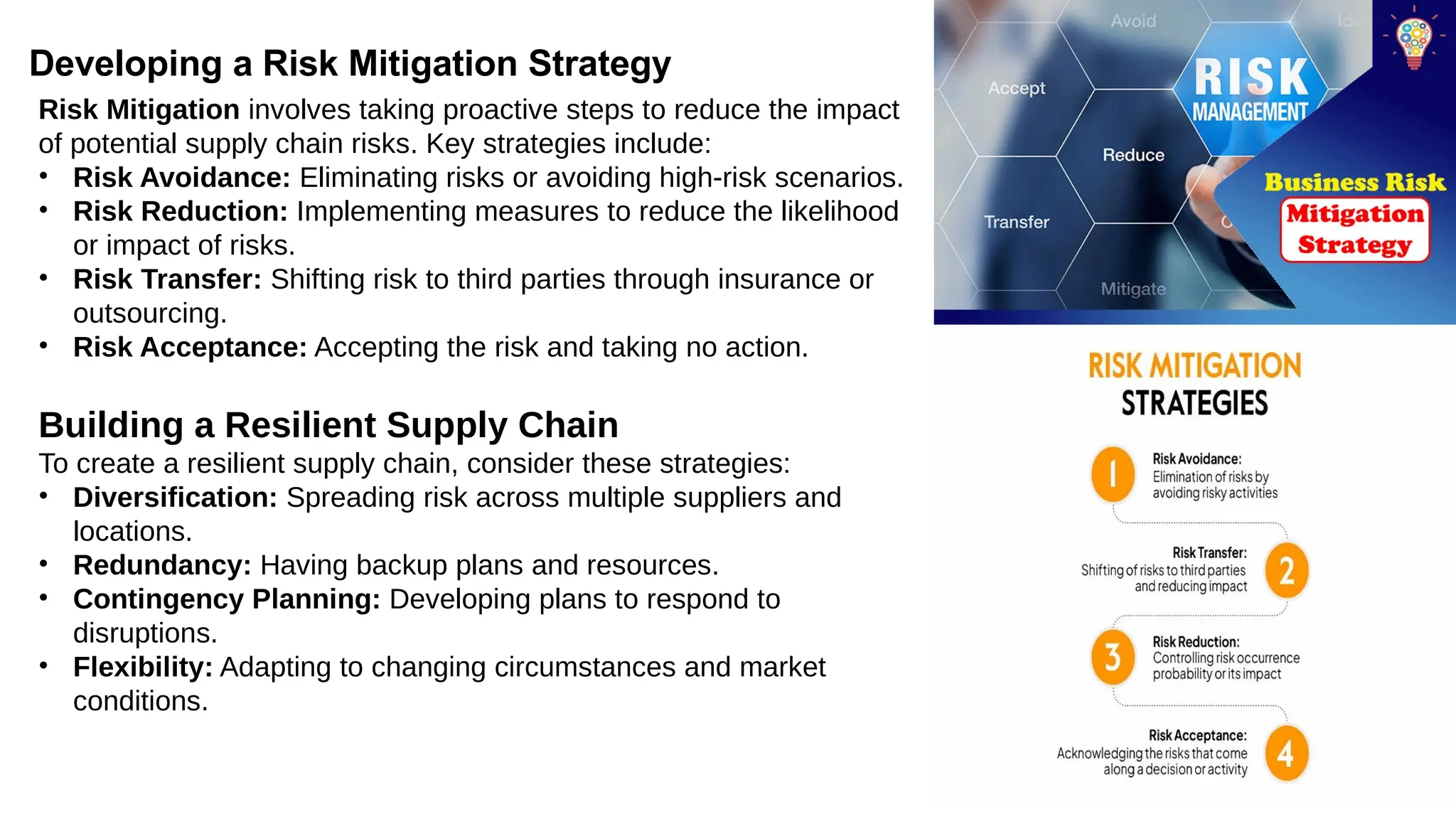
Developing a Risk Mitigation Strategy
Risk Mitigation involves taking proactive steps to reduce the impact
of potential supply chain risks. Key strategies include:
• Risk Avoidance: Eliminating risks or avoiding high-risk scenarios.
• Risk Reduction: Implementing measures to reduce the likelihood
or impact of risks.
• Risk Transfer: Shifting risk to third parties through insurance or
outsourcing.
• Risk Acceptance: Accepting the risk and taking no action.
Building a Resilient Supply Chain
To create a resilient supply chain, consider these strategies:
• Diversification: Spreading risk across multiple suppliers and
locations.
• Redundancy: Having backup plans and resources.
• Contingency Planning: Developing plans to respond to
disruptions.
• Flexibility: Adapting to changing circumstances and market
conditions.
Risks Management
Process
Risks
Identification
 Collect data
 Internal and
external
Evaluate
Options
 Interdepartmental
team - supply
management as key
 Cost benefit
analysis
 Develop rank and
priorities
Continuous
Assessment
 Regular review of
risk and mitigations
 Update to top
management
Implement
Mitigations
 Assign action leads
 Apply identified
tactics
Implementing Risk Management Strategies: Real-world Examples
entification and Assessment
•
Toyota: Uses a rigorous Failure Mode and Effects Analysis (FMEA) to identify potential k Identification
and Assessment
•Toyota: Uses a rigorous Failure Mode and
Effects Analysis (FMEA) to identify
potential failures in its manufacturing
processes and takes proactive steps to
mitigate them.
Risk Identification and Assessment
Toyota: Uses a rigorous Failure Mode and Effects Analysis (FMEA) to identify potential failures
in its manufacturing processes and takes proactive steps to mitigate them.
Risk Mitigation Strategies
•Risk Avoidance: Apple: Diversifies its supply chain by sourcing components from multiple suppliers
to reduce dependence on a single source.
Risk Reduction:
•Boeing: Invests heavily in quality control and testing to minimize product defects.
•Amazon: Implements robust warehouse management systems to optimize inventory levels and
reduce the risk of stockouts.
•Risk Transfer:
•Many companies: Purchase insurance policies to protect against various risks, such as property
damage, liability claims, and business interruption.
•Risk Acceptance:
•Startups: May accept certain risks, such as market uncertainty, as part of their growth strategy.
Building a Resilient Supply Chain
•Diversification:
•Tesla: Sources raw materials from multiple suppliers to mitigate
supply chain disruptions.
•Redundancy:
•Intel: Maintains multiple manufacturing facilities worldwide to
minimize the impact of localized disruptions.
•Contingency Planning:
•Honda: Has detailed contingency plans for natural disasters, labor
strikes, and other unforeseen events.
•Flexibility:
•Zara: Uses a fast fashion model to quickly adapt to changing trends
and consumer preferences
Technology-Enabled Risk Management
•Real-time Tracking: Companies like FedEx and UPS use GPS tracking to
monitor shipments and improve delivery times.
•Predictive Analytics: Retailers like Amazon use data analytics to forecast
demand and optimize inventory levels.
•Blockchain: Companies in various industries are exploring blockchain
technology to enhance supply chain transparency and security.
Continuous Monitoring and Evaluation
•Regular Risk Assessments: Many companies conduct annual risk
assessments to identify emerging threats and opportunities.
•Key Performance Indicator (KPI) Tracking: Monitoring KPIs like
delivery time, quality, and cost to identify potential issues.
•Post-Incident Reviews: Analyzing past incidents to learn from
mistakes and improve future risk management practices.
Monitoring and evaluating the supply chain risk:
Mitigating Disruptions in the Automotive Industry:
1.Identifying Risks: The automotive industry is particularly vulnerable to supply chain disruptions, such as
shortages of critical components or natural disasters affecting manufacturing facilities. Nissan’s Tsunami
Response: After the 2011 earthquake and tsunami in Japan, Nissan implemented disaster recovery plans that
allowed them to quickly restore production. The company-built redundancies into its manufacturing processes
and suppliers to ensure that it could continue operations in the event of another disaster.
2.Scenario Planning: Leading automakers develop detailed contingency plans to address potential disruptions,
including alternative sourcing, inventory buffers, and production flexibility.
Ford and Brexit: In the lead-up to Brexit, Ford conducted thorough scenario planning to assess how potential
tariffs and border delays might impact its UK-based production. The company adjusted its supply chain and
production plans to manage potential border disruptions and cost increases.
3. Inventory Management & Safety Stock: Building up safety stock and strategically managing inventory can
help cushion against short-term disruptions. However, this comes at the risk of increasing holding costs.
Toyota’s Just-in-Time (JIT) Adjustment: Toyota is known for its JIT manufacturing system. In response to
disruptions, the company adjusted its JIT strategy by increasing its inventory of key components (such as
semiconductors) and creating a more flexible supply chain that could adapt to unforeseen events.
In conclusion, effective supply chain risk management (SCRM) is paramount for
businesses to thrive in today's dynamic global landscape. By proactively identifying,
assessing, and mitigating risks, organizations can safeguard their supply chains
against disruptions and ensure business continuity. Leveraging advanced technologies
like AI, blockchain, and IoT empowers businesses to gain real-time visibility, make
data-driven decisions, and respond swiftly to emerging challenges. By embracing a
holistic approach to risk management, organizations can build resilient supply chains
that are agile, adaptable, and sustainable, ultimately driving long-term success and
competitive advantage.
CONCLUSION

Risk management in global supply chain.pptx

  • 1.
    SUPPLY CHAIN RISK MANAGEMENTIN GLOBAL BUSINESS Made By: Akshit Aggarwal(500125566) Anshul Sharma (500124624) Divij Hajela (500126643) Harshit Bisht(500123339) Niharika Singh (500122295) Ritik Yadav(500126063) Submitted To : Dr. Pradeep Chauhan
  • 2.
    “Risk comes from not knowing whatyou`re doing” Warren Buffett
  • 3.
    Supply chain riskmanagement (SCRM) is "the implementation of strategies to manage both everyday and exceptional risks along the supply chain based on continuous risk assessment with the objective of reducing vulnerability and ensuring continuity” Wikipedia
  • 4.
    A global supplychain is “the worldwide system a business uses to produce products or services,” according to the Business Development Bank of Canada (BDC). This system covers every stage of the process, starting with the procurement of raw materials and continuing through production, assembly, shipping, and customer delivery of the completed product. A global supply chain can have a genuinely wide-ranging impact, including many continents and a number of stakeholders, including distributors, manufacturers, and overseas suppliers. INTRODUCTION TO GLOBAL SUPPLY CHAIN
  • 5.
    1.Cost Efficiency: • Economiesof Scale • Competitive Pricing 2. Market Expansion: • Global Reach • Increased Revenue. 3. Access to Resources: • Diverse Suppliers • Innovation and Expertise 4. Risk Management: • Diversification • Resilience IMPORTANCE OF GLOBAL SUPPLY CHAIN
  • 6.
    Key trends shapingthe evolving landscape of global supply chains: 1.Resilience and Risk Management •The COVID-19 pandemic highlighted vulnerabilities in global supply chains, leading businesses to prioritize resilience. Companies are now implementing strategies like dual sourcing, nearshoring, and increasing inventory buffers to mitigate disruptions. •Risk management has become central, with firms analyzing geopolitical tensions, climate risks, and trade regulations to build more adaptable supply chains. 2. Digital Transformation and Technology Adoption •Technologies such as IoT, AI, blockchain, and advanced analytics are transforming supply chain operations. These tools enable real-time visibility, predictive analytics, and data-driven decision-making, leading to enhanced efficiency and responsiveness. •Blockchain, for instance, enhances transparency and traceability, while AI and machine learning facilitate demand forecasting, inventory optimization, and route planning. 3. Sustainability and Green Supply Chains •With increased consumer awareness and regulatory pressure, companies are focusing on sustainable practices. This includes reducing carbon emissions, utilizing eco-friendly packaging, and optimizing logistics for lower environmental impact. •Green supply chain practices also involve circular economy models where products are reused, recycled, or refurbished to minimize waste.
  • 7.
    1. Background Identifying andAssessing Supply Chain Risks Types of Supply Chain Risks 1. Operational Risks: 1. Disruptions: Natural disasters, labor strikes, political instability, and pandemics can disrupt supply chains. 2. Quality Issues: Product defects, quality control failures, and supplier quality issues can lead to customer dissatisfaction and financial losses. 3. Capacity Constraints: Insufficient production capacity or logistical limitations can hinder timely delivery. 4. Inventory Management Issues: Poor inventory management can result in stockouts or excess inventory. 2. Financial Risks: 1. Currency Fluctuations: Changes in exchange rates can impact the cost of imports and exports. 2. Credit Risk: The risk of non-payment from customers or suppliers. 3. Economic Downturns: Economic recessions can reduce demand and increase costs. 3. Security Risks: 1. Cybersecurity Threats: Cyberattacks can compromise sensitive data and disrupt operations. 2. Physical Security Threats: Theft, piracy, and terrorism can disrupt supply chains. 3. Counterfeit Products: Counterfeit goods can damage brand reputation and erode market share.
  • 8.
    Risk Assessment Techniques SWOTAnalysis: •Identifies strengths, weaknesses, opportunities, and threats. •Helps assess internal capabilities and external factors that may impact the supply chain. PESTLE Analysis: •Considers political, economic, social, technological, legal, and environmental factors. •Helps identify external factors that may affect the supply chain. Risk Matrix: •Prioritizes risks based on their likelihood and impact. •Visualizes risks and helps in decision-making regarding risk mitigation strategies.
  • 9.
    Developing a RiskMitigation Strategy Risk Mitigation involves taking proactive steps to reduce the impact of potential supply chain risks. Key strategies include: • Risk Avoidance: Eliminating risks or avoiding high-risk scenarios. • Risk Reduction: Implementing measures to reduce the likelihood or impact of risks. • Risk Transfer: Shifting risk to third parties through insurance or outsourcing. • Risk Acceptance: Accepting the risk and taking no action. Building a Resilient Supply Chain To create a resilient supply chain, consider these strategies: • Diversification: Spreading risk across multiple suppliers and locations. • Redundancy: Having backup plans and resources. • Contingency Planning: Developing plans to respond to disruptions. • Flexibility: Adapting to changing circumstances and market conditions.
  • 10.
    Risks Management Process Risks Identification  Collectdata  Internal and external Evaluate Options  Interdepartmental team - supply management as key  Cost benefit analysis  Develop rank and priorities Continuous Assessment  Regular review of risk and mitigations  Update to top management Implement Mitigations  Assign action leads  Apply identified tactics
  • 11.
    Implementing Risk ManagementStrategies: Real-world Examples entification and Assessment • Toyota: Uses a rigorous Failure Mode and Effects Analysis (FMEA) to identify potential k Identification and Assessment •Toyota: Uses a rigorous Failure Mode and Effects Analysis (FMEA) to identify potential failures in its manufacturing processes and takes proactive steps to mitigate them. Risk Identification and Assessment Toyota: Uses a rigorous Failure Mode and Effects Analysis (FMEA) to identify potential failures in its manufacturing processes and takes proactive steps to mitigate them. Risk Mitigation Strategies •Risk Avoidance: Apple: Diversifies its supply chain by sourcing components from multiple suppliers to reduce dependence on a single source. Risk Reduction: •Boeing: Invests heavily in quality control and testing to minimize product defects. •Amazon: Implements robust warehouse management systems to optimize inventory levels and reduce the risk of stockouts.
  • 12.
    •Risk Transfer: •Many companies:Purchase insurance policies to protect against various risks, such as property damage, liability claims, and business interruption. •Risk Acceptance: •Startups: May accept certain risks, such as market uncertainty, as part of their growth strategy. Building a Resilient Supply Chain •Diversification: •Tesla: Sources raw materials from multiple suppliers to mitigate supply chain disruptions. •Redundancy: •Intel: Maintains multiple manufacturing facilities worldwide to minimize the impact of localized disruptions. •Contingency Planning: •Honda: Has detailed contingency plans for natural disasters, labor strikes, and other unforeseen events. •Flexibility: •Zara: Uses a fast fashion model to quickly adapt to changing trends and consumer preferences
  • 13.
    Technology-Enabled Risk Management •Real-timeTracking: Companies like FedEx and UPS use GPS tracking to monitor shipments and improve delivery times. •Predictive Analytics: Retailers like Amazon use data analytics to forecast demand and optimize inventory levels. •Blockchain: Companies in various industries are exploring blockchain technology to enhance supply chain transparency and security. Continuous Monitoring and Evaluation •Regular Risk Assessments: Many companies conduct annual risk assessments to identify emerging threats and opportunities. •Key Performance Indicator (KPI) Tracking: Monitoring KPIs like delivery time, quality, and cost to identify potential issues. •Post-Incident Reviews: Analyzing past incidents to learn from mistakes and improve future risk management practices.
  • 14.
    Monitoring and evaluatingthe supply chain risk: Mitigating Disruptions in the Automotive Industry: 1.Identifying Risks: The automotive industry is particularly vulnerable to supply chain disruptions, such as shortages of critical components or natural disasters affecting manufacturing facilities. Nissan’s Tsunami Response: After the 2011 earthquake and tsunami in Japan, Nissan implemented disaster recovery plans that allowed them to quickly restore production. The company-built redundancies into its manufacturing processes and suppliers to ensure that it could continue operations in the event of another disaster. 2.Scenario Planning: Leading automakers develop detailed contingency plans to address potential disruptions, including alternative sourcing, inventory buffers, and production flexibility. Ford and Brexit: In the lead-up to Brexit, Ford conducted thorough scenario planning to assess how potential tariffs and border delays might impact its UK-based production. The company adjusted its supply chain and production plans to manage potential border disruptions and cost increases. 3. Inventory Management & Safety Stock: Building up safety stock and strategically managing inventory can help cushion against short-term disruptions. However, this comes at the risk of increasing holding costs. Toyota’s Just-in-Time (JIT) Adjustment: Toyota is known for its JIT manufacturing system. In response to disruptions, the company adjusted its JIT strategy by increasing its inventory of key components (such as semiconductors) and creating a more flexible supply chain that could adapt to unforeseen events.
  • 15.
    In conclusion, effectivesupply chain risk management (SCRM) is paramount for businesses to thrive in today's dynamic global landscape. By proactively identifying, assessing, and mitigating risks, organizations can safeguard their supply chains against disruptions and ensure business continuity. Leveraging advanced technologies like AI, blockchain, and IoT empowers businesses to gain real-time visibility, make data-driven decisions, and respond swiftly to emerging challenges. By embracing a holistic approach to risk management, organizations can build resilient supply chains that are agile, adaptable, and sustainable, ultimately driving long-term success and competitive advantage. CONCLUSION