

Tips on using my ppt.
1. You can freely download, edit, modify and put your
name etc.
2. Don’t be concerned about number of slides. Half the
slides are blanks except for the title.
3. First show the blank slides (eg. Aetiology ) > Ask
students what they already know about ethology of
today's topic. > Then show next slide which enumerates
aetiologies.
4. At the end rerun the show – show blank> ask questions >
show next slide.
5. This will be an ACTIVE LEARNING SESSION x
three revisions.
6. Good for self study also.
7. See notes for bibliography.
Learning Objectives
Learning Objectives
1. Introduction & History
2. Relevant Anatomy, Physiology
3. Aetiology
4. Pathophysiology
5. Pathology
6. Classification
7. Clinical Features
8. Investigations
9. Management
10. Prevention
11. Guidelines
12. Take home messages
Introduction & History.
•
Introduction & History.
• Coronavirus disease 2019 (COVID-19) is
defined as illness caused by a novel
coronavirus now called severe acute
respiratory syndrome coronavirus 2 (SARS-
CoV-2; formerly called 2019-nCoV),
• First identified amid an outbreak of
respiratory illness cases in Wuhan City,
Hubei Province, China.
Introduction & History.
• It was initially reported to the WHO on
December 31, 2019. On January 30, 2020,
the WHO declared the COVID-19 outbreak
a global health emergency. [2, 3] On March
11, 2020, the WHO declared COVID-19 a
global pandemic,
Aetiology
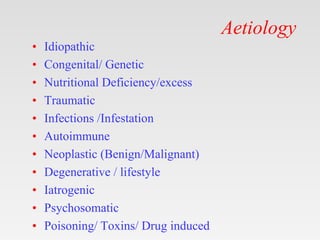
Aetiology
• Idiopathic
• Congenital/ Genetic
• Nutritional Deficiency/excess
• Traumatic
• Infections /Infestation
• Autoimmune
• Neoplastic (Benign/Malignant)
• Degenerative / lifestyle
• Iatrogenic
• Psychosomatic
• Poisoning/ Toxins/ Drug induced
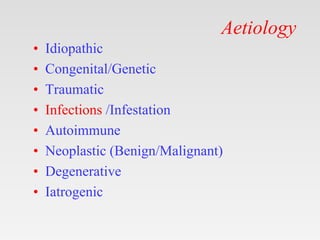
Aetiology
• Idiopathic
• Congenital/Genetic
• Traumatic
• Infections /Infestation
• Autoimmune
• Neoplastic (Benign/Malignant)
• Degenerative
• Iatrogenic
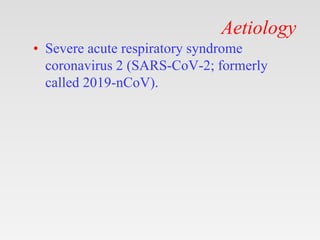
Aetiology
• Severe acute respiratory syndrome
coronavirus 2 (SARS-CoV-2; formerly
called 2019-nCoV).
Aetiology of Aetiology
•
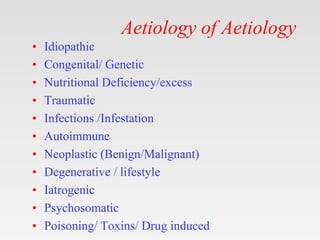
Aetiology of Aetiology
• Idiopathic
• Congenital/ Genetic
• Nutritional Deficiency/excess
• Traumatic
• Infections /Infestation
• Autoimmune
• Neoplastic (Benign/Malignant)
• Degenerative / lifestyle
• Iatrogenic
• Psychosomatic
• Poisoning/ Toxins/ Drug induced
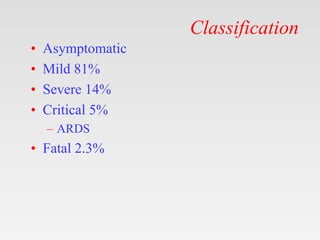
Classification
Classification
• Asymptomatic
• Mild 81%
• Severe 14%
• Critical 5%
– ARDS
• Fatal 2.3%
Clinical Features
•
Clinical Features
• Demography
• Symptoms
• Signs
• Prognosis
• Complications
Demography
Demography
• Incidence & Prevalence
• Geographical distribution.
• Race
• Age
• Sex
• Socioeconomic status
• Temporal behaviour
Demography
• Incidence & Prevalence-
Demography
• Geographical distribution.
Demography
• Race.
Demography
• Age
Demography
• Sex
Demography
• Socioeconomic status
Demography
• Temporal behaviour
Symptoms
Symptoms
• Presentations of COVID-19 have ranged
from asymptomatic/mild symptoms to
severe illness and mortality.
• Mean incubation period to be 5.1 days 2
days to 2 weeks.
Symptoms
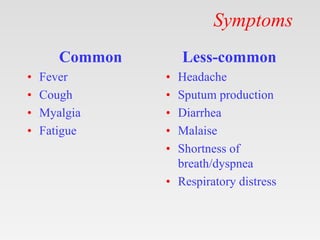
Common
• Fever
• Cough
• Myalgia
• Fatigue
Less-common
• Headache
• Sputum production
• Diarrhea
• Malaise
• Shortness of
breath/dyspnea
• Respiratory distress
Symptoms
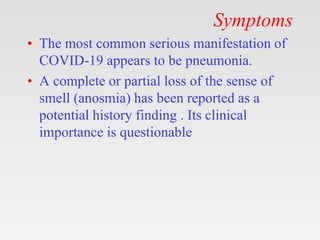
• The most common serious manifestation of
COVID-19 appears to be pneumonia.
• A complete or partial loss of the sense of
smell (anosmia) has been reported as a
potential history finding . Its clinical
importance is questionable
Signs
Signs
• General Examination
• Systemic Examination
• Local Examination
Signs
• General Examination
Signs
• Systemic Examination
Signs
• Local Examination
Prognosis
Prognosis
• Morbidity
• Mortality rate
• 5 year survival in Malignancy
Investigations
Investigations
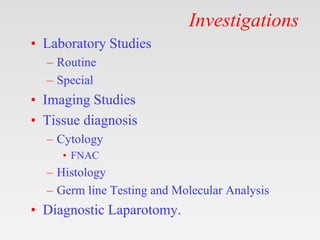
• Laboratory Studies
– Routine
– Special
• Imaging Studies
• Tissue diagnosis
– Cytology
• FNAC
– Histology
– Germ line Testing and Molecular Analysis
• Diagnostic Laparotomy.
Investigations
• Laboratory Studies
– Routine
– Special
• Imaging Studies
• Tissue diagnosis
– Cytology
• FNAC
– Histology
Investigations in Malignancy
•
Investigations in Malignancy
• For diagnosis
• For staging
• For Screening
• For Monitoring
Diagnostic Studies
Diagnostic Studies
Imaging Studies
• X-Ray
• USG
• CT
• Angiography
• MRI
• Endoscopy
• Nuclear scan
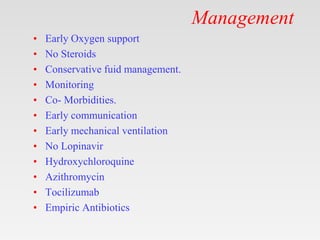
Management
Management
• Early Oxygen support
• No Steroids
• Conservative fuid management.
• Monitoring
• Co- Morbidities.
• Early communication
• Early mechanical ventilation
• No Lopinavir
• Hydroxychloroquine
• Azithromycin
• Tocilizumab
• Empiric Antibiotics
Mechanical Ventilation
• Low tidal volume 4-8ml/Kg
• Low plateau pressure <30cm of water
• High PEEP
• Permissive hypercapnoea
• Deep sedation
• Prone
• Target Spo2 90%
Prevention
Prevention
• Screening
• Risk reduction
Mythbusters
Myths Facts
Guidelines
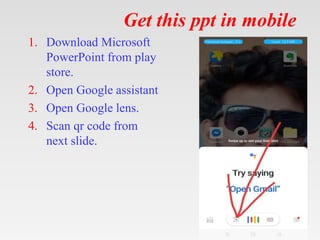
Get this ppt in mobile
1. Download Microsoft
PowerPoint from play
store.
2. Open Google assistant
3. Open Google lens.
4. Scan qr code from
next slide.
Get this ppt in mobile
Get my ppt collection
• https://www.slideshare.net/drpradeeppande/
edit_my_uploads
• https://www.dropbox.com/sh/x600md3cvj8
5woy/AACVMHuQtvHvl_K8ehc3ltkEa?dl
=0
• https://www.facebook.com/doctorpradeeppa
nde/?ref=pages_you_manage

Covid -19.pptx

Editor's Notes

  • #2 drpradeeppande@gmail.com 7697305442