
Urban  D ata  F usion   I ntegrating  G eographical  I nformation  Models  and   B uilding  I nformation  M odels of  t he  U rban  E nvironment   Umit Isikdag, Dr. Nigel Trodd School of Science and Environment  Coventry University
Presentation Content What is urban data fusion ? Geographical Information Models Building Information Models Integration Approaches Summary
What is urban data A general definition of urban data can be; all data related to built, natural and socio-economic aspect of the urban environment. 80% of urban data have a spatial component. i.e. they can be mapped.
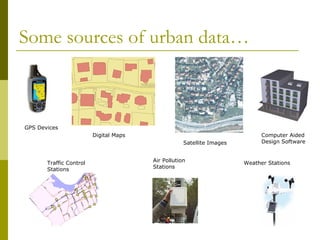
Some sources of urban data…  GPS Devices Digital Maps Satellite Images Computer Aided Design Software Traffic Control Stations Air Pollution Stations Weather Stations
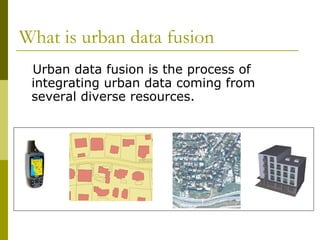
What is urban data fusion Urban data fusion is the process of integrating urban data coming from several diverse resources.
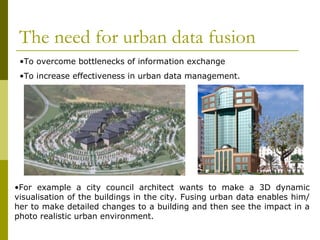
The need for urban data fusion For example a city council architect wants to make a 3D dynamic visualisation of the buildings in the city. Fusing urban data enables him/her to make detailed changes to a building and then see the impact in a photo realistic urban environment. To overcome bottlenecks of information exchange To increase effectiveness in urban data management.
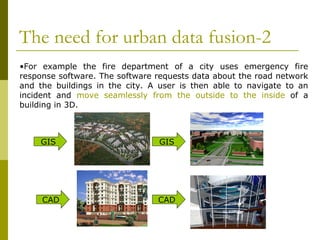
The need for urban data fusion-2 For example the fire department of a city uses emergency fire response software. The software requests data about the road network and the buildings in the city. A user is then able to navigate to an incident and  move seamlessly from the outside to the inside  of a building in 3D.  GIS GIS CAD CAD
Information systems to manage urban data Urban data are created and managed with several information systems. The two main ones are:  Geographical Information Systems (GIS) and Computer Aided Design Systems (CAD) Roads 3D Buildings Rivers Cadastre Traffic Data Weather Data  Pollution Data Managed by GIS  Managed by CAD
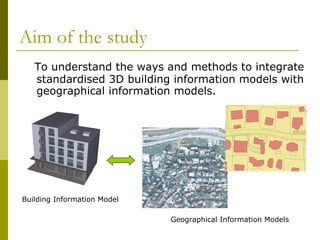
Aim of the study To understand the ways and methods to integrate standardised 3D building information models with geographical information models. Building Information Model Geographical Information Models
Methodology Literature review Technology watch and implementation Proof of concept study
Geographical Information Models and  Methods of exchanging geographic information models
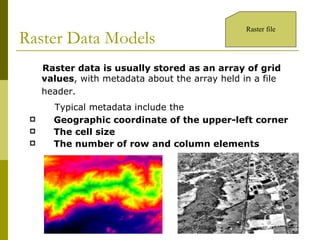
Raster data is usually stored as an array of grid values , with metadata about the array held in a file header.   Typical metadata include the  Geographic coordinate of the upper-left corner  The cell size The number of row and column elements  Raster Data Models Raster file
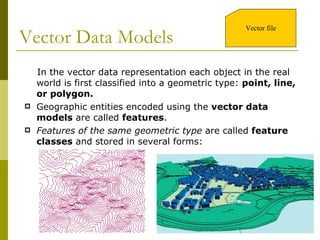
Vector Data Models In the vector data representation each object in the real world is first classified into a geometric type:  point, line, or polygon.  Geographic entities encoded using the  vector data models  are called  features .  Features of the same geometric type  are called  feature classes  and stored in several forms: Vector file
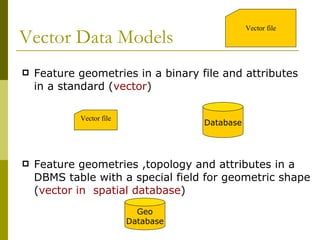
Feature geometries in a binary file and attributes in a standard ( vector ) Feature geometries ,topology and attributes in a DBMS table with a special field for geometric shape ( vector in  spatial database ) Vector Data Models Vector file Vector file Database Geo Database
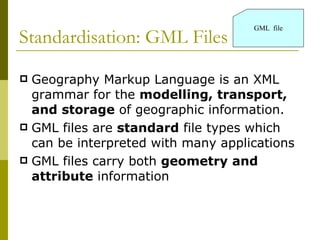
Standardisation: GML Files Geography Markup Language is an XML grammar for the  modelling, transport, and storage  of geographic information. GML files are  standard  file types which can be interpreted with many applications GML files carry both  geometry and attribute  information GML  file
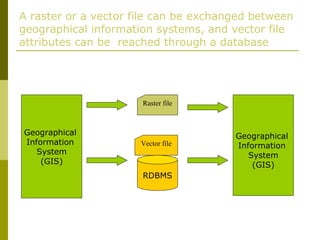
A raster or a vector file can be exchanged between geographical information systems, and vector file attributes can be  reached through a database Raster file Vector file Geographical  Information  System (GIS) Geographical  Information  System (GIS) RDBMS
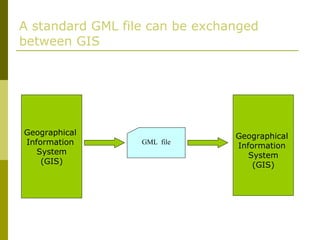
A standard GML file can be exchanged between GIS Geographical  Information  System (GIS) Geographical  Information  System (GIS) GML  file
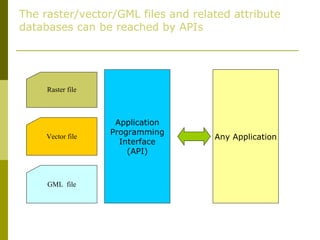
The raster/vector/GML files and related attribute databases can be reached by APIs Raster file Vector file GML  file Application Programming Interface (API) Any Application
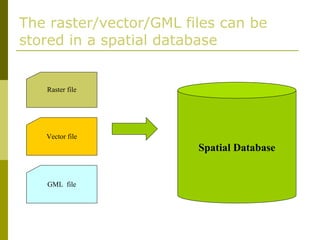
The raster/vector/GML files can be stored in a spatial database Spatial Database Raster file Vector file GML  file
Building Information Models and Methods of exchanging  building information
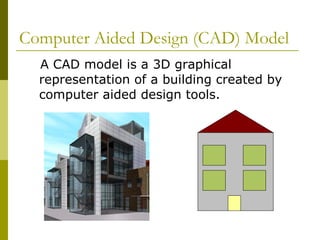
Computer Aided Design (CAD) Model A CAD model is a 3D graphical representation of a building created by computer aided design tools.
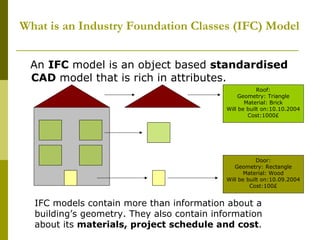
What is an Industry Foundation Classes (IFC) Model An  IFC  model is an object based  standardised   CAD  model that is rich in attributes.  IFC models contain more than information about a building’s geometry. They also contain information about its  materials, project schedule and cost . Roof: Geometry: Triangle Material: Brick Will be built on:10.10.2004 Cost:1000£ Door: Geometry: Rectangle Material: Wood Will be built on:10.09.2004 Cost:100£
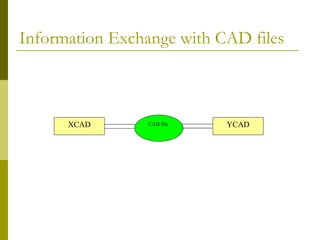
Information Exchange with CAD files CAD file  XCAD YCAD
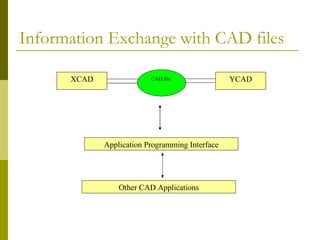
Information Exchange with CAD files CAD file  XCAD YCAD Application Programming Interface Other CAD Applications
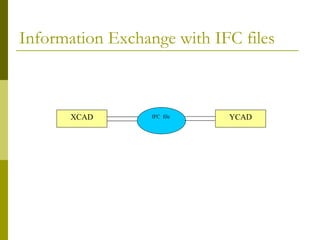
Information Exchange with IFC files IFC  file  XCAD YCAD
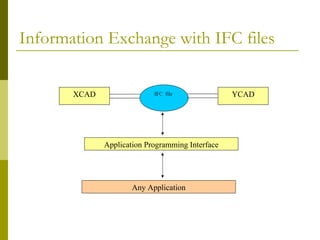
Information Exchange with IFC files IFC  file  XCAD YCAD Application Programming Interface Any Application
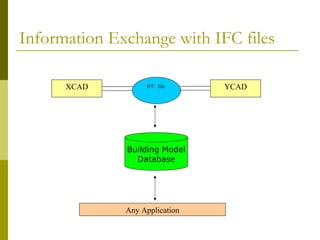
Information Exchange with IFC files IFC  file  XCAD YCAD Any Application Building Model Database
Approaches to  Urban Data Fusion
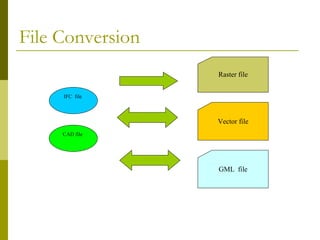
File Conversion IFC  file  CAD file  Raster file Vector file GML  file
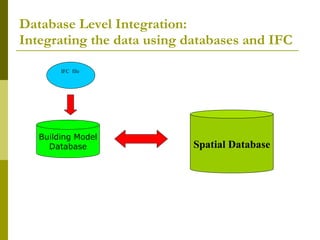
Database Level Integration: Integrating the data using databases and IFC Building Model Database Spatial Database IFC  file
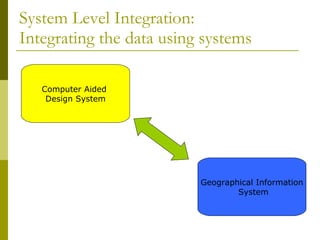
System Level Integration: Integrating the data using systems Computer Aided  Design System Geographical Information System
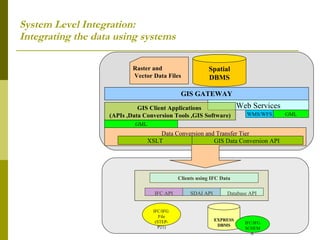
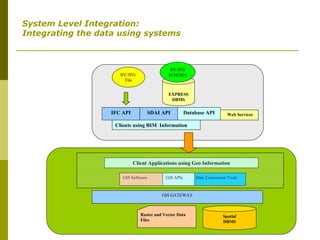
System Level Integration: Integrating the data using systems EXPRESS DBMS IFC/IFG SCHEMA  IFC/IFG  File (STEP-P21) SDAI API Database API Clients using IFC Data Spatial DBMS Raster and Vector Data Files GIS GATEWAY Web Services GIS Client Applications  (APIs ,Data Conversion Tools ,GIS Software) GML GML WMS/WFS IFC API Data Conversion and Transfer Tier GIS Data Conversion API XSLT
Spatial DBMS Raster and Vector Data Files GIS GATEWAY GIS Software Data Conversion Tools GIS APIs Client Applications using Geo Information EXPRESS DBMS SDAI API Database API Clients using BIM  Information IFC/IFG SCHEMA  IFC/IFG  File IFC API Web Services System Level Integration: Integrating the data using systems
Summary and Conclusion
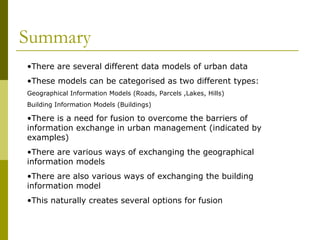
Summary There are several different data models of urban data These models can be categorised as two different types: Geographical Information Models (Roads, Parcels ,Lakes, Hills) Building Information Models (Buildings) There is a need for fusion to overcome the barriers of information exchange in urban management (indicated by examples) There are various ways of exchanging the geographical information models There are also various ways of exchanging the building information model This naturally creates several options for fusion
Conclusion The further stages of the research will focus on a proof of concept study for the fusion.  Thanks for listening....

Urban Data Fusion

  • 1.
    Urban Data F usion I ntegrating G eographical I nformation Models and B uilding I nformation M odels of t he U rban E nvironment Umit Isikdag, Dr. Nigel Trodd School of Science and Environment Coventry University
  • 2.
    Presentation Content Whatis urban data fusion ? Geographical Information Models Building Information Models Integration Approaches Summary
  • 3.
    What is urbandata A general definition of urban data can be; all data related to built, natural and socio-economic aspect of the urban environment. 80% of urban data have a spatial component. i.e. they can be mapped.
  • 4.
    Some sources ofurban data… GPS Devices Digital Maps Satellite Images Computer Aided Design Software Traffic Control Stations Air Pollution Stations Weather Stations
  • 5.
    What is urbandata fusion Urban data fusion is the process of integrating urban data coming from several diverse resources.
  • 6.
    The need forurban data fusion For example a city council architect wants to make a 3D dynamic visualisation of the buildings in the city. Fusing urban data enables him/her to make detailed changes to a building and then see the impact in a photo realistic urban environment. To overcome bottlenecks of information exchange To increase effectiveness in urban data management.
  • 7.
    The need forurban data fusion-2 For example the fire department of a city uses emergency fire response software. The software requests data about the road network and the buildings in the city. A user is then able to navigate to an incident and move seamlessly from the outside to the inside of a building in 3D. GIS GIS CAD CAD
  • 8.
    Information systems tomanage urban data Urban data are created and managed with several information systems. The two main ones are: Geographical Information Systems (GIS) and Computer Aided Design Systems (CAD) Roads 3D Buildings Rivers Cadastre Traffic Data Weather Data Pollution Data Managed by GIS Managed by CAD
  • 9.
    Aim of thestudy To understand the ways and methods to integrate standardised 3D building information models with geographical information models. Building Information Model Geographical Information Models
  • 10.
    Methodology Literature reviewTechnology watch and implementation Proof of concept study
  • 11.
    Geographical Information Modelsand Methods of exchanging geographic information models
  • 12.
    Raster data isusually stored as an array of grid values , with metadata about the array held in a file header. Typical metadata include the Geographic coordinate of the upper-left corner The cell size The number of row and column elements Raster Data Models Raster file
  • 13.
    Vector Data ModelsIn the vector data representation each object in the real world is first classified into a geometric type: point, line, or polygon. Geographic entities encoded using the vector data models are called features . Features of the same geometric type are called feature classes and stored in several forms: Vector file
  • 14.
    Feature geometries ina binary file and attributes in a standard ( vector ) Feature geometries ,topology and attributes in a DBMS table with a special field for geometric shape ( vector in spatial database ) Vector Data Models Vector file Vector file Database Geo Database
  • 15.
    Standardisation: GML FilesGeography Markup Language is an XML grammar for the modelling, transport, and storage of geographic information. GML files are standard file types which can be interpreted with many applications GML files carry both geometry and attribute information GML file
  • 16.
    A raster ora vector file can be exchanged between geographical information systems, and vector file attributes can be reached through a database Raster file Vector file Geographical Information System (GIS) Geographical Information System (GIS) RDBMS
  • 17.
    A standard GMLfile can be exchanged between GIS Geographical Information System (GIS) Geographical Information System (GIS) GML file
  • 18.
    The raster/vector/GML filesand related attribute databases can be reached by APIs Raster file Vector file GML file Application Programming Interface (API) Any Application
  • 19.
    The raster/vector/GML filescan be stored in a spatial database Spatial Database Raster file Vector file GML file
  • 20.
    Building Information Modelsand Methods of exchanging building information
  • 21.
    Computer Aided Design(CAD) Model A CAD model is a 3D graphical representation of a building created by computer aided design tools.
  • 22.
    What is anIndustry Foundation Classes (IFC) Model An IFC model is an object based standardised CAD model that is rich in attributes. IFC models contain more than information about a building’s geometry. They also contain information about its materials, project schedule and cost . Roof: Geometry: Triangle Material: Brick Will be built on:10.10.2004 Cost:1000£ Door: Geometry: Rectangle Material: Wood Will be built on:10.09.2004 Cost:100£
  • 23.
    Information Exchange withCAD files CAD file XCAD YCAD
  • 24.
    Information Exchange withCAD files CAD file XCAD YCAD Application Programming Interface Other CAD Applications
  • 25.
    Information Exchange withIFC files IFC file XCAD YCAD
  • 26.
    Information Exchange withIFC files IFC file XCAD YCAD Application Programming Interface Any Application
  • 27.
    Information Exchange withIFC files IFC file XCAD YCAD Any Application Building Model Database
  • 28.
    Approaches to Urban Data Fusion
  • 29.
    File Conversion IFC file CAD file Raster file Vector file GML file
  • 30.
    Database Level Integration:Integrating the data using databases and IFC Building Model Database Spatial Database IFC file
  • 31.
    System Level Integration:Integrating the data using systems Computer Aided Design System Geographical Information System
  • 32.
    System Level Integration:Integrating the data using systems EXPRESS DBMS IFC/IFG SCHEMA IFC/IFG File (STEP-P21) SDAI API Database API Clients using IFC Data Spatial DBMS Raster and Vector Data Files GIS GATEWAY Web Services GIS Client Applications (APIs ,Data Conversion Tools ,GIS Software) GML GML WMS/WFS IFC API Data Conversion and Transfer Tier GIS Data Conversion API XSLT
  • 33.
    Spatial DBMS Rasterand Vector Data Files GIS GATEWAY GIS Software Data Conversion Tools GIS APIs Client Applications using Geo Information EXPRESS DBMS SDAI API Database API Clients using BIM Information IFC/IFG SCHEMA IFC/IFG File IFC API Web Services System Level Integration: Integrating the data using systems
  • 34.
  • 35.
    Summary There areseveral different data models of urban data These models can be categorised as two different types: Geographical Information Models (Roads, Parcels ,Lakes, Hills) Building Information Models (Buildings) There is a need for fusion to overcome the barriers of information exchange in urban management (indicated by examples) There are various ways of exchanging the geographical information models There are also various ways of exchanging the building information model This naturally creates several options for fusion
  • 36.
    Conclusion The furtherstages of the research will focus on a proof of concept study for the fusion. Thanks for listening....