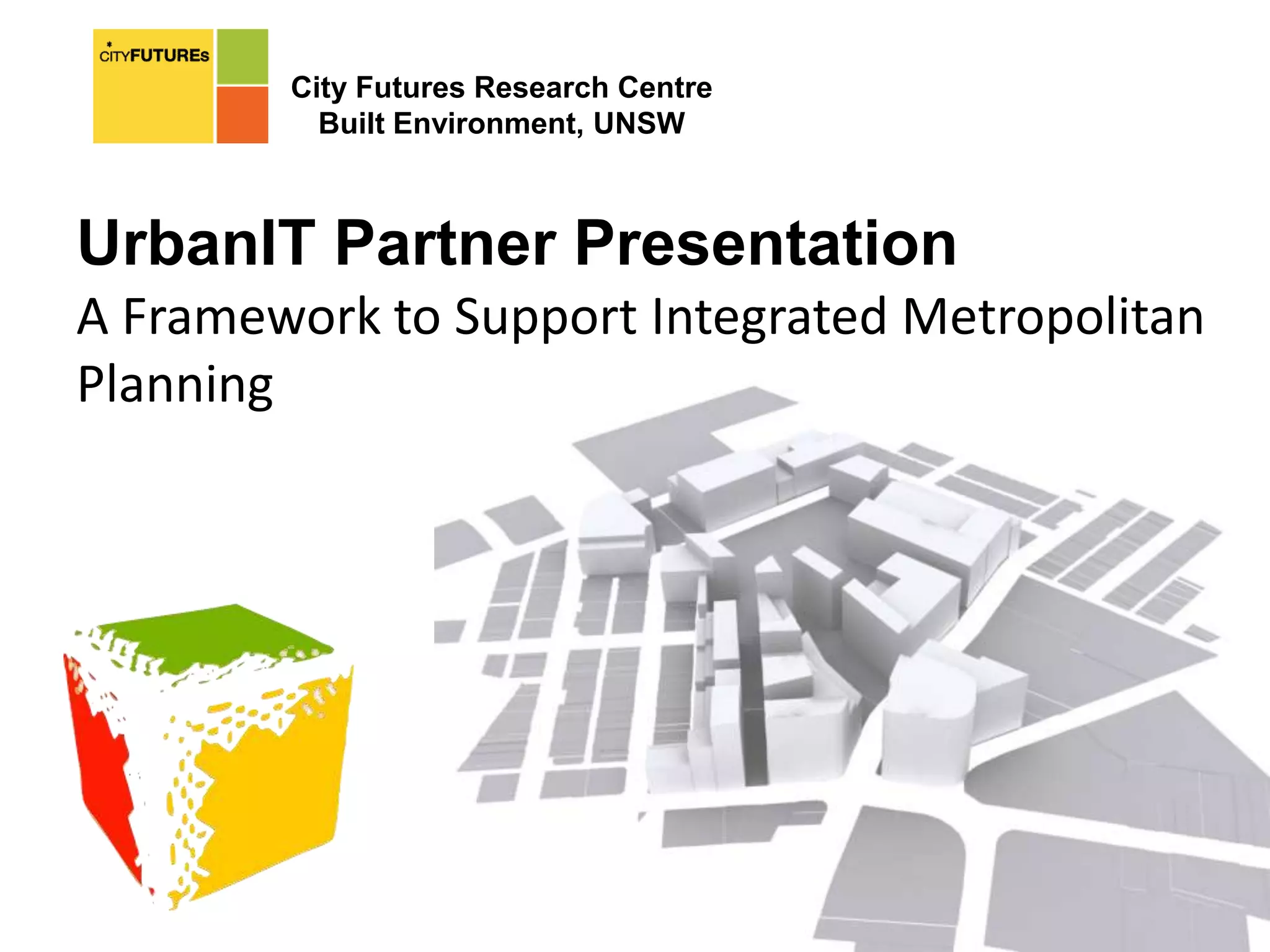
City Futures Research CentreBuilt Environment, UNSWUrbanIT Partner PresentationA Framework to Support Integrated Metropolitan Planning
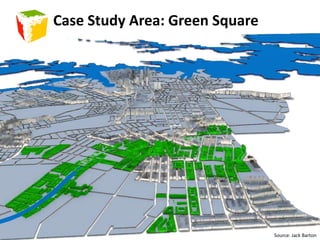
Case Study Area: Green SquareSource: Jack Barton
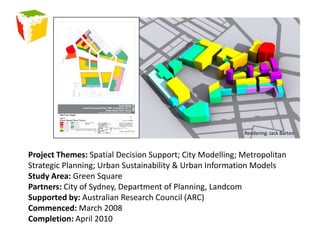
Rendering: Jack BartonProject Themes: Spatial Decision Support; City Modelling; Metropolitan Strategic Planning; Urban Sustainability & Urban Information ModelsStudy Area: Green SquarePartners: City of Sydney, Department of Planning, LandcomSupported by: Australian Research Council (ARC)Commenced: March 2008Completion: April 2010
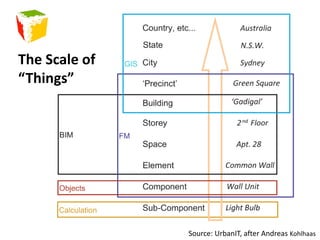
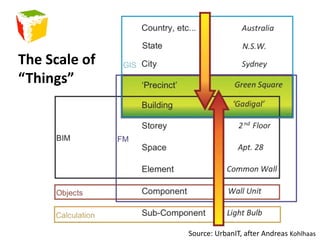
The Scale of “Things”Source: UrbanIT, after Andreas Kohlhaas
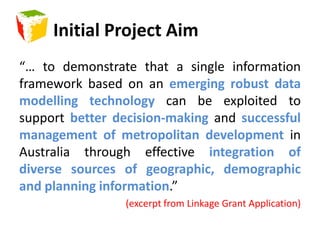
Initial Project Aim“… to demonstrate that a single information framework based on an emerging robust data modelling technology can be exploited to support better decision-making and successful management of metropolitan development in Australia through effective integration of diverse sources of geographic, demographic and planning information.”(excerpt from Linkage Grant Application)
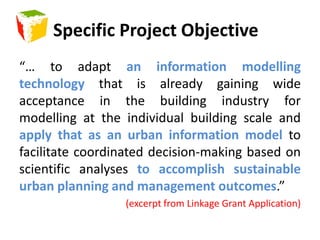
Specific Project Objective“… to adapt an information modelling technology that is already gaining wide acceptance in the building industry for modelling at the individual building scale and apply that as an urban information model to facilitate coordinated decision-making based on scientific analyses to accomplish sustainable urban planning and management outcomes.”(excerpt from Linkage Grant Application)
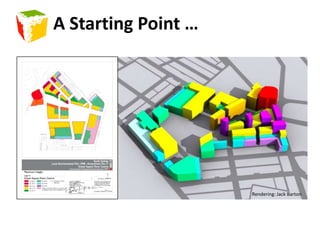
A Starting Point …Rendering: Jack Barton
UrbanIT VisionEnable a deep understanding of a development within its urban context, rather than in isolationA significant step beyond urban visualisationWell informed decision-makingDocumented spatial information for large developmentsPublically transparent, informed governanceFacilitate local community participation
UrbanIT ApproachUse of open standards for information managementOGC: Open Geospatial ConsortiumISO IFC: buildingSMART (adapted for urban models)Open SolutionsUse of ontologies to manage integrationAdoption of object-oriented database management systems (OODBMS)
Neighbouring DevelopmentsGIS and OGC web serviceshttp://www.opengeospatial.org/pressroom/pressreleases/732 (June 2007)City models and CityGMLhttp://opportunity.bv.tu-berlin.de/software/projects/show/3dcitydbSemantic Web and OntologiesGoogle Earth and KMLUrban Ontologies (UK Ordnance)http://www.ordnancesurvey.co.uk/oswebsite/ontology/
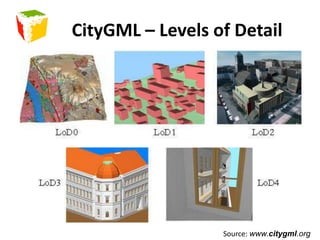
CityGML – Levels of DetailSource: www.citygml.org
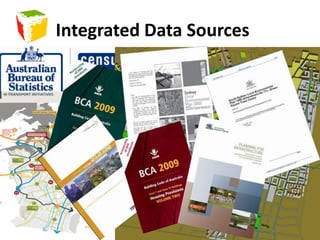
Integrated Data Sources
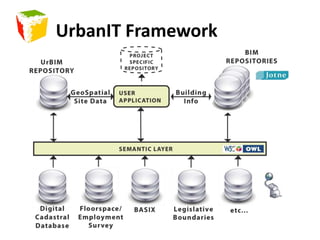
UrbanIT Framework
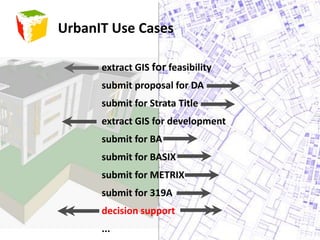
UrbanIT Use Casesextract GIS for feasibilitysubmit proposal for DAsubmit for Strata Titleextract GIS for developmentsubmit for BAsubmit for BASIXsubmit for METRIXsubmit for 319Adecision support...
Presentation StructureUrban Information ModelOntologiesContext AnalysisProject Compliance Checking
Urban Information ModelBuilding Information ModelObject-based conceptUrban Information ModelBased on the IFC standardInternational Endorsement - buildingSMARTModel Server TechnologyEPM Technology – Norway
Presentation StructureUrban Information ModelOntologiesContext AnalysisProject Compliance Checking
Drivers for Urban ModelsNations are responding to climate changeThe built environment must be sustainablePlanning has many pressure pointsIntegration of diverse policy, social and city asset data needs a quantum improvementGovernment and City authorities need better informationSecurity, emergency, transport, etc, etcAdoption of Digital Object Modelling in AustraliaInevitable that BIM will become a primary technology for the built environment
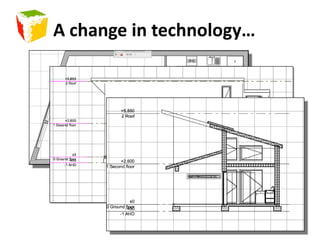
A change in technology…
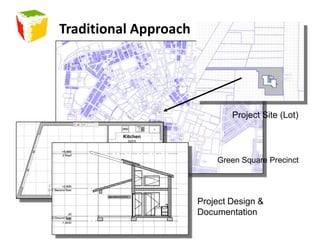
Traditional ApproachProject Site (Lot)Green Square PrecinctProject Design & Documentation
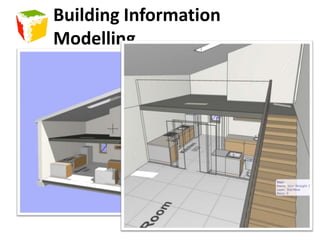
Building Information Modelling
Cadastre – links GIS & BIM “A cadastre (also spelt cadaster), using a cadastral survey[1] or cadastral map, is a comprehensive register of the (boundary)metes-and-boundsof real property of a country.
A cadastre commonly includes details of the ownership, the tenure, the precise location (some include GPS coordinates), the dimensions (and area), the cultivations if rural, and the value of individual parcels of land”.
To build requires the ownership of land, and only relatively recently has it been possible to own part of a facility, that is a strata title.Australian Cadastral Types[1] See Wikipedia, http://en.wikipedia.org/wiki/Cadastre
Cadastre & Geo-referencing in IFCIFC is the open ISO Standard that supports the exchange of whole of life data for buildings – a common language for the built environmentA complementary development of two activities:UNSW,  Australia urbanITCadastre project and Statsbygg, Norway Geo-referencing projectKey objectivesGIS to BIM - precise land data and context to support facility development referenced to map systemsBIM to GIS - create building models at appropriate levels of detail to support urban planning, control and managementAchieve an effective integration of diverse sources of geographic, demographic and planning information in BIM
Land Data ConversionifcSite entityTwo geometrical representations:Cadastral boundary
TerrainSpecific Coordinate Reference System
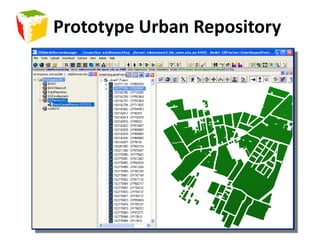
Prototype Urban Repository
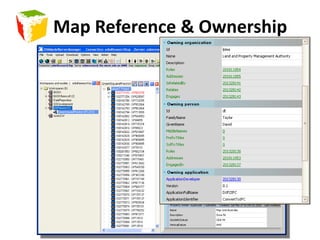
Map Reference & Ownership
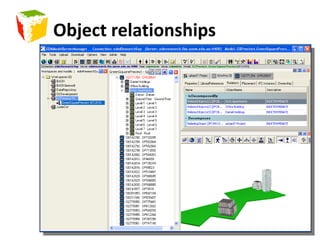
Object relationships
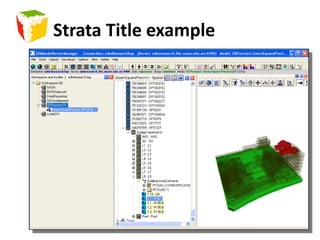
Strata Title example
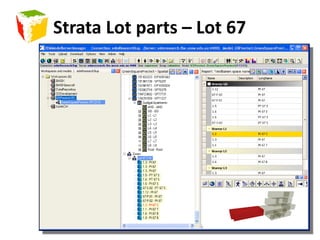
Strata Lot parts – Lot 67
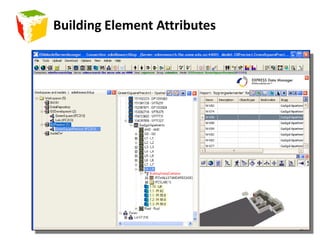
Building Element Attributes
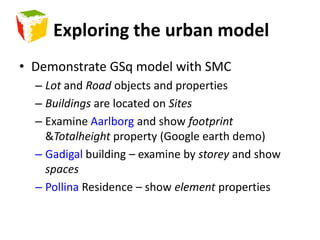
Exploring the urban modelDemonstrate GSq model with SMCLot and Road objects and propertiesBuildings are located on SitesExamine Aarlborg and show footprint & Totalheight property (Google earth demo)Gadigal building – examine by storey and show spacesPollina Residence – show element properties
Cadastre & the IFC StandardScopethis work is an enhancement of the current IFC specification (precisely the ifcSite entity)ITM 44.10Resolution : “ITM agrees that the geo-referencing and cadastre extensions (A Note on Cadastre, v3.02, 18 Jan 2010) in IFC model use as submitted by NO and AC chapters are in principle important and agrees to review the proposal … no less than 6 weeks before the ITM meeting in Korea”.
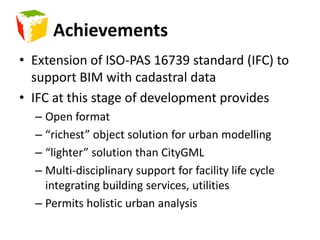
AchievementsExtension of ISO-PAS 16739 standard (IFC) to support BIM with cadastral dataIFC at this stage of development providesOpen format“richest” object solution for urban modelling“lighter” solution than CityGMLMulti-disciplinary support for facility life cycle integrating building services, utilitiesPermits holistic urban analysis
Presentation StructureUrban Information ModelOntologiesContext AnalysisProject Compliance Checking
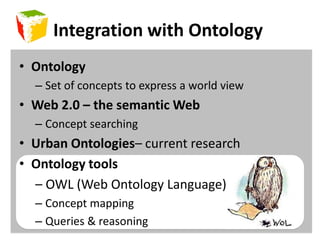
Integration with OntologyOntologySet of concepts to express a world viewWeb 2.0 – the semantic WebConcept searchingUrban Ontologies– current researchOntology tools     – OWL (Web Ontology Language)Concept mappingQueries & reasoning
Presentation StructureUrban Information ModelOntologiesContext AnalysisProject Compliance Checking
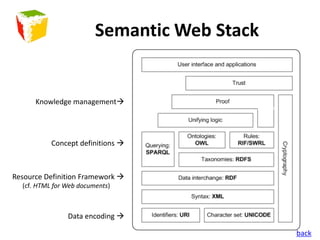
Semantic Web StackKnowledge managementConcept definitions Resource Definition Framework (cf. HTML for Web documents)Data encoding back
OntologyIFC/Express Schema / Walrus Visualisation46Source: Walrus / Jack Barton
47Source: Walrus / Jack Barton
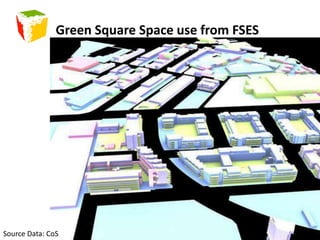
Green Square Space use from FSESSource Data: CoS
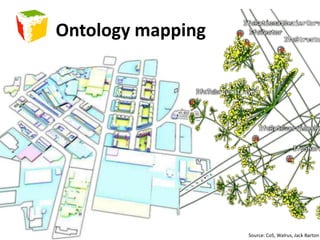
Ontology mappingSource: CoS, Walrus, Jack Barton
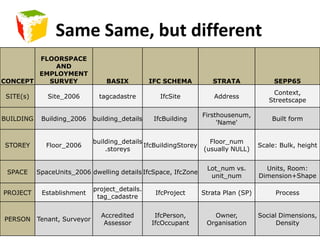
Same Same, but different
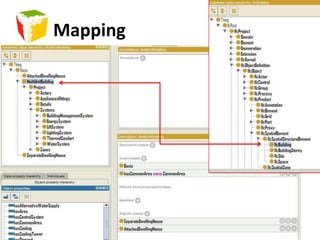
Mapping
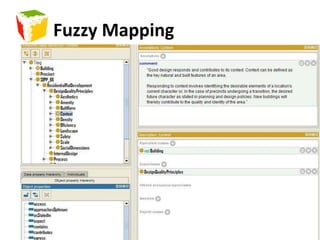
Fuzzy Mapping
Information Leverage & IntegrationInformation System Development in Urban EnvironmentCharacteristics of Data SourcesChallenges in Urban Modelling/Spatial Decision Support Advanced Metropolitan Strategic Planning53
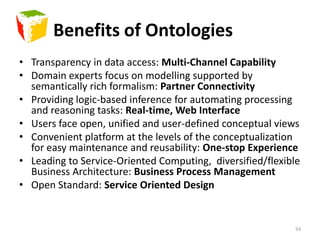
Benefits of OntologiesTransparency in data access: Multi-Channel Capability
Domain experts focus on modelling supported by semantically rich formalism: Partner Connectivity
Providing logic-based inference for automating processing and reasoning tasks: Real-time, Web Interface
Users face open, unified and user-defined conceptual views
Convenient platform at the levels of the conceptualization for easy maintenance and reusability: One-stop Experience
Leading to Service-Oriented Computing,  diversified/flexible Business Architecture: Business Process Management
Open Standard: Service Oriented Design54
Presentation StructureUrban Information ModelOntologiesContext AnalysisProject Compliance Checking
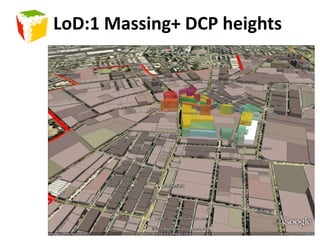
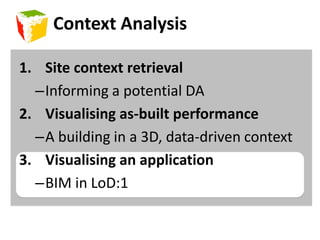
Context AnalysisSite context retrieval Informing a potential DAVisualising as-built performanceA building in a 3D, data-driven contextVisualising an applicationBIM in LoD:1LoD:1 Massing+ DCP heights
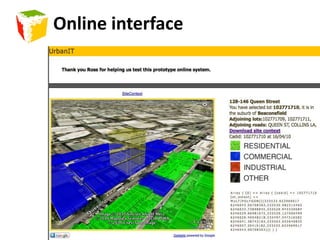
Context AnalysisSite context retrieval Informing a potential DAVisualising as-built performanceA building in a 3D, data-driven contextVisualising an applicationBIM in LoD:1Online interface
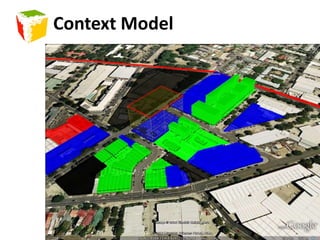
Context Model
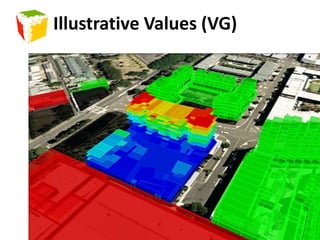
Context AnalysisSite context retrieval Informing a potential DAVisualising as-built performanceA building in a 3D, data-driven contextVisualising an applicationBIM in LoD:1Illustrative Values (VG)
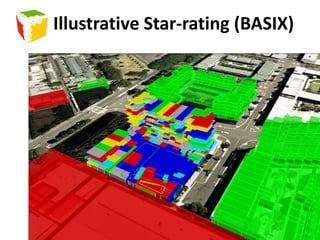
Illustrative Star-rating (BASIX)
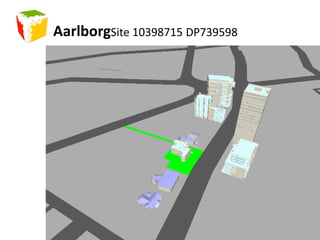
Context AnalysisSite context retrieval Informing a potential DAVisualising as-built performanceA building in a 3D, data-driven contextVisualising an applicationBIM in LoD:1AarlborgSite 10398715 DP739598
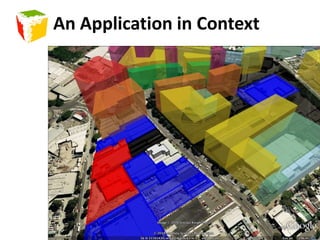
An Application in Context
CONSIDERATIONSLevel of detailLevels of security: open/public data vs private dataLevel of spatio-temporal accuracy: Unverified / VerifiedCustodianship, accountabilityPreservation of Spatial Coordinate Systems, metadata, Three-dimensionality (ANZLIC)												http://www.anzlic.org.au/
UrbanIT STRENGTHSOPEN FORMATS EXTENDED(MOSTLY) OPENSOURCEDATABASE DRIVEN, WEB DELIVEREDDYNAMIC, SEMANTIC AND (GEO)SPATIALLIVENATIONAL/INTERNATIONAL ORIGINALITY
Presentation StructureUrban Information ModelOntologiesContext AnalysisProject Compliance Checking
Compliance CheckingModel Server as a RepositoryInformation model uploadCompliance CheckingReports based on information contentModel auditingBASIX compliance exampleIFC schema & BASIX compliance analysis
Presentation StructureUrban Information ModelOntologiesContext AnalysisProject Compliance Checking
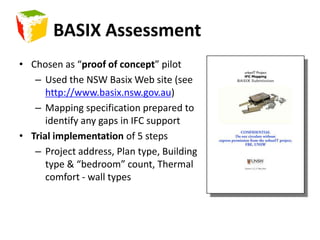
BASIX AssessmentChosen as “proof of concept” pilotUsed the NSW Basix Web site (see http://www.basix.nsw.gov.au)Mapping specification prepared to identify any gaps in IFC supportTrial implementation of 5 stepsProject address, Plan type, Building type & “bedroom” count, Thermal comfort - wall types
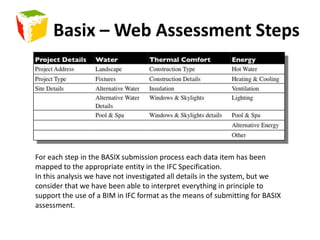
Basix – Web Assessment StepsFor each step in the BASIX submission process each data item has been mapped to the appropriate entity in the IFC Specification. In this analysis we have not investigated all details in the system, but we consider that we have been able to interpret everything in principle to support the use of a BIM in IFC format as the means of submitting for BASIX assessment.
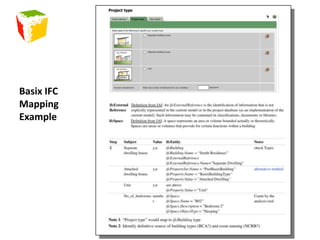
Basix IFC MappingExample
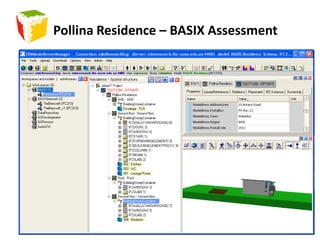
Pollina Residence – BASIX Assessment
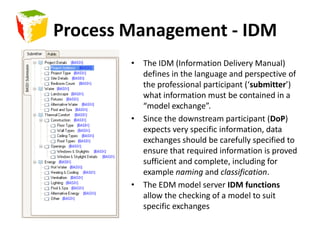
Process Management - IDMThe IDM (Information Delivery Manual) defines in the language and perspective of the professional participant (‘submitter’) what information must be contained in a “model exchange”. Since the downstream participant (DoP) expects very specific information, data exchanges should be carefully specified to ensure that required information is proved sufficient and complete, including for example naming and classification.The EDM model server IDM functions allow the checking of a model to suit specific exchanges
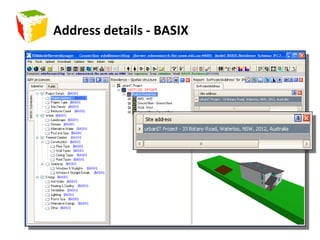
Address details - BASIX
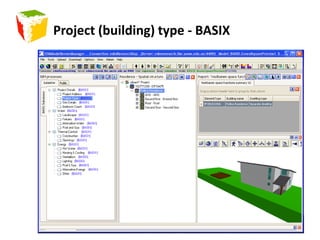
Project (building) type - BASIX
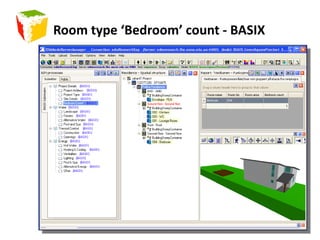
Room type ‘Bedroom’ count - BASIX
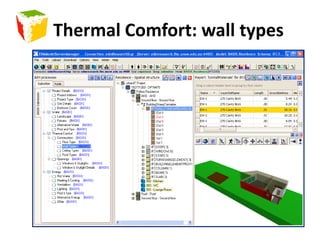
Thermal Comfort: wall types
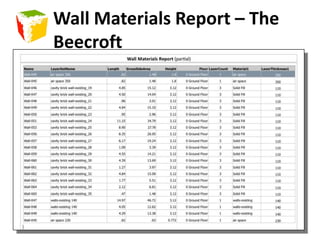
Wall Materials Report – The Beecroft
Auditing & Checking Models“Well built” models are models created to a formal guideline or specificationThe CRC-CI has initiated such guidelines(see http://www.buldingSMART.org.au/)IFC modelservers have tools and functions to automate such IDMs to validate data conformance, content etcModel Guidelines are an essential next step
UrbanIT StrengthsBetter access to planning informationBetter communication between experts/non-expertsBetter intergovernmental information sharingMovement away from bureaucratic duplication toward automation. Text based moving toward spatially enabled secure, logged and verifiable transactionsSeamless integration with existing planning toolsAbility to see a development in an urban context, rather than in isolation
What makes this different?BIMextension to form an urban information modelGISachieves better granularity at the urban scaleOntologiesfor knowledge integration
Exploiting the urban modelHow can the urbanIT framework support planning and local government?Creation & management of asset dataCompliance checkingDA assessmentBASIX assessmentOccupancy Certificate and related certificationPlanning policy and analysisSustainability & resource analysis

UrbanIT Partner Presentation

  • 1.
    City Futures ResearchCentreBuilt Environment, UNSWUrbanIT Partner PresentationA Framework to Support Integrated Metropolitan Planning
  • 2.
    Case Study Area:Green SquareSource: Jack Barton
  • 3.
    Rendering: Jack BartonProjectThemes: Spatial Decision Support; City Modelling; Metropolitan Strategic Planning; Urban Sustainability & Urban Information ModelsStudy Area: Green SquarePartners: City of Sydney, Department of Planning, LandcomSupported by: Australian Research Council (ARC)Commenced: March 2008Completion: April 2010
  • 4.
    The Scale of“Things”Source: UrbanIT, after Andreas Kohlhaas
  • 5.
    The Scale of“Things”Source: UrbanIT, after Andreas Kohlhaas
  • 6.
    Initial Project Aim“…to demonstrate that a single information framework based on an emerging robust data modelling technology can be exploited to support better decision-making and successful management of metropolitan development in Australia through effective integration of diverse sources of geographic, demographic and planning information.”(excerpt from Linkage Grant Application)
  • 7.
    Specific Project Objective“…to adapt an information modelling technology that is already gaining wide acceptance in the building industry for modelling at the individual building scale and apply that as an urban information model to facilitate coordinated decision-making based on scientific analyses to accomplish sustainable urban planning and management outcomes.”(excerpt from Linkage Grant Application)
  • 8.
    A Starting Point…Rendering: Jack Barton
  • 9.
    UrbanIT VisionEnable adeep understanding of a development within its urban context, rather than in isolationA significant step beyond urban visualisationWell informed decision-makingDocumented spatial information for large developmentsPublically transparent, informed governanceFacilitate local community participation
  • 10.
    UrbanIT ApproachUse ofopen standards for information managementOGC: Open Geospatial ConsortiumISO IFC: buildingSMART (adapted for urban models)Open SolutionsUse of ontologies to manage integrationAdoption of object-oriented database management systems (OODBMS)
  • 11.
    Neighbouring DevelopmentsGIS andOGC web serviceshttp://www.opengeospatial.org/pressroom/pressreleases/732 (June 2007)City models and CityGMLhttp://opportunity.bv.tu-berlin.de/software/projects/show/3dcitydbSemantic Web and OntologiesGoogle Earth and KMLUrban Ontologies (UK Ordnance)http://www.ordnancesurvey.co.uk/oswebsite/ontology/
  • 12.
    CityGML – Levelsof DetailSource: www.citygml.org
  • 13.
  • 14.
  • 15.
    UrbanIT Use CasesextractGIS for feasibilitysubmit proposal for DAsubmit for Strata Titleextract GIS for developmentsubmit for BAsubmit for BASIXsubmit for METRIXsubmit for 319Adecision support...
  • 16.
    Presentation StructureUrban InformationModelOntologiesContext AnalysisProject Compliance Checking
  • 17.
    Presentation StructureUrban InformationModelOntologiesContext AnalysisProject Compliance Checking
  • 18.
    Urban Information ModelBuildingInformation ModelObject-based conceptUrban Information ModelBased on the IFC standardInternational Endorsement - buildingSMARTModel Server TechnologyEPM Technology – Norway
  • 19.
    Urban Information ModelBuildingInformation ModelObject-based conceptUrban Information ModelBased on the IFC standardInternational Endorsement - buildingSMARTModel Server TechnologyEPM Technology – Norway
  • 20.
    Urban Information ModelBuildingInformation ModelObject-based conceptUrban Information ModelBased on the IFC standardInternational Endorsement - buildingSMARTModel Server TechnologyEPM Technology – Norway
  • 21.
    Urban Information ModelBuildingInformation ModelObject-based conceptUrban Information ModelBased on the IFC standardInternational Endorsement - buildingSMARTModel Server TechnologyEPM Technology – Norway
  • 22.
    Presentation StructureUrban InformationModelOntologiesContext AnalysisProject Compliance Checking
  • 23.
    Drivers for UrbanModelsNations are responding to climate changeThe built environment must be sustainablePlanning has many pressure pointsIntegration of diverse policy, social and city asset data needs a quantum improvementGovernment and City authorities need better informationSecurity, emergency, transport, etc, etcAdoption of Digital Object Modelling in AustraliaInevitable that BIM will become a primary technology for the built environment
  • 24.
    A change intechnology…
  • 25.
    Traditional ApproachProject Site(Lot)Green Square PrecinctProject Design & Documentation
  • 26.
  • 27.
    Cadastre – linksGIS & BIM “A cadastre (also spelt cadaster), using a cadastral survey[1] or cadastral map, is a comprehensive register of the (boundary)metes-and-boundsof real property of a country.
  • 28.
    A cadastre commonlyincludes details of the ownership, the tenure, the precise location (some include GPS coordinates), the dimensions (and area), the cultivations if rural, and the value of individual parcels of land”.
  • 29.
    To build requiresthe ownership of land, and only relatively recently has it been possible to own part of a facility, that is a strata title.Australian Cadastral Types[1] See Wikipedia, http://en.wikipedia.org/wiki/Cadastre
  • 30.
    Cadastre & Geo-referencingin IFCIFC is the open ISO Standard that supports the exchange of whole of life data for buildings – a common language for the built environmentA complementary development of two activities:UNSW, Australia urbanITCadastre project and Statsbygg, Norway Geo-referencing projectKey objectivesGIS to BIM - precise land data and context to support facility development referenced to map systemsBIM to GIS - create building models at appropriate levels of detail to support urban planning, control and managementAchieve an effective integration of diverse sources of geographic, demographic and planning information in BIM
  • 31.
    Land Data ConversionifcSiteentityTwo geometrical representations:Cadastral boundary
  • 32.
  • 33.
  • 34.
  • 35.
  • 36.
  • 37.
  • 38.
  • 39.
    Exploring the urbanmodelDemonstrate GSq model with SMCLot and Road objects and propertiesBuildings are located on SitesExamine Aarlborg and show footprint & Totalheight property (Google earth demo)Gadigal building – examine by storey and show spacesPollina Residence – show element properties
  • 40.
    Cadastre & theIFC StandardScopethis work is an enhancement of the current IFC specification (precisely the ifcSite entity)ITM 44.10Resolution : “ITM agrees that the geo-referencing and cadastre extensions (A Note on Cadastre, v3.02, 18 Jan 2010) in IFC model use as submitted by NO and AC chapters are in principle important and agrees to review the proposal … no less than 6 weeks before the ITM meeting in Korea”.
  • 41.
    AchievementsExtension of ISO-PAS16739 standard (IFC) to support BIM with cadastral dataIFC at this stage of development providesOpen format“richest” object solution for urban modelling“lighter” solution than CityGMLMulti-disciplinary support for facility life cycle integrating building services, utilitiesPermits holistic urban analysis
  • 42.
    Presentation StructureUrban InformationModelOntologiesContext AnalysisProject Compliance Checking
  • 43.
    Integration with OntologyOntologySetof concepts to express a world viewWeb 2.0 – the semantic WebConcept searchingUrban Ontologies– current researchOntology tools – OWL (Web Ontology Language)Concept mappingQueries & reasoning
  • 44.
    Integration with OntologyOntologySetof concepts to express a world viewWeb 2.0 – the semantic WebConcept searchingUrban Ontologies– current researchOntology tools – OWL (Web Ontology Language)Concept mappingQueries & reasoning
  • 45.
    Integration with OntologyOntologySetof concepts to express a world viewWeb 2.0 – the semantic WebConcept searchingUrban Ontologies– current researchOntology tools – OWL (Web Ontology Language)Concept mappingQueries & reasoning
  • 46.
    Integration with OntologyOntologySetof concepts to express a world viewWeb 2.0 – the semantic WebConcept searchingUrban Ontologies– current researchOntology tools – OWL (Web Ontology Language)Concept mappingQueries & reasoning
  • 47.
    Presentation StructureUrban InformationModelOntologiesContext AnalysisProject Compliance Checking
  • 48.
    Semantic Web StackKnowledgemanagementConcept definitions Resource Definition Framework (cf. HTML for Web documents)Data encoding back
  • 49.
    OntologyIFC/Express Schema /Walrus Visualisation46Source: Walrus / Jack Barton
  • 50.
  • 51.
    Green Square Spaceuse from FSESSource Data: CoS
  • 52.
    Ontology mappingSource: CoS,Walrus, Jack Barton
  • 53.
  • 54.
  • 55.
  • 56.
    Information Leverage &IntegrationInformation System Development in Urban EnvironmentCharacteristics of Data SourcesChallenges in Urban Modelling/Spatial Decision Support Advanced Metropolitan Strategic Planning53
  • 57.
    Benefits of OntologiesTransparencyin data access: Multi-Channel Capability
  • 58.
    Domain experts focuson modelling supported by semantically rich formalism: Partner Connectivity
  • 59.
    Providing logic-based inferencefor automating processing and reasoning tasks: Real-time, Web Interface
  • 60.
    Users face open,unified and user-defined conceptual views
  • 61.
    Convenient platform atthe levels of the conceptualization for easy maintenance and reusability: One-stop Experience
  • 62.
    Leading to Service-OrientedComputing, diversified/flexible Business Architecture: Business Process Management
  • 63.
    Open Standard: ServiceOriented Design54
  • 64.
    Presentation StructureUrban InformationModelOntologiesContext AnalysisProject Compliance Checking
  • 65.
    Context AnalysisSite contextretrieval Informing a potential DAVisualising as-built performanceA building in a 3D, data-driven contextVisualising an applicationBIM in LoD:1LoD:1 Massing+ DCP heights
  • 66.
    Context AnalysisSite contextretrieval Informing a potential DAVisualising as-built performanceA building in a 3D, data-driven contextVisualising an applicationBIM in LoD:1Online interface
  • 67.
  • 68.
    Context AnalysisSite contextretrieval Informing a potential DAVisualising as-built performanceA building in a 3D, data-driven contextVisualising an applicationBIM in LoD:1Illustrative Values (VG)
  • 69.
  • 70.
    Context AnalysisSite contextretrieval Informing a potential DAVisualising as-built performanceA building in a 3D, data-driven contextVisualising an applicationBIM in LoD:1AarlborgSite 10398715 DP739598
  • 71.
  • 72.
    CONSIDERATIONSLevel of detailLevelsof security: open/public data vs private dataLevel of spatio-temporal accuracy: Unverified / VerifiedCustodianship, accountabilityPreservation of Spatial Coordinate Systems, metadata, Three-dimensionality (ANZLIC) http://www.anzlic.org.au/
  • 73.
    UrbanIT STRENGTHSOPEN FORMATSEXTENDED(MOSTLY) OPENSOURCEDATABASE DRIVEN, WEB DELIVEREDDYNAMIC, SEMANTIC AND (GEO)SPATIALLIVENATIONAL/INTERNATIONAL ORIGINALITY
  • 74.
    Presentation StructureUrban InformationModelOntologiesContext AnalysisProject Compliance Checking
  • 75.
    Compliance CheckingModel Serveras a RepositoryInformation model uploadCompliance CheckingReports based on information contentModel auditingBASIX compliance exampleIFC schema & BASIX compliance analysis
  • 76.
    Compliance CheckingModel Serveras a RepositoryInformation model uploadCompliance CheckingReports based on information contentModel auditingBASIX compliance exampleIFC schema & BASIX compliance analysis
  • 77.
    Compliance CheckingModel Serveras a RepositoryInformation model uploadCompliance CheckingReports based on information contentModel auditingBASIX compliance exampleIFC schema & BASIX compliance analysis
  • 78.
    Compliance CheckingModel Serveras a RepositoryInformation model uploadCompliance CheckingReports based on information contentModel auditingBASIX compliance exampleIFC schema & BASIX compliance analysis
  • 79.
    Presentation StructureUrban InformationModelOntologiesContext AnalysisProject Compliance Checking
  • 80.
    BASIX AssessmentChosen as“proof of concept” pilotUsed the NSW Basix Web site (see http://www.basix.nsw.gov.au)Mapping specification prepared to identify any gaps in IFC supportTrial implementation of 5 stepsProject address, Plan type, Building type & “bedroom” count, Thermal comfort - wall types
  • 81.
    Basix – WebAssessment StepsFor each step in the BASIX submission process each data item has been mapped to the appropriate entity in the IFC Specification. In this analysis we have not investigated all details in the system, but we consider that we have been able to interpret everything in principle to support the use of a BIM in IFC format as the means of submitting for BASIX assessment.
  • 82.
  • 83.
    Pollina Residence –BASIX Assessment
  • 84.
    Process Management -IDMThe IDM (Information Delivery Manual) defines in the language and perspective of the professional participant (‘submitter’) what information must be contained in a “model exchange”. Since the downstream participant (DoP) expects very specific information, data exchanges should be carefully specified to ensure that required information is proved sufficient and complete, including for example naming and classification.The EDM model server IDM functions allow the checking of a model to suit specific exchanges
  • 85.
  • 86.
  • 87.
  • 88.
  • 89.
    Wall Materials Report– The Beecroft
  • 90.
    Auditing & CheckingModels“Well built” models are models created to a formal guideline or specificationThe CRC-CI has initiated such guidelines(see http://www.buldingSMART.org.au/)IFC modelservers have tools and functions to automate such IDMs to validate data conformance, content etcModel Guidelines are an essential next step
  • 91.
    UrbanIT StrengthsBetter accessto planning informationBetter communication between experts/non-expertsBetter intergovernmental information sharingMovement away from bureaucratic duplication toward automation. Text based moving toward spatially enabled secure, logged and verifiable transactionsSeamless integration with existing planning toolsAbility to see a development in an urban context, rather than in isolation
  • 92.
    What makes thisdifferent?BIMextension to form an urban information modelGISachieves better granularity at the urban scaleOntologiesfor knowledge integration
  • 93.
    Exploiting the urbanmodelHow can the urbanIT framework support planning and local government?Creation & management of asset dataCompliance checkingDA assessmentBASIX assessmentOccupancy Certificate and related certificationPlanning policy and analysisSustainability & resource analysis
  • 94.
    Exploiting the urbanmodelHow can the urbanIT framework support planning and local government?Creation & management of asset dataCompliance checkingDA assessmentBASIX assessmentOccupancy Certificate and related certificationPlanning policy and analysisSustainability & resource analysis
  • 95.
    Exploiting the urbanmodelHow can the urbanIT framework support planning and local government?Creation & management of asset dataCompliance checkingDA assessmentBASIX assessmentOccupancy Certificate and related certificationPlanning policy and analysisSustainability & resource analysis
  • 96.
    Exploiting the urbanmodelHow can the urbanIT framework support planning and local government?Creation & management of asset dataCompliance checkingDA assessmentBASIX assessmentOccupancy Certificate and related certificationPlanning policy and analysisSustainability & resource analysis
  • 97.
    Exploiting the urbanmodelHow can the urbanIT framework support planning and local government?Creation & management of asset dataCompliance checkingDA assessmentBASIX assessmentOccupancy Certificate and related certificationPlanning policy and analysisSustainability & resource analysis

Editor's Notes

  • #2 This PPT document is an annotated version of the one presented on Friday 16th April in the Arcade Room at the University of New South Wales. It formed the final UrbanIT Partner Presentation marking the completion of the formal ARC Linkage research program.
  • #3 This image focuses on the Green Square area and shows a conceptual urban design proposal from Simpson Wilson Architects for the Sustainable Sydney 2030 plan.
  • #5 This figure, adapted from one by Andreas Kohlhaas (from Graphisoft), shows rather elegantly, the concept of modelling the built environment from the very precise sub-component level through to the macro national scale, showing the domain of BIM and GIS across those scales and where they intersect.
  • #6 The UrbanIT project seeks to work up from the building component modelling end and down from the GIS urban modelling end to identify how those modelling technologies can be brought together in support of effective urban planning.
  • #7 This is the initial project aim formulated in late 2006 when the project application was submitted. The project was formally approved in mid 2007, but did not commence fully until early 2008. We believe that we have delivered on that aim through the development of what has become known as the UrbanIT framework.The “robust data modelling technology” referred to in this aim was the open IFC standard developed by BuildingSMART for building information modelling, but extended to incorporate urban information.
  • #8 This follows from the previous slide and states the specific objectives that were identified as core to this project as it was originally conceived. It breaks down in to the three highlighted parts: technology development, application and outcomes.As the project unfolded, it became clear that there are three information modelling technologies that impact on this project: the extended IFC schema to represent urban information models; the set of OGC-compliant standards for modelling geographic data; and the Web ontology language standards needed to manage the embedded meaning of much of the information required to facilitate decision-making.This presentation will show how those three technologies have been brought together.
  • #10 That leads to the central UrbanIT vision expressed in this slide.
  • #11 This slide pulls all those concepts together, summarising our UrbanIT approach to urban information modelling, relying on open standards and solutions, employing ontologies to manage integration and using object-oriented technologies as a natural way of modelling the urban context.
  • #12 This slide is simply a reminder that we are not working in this field alone. Our project is not intended to replace or subvert existing approaches, but to open up a new integrating concept that binds several of these technologies together.An important concept to highlight from this slide revolves around the CityGML notion of level of detail …
  • #13 The CityGML schema specifies 5 Levels of Detail as a means of managing geographically expansive datasets at a low level of detail, or very detailed views of more localised building information.LoD0 is simply a terrain surface draped with aerial imagery. LoD1 adds structures to that model represented as simple extruded forms. LoD2 articulates those forms and paints on façade details to increase the visual quality of the model. At LoD3, the actual façade and roof forms are more accurately articulated with material renderings and at LoD4, internal spaces are defined and wall openings are properly modelled.The UrbanIT framework recognises this as an important concept, allowing for greater levels of detail as greater attention is paid to the objects that make up the urban environment.
  • #14 This slide reinforces the core challenges of true data integration, dealing with very diverse and complex data sources, ranging from robust legacy databases containing survey or consumption data through to text-based regulatory documents. The purpose of the UrbanIT framework is to provide a way of effectively pulling together information from all these sources.
  • #15 This slide captures the key aspects of the UrbanIT framework, introducing the following points:Access to urban information is via some kind of user application, whether it be a Web portal or an analysis tool.Legacy urban data is held in GIS datasets and OGC-compliant web service databases that often need to be interpreted through what we refer to as a semantic layer. We use ontologies to facilitate that, as explained later.Building data is increasingly held in BIM models that are able to be stored in object database repositories accessible via the Internet.The UrbanIT framework extends BIM to include the concept of a cadastral lot, leading to the idea of an urban information model that bridges the gap between GIS-style data and BIM.Adoption of a database server technology based on the UrbanIT framework provides the opportunity to host a comprehensive urban information model accessible across the Internet.However, it would be unrealistic to assume that legacy data sources would all be swallowed up in to a single unified database schema, so a semantic bridge is proposed to automate the data links between diverse urban data sources, an urban information model and the specific needs of urban planning projects.The idea of a project repository (shown dotted) would provide a single repository of information, collected from diverse sources, to support a specific project purpose.
  • #17 With that introduction, the presentation now follows in four sections as listed, each dealing with a significant aspect of the project.
  • #18 We begin with the notion of an urban information model.
  • #19 We begin with a brief introduction to the Urban Information Model adopted for this project.
  • #20 Later slides explain this concept in greater detail, but at its core is the existing technology of building information modelling (BIM), which is essentially an object-based concept. This is a compelling technology for representing the real world because it is natural to understanding the world as a set of related objects that together for a dynamic whole.
  • #21 We have adopted an international standard for representing BIM data known as IFC, developed by a consortium known as buildingSMART. Our extension or adaptation of that schema to incorporate urban information has received tentative endorsement by buildingSMART International.
  • #22 A key benefit of the IFC standard is that it is not just another file format (though it is commonly seen and used as just that), but it is in fact an object database schema that enables us to hold complex urban models in an Internet-accessible database form. We have used a proprietary model server technology that is based on the open IFC standard to test the development of an urban information model repository.
  • #23 The following series of slides gives details of that urban information model implementation.
  • #24 This slide outlines the key drivers behind this initiative.
  • #25 The traditional way of exchanging information through 2D dawings.
  • #27 This slides expands on the concept of an object in a BIM representation.
  • #30 This document has been prepared as part of the UrbanIT research project and has been submitted to the International Technical Meeting of buildingSMART at is April Meeting in Korea.This slide introduces an extension to concept of the ifcSite entity in IFC, showing a plan view of an IFC model of the Green Square area.
  • #31 The site objects (ifcSite entity) have 2 attributes displayed – the LPMA CADid, and the Plan Label (DP… or SP…)
  • #32 This demonstrates the key concept of ownership, both of the owner organisation and the individual who created the entity data. Ownership is a critical aspect of urban information modelling, to manage both data integrity and for tracking changes.
  • #33 This shows the two-way relationship of a building to a site, in this case, multiple buildings being associated with a single complex site.
  • #34 This shows how the information model represents strata title data, starting with the space entity (highlighted in red) associated with a particular storey within a building located on a site.
  • #35 The strata title can be effectively represented as a zone made up of a set of disjoint spaces within a site context, in this case the apartment spread over three storeys and including car parking and shared spaces.
  • #36 Here we see an example of being able to isolate a single entity (in this case, a story within a building) and examine its attributes.
  • #37 At this point in the presentation a live demo showed how the data model can be extracted from the urban model server and loaded in to another IFC-compatible viewing and auditing tool (known as Solibri Model Checker). This allowed an inspection of the detailed components that make up the model, moving from the large urban scale and moving in to the precise details of individual building elements such as wall materials and fixtures.
  • #39 The achievements of this aspect of the work.
  • #40 The second key part of this presentation deals with the emerging technology of ontologies.
  • #41 The base meaning of the word ontology is related to hermeneutics and the way we interpret the meanings of words within the context of a particular world view.
  • #42 Ontological research has been one of the key drivers in Web 2.0 development towards what has become known as the semantic Web. In essence, when searching the Web for information, we are concerned with the meaning of the concepts so that traditional keyword searching is no longer seen as an effective way of locating useful information within the amorphous data sets available on the Web.Our project adopts that technology as a way of effectively managing the diverse information sources that inform urban planning.
  • #43 This is simply to acknowledge that there is a growing body of research around the application of ontologies to model and interpret urban information. Our work forms part of that larger international initiative.A key example of that is the UK Ordinace Survey work.
  • #44 The ontology tool used in this work is known as OWL.The natural acronym for Web Ontology Language would be WOL instead of OWL. Although the character Owl from Winnie the Pooh wrote his name WOL, the acronym OWL was proposed without reference to that character, as an easily pronounced acronym that would yield good logos, suggest wisdom, and honor William A. Martin's One World LanguageKR project from the 1970s. And, to quote Guus Schreiber, "Why not be inconsistent in at least one aspect of a language which is all about consistency?”Source:Wikipedia
  • #45 The following slides expand on our work with ontologies.
  • #46 Here is the Semantic Web Stack as proposed by Tim Berners-Lee. You can look at it as a layer-based process that takes low-level machine data and ‘humanises’ it toward the higher levels.We are focusing on the ontology component in the middle- we are mapping all the technical elements in our data to higher concepts a person can easily understand… to put it simply!
  • #47 This image is a visualisation of the 1138 elements in the Ifc Schema (the yellow dots represent each entity). This illustration not only shows the complexity of the schema, but reveals the patterns and clustering that organise the schema into a formally-structured entity.
  • #48 Here is the previous visualisation of the Ifc schema combined with the CityGML schema. You can see common concepts clustering around each other.All these ‘things’ form an exhaustive vocabulary about the built environment.
  • #49 This is an extract from the City of Sydney’s Floor Space and Employment Survey. The different colours indicate different space uses, for instance pink represents covered circulation areas, and green indicates outdoor spaces.
  • #50 We are using ontologies to connect the abstract schemas with the Floor Space and Employment Survey (FSES). For instance, we can connect the schematic ‘IfcBuilding’ with the similar concept described in the FSES (We called it Building_2006)Also, we mapped the ‘IfcSite’ to ‘Site_2006’.Once these concepts are connected, we can map out sites, buildings, spaces, and how they relate to each other- for instance, “The Building sits on a Site”. This introduced logical relationships into the framework.
  • #51 This slide illustrates the common concepts spanning our different data and information sources, such as Site, Building, Storey etc, and lists the corresponding concepts ‘formal’ name from each source.Sometimes we have a direct connection, but other times inconsistencies appear. Simply, different data has been structured and collected in different contexts for different purposes. The ontology (or semantic layer) can span across all these different sources to bring together unconnected datasets and homogenise them in a structured, meaningful way.
  • #52 This slide demonstrates some sreenshots from the Protégé development environment. It is showing the notional connection between IcBuilding from the Ifc schema, and ‘MultiUnitBuilding’ From the BASIX schema
  • #53 This slide illustrates an experimental approach attempting to codify a text-based policy document that describes the built environment.You can see here, we have defined a building’s context as ‘everything but the focus building’
  • #54 Simply, the ontology layer can help us bring together scattered data about the built environment and help us collaborate with better knowledge.
  • #55 Simply, the ontology layer can help us bring together scattered data about the built environment and help us collaborate with better knowledge.
  • #56 The third stage of this presentation shows how these two key aspects of the work are brought together to support urban planning, in particular the ability to carry out a series of urban context analyses by drawing data from diverse sources.
  • #57 We do this through example scenarios.
  • #58 Here is a view of Green Square using Google Earth illustrating the bringing together of several sources from GIS environmentsThis screenshot shows:The Green Square administrative boundary in redThe existing building massing dynamically retrieved from the database in LoD:1 (extruded footprints)The colour coded maximum height envelopes extracted from the Development Control Plan for Green Square.This helps orientate a user who might be interested in lodging an application to develop a site, and provides links to traditionally non-spatial documents.
  • #59 The first scenario is where a designer is seeking information to inform a planned DA submission.
  • #60 This is a randomly selected site that an authorised user (‘Ross’) has retrieved. The immediate site context is shown colour-coded to use, and the adjoining sites and roads have been dynamically identified.The user has the option to download a specifically generated KML file for use on their own machine and as a record of the transaction.
  • #61 The site context data helps the user make better informed decisions by sharing information with council and other authorities.
  • #62 This scenario explores different ways of visualising the performance of a development, based on data drawn from diverse data sources.We have used a development that we have named the Gadigal, being an existing development located on Gadigal Road. It is important to note that for reasons of confidentiality, we have substituted the real data with plausible values held in the same form as might be available in existing data sources.
  • #63 Here is an example of a more advanced query a professional user might access. It shows the notional range of values that the respective apartments in the building could have been traded at, with blue as the lower prices and red as the higher.
  • #64 This query shows how energy use data might be retrieved and visualised from the BASIX database. The cooler colours (blue and green) reflect places that might have energy efficient Air-conditioners fitted, while the red spaces are less energy efficient.
  • #65 In this scenario, a full BIM has been submitted (uploaded) to an urban information model server and this query extracts an LOD1 representation of that building (essentially, the footprint and height of the building) from the server and merges that into an urban context, visualised using Google Earth.
  • #66 Here is an example site visualised in a detailed BIM environment. Note the complete BIM modelling that actually goes beyond the LOD4 representation and the shape of the site.
  • #67 Here is an example of the same building at lower detail (LoD:1) having been retrieved from the BIM server and placed in an information-rich context to assist in the review of the building application.Note that the representation has been superimposed on the form of the existing structure on the site in this Google Earth view.
  • #68 Following from the CityGML concept of multiple, appropriate levels of detail, there are issues surrounding a security and accuracy. For instance, what data is in the public realm, and should be completely accessible, or what data is private and should be highly secure? The Australia/ New Zealand Land and Information Council (ANZLIC) present comprehensive guidelines for building this solid data foundation.
  • #69 i.e., to say the opposite of the above:we did not have to use closed formats we did not rely on a single proprietary system it did not just use files on a local machine queries were not hard coded, did not just use ‘dumb’ data with arbitrary coordinate systems it was not pre-recordedIt is not uncalled for nationally and it is not boring to the international community!
  • #70 The final segment of the presentation picks up the potential of using an urban information model for compliance checking.
  • #71 Here is a quick introduction to way that compliance checking may be managed.
  • #72 Firstly, the urban information model server database can be viewed as a central repository in to which a BIM representation of a proposed development can be uploaded.
  • #73 The proprietary EPM model server technology employed in this project provides reporting tools that enable us to check for the existence of specific information within a model an d to report that data. This amounts to model auditing.
  • #74 We have developed an example of that process based on BASIX requirements.
  • #75 The following series of slides illustrates and details that process.
  • #76 The work commenced with the preparation of a detailed analysis of BASIX, identifying the IFC entities and attribute data that would be required to do a full BASIX analysis.We implement a few of those steps as a pilot study.
  • #77 This shows the key steps involved in a BASIX assessment.
  • #78 An example of how the concept of project type can be captured from an IFC model.
  • #79 The model describes a lot of detail.In this modelserver interface we can navigate the model & manually inspect the data. How can we access the information in a more structured way?
  • #80 IDM –another complementary technology of the IFC standard – is a means of defining process.With model based collaboration we need to be more precise in the information we send to a partner.In this case, what information does a designer need to incorporate in his submission model – we can summarise by saying “BASIX Submission”The EDM model server provides functions that can define all the required data checking that in total is the “compliance” or code checking role.
  • #81 Here we see a series of process steps on the left that define a full BASIX compliance check across the three aspects of project details, water use, thermal control and energy efficiency.The example shows that the site entity can report a concatenated string to provide address details as required by BASIX.
  • #82 Here we report the building type from data held in the model.
  • #83 BASIX uses bedroom count to assess the expected number of occupants in the property.Here we show how a simple count of rooms (ifcSpace) that are identifiably bedrooms can provide that piece of data.
  • #84 In a slightly more complex example, the materiality and construction of wall elements, including accurate geometric data, can be reported from the BIM representation.
  • #85 The same data exported in report form.
  • #86 This slide summarises the potential for compliance checking using rich information model technologies.
  • #87 We bring the presentation to a close by first summarising what we see as the key benefits of the UrbanIT approach.
  • #88 This work is unique in that it brings together three crucial technologies to achieve better urban planning and management.
  • #89 So, how can we exploit the urban information model to support planning and local government?
  • #90 Firstly, through providing a single information repository to support the storage and management of asset data at any scale or level of detail.A key concept here is the idea of multiple geometric representations of objects to suits different asset management purposes. If you only need building footprints, then that information can be extracted from an urban model repository, but if you require full and accurate tenancy data, that that can be easily extracted as a different representation of a development project.
  • #91 We have demonstrated the potential for automated compliance-checking, but there are many applications of that concept that can be explored going forward.
  • #92 The ability to view urban information extracted from diverse data sources opend enormous opportunities for developing informed urban policy based on rigorous analysis of information.
  • #93 Finally, this urban model framework can be exploited as a very powerful tool to monitor resource use and measure sustainability factors at an urban scale. As such, it is an essential tool for moving towards a genuine low carbon future.
  • #94 We now want to work with our partners to identify the next steps.
  • #95 These are just some of our initial thoughts.
  • #96 Practical details to be worked through to close off the ARC Project.
  • #97 Thanks to our Partners
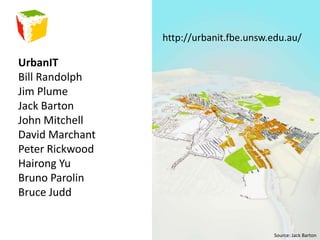
  • #98 Acknowledgment of the team who made this work possible.