
Integrating  Building Information Models  with  Geographic Information Systems The Technology Review   Umit Isikdag, Prof.Ghassan Aouad Dr. Jason Underwood, Dr. Nigel Trodd
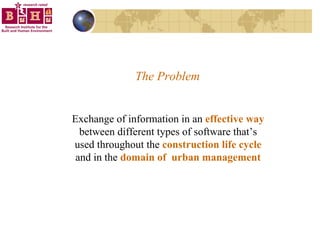
The Problem Exchange of information in an  effective way  between different types of software that’s used throughout the  construction life cycle  and in the  domain of  urban management
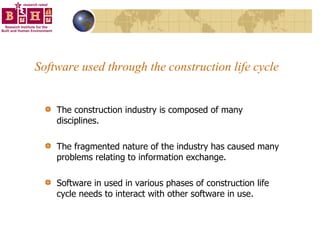
Software used through the construction life cycle The construction industry is composed of many disciplines.  The fragmented nature of the industry has caused many problems relating to information exchange.  Software in used in various phases of construction life cycle needs to interact with other software in use.
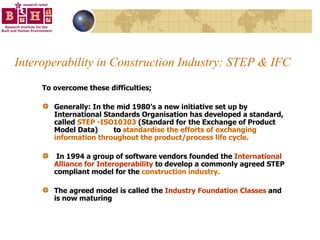
Interoperability in Construction Industry: STEP & IFC To overcome these difficulties; Generally: In the mid 1980’s a new initiative set up by International Standards Organisation has developed a standard, called  STEP -ISO10303  (Standard for the Exchange of Product Model Data)   to  standardise the efforts of exchanging information throughout the product/process life cycle.  In 1994 a group of software vendors founded the  International Alliance for Interoperability  to develop a commonly agreed STEP compliant model for the  construction industry.   The agreed model is called the  Industry Foundation Classes  and is now maturing
Software used in  the urban management The urban management domain receive many inputs from and provides outputs to its related domains.  The amount of information is high so it difficult to store exchange and manage the information.  Urban management systems should work collaboratively with many other information systems
GIS is the common denominator of urban management systems GI Systems are systems which link the  geographical  information with  descriptive  information, or in other words systems which link the  geo-geometry  with the associated  data. GISs are used in many areas and also in, various stages in construction life cycle.
Interoperability in GIS  As the number and type of applications that processes geographic data increases the  concept of interoperability  is also becoming important for geographic information GI Interoperability standards include STEP compliant  TC211  and XML based  GML
The background for the research (AEC Scope) AEC Domain (the need for geographic information): 1)Design Phase of building life cycle data about  • Location (Map) • Demographics • Zoning • Risk factors is taken from central property registry 2)Design Phase: Simulation (Noise, Thermal, Lighting) 3)Registrering as built info into central property registry 4)Geo relational construction activities
The background for the research  (Urban Management Scope) We need building related data: Effective Disaster Damage Analysis Urban Demolition Projects VR in Urban Environments 3D,4D (also for landscape architecture) Planning  of Services (Pipeline, Gas, Electric) Effective Maintenance Management in Urban Scale Delivery of goods The integration will provide an infrastructure for integration of local information with global information
Aim of the research The general research aim is: To find out the needs for integration  and  to investigate the ways and methods  of integration between them. This presentation is focused on the technology review stage of the research.
THE TECHNOLGY REVIEW PART 1 GIS
Raster & Vector Data  Models Raster data is usually stored as an array of grid values , with metadata about the array held in a file header.  In the vector data representation each object in the real world is first classified into a geometric type:  point, line, or polygon.   a) Geometries in a binary file and attributes in a DBMS table ( vector ) b) Geometries in a binary file and attributes and topology in a DBMS table ( vector topologic,3d TIN ) c) Geometries ,topology and attributes in a DBMS table with a special field for geometric shape ( vector in database )
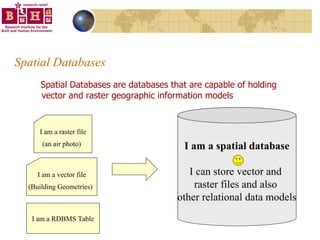
Spatial Databases Spatial Databases are databases that are capable of holding vector and raster geographic information models I am a spatial database I can store vector and  raster files and also  other relational data models I am a raster file (an air photo)   I am a vector file (Building Geometries)   I am a RDBMS Table
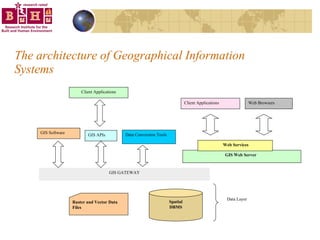
The architecture of Geographical Information Systems Spatial DBMS Raster and Vector Data Files GIS GATEWAY GIS Web Server   Web Services GIS Software Data Conversion Tools GIS APIs Client Applications Client Applications Web Browsers Data Layer
THE TECHNOLGY REVIEW PART 2 IFC
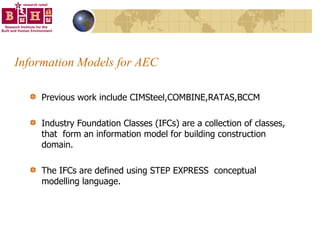
Information Models for AEC Previous work include CIMSteel,COMBINE,RATAS,BCCM Industry Foundation Classes (IFCs) are a collection of classes, that  form an information model for building construction domain. The IFCs are defined using STEP EXPRESS  conceptual modelling language.
The Structure of  the STEP and IFC
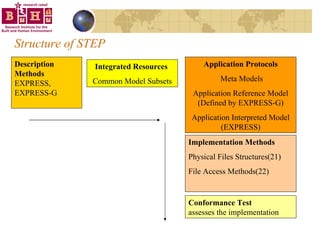
Structure of STEP Description Methods  EXPRESS, EXPRESS-G  IDEF1x ,NIAM,  Integrated Resources   Common Model Subsets Application Protocols Meta Models Application Reference Model (Defined by EXPRESS-G) Application Interpreted Model (EXPRESS) Implementation Methods Physical Files Structures(21)  File Access Methods(22) Conformance Test  assesses the implementation
IFC Schema = The Meta Model Meta Model file is  called  IFC Schema Meta Model file holds the IFC entities IFC entities contain descriptive information about IfcObjects.  Meta Model is defined by  EXPRESS  The meta model file has the .exp extension ENTITY IfcOrganizationRelationship; Name : IfcLabel; Description : OPTIONAL IfcText; RelatingOrganization : IfcOrganization; RelatedOrganizations : SET [1:?] OF IfcOrganization; END_ENTITY;
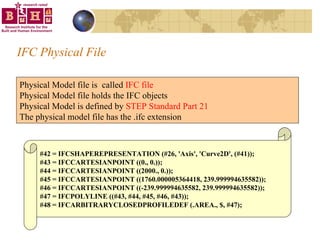
IFC Physical File Physical Model file is  called  IFC file Physical Model file holds the IFC objects Physical Model is defined by  STEP Standard Part 21   The physical model file has the .ifc extension #42 = IFCSHAPEREPRESENTATION (#26, 'Axis', 'Curve2D', (#41)); #43 = IFCCARTESIANPOINT ((0., 0.)); #44 = IFCCARTESIANPOINT ((2000., 0.)); #45 = IFCCARTESIANPOINT ((1760.000005364418, 239.999994635582)); #46 = IFCCARTESIANPOINT ((-239.999994635582, 239.999994635582)); #47 = IFCPOLYLINE ((#43, #44, #45, #46, #43)); #48 = IFCARBITRARYCLOSEDPROFILEDEF (.AREA., $, #47);
IFC Information Exchange Architectures
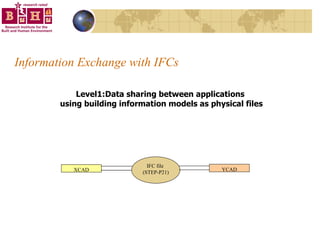
Information Exchange with IFCs IFC file  (STEP-P21) XCAD YCAD Level1:Data sharing between applications  using building information models as physical files
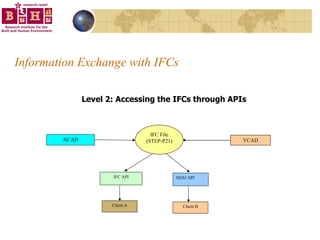
Information Exchange with IFCs Level 2: Accessing the IFCs through APIs  IFC File (STEP-P21) IFC API SDAI API XCAD Client B YCAD Client A
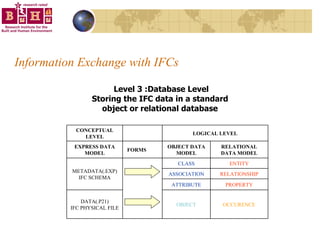
Information Exchange with IFCs Level 3 :Database Level Storing the IFC data in a standard  object or relational database   OCCURENCE OBJECT DATA(.P21) IFC PHYSICAL FILE PROPERTY ATTRIBUTE RELATIONSHIP ASSOCIATION ENTITY CLASS METADATA(.EXP) IFC SCHEMA RELATIONAL DATA MODEL OBJECT DATA MODEL FORMS EXPRESS DATA MODEL LOGICAL LEVEL CONCEPTUAL LEVEL
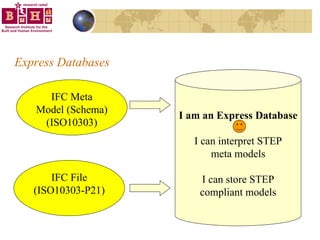
Express Databases I am an Express Database I can interpret STEP meta models I can store STEP compliant models IFC Meta Model (Schema) (ISO10303) IFC File (ISO10303-P21)
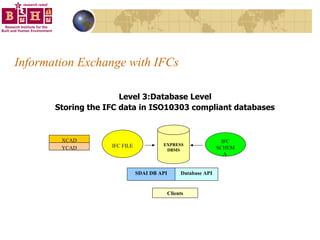
Information Exchange with IFCs Level 3:Database Level  Storing the IFC data in ISO10303 compliant databases   EXPRESS DBMS IFC SCHEMA  IFC FILE SDAI DB API Database API Clients XCAD YCAD
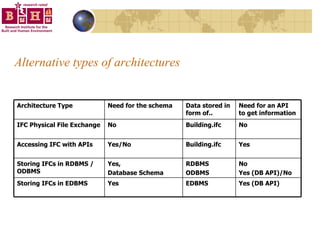
Alternative types of architectures Yes Yes, Database Schema Yes/No No Need for the schema No Yes (DB API)/No RDBMS ODBMS Storing IFCs in RDBMS / ODBMS Yes Building.ifc Accessing IFC with APIs EDBMS Building.ifc Data stored in form of.. Yes (DB API) Storing IFCs in EDBMS No IFC Physical File Exchange Need for an API  to get information  Architecture Type
Conclusion Several  Possible  System Architectures Physical File Level Database Level Application Level
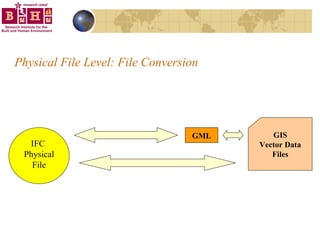
Physical File Level: File Conversion IFC  Physical File GIS Vector Data Files GML
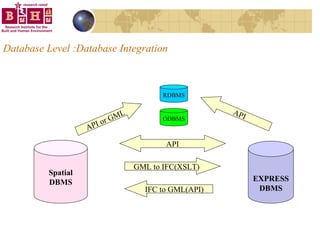
Database Level :Database Integration Spatial DBMS EXPRESS DBMS API GML to IFC(XSLT) IFC to GML(API) RDBMS API API or GML ODBMS
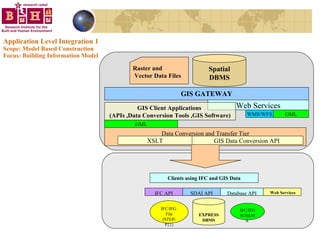
Application Level Integration 1 Scope: Model Based Construction Focus: Building Information Model EXPRESS DBMS IFC/IFG SCHEMA  IFC/IFG  File (STEP-P21) SDAI API Database API Clients using IFC and GIS Data Spatial DBMS Raster and Vector Data Files GIS GATEWAY Web Services GIS Client Applications  (APIs ,Data Conversion Tools ,GIS Software) GML GML WMS/WFS IFC API Web Services Data Conversion and Transfer Tier GIS Data Conversion API XSLT
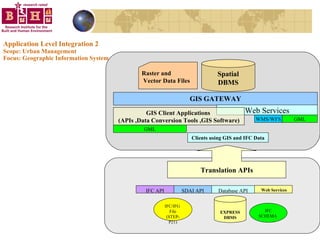
Application Level Integration 2 Scope: Urban Management  Focus: Geographic Information System EXPRESS DBMS IFC SCHEMA  IFC/IFG  File (STEP-P21) SDAI API Database API Clients using GIS and IFC Data IFC API Web Services Translation APIs Spatial DBMS Raster and Vector Data Files GIS GATEWAY Web Services GIS Client Applications  (APIs ,Data Conversion Tools ,GIS Software) GML GML WMS/WFS
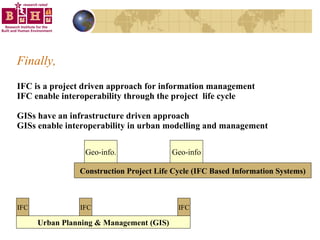
Finally, IFC is a project driven approach for information management IFC enable interoperability through the project  life cycle  GISs have an infrastructure driven approach  GISs enable interoperability in urban modelling and management Urban Planning & Management (GIS) IFC IFC IFC Construction Project Life Cycle (IFC Based Information Systems) Geo-info. Geo-info
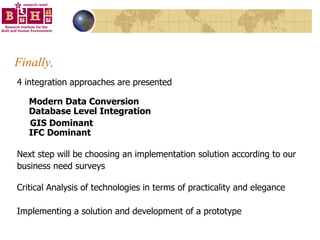
Finally, 4 integration approaches are presented Modern Data Conversion Database Level Integration GIS Dominant IFC Dominant Next step will be choosing an implementation solution according to our business need surveys Critical Analysis of technologies in terms of practicality and elegance Implementing a solution and development of a prototype
Thanks for listening…
NEW APPROACHES
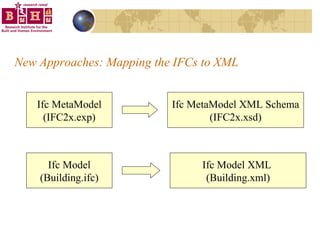
New Approaches: Mapping the IFCs to XML Ifc MetaModel (IFC2x.exp) Ifc Model (Building.ifc) Ifc MetaModel XML Schema (IFC2x.xsd) Ifc Model XML  (Building.xml)
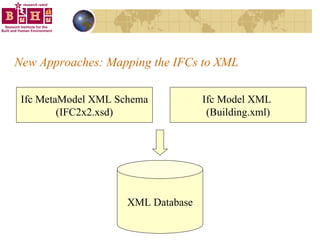
New Approaches: Mapping the IFCs to XML Ifc MetaModel XML Schema (IFC2x2.xsd) Ifc Model XML  (Building.xml) XML Database
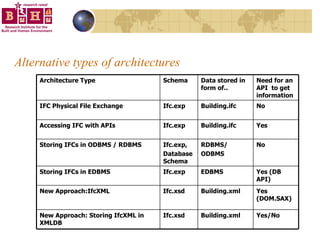
Alternative types of architectures Yes/No Building.xml Ifc.xsd New Approach: Storing IfcXML in XMLDB Ifc.xsd Ifc.exp Ifc.exp, Database Schema Ifc.exp Ifc.exp Schema No RDBMS/ ODBMS Storing IFCs in ODBMS / RDBMS Yes Building.ifc Accessing IFC with APIs Building.xml EDBMS Building.ifc Data stored in form of.. Yes (DOM.SAX) New Approach:IfcXML Yes (DB API) Storing IFCs in EDBMS No IFC Physical File Exchange Need for an API  to get information  Architecture Type
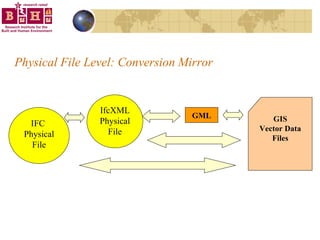
Physical File Level: Conversion Mirror IFC  Physical File IfcXML Physical File GIS Vector Data Files GML
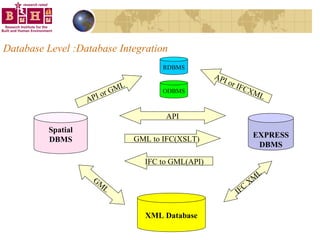
Database Level :Database Integration Spatial DBMS EXPRESS DBMS XML Database GML IFC XML API GML to IFC(XSLT) IFC to GML(API) RDBMS API or IFCXML API or GML ODBMS
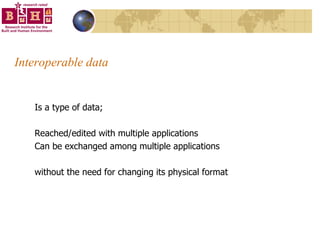
Interoperable data Is a type of data; Reached/edited with multiple applications  Can be exchanged among multiple applications without the need for changing its physical format

IRW 2004

  • 1.
    Integrating BuildingInformation Models with Geographic Information Systems The Technology Review Umit Isikdag, Prof.Ghassan Aouad Dr. Jason Underwood, Dr. Nigel Trodd
  • 2.
    The Problem Exchangeof information in an effective way between different types of software that’s used throughout the construction life cycle and in the domain of urban management
  • 3.
    Software used throughthe construction life cycle The construction industry is composed of many disciplines. The fragmented nature of the industry has caused many problems relating to information exchange. Software in used in various phases of construction life cycle needs to interact with other software in use.
  • 4.
    Interoperability in ConstructionIndustry: STEP & IFC To overcome these difficulties; Generally: In the mid 1980’s a new initiative set up by International Standards Organisation has developed a standard, called STEP -ISO10303 (Standard for the Exchange of Product Model Data) to standardise the efforts of exchanging information throughout the product/process life cycle. In 1994 a group of software vendors founded the International Alliance for Interoperability to develop a commonly agreed STEP compliant model for the construction industry. The agreed model is called the Industry Foundation Classes and is now maturing
  • 5.
    Software used in the urban management The urban management domain receive many inputs from and provides outputs to its related domains. The amount of information is high so it difficult to store exchange and manage the information. Urban management systems should work collaboratively with many other information systems
  • 6.
    GIS is thecommon denominator of urban management systems GI Systems are systems which link the geographical information with descriptive information, or in other words systems which link the geo-geometry with the associated data. GISs are used in many areas and also in, various stages in construction life cycle.
  • 7.
    Interoperability in GIS As the number and type of applications that processes geographic data increases the concept of interoperability is also becoming important for geographic information GI Interoperability standards include STEP compliant TC211 and XML based GML
  • 8.
    The background forthe research (AEC Scope) AEC Domain (the need for geographic information): 1)Design Phase of building life cycle data about • Location (Map) • Demographics • Zoning • Risk factors is taken from central property registry 2)Design Phase: Simulation (Noise, Thermal, Lighting) 3)Registrering as built info into central property registry 4)Geo relational construction activities
  • 9.
    The background forthe research (Urban Management Scope) We need building related data: Effective Disaster Damage Analysis Urban Demolition Projects VR in Urban Environments 3D,4D (also for landscape architecture) Planning of Services (Pipeline, Gas, Electric) Effective Maintenance Management in Urban Scale Delivery of goods The integration will provide an infrastructure for integration of local information with global information
  • 10.
    Aim of theresearch The general research aim is: To find out the needs for integration and to investigate the ways and methods of integration between them. This presentation is focused on the technology review stage of the research.
  • 11.
  • 12.
    Raster & VectorData Models Raster data is usually stored as an array of grid values , with metadata about the array held in a file header. In the vector data representation each object in the real world is first classified into a geometric type: point, line, or polygon. a) Geometries in a binary file and attributes in a DBMS table ( vector ) b) Geometries in a binary file and attributes and topology in a DBMS table ( vector topologic,3d TIN ) c) Geometries ,topology and attributes in a DBMS table with a special field for geometric shape ( vector in database )
  • 13.
    Spatial Databases SpatialDatabases are databases that are capable of holding vector and raster geographic information models I am a spatial database I can store vector and raster files and also other relational data models I am a raster file (an air photo) I am a vector file (Building Geometries) I am a RDBMS Table
  • 14.
    The architecture ofGeographical Information Systems Spatial DBMS Raster and Vector Data Files GIS GATEWAY GIS Web Server Web Services GIS Software Data Conversion Tools GIS APIs Client Applications Client Applications Web Browsers Data Layer
  • 15.
  • 16.
    Information Models forAEC Previous work include CIMSteel,COMBINE,RATAS,BCCM Industry Foundation Classes (IFCs) are a collection of classes, that form an information model for building construction domain. The IFCs are defined using STEP EXPRESS conceptual modelling language.
  • 17.
    The Structure of the STEP and IFC
  • 18.
    Structure of STEPDescription Methods EXPRESS, EXPRESS-G IDEF1x ,NIAM, Integrated Resources Common Model Subsets Application Protocols Meta Models Application Reference Model (Defined by EXPRESS-G) Application Interpreted Model (EXPRESS) Implementation Methods Physical Files Structures(21) File Access Methods(22) Conformance Test assesses the implementation
  • 19.
    IFC Schema =The Meta Model Meta Model file is called IFC Schema Meta Model file holds the IFC entities IFC entities contain descriptive information about IfcObjects. Meta Model is defined by EXPRESS The meta model file has the .exp extension ENTITY IfcOrganizationRelationship; Name : IfcLabel; Description : OPTIONAL IfcText; RelatingOrganization : IfcOrganization; RelatedOrganizations : SET [1:?] OF IfcOrganization; END_ENTITY;
  • 20.
    IFC Physical FilePhysical Model file is called IFC file Physical Model file holds the IFC objects Physical Model is defined by STEP Standard Part 21 The physical model file has the .ifc extension #42 = IFCSHAPEREPRESENTATION (#26, 'Axis', 'Curve2D', (#41)); #43 = IFCCARTESIANPOINT ((0., 0.)); #44 = IFCCARTESIANPOINT ((2000., 0.)); #45 = IFCCARTESIANPOINT ((1760.000005364418, 239.999994635582)); #46 = IFCCARTESIANPOINT ((-239.999994635582, 239.999994635582)); #47 = IFCPOLYLINE ((#43, #44, #45, #46, #43)); #48 = IFCARBITRARYCLOSEDPROFILEDEF (.AREA., $, #47);
  • 21.
  • 22.
    Information Exchange withIFCs IFC file (STEP-P21) XCAD YCAD Level1:Data sharing between applications using building information models as physical files
  • 23.
    Information Exchange withIFCs Level 2: Accessing the IFCs through APIs IFC File (STEP-P21) IFC API SDAI API XCAD Client B YCAD Client A
  • 24.
    Information Exchange withIFCs Level 3 :Database Level Storing the IFC data in a standard object or relational database OCCURENCE OBJECT DATA(.P21) IFC PHYSICAL FILE PROPERTY ATTRIBUTE RELATIONSHIP ASSOCIATION ENTITY CLASS METADATA(.EXP) IFC SCHEMA RELATIONAL DATA MODEL OBJECT DATA MODEL FORMS EXPRESS DATA MODEL LOGICAL LEVEL CONCEPTUAL LEVEL
  • 25.
    Express Databases Iam an Express Database I can interpret STEP meta models I can store STEP compliant models IFC Meta Model (Schema) (ISO10303) IFC File (ISO10303-P21)
  • 26.
    Information Exchange withIFCs Level 3:Database Level Storing the IFC data in ISO10303 compliant databases EXPRESS DBMS IFC SCHEMA IFC FILE SDAI DB API Database API Clients XCAD YCAD
  • 27.
    Alternative types ofarchitectures Yes Yes, Database Schema Yes/No No Need for the schema No Yes (DB API)/No RDBMS ODBMS Storing IFCs in RDBMS / ODBMS Yes Building.ifc Accessing IFC with APIs EDBMS Building.ifc Data stored in form of.. Yes (DB API) Storing IFCs in EDBMS No IFC Physical File Exchange Need for an API to get information Architecture Type
  • 28.
    Conclusion Several Possible System Architectures Physical File Level Database Level Application Level
  • 29.
    Physical File Level:File Conversion IFC Physical File GIS Vector Data Files GML
  • 30.
    Database Level :DatabaseIntegration Spatial DBMS EXPRESS DBMS API GML to IFC(XSLT) IFC to GML(API) RDBMS API API or GML ODBMS
  • 31.
    Application Level Integration1 Scope: Model Based Construction Focus: Building Information Model EXPRESS DBMS IFC/IFG SCHEMA IFC/IFG File (STEP-P21) SDAI API Database API Clients using IFC and GIS Data Spatial DBMS Raster and Vector Data Files GIS GATEWAY Web Services GIS Client Applications (APIs ,Data Conversion Tools ,GIS Software) GML GML WMS/WFS IFC API Web Services Data Conversion and Transfer Tier GIS Data Conversion API XSLT
  • 32.
    Application Level Integration2 Scope: Urban Management Focus: Geographic Information System EXPRESS DBMS IFC SCHEMA IFC/IFG File (STEP-P21) SDAI API Database API Clients using GIS and IFC Data IFC API Web Services Translation APIs Spatial DBMS Raster and Vector Data Files GIS GATEWAY Web Services GIS Client Applications (APIs ,Data Conversion Tools ,GIS Software) GML GML WMS/WFS
  • 33.
    Finally, IFC isa project driven approach for information management IFC enable interoperability through the project life cycle GISs have an infrastructure driven approach GISs enable interoperability in urban modelling and management Urban Planning & Management (GIS) IFC IFC IFC Construction Project Life Cycle (IFC Based Information Systems) Geo-info. Geo-info
  • 34.
    Finally, 4 integrationapproaches are presented Modern Data Conversion Database Level Integration GIS Dominant IFC Dominant Next step will be choosing an implementation solution according to our business need surveys Critical Analysis of technologies in terms of practicality and elegance Implementing a solution and development of a prototype
  • 35.
  • 36.
  • 37.
    New Approaches: Mappingthe IFCs to XML Ifc MetaModel (IFC2x.exp) Ifc Model (Building.ifc) Ifc MetaModel XML Schema (IFC2x.xsd) Ifc Model XML (Building.xml)
  • 38.
    New Approaches: Mappingthe IFCs to XML Ifc MetaModel XML Schema (IFC2x2.xsd) Ifc Model XML (Building.xml) XML Database
  • 39.
    Alternative types ofarchitectures Yes/No Building.xml Ifc.xsd New Approach: Storing IfcXML in XMLDB Ifc.xsd Ifc.exp Ifc.exp, Database Schema Ifc.exp Ifc.exp Schema No RDBMS/ ODBMS Storing IFCs in ODBMS / RDBMS Yes Building.ifc Accessing IFC with APIs Building.xml EDBMS Building.ifc Data stored in form of.. Yes (DOM.SAX) New Approach:IfcXML Yes (DB API) Storing IFCs in EDBMS No IFC Physical File Exchange Need for an API to get information Architecture Type
  • 40.
    Physical File Level:Conversion Mirror IFC Physical File IfcXML Physical File GIS Vector Data Files GML
  • 41.
    Database Level :DatabaseIntegration Spatial DBMS EXPRESS DBMS XML Database GML IFC XML API GML to IFC(XSLT) IFC to GML(API) RDBMS API or IFCXML API or GML ODBMS
  • 42.
    Interoperable data Isa type of data; Reached/edited with multiple applications Can be exchanged among multiple applications without the need for changing its physical format