OLIGOPOLY
Oligopoly is a market with few sellers selling
similar or identical products. “Few” means more
than one, but not so many that each firm doesn’t
have a substantial influence over market price.
OLIGOPOLY
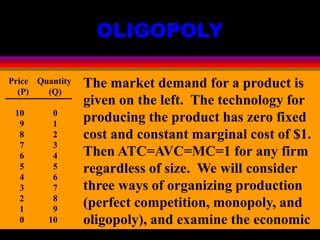
Price Quantity
(P) (Q)
10 0
9 1
8 2
7 3
6 4
5 5
4 6
3 7
2 8
1 9
0 10
The market demand for a product is
given on the left. The technology for
producing the product has zero fixed
cost and constant marginal cost of $1.
Then ATC=AVC=MC=1 for any firm
regardless of size. We will consider
three ways of organizing production
(perfect competition, monopoly, and
oligopoly), and examine the economic
OLIGOPOLY
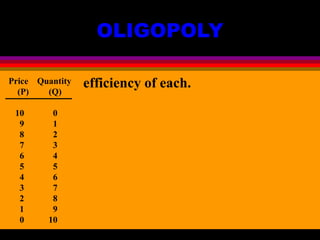
Price Quantity
(P) (Q)
10 0
9 1
8 2
7 3
6 4
5 5
4 6
3 7
2 8
1 9
0 10
efficiency of each.
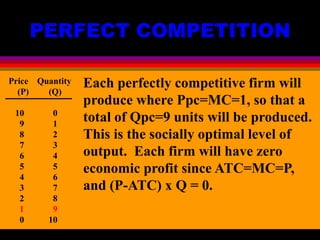
PERFECT COMPETITION
Price Quantity
(P) (Q)
10 0
9 1
8 2
7 3
6 4
5 5
4 6
3 7
2 8
1 9
0 10
Each perfectly competitive firm will
produce where Ppc=MC=1, so that a
total of Qpc=9 units will be produced.
This is the socially optimal level of
output. Each firm will have zero
economic profit since ATC=MC=P,
and (P-ATC) x Q = 0.
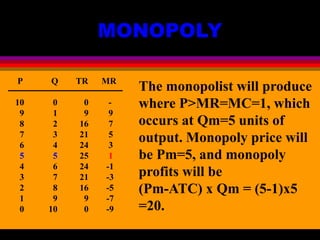
MONOPOLY
P Q TR MR
10 0 0 -
9 1 9 9
8 2 16 7
7 3 21 5
6 4 24 3
5 5 25 1
4 6 24 -1
3 7 21 -3
2 8 16 -5
1 9 9 -7
0 10 0 -9
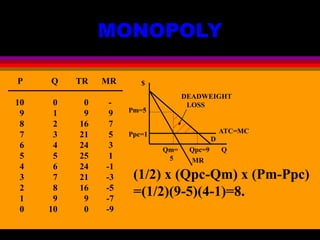
The monopolist will produce
where P>MR=MC=1, which
occurs at Qm=5 units of
output. Monopoly price will
be Pm=5, and monopoly
profits will be
(Pm-ATC) x Qm = (5-1)x5
=20.
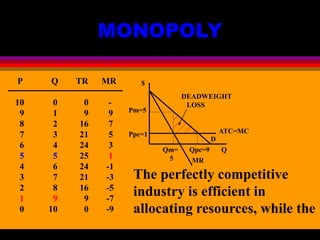
MONOPOLY
P Q TR MR
10 0 0 -
9 1 9 9
8 2 16 7
7 3 21 5
6 4 24 3
5 5 25 1
4 6 24 -1
3 7 21 -3
2 8 16 -5
1 9 9 -7
0 10 0 -9
$
Q
ATC=MC
D
MR
Ppc=1
Pm=5
Qm=
5
Qpc=9
DEADWEIGHT
LOSS
The perfectly competitive
industry is efficient in
allocating resources, while the
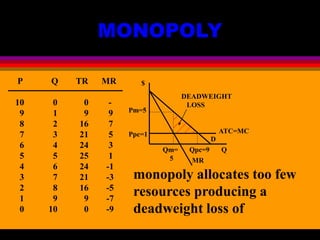
MONOPOLY
P Q TR MR
10 0 0 -
9 1 9 9
8 2 16 7
7 3 21 5
6 4 24 3
5 5 25 1
4 6 24 -1
3 7 21 -3
2 8 16 -5
1 9 9 -7
0 10 0 -9
$
Q
ATC=MC
D
MR
Ppc=1
Pm=5
Qm=
5
Qpc=9
DEADWEIGHT
LOSS
monopoly allocates too few
resources producing a
deadweight loss of
MONOPOLY
P Q TR MR
10 0 0 -
9 1 9 9
8 2 16 7
7 3 21 5
6 4 24 3
5 5 25 1
4 6 24 -1
3 7 21 -3
2 8 16 -5
1 9 9 -7
0 10 0 -9
$
Q
ATC=MC
D
MR
Ppc=1
Pm=5
Qm=
5
Qpc=9
DEADWEIGHT
LOSS
(1/2) x (Qpc-Qm) x (Pm-Ppc)
=(1/2)(9-5)(4-1)=8.
DUOPOLY
P Q TR MR
10 0 0 -
9 1 9 9
8 2 16 7
7 3 21 5
6 4 24 3
5 5 25 1
4 6 24 -1
3 7 21 -3
2 8 16 -5
1 9 9 -7
0 10 0 -9
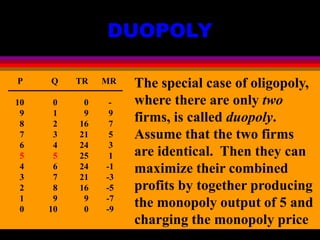
The special case of oligopoly,
where there are only two
firms, is called duopoly.
Assume that the two firms
are identical. Then they can
maximize their combined
profits by together producing
the monopoly output of 5 and
charging the monopoly price
DUOPOLY
P Q TR MR
10 0 0 -
9 1 9 9
8 2 16 7
7 3 21 5
6 4 24 3
5 5 25 1
4 6 24 -1
3 7 21 -3
2 8 16 -5
1 9 9 -7
0 10 0 -9
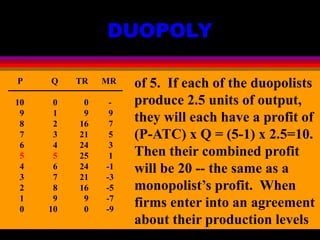
of 5. If each of the duopolists
produce 2.5 units of output,
they will each have a profit of
(P-ATC) x Q = (5-1) x 2.5=10.
Then their combined profit
will be 20 -- the same as a
monopolist’s profit. When
firms enter into an agreement
about their production levels
DUOPOLY
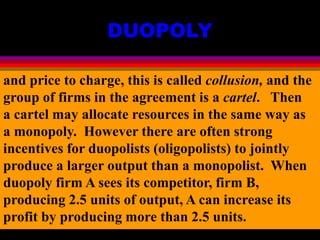
and price to charge, this is called collusion, and the
group of firms in the agreement is a cartel. Then
a cartel may allocate resources in the same way as
a monopoly. However there are often strong
incentives for duopolists (oligopolists) to jointly
produce a larger output than a monopolist. When
duopoly firm A sees its competitor, firm B,
producing 2.5 units of output, A can increase its
profit by producing more than 2.5 units.
DUOPOLY
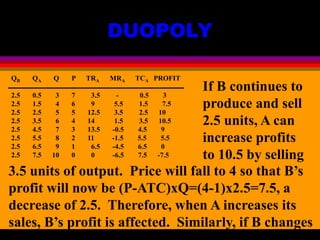
QB QA Q P TRA MRA TCA PROFIT
2.5 0.5 3 7 3.5 - 0.5 3
2.5 1.5 4 6 9 5.5 1.5 7.5
2.5 2.5 5 5 12.5 3.5 2.5 10
2.5 3.5 6 4 14 1.5 3.5 10.5
2.5 4.5 7 3 13.5 -0.5 4.5 9
2.5 5.5 8 2 11 -1.5 5.5 5.5
2.5 6.5 9 1 6.5 -4.5 6.5 0
2.5 7.5 10 0 0 -6.5 7.5 -7.5
If B continues to
produce and sell
2.5 units, A can
increase profits
to 10.5 by selling
3.5 units of output. Price will fall to 4 so that B’s
profit will now be (P-ATC)xQ=(4-1)x2.5=7.5, a
decrease of 2.5. Therefore, when A increases its
sales, B’s profit is affected. Similarly, if B changes
DUOPOLY
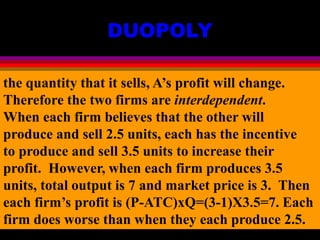
the quantity that it sells, A’s profit will change.
Therefore the two firms are interdependent.
When each firm believes that the other will
produce and sell 2.5 units, each has the incentive
to produce and sell 3.5 units to increase their
profit. However, when each firm produces 3.5
units, total output is 7 and market price is 3. Then
each firm’s profit is (P-ATC)xQ=(3-1)X3.5=7. Each
firm does worse than when they each produce 2.5.
DUOPOLY
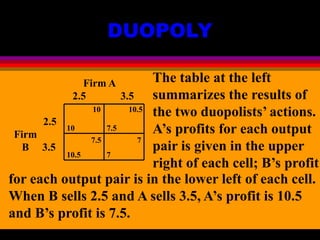
Firm A
2.5 3.5
2.5
Firm
B 3.5
10 10.5
10 7.5
7.5 7
10.5 7
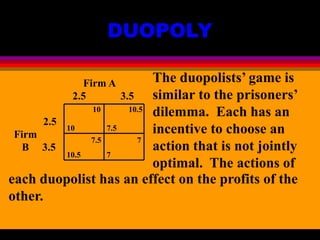
The table at the left
summarizes the results of
the two duopolists’ actions.
A’s profits for each output
pair is given in the upper
right of each cell; B’s profit
for each output pair is in the lower left of each cell.
When B sells 2.5 and A sells 3.5, A’s profit is 10.5
and B’s profit is 7.5.
GAME THEORY
Since the duopolists’ actions affect each other, they
must develop strategies for deciding how much
output to produce. Strategic decision making can
be conveniently analyzed using game theory. An
elementary game is known as the prisoners’
dilemma.
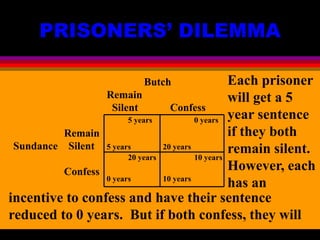
PRISONERS’ DILEMMA
Butch
Remain
Silent Confess
Remain
Sundance Silent
Confess
5 years 0 years
5 years 20 years
20 years 10 years
0 years 10 years
Each prisoner
will get a 5
year sentence
if they both
remain silent.
However, each
has an
incentive to confess and have their sentence
reduced to 0 years. But if both confess, they will
PRISONERS’ DILEMMA
Butch
Remain
Silent Confess
Remain
Sundance Silent
Confess
5 years 0 years
5 years 20 years
20 years 10 years
0 years 10 years
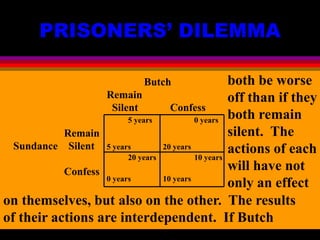
both be worse
off than if they
both remain
silent. The
actions of each
will have not
only an effect
on themselves, but also on the other. The results
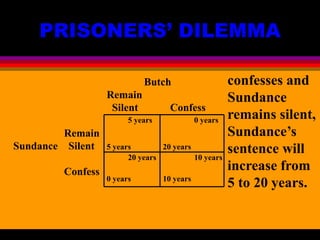
of their actions are interdependent. If Butch
PRISONERS’ DILEMMA
Butch
Remain
Silent Confess
Remain
Sundance Silent
Confess
5 years 0 years
5 years 20 years
20 years 10 years
0 years 10 years
confesses and
Sundance
remains silent,
Sundance’s
sentence will
increase from
5 to 20 years.
DUOPOLY
Firm A
2.5 3.5
2.5
Firm
B 3.5
10 10.5
10 7.5
7.5 7
10.5 7
The duopolists’ game is
similar to the prisoners’
dilemma. Each has an
incentive to choose an
action that is not jointly
optimal. The actions of
each duopolist has an effect on the profits of the
other.
OPEC
Founded in 1960, the Organization of Petroleum
Exporting Countries (OPEC) is a cartel of 11
countries that collectively produce about 75% of
the world’s oil. Periodically, the cartel assigns
production quotas to each of its members to limit
production in order to increase price and profits
of its members. The cartel has no legal means of
enforcing the production quotas. They are simply
accepted by mutual consent. When price is high,
OPEC
each country has an incentive to increase its
production to increase its own profits. But when
a number of countries increase production, price
will fall and so will the OPEC members’ profits.
In fact the history of OPEC has seen output quotas
raise petroleum (and gasoline) prices, only to have
some members eventually cheat on the agreement.
Saudi Arabia (which is an OPEC member) has
attempted to penalize the cheaters by flooding the
OPEC
world market with oil, and driving down world
price and the profits of oil producers. The idea
that Saudi Arabia is attempting to convey is that
countries who cheat will be “punished” with low
prices and profits when they do not follow their
production quotas. Repeatedly playing this game
OPEC members should eventually learn that the
best strategy to play is to adhere to their production
quotas.

day22.ppt

  • 1.
    OLIGOPOLY Oligopoly is amarket with few sellers selling similar or identical products. “Few” means more than one, but not so many that each firm doesn’t have a substantial influence over market price.
  • 2.
    OLIGOPOLY Price Quantity (P) (Q) 100 9 1 8 2 7 3 6 4 5 5 4 6 3 7 2 8 1 9 0 10 The market demand for a product is given on the left. The technology for producing the product has zero fixed cost and constant marginal cost of $1. Then ATC=AVC=MC=1 for any firm regardless of size. We will consider three ways of organizing production (perfect competition, monopoly, and oligopoly), and examine the economic
  • 3.
    OLIGOPOLY Price Quantity (P) (Q) 100 9 1 8 2 7 3 6 4 5 5 4 6 3 7 2 8 1 9 0 10 efficiency of each.
  • 4.
    PERFECT COMPETITION Price Quantity (P)(Q) 10 0 9 1 8 2 7 3 6 4 5 5 4 6 3 7 2 8 1 9 0 10 Each perfectly competitive firm will produce where Ppc=MC=1, so that a total of Qpc=9 units will be produced. This is the socially optimal level of output. Each firm will have zero economic profit since ATC=MC=P, and (P-ATC) x Q = 0.
  • 5.
    MONOPOLY P Q TRMR 10 0 0 - 9 1 9 9 8 2 16 7 7 3 21 5 6 4 24 3 5 5 25 1 4 6 24 -1 3 7 21 -3 2 8 16 -5 1 9 9 -7 0 10 0 -9 The monopolist will produce where P>MR=MC=1, which occurs at Qm=5 units of output. Monopoly price will be Pm=5, and monopoly profits will be (Pm-ATC) x Qm = (5-1)x5 =20.
  • 6.
    MONOPOLY P Q TRMR 10 0 0 - 9 1 9 9 8 2 16 7 7 3 21 5 6 4 24 3 5 5 25 1 4 6 24 -1 3 7 21 -3 2 8 16 -5 1 9 9 -7 0 10 0 -9 $ Q ATC=MC D MR Ppc=1 Pm=5 Qm= 5 Qpc=9 DEADWEIGHT LOSS The perfectly competitive industry is efficient in allocating resources, while the
  • 7.
    MONOPOLY P Q TRMR 10 0 0 - 9 1 9 9 8 2 16 7 7 3 21 5 6 4 24 3 5 5 25 1 4 6 24 -1 3 7 21 -3 2 8 16 -5 1 9 9 -7 0 10 0 -9 $ Q ATC=MC D MR Ppc=1 Pm=5 Qm= 5 Qpc=9 DEADWEIGHT LOSS monopoly allocates too few resources producing a deadweight loss of
  • 8.
    MONOPOLY P Q TRMR 10 0 0 - 9 1 9 9 8 2 16 7 7 3 21 5 6 4 24 3 5 5 25 1 4 6 24 -1 3 7 21 -3 2 8 16 -5 1 9 9 -7 0 10 0 -9 $ Q ATC=MC D MR Ppc=1 Pm=5 Qm= 5 Qpc=9 DEADWEIGHT LOSS (1/2) x (Qpc-Qm) x (Pm-Ppc) =(1/2)(9-5)(4-1)=8.
  • 9.
    DUOPOLY P Q TRMR 10 0 0 - 9 1 9 9 8 2 16 7 7 3 21 5 6 4 24 3 5 5 25 1 4 6 24 -1 3 7 21 -3 2 8 16 -5 1 9 9 -7 0 10 0 -9 The special case of oligopoly, where there are only two firms, is called duopoly. Assume that the two firms are identical. Then they can maximize their combined profits by together producing the monopoly output of 5 and charging the monopoly price
  • 10.
    DUOPOLY P Q TRMR 10 0 0 - 9 1 9 9 8 2 16 7 7 3 21 5 6 4 24 3 5 5 25 1 4 6 24 -1 3 7 21 -3 2 8 16 -5 1 9 9 -7 0 10 0 -9 of 5. If each of the duopolists produce 2.5 units of output, they will each have a profit of (P-ATC) x Q = (5-1) x 2.5=10. Then their combined profit will be 20 -- the same as a monopolist’s profit. When firms enter into an agreement about their production levels
  • 11.
    DUOPOLY and price tocharge, this is called collusion, and the group of firms in the agreement is a cartel. Then a cartel may allocate resources in the same way as a monopoly. However there are often strong incentives for duopolists (oligopolists) to jointly produce a larger output than a monopolist. When duopoly firm A sees its competitor, firm B, producing 2.5 units of output, A can increase its profit by producing more than 2.5 units.
  • 12.
    DUOPOLY QB QA QP TRA MRA TCA PROFIT 2.5 0.5 3 7 3.5 - 0.5 3 2.5 1.5 4 6 9 5.5 1.5 7.5 2.5 2.5 5 5 12.5 3.5 2.5 10 2.5 3.5 6 4 14 1.5 3.5 10.5 2.5 4.5 7 3 13.5 -0.5 4.5 9 2.5 5.5 8 2 11 -1.5 5.5 5.5 2.5 6.5 9 1 6.5 -4.5 6.5 0 2.5 7.5 10 0 0 -6.5 7.5 -7.5 If B continues to produce and sell 2.5 units, A can increase profits to 10.5 by selling 3.5 units of output. Price will fall to 4 so that B’s profit will now be (P-ATC)xQ=(4-1)x2.5=7.5, a decrease of 2.5. Therefore, when A increases its sales, B’s profit is affected. Similarly, if B changes
  • 13.
    DUOPOLY the quantity thatit sells, A’s profit will change. Therefore the two firms are interdependent. When each firm believes that the other will produce and sell 2.5 units, each has the incentive to produce and sell 3.5 units to increase their profit. However, when each firm produces 3.5 units, total output is 7 and market price is 3. Then each firm’s profit is (P-ATC)xQ=(3-1)X3.5=7. Each firm does worse than when they each produce 2.5.
  • 14.
    DUOPOLY Firm A 2.5 3.5 2.5 Firm B3.5 10 10.5 10 7.5 7.5 7 10.5 7 The table at the left summarizes the results of the two duopolists’ actions. A’s profits for each output pair is given in the upper right of each cell; B’s profit for each output pair is in the lower left of each cell. When B sells 2.5 and A sells 3.5, A’s profit is 10.5 and B’s profit is 7.5.
  • 15.
    GAME THEORY Since theduopolists’ actions affect each other, they must develop strategies for deciding how much output to produce. Strategic decision making can be conveniently analyzed using game theory. An elementary game is known as the prisoners’ dilemma.
  • 16.
    PRISONERS’ DILEMMA Butch Remain Silent Confess Remain SundanceSilent Confess 5 years 0 years 5 years 20 years 20 years 10 years 0 years 10 years Each prisoner will get a 5 year sentence if they both remain silent. However, each has an incentive to confess and have their sentence reduced to 0 years. But if both confess, they will
  • 17.
    PRISONERS’ DILEMMA Butch Remain Silent Confess Remain SundanceSilent Confess 5 years 0 years 5 years 20 years 20 years 10 years 0 years 10 years both be worse off than if they both remain silent. The actions of each will have not only an effect on themselves, but also on the other. The results of their actions are interdependent. If Butch
  • 18.
    PRISONERS’ DILEMMA Butch Remain Silent Confess Remain SundanceSilent Confess 5 years 0 years 5 years 20 years 20 years 10 years 0 years 10 years confesses and Sundance remains silent, Sundance’s sentence will increase from 5 to 20 years.
  • 19.
    DUOPOLY Firm A 2.5 3.5 2.5 Firm B3.5 10 10.5 10 7.5 7.5 7 10.5 7 The duopolists’ game is similar to the prisoners’ dilemma. Each has an incentive to choose an action that is not jointly optimal. The actions of each duopolist has an effect on the profits of the other.
  • 20.
    OPEC Founded in 1960,the Organization of Petroleum Exporting Countries (OPEC) is a cartel of 11 countries that collectively produce about 75% of the world’s oil. Periodically, the cartel assigns production quotas to each of its members to limit production in order to increase price and profits of its members. The cartel has no legal means of enforcing the production quotas. They are simply accepted by mutual consent. When price is high,
  • 21.
    OPEC each country hasan incentive to increase its production to increase its own profits. But when a number of countries increase production, price will fall and so will the OPEC members’ profits. In fact the history of OPEC has seen output quotas raise petroleum (and gasoline) prices, only to have some members eventually cheat on the agreement. Saudi Arabia (which is an OPEC member) has attempted to penalize the cheaters by flooding the
  • 22.
    OPEC world market withoil, and driving down world price and the profits of oil producers. The idea that Saudi Arabia is attempting to convey is that countries who cheat will be “punished” with low prices and profits when they do not follow their production quotas. Repeatedly playing this game OPEC members should eventually learn that the best strategy to play is to adhere to their production quotas.