COSTING
BY
PICHANO KIKON
PHD SCHOLAR
LIS-451
Introduction
• Costing is the process by which an organization obtains estimates for
producing a product, providing a service, performing a function, or
operating a department (Encyclopedia Britannica, 1974).
• Cost accounting means measuring an organization in terms of money
or cost.
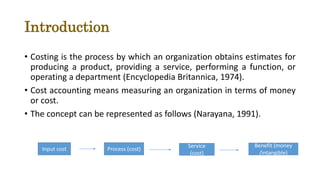
• The concept can be represented as follows (Narayana, 1991).
Input cost Process (cost)
Service
(cost)
Benefit (money
/intangible)
Definition
• Bob Mckee defines costing as a process of analyzing costs in detail -
often at the level of unit cost (that is, the full cost, in detail, of a single
process or action) in order to apportion expenditure to specific areas
of activity.
Why Costing in Libraries?
• Any library incurs some expenditure either in terms of money or other
resources like manpower, equipment, transportation, postage, etc., for
providing services or information products.
• Costing of them becomes necessary for determining the best product or
service at a minimum possible cost.
• A library provides different services or products.
• By costing each of them and judging them in terms of its contribution
towards meeting the objectives of the library, it should be possible for the
library to select the best possible service at minimum possible cost.
• For this it must know the costs of various components of the library, and
those of its various activities, services and products.
The important of costing
• It helps in determining the productivity of different staff members
and in effective supervision of various operations/activities and for
controlling them effectively.
• It helps in developing performance indicators which would measure
the `success' of the service.
• It helps in fixing prices for various library services and information
products (retrospective searches, SDI services, abstracting services,
bibliographies, databases, etc.).
• It can be used for comparing costs as a measure of efficiency or in
achieving cost effectiveness of services and for deciding alternatives
to make the best use of resources.
• It helps in convincing funding agencies about the cost effectiveness of the library services
and for securing necessary funding for the library.
• Thus it helps in budget formulation and presentation effectively.
• It helps in decision-making about whether to carry out certain functions or services
within the system or not.
• It helps in forecasting costs in planning a new or reorganizing an existing information
system.
• Cost information prevents from jumping to wrong conclusions.
• It helps in identifying priorities and setting objectives and targets for service delivery.
Types of Costs
• In the costing of library operations and services generally there are
two types of costs:
• Direct and indirect costs and
• Fixed and variable costs.
Direct Cost and Indirect Cost
• Direct costs are those which can be directly attributed to a particular activity like
the cost of materials, labor, transportation and mailing costs used for the activity.
• Indirect costs are the overhead costs like those of buildings, electricity, water and
other such facilities which are not exclusively used for a particular activity.
Fixed and Variable Costs
• Fixed costs are those which do not change with the volume of production or size
of activity
• while variable costs are those directly related to the volume of production or
quantum of an activity.
• These two types of costs are again sub-divided into components
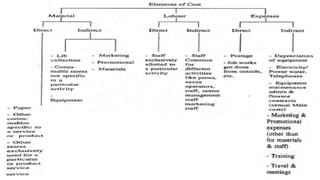
Elements of Cost
Material Cost
• The cost of materials used for providing a product or service is termed the
material cost.
• The direct material costs are those which can be assigned to specific physical
units of a product.
• For example, paper used for the product, the packaging used and so on.
• The indirect material costs are those which cannot be conveniently assigned to a
specific product or service.
• These may include library collection, equipment, common consumable items,
stationery, etc.
Labour Cost
• For preparing the information products or providing services, human effort is
needed.
• The cost of such human effort is called the labor cost.
• Direct labor costs are the costs of human effort which include the proportionate
costs of the staff wages (the costs of their perks may not be included in the Indian
situation at present).
• Indirect labor costs are those costs of staff which cannot be conveniently
approved to a particular product or service.
• Wages of the administrative, stores and finance staff, etc., are examples of this
cost
Expenses
• These can also be direct and indirect expenses.
• Direct expenses are those which can be conveniently allocated to specific cost
centers (these are explained below).
• Examples are postage and freight charges incurred for mailing information
products.
• Indirect expenses are those which cannot be allocated to cost centers.
• They include depreciation costs, equipment maintenance costs, electricity,
telephones, management and administrative expenses of the organization,
marketing and promotional expense and so on.
Capital Cost
• Apart from the costs stated above, there is yet another cost which has a bearing on the
total cost of a product, service or activity.
• It is the Capital Cost.
• This includes the cost of items which are used over a long period.
• They include the cost of buildings, equipment, library collection, furniture, transport
vehicles and other fixed assets.
• For costing purposes, depreciation of these items is to be considered which is grouped
under Expense-indirect.
Classification of Costs
Costs can be classified as
• Fixed
• Variable
• Semi-variable and
• Step costs.
Fixed Costs
• Management salary, administrative overheads of the organization in which the
library functions (the marginal increase due to promotions or certain staff or DA
revision are not considered).
Variable Costs
• Cost of direct material, electricity, wages of library staff, cost of online searches,
cost of information products, etc.
Semi-Variable Costs
• Depreciation, repairs, etc.
Step-Costs
• The salary of additional staff member when a particular work exceeds the
capacity of one staff member.
Thank You

Costing

  • 1.
  • 2.
    Introduction • Costing isthe process by which an organization obtains estimates for producing a product, providing a service, performing a function, or operating a department (Encyclopedia Britannica, 1974). • Cost accounting means measuring an organization in terms of money or cost. • The concept can be represented as follows (Narayana, 1991). Input cost Process (cost) Service (cost) Benefit (money /intangible)
  • 3.
    Definition • Bob Mckeedefines costing as a process of analyzing costs in detail - often at the level of unit cost (that is, the full cost, in detail, of a single process or action) in order to apportion expenditure to specific areas of activity.
  • 4.
    Why Costing inLibraries? • Any library incurs some expenditure either in terms of money or other resources like manpower, equipment, transportation, postage, etc., for providing services or information products. • Costing of them becomes necessary for determining the best product or service at a minimum possible cost. • A library provides different services or products. • By costing each of them and judging them in terms of its contribution towards meeting the objectives of the library, it should be possible for the library to select the best possible service at minimum possible cost. • For this it must know the costs of various components of the library, and those of its various activities, services and products.
  • 5.
    The important ofcosting • It helps in determining the productivity of different staff members and in effective supervision of various operations/activities and for controlling them effectively. • It helps in developing performance indicators which would measure the `success' of the service. • It helps in fixing prices for various library services and information products (retrospective searches, SDI services, abstracting services, bibliographies, databases, etc.). • It can be used for comparing costs as a measure of efficiency or in achieving cost effectiveness of services and for deciding alternatives to make the best use of resources.
  • 6.
    • It helpsin convincing funding agencies about the cost effectiveness of the library services and for securing necessary funding for the library. • Thus it helps in budget formulation and presentation effectively. • It helps in decision-making about whether to carry out certain functions or services within the system or not. • It helps in forecasting costs in planning a new or reorganizing an existing information system. • Cost information prevents from jumping to wrong conclusions. • It helps in identifying priorities and setting objectives and targets for service delivery.
  • 7.
    Types of Costs •In the costing of library operations and services generally there are two types of costs: • Direct and indirect costs and • Fixed and variable costs.
  • 8.
    Direct Cost andIndirect Cost • Direct costs are those which can be directly attributed to a particular activity like the cost of materials, labor, transportation and mailing costs used for the activity. • Indirect costs are the overhead costs like those of buildings, electricity, water and other such facilities which are not exclusively used for a particular activity.
  • 9.
    Fixed and VariableCosts • Fixed costs are those which do not change with the volume of production or size of activity • while variable costs are those directly related to the volume of production or quantum of an activity. • These two types of costs are again sub-divided into components
  • 11.
    Elements of Cost MaterialCost • The cost of materials used for providing a product or service is termed the material cost. • The direct material costs are those which can be assigned to specific physical units of a product. • For example, paper used for the product, the packaging used and so on. • The indirect material costs are those which cannot be conveniently assigned to a specific product or service. • These may include library collection, equipment, common consumable items, stationery, etc.
  • 12.
    Labour Cost • Forpreparing the information products or providing services, human effort is needed. • The cost of such human effort is called the labor cost. • Direct labor costs are the costs of human effort which include the proportionate costs of the staff wages (the costs of their perks may not be included in the Indian situation at present). • Indirect labor costs are those costs of staff which cannot be conveniently approved to a particular product or service. • Wages of the administrative, stores and finance staff, etc., are examples of this cost
  • 13.
    Expenses • These canalso be direct and indirect expenses. • Direct expenses are those which can be conveniently allocated to specific cost centers (these are explained below). • Examples are postage and freight charges incurred for mailing information products. • Indirect expenses are those which cannot be allocated to cost centers. • They include depreciation costs, equipment maintenance costs, electricity, telephones, management and administrative expenses of the organization, marketing and promotional expense and so on.
  • 14.
    Capital Cost • Apartfrom the costs stated above, there is yet another cost which has a bearing on the total cost of a product, service or activity. • It is the Capital Cost. • This includes the cost of items which are used over a long period. • They include the cost of buildings, equipment, library collection, furniture, transport vehicles and other fixed assets. • For costing purposes, depreciation of these items is to be considered which is grouped under Expense-indirect.
  • 15.
    Classification of Costs Costscan be classified as • Fixed • Variable • Semi-variable and • Step costs.
  • 16.
    Fixed Costs • Managementsalary, administrative overheads of the organization in which the library functions (the marginal increase due to promotions or certain staff or DA revision are not considered). Variable Costs • Cost of direct material, electricity, wages of library staff, cost of online searches, cost of information products, etc. Semi-Variable Costs • Depreciation, repairs, etc. Step-Costs • The salary of additional staff member when a particular work exceeds the capacity of one staff member.
  • 17.