The document provides a comprehensive overview of cost accounting as a specialized branch of accounting that addresses the limitations of financial accounting by analyzing and controlling costs associated with products and services. It outlines the objectives, principles, and differences between cost accounting and financial accounting, highlighting the importance of cost accounting in helping management make informed decisions. Key benefits of implementing a cost accounting system include improved cost control, enhanced efficiency, and better decision-making concerning pricing and production.
![[School of Distance Education]
Cost Accounting Page 1
COST ACCOUNTING
CORE COURSE
IV Semester – B.Com
(2011 ADMISSION ONWARDS)
UNIVERSITY OF CALICUT
SCHOOL OF DISTANCE EDUCATION
Calicut University, P.O. Malappuram, Kerala, India-673 635
330
[School of Distance Education]
Cost Accounting Page 1
COST ACCOUNTING
CORE COURSE
IV Semester – B.Com
(2011 ADMISSION ONWARDS)
UNIVERSITY OF CALICUT
SCHOOL OF DISTANCE EDUCATION
Calicut University, P.O. Malappuram, Kerala, India-673 635
330
[School of Distance Education]
Cost Accounting Page 1
COST ACCOUNTING
CORE COURSE
IV Semester – B.Com
(2011 ADMISSION ONWARDS)
UNIVERSITY OF CALICUT
SCHOOL OF DISTANCE EDUCATION
Calicut University, P.O. Malappuram, Kerala, India-673 635
330](https://image.slidesharecdn.com/bcomcorecostaccounting-240618100859-4a3f69c1/75/B-Com-Core-Cost-Accounting-school-of-distance-education-1-2048.jpg)
![[School of Distance Education]
Cost Accounting Page 2
UNIVERSITY OF CALICUT
SCHOOL OF DISTANCE EDUCATION
COST ACCOUNTING
IV SEMESTER
CORE COURSE - B.Com.
Prepared by: 1. Sri. Vinesh Ottuparammal,
Assistant Professor,
Govt. College, Malappuram
2. Smt. T. Shameera Kunhu. T,
Assistant Professor,
Govt. College, Malappuram
3. Sri.T.H. Jahfarali,
Assistant Professor,
Govt. College, Malappuram.
Scrutinised by: Dr. K. Venugopalan,
Associate Professor,
Dept. of Commerce,
Govt. College, Madappally.
Layout & Settings: Computer Section SDE
©
Reserved](https://image.slidesharecdn.com/bcomcorecostaccounting-240618100859-4a3f69c1/75/B-Com-Core-Cost-Accounting-school-of-distance-education-2-2048.jpg)
![[School of Distance Education]
Cost Accounting Page 3
CONTENT PAGE
Module I 5
Module II 19
Module III 34
Module IV 60
Module V 98](https://image.slidesharecdn.com/bcomcorecostaccounting-240618100859-4a3f69c1/75/B-Com-Core-Cost-Accounting-school-of-distance-education-3-2048.jpg)
![[School of Distance Education]
Cost Accounting Page 4](https://image.slidesharecdn.com/bcomcorecostaccounting-240618100859-4a3f69c1/75/B-Com-Core-Cost-Accounting-school-of-distance-education-4-2048.jpg)
![[School of Distance Education]
Cost Accounting Page 5
Module I
Introduction
Cost Accounting is a branch of accounting and has been developed due to limitations of financial
accounting. Financial accounting is primarily concerned with record keeping directed towards the
preparation of Profit and Loss Account and Balance Sheet. It provides information regarding the
profit and loss that the business enterprise is making and also its financial position on a particular
date. The financial accounting reports help the management to control in a general way the various
functions of the business but it fails to give detailed reports on the efficiency of various divisions.
The limitations of Financial Accounting which led to the development of cost accounting are as
follows.
Limitations of Financial Accounting
1. No clear idea of operating efficiency: Sometimes profits in an organization may be less or
more because of inflation or trade depression and not due to efficiency or inefficiency. But
financial accounting does not give a clear reason for profit or loss.
2. Weakness not spotted out by collective results: Financial Accounting shows the net result
of an organization. When the profit and loss account of an organization, shows less profit or a
loss, it does not give the reason for it or it does not show where the weakness lies.
3. Does not help in fixing the price: In Financial Accounting, we get the total cost of
production but it does not aid in determining prices of the products, services, production order
and lines of products.
4. No classification of expenses and accounts: In Financial Accounting, we don’t get data
relating to costs incurred by departments, processes separately or per unit cost of product
lines, or cost incurred in various sales territories. Further expenses are not classified as direct
or indirect, controllable and uncontrollable overheads and the value added in each process is
not reported.
5. No data for comparison and decision making: It does not supply useful data to
management for comparison with previous period and for taking various financial decisions
as introduction of new products, replacement of labour by machines, price in normal or
special circumstances, producing a part in the factory or buying it from outside market,
production of a product to be continued or given up, priority accorded to different products,
investment to be made in new products or not etc.
6. No control on cost: Financial Accounting does not help to control materials, supplies,
wages, labour and overhead costs.
7. Does not provide standards to assess the performance: Financial Accounting does not help
in developing standards to assess the performance of various persons ordepartments. It also
does not help in checking that costs do not exceed a reasonable limit for a given quantum of
work of the requisite quality.
8. Provides only historical information: Financial Accounting records only the historical
costs incurred. It does not provide day-to-day cost information to the management for
making effective plans for the future.](https://image.slidesharecdn.com/bcomcorecostaccounting-240618100859-4a3f69c1/75/B-Com-Core-Cost-Accounting-school-of-distance-education-5-2048.jpg)
![[School of Distance Education]
Cost Accounting Page 6
9. No analysis of losses: It does not provide complete analysis of losses due to defective
material, idle time, idle plant and equipment etc.. In other words, no distinction is made
between avoidable and unavoidable wastage.
10. Inadequate information for reports: It does not provide adequate information for reports
to outside agencies such as banks, government, insurance companies and trade associations.
11. No answer for certain questions: Financial Accounting will not help to answer questions
like:-
(a) Should an attempt be made to sell more products or is the factory operating to capacity?
(b) if an order or contract is accepted, is the price obtainable sufficient to show a profit?
(c) if the manufacture or sale of product A were discontinued and efforts make to increase
the sale of B, what would be the effect on the net profit? (d) Why the profit of last year is
of such a small amount despite the fact that output was increased substantially? Etc.
Costing and Cost Accounting
The costing terminology of C.I.M.A ., London defines costing as the “the techniques and
processes of ascertaining costs”. These techniques consist of principles and rules which govern the
procedure of ascertaining cost of products or services. The techniques to be followed for the
analysis of expenses and the processes by which such an analysis should be related to different
products or services differ from industry to industry. These techniques are also dynamic and they
change with time.
The main object of traditional cost accounts is the analysis of financial records, so as to
subdivide expenditure and to allocate it carefully to selected cost centers, and hence to build up a
total cost for the departments, processes or jobs or contracts of the undertaking. The extent to which
the analysis of expenditure should be carried will depend upon the nature of business and degree of
accuracy desired. The other important objective of costing are cost control and cost reduction.
Cost Accounting may be regarded as “a specialized branch of accounting which involves
classification, accumulation, assignment and control of costs.” The costing terminology of C.I.M.A,
London defines cost accounting as “the process of accounting for costs from the point at which
expenditure is incurred or committed to the establishment of its ultimate relationship with cost
centers and cost units. In its widest usage, it embraces the preparation of statistical data, the
application of cost control methods and the ascertainment of profitability of activities carried out or
planned”.
Wheldon defines cost accounting as “classifying, recording and appropriate allocation of
expenditure for determination of costs of products or services and for the presentation of suitably
arranged data purposes of control and guidance of management”. It is thus a formal mechanism by
means of which costs of products or services are ascertained and controlled.
General Principles of Cost Accounting
The following may be considered as the General Principles of Cost Accounting:
1. A cost should be related to its causes: Cost should be related as closely as possible to their
causes so that cost will be shared only among the cost units that pass thorough the
department of which the expenses are related.](https://image.slidesharecdn.com/bcomcorecostaccounting-240618100859-4a3f69c1/75/B-Com-Core-Cost-Accounting-school-of-distance-education-6-2048.jpg)
![[School of Distance Education]
Cost Accounting Page 7
2. A cost should be charged only after it has been incurred: While determining the cost of
individual units those costs which have actually been incurred should be considered. For
example, a cost unit should not be charged to the selling costs, while it is still in the factory.
Selling costs can be charged with the products which are sold.
3. The convention of prudence should be ignored: Usually accountants believe in historical
costs and while determining cost, they always attach importance to historical cost. In Cost
Accounting this convention must be ignored, otherwise, the management appraisal of the
profitability of the projects may be vitiated. According to W.M. Harper, “a cost statement
should, as far as possible, give facts with no known bias. If a contingency needs to be taken
into consideration it should be shown separately and distinctly”.
4. Abnormal costs should be excluded from cost accounts: Costs which are of abnormal
nature (eg. Accident, negligence etc.) should be ignored while computing the cost,
otherwise, it will distort costs figures and mislead management as to working results of their
undertaking under normal conditions.
5. Past costs not to be charged to future period: Costs which could not be recovered or charged
in full during the concerned period should not be taken to a future period, for recovery. If
past costs are included in the future period, they are likely to influence the future period
and future results are likely to be distorted.
6. Principles of double entry should be applied wherever necessary: Costing requires a greater
use of cost sheets and cost statements for the purpose of cost ascertainment and cost control,
but cost ledger and cost control accounts should be kept on double entry principle as far as
possible.
Objectives of Cost Accounting
Cost accounting aims at systematic recording of expenses and analysis of the same so as to
ascertain the cost of each product manufactured or service rendered by an organization. Information
regarding cost of each product or service would enable the management to know where to
economize on costs, how to fix prices, how to maximize profits and so on. Thus, the main
objectives of cost accounting are the following.
1. To analyse and classify all expenditure with reference to the cost of products and
operations.
2. To arrive at the cost of production of every unit, job, operation, process, department or
service and to develop cost standard.
3. To indicate to the management any inefficiencies and the extent of various forms of waste,
whether of materials, time, expenses or in the use of machinery, equipment and tools.
Analysis of the causes of unsatisfactory results may indicate remedial measures.
4. To provide data for periodical profit and loss accounts and balance sheets at such intervals,
e.g. weekly, monthly or quarterly as may be desired by the management during the financial](https://image.slidesharecdn.com/bcomcorecostaccounting-240618100859-4a3f69c1/75/B-Com-Core-Cost-Accounting-school-of-distance-education-7-2048.jpg)
![[School of Distance Education]
Cost Accounting Page 8
year, not only for the whole business but also by departments or individual products. Also,
to explain in detail the exact reasons for profit or loss revealed in total in the profit and loss
accounts.
5. To reveal sources of economies in production having regard to methods, types of
equipment, design, output and layout. Daily, Weekly, Monthly or Quarterly information
may be necessary to ensure prompt constructive action.
6. To provide actual figures of costs for comparison with estimates and to serve as a guide for
future estimates or quotations and to assist the management in their price fixing policy.
7. To show, where Standard Costs are prepared, what the cost of production ought to be and
with which the actual costs which are eventually recorded may be compared.
8. To present comparative cost data for different periods and various volume of output and to
provide guidance in the development of business. This is also helpful in budgetary control.
9. To record the relative production results of each unit of plant and machinery in use as a
basis for examining its efficiency. A comparison with the performance of other types of
machines may suggest the necessity for replacement.
10. To provide a perpetual inventory of stores and other materials so that interim Profit and
Loss Account and Balance Sheet can be prepared without stock taking and checks on stores
and adjustments are made at frequent intervals. Also to provide the basis for production
planning and for avoiding unnecessary wastages or losses of materials and stores.
Last but not the least, to provide information to enable management to make short term
decisions of various types, such as quotation of price to special customers or during a slump, make
or buy decision, assigning priorities to various products, etc.
Cost Accounting and Financial Accounting-
Both financial accounting and cost accounting are concerned with systematic recording and
presentation of financial data. Financial accounting reveals profits and losses of the business as a
whole during a particular period, while cost accounting shows, by analysis and localization, the unit
costs and profits and losses of different product lines. The main difference between financial
accounting and cost accounting are summarized below.
1. Financial accounting aims at safeguarding the interests of the business and its proprietors
and others connected with it. This is done by providing suitable information to various
parties, such as shareholders or partners, present or prospective creditors etc. Cost
accounting on the other hand, renders information for the guidance of the management for
proper planning, operation, control and decision making.
2. Financial accounts are kept in such a way as to meet the requirements of the Companies
Act, Income Tax Act and other statues. On the other hand cost accounts are generally kept
voluntarily to meet the requirements of the management. But now the Companies Act has
made it obligatory to keep cost records in some manufacturing industries.
3. Financial accounting emphasizes the measurement of profitability, while cost accounting
aims at ascertainment of costs and accumulates data for this very purpose.](https://image.slidesharecdn.com/bcomcorecostaccounting-240618100859-4a3f69c1/75/B-Com-Core-Cost-Accounting-school-of-distance-education-8-2048.jpg)
![[School of Distance Education]
Cost Accounting Page 9
4. Financial accounts disclose the net profit and loss of the business as a whole, whereas cost
accounts disclose profit or loss of each product, job or service. This enables the
management to eliminate less profitable product lines and maximize the profits by
concentrating on more profitable ones.
5. Financial accounting provides operating results and financial position usually gives
information through cost reports to the management as and when desired.
6. Financial accounts deal mainly with actual facts and figures, but cost accounts deal partly
with facts and figures, but cost accounts deal with facts and figures and partly with
estimates.
7. In case of financial accounts stress is on the ascertainment and exhibition of profits earned
or losses incurred in the business. On account of this reason in financial accounts, the
transactions are recorded, classified and analyzed in a subjective manner i.e. according to
the nature of expenditure. In cost accounts the emphasis is more on aspects of planning and
control and therefore transactions are recorded in an objective manner.
8. Financial accounts are concerned with external transactions i.e. transactions between the
business concern on one side and third parties on the other. These transactions form the
basis for payment or receipt of cash. While cost accounts are concerned with internal
transactions which do not form the basis of payment or receipt of cash.
9. The costs are reported in aggregate in financial accounts but costs are broken into unit basis
in cost accounts.
10. Financial accounts do not provide information on the relative efficiencies of various
workers, plants and machinery while cost accounts provide valuable information on the
relative efficiencies of various plants and machinery.
11. In financial accounts stocks are valued at cost or market price whichever is less, whereas
stocks are valued at cost price in cost accounts.
Importance of Cost Accounting
The limitations of financial accounting have made the management to realize the
importance of cost accounting. Whatever may be the type of business, it involves expenditure on
labour, materials and other items required for manufacturing and disposing of the product. The
management has to avoid the possibility of waste at each stage. It has to ensure that no machine
remains idle, efficient labour gets due incentive, by-products are properly utilized and costs are
properly ascertained. Besides the management, the creditors and employees are also benefited in
numerous ways by installation of a good costing system. Cost accounting increases the overall
productivity of an organization and serves as an important tool, in bringing prosperity to the nation,
thus, the importance of cost accounting can be discussed under the following headings:
a) Costing as an aid to management:- Cost accounting provides invaluable aid to management.
It provides detailed costing information to the management to enable them to maintain effective
control over stores and inventory, to increase efficiency of the organization and to check
wastage and losses. It facilitates delegation of responsibility for important tasks and rating of
employees. For all these the management should be capable of using the information provided
by cost accounts in a proper way. The various advantages derived by the management from a
good system of costing are as follows:](https://image.slidesharecdn.com/bcomcorecostaccounting-240618100859-4a3f69c1/75/B-Com-Core-Cost-Accounting-school-of-distance-education-9-2048.jpg)
![[School of Distance Education]
Cost Accounting Page 10
1. Cost accounting helps in periods of trade depression and trade competition. In periods of
trade depression, the organization cannot afford to have wastages which pass unchecked. The
management must know areas where economies may be sought, waste eliminated and
efficiency increased. The organization must wage a war not only for its survival but also
continued growth. The management should know the actual cost of their products before
embarking on any scheme of price reduction. Adequate system of costing facilitates this.
2. Cost accounting aids price fixation. Although the law of supply and demand determines the
price of the product, cost to the producer does play an important role. The producer can take
necessary guidance from his costing records in case he is in a position to fix or change the price
charged.
3. Cost accounting helps in making estimates. Adequate costing records provide a reliable basis
for making estimates and quoting tenders.
4. Cost accounting helps in channelizing production on right lines. Proper costing information
makes it possible for the management to distinguish between profitable and non-profitable
activities; profits can be maximized by concentrating on profitable operations and eliminating
non-profitable ones.
5. Cost accounting eliminates wastages. As cost accounting is concerned with detailed breakup
of costs, it is possible to check various forms of wastages or losses.
6. Cost accounting makes comparisons possible. Proper maintenance of costing records
provides various costing data for comparisons which in turn helps the management in
formulating future lines of action.
7. Cost accounting provides data for periodical Profit and Loss Account. Adequate costing
records provide the management with such data as may be necessary for preparation of Profit
and Loss Account and Balance Sheet at such intervals as may be desired by the management.
8. Cost accounting helps in determining and enhancing efficiency. Losses due to wastage of
materials, idle time of workers, poor supervision etc will be disclosed if the various operations
involved in the production are studied carefully. Efficiency can be measured, cost controlled
and various steps can be taken to increase the efficiency.
9. Cost accounting helps in inventory control. Cost accounting furnishes control which
management requires, in respect of stock of materials, work in progress and finished goods.
b) Costing as an aid to Creditors.
Investors, banks and other money lending institutions have a stake in the success of the
business concern are therefore benefitted immensely by the installation of an efficient
system of costing. They can base their judgment about the profitability and future prospects
of the enterprise on the costing records.
c) Costing as an aid to employees.
Employees have a vital interest in their employer’s enterprise in which they are employed.
They are benefited by a number of ways by the installation of an efficient system of costing.
They are benefited, through continuous employment and higher remuneration by way of
incentives, bonus plans, etc.](https://image.slidesharecdn.com/bcomcorecostaccounting-240618100859-4a3f69c1/75/B-Com-Core-Cost-Accounting-school-of-distance-education-10-2048.jpg)
![[School of Distance Education]
Cost Accounting Page 11
d) Costing as an aid to National Economy
An efficient system of costing brings prosperity to the business enterprise which in turn
brings prosperity to the business enterprise which in turn results in stepping up of the
government revenue. The overall economic development o f a country takes place as a
consequence of increase in efficiency of production. Control of costs, elimination of
wastages and inefficiencies led to the progress of the industry and, in consequence of the
nation as a whole.
Cost units- The Chartered Institute of Management Accountants, London, defines a unit of cost as
“a unit of quantity of product, service or time in relation to which costs may be ascertained or
expressed”.
The forms of measurement used as cost units are usually the units of physical measurements like
number, weight, area, length, value, time etc.
Following are some examples of cost unit.
Industry/product Cost unit basis
Automobile Numbers
Brick works per 1000 bricks
Cement per Tonne
Chemicals Litre, gallon, kilogram, ton
Steel Tonne
Sugar Tonne
Transport Passenger-kilometre, tonne kilometer
Cost centre – According to Chartered Institute of Management Accountants, London, cost centre
means “a location, person or item of equipment (or group of these) for which costs may be
ascertained and used for the purpose of cost control”. Cost centre is the smallest organizational sub-
unit for which separate cost collection is attempted. Thus cost centre refers to one of the convenient
unit into which the whole factory organization has been appropriately divided for costing purposes.
Each such unit consists of a department or a sub-department or item of equipment or , machinery or
a person or a group of persons.
For example, although an assembly department may be supervised by one foreman, it may contain
several assembly lines. Some times each assembly line is regarded as a separate cost centre with its
own assistant foreman.
The selection of suitable cost centres or cost units for which costs are to be ascertained in an
undertaking depends upon a number of factors which are listed as follows.
1. Organization of the factory
2. Conditions of incidence of cost
3. Requirements of the costing system ie. Suitability of the units or centres for cost purposes.
4. Availability of information
5. Management policy regarding making a particular choice from several alternatives.](https://image.slidesharecdn.com/bcomcorecostaccounting-240618100859-4a3f69c1/75/B-Com-Core-Cost-Accounting-school-of-distance-education-11-2048.jpg)
![[School of Distance Education]
Cost Accounting Page 12
Profit centre – A profit centre is that segment of activity of a business which is responsible for
both revenue and expenses and discloses the profit of a particular segment of activity. Profit centres
are created to delegate responsibility to individuals and measure their performance.
Difference between Profit centre and Cost centre
The various points of difference between Profit centre and cost centre are as follows. Cost centre
is the smallest unit of activity or area of responsibility for which costs are collected whereas a profit
centre is that segment of activity of a business which is responsible for both revenue and expenses.
(i) Cost centres are created for accounting conveniences of costs and their control
whereas as a profit centre is created because of decentralization of operations i.e., to
delegate responsibility to individuals who have greater knowledge of local conditions
etc.
(ii) Cost centers are not autonomous whereas profit centres are autonomous.
(iii) A cost centre does not have target cost but efforts are made to minimize costs, but
each profit centre has a profit target and enjoys authority to adopt such policies as are
necessary to achieve its targets.
(iv) There may be a number of cost centres in a profit centre in a profit centre as
production or service cost centres or personal or impersonal but a profit centre may be a
subsidiary company within a group or division in a company.
Cost classification
Costs can be classified or grouped according to their common characteristics. Proper
classification of costs is very important for identifying the costs with the cost centers or cost units.
The same costs are classified according to different ways of costing depending upon the purpose to
be achieved and requirements of a particular concern. The important ways of classification are:
1. By Nature or Elements. According to this classification the costs are classified into three
categories i.e., Materials, Labour and Expenses. Materials can further be sub-classified as raw
materials components, spare parts, consumable stores, packing materials etc. This helps in
finding the total cost of production and the percentage of materials (labour or other expenses)
constituted in the total cost. It also helps in valuation of work-in-progress.
2. By Functions: This classification is on the basis of costs incurred in various functions of an
organization ie. Production, administration, selling and distribution. According to this
classification, costs are divided into Manufacturing and Production Costs and Commercial
costs.
Manufacturing and Production Costs are costs involved in manufacture, construction and
fabrication of products.
Commercial Costs are (a) administration costs (b) selling and distribution costs.
3. By Degree of Traceability to the Product : According to this, costs are divided indirect costs
and indirect costs. Direct Costs are those costs which are incurred for a particular product and
can be identified with a particular cost centre or cost unit. Eg:- Materials, Labour. Indirect
Costs are those costs which are incurred for the benefit of a number of cost centre or cost units
and cannot be conveniently identified with a particular cost centre or cost unit. Eg:- Rent of
Building, electricity charges, salary of staff etc.](https://image.slidesharecdn.com/bcomcorecostaccounting-240618100859-4a3f69c1/75/B-Com-Core-Cost-Accounting-school-of-distance-education-12-2048.jpg)
![[School of Distance Education]
Cost Accounting Page 13
4. By Changes in Activity or Volume: According to this costs are classified according to their
behavior in relation to changes in the level of activity or volume of production. They are fixed,
variable and semi-variable. Fixed Costs are those costs which remain fixed in total amount with
increase or decrease in the volume of the output or productive activity for a given period of
time. Fixed Costs per unit decreases as production increases and vice versa. Eg:- rent, insurance
of factory building, factory manager’s salary etc. Variable Costs are those costs which vary in
direct proportion to the volume of output. These costs fluctuate in total but remain constant per
unit as production activity changes. Eg:- direct material costs, direct labour costs, power, repairs
etc. Semi-variable Costs are those which are partly fixed and partly variable. For example;
Depreciation, for two shifts working the total depreciation may be only 50% more than that for
single shift working. They may change with comparatively small changes in output but not in
the same proportion.
5. Association with the Product: Cost can be classified as product costs and period costs.
Product costs are those which are traceable to the product and included in inventory cost, thus
product cost is full factory cost. Period costs are incurred on the basis of time such as rent,
salaries etc. thus it includes all selling and administration costs. These costs are incurred for a
period and are treated as expenses.
6. By Controllability: The CIMA defines controllable cost as “a cost which can be influenced by
the action of a specified member of an undertaking” and a non-controllable cost as “a cost
which cannot be influenced by the action of a specified member of an undertaking”.
7. By Normality: There are normal costs and abnormal costs. Normal costs are the costs which
are normally incurred at a given level of output under normal conditions. Abnormal costs are
costs incurred under abnormal conditions which are not normally incurred in the normal course
of production.Eg:- damaged goods due to machine break down, extra expenses due to
disruption of electricity, inefficiency of workers etc.
8. By Relationship with Accounting Period: There are capital and revenue expenses depending
on the length of the period for which it is incurred. The cost which is incurred in purchasing an
asset either to earn income or increasing the earning capacity of the business is called capital
cost, for example, the cost of a machine in a factory. Such cost is incurred at one point of time
but the benefits accruing from it are spread over a number of accounting years. The cost which
is incurred for maintaining an asset or running a business is revenue expenditure. Eg:- cost of
materials, salary and wages paid, depreciation, repairs and maintenance, selling and
distribution.
9. By Time..Costs can be classified as 1) Historical cost and 2) Predetermined Costs.
The costs which are ascertained and recorded after it has been incurred is called historical costs.
They are based on recorded facts hence they can be verified and are always supported by
evidences. Predetermined costs are also known as estimated costs as they are computed in
advance of production taking into consideration the previous periods’ costs and the factors
affecting such costs. Predetermined costs when calculated scientifically become standard costs.
Standard costs are used to prepare budgets and then the actual cost incurred is later-on
compared with such predetermined cost and the variance is studied for future correction.](https://image.slidesharecdn.com/bcomcorecostaccounting-240618100859-4a3f69c1/75/B-Com-Core-Cost-Accounting-school-of-distance-education-13-2048.jpg)
![[School of Distance Education]
Cost Accounting Page 14
Types, Methods and Techniques of Costing
The general fundamental principles of ascertaining costs are the same in every system of
cost accounting, but the methods of analysis and presenting the costs vary from industry to
industry. Different methods are used because business enterprises vary in their nature and in the
type of products or services they produce or render. Basically, there are two principal methods of
costing, namely (i) Job Costing, and (ii) Process costing.
1. Job costing: It refers to a system of costing in which costs are ascertained in terms of specific
jobs or orders which are not comparable with each other. Industries where this method of
costing is generally applied are Printing Process, Automobile Garages, Repair Shops, Ship-
building, House building, Engine and Machine construction, etc. Job Costing includes the
following methods of costing:
(a) Contract Costing: Although contract costing does not differ in principle from job costing, it is
convenient to treat contract cost accounts separately. The term is usually applied to the costing
method adopted where large scale contracts at different sites are carried out, as in the case of
building construction.
(b) Bach Costing: This method is also a type of job costing. A batch of similar products is regarded
as one job and the cost of this complete batch is ascertained. It is then used to determine the unit
cost of the articles produced. It should, however, be noted that the articles produced should not
lose their identity in manufacturing operations.
(c) Terminal Costing: This method is also a type of job costing. This method emphasizes the
essential nature of job costing, ie, the cost can be properly terminated at some point and related
to a particular job.
(d) Operation Costing: This method is adopted when it is desired to ascertain the cost of carrying
out an operation in a department, for example, welding. For large undertaking, it is frequently
necessary to ascertain the cost of various operations.
2. Process Costing: Where a product passes through distinct stages or processes, the output of one
process being the input of the subsequent process, it is frequently desired to ascertain the cost of
each stage or process of production. This is known as process costing. This method is used
where it is difficult to trace the item of prime cost to a particular order because its identity is
lost in volume of continuous production. Process costing is generally adopted in textile
industries, chemical industries, oil refineries, soap manufacturing, paper manufacturing,
tanneries, etc.
3. Unit or single or output or single output costing: This method is used where a single article
is produced or service is rendered by continuous manufacturing activity. The cost of the whole
production cycle is ascertained as a process or series of processes and the cost per unit is arrived
at by dividing the total cost by the number of units produced. The unit of costing is chosen
according to the nature of the product. Cost statements or cost sheets are prepared under which
various items of expenses are classified and the total expenditure is divided by total quantity
produced in order to arrive at unit cost of production. This method is suitable in industries like
brick-making, collieries, flour mills, cement manufacturing, etc. this method is useful for the
assembly department in a factory producing a mechanical article eg. Bicycle.](https://image.slidesharecdn.com/bcomcorecostaccounting-240618100859-4a3f69c1/75/B-Com-Core-Cost-Accounting-school-of-distance-education-14-2048.jpg)
![[School of Distance Education]
Cost Accounting Page 15
4. Operating Costing: This method is applicable where services are rendered rather than goods
produced. The procedure is same as in the case of single output costing. The total expenses of
the operation are divided by the units and cost per unit of services is arrived at. This method is
employed in Railways, Road Transport, Water supply undertakings, Telephone services,
Electricity companies, Hospital services, Municipal services, etc.
5. Multiple or Complete Costing: Some products are so complex that no single system of costing
is applicable. It is used where there are a variety of components separately produced and
subsequently assembled in a complex production. Total cost is ascertained by computing
component costs which are collected by job or process costing and then aggregating the costs
through use of the single or output costing system. This method is applicable to manufacturing
concerns producing Motor Cars, Aeroplanes, Machine tools, Type-writers, Radios, Cycles,
Sewing Machines, etc.
6. Uniform Costing: It is not a distinct method of costing by itself. It is the name given to a
common system of costing followed by a number of firms in the same industry. This helps in
comparing performance of one firm with that of another.
7. Departmental Costing: When costs are ascertained department by department, the method is
called “Departmental Costing”. Usually, for ascertaining the cost of various goods or services
produced by the department, the total costs will have to be analysed, say, by the use of job
costing or unit costing.
In addition to the above methods of costing, mention can be made of the following techniques
of costing which can be applied to any one of the above method of costing for special purposes
of cost control and policy making:
a) Standard or Predetermined Costs.
b) Marginal Costs
Elements of Cost- The management of an organization needs necessary data to analyze and
classify costs for proper control and for taking decisions for future course of action. Hence the
total cost is analyzed by elements of costs ie by the nature of expenses. The elements of costs
are three and they are materials, labour and other expenses. These can be further analyzed as
follows.](https://image.slidesharecdn.com/bcomcorecostaccounting-240618100859-4a3f69c1/75/B-Com-Core-Cost-Accounting-school-of-distance-education-15-2048.jpg)
![[School of Distance Education]
Cost Accounting Page 16
By grouping the above elements of cost, the following divisions of cost are obtained.
1. Prime cost = Direct Materials + Direct Labour+ Direct Expenses
2. Works or Factory Cost = Prime Cost + Works or Factory Overheads
3. Cost of Production = Works Cost + Administration Overheads
4. Total Cost or Cost of Sales = Cost of Production + Selling and Distribution Overheads
The difference between the cost of sales and selling price represents profit or loss.
Illustration 1. Find the Prime Cost, Works Cost, Cost of production, total Cost and profit from the
following:- Direct Materials Rs.20000; Direct Labour Rs. 10000; Factory Expenses Rs. 7000;
Administration Expenses Rs. 5000; Selling Expenses Rs. 7000 and Sales Rs.60,000.
Solution:
Prime Cost = Direct Materials + Direct Labour = Rs.20,000 + Rs.10,000 = Rs.30,000.
Works Cost = Prime Cost + Factory Expenses = Rs.30,000 + Rs.7,000 = Rs.37,000.
Cost of Production = Works Cost + Administration Expenses=Rs.37000+ Rs.5, 000 = Rs.42, 000.
Total Cost or Cost of sales= Cost of Production + Selling Expenses = Rs.42, 000+ Rs.7, 000 = Rs.49, 000.
Profit = Sales - Total Cost = Rs.60,000 - Rs.49,000=Rs.11, 000.
These terms can be explained as follows
1. Direct Materials are those materials which can be identified in the product and can be
conveniently measured and directly charged to the product. For example, bricks in houses,
wood in furniture etc. Hence all raw materials, materials purchased specifically for a job or
process like glue for book making, parts or components purchased or produced like batteries for
radios and tyres for cycles, and primary packing materials are direct materials.
2. Indirect Materials are those materials which cannot be classified as direct materials. Examples
are consumables like cotton waste, lubricants, brooms, rags, cleaning materials, materials for
repairs and maintenance of fixed assets, high speed diesel used in power generators etc.
3. Direct Labour is all labour expended in altering the construction, composition, confirmation or
condition of the product. Thus direct wages means the wages of labour which can be
conveniently identified or attributed wholly to a particular job, product or process or expended
in converting raw materials into finished goods. Thus payment made to groups of labourers
engaged in actual production, or carrying out of an operation or process, or supervision,
maintenance, tools setting, transportation of materials, inspection, analysis etc is direct labour.
4. Direct Expenses are expenses directly identified to a particular cost centre. Hence expenses
incurred for a particular product, job, department etc are direct expenses. Example royalty,
excise duty, hire charges of a specific plant and equipment, cost of any experimental work
carried out especially for a particular job, travelling expenses incurred in connection with a
particular contract or job etc.
5. Overheads may be defined as the aggregate of the cost of indirect materials, indirect labour and
such other expenses including services as cannot conveniently be charged direct ot specific cost
units. Overheads may be sub-divided into (i) Manufacturing Overheads; (ii) Administration
Overheads; (iii) Selling Overheads; (iv) Distribution Overheads; (v) Research and Development
Overheads.](https://image.slidesharecdn.com/bcomcorecostaccounting-240618100859-4a3f69c1/75/B-Com-Core-Cost-Accounting-school-of-distance-education-16-2048.jpg)
![[School of Distance Education]
Cost Accounting Page 17
Cost sheet or Statement of Cost: When costing information is set out in the form of a statement, it
is called “Cost Sheet”. It is usually adopted when there is only one main product and all costs
almost are incurred for that product only. The information incorporated in a cost sheet would
depend upon the requirement of management for the purpose of control.
Specimen of Cost Sheet or Statement of Cost
Total Cost Cost per Unit
Rs. Rs.
Direct Materials xxx xxx
Direct Labour xxx xxx
Prime cost xxx xxx
Add: Works Overheads xxx xxx
Works Cost xxx xxx
Add: Administrative Overheads xxx xxx
Cost of Production xxx xxx
Add: Selling and Distribution Overheads xxx xxx
Total Cost or Cost of Sales xxx xxx
Illustration 2: Calculate Prime Cost, Factory Cost, Cost of Production, Cost of Sales and profit
from the following particulars:
Rs. Rs.
Direct Materials 1,00,000 Consumable stores 2,500
Direct Wages 30,000 Manager’s Salary 5,000
Wages of Foreman 2,500 Directors’ fees 1,250
Electric power 500 Office Stationery 500
Lighting: Factory 1,500 Telephone Charges 125
Office 500 Postage and Telegrams 250
Storekeeper’s wages 1,000 Salesmen’s salary 1,250
Oil and water 500 Travelling expenses 500
Rent: Factory 5,000 Advertising 1,250
Office 2,500 Warehouse charges 500
Repairs and Renewals: Sales 1,89,500
Factory plant 3,500 Carriage outward 375
Transfer to Reserves 1,000 Dividend 2,000
Discount on shares written off 500
Depreciation: Factory Plant 500
Office Premises 1,250](https://image.slidesharecdn.com/bcomcorecostaccounting-240618100859-4a3f69c1/75/B-Com-Core-Cost-Accounting-school-of-distance-education-17-2048.jpg)
![[School of Distance Education]
Cost Accounting Page 18
Solution
STATEMENT OF COST AND PROFIT
Rs. Rs.
Direct Materials 1,00,000
Direct Wages 30,000
Prime Cost 1,30,000
Add: Factory Overheads:
Wages of foreman 2,500
Electric power 500
Storekeeper’s Wages 1,000
Oil and Water 500
Factory rent 5,000
Repairs and renewals-Factory Plant 3,500
Factory lighting 1,500
Depreciation-Factory Plant 500
Consumable stores 2,500
17,500
Factory Cost 1,47,500
Add: Administration Overheads:
Office rent 2,500
Repairs and Renewals-Office Premises 500
Office lighting 500
Depreciation : Office Premises 1,250
Manager’s Salary 5,000
Director’s fees 1,250
Office Stationery 500
Telephone charges 125
Postage and telegrams 250
11,875
Cost of Production 1,59,375
Add: Selling and Distribution Overheads:
Carriage Outward 375
Salesmen’s Salaries 1,250
Travelling Expenses 500
Advertising 1,250
Warehouse charges 500
3,875
Cost of Sales 1,63,250
Profit 26,250
Sales 1,89,500](https://image.slidesharecdn.com/bcomcorecostaccounting-240618100859-4a3f69c1/75/B-Com-Core-Cost-Accounting-school-of-distance-education-18-2048.jpg)
![[School of Distance Education]
Cost Accounting Page 19
Module II
Materials
Materials: - The materials are a major part of the total cost of producing a product and are one of
the most important assets in majority of the business enterprises. Hence the total cost of a product
can be controlled and reduced by efficiently using materials.
The materials are of two types, namely:
(i) Direct materials: The materials which can be easily identified and attributable to the individual
units being manufactured are known as direct materials. These materials also form part of
finished products. All costs which are incurred to obtain direct materials are known as direct
material costs.
(ii) Indirect materials: Indirect materials, on the other hand, are those materials which are of small
value such as nuts, pins, screws, etc. and do not physically form part of the finished product.
Costs associated with indirect materials are known as indirect material costs.
Factory supplies, office supplies and selling supplies are generally termed as stores.
Purchasing Control and Procedure: Purchasing is an art. Wrong purchases increase the cost of
materials, store equipments and the finished goods. Hence it is imperative that purchases should be
effectively, efficiently and economically performed.
Dr. Walters defines scientific purchasing as the “Procurement by purchase of the proper
materials, machinery, equipment and supplies of stores used in the manufacture of a product,
adapted to marketing in the proper quantity and quality at the proper time and the lowest price
consistent with the quality desired”.
According to Alford and Beatty, “Purchasing is the procuring of materials, supplies,
machines tools and services required for the equipment, maintenance and operation of a
manufacturing plant”.
The major objectives of scientific purchasing it to purchase the right quantity at the best
price, materials purchased should suit the objective, production should not be held up,
unnecessarily capital should not be locked up in stores, best quality of materials should be
purchased and company’s competitive position and its reputation for fairness and integrity should
be safeguarded.
Only scientific purchasing will help in achieving the above objectives. With proper plans,
materials can be purchased at a lower price than competitors, turnover of investment in inventories
can be high, purchasing department can advise regarding substitute materials, new products, change
in trends, creating goodwill etc.
Methods of Purchasing
Purchasing can be broadly classified as centralized and localized purchasing.
(a) Centralized Purchasing: In a large organization, manufacturing units are many. In such
cases centralized purchasing is beneficial. The advantages of centralized purchasing are:
1. Specialized and expert knowledge is available.
2. Advantages arise due to bulk purchases.](https://image.slidesharecdn.com/bcomcorecostaccounting-240618100859-4a3f69c1/75/B-Com-Core-Cost-Accounting-school-of-distance-education-19-2048.jpg)
![[School of Distance Education]
Cost Accounting Page 20
3. The cost of purchasing can be reduced and selling price can be lowered.
4. As there is good knowledge of market conditions, greater control can be exercised.
5. When materials have to be imported, it is advantageous to centralize the buying.
6. Economy and ease in compilation and consultation of results.
7. It can take advantage of market changes.
8. Investment in inventories can be reduced.
9. Other advantages include undivided responsibility, consistent buying policies.
Factors to be considered when decision regarding centralization has to be taken are
geographical separation of plants, homogeneity of products, type of material bought,
location of supplies etc.
(b) Decentralization of Purchases: The advantages of localized purchasing or decentralization
of purchases are:-
1. Each plant may have its own particular need. This can be given special attention.
2. Direct contact can be established with suppliers.
3. The time lag between indenting and receiving materials can be reduced.
4. Technical requirements of each plant can be ascertained.
Purchase Procedure: The steps usually followed for purchase of materials may be enumerated as
follows:-
1. Indenting for materials : The stores department prepares indents for the purchase of
materials for replenishment of stocks (regular indents) or for a special job(special indents)
and sends it to the purchase department. Regular indents are prepared periodically and
placed when the ordering level for different items of stocks are reached. The quantity
indented is equal to the ordering quantity fixed for each item. The special indents are based
on the demands received either from the planning or production department.
XYZ Co. Ltd.
MATERIAL PURCHASE INDENT
Date: For the Period:
Indent No: Demand Note No:
Regular/Special
Sl.
No.
Description
Stores
Code No.
Quantity
Last Pur.
Order No.
Special remarks
Store Keeper
For Purchase Dept. Use
Tender Nos.
Issued on.](https://image.slidesharecdn.com/bcomcorecostaccounting-240618100859-4a3f69c1/75/B-Com-Core-Cost-Accounting-school-of-distance-education-20-2048.jpg)
![[School of Distance Education]
Cost Accounting Page 21
2. Issue of tenders to suppliers: The purchase department issue tenders to suppliers or publish
them in papers. The suppliers quote their terms of price and delivery/payment. After the last
date for receipt of quotations is over, the tenders are opened and a comparative statement is
prepared. Tenders are prepared in triplicate. Of them, two are sent to the suppliers and one is
retained with the purchase department. The supplier mentions his terms in the original.
While considering the tenders, the reliability of the supplier has to be taken into account. The
quality of goods and time taken to deliver the goods on previous occasions should be checked.
The financial stability and capacity to deliver goods should be ensured.
Sometimes purchases may be made without inviting quotations. The circumstances are when
prices are controlled, or purchases are made under long term contracts, or catalogue prices are
available or when there is a cost plus contract. If purchase is made under cost plus profit basis,
the cost composition and reasonableness of price should be checked.
INVITATION TO TENDER
Indent No: Tender No:
Date: Date:
To
XYZ Co.Ltd.
…………….
…………….
Dear Sirs,
The stores mentioned below are required to be delivered at our works godown. The terms and
conditions of supply are mentioned overleaf. The first copy of this tender should be returned to us
duly filled in before………………….
A security deposit of Rs…………should also accompany your reply which will be returned if
we do not place an order with you.
Yours faithfully,
For ABC Co.Ltd.
Particulars
Of stores/
Supplies
Quantity
required
Place of
Delivery
Date of
delivery
required
Quantity
which can
be supplied
Rate
Per Unit Price
We agree to supply the above on terms mentioned below.
Special conditions:
Place: For XYZ Co. Ltd.
3. Placing of purchase orders: Normally six copies of purchase order are made. The supplier,
stores, inspection department, store accounting section, purchase department and progress
department are sent one copy each.
The purchase order has legal and accounting significance. From legal point of view, it binds both
the parties to the terms of the contract. Form the accounting point of view; it signifies the](https://image.slidesharecdn.com/bcomcorecostaccounting-240618100859-4a3f69c1/75/B-Com-Core-Cost-Accounting-school-of-distance-education-21-2048.jpg)
![[School of Distance Education]
Cost Accounting Page 22
amount which has to be spent. It signifies the stores department to accept the goods and the
accounts department to accept the bill.
A.B.C. CO. LTD.
MATERIALS PURCHASE ORDER
Order No: Indent No: Store Receipt No:
Date: Quotation No: Inspection Note No:
To
……………….
……………….
This is in response to your quotation against our Tender No:…………….. The terms and
conditions mentioned overleaf will be applicable. Please supply the following items at the prices
indicated below:
Sl.
No.
Description Stores
Code
No.
Specification Quantity Unit Price
Terms of Delivery: Please send bill to:
Terms of Payment:
Special Conditions: For A.B.C. Co. Ltd.
4. Inspection: The supplier delivers goods at the place specified. Two delivery challans are
prepared by the supplier one of which is returned. It is a proof of delivery. After receiving
the goods, the inspection department or production department or maintenance department
(as the case may be) is intimated.
The inspector checks that the materials are in accordance with the quality required, standard
expected, tolerances allowed etc. After inspection an inspection note is prepared in
triplicate, one copy is sent to the supplier, one to the stores, and one to the inspection
department.
5. Receiving Stores: The stores department prepares a Stores Receipt Note for the quantity of
stock accepted in inspection. After issuing of the Stores Receipt, the Storekeeper is](https://image.slidesharecdn.com/bcomcorecostaccounting-240618100859-4a3f69c1/75/B-Com-Core-Cost-Accounting-school-of-distance-education-22-2048.jpg)
![[School of Distance Education]
Cost Accounting Page 23
responsible for the stocks. The stores receipt is the document for the posting of receipts in
Bin Card and the Stores Ledger. It is prepared in quadruplicate and sent to the supplier;
stores accounting section and purchase department and one copy are retained with the
stores. The supplier encloses this copy along with his bill. The stores accounting section
compares the note with the purchase order.
ABC CO. Ltd.
STORES RECEIPT NOTE
S.R. No: P.O.No: Inspection Note No:
Date: Date: Date:
Received form M/s ___________________under their delivery challan no:_________ dated
_______the following items of stores against the above purchase order:
Stores
Code No:
Description Unit Quantity Price
Value
Posted in:-
Bin Card ………………. Stores Ledger………………… Signature of
Storekeeper……………….
6. Checking and passing of bills for payment: Bills received by the purchase department are
forwarded to the stores accounting section to check the authenticity regarding quantity and
price and the arithmetical accuracy. Special items included in the bills eg:- freight, packing
charges are verified with the purchase order. The bill is later passed for payment.
Storekeeping: Store keeping is a service function. The storekeeper is a custodian of all the items
kept in the store. The stores should be maintained properly and cost minimized. The main
objectives of store keeping are:-
i) To protect stores against losses
ii) To keep goods ready for delivery/issue
iii) To provide maximum service at minimum cost.
The duties and functions of Store-keeper can be summarized as follows:
i) Materials should be received, unloaded, inspected and then moved to stores. The materials
have to be stored in appropriate places and records the receipts in proper books.
ii) The stores records should be maintained in an efficient and orderly manner so that materials
can be easily located and information can be obtained for various departments.](https://image.slidesharecdn.com/bcomcorecostaccounting-240618100859-4a3f69c1/75/B-Com-Core-Cost-Accounting-school-of-distance-education-23-2048.jpg)
![[School of Distance Education]
Cost Accounting Page 24
iii) The stores should provide maximum protection and safety and accessibility and utilize
minimum space. Suitable storage devices should be installed.
iv) The materials should be given special covering to prevent damage due to atmospheric
conditions.
v) All issues should be properly recorded, efficiently, promptly and accurately. All issues
should be duly authorized and procedures laid down should be duly followed.
vi) The storekeeper is responsible for co-ordination with materials control according to the
type of production, size of the company, the organization structure etc.
vii) Ensure that all transactions are posted in the Bin Card see that the Bin Card is up-to-
date.
viii) All items should be in its proper place.
ix) Maintenance of stores at required levels.
x) Neatness in stores to facilitate physical verification.
xi) Co-ordination and supervision of staff in the stores department.
xii) Periodical review of various scales, measuring instruments, conversion ratios etc.
xiii) Protect stores from fires, rust, erosion, dust, theft, weather, heat, cold, moisture and
deterioration etc.
Requisitioning for Stores
One of the duties of the storekeeper is to send requisitions for materials for replenishment in time
so that the production is not held up due to shortage of materials. The storekeeper should also see
that there is no unnecessary blocking of capital due to overstocking of materials. For this he keeps a
check on the re-order level, economic ordering quantity, and the maximum and minimum quantity
which he is authorized to store in respect of each kind of material.
(a) Re-ordering Level
Re-ordering level is that point of level of stock of a material where the storekeeper starts the
process of initiating purchase requisition for fresh supplies of that materials. This level is
fixed somewhere between the maximum and minimum levels in such a way that the
difference of quantity of the material between the re-ordering level and minimum level will
be sufficient to meet the requirements of production until the fresh supply of the materials is
received.
Re-ordering Level= Minimum Level + Consumption during the time required to get the
fresh delivery
According to Wheldon,
Re-ordering Level= Maximum Level x Minimum re-order period.
Here, maximum re-order period means the maximum period taken to get the material once
the order for new material is placed. Wheldon has taken the maximum period and maximum
consumption during that period so that factory may not stop production due to shortage of
materials.](https://image.slidesharecdn.com/bcomcorecostaccounting-240618100859-4a3f69c1/75/B-Com-Core-Cost-Accounting-school-of-distance-education-24-2048.jpg)
![[School of Distance Education]
Cost Accounting Page 25
Illustration: 3. Calculate the ordering level of material A from the following particulars:
Minimum Limit 1,000 units.
Maximum Limit 5,000 units.
Daily requirement of material 200 units.
Time required for fresh delivery 10 days.
Solution
Ordering Level=Minimum limit + Consumption during the time required for fresh delivery = 1000
units+ 200 units x 10 days = 3000 units
Order for the purchase of material should be placed when the material in stock reaches 3,000 units.
Illustration: 4. Calculate the re-ordering level from the following information:
Maximum consumption = 500 units per day
Minimum consumption = 400 units per day
Re-order period = 10 to 12 days
Solution
Re-order Level = Maximum consumption x maximum re-order period
= 500 units x 12 days = 6000 units.
(b) Economic Ordering Quantity
The quantity of material to be ordered at one time is known as economic ordering quantity. This
quantity is fixed in such a manner as to minimize the cost of ordering and carrying the stock.
The total costs of a material usually consist of:
Total acquisition cost + total ordering cost + total carrying cost.
Since the acquisition cost per unit of material is same whatever is the quantity purchased, it is
usually excluded when deciding the quantity of a material to be ordered at one time. The only
costs to be taken care of are the ordering costs and carrying costs which vary with the quantity
ordered.
Carrying Cost: It is the cost of holding the materials in the store and includes:
1. Cost of storage space which could have been utilized for some other purpose.
2. Cost of bins and racks
3. Cost of maintaining the materials to avoid deterioration.
4. Amount of interest payable on the amount of money locked up in the materials.
5. Cost of spoilage in stores and handling.
6. Transportation cost in relation to stock.
7. Cost of obsolescence of materials due to change in the process or product.
8. Insurance cost
9. Clerical cost etc.
In India all these costs amount to 20 to 25 % of the cost of materials per year. Hence it
becomes necessary to reduce such carrying cost for efficient operations.
Ordering Cost: It is the cost of placing orders for the purchase of materials and includes:
1. Cost of staff posted in the purchasing department, inspection section and stores accounts
department.
2. Cost of stationary postage and telephone charges.](https://image.slidesharecdn.com/bcomcorecostaccounting-240618100859-4a3f69c1/75/B-Com-Core-Cost-Accounting-school-of-distance-education-25-2048.jpg)
![[School of Distance Education]
Cost Accounting Page 26
Thus, this type of costs includes cost of floating tenders, cost of comparative evaluation of
quotations, cost of paper work, and postage involved in placing the order, cost of inspection and
cost of accounting and making payments. In other words, the cost varies with the number of orders.
When the quantity of materials ordered is less, the cost of carrying will decrease but ordering cost
will increase and vice versa.
Q = 2CO
I
Q = Quantity to be ordered
C = Consumption of the material concerned in units during a year.
O = Cost of placing one order including the cost of receiving the goods i.e. the cost of getting an item
into the firms inventory
I = Interest payment including variable cost of storing per unit per year i.e holding costs of inventory.
Illustration 4: Find out the economic ordering quantity (EOQ) from the following particulars.
Annual usage: 6000 units
Cost of material per unit: Rs. 20
Cost of Placing and receiving one order: Rs.60
Annual carrying cost of one unit: 10% of inventory value.
Solution
EOQ = 2CO
I
Where C = Annual usage of material ie6,000 units
O = Cost of placing one order ie Rs.60
I = Annual carrying cost of one unit ieRs. 20 x 10= Rs. 2
100
EOQ = 2 x 6,000units x 60 = 3,60,000 = 600 units
Rs.2
The formula 2CO of economic ordering quantity is applicable only if annual consumption of raw material
in
I
units is given. But if the consumption of material is given in value, the formula 2CO of economic ordering
I
quantity will remain the same; however, the meaning of signs will differ as given:
C= Annual requirement of material in rupees
O= Cost of placing one order
I = % carrying Cost.](https://image.slidesharecdn.com/bcomcorecostaccounting-240618100859-4a3f69c1/75/B-Com-Core-Cost-Accounting-school-of-distance-education-26-2048.jpg)
![[School of Distance Education]
Cost Accounting Page 27
c) Minimum Level or Safety Stock level
The minimum level is the minimum quantity of the material which must be maintained in hand at
all times. The quantity is fixed so that the production is not held up due to shortage of the
materials. In fixing this level, the following factors should be considered:
1. Lead time i.e. time lag between indenting and receiving of the material. It is the time
required to replenish the supply.
2. Rate of consumption of the material during the lead time.
3. Nature of the material. Minimum level is not required in case of a special material which is
required against customer’s specific order.
Formula for calculating minimum level or safety stock level given by Wheldon is as follows:
Minimum Stock Level = Re-ordering level – (Normal consumption x Normal Re-order period)
d) Maximum Level
It is the maximum of stock which should be held in stock at any time during the year. The quantity
is fixed so as to avoid overstocking as it leads to the following disadvantages.
1. Overstocking leads to increase in working capital requirement which could be profitable
used somewhere else.
2. Overstocking will need more godown space, so more rent will have to be paid.
3. It may also lead to obsolescence on account of overstocking.
4. There are chances that the quality of materials will deteriorate because large stock will
require more time before they are consumed.
5. There may be fear of depreciation in market values of the overstocked materials.
According to Wheldon,
Maximum Stock level = Reordering level + Re-ordering Quantity –
(Minimum consumption x Minimum re-ordering period)
e) Danger Level
This level means that level of stock at which normal issues of the material are stopped and issues
are made only under specific instructions. The purchase officer will make special arrangements to
get the materials which reach at their danger levels so that the production may not stop due to
shortage of materials.
Danger Level = Average consumption x Max.re-order period for emergency purchases.
f) Average Stock Level
The average stock level is calculated by the following formula:
Average Stock Level = Minimum Stock Level + ½ of Re-order Quantity.
Or ½ (Minimum Stock Level + Maximum Stock Level)
Illustration 5: Calculate the minimum stock level, maximum stock level, re-ordering level and
average stock level from the following information:
(i) Minimum consumption = 100 units per day
(ii) Maximum consumption = 150 units per day
(iii) Normal consumption = 120 units per day
(iv) Re-order period = 10-15 days
(v) Re-order quantity = 1,500 units
(vi) Normal re-order period = 12 days](https://image.slidesharecdn.com/bcomcorecostaccounting-240618100859-4a3f69c1/75/B-Com-Core-Cost-Accounting-school-of-distance-education-27-2048.jpg)
![[School of Distance Education]
Cost Accounting Page 28
Solution
Re-ordering Level = Maximum Consumption x Maximum re-order period
= 150 units x 15 days = 2,250 units
Minimum Stock Level = Re-ordering Level-(Normal consumption x Normal re-order period)
= 2,250 – (120 x12) = 810 units
Maximum Stock Level = Re-ordering Level + Re-order Quantity – (Minimum Consumption x Minimum
Re-Order Period)
= 2,250 + 1500 – (100 x 10)= 2,750 units
Average stock Level = Minimum Stock Level + ½ Re-order Quantity
= 810 units + ½ x 1500 units = 1,560 units
Stores (or Materials) records
In the stores the most important two records kept are bin cards and stores ledger.
(a) Bin Card. A bin card is a record of the receipt and issue of material and is prepared by the
store keeper for each item of stores. A bin card is also known as bin tag or stock card and is
usually kept in the rack where the material is kept. In a bin card not only the receipt and
issue of material is recorded, minimum quantity, maximum quantity and ordering quantity
are stated on the card. This helps the store keeper to send the material requisition for the
purchase of material in time.
(b) Stores Ledger: This ledger is kept in the costing department and is identical with the bin
card except that receipts, issues and balances are shown along with their money values. This
provides the information for the pricing of materials issued and the money value at any time
of each item of stores.
Perpetual Inventory System
The Chartered Institute of Management Accountants, London, defines the perpetual inventory as “a
system of records maintained by the controlling department, which reflects the physical movements
of stocks and their current balance”. Thus this is a system in which, with the help of Bin Cards and
Stores Ledger, the balance of stock is ascertained after every receipt and issue of materials. This is
helps in avoiding closing down of firm for physical verification.
Advantages of the Perpetual Inventory System
The following are the advantages of the perpetual inventory system:
1. It avoids the disruption of production for physical checking of all items of stores at the end
of the year.
2. The preparation of Profit and Loss Account and Balance Sheet is possible without physical
verification of stock.
3. A detailed and more reliable control on the materials in store is obtained.
4. As the work of recording and continuous stocktaking is carried out systematically and
without undue haste, the figures are more reliable.
5. Continuous stocktaking will make the storekeeper and the stores accountant more vigilant in
their work and they will try to keep the records accurate and up-to-date.
6. Planning of production can be done without any fear of shortage as the management is
constantly informed of the stores position.](https://image.slidesharecdn.com/bcomcorecostaccounting-240618100859-4a3f69c1/75/B-Com-Core-Cost-Accounting-school-of-distance-education-28-2048.jpg)
![[School of Distance Education]
Cost Accounting Page 29
7. An inbuilt system of internal check will be in operation as bin cards and the stores ledger
keep a check on each other.
8. Errors and shortage of stock are readily discovered and efforts are made to avoid the
shortage of stock in future.
9. The capital invested in the stores can be kept under control and efficiently used as stock can
be compared with the minimum and maximum levels.
10. It makes available correct stock figures for claim to be lodged with the insurance company
for loss on account of stock destroyed by fire.
ABC Analysis
Under ABC Analysis, the materials in stock are divided into three categories for the purpose of
control. Generally it is seen that the materials which constitute the least percentage of items in stock
may contribute to a large percentage of value and a large percentage of items may represent a
smaller percentage of value of items consumed. Between these two items are those items, the
percentage of which is more or less equal to their value in consumption. Items falling in the first
category are treated as ‘A’ items, of the second category as ‘B’ items and items of the third
category are taken as ‘C’ items. Such an analysis of material is known as ABC analysis. This
technique of stock control is also known as stock control according to value method or Always
Better Control method or Proportional Parts Value Analysis method. Thus, under this technique of
material control, materials are listed in ‘A’, ‘B’ and ‘C’ categories in descending order based on
money value of consumption.
ABC analysis measures the cost significance of each item of material. It concentrates on important
items, so it is also known as ‘Control by Importance and Exception” (CIE).
The report of the Indian Productivity Team on “Stores and Inventory Control in U.S.A., Japan and
West Germany” gives the following example of ABC Analysis:
Group Percentage of Items Percentage of Costs
A 8% 75%
B 25% 20%
C 67% 5%
The significance of this analysis is that a very close control is exercised over the items of ‘A’ group
which account for a high percentage of costs while less stringent control is adequate for category
‘B’ and very little control would suffice for category ’C’ items.
Issue of materials
Materials issued from stores are debited to the jobs or work orders which received them and
credited to the materials account. These jobs are debited with the value of materials issued to them.
But what is the value of materials? Theoretically the value includes the invoice price less trade
discount, the freight, cartage, octroi and insurance on incoming materials, expenses of purchase,
receiving, storing and record keeping and carriage from the stores up to the process plant. However,](https://image.slidesharecdn.com/bcomcorecostaccounting-240618100859-4a3f69c1/75/B-Com-Core-Cost-Accounting-school-of-distance-education-29-2048.jpg)
![[School of Distance Education]
Cost Accounting Page 30
in practice, it involves minute calculations for including all these expenses and is a big task
compared to the benefit derived from it.
Moreover the price changes according to the market conditions and at any given time there will be
stock of materials purchased at different times at different prices. Hence the problem as to at what
price the materials should be issued?
There are many methods of pricing material issues. The most important being: FIFO, LIFO, simple
and weighed average methods.
1) First in First Out (FIFO)
Under this method material is first issued from the earliest consignment on hand and priced
at the cost at which that consignment was placed in the stores. In other words, materials
received first are issued first. The units in the opening stock of materials are treated as if
they are issued first, the units from the first purchase issued next, and so on until the units
left in the closing stock of materials are valued at the latest cost of purchases.
This method is most suitable in times of falling prices because the issue price of materials to
jobs or work order will be high while the cost of replacement of materials will be low. But
in case of rising prices this method is not suitable because the issue price of materials to
production will be low while the cost of replacement of materials will be high. The
following example will illustrate how issues of materials are valued under this method.
Illustration 6: The received side of the Stores Ledger Account shows the following
particulars:
Jan. 1 Opening Balance: 500 units @ Rs.4
Jan. 5 Received from vendor: 200 units @ Rs.4.25
Jan.12 Received from vendor: 150 units @ Rs.4.10
Jan.20 Received from vendor: 300 units @ Rs.4.50
Jan.25 Received from vendor: 400 units @ Rs.4
Issues of material were as follows:
Jan. 4- 200 units; Jan.10- 400 units; Jan. 15- 100 units; Jan 19- 100 units; Jan.26- 200 units;
Jan.30- 250 units.
Issues are to be priced on the principle of “first in first out”. Write the Stores Ledger
Account in respect of the materials for the month of January.
Solution:
2) Last in Last Out (LILO)
Under this method, issues are priced in the reverse order of purchase i.e., the prices of the
latest available consignment is taken. This method is suitable in times of rising prices
because material will be issued from the latest consignment at a price which is closely
related to the current price levels. Valuing material issues at the price of the latest available
consignment will help the management in fixing the competitive selling prices of the
products.](https://image.slidesharecdn.com/bcomcorecostaccounting-240618100859-4a3f69c1/75/B-Com-Core-Cost-Accounting-school-of-distance-education-30-2048.jpg)
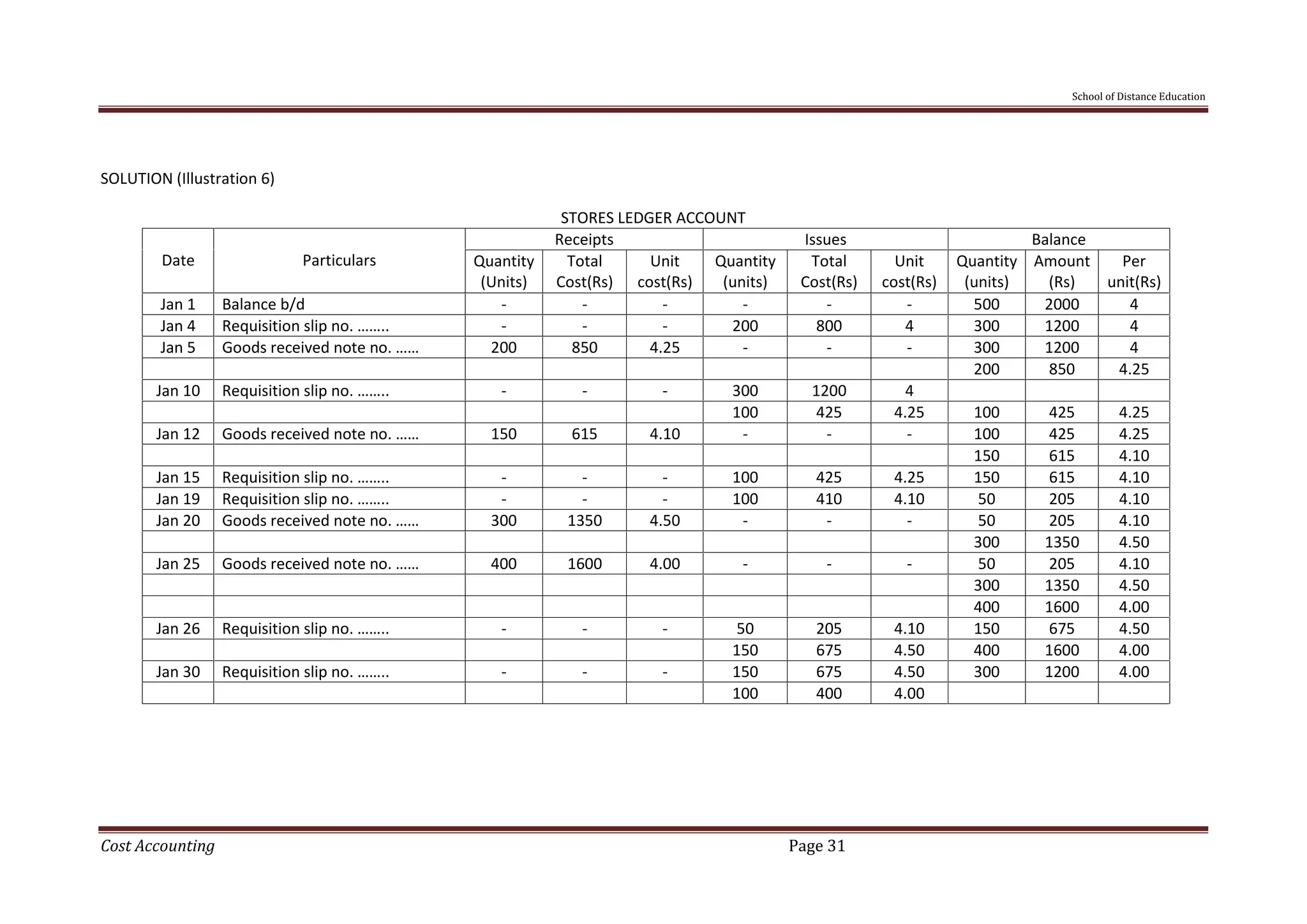
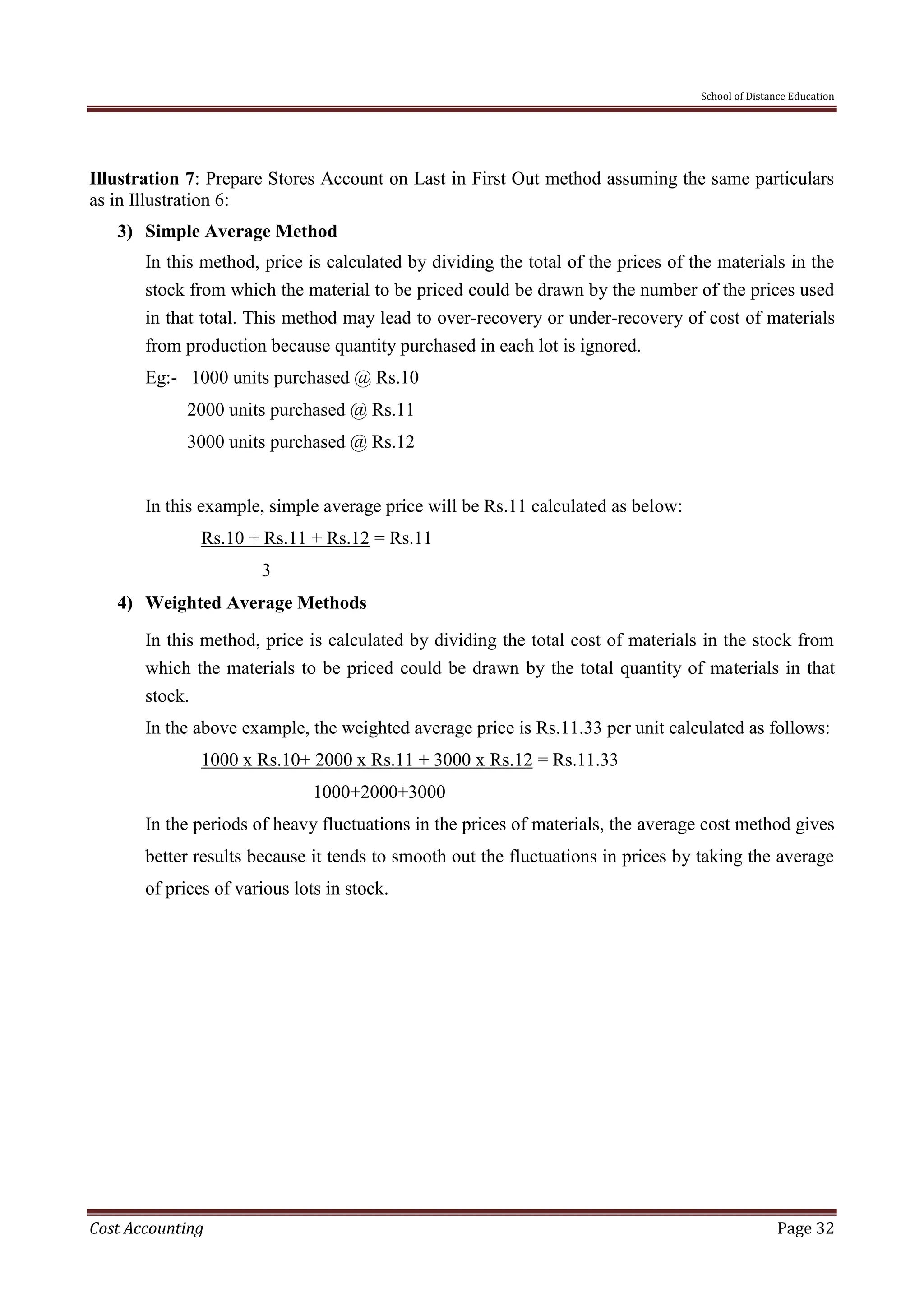

![[School of Distance Education]
Cost Accounting Page 35
Methods of Time-keeping
There are two methods of time-keeping. They are the manual methods and the
mechanicalmethods. Whichever method is used it should make a correct record of the time and the
method should be cost effective and minimize the risk of fraud.
The manual methods of time keeping are as follows:
a) Attendance Register Method, and
b) Metal Disc Method
Attendance Register Method
This is the traditional method where an attendance register or muster roll is kept at the time office
near the factory gate or in each department. The timekeeper records the name of the worker, the
worker’s number, the department in which he is working, the rate of wages, the time of arrival and
departure, normal time and overtime. If the workers are literate, they may make a record of time
themselves in the presence of a time-keeper or foreman.
This method is simple and inexpensive and can be used in small firms where the number of workers
is not large. However recording the time of workers who work at customers’ premises and places
which are situated at a distance from the factory is not practical in this method.
Metal Disc Method
Under this method, each worker is allotted a metal disc or a token with a hole bearing his
identification number. A board is kept at the gate with pegs on it and all tokens are hung on this
board. These boards can be maintained separately for each department so that the workers can
remove the token without delay and put it in a tray or box kept near the board. Immediately after
the scheduled time for entering the factory, the box is removed and the latecomers will have to give
their tokens to the timekeeper and their exact time of arrival is recorded. The tokens or disc left on
the board will represent the absentee workers. Later the timekeeper records the attendance in the
attendance register and subsequently it is passed on to the Pay Roll Department.
Mechanical Methods
The mechanical methods that are generally used for the recording of time of workers may be as
follows:
(a) Time Recording Clocks
(b) Dial Time Records
Time Recording Clocks
The time recording clock is a mechanical device which automatically records the time of the
workers. Under this method, each worker is given a Time Card which is kept in a tray near the
factory gate and as the worker enters the gate, he picks up his card from the tray, puts it in the time
recording clock which prints the exact time of arrival in the proper space against the particular day.
This procedure is repeated for recording time of departure for lunch, return from lunch and time of
leaving the factory in the evening. Late arrivals and overtime are recorded in red to attract the
attention of the management.](https://image.slidesharecdn.com/bcomcorecostaccounting-240618100859-4a3f69c1/75/B-Com-Core-Cost-Accounting-school-of-distance-education-35-2048.jpg)
![[School of Distance Education]
Cost Accounting Page 36
Dial Time Records
Under this method, a dial time recorder machine us used. It has a dial with number of holes (usually
about 150) and each hole bears a number corresponding to the identification number of the worker
concerned. There is one radial arm at the centre of the dial. As a worker enters the factory gate, he
is to press the radial arm after placing it at the hole of his number and his time will automatically be
recorded on roll of a paper inside the dial time recorder against the number. The sheet on which the
time is recorded provides a running account of the worker’s time and it can calculate the number of
hours and prepare the wage sheets. However, the high installation cost of the dial time recorder and
its use for only a limited number of worker are the drawbacks of this method.
Time Booking
Time booking is the recording of time spent by the worker on different jobs or work orders carried
out by him during his period of attendance in the factory. The objects of time booking are:
1. To ensure that time spent by a worker in a factory is properly utilized on different jobs or
work orders.
2. To ascertain the labour cost of each individual job or work order.
3. To provide a basis for the apportionment of overhead expenses over various jobs or work
orders when the method for the allocation of overheads depends upon time spent on
different jobs.
4. To ascertain unproductive time or idle time so as to make efforts to keep it in limit.
5. To know the time taken to complete a particular job so that bonus can be paid as per the
incentive schemes.
6. To know the efficiency of workers, it is necessary to make the comparison of actual time
taken with time allowed for completing a particular task.
Following documents are generally used for time booking:
1. Daily Time Sheets
2. Weekly Time Sheets
3. Job Tickets or Job Cards.
Daily time sheets are given to each worker where he records the time spent by him on each job or
work order. Weekly time sheets record the same particulars for a week and hence one card is
required for a week. Job cards are used to keep a close watch on the time spent by a worker on each
job so that the labour cost of a job may be conveniently ascertained.
Idle Time
There is always a difference between the time booked to different jobs or work orders and the time
recorded at the factory gate. This difference is known as idle time. Idle time is of two types.
(a) Normal Idle Time
(b) Abnormal Idle Time](https://image.slidesharecdn.com/bcomcorecostaccounting-240618100859-4a3f69c1/75/B-Com-Core-Cost-Accounting-school-of-distance-education-36-2048.jpg)
![[School of Distance Education]
Cost Accounting Page 37
Normal Idle Time: This represents the time, the wastage of which cannot be avoided and,
therefore, the employer must bear the labour cost of this time. But every effort should be made to
reduce it to the lowest possible level. Examples of normal idle time are: time taken in going from
the factory gate to the department in which the worker is to work and back at the end of the day,
time taken in picking up the work for the day, time between the completion of one work and the
start of another work, time taken for personal needs like tea or toilet, time taken for machine
maintenance, time taken for waiting for instructions, printouts, machine set-up time etc.
Normal Idle Time is unavoidable cost as such should be included in cost of production. The cost of
normal idle time can be treated as an item of factory expenses and recovered as an indirect charge
or added to labour cost.
Abnormal Idle Time: It is that time the wastage of which can be avoided if proper precautions are
taken. Example: time wasted due:- to breakdown of machinery on account of inefficiency of the
works engineer, failure of the power supply, shortage of materials, waiting for instructions, waiting
for tools and raw materials, strikes or lock-outs in the factory.
It is a principle of costing that all abnormal expenses and losses should not be included in costs and
as such wages paid for abnormal idle time should not form part of the cost of production. Hence it
is debited to Costing Profit and Loss Account.
Over Time: - It is the work done beyond the normal working period in a day or week. For overtime
done, the workers are given double the wages for the overtime done. The additional amount paid on
account of overtime is known as overtime premium.
Overtime increases the cost of production and should not be encouraged as it has the following
disadvantages.
1. Overtime is paid at higher rate.
2. Overtime is done at late hours when workers have become tired and efficiency will it be as
much as during the normal working hours.
3. Workers will develop the habit of working slowly during normal hours and complete the
work using overtime to earn more wages.
4. Expenses like lighting, cost of supervision, and wear and tear of machines will increase
disproportionately.
Overtime should be recorded separately and thoroughly investigated to see that it is incurred only
when genuinely required.
The treatment of overtime depends on the situation. If overtime is incurred for because of the
sequence of jobs, then normal wages is charged to labour cost for the overtime also but if it is a
rush job, then the overtime wages is added to the cost of labour. On the other hand if overtime
arises due to any abnormal reason like breakdown of machinery or power failure, overtime
premium is excluded from the cost of production and is debited to the Costing Profit and Loss
Account.](https://image.slidesharecdn.com/bcomcorecostaccounting-240618100859-4a3f69c1/75/B-Com-Core-Cost-Accounting-school-of-distance-education-37-2048.jpg)
![[School of Distance Education]
Cost Accounting Page 38
Illustration 8: Calculate the normal and overtime wages payable to a workman from the
following data:
Days Hours Worked
Monday 8 hrs.
Tuesday 10 hrs.
Wednesday 9 hrs.
Thursday 11 hrs.
Friday 9 hrs.
Saturday 4 hrs.
Total 51 hrs.
Normal Working Hours 8 hours per day
Normal rate Re.1 per hour
Overtime rate up to 9 hours in a day at single rate and over 9 hours in a day at
double rate; or up to 48 hours in a week at single rate and over 48
hours at double rate whichever is more beneficial to the workman.
Solution:
Normal Wages for 44 hours @ Re.1 Rs.44
Overtime Wages:
At single rate for 4 hours @ Re.1 = Rs.4
At double rate for 3 hours @ Rs.2 = Rs.6 Rs.10
Total Wages Rs.54
Or
Normal Wages for 48 hours @ Re.1 per hour = Rs.48
Overtime Wages for 3 hours @ Rs.2 per hour= Rs. 6
Rs.54
Therefore, whichever method is followed, the amount of the wages payable to the worker is Rs.54.
System of Wage Payment
There is no single method of wage payment which is acceptable both to the employers and the
workers. The system of wages should result into higher production, improved quality of output and
a contented labour force.
Days Total Hours Normal Working Hours
Overtime Hours
At Single rate At Double rate
Monday
Tuesday
Wednesday
Thursday
Friday
Saturday
8
10
9
11
9
4
8
8
8
8
8
4
-
1
1
1
1
-
1
-
2
-
Total 51 44 4 3](https://image.slidesharecdn.com/bcomcorecostaccounting-240618100859-4a3f69c1/75/B-Com-Core-Cost-Accounting-school-of-distance-education-38-2048.jpg)
![[School of Distance Education]
Cost Accounting Page 39
There are two principal wage systems: (i) Payment on the basis of time spent in the factory
irrespective of the amount of work done. This method is known as time wage system. (ii) Payment
on the basis of the work done irrespective of the time taken by the worker. This method is called
piece rate system.
Other methods called premium plans or bonus and profit sharing schemes are used with either of
the two principal methods of wage payment.
Time Wage System
Under this method of wage payment, the worker is paid at an hourly, daily, weekly or monthly rate.
This payment is made according to the time worked irrespective of the work done.
This method is highly suitable for following types of work:
1. Where highly skilled and apprentices are working.
2. Where quality of goods produced is of extreme importance eg., artistic goods
3. Where the speed of work is beyond the control of the workers.
4. Where close supervision of work is possible.
5. Where output cannot be measured.
The disadvantages of this method are:
1. Workers are not motivated.
2. Workers will get payment for idle time.
3. Efficient workers will become inefficient in the long run as all of them get same wages.
4. Employer finds it difficult to calculate labour cost per unit as it varies as production
increases and decreases.
5. Strict supervision is necessary to get the work done.
6. Inefficiency results in upsetting the production schedule and increases the cost per unit.
7. It will encourage a tendency among workers to go slow so as to earn overtime wages.
Thus this method does not establish a proportionate relationship between effort and reward and the
result is that it is not helpful in increasing production and lowering labour cost per unit.
Piece Rate System (payment by result)
Under this system of wage payment, a fixed rate is paid for each unit produced, job completed or an
operation performed. Thus, payment is made according to the quantity of work done no
consideration is given to the time taken by the workers to perform the work.
There are four variants of this system.
a) Straight piece rate system
b) Taylor’s differential piece rate system
c) Merrick’s multiple piece rate system
d) Gant’s task and bonus plan
(a) Straight piece rate system
Payment is made as per the number of units produced at a fixed rate per unit. Another method is
piece rate with guaranteed time rate in which the worker is given time rate wages if his piece rate
wages is less than the time rate.](https://image.slidesharecdn.com/bcomcorecostaccounting-240618100859-4a3f69c1/75/B-Com-Core-Cost-Accounting-school-of-distance-education-39-2048.jpg)
![[School of Distance Education]
Cost Accounting Page 40
Advantages
1. Wages are linked to output so workers are paid according to their merits.
2. Workers are motivated to increase production to earn more wages.
3. Increased production leads to decreased cost per unit of production and hence profit per unit
increases.
4. Idle time is not paid for and is minimized.
5. The employer knows his exact labour cost and hence can make quotations confidently.
6. Workers use their tools and machinery with a greater care so that the production may not be
held up on account of their defective tools and machinery.
7. Less supervision is required because workers get wages for only the units produced.
8. Inefficient workers are motivated to become efficient and earn more wages by producing more.
Disadvantages
1. Fixing of piece work rate is difficult as low piece rate will not induce workers to increase
production.
2. Quality of output will suffer because workers will try to produce more quickly to earn more
wages.
3. There may not be an effective use of material, because of the efforts of workers to increase the
production. Haste makes waste. Thus there will be more wastage of material.
4. When there is increased production, there may be increased wastage of materials, high cost of
supervision and inspection and high tools cost and hence cost of production might increase.
5. Increased production will not reduce the labour cost per unit because the same rate will be paid
for all units. On the other hand, increased production will reduce the labour cost per unit under
the time wage system.
6. Workers have the fear of losing wages if they are not able to work due to some reason.
7. Workers may work for long hours to earn more wages, and thus, may spoil their health.
8. Workers may work at a very high speed for a few days, earn good wages and then absent
themselves for a few days, upsetting the uniform flow of production.
9. Workers in the habit of producing quality goods will suffer because they will not get any extra
remuneration for good quality.
10. The system will cause discontentment among the slower workers because they are not able to
earn more wages.
This method can be successfully applied when:
1. The work is of a repetitive type.
2. Quantity of output can be measured.
3. Quality of goods can be controlled.
4. It is possible to fix an equitable and acceptable piece rate
5. The system is flexible and rates can be adjusted to changes in price level.
6. Materials, tools and machines are sufficiently available to cope with the possible increase in
production.
7. Time cards are maintained so that workers are punctual and regular so that production may
not slow down.](https://image.slidesharecdn.com/bcomcorecostaccounting-240618100859-4a3f69c1/75/B-Com-Core-Cost-Accounting-school-of-distance-education-40-2048.jpg)
![[School of Distance Education]
Cost Accounting Page 41
(b) Taylor’s Differential Piece Rate system
This system was introduced by Taylor, the father of scientific management to encourage the
workers to complete the work within or less than the standard time. Taylor advocated two
piece rates, so that if a worker performs the work within or less than the standard time, he is
paid a higher piece rate and if he does not complete the work within the standard time, he is
given a lower piece rate.
Illustration 9 : Calculate the earnings of workers A and B under Straight Piece-rate System and
Taylor’s Differential Piece-rate System form the following particulars.
Normal rate per hour = Rs.1.80
Standard time per unit = 20 seconds
Differentials to be applied:
80 % of piece rate below standard
120% of piece rate at or above standard.
Worker A produces 1,300 units per day and worker B produces 1,500 units per day.
SOLUTION
Standard production per 20 seconds = 1 unit
Standard production per minute = 60/20= 3 units
Standard production per hour = 3 x 60 = 180 units
Standard production per day of 8 hrs(assumed) = 180 x 8 = 1440 units
Normal rate per hour = Rs.1.80
Normal piece rate = Rs.1.80/ 180 units = 1 paisa
Low piece rate below standard production 1P x 80 = 0.8 paise
100
High piece rate at or above standard 1P x 120 = 1.2 paise
100
Earning of worker A
Under straight piece rate system
1300 units @ 1P = 1300 x 1 = Rs.13
100
Under Taylor’s Differential Piece-rate System
1300 units @ 0.8 P =1300 x 0.8 =Rs.10.40
100
Low piece rate has been applied because worker A’s daily production of 1300 units is less than the
standard daily production of 1,440 units.
Earnings of Worker B
Under Straight Piece-rate System
1500 units @ 1P = 1500 x 1 = Rs.15
100
Under Taylor’s Differential Piece-rate System
1500 units @ 1.2P = 1500 x 1.2= Rs.18
100](https://image.slidesharecdn.com/bcomcorecostaccounting-240618100859-4a3f69c1/75/B-Com-Core-Cost-Accounting-school-of-distance-education-41-2048.jpg)
![[School of Distance Education]
Cost Accounting Page 42
High piece-rate has been applied because worker B’s daily production of 1500 units is more than
the standard daily production of 1440 units.
c) Merrick’s Multiple Piece Rate System
This method seeks to make an improvement in the Taylor’s differential piece rate system. Under
this method, three piece rates are applied for workers with different levels of performance. Wages
are paid at ordinary piece rate to those workers whose performance is less than 83% of the standard
output, 110% of the ordinary piece rate is given to workers whose level of performance is between
83% and 100% of the standard and 120% of the ordinary piece rate is given to workers who
produce more than 100% of the standard output.
This method is not as harsh as Taylor’s piece rate because penalty for slow workers is relatively
lower.
Illustration 10: Calculate the earnings of workers A, B and C under straight piece rate system and
Merrick’s multiple piece rate system from the following particulars:
Normal rate per hour Rs.1.8
Standard time per unit1 minute
Output per day is as follows:
Worker A : 384 units
Worker B : 450 units
Worker C : 552 units
Wording hours per day are 8
SOLUTION
Standard output per minute = 1 unit
Standard production per hour = 60 units
Standard production per day of 8 hours= 480 units( 8 x 60)
Normal rate per hour = Rs.1.80
Normal output per hour = 60 units
Normal piece rate = Rs. 1.80 = 3 paise
60
Calculation of level of performance:
Standard output per day = 480 units
Worker A’s output per day = 384 units
Worker A’s level of performance = 384 x 100 = 80%
480
Worker B’s output per day = 450 units
Worker B’s level of performance = 450 x 100 = 93.75%
480
Worker C’s output per day = 552 units
Worker C’s level of performance = 552 x 100 = 115%
480
Earnings of Worker A
Under straight piece rate system:
For 384 units @ 3 paise per unit = 384 x 0.03 = Rs.11.52](https://image.slidesharecdn.com/bcomcorecostaccounting-240618100859-4a3f69c1/75/B-Com-Core-Cost-Accounting-school-of-distance-education-42-2048.jpg)
![[School of Distance Education]
Cost Accounting Page 43
Under Merrick’s multiple piece rate system:
For 384 units @ 3 paise per unit =384 x 0.03 = Rs.11.52
Earnings of Worker B
Under straight piece rate system:
For 450 units @ 3 paise per unit = 450 x 0.03 = Rs.13.50
Under Merrick’s multiple piece rate system:
For 450 units @ 3.3 paise per unit =450 x 0.033= Rs.14.85
Earnings of Worker C
Under straight piece rate system:
For 552 units @ 3 paise per unit = 552 x 0.03 = Rs.16.56
Under Merrick’s multiple piece rate system:
For 552 units @ 3.6paise per unit =552 x 0.036 = Rs.19.87
Worker C’s level of performance is 115% which is more than 100% of standard output; so he is
entitled to get 120% of normal piece rate (ie. 120% of 3 paise or 3.6 paise per unit)
Premium and Bonus Plan
The object of a premium plan is to increase the production by giving an inducement to the workers
in the form of higher wages for less time worked.
Under a premium plan, a standard time is fixed for the completion of a specific job or operation at
an hourly rate plus wages for a certain fraction of the time saved by way of a bonus. The plan is
also known as incentive plan because a worker has the incentive to earn more wages by completing
the work in less time.
This system of wage payment is in between the time wage system and piece work system. In time
wage system, worker does not get any reward for the time saved and in piece work system, the
worker gets full payment for time saved whereas in a premium plan both the worker and the
employer share the labour cost of the time saved.
The following are some of the important premium plans.
(i) Halsey Premium Plan: Under this method, the worker is given wages for the actual
time taken and a bonus equal to half of wages for time saved. The standard time for
doing each job or operation is fixed. In practice the bonus may vary from 33⅓ % to
66⅔ % of the wages of the time saved.
Thus if S is the standard time, T the time taken, R the labour rate per hour, and % the
percentage of the wages of time saved to be given as bonus, total earnings of the worker
will be:
T x R + % (S-T) R
Under Halsey-Weir plan, the premium is set at 30% of the time saved.](https://image.slidesharecdn.com/bcomcorecostaccounting-240618100859-4a3f69c1/75/B-Com-Core-Cost-Accounting-school-of-distance-education-43-2048.jpg)
![[School of Distance Education]
Cost Accounting Page 44
Illustration 11:
Rate per hour = Rs.1.50 per hour
Time allowed for job = 20 hours
Time taken = 15 hours
Calculate the total earnings of the worker under the Halsey Plan. Also find out effective
rate of earnings.
SOLUTION:
Standard time (S) = 20 hours
Time taken (T) = 15 hours
Rate per hour (R)= Rs.1.50 per hour
Total Earnings = T x R + 50% (S-T) x R
= 15 X Rs. 1.50 + 50 (20-15) x Rs.1.50
100
=Rs.26.25
Total wages for 15 hours = Rs.26.25
Therefore, effective rate of earning per hour
= Total Wages = Rs.26.25 = Rs.1.75
Actual Time Taken
(The percentage of bonus is taken as 50% when not given)
The advantages of the Halsey Premium Plan are:
It is simple to understand and relatively simple to calculate.
1. It guarantees time wages to workers.
2. The wages of time saved are shared by both employers and workers, so it is helpful in
reducing labour cost per unit.
3. It motivates efficient workers to work more as there is increasing incentive to efficient
workers.
4. Fixed overhead cost per unit is reduced with increase in production.
5. The employer is able to reduce cost of production by having reduction in labour cost and
fixed overhead cost per unit. So, he is induced to provide the best possible equipment and
working conditions.
Disadvantages
1. Quality of work suffers because workers are in a hurry to save more and more time to get
more and more bonus.
2. Workers criticize this method on the ground that the employer gets a share of wages of the
time saved.
(ii) Rowan Plan: The difference between Halsey plan and Rowan Plan is the calculation of
the bonus. Under this method also the workers are guaranteed the time wages but the
bonus is that proportion of the wages of the time taken which the time saved bears to the
standard time allowed.
Total Earnings = T x R + S-T x T x R
S](https://image.slidesharecdn.com/bcomcorecostaccounting-240618100859-4a3f69c1/75/B-Com-Core-Cost-Accounting-school-of-distance-education-44-2048.jpg)
![[School of Distance Education]
Cost Accounting Page 45
Illustration 12:
A worker completes a job in a certain number of hours. The standard time allowed for the job is 10
hours, and the hourly rate of wages is Rs.1. The worker earns a 50% rate of bonus of Rs. 2 under
Halsey Plan. Ascertain his total wages under the Rowan Premium Plan.
Solution: The worker earns Rs.2 as bonus at 50%; so total bonus at 100% should be Rs.4. The
hourly rate of wages being Re.1, the time saved should be 4 hours.
Standard time allowed 10 hours
Less: Time Saved 4 hours
Time Taken 6 hours
Earnings under the Rowan Premium Plan
Earnings =T x R + S-T x T x R
S
Where, T = 6 hours
S = 10 hours
R = Re.1 per hour
Earnings = 6 x 1 + 10-6 x 6 x 1
10
= 6 + Rs.2.40 = Rs.8.40
Advantages
1. It guarantees time wages to workers
2. The quality of work does not suffer as they are not induced to rush through production as
bonus increases at a decreasing rate at higher levels of efficiency.
3. Labour cost per unit is reduced because wages of time saved are shared by employer and
employee.
4. Fixed overhead cost is reduced with increase in production.
Disadvantages
1. The Rowan plan is criticized by workers on the ground that they do not get the full benefit
of the time saved by them as they are paid bonus for a portion of the time saved.
2. The Rowan plan suffers from another drawback that two workers, one very efficient and the
other not so efficient, may get the same bonus.
Overheads: -
Cost related to a cost center or cost unit may be divided into two ie. Direct and Indirect cost. The
Indirect cost is the overhead cost and is the total of indirect material cost, indirect labour cost,
indirect expenses. CIMA defines indirect cost as “expenditure on labour, materials or services
which cannot be economically identified with a specific salable cost per unit”. Indirect costs are
those costs which are incurred for the benefit of a number of cost centers or cost units. So any
expenditure over and above prime cost is known as overhead. It is also called ‘burden’,
‘supplementary costs’, ‘on costs’, ‘indirect expenses’.](https://image.slidesharecdn.com/bcomcorecostaccounting-240618100859-4a3f69c1/75/B-Com-Core-Cost-Accounting-school-of-distance-education-45-2048.jpg)
![[School of Distance Education]
Cost Accounting Page 46
Classification of Overheads
Overheads can be classified on the following basis:
i) Function-wise classification: Overheads can be divided into the following categories on
functional basis.
(a) Manufacturing or production overheads eg:- indirect materials like lubricants, cotton
wastes, indirect labour like salaries and wages of supervisors, inspectors,
storekeepers, indirect expenses like rent, rates and insurance of factory, power,
lighting of factory, welfare expenses like canteen, medical etc.
(b) Administration overheads eg:- indirect materials like office stationery and printing,
indirect labour salaries of office clerks, secretaries, accountants, indirect expenses
rent, rates and insurance of office, lighting heating and cleaning of office, etc.
(c) Selling and Distribution overheads eg:- indirect materials like catalogues, printing,
stationery, price list, indirect salary of salesmen, agents, travellers, sales managers,
indirect expenses like rent, rates and insurance of showroom, finished goods,
godown etc., advertising expenses, after sales service, discounts, bad debts etc.
ii) Behavior-wise classification: Overheads can be classified into the following categories as
per behavior pattern.
(a) Fixed overheads like managerial remuneration, rent of building, insurance of
building, plant etc.
(b) Variable overheads like direct material and direct labour.
(c) Semi-variable overheads like depreciation, telephone charges, repair and
maintenance of buildings, machines and equipment etc.
iii) Element-wise classification: Overheads can be classified into the following categories as
per element.
(a) Indirect materials
(b) Indirect labour
(c) Indirect expenses
Allocation and Apportionment of Overhead to Cost Centres (Depart-mentalisation of
Overhead)
When all the items are collected properly under suitable account headings, the next step is
allocation and apportionment of such expenses to cost centres. This is also known as
departmentalization or primary distribution of overhead.
A factory is administratively divided into different departments like Manufacturing or
Producing department, Service department, partly producing departments.
Allocation of Overhead Expenses
Allocation is the process of identification of overheads with cost centres. An expense which is
directly identifiable with a specific cost centre is allocated to that centre. Thus it is allotment of a
whole item of cost to a cost centre or cost unit. For example the total overtime wages of workers of
a department should be charged to that department. The electricity charges of a department if
separate meters are there should be charged to that particular department only.](https://image.slidesharecdn.com/bcomcorecostaccounting-240618100859-4a3f69c1/75/B-Com-Core-Cost-Accounting-school-of-distance-education-46-2048.jpg)
![[School of Distance Education]
Cost Accounting Page 47
Apportionment of Overhead Expenses
Cost apportionment is the allotment of proportions of cost to cost centres or cost units. If a cost is
incurred for two or more divisions or departments then it is to be apportioned to the different
departments on the basis of benefit received by them. Common items of overheads are rent and
rates, depreciation, repairs and maintenance, lighting, works manager’s salary etc.
Basis of Apportionment
Suitable bases have to be found out for apportioning the items of overhead cost to production and
service departments and then for reapportionment of service departments costs to other service and
production departments. The basis selected should be correlated to the expenses and the expense
should be measurable by the basis. This process of distribution of common expenses over the
departments on some equitable basis is known as ‘Primary Distribution’.
The following are the main bases of overhead apportionment utilized in manufacturing concerns:
Direct Allocation. Under direct allocation, overheads are directly allocated to the department for
which it is incurred. Example overtime premium of workers engaged in a particular department,
power, repairs of a particular department etc.
(i) Direct Labour/Machine Hours. Under this basis, overhead expenses are distributed to
various departments in the ratio of total number of labour or machine hours worked in
each department. Majority of general overhead items are apportioned on this basis.
(ii) Value of materials passing through cost centres. This basis is adopted for expenses
associated with material such as material handling expenses.
(iii) Direct wages. Expenses which are booked with the amounts of wages eg:- worker’s
insurance, their contribution to provident fund, worker’s compensation etc. are
distributed amongst the departments in the ratio of wages.
Illustration 13: The Modern Company is divided into four departments: A, B and C are producing
departments, and D is a service departments. The actual costs for a period are as follows:
Rent Rs.1000 Repairs to Plant Rs.600
Supervision Rs.1500 Fire Insurance in respect of Stock Rs.500
Depreciation of Plant Rs.450 Power Rs.900
Light Rs.120 Employers’ liability for insurance Rs.150
The following information is available in respect of the four departments;
Dept.A Dept.B Dept.C Dept.D
Area (sq.mtrs) 1,500 1,100 900 500
Number of Employees 20 15 10 5
Total Wages (Rs.) 6,000 4,000 3,000 2,000
Value of Plant (Rs.) 24,000 18,000 12,000 6,000
Value of stock (Rs.) 15,000 9,000 6,000 -
H.P. of Plant 24 18 12 6
Apportion the costs to the various departments on the most equitable basis.](https://image.slidesharecdn.com/bcomcorecostaccounting-240618100859-4a3f69c1/75/B-Com-Core-Cost-Accounting-school-of-distance-education-47-2048.jpg)
![[School of Distance Education]
Cost Accounting Page 48
SOLUTION
OVERHEADS DISTRIBUTION SUMMARY
Items
Basis of
apportionment
Total
Amount
Rs.
Product Departments Service
Department
D
Rs.
A
Rs.
B
Rs.
C
Rs.
Rent Floor Area 1,000 375 275 225 125
Supervision No. of Employees 1,500 600 450 300 150
Depreciation Plant Value 450 180 135 90 45
Light Floor area 120 45 33 27 15
Repairs to Plant Plant Value 600 240 180 120 60
Fire Insurance Stock Value 500 250 150 100 -
Power HP. Of Plant 900 360 270 180 90
Employer’s Liability No. of Employees 150 60 45 30 15
Total 5,220 2,110 1,538 1,072 500
Re-apportionment of Service Department Costs to Production Departments
Service department costs are to be reapportioned to the production departments or the cost
centres where production is going on. This process of re-apportionment of overhead expenses is
known as ‘Service Distribution’. The following is a list of the bases of apportionment which may
be accepted for the service departments noted against
Service Department Cost Basis of Apportionment
1. Maintenance Department
2. Payroll or time-keeping department
3. Store keeping department
4. Employment or Personnel epartment.
5. Purchase Department
6. Welfare, ambulance, canteen service,
recreation room expenses.
7. Building service department
8. Internal transport service or
overhead crane service
9. Transport Department
10. Power House (Electric power cost)
-Hours worked for each department
-Total labour or Machine hours or number of
employees in each department
- no. of requisitions or value of materials of
each department.
- Rate of labour turnover or number of
employees in each department.
-no. of purchase orders or value of materials
-No. of employees in each department.
-Relative are in each department
-Weight, value graded product handled, weight
and distance travelled.
-crane hours, truck hours, truck mileage,
truck tonnage, truck tonne-hours, tonnage
handled, number of packages.
–wattage, horse power, horse power machine
hours, number of electric points etc.](https://image.slidesharecdn.com/bcomcorecostaccounting-240618100859-4a3f69c1/75/B-Com-Core-Cost-Accounting-school-of-distance-education-48-2048.jpg)
![[School of Distance Education]
Cost Accounting Page 49
The following are the various methods of re-distribution of service department costs to production
departments.
1. Direct re-distribution method
2. Step distribution method
3. Reciprocal Services method
a. Simultaneous Equation Method
b. Repeated Distribution Method
c. Trial and Error Method
Direct re-distribution method
Under this method, the costs of service departments are directly apportioned to production
departments without taking into consideration any service from one service department to another
service department. Thus, proper apportionment cannot be done on the assumption that service
departments do not serve each other and as a result the production departments may either be
overcharged or undercharged. The share of each service department cannot be ascertained
accurately for control purposes. Budget for each department cannot be prepared thoroughly.
Therefore, Department Overhead rates cannot be ascertained correctly.
Illustration 14:In an Engineering factory, the following particulars have been collected for the
three months’ period ended on 31st
March, 2007. You are required to prepare Production Overheads
Distribution Summary showing clearly the basis of apportionment where necessary.
Production Departments Service Departments
A B C D E
Direct Wages Rs.
Direct Material Rs.
Staff Nos.
Electricity Kwh.
Light Points No.
Asset Value Rs.
Area Occupied
Sq.m.
2000
1000
100
4000
10
60,000
150
3000
2000
150
3000
16
40,000
250
4000
2000
150
2000
4
30,000
50
1000
1500
50
1000
6
10,000
50
2000
1500
50
1000
4
10000
50
The expenses for the period were:
Motive power Rs.550; Lighting Power Rs.100; Stores Overheads Rs.400; Amenities to Staff
Rs.1500; Depreciation Rs.15,000; Repairs and Maintenance Rs.3,000; General Overheads Rs.6000;
and Rent and Taxes Rs. 275.
Apportion the expenses of service department E in proportion of 3:3:4 and those of service
department D in the ratio of 3:1:1 to departments A, B and C respectively.](https://image.slidesharecdn.com/bcomcorecostaccounting-240618100859-4a3f69c1/75/B-Com-Core-Cost-Accounting-school-of-distance-education-49-2048.jpg)
![[School of Distance Education]
Cost Accounting Page 50
SOLUTION
PRODUCTION OVERHADS DISTRIBUTION SUMMARY
For the quarter ending 31st
March, 2007
Production Departments Service
Departments
Total
Rs.
A
Rs.
B
Rs.
C
Rs.
D
Rs.
E
Rs.
Direct Wages
Direct Materials
Motive Power @ 5p.per Kwh
Lighting Power @ Rs.2.50per Point
Stores Overhead @ 5% of Direct Material
Amenities to staff @ Rs.3 per employee
Depreciation @ 10% of the value of asset.
Repairs and maintenance @ 2% of value
General Overheads @ 50% of Direct
Wages
Rent and Taxes @Re.0.50 per sq.meter
200
25
50
300
6000
1200
1000
75
150
40
100
450
4000
800
1500
125
100
10
100
450
3000
600
2000
25
1000
1500
50
15
75
150
1000
200
500
25
2000
1500
50
10
75
150
1000
200
1000
25
3000
3000
550
100
400
1500
15000
3000
6000
275
Total
Dept. E ( 3: 3 : 4)
Dept. D (3 : 1 : 1)
8,850
1,803
2,709
7,165
1,803
903
6,285
2,404
903
4,515
(4,515)
6,010
(6,010)
32,825
Total 13,362 9,871 9,592 32,825
Step Distribution Method
Under this method, the cost of most serviceable department is first apportioned to other service
departments and production departments. The next service department is taken up and its cost is
apportioned and this process goes on till the cost of the last service department is apportioned.
Thus, the cost of last service department is apportioned only to production departments.
Illustration 15: A manufacturing company has two Production Departments, P1 and P2 and three
Service Departments, Time-keeping, Stores and Maintenance. The Departmental Summary showed
the following expenses for July, 2007 .](https://image.slidesharecdn.com/bcomcorecostaccounting-240618100859-4a3f69c1/75/B-Com-Core-Cost-Accounting-school-of-distance-education-50-2048.jpg)
![[School of Distance Education]
Cost Accounting Page 51
Production Departments Service Departments
(in order of their importance)
P1 P2 S1 S2 S3
(Time-keeping) (Stores) (Maintenance)
Rs. Rs. Rs. Rs. Rs.
16,000 10,000 4,000 5,000 3,000
The other information relating to departments were:
Service Departments Production Departments
S1 (Time-
keeping)
S2
(Stores)
S3(Main-
tenance)
P1 P2
No. of Employees
No. of Stores requisitions
Machine Hours
-
-
-
20
-
-
10
6
-
40
24
2400
30
20
1600
SOLUTION:
Department
As per Primary
Distribution
System
S1 (Time-keeping)
S2 Stores
S3 Maintenance
P1
P2
4000
5000
3000
16000
10000
(-) 4000
800
400
1600
1200
(-) 5800
696
2784
2320
(-) 4096
2458
1638
22,842
15,158
38,000 38,000](https://image.slidesharecdn.com/bcomcorecostaccounting-240618100859-4a3f69c1/75/B-Com-Core-Cost-Accounting-school-of-distance-education-51-2048.jpg)
![[School of Distance Education]
Cost Accounting Page 52
Note: basis of apportionment
(a) Time-keeping – No. of employees (ie. 2:1:4:3)
(b) Stores – No. of stores requisitions ( ie. 3:12:10)
(c) Maintenance- Machine Hours (ie. 3:2)
The most important limitation of this method is that the cost of one service centre to other service
cost centres is ignored and thus the cost of individual cost centres are not truly reflected.
Reciprocal Services Method
In order to avoid the limitation of Step Method, this method is adopted. This method recognizes the
fact that if a given department receives service from another department, the department receiving
such service should be charged. If two departments provide service to each other, each department
should be charged for the cost of services rendered by the other. There are three methods available
for dealing with inter-service departmental transfer:
a. Simultaneous Equation Method
b. Repeated Distribution Method
c. Trial and Error Method
(a) Simultaneous Equation method
Under this method, the true cost of the service departments are ascertained first with the help of
simultaneous equations; these are then redistributed to production departments on the basis of
given percentage. The following illustration may be taken to discuss the application of this
method.
Illustration 16:
A company has three production departments and two service departments, and for a period the
departmental distribution summary has the following totals.
Rs.
Production Departments
P1- Rs. 800; P2- Rs. 700; P3- Rs.500 2000
Service Departments:
S1 – Rs. 234; S2- Rs.300 534
2534
The expenses of the service departments are charged out on a percentage basis as follows;
P1 P2 P3 S1 S2
Service Department S1 20% 40% 30% - 10%
Service Department S2 40% 20% 20% 20% -](https://image.slidesharecdn.com/bcomcorecostaccounting-240618100859-4a3f69c1/75/B-Com-Core-Cost-Accounting-school-of-distance-education-52-2048.jpg)
![[School of Distance Education]
Cost Accounting Page 53
Prepare a statement showing the apportionment of two service departments expenses to production
departments by Simultaneous Equation Method.
SOLUTION:
By Simultaneous Equation Method
Let x = total overheads of department S1
y = total overheads of department S2
Then,
x=Rs.234+. 2y
y=Rs.300+. 1x
Rearranging and multiplying to eliminate decimals;
10x-2y=Rs.2,340 ………….(1)
-x+10y=Rs.3,000 …………(2)
Multiplying equation (1) by 5 and add result to (2), we get
49x=Rs.14,700
x=Rs.300
Substituting this value in equation (1), we get
y=Rs.330
All that now remains to be done is to take these values x=Rs.300 and y=Rs.330 and apportion them
on the basis of the agreed percentage to the three production departments; thus:
Total P1 P2 P3
Per distribution summary
Service department S1
Service department S2
2,000
270
264
800
60
132
700
120
66
500
90
66
2,534 992 886 656
This method is recommended in more than two service departments if the data is processed with
computers and in two service departments only where the data is processed manually.
(b) Repeated Distribution Method
Under this method, the totals are shown in the departmental distribution summary, are put out in
a line, and then the service department totals are exhausted in turn repeatedly according to the
agreed percentages until the figures become too small to matter.
By solving illustration 16 by Repeated Distribution Method, we get the Secondary Distribution
Summary which is given as follows:](https://image.slidesharecdn.com/bcomcorecostaccounting-240618100859-4a3f69c1/75/B-Com-Core-Cost-Accounting-school-of-distance-education-53-2048.jpg)
![[School of Distance Education]
Cost Accounting Page 54
SECONDARY DISTRIBUTION SUMMARY
P1 P2 P3 S1 S2
As per summary
Service Department S1
Service Department S2
Service Department S1
Service Department S2
Rs.
800
47
129
14
2
Rs.
700
94
65
25
2
Rs.
500
70
65
19
2
Rs.
234
(234)
64
(64)
Rs.
300
23
(323)
6
(6)
992 886 656 - -
(c) Trial and Error Method
Under this method, the cost of one service department is apportioned to another centre. The cost
of another centre plus the share received from the first centre is again apportioned to the first
cost centre and this process is repeated till the balancing figure becomes negligible.
By solving illustration 16 by Trial and Error Method, we get the following:
Service Departments
S1 S2
Original apportionment
Rs.
234
(23)
65(20% of 323)
(65)
1(20% of 7)
Rs.
300
23 (10% of 234)
(323)
7 (10% of 65)
(7)
Total of positive figures
300 330
ABSORPTION OF OVERHEAD
Absorption means the distribution of the overhead expenses allotted to a particular department
over the units produced in that department. Overhead absorption is accomplished by overhead
rates.
Methods of Absorption of Manufacturing Overhead
The following are the main methods of absorption of manufacturing or factory overheads.
(a) Direct Material Cost Method. Under this method percentage of factory expenses to value
of direct materials consumed in production is calculated to absorb manufacturing
overheads.
The formula is Overhead Rate = Production Overhead Expenses (Budgeted)
Anticipated Direct Material Cost](https://image.slidesharecdn.com/bcomcorecostaccounting-240618100859-4a3f69c1/75/B-Com-Core-Cost-Accounting-school-of-distance-education-54-2048.jpg)
![[School of Distance Education]
Cost Accounting Page 55
If in a factory the anticipated cost of direct material is Rs. 4,00,000 and the over head
budgeted expenses are Rs. 1,00,000, then the overhead rate will be 25% ie.( Rs.1,00,000 ÷
Rs.4,00,000) of the materials used. It is assumed that relationship between materials and
factory expenses will not change. This method is simple and can be adopted under the
following circumstances:
(i) Where the proportion of overheads to the total cost is significant.
(ii) Where the prices of materials are stable.
(iii) Where the output is uniform ie. Only one kind of article is produced.
(b) Direct Labour Cost (or Direct Wages) Method. This is a simple and easy method and
widely used in most of the concerns. The overhead rate is calculated as under:
Overhead Rate= Production Overhead Expenses
Direct Labour Cost
If from past experience, the percentage of factory expenses to direct wages is 50%, then the
factory expenses in the next year is taken as 50% of the direct wages.
This method is suitable under the following situations:
(i) Where direct labour constitutes a major proportion of the total cost of production.
(ii) Where production is uniform.
(iii) Where labour employed and types of work performed are uniform.
(iv) Where the ratio of skilled and unskilled labour is constant.
(v) Where there are no variations in the rates of pay ie., the rates of pay and the methods are
the same for the majority of the workers in the concern.
In some concerns a separate rate is calculated for the fringe benefits and applied on the basis of
direct labour cost.
(c) Prime Cost Method. Under this method the recovery rate is calculated dividing the
budgeted overhead expenses by the aggregate of direct materials and direct labour cost of
all the products of a cost centre. The formula is
Overhead Recovery Rate = Production Budgeted Overhead Expenses
Anticipated Direct Materials and Direct Labour Cost
Suppose if the budgeted overheads are Rs.50,000 and the estimated values of direct
materials and direct labour are Rs.30,000 and Rs.20,000, then overhead recovery rate will
be 100%
i.e., 50000 x 100.
30000+20000
(d) Direct Labour (or Production) Hour Method. This rate is obtained by dividing the
overhead expenses by the aggregate of the productive hours of direct workers. The formula
is](https://image.slidesharecdn.com/bcomcorecostaccounting-240618100859-4a3f69c1/75/B-Com-Core-Cost-Accounting-school-of-distance-education-55-2048.jpg)
![[School of Distance Education]
Cost Accounting Page 56
Overhead rate = Production Overhead Expenses
Direct Labour Hours
If in a particular period the overhead expenses are Rs.50,000 and direct labour hours are
1,00,000, then overhead labour rate will be Re.0.50 (i.e., Rs.50,000 ÷1,00,000).
This rate is suitable where:
(i) The production is done using more of labour and less technology is used.
(ii) It is desired to taken into consideration the time factor.
(iii) The rate may not be affected by the method of wage payment or the grade or the rate
of workers.
Illustration17: From the following particulars find out “Direct Labour Rate”.
(a) Total number of labourers working in the department. 400
(b) Total working days in a year 300
(c) Number of working hours per day 8
(d) Total departmental overheads per year Rs.1,82,400
(e) Normal idle time allowed. 5%
SOLUTION:
CALCULATION OF DIRECT LABOUR RATE FOR DEPARTMENTAL OVERHEADS
Total working days in a year 300
Number of working hours per day 8
Total working hours available per worker per year 2,400
(300 x 8)
Less: normal idle time allowed (5% of 2,400hrs) 120
Effective working hours per worker per year (2400-120) 2,280
Number of workers working in the department 400
Total effective working hours in the department(2280 x 400) 9,12,000
Total departmental overheads per year Rs.1,82,000
Direct Labour Rate for absorption of overheads per hour Re.0.20
(Rs.182,400÷9,12,000hrs=Rs.0.20)
(e) Machine Hour Rate. Machine hour rate is the cost of running a machine per hour. It is one
of the methods of absorbing factory expenses to production. There is a basic similarity
between the machine hour and the direct labour hour rate methods, in so far as both are
based on the time factor. The choice of one or the other method depends on the actual
circumstances of the individual case. In respect of departments or operations, in which](https://image.slidesharecdn.com/bcomcorecostaccounting-240618100859-4a3f69c1/75/B-Com-Core-Cost-Accounting-school-of-distance-education-56-2048.jpg)
![[School of Distance Education]
Cost Accounting Page 57
machines predominate and the operators perform a relatively a passive part, the machine
hour rate is more appropriate. This is generally the case for operations or processes
performed by costly machines which are automatic or semi-automatic and where operators
are needed merely for feeding and tending them rather than for regulating the quality or
quantity of their output. In such cases, the machine hour rate method alone can be depended
on to correctly apportion the manufacturing overhead expenses to different items of
production. What is needed for computing the machine hour rate is to divide overhead
expenses for a specific machine or group of machines for a period by the operating hours of
the machine or the group of machines for the period. It is calculated as follows:
Machine hour rate = Amount of overheads
----------------------------------------------
Machine hours during a given period
The following steps are required to be taken for the calculation of machine hour rate:
1) Each machine or group of machine should be treated as a cost centre.
2) The estimated overhead expenses for the period should be determined for each machine
or group of machines.
3) Overheads relating to a machine are divided into two parts i.e., fixed or standing charges
and variable or machine expenses.
4) Standing charges are estimated for a period for every machine and the amount so
estimated is divided by the total number of normal working hours of the machine during
that period in order to calculate an hourly rate for fixed charges. For machine expenses,
an hourly rate is calculated for each item of expenses separately by dividing the
expenses by the normal working hours.
5) Total of standing charges and machines expenses rates will give the ordinary machine
hour rate.
Some of the bases which may be adopted for apportioning the different expenses for the
purpose of calculation of machine hour rate are given below.
Some of the expenses and the basis of apportionment are given below.
1. Rent and Rates - Floor area occupied by each machine including
the surrounding space.
2. Heating and Lighting - The number of points used plus cost of special lighting or
heating for any individual machine, alternatively according to floor area occupied by
each machine.
3. Supervision – estimated time devoted by the supervisory staff to each machine.
4. Lubricating Oil and Consumable Stores – On the basis of past experience.
5. Insurance – Insurable value of each machine
6. Miscellaneous Expenses – Equitable basis depending upon facts.](https://image.slidesharecdn.com/bcomcorecostaccounting-240618100859-4a3f69c1/75/B-Com-Core-Cost-Accounting-school-of-distance-education-57-2048.jpg)
![[School of Distance Education]
Cost Accounting Page 58
Machine Expenses
1. Depreciation – cost of machine including cost of stand-by equipment such as spare
motors, switchgears etc., less residual value spread over its working life.
2. Power – Actual consumption as shown by meter readings or estimated consumption
ascertained from past experience.
3. Repairs – Cost of repairs spread over its working life.
Illustration 18: A machine is purchased for cash at Rs.9,200. Its working life is estimated to be
18,000 hours after which its scrap value is estimated at Rs.200. it is assumed from past experience
that:
(i) The machine will work for 1,800 hours annually.
(ii) The repair charges will be Rs.1,800 during the whole period of life of the machine.
(iii) The power consumption will be 5 units per hour at 6 paisa per unit.
(iv) Other annual standing charges are estimated to be: Rs.
(a) Rent of department (machine occupies 1/5th
of total space) 780
(b) Light (12 points in the department-2 points engage d in the machine) 288
(c) Foreman’s salary (1/4th
of his time is occupied in the machine) 6000
(d) Insurance premium (fire) for machinery 36
(e) Cotton waste 60
Find out the machine hour rate on the basis of above data for allocation of the works expenses to all
jobs for which the machine is used.
SOLUTION:
CALCULATION OF MACHINE HOUR RATE
Standing Charges:
Rent[ Rs.780 ÷Rs.5]
Light [ 2/12 x Rs.288]
Insurance Charges
Cotton waste
Total Standing Charges
Hourly rate of standing charges Rs.1800
1800
Machine Expenses:
Depreciation (Rs.9,200-Rs.200)÷18,000 = Rs.9000 ÷18,000
Repairs and Maintenance (Rs.1,080÷18,000)
Power (0.06 x 5)
Per Annum
Rs.
156
48
36
60
1,500
1,800
Per Hour
Rs.
1.00
0.50
0.06
0.30
Machine Hour Rate 1.86](https://image.slidesharecdn.com/bcomcorecostaccounting-240618100859-4a3f69c1/75/B-Com-Core-Cost-Accounting-school-of-distance-education-58-2048.jpg)
![[School of Distance Education]
Cost Accounting Page 59
(f) Rate Per Unit of Production. This method is simple, direct and easy. It is suitable for
mining and other extractive industries, foundries and brick laying industries, where the
output is measured in convenient physical units like number, weight, volume etc. the rate is
calculated as under:
Overhead Rate= Overhead expenses (budgeted)
Budgeted production
For example, if the overhead expenses (budgeted) are Rs. 30,000 and the budgeted
production is 10,000 tonnes, then overhead rate according to this method will be Rs. 3 per
tonne.
The main limitation of this method is that it is restricted to those concerns which produce
only one item of product or a few sizes, qualities or grades of the same product. If more
than one item are produced, then it is essential to express dissimilar units against a common
denominator on weightage or point basis.
(g) Sale Price Method: Under this method, budgeted overhead expenses are divided by the sale
price of units of production in order to calculate the overhead recovery rate. The formula is
sale price of units of production in order to calculate the overhead recovery rate, the formula
is
Overhead Recovery Rate= Budgeted overhead expenses
Sale value of units of production
The method is more suitable for apportioning of administration, selling and distribution,
research, development and design costs of products. It can also be used with advantage for
the appropriation of joint products costs.](https://image.slidesharecdn.com/bcomcorecostaccounting-240618100859-4a3f69c1/75/B-Com-Core-Cost-Accounting-school-of-distance-education-59-2048.jpg)
![[School of Distance Education]
Cost Accounting Page 60
Module IV
Methods of Costing
1. UNIT COSTING
It is an important method of costing. It is also known as output costing or single costing. It is used to
ascertain the cost of producing a unit of output.. This method is called ‘unit’ costing since every unit of
production is identical in all respects and the cost unit is a standard product.
According to J.R Batliboi, “Single or output cost system is used in business where a standard
product is turned out and it is desired to find out the cost of a basic unit of production.”
Features:
1. It is used where output can be measured in convenient physical unit
2. It is followed in concern s engaged in the production of a single product
3. It is followed in industries where manufacturing process is continuous
4. It is followed where all units of production are identical
Cost sheet:
Cost sheet is a device used to determine and present the cost under unit costing. It is a statement of costs
incurred at each level of manufacturing a product or service. In a Cost sheet all the elements of cost is taken
into consideration. It includes Prime cost, Factory/manufacturing cost, cost of production, cost of sale
Profit/loss etc.
Items excluded from Cost Sheet:
1. Pure financial expenses like interest on capital, interest on loan, discount on debentures, loss on sale
of fixed asset provision for bad debts and doubtful debts, writing off goodwill, copyright,
preliminary expenses etc.
2. Pure financial incomes like interest received, profit on sale of investment, dividend received, rent
received, commission received, discount received etc.
In addition to the above, no appropriation items will include in cost sheet
Form of a Cost Sheet: Cost sheet for the period ending --------------
Total Per Unit
Direct material
Direct wages
Direct Expenses
Prime Cost
Add Factory OH
Factory Cost
Add Administration OH
Cost of Production
Add selling and distribution OH
Total Cost /Cost of sale
Xxx
Xxx
Xxx
Xxx
xx
xxx
xx
xxx
xx
xxx
=========
Xx
Xx
Xx
Xx
Xx
Xx
Xx
Xx
Xx
Xx
=========](https://image.slidesharecdn.com/bcomcorecostaccounting-240618100859-4a3f69c1/75/B-Com-Core-Cost-Accounting-school-of-distance-education-60-2048.jpg)
![[School of Distance Education]
Cost Accounting Page 61
Treatment of Stock:
While preparing a cost sheet we have to consider the opening and closing stocks of the following
three items
1. Stock of Raw materials
2. Stock of finished goods
3. Stock of work in progress
Stock of Raw materials: In order to get the cost of material consumed, opening stock of material
is added to the cost of raw materials purchased and closing stock of raw materials is deducted from
it.
Opening stock of raw materials xxx
Add Purchase of RM xxx
-------
xxx
Less closing stock of RM xx
-------
Cost of materials consumed xxx
=====
Stock of Work – in – progress: The Cost of work in progress are adjusted at the work cost stage
Prime cost xxx
Add works OH xxx
--------
Xxx
Add opening stock of WIP xx
--------
xxx
Less closing stock of WIP xx
-------
Works cost xxxx
=====
Stock of finished goods: It is adjusted immediately after ascertaining the cost of production.
Cost of production xxx
Add opening stock of FG xx
-------
Xxxx
Less closing stock of FG xxx
-------
Cost of Goods sold xxxx
=====
Illustration 1
From the following particulars prepare a cost sheet for the month of March 2008.
Rs.
Stock in hand 1st
March
Raw materials 26,000
Finished goods 18,300](https://image.slidesharecdn.com/bcomcorecostaccounting-240618100859-4a3f69c1/75/B-Com-Core-Cost-Accounting-school-of-distance-education-61-2048.jpg)
![[School of Distance Education]
Cost Accounting Page 62
Work in Progress 9,200
Stock on hand – 31st
March
Raw materials 27,200
Finished goods 16,700
Work in Progress 10,100
Purchase of Raw materials 23,000
Carriage on purchases 1,500
Direct wages 18,500
Indirect wages 1,000
Sale of finished goods 76,000
Chargeable expenses 2,200
Factory overheads 9,500
Administration OH 4,000
Selling and Distribution OH 5,200
Solution
Cost sheet for the month of March 2008
Opening stock of materials
Add Purchases
Add carriages on Purchases
Less closing stock of materials
Cost of materials consumed
, ,Direct wages
Chargeable expenses
PRIME COST
Factory OH
Indirect wages
Add opening stock of WIP
Less closing stock of WIP
Factory Cost
Add Administration OH
Cost of Production
Add opening stock of finished goods
Less closing stock of finished goods
Cost of goods sold
Add selling and distribution OH
Total cost
Profit
Sales
Rs.
26,000
23,000
1,500
50,500
27,200
Rs.
23,300
18,500
2,200
44,000
9,500
1,000
9,200
63,700
10,100
53,600
4,000
57,600
18,300
75,900
16,700
59,200
5,200
64,400
11,600
76,000
=========](https://image.slidesharecdn.com/bcomcorecostaccounting-240618100859-4a3f69c1/75/B-Com-Core-Cost-Accounting-school-of-distance-education-62-2048.jpg)
![[School of Distance Education]
Cost Accounting Page 63
Tenders or Quotations: A tender or quotation is an offer made by a person to supply certain goods
at a specified price. It is an estimated price which is determined in advance of production. A
reasonable margin of profit is added to the estimated cost to get the tender price. A tender has to be
prepared very carefully as the receipts of orders depend upon the acceptance of quotations or
tenders supplied by the manufacturers. It requires information regarding Prime cost, works cost,
administration and selling overhead cost and profit of the preceding period.
Computation of Tender price
I. Calculation of Tender price on the basis of Percentages of Overheads
In this case a cost sheet is prepared for the past period with the total amount of different
elements of cost. Here Indirect or overhead costs are charged on a percentage basis. The
percentage is calculated on the basis of the past year’s cost sheet. These are calculated
as follows:
a. Factory OH is charged as a percentage if direct wages.
=Factory OH x 100
Direct wages
b. Administration OH is charged as a percentage of Factory cost
= Administration OH x 100
Factory Cost
c. Selling and Distribution OH is charged as percentage of Factory cost
= Selling and Distribution x 100
Factory cost
Profit may be calculated either as a percentage of cost or selling price. If the given
percentage of profit is on selling price, the percentage of profit on selling price should be converted
into percentage of profit on cost.
Illustration 1. Following particulars relates to the manufacture of machines by ABC Co Ltd for the
year ending 31st
March 2011
Materials used 2,50,000
Direct wages 1,90,000
Factory OH 38,000
Establishment charges 35900
Prepare a cost sheet showing the cost of Production of the Machines. What price the company
should quote to manufacture a machine which, it is estimated will require an expenditure of Rs.
12,000 in material and Rs. 10,000 in wages so that it will yield a profit of 20% on selling price.
Solution:
Cost sheet for the year ending 31st
March 2011
Materials used
Direct wages
Prime cost
Factory Over head
Factory Cost
Establishment charges
Cost of Production
Rs.
2,50,000
1,90,000
4,40,000
38,000
4,78,000
35,900
5,13,900](https://image.slidesharecdn.com/bcomcorecostaccounting-240618100859-4a3f69c1/75/B-Com-Core-Cost-Accounting-school-of-distance-education-63-2048.jpg)
![[School of Distance Education]
Cost Accounting Page 64
a. Percentage of factory overhead on direct wages = 38,000 x 100
1,90,000
= 20%
b. Percentages of establishment charges on factory OH
= 35900 x100
4,78,000
= 7.5%
Estimated Cost Sheet
Materials
Direct wages
Prime Cost
Factory OH (20% on direct wages)
Factory Cost
Establishment charges (7.5% on factory cost)
Cost of Production
Profit (20 % on selling price or 25% on cost)
Selling price
Rs.
12,000
10,000
22,000
2,000
24,000
1,800
25,800
6,450
32,250
==========
II. Computation of Tender price on the basis of Previous year’s per unit cost:
Under this situation , previous periods cost and output figures are available. Tender
price is fixed by multiplying the quantity with previous periods per unit cost and adding
the required percentage of profit. There are three different situations under this method.
a. When there is no change in past cost and past percentage of profit. In this case a
detailed probable cost sheet is prepared by multiplying previous period’s cost of
each unit with the quantity of tender. Profit is added at the same percentage of
profits of the past period.
b. When there is change in past cost, but no change in past percentage of profit: -
Here the cost of the tender is calculated by making necessary adjustments in the
elements of cost. Same percentage of cost is added as profit to get tender price.
c. When there is change in past cost and past percentage of profit: - Here the total
cost tender is calculated by making necessary adjustments in the cost and the tender
price is then calculated by adding the required percentage of profit.](https://image.slidesharecdn.com/bcomcorecostaccounting-240618100859-4a3f69c1/75/B-Com-Core-Cost-Accounting-school-of-distance-education-64-2048.jpg)
![[School of Distance Education]
Cost Accounting Page 65
Illustration II. The following is the Trading and Profit and loss account of XYZ Co. for the year
ending 31st
March 2011 in which half year 1000 refrigerators manufactured and sold.
Trading and Profit & Loss Account
To materials
To wages
To Manufacturing exp
To G/P C/D
To staff salaries
“Selling Exp
“ General Exp
“ Rent & Taxes
“ N/P
Rs.
80,000
1,20,000
50,000
1,50,000
4,00,000
60,000
30,000
20,000
10,000
30,000
1,50,000
=======
By sales
By GP/b/d
Rs.
4,00,000
4,00,000
1,50,000
1,50,000
=======
For the year ending 31st
March 2012, it is estimated that:
1. The price of raw materials will increase by 20% on the previous year’s level.
2. Rate of wages will rise by 5%
3. The output and sale will be 1,200 Refrigerators
4. Selling exp. Per unit will remain constant.
5. Manufacturing OH will rise in proportion to combined cost of material and wages
6. Other expenses remain unaffected by the rise in output.
You are required to prepare an estimated cost sheet for the year 2012, showing the prices at
which a refrigerator should be sold keeping a net profit of 10% on the selling price.
Solution: Cost sheet for the year ended 31st
March 2011
Total Rs(1000) Per unit cost(Rs.)
Material
Labour
Prime cost
Manufacturing OH
Factory cost
Office OH
Cost of Production
Selling Exp.
Cost of Sale
Profit
Sales
80,000
1,20,000
2,00,000
50,000
2,50,000
90,000
3,40,000
30,000
3,70,000
30,000
4,00,000
========
80
120
200
50
250
90
340
30
370
30
400
======](https://image.slidesharecdn.com/bcomcorecostaccounting-240618100859-4a3f69c1/75/B-Com-Core-Cost-Accounting-school-of-distance-education-65-2048.jpg)
![[School of Distance Education]
Cost Accounting Page 66
Estimated cost sheet for the year ended 31st
March 2012
Total (1200)Rs Per unit(Rs)
Material (80+20)
Labour (120+5)
Prime Cost
Manufacturing OH(50x 222/200)
Factory Cost
Office OH (9o,000/1,200)
Cost of Production
Selling exp.
Cost of Sale
Profit (10% of selling price, ie 1/9 of cost)
Sales
1,15,200
1,51,200
2,66,400
66,600
3,33,000
90,000
4,23,000
36,000
4,59,000
51,000
5,10,000
96
126
222
55.5
277.5
75
352.5
30
382.5
42.5
425
III Calculation of Tender price based on fixed and variable costs: Here, costs are classified
according to variability into three types,, fixed, variable and semi variable. Tender price is
calculated on the basis of degree of variability
Illustration III The Cost of manufacturing 5000 units of a commodity comprises Material cost Rs.
40,000, wages Rs. 50,000 Direct expenses Rs. 800, Variable OH Rs. 8000 and fixed OH Rs.
32,000. For the manufacturing of every 1000 extra units of the commodity, the cost of production
increases as follows:
a. Fixed OH Rs. 400 extra
b. Direct expenses proportionately
c. Wages 10% less than proportionately
d. Materials proportionately
e. Variable OH 25% less than proportionately.
Calculate the estimated cost of producing 8,000 units of the commodity.](https://image.slidesharecdn.com/bcomcorecostaccounting-240618100859-4a3f69c1/75/B-Com-Core-Cost-Accounting-school-of-distance-education-66-2048.jpg)
![[School of Distance Education]
Cost Accounting Page 67
Solution:
Statement of Cost
5000 units
(Rs)
3000 extra
units(Rs)
8000 units
(Rs)
Materials
Wages
Direct expenses
Prime Cost
Fixed OH
Variable OH
40,000
50,000
800
90,800
32,000
8,000
1,30,800
========
24,000
27,000
480
51,480
1,200
3,600
56,280
========
64,000
77,000
1,280
1,42,280
33,200
11,600
1,87080
========
Notes:
Increase in the Value of Materials = 40,000/5000 x 3000 = Rs. 24,000
“ Wages = 50000/5000 x3000 – 10% = Rs. 27,000
“ Direct expenses = 800/5000 x 3000 = Rs. 480
“ Fixed Expenses = 400 x3 =Rs. 1200
“ Variable expenses = 8000/5000 x 3000 - 25% = Rs. 3,600
JOB COSTING
It means ascertaining costs of an individual job, work order or project separately. According to
ICMA London, “job costing is that form of specific order costing which applies where work is
undertaken to customer’s specific requirements and each order is of comparatively of short
duration.” Under this method of costing, each job is considered to be a distinct cost unit. As such,
each job is separately identifiable.
In the case of a job, work is usually carried out within the factory or workshop. Sometimes,
a job is accomplished even in the customer’s premises. This method of costing is applicable to ship
building, printing, engineering, machine tools, readymade garments, shoes, hats, furniture, musical
instruments, interior decorations etc.
Features:
1. Each job has its own characteristics, depending up on the special order placed by the
customer.
2. Each job is treated as a cost unit.
3. A separate job cost sheet is made out for each job on the basis of distinguishing numbers.
4. A separate work in progress ledger is maintained for each job.
5. The duration of the job is normally a short period.
6. Profit or loss is determined for each job independently of others](https://image.slidesharecdn.com/bcomcorecostaccounting-240618100859-4a3f69c1/75/B-Com-Core-Cost-Accounting-school-of-distance-education-67-2048.jpg)
![[School of Distance Education]
Cost Accounting Page 68
Advantages of Job costing:
1. It helps to distinguish profitable jobs from unprofitable jobs
2. It helps to identify defective work and spoilage with a department or person
3. Selling price of special orders can easily be fixed.
4. It helps to prepare estimates of cost for submitting quotations and tender for similar jobs
5. It helps to control future cost.
Requisites of Job costing system:
1. A sound system of production control
2. An effective time booking system
3. Clearly defined cost centre
4. Appropriate overhead absorption rate, and
5. Proper material issue pricing method.
Procedure for Job order costing system:
The Procedure for job order costing system may be summarized as follows:-
1. Receiving an enquiry from the customer regarding price, quality etc
2. Make an estimation of the price of the job after considering the cost incurred for the
execution of similar job in the previous year
3. Receiving an order, if the customer is satisfied with the quotation price and other terms of
execution.
4. If the job is accepted, a production order is made by the Planning department.
5. The costs are collected and recorded for each job under separate production order Number,
and a Job Cost Sheet is maintained for that purpose.
6. On completion of job, a completion report is sent to costing department.
Illustration I
From the following particulars calculate the cost of Job No.505 and price for the job to give a profit
of 25% on the selling price.
Material : Rs. 6820
Wage details:
Department X : 60 hrs @ Rs. 3 per hr
Y : 50 hrs @ Rs. 3 per hr
Z : 30 hrs @ Rs. 5 per hr
The variable Overheads are as follows:
Department X : Rs. 5000 for 5000 hrs
Y : Rs. 4000 for 2000 hrs
Z : Rs. 2000 for 500 hrs](https://image.slidesharecdn.com/bcomcorecostaccounting-240618100859-4a3f69c1/75/B-Com-Core-Cost-Accounting-school-of-distance-education-68-2048.jpg)
![[School of Distance Education]
Cost Accounting Page 69
The total fixed expenses amounted to Rs. 20,000 for 10,000 working hours.
Calculate the cost of Job No. 505 and price for the job to give a profit of 25% on selling price
Solution:
Job Cost Sheet No. 505
Rs.
Direct Material 6,820
Wages:
Department X 60x3=180
Department Y 50x3=150
Department Z 30x5=150 480
------------------
Prime Cost 7,300
Overheads: - Variables
Department X 60 x1 = 60
Department Y 50 x2= 100
Department Y 30x 4= 120 280
------------------
7,580
Fixed OH 140 x 2 = 280(60+50+30 x 2) 280
------------------
Total cost 7,860
Profit 25% on selling price ie 1/3 of cost 7860 x1/3 2, 620
-----------------
Selling price 10,480
Practical problem 1
The following information is extracted from the Job ledger in respect of Job No. 205
Materials Rs. 8,500
Wages : 80 hours @ Rs. 6 per hour
Variable OH incurred for all jobs is Rs. 10,000 for 4,000 labour hours. Find the profit if the job is
billed for Rs. 8,400.
Practical Problem 2
From the following information, ascertain the work cost of Job No. 505
The job was commenced on 10th
January 2011 and completed on 1st
Feb.2011. Materials used were
Rs. 2,400 and labour charges were Rs. 1,600. Other details were as follows:
1. Indirect labour cost in the factory amounted to Rs. 1,200
2. Machine X was used for 50 hours @ Rs. 20 per hour
3. Machine Z was used for 40 hours @ Rs. 22 per hour](https://image.slidesharecdn.com/bcomcorecostaccounting-240618100859-4a3f69c1/75/B-Com-Core-Cost-Accounting-school-of-distance-education-69-2048.jpg)
![[School of Distance Education]
Cost Accounting Page 70
CONTRACT COSTING
Meaning
It is a special form of job costing and it is the most appropriate method to be adopted in
such industries as building and construction work, civil engineering, mechanical fabrication and
ship building. In other words, it is a form of specific order costing which applies where the work is
undertaken to customer’s requirements and each order of long duration as compared to job costing.
It is also known as terminal costing.
The official CIMA terminology defines contract costing as “ a form of specific order
costing in which costs are attributed to individual contracts.”
Basic features:
1. Each contract itself a cost unit.
2. Work is executed at customers site
3. The existence of sub contract
4. Most of the expenses incurred upon the contracts are direct.
5. Cost control is very difficult in contract costing.
Types of contracts
Generally there are three types of contracts:
1. Fixed price contracts: Under these contracts both parties agree to a fixed contract price.
2. Fixed price contract with Escalation clause
3. Cost plus contract: Under this contract no fixed price could be settled for a contract.
Contract Account
A contract account is a nominal account in nature. It is prepared to find out the cost of contract and
to know profit or loss made on the contract. A contractor may undertake a number of contracts at a
time. For each contract a separate account is opened. In the contract account all direct cost such
as material, labour and other direct expenses incurred during an accounting period are debited and
the indirect expenses are apportioned on an equitable basis. The differences between the two sides
are known as Notional profit or notional loss.
SPECIAL TERMS IN CONTRACT ACCOUNT
1. Work in Progress: It is the unfinished contract at the end of the accounting period and it
includes amount of work certified and amount of work uncertified. Work in progress is an
asset, shown in the balance sheet by deducting there from any advance received from the
contractee.
2. Work certified: The sales value of work completed as certified by the architect is known as
‘work certified’. In the case of contracts of long duration, the amount payable by the
customer to the contractor is based on the sales value of work done as certified by the
architect. At the end of the financial year, the total sales value of work done and certified
by the architect is credited to the contract account.](https://image.slidesharecdn.com/bcomcorecostaccounting-240618100859-4a3f69c1/75/B-Com-Core-Cost-Accounting-school-of-distance-education-70-2048.jpg)
![[School of Distance Education]
Cost Accounting Page 71
3. Work Uncertified: It means work which has been carried out by the contractor but has not
been certified by the architect. Sometimes, work which is complete remains uncertified at
the end of the financial year. The reasons for the same may be
a. Work not sufficient enough to be certified
b. Work has not reached the stipulated stage to qualify for certification
It is always valued at cost and credited to the contract account.
4. Retention money: - Regardless of the amount of work certified, the contractor is paid a
specified percentage of the same and the balance is held or retained by the contractee. This
is because of the fact that the contractee has to safe guard himself against any contingency
arising from the non fulfillment of the terms of the contract by the contractor. The unpaid
balance of work certified or the amount held back or retained by the contractee is known as
‘retention money’.
5. Sub contract: Sometimes the contractor enters into contracts with another contractor to
give a portion of work undertaken by him. In such cases the work performed by the
subcontractor s forms a direct charge to the contract concerned. Sub contract cost will be
shown on the debit side of the contract account.
6. Escalation clause: This is clause which is provided in the contract to cover up any increase
in the price of the contract due to increase in the prices of raw material or labour or in the
utilization of any other factors of production. If material and labour utilization exceeds a
particular limit, the customer agrees to bear the additional cost occasioned by excessive
utilization. Here, the contractor has to satisfy the customer that excessive utilization is not
the result of decreased efficiency.
SPECIMEN FORM OF CONTRACT ACCOUNT (Unfinished contract)
Contract A/C
To materials
To Labour
To Plant
To Overheads
To cost of sub contracts
To Notional Profit c/d(B/F)
To Profit and Loss A/C
To WIP (B/F)
Xxx
Xxx
Xxx
Xxx
Xxx
Xxx
Xxx
Xxx
Xxx
Xxx
=======
By work in progress:
Work certified
xxx
Work uncertified
xxx
By material returned
By plant
xxx
Less:Depreciation xx
By material lying at site
By Notional profit B/d
Xxx
Xxx
Xxx
Xxx
Xxx
Xxx
Xxx
========](https://image.slidesharecdn.com/bcomcorecostaccounting-240618100859-4a3f69c1/75/B-Com-Core-Cost-Accounting-school-of-distance-education-71-2048.jpg)
![[School of Distance Education]
Cost Accounting Page 72
Treatment of Plant and Machinery:
One of the distinguishing features of a contract is the use of special plant and machinery. The cost
of these is capital expenditure, but yet, the usage of these should be reflected in the form of
depreciation. There are two distinct methods of charging depreciation.
1. At the time of issue of plant to contract the contract account is debited with the full value of
the plant. At the end of the period contract account is credited with the depreciated value.
This method is used when plant and machinery is used at the contract site for a long period.
2. In the second method, contract account is debited with an hourly rate of depreciation for the
number of hours the plant is used on the contract. A cost centre is set up for each machine.
An estimate is made is made of the cost such as maintenance, depreciation, driver’s wage
etc to be incurred. The total of this cost is divided by the number of hours that the machine
is expected to be used.
Profit on Incomplete Contract:
In the case of a small contract extending over the financial period, profit or loss on the same may be
ascertained by crediting it with the contract price due by the contractee. This procedure cannot be
adopted in the case of contracts extending beyond the accounting period, and taking a long time for
completion. If there is any profit upon the incomplete contract, it cannot be taken as actual profit.
The profit upon the incomplete contract is called notional profit.
For the purpose of determining the amount of profit to be transferred to profit and loss
account and making provision for future contingencies, the following guidelines may be kept in
mind.
1. When the work has not reasonably advanced (1/4 or less than ¼) : - No profit should be
taken to the credit of p/L account in the case of contracts which have just commenced and a
small portion of the work is complete.
2. Where the work is complete more than ¼ but less than ½ of contract price: In this case
1/3 of the notional profit as reduced by the percentage of cash received may be credited to
profit and loss account. The usual formula is
Notional profit x1/3 x Cash received
Work certified
The balance of notional profit shall be kept as reserve till the completion
3. If the contract completed is more than 1/2 but less than 90%: Here 2/3 rd of the notional
profit should be taken to profit and loss account.
Notional profit x2/3 x Cash received
Work certified
The balance of notional profit shall be transferred to work in progress as reserve. It is to be
noted that in order to find out how much portion of contract is completed, work certified
should be compared with contract price.
4. If the contract is nearing completion: Here, estimated profit may be ascertained by
deducting the total cost of contract to date plus estimated additional expenses to complete
the contract , from the contract price. It is calculated by using the following formula
Estimated profit x Cash received
Contract price](https://image.slidesharecdn.com/bcomcorecostaccounting-240618100859-4a3f69c1/75/B-Com-Core-Cost-Accounting-school-of-distance-education-72-2048.jpg)
![[School of Distance Education]
Cost Accounting Page 73
The loss on incomplete contract should be fully transferred to profit and loss account.
Example 1
The following was the expenditure on a contract for Rs. 6,00,000
Material 1,20,000
Wages 1,64,000
Plant 20,000
Overheads 8,600
Cash received on account of the contract was Rs. 2,40,000 being 80% of the work certified. The
Value of material in hand was Rs. 10,000. The plant has undergone 20% depreciation.
Solution:
CONTRACT ACCOUNT
Rs. Rs.
To materials 1,20,000 By material in hand 10,000
To Wages 1,64,000 By plant on hand 16,000
To Plant 20,000 By work certified
To overheads 8,600 (2,40,000x100/80) 3,00,000
To Notional profit 13,400
_______ ______
3,26,000 3,26,000
====== =====
To P/L account 7,147 By notional profit b/d 13,400
To Balance c/d 6,253
---------- ---------
13, 400 13,400
Example 2
XY Ltd undertook a contract, the following was the expenditure on a contract for Rs. 6,00,000.
Material issued to contract Rs. 1,02,000
Plant issued for contract Rs. 30000
Wages Rs.1,62,000
Other expenses Rs. 10,000
Cash received on account of contract up to 31st
march 2011 amounted to Rs. 2,56,000 being
80% of work certified. Of the plant and material charged to the contract plant costing Rs. 3000 and
material costing Rs. 4000/ were lost. On Ist March 2011, Plant which cost Rs. 2,000 was returned
to the store, the cost of work done but not certified was Rs. 3000 and material costing Rs. 2,500
were in hand on site. Provide 10% depreciation on plant, reserve 1/3 of profit received and prepare
contract account from the above particulars.](https://image.slidesharecdn.com/bcomcorecostaccounting-240618100859-4a3f69c1/75/B-Com-Core-Cost-Accounting-school-of-distance-education-73-2048.jpg)
![[School of Distance Education]
Cost Accounting Page 74
Solution
CONTRACT ACCOUNT
To materials
To Plant
To wages
To other expenses
To Notional profit c/d (B. F)
To P/L Account
52800x2/3x80/100
Reserve BF
1,02,000
30,000
1,62,000
10,000
52800
356800
28160
24640
52 800
========
By work in progress:
Work certified
256000x100/80 3,20000
Work uncertified 3000
By P & L Account
Plant lost 3000
Material lost 4000
By plant returned: 2,000
Less: depreciation 200
By material in hand
By plant at site(30000-3000-
2000) 25000
Less: depr 2500
By notional profit B/d
3,23,000
7000
1,800
2,500
22500
356800
=========
52 800
52 800
=========
WORK IN PROGRESS ACCOUNT
To contract A/c 3 23,000
3,23,000
==========
By Contract A/c (reserve)
By Balance c/d
24640
2,98,360
3,23,000
==========
Note: It is assumed that the contract has begun on 1/4/10.
Example- 3
Mr. A has undertaken several contract works. He maintains a separate record for each contract.
From the records for the year ending 31-12-98, Prepare contract account for Contract No.50 and
find the amount transferred to profit and loss account.
Direct purchase of material 1,80,000
Material issued from stores 50,000
Wages 2,44000
Direct expenses 24,000
Machinery purchased 1,60,000
Establishment charges 54,000](https://image.slidesharecdn.com/bcomcorecostaccounting-240618100859-4a3f69c1/75/B-Com-Core-Cost-Accounting-school-of-distance-education-74-2048.jpg)
![[School of Distance Education]
Cost Accounting Page 75
The contract price was Rs. 15,00,000. Cash received up to 31-12-2008 was Rs. 6,00,000 which is
80% of work certified . Material at site Rs. 16,000. Depreciation for Machine Rs. 16,000.
Solution:
To materials:
Direct purchase
Issued from stores
Wages
Direct expenses
Machinery purchased
Establishment
Notional profit
To P/L account
Work in progress A/c
1,80,000
50,000
2,44,000
24,000
1,60,000
54,000
1,98,000
9,10,000
=======
1,05,600
92,400
1,98,000
========
By material at site
Machinery on hand (1,60,000-
16000)
Work certified
By notional profit b/d
16,000
1, 44,000
7, 50,000
9, 10,000
=======
1,98,000
1,98,000
=======
PROCESS COSTING
Process costing is the method of costing applied in the industries engaged in continuous or
mass production. Process costing is a method of costing used to ascertain the cost of a product at
each process or stage of manufacturing.
According to ICMA terminology, “Process Costing is that form of operation costing which
applies where standardized goods are produced”.
So it is a basic method to ascertain the cost at each stage of manufacturing. Separate
accounts are maintained at each process to which expenditure incurred. At the end of each process
the cost per unit is determined by dividing the total cost by the number of units produced at each
stage. Hence, this costing is also called as “Average Costing” or “Continuous Costing”. Process
Costing is used in the industries like manufacturing industries, chemical industries, mining works
and public utility undertakings.
Characteristics of Process Costing
1. Production is continuous
2. Products pass through two or more distinct processes of completion.
3. Products are standardized and homogeneous.
4. Products are not distinguishable in processing stage.
5. The finished product of one process becomes the raw material of the subsequent process.
6. Cost of material, labour and overheads are collected for each process and charged accordingly.](https://image.slidesharecdn.com/bcomcorecostaccounting-240618100859-4a3f69c1/75/B-Com-Core-Cost-Accounting-school-of-distance-education-75-2048.jpg)
![[School of Distance Education]
Cost Accounting Page 76
Advantages of Process Costing
1. It is easy to compute average cot because the products are homogeneous in Process Costing.
2. It is possible to ascertain the process costs at short intervals.
3. Process Costing is simple and less expensive in relation o job costing.
4. By evaluating the performance of each process effective managerial control is possible.
Disadvantages of Process Costing
1. Valuation of work in progress is difficult.
2. It is not easy to value losses, wastes, scraps etc.
3. The apportionment of total cost among joint products and by-products is difficult.
4. Process cost are not accurate, they are only average costs
5. Process costs are only historical.
Principles of Process Costing
The following points are considered while determining the cost under Process Costing.
1. Production activity should be divided into different processes or departments.
2. A separate account is opened for each process.
3. Both direct and indirect costs are collected for each process.
4. The quantity of output and costs are recorded in the respective process accounts.
5. The cost per unit is determined by dividing the total cost at the end of each process by the
number of output of each process.
6. Normal loss and abnormal loss are credited in the process account
7. The accumulated cost of each process is transferred to subsequent process along with
output. The output of the last process along with cost is transferred to the finished goods
account.
8. In case of by-products and joint products their share in joint cost should be estimated and
credited to the min process.
9. When there is work in progress at the end of the period the computation of inventory is
made I terms of complete units.
Difference between Process Costing and Job Costing
Process Costing Job Costing
1. Production is continuous
2. Production is for stock
3. All units produced are identical or
homogeneous
4. There is regular transfer of cost of one
process to subsequent processes
5. Work in progress always exists
1. Production is according to
customers’ orders
2. Production is not for stock
3. Each job is different from the other
4. There is no regular transfer of cost
from one job to another
5. Work in progress may or may not
exist
Procedure for Process Costing
1. Each process is separately identified. Separate process account is opened for each process.
2. Along with ‘Particulars Column’, two columns are provided on both sides of the process
account – units (quantity) and amount (Rupees).
3. All the expenses are debited in the respective process account.](https://image.slidesharecdn.com/bcomcorecostaccounting-240618100859-4a3f69c1/75/B-Com-Core-Cost-Accounting-school-of-distance-education-76-2048.jpg)
![[School of Distance Education]
Cost Accounting Page 77
4. Wastage, sale of scrap, by-products etc are reordered on the credit side 0f the process
account.
5. The difference between debit and credit side shows the cost of production and output of that
particular process which is transferred to the next process.
6. The cost per unit in every process is calculated by dividing the net cost by the output.
7. The output of last process is transferred to the Finished Stock Account.
8. Incomplete units at the end of the each period ion every process s converted in terms of
completed units.
Specimen of Process Account
Process Account
Units Rs. Units Rs.
To Direct materials
To Direct Wages
To Direct Expenses
To Indirect expenses
To Other Expenses (if any)
By Loss in weight
(Normal
Loss)
By sale of Scrap
By Next Process
Account(Transfer)
Preparation of Process Accounts
The preparation of Process Account depends upon the following situations
1. Simple Process Account
2. Process costing with normal process loss
3. Process costing with abnormal process loss
4. Process costing with abnormal process gains
5. Inter – process profits.
Simple Process Account
Under this case it is very easy to prepare process account. A separate account is opened for
each process. All costs are debited to the process account. The total cost of the process is
transferred to the next process. At the end of each process the cost per unit is obtained by dividing
the total cost by the number of units.
Illustration 1: Product A requires three distinct processes and after the third process the product is
transferred to finished stock. Prepare various process accounts from the following information.
Total P1 P2 P3
Direct Materials
Direct Labour
Direct Expenses
Production overheads
5000
4000
800
6000
4000
1500
500
600
1600
300
400
900
Production overheads to be allocated to different processes on the basis of 150% of direct
wages. Production during the period was 200 units. Assume 5here is no opening or closing stock.](https://image.slidesharecdn.com/bcomcorecostaccounting-240618100859-4a3f69c1/75/B-Com-Core-Cost-Accounting-school-of-distance-education-77-2048.jpg)
![[School of Distance Education]
Cost Accounting Page 78
Solution:
Process I Account
Units Rs. Units Rs.
To Direct materials
To Direct Wages
To Direct Expenses
To Production overheads
(1500x150%)
200 4000
1500
500
2250
By Process II
Account(Transfer)
Cost per unit 8250 =
41.25
200
200 8250
200 8250 200 8250
Process II Account
Units Rs. Units Rs.
To Process I A/c
To Direct materials
To Direct Wages
To Direct Expenses
To Production overheads
(1600x150%)
200 8250
600
1600
300
2400
By Process III
Account(Transfer)
Cost per unit 13150 =
65.75
200
200 13150
200 13150 200 13150
Process III Account
Units Rs. Units Rs.
To Process II A/c
To Direct materials
To Direct Wages
To Production overheads
(900x150%)
200 13150
400
900
1350
By Finished stock A/c
(Output Transferred )
Cost per unit 15800 = 79
200
200 15800
200 15800 200 15800
Process losses
The process loss is classified into two- normal process loss and abnormal process loss.
Normal process loss
This is the loss which is unavoidable on account of inherent nature of production process. It
arises under normal conditions. It is usually calculated as a certain percentage of input. Normal
process los includes either waste or scrap r both. Waste is unsalable and has no value. Loss in
weight is an example of waste. Loss in weight should be credited to the concerned process account.
It should be recorded only in terms of quantity.
Loss in weight = Opening Stock + output from the preceding process – (output of the
Concerned process + closing stock)
Illustration 2: From the following figures, show the cost of three processes of manufacture. The
production of each process is passed on to the next process immediately on completion.](https://image.slidesharecdn.com/bcomcorecostaccounting-240618100859-4a3f69c1/75/B-Com-Core-Cost-Accounting-school-of-distance-education-78-2048.jpg)
![[School of Distance Education]
Cost Accounting Page 79
Process
A
Process
B
Process
C
Wages and Materials
Works Overhead
Production ion units
Stock on 1 July 2012 (units from preceding
process)
Stock on 31 July 2012 (units from preceding
process)
30400
5600
36000
12000
5250
37500
4000
1000
29250
6000
48000
16500
5500
Solution:
Process A Account
Units Rs. Units Rs.
To Wages and Materials
To Works Overhead
36000 30400
5600
By Process B A/c
(Transfer )
Cost per unit 36000 = 1
36000
36000 36000
36000 36000 36000 36000
Process B Account
Units Rs. Units Rs.
To Opening Stock (Re.1 p.u)
To Process A A/c (transfer)
To Wages and Materials
To Works Overhead
4000
36000
4000
36000
12000
5250
By loss in weight (Bal. fig)
By Closing stock @ Re.1
p.u
By Process C A/c (Transfer )
Cost per unit 56250 = 1.50
37500
1500
1000
37500
1000
56250
40000 57250 40000 57250
Process C Account
Units Rs. Units Rs.
To Opening Stock (Rs.1.50
p.u)
To Process B A/c (transfer)
To Wages and Materials
To Works Overhead
16500
37500
24750
56250
29250
6000
By loss in weight (Bal.
fig)
By Closing
stock@Rs.1.5p.u
By Finished stock A/c
(Transfer)
Cost per unit108000 =
2.25
48000
500
5500
48000
8250
108000
54000 116250 54000 116250](https://image.slidesharecdn.com/bcomcorecostaccounting-240618100859-4a3f69c1/75/B-Com-Core-Cost-Accounting-school-of-distance-education-79-2048.jpg)
![[School of Distance Education]
Cost Accounting Page 80
Illustration 3: Bihar Chemicals Ltd produced three chemicals during the month of July 2012 by
three consecutive processes. In each process 2% of the total weight put in is lost and 10 % is scrap
which from process 1 and 2 realizes Rs.100 a ton and from process 3Rs.20 a ton.
The product of three processes is dealt with as follows:
Process 1 Process 2 Process 3
Passed on to the next process
Sent to warehouse for sale
75%
25%
50%
50% 100%
Expenses incurred:
Rs Tons Rs Tons Rs Tons
Raw materials
Manufacturing wages
General expenses
120000
20500
10300
1000 28000
18520
7240
140 107840
15000
3100
1348
Prepare Process Cost Accounts showing the cost per ton of each product.
Solution:
Process 1 Account
Tons Rs. Tons Rs.
To Raw materials
To Manufacturing wages
To General expenses
1000 120000
20500
10300
By loss in weight (2%)
By Sale of scrap (10%)
By Warehouse - transfer
(880x25%)
By Process 2
A/c(Transfer )
Cost per unit 140800 =
160
880
20
100
220
660
10000
35200
105600
1000 150800 1000 150800
Process 2 Account
Tons Rs. Tons Rs.
To Process 1 A/c(Transfer )
To Raw materials
To Manufacturing wages
To General expenses
660
140
105600
28000
18520
7240
By loss in weight (2%)
By Sale of scrap (10%)
By Warehouse - transfer
(704x50%)
By Process 2
A/c(Transfer )
Cost per unit 151360 =
215
704
16
80
352
352
8000
75680
75680
800 159360 800 159360](https://image.slidesharecdn.com/bcomcorecostaccounting-240618100859-4a3f69c1/75/B-Com-Core-Cost-Accounting-school-of-distance-education-80-2048.jpg)
![[School of Distance Education]
Cost Accounting Page 81
Process 3 Account
Tons Rs. Tons Rs.
To Process 2 A/c(Transfer )
To Raw materials
To Manufacturing wages
To General expenses
352
1348
75680
107840
15000
3100
By loss in weight (2%)
By Sale of scrap (10%)
By Warehouse - transfer
Cost p unit 198220
=132.5
1496
34
170
1496
3400
198220
1700 201620 1700 201620
Abnormal Process Loss
Any loss caused by unexpected or abnormal conditions such as plant break don, substandard
materials, carelessness, accident etc. or loss in exceeds of the margin anticipated for normal process
loss can be called as abnormal process loss. It is controllable and avoidable. When actual loss in the
process is greater than the estimated normal loss, it is a case of abnormal loss. It may also be
determined by comparing actual output with expected or normal output. If actual output is les than
the normal output, the difference is abnormal loss.
Value of Abnormal loss = Normal cost of normal output x Units of Abnormal loss
Normal output
Normal cost of normal output = Total expenditure (i.e., total debit of process A/c) – Sale
Proceeds of scrap (i.e. Value of normal loss)
Normal output = Input – Units of normal loss
Illustration 4: In process A 100 units of raw materials were introduced at a cost of Rs.1000. the
other expenditure incurred by the process was Rs. 602. Of the units introduced 10% are normally
lost in the course of manufacture and them posses a scrap value of Rs.3 each. The output of process
A was only 75 units. Prepare Process A A/c and Abnormal loss A/c.
Solution:
Process A A/c
Units Rs. Units Rs.
To Raw Materials
To Other expenses
100 1000
602
By Normal loss-
100x10% @Rs.3 each
By Abnormal loss
(Bal.Fig)
By Process B A/c
(transfer)
10
15
75
30
262*
1310
100 1602 100 1602
Working Note:
Normal cost of normal output = Total expenditure – Sale Proceeds of scrap
= 1602-30= 1572
Normal output = Input – Units of normal loss
= 100 – 10 = 90](https://image.slidesharecdn.com/bcomcorecostaccounting-240618100859-4a3f69c1/75/B-Com-Core-Cost-Accounting-school-of-distance-education-81-2048.jpg)
![[School of Distance Education]
Cost Accounting Page 82
Value of Abnormal loss = Normal cost of normal output x Units of Abnormal loss
Normal output
= 1572 x 15 = Rs. 262
90
Abnormal Loss A/c
Units Rs. Units Rs.
To Process A 15 262 By Cash (scrap value of
loss @ Rs.3)
By Costing P&L A/c
15 45
217
15 262 15 262
Abnormal Gain (or Abnormal Effective)
Sometimes actual loss or wastage in a process is less than expected normal loss. In this case
the difference between actual loss and expected loss is known as abnormal gain or abnormal
effective. It is the excess of actual production over normal output.
Abnormal gain is valued in the same manner as abnormal loss. The value of abnormal gain
is debited to process A/c and credited to abnormal gain A/c. the value of scrap is debited to
abnormal gain A/.c and credited to normal loss A/c. finally abnormal loss A/c is closed by
transferring the credit balance to Costing P&L A/c.
Value of Abnormal Gain = Normal cost of normal output x Units of Abnormal gain
Normal output
Normal cost of normal output = Total expenditure– Sale Proceeds of scrap
Normal output = Input – Units of normal loss
Units of Abnormal gain = Normal loss- Actual loss
Or = Actual output - Normal output
Illustration 5: Product X is obtained after it passes through three distinct processes. 2000 kg of
materials at Rs.5 per kg were issued to the first process. Direct wages amounted to Rs.900 and
production overhead incurred was Rs.500. Normal loss is estimated at 10% of input. This wastage
is sold at Rs.3 per kg. The actual output is 1850 kg. Prepare process I A/c and Abnormal Gain/
Abnormal loss A/c as the case may be.
Solution:
Process I Account
Kg Rs. Kg Rs.
To Materials
To Direct wages
To Production OH
To Abnormal gain (Bal.)
2000
501
10000
900
500
3003
By Normal loss (Sale of
scrap )
By Process II - transfer
200
1850
600
111002
2050 11700 2050 11700](https://image.slidesharecdn.com/bcomcorecostaccounting-240618100859-4a3f69c1/75/B-Com-Core-Cost-Accounting-school-of-distance-education-82-2048.jpg)
![[School of Distance Education]
Cost Accounting Page 83
Abnormal Gain A/c
Kg Rs. Kg Rs.
To Normal loss (loss of
income)
To Costing P&L A/c (Bal.)
50 150
150
By Process I A/c 50 300
50 300 50 300
Working note:
1. (200+1850)-2000=50
2. (10000+900+500)-600 = Rs.6
1850-50
1850x6=11100
3. 50x6=30
Illustration 6: The product of a company passes through three distinct processes to completion –
A,B and C. from the past experience it s ascertained that los s incurred in each process as – A-2%,
B-5% and C-10%.
In each case the percentage of loss is computed on te number of units entering the process
concerned. The loss of each process possesses a scrap value. The los of processes A and B sold at
Rs.5 per 100 units and that of C at Rs.20 per 100 units.
The output of each process passes immediately to the next process and the finished units are
passed from process C into stock.
Process A Process B Process C
Materials consumed
Direct labour
Manufacturing expenses
6000
8000
1000
4000
6000
1000
2000
3000
1500
20000 units have been issued to process A at a cost of Rs.10000. the output of each process
has been as under:
A-19500, B- 18800 and C - 16000.
There is no work in progress in any process. Prepare process accounts. Calculations should be made
to the nearest rupee.
Solution:
Process A Account
Units Rs. Units Rs.
To Units introduced
To Materials
To Direct labour
To Manufacturing Expenses
20000 10000
6000
8000
1000
By Normal loss
By Abnormal loss (Bal.)
By Process B - transfer
400
100
19500
20
127
24853
20000 25000 20000 25000](https://image.slidesharecdn.com/bcomcorecostaccounting-240618100859-4a3f69c1/75/B-Com-Core-Cost-Accounting-school-of-distance-education-83-2048.jpg)
![[School of Distance Education]
Cost Accounting Page 84
Process B Account
Units Rs. Units Rs.
To Process A A/c
To Materials
To Direct labour
To Manufacturing Expenses
To abnormal gain
19500
275
24853
4000
6000
1000
532
By Normal loss
By Process C - transfer
975
18800
49
36336
19775 36385 19775 36385
Process C Account
Units Rs. Units Rs.
To Process B A/c
To Materials
To Direct labour
To Manufacturing Expenses
18800 36336
2000
3000
1500
By Normal loss
By To abnormal loss
By Finished stock A/c -
transfer
1880
920
16000
376
2309
40151
18800 42836 18800 42836
Finished Stock A/c
Units Rs. Units Rs.
To Process C A/c 16000 40151
16000 40151 16000 40151
Abnormal Loss A/c
Units Rs. Units Rs.
To Process A
To Process C
100
920
127
2309
By Cash (100@Rs.5 per
100+920@Rs.20per 100)
By Costing P&L A/c
1020 189
2247
1020 2436 1020 2436
Normal loss A/c
Units Rs. Units Rs.
To Process A
To Process B
To Process C
400
975
1880
20
49
376
By Abnormal Gain
By Cash/Debtors A/c
275
2980
14
431
3255 445 3255 445](https://image.slidesharecdn.com/bcomcorecostaccounting-240618100859-4a3f69c1/75/B-Com-Core-Cost-Accounting-school-of-distance-education-84-2048.jpg)
![[School of Distance Education]
Cost Accounting Page 85
Abnormal Gain A/c
Units Rs. Units Rs.
To Normal loss (loss of
income)
To Costing P&L A/c (Bal.)
275 14
538
By Process C A/c 275 532
275 532 275 532
Working note:
Process A:
Value of Abnormal loss = Rs.24980/19600 units x 100 units = Rs. 127.
Process B:
Value of Abnormal gain = Rs.35804/18525 units x 275 units = Rs. 532.
Process C:
Value of Abnormal loss = Rs.42460/16920 units x 920 units = Rs. 2309.
Work-in-Progress
In most of the firms manufacturing is on a continuous basis and the problem of work-in-
progress is quite common. The work-in-progress consists of direct materials, direct wages and
production overhead.
Equivalent Production
Equivalent production represents the production of a process in terms of completed units. In
other words, it means converting the incomplete units into its equivalent of completed units. It is
also known as effective production. For calculating equivalent production, work-in-progress needs
to be inspected. Then an estimate is made of the degree of completion, usually on a percentage
basis.
Steps and procedure of computation of Equivalent Production
1. Ascertain Equivalent Production in respect of opening work-in-progress, if any. In this case the
Equivalent Production is computed by taking into consideration the percentage of work required to
finish now in the process. The following formula is used.
Opening WIP (Units) x % of work needed to complete.
2. Find the units introduced and completed and add this to (1). It is calculated as follows:
Units completed and transferred – Opening work-in-progress.
3. Convert the equivalent production of closing work-in-progress and add to the above.
The formula is:
Closing work-in-progress (units) x% of work completed.
4. Obtain the total Equivalent Production terms of materials, labour and overhead separately (if
degree of completion is different). For this, ‘Statement of Equivalent Production’ is prepared.
5. Find out the net process costs, element wise- materials, labour and overheads.](https://image.slidesharecdn.com/bcomcorecostaccounting-240618100859-4a3f69c1/75/B-Com-Core-Cost-Accounting-school-of-distance-education-85-2048.jpg)
![[School of Distance Education]
Cost Accounting Page 86
6. Ascertain the cost per unit of Equivalent Production for each element of cost separately.
Material cost per unit= Material cost
Equivalent Production in respect of materials
Labour cost per unit = Labour cost
Equivalent Production in respect of labour
Overhead cost per unit = Overhead cost
Equivalent Production in respect of overhead
For this purpose ‘Statement of Cost is prepared’
7. Find out the value of opening work-in-progress, finished units and closing work-in-progress. The
formula is:
Equivalent Production in respect of materials x Material cost per unit
Equivalent Production in respect of labour x Labour cost per unit
Equivalent Production in respect of overhead x Overhead cost per unit
For this purpose ‘Statement of Evaluation or Apportionment’ is prepared.
In short, the following three statements are to be prepared:
1. Statement of Equivalent Production
2. Statement of Cost
3. Statement of Evaluation.
I. When there is only closing work-in-progress but with no process losses
Under this case the closing work-in-progress is converted into equivalent units on the basis
of estimate as regards degree of completion o materials, labour and production overhead.
Illustration 7: Input 3800 units, Output 3000 units and closing work-in-progress 800 units.
Degree of
completion
Process costs Rs.
Materials
Labour
Overheads
80%
70%
70%
7280
10680
7120
Find out Equivalent Production, Cost per unit of equivalent production and prepare the
Process A A/c assuming that there is no opening work-in-progress and process loss.
Solution:
Statement of Equivalent Production
Input Output Equivalent Production
Items Units Items Units
Materials
Labour &
Overhead
Units % Units %
Units
introduced 3800
Units completed &
transferred
Work in progress
3000
800
3000
640
100
80
3000
560
100
70
3800 3800 3640 3560](https://image.slidesharecdn.com/bcomcorecostaccounting-240618100859-4a3f69c1/75/B-Com-Core-Cost-Accounting-school-of-distance-education-86-2048.jpg)
![[School of Distance Education]
Cost Accounting Page 87
Statement of Cost
Elements of cost Cost (Rs.)
Equivalent Production
(units)
Cost per completed
unit
Materials
Labour
Overheads
7280
10680
7120
3640
3560
3560
2.00
3.00
2.00
25080 7.00
Statement of Evaluation
Finished goods 3000x7
Work-in-progress:
Materials 640x2
Labour 560x3
Overhead 560x2
1280
1680
1120
21000
4080
Process A A/c
Units Rs. Units Rs.
To Materials
To Labour
To Overhead
3800 7280
10680
7120
By Finished stock A/c -
transfer
By Work-in-progress
3000
800
21000
4080
3800 25080 3800 25080
II. When there is only closing work-in-progress but with process losses
In case of normal loss, nothing should be added as equivalent production. However,
abnormal loss should be considered as production of good units completed during the period.
Illustration 8: During January 2000 units were introduced into Process I. the normal loss was
estimated at 5% on input. At the end of the month, 1400 units had been produce and transferred to
the next process, 460 units were uncompleted and 140 units had been scrapped. It was estimated
that uncompleted units had reached a stage in production as follows:
Material 75% completed
Labour 50% completed
Overheads 50% completed
The cost of 20000 units was Rs.5800
Direct material introduced during the process Rs.1440
Direct wages Rs.3340
Production overheads incurred were Rs. 1670
Units scrapped realized Re.1 each.](https://image.slidesharecdn.com/bcomcorecostaccounting-240618100859-4a3f69c1/75/B-Com-Core-Cost-Accounting-school-of-distance-education-87-2048.jpg)
![[School of Distance Education]
Cost Accounting Page 88
Units scrapped passed through the process, so were 100% completed as regards material, labour
and overhead.
Find out Equivalent Production, Cost per unit and prepare the necessary accounts.
Solution:
Statement of Equivalent Production
Input
Output
Units
Equivalent Production
Units
Materials Labour &
Overhead
Units % Units %
2000 Normal loss
Abnormal loss
Finished production
Work in progress
100
40
1400
460
40
1400
345
100
100
75
40
1400
230
100
100
50
2000 2000 1785 1670
Statement of Cost
Elements of cost Cost
(Rs.)
Equivalent
Production (units)
Cost per completed
unit
Materials
Cost of units introduced
Direct Materials
Less: Scrap vale of normal loss
Direct wages
Overheads
Total
5800
1440
1785
1670
1670
4
2
1
7240
100
7140
3340
1670
12150 5125 7
Statement of Evaluation
Production Cost Elements Equivalent Production Cost per unit Cost Total Cost
Abnormal
loss
Material
Labour
Overheads
40
40
40
4
2
1
160
80
40 280
Finished
production
Material
Labour
Overheads
1400
1400
1400
4
2
1
5600
2800
1400 9800
Work-in-
progress
Material
Labour
Overheads
345
230
230
4
2
1
1380
460
230 2070
12150](https://image.slidesharecdn.com/bcomcorecostaccounting-240618100859-4a3f69c1/75/B-Com-Core-Cost-Accounting-school-of-distance-education-88-2048.jpg)
![[School of Distance Education]
Cost Accounting Page 89
Process I A/c
Units Rs. Units Rs.
To Units introduced
To Materials
To Labour
To Overhead
2000 5800
1440
3340
1670
By Normal loss
By abnormal loss
By Finished production
By Balance c/d
(Work-in-progress)
100
40
1400
460
100
280
9800
2070
2000 12250 2000 12250
Finished Production A/c
Units Rs. Units Rs.
To Process I A/c 1400 9800
Abnormal Loss A/c
Units Rs. Units Rs.
To Process I A/c 40 280 By Cash (sale @ Re.1 p.u)
By Costing P&L A/c (loss)
40 40
240
40 280 40 280
III. When there is opening as well as closing work in progress but with no process loss.
Sometimes in a continuous process there will be opening as well as closing work in
progress which are to be converted into equivalent of completed units for apportionment of process
costs. The procedure of conversion of opening work in progress will vary depending upon whether
average cost or FIFO or LIFO method of apportionment of costs is followed.
Illustration 9: From the following details, prepare statement of equivalent production, statement of
cost, statement of evaluation and process A/c by following FIFO method.
Opening work-in-progress (2000 units):
Materials (100% complete) Rs. 5000
Labour (60% complete) Rs. 3000
Overheads (60% complete) Rs. 1500
Units introdu4ed into the process Rs. 8000
There are 2000 units in progress and the stage of completion is estimated to be:
Materials 100%
Labour 50%
Overheads 50%
8000 units are transferred to the next process:
The process costs for the period are:
Materials Rs.96000
Labour Rs. 54600
Overheads Rs. 31200](https://image.slidesharecdn.com/bcomcorecostaccounting-240618100859-4a3f69c1/75/B-Com-Core-Cost-Accounting-school-of-distance-education-89-2048.jpg)
![[School of Distance Education]
Cost Accounting Page 90
Solution:
Statement of Equivalent Production
Output
Units
Equivalent Production
Materials
Labour &
Overhead
Units % Units %
Opening WIP
Completed processed during the
period(8000-2000)
Closing WIP
2000
6000
2000
6000
2000
10
0
10
0
800
6000
1000
40
100
50
Total 10000 8000 7800
Statement of Cost
Elements of cost Cost
(Rs.)
Equivalent
Production (units)
Cost per
completed unit
Materials
Labour
Overheads
Total
96000
54600
31200
8000
7800
7800
12
7
4
181800 23
Statement of Evaluation
Opening Work-in-progress (current cost)
Materials
Labour 800x7
Overhead 800x4
Closing WIP
Materials 2000x12
Labour 1000x7
Overhead 1000x4
units completely processed during the period 6000@23
5600
3200
24000
7000
4000
8800
35000
138000
181800
Process A/c
Units Rs. Units Rs.
To Opening WIP
To Materials
To Labour
To Overhead
2000
8000
9500
96000
54600
31200
By Finished stock transferred
to next process
(9500+8800+138000)
By Closing WIP
8000
2000
156300
35000
10000 191300 10000 191300](https://image.slidesharecdn.com/bcomcorecostaccounting-240618100859-4a3f69c1/75/B-Com-Core-Cost-Accounting-school-of-distance-education-90-2048.jpg)
![[School of Distance Education]
Cost Accounting Page 91
IV. When there is opening as well as closing work-in-progress but with losses.
Under this equivalent production units regarding opening and closing work in progress are
to be calculated with due adjustment for process losses.
Illustration 10: Following data are relating Process A for March 2012.
Opening WIP – 1500 units for Rs.15000
Degree of completion:
Materials 100%, Labour and overheads 33 1/3%
Input of materials 18500 units at Rs.52000
Direct labour Rs. 14000
Overheads Rs. 28000
Closing WIP - 5000 units.
Degree of completion: Materials 90% and labour and overheads 30%.
Norma process loss is 10% of total input (opening WIP units + units put in)
Scrap value Rs. 2 per unit.
Unit transferred to the next process 15000 units.
Compute equivalent units of production, cost per equivalent unit for each cost element and
cost of finished output and closing WIP. Also prepare Process and other accounts. Assume that
FIFO method is used by the company and the cost of opening WIP is fully transferred to the next
process.
Solution:
Statement of Equivalent Production and Cost
Input Output Units Equivalent Production
Units Materials Labour Overhead
Units % Units % Units %
1500
18500
Opening WIP
transfer
Normal loss
Finished goods
Closing WIP
less: Abnormal
gain
Materials
less: scrap value
Cost per
equivalent unit
1500
2000
13500
5000
13500
4500
100
90
100
1000
13500
1500
662/3
100
30
100
1000
13500
1500
16000
2000
14000
28000
Rs.2
66
2/3
100
30
100
20000 22000
2000
20000
52000
4000
18000
2000
16000
48000
Rs.3
16000
2000
14000
14000
Rs.1](https://image.slidesharecdn.com/bcomcorecostaccounting-240618100859-4a3f69c1/75/B-Com-Core-Cost-Accounting-school-of-distance-education-91-2048.jpg)
![[School of Distance Education]
Cost Accounting Page 92
Statement of Evaluation
Opening Work-in-progress
Materials
Labour 1000x1
Overhead 1000x2
Finished goods 13500x6
Abnormal gain 2000x6
Closing WIP
Materials 4500x3
Labour 1500x1
Overhead 1500x2
1000
2000
13500
1500
3000
3000
81000
12000
18000
Process I A/c
Units Rs. Units Rs.
To Opening WIP
To Materials
To Labour
To Overhead
To Abnormal gain
1500
18500
2000
15000
52000
14000
28000
12000
By normal loss
By Finished stock
(18000+81000)
By Closing WIP
2000
15000
5000
4000
99000
18000
22000 121000 22000 121000
Normal loss A/c
Units Rs. Units Rs.
To Process I 2000 4000 By Abnormal Gain 2000 4000
Abnormal Gain A/c
Units Rs. Units Rs.
To Normal loss (loss of income)
To Costing P&L A/c (Bal.)
2000 4000
8000
By Process I A/c 2000 12000
2000 12000 2000 12000
OPERATING COSTING
(SERVICE COSTING)
It is the costing procedure used for determining the cost of per unit of service rendered. It is a
method of costing applied to undertaking which provides service rather than production of
commodities. The services may be in the form of transport, supply service, welfare service, etc.
There is a difference between operating costing and operation costing. Operating costing is a
method of costing designed to find out the cost of operating or rendering a service. On the other
hand, operation costing is a method of costing applied to determine the total cost and unit cost of](https://image.slidesharecdn.com/bcomcorecostaccounting-240618100859-4a3f69c1/75/B-Com-Core-Cost-Accounting-school-of-distance-education-92-2048.jpg)
![[School of Distance Education]
Cost Accounting Page 93
each operation. Though service undertakings are of different types, but here we discuss only
transport operating costing.
Transport costing:
Transport industries include Air, Water, Rail and Road. They render services to the community at
large. We have to give utmost care while selecting the cost unit. The cost unit of other forms
operation costing is quite different from that of a service undertaking. The cost unit of a service
organization is a composite unit. The important factors to be considered includes the number of
passengers, tonnage carried, distance covered etc.
Classification of Costs:
Operating costs of a transport undertaking comprising different items, which are classified under
the following three groups.
1. Standing or fixed charges: These charges are incurred in spite of the kilometers run. It is
fixed in nature. Eg. Insurance, Motor vehicle tax, license fee, rent, salary of operating
manager etc.
2. Maintenance charges: It includes semi variable expenses Eg. Tyres and tubes, repairs and
paintings etc.
3. Operating and running charges: These charges vary more or less in direct proportion to
kilometers. All the variable charges of running vehicles are included in this group.
Generally it includes, petrol, oil,, grease etc., wages of driver, attendant if payment is related
to time or distance of trip etc.
In the place of the above classification, all expenses can be divided into two – fixed cost and
variable costs. Here, both maintenance charges and running charges are considered as
variable charges.
Selection of Unit:
In transport costing, a composite unit such as passenger mile or passenger kilometer or tone
kilometer is often selected. Such unit takes into account both the number of passengers or weight
of goods carried and distance run.
Absolute passenger or commercial passenger/ tone km:
It is calculated by multiplying every part of distance travelled/covered with either weight carried or
passenger carried.. After getting the product of each journey we add all the products. The total is
absolute ton/quintal km
In the case of goods transport the equation is
Distance of each part of journey x weight carried
In the case of passenger transport, the following formula is used
Distance of each part of journey x No. of passengers taken for the same distance
Commercial method:
The following steps are used to find out the commercial tone km
a. Find out average trip load
b. Find out total distance of journey
c. Multiply a and b , the resultant figure is commercial tone km](https://image.slidesharecdn.com/bcomcorecostaccounting-240618100859-4a3f69c1/75/B-Com-Core-Cost-Accounting-school-of-distance-education-93-2048.jpg)
![[School of Distance Education]
Cost Accounting Page 94
Example 1
A truck starts with a load of 10 tonnes of goods from station P. It unloads 4 tonnes at station Q and
rest of the goods at station R. It reaches back directly to station P after getting reloaded with 8
tonnes of goods at station R. The distance between P to Q, Q to R and then from R to P are 40
kms, 60 kms, and 80 kms respectively. Compute absolute tone kms and commercial tone-km .
Absolute ton/ km = Total distance x weight carried
= (40x10) + (60x6) + (80x8) =400+360+640= 1400
Commercial tone/km = Distance x average load
= [40+60+80] x{10+6+8/3}= 180x8=1440
Example 2
A bus with a capacity of 50 passengers makes a return trip from P to Q via station X every day.
The distance between P and X is 60 kms where as between X and Q is 40 40 km. During the
onward journey, the bus is full to capacity up to station X but only 60% full between X and Q. On
the other hand, on return trip it is full from Q to X but only comes 40% of the capacity between X
and P.
Compute the total passenger kms of service the bus renders every day.
Solution:
Total passenger kms per day:
Onward journey:
P to X 60kms X 50 =3000
X to Q 40kmsX50X60% =1200
--------
Total (A) 4200
Return Trip:
Q to X 40 kms X 50 X 100% =2000
X to P 60 kms X 50 X 40 % =1200
--------
Total (B) 3200
Total passenger kms every day= (A) + (B) =4200+3200= 7400 kms
Preparation of Operating Cost sheet:
An operating cost sheet is prepared periodically in order to ascertain the cost per unit. Here, the
total fixed, maintenance and running costs are collected and allocated under respective heads and
these are then divided by total units.
The Performa of a operating cost sheet is given below:](https://image.slidesharecdn.com/bcomcorecostaccounting-240618100859-4a3f69c1/75/B-Com-Core-Cost-Accounting-school-of-distance-education-94-2048.jpg)
![[School of Distance Education]
Cost Accounting Page 95
OPERATING COST SHEET
Particulars Total cost Cost per unit
A. Fixed or standing charges:
Garage rent
License fee
Insurance
Motor vehicle tax
Interest on capital
Supervision
Office establishment
Administrative overheads
Salary of foreman , manager etc
Total
B. Maintenance charges:
Repairs and renewals
Tyres and tubes
Paintings
Overhauling
Cleaning
Gas and electric charges
Spare parts and accessories
Total
C. Operating charges:
Petrol
Engine oil
Lubricating oil, grease etc
Wages of operators
Depreciation
Salaries of running staff
Water
Total
Calculation of Depreciation:
If the rate of depreciation is not given, depreciation is calculated as follows:
Depreciation =Cost- scrap
Life in years
Depreciation per mile, or km = Depreciation p.a
Kms/miles run p.a
Example 3
From the following data calculate the cost per mile of a vehicle:
Value of vehicle Rs. 15,000
Road license for the year 500
Insurance charges per year 100
Garage rent per year 600
Drivers’ wages per month 200](https://image.slidesharecdn.com/bcomcorecostaccounting-240618100859-4a3f69c1/75/B-Com-Core-Cost-Accounting-school-of-distance-education-95-2048.jpg)
![[School of Distance Education]
Cost Accounting Page 96
Cost of petrol per litre 0.80
Miles per litre 8
Proportional charge for tyre and maintenance per mile 0.20
Estimated life 1,50, 000 miles
Ignore interest on capital.
Solution:
Operating cost statement
Particulars Annual cost Cost per unit
Fixed expenses:
Road license fee
Insurance charge
Garage rent
Maintenance charges:
Cost of tyre and maintenance of per mile
Operating /running charges:
Cost of petrol per mile 80p/8
Drivers wage per mile 2400/6000
Depreciation of vehicle 15000X6000/1,50,000
500
100
600
0.20
0.08
0.02
0.10
0.20
0.10
0.40
0.10
1.00
=========
Example 4
Mathrubhumi Transport Co. is running four buses between two towns which are fifty miles apart,
seating capacity of each bus is 40 passengers.
The following particulars were obtained from their books for the month of November 2010.
Salaries of office and supervisory staff Rs. 3000
Diesel oil and other oils Rs/ 4000
Wages of Drivers and conductors Rs. 2400
Repairs and maintenance Rs. 800
Taxation, insurance etc Rs. 1600
Depreciation Rs. 2600
Interest and other charges Rs. 2000
-----------
16,400
Actual passengers carried were 75% of the seating capacity. All the four buses ran on 30 days in a
month, each bus made one round trip per day.
Prepare an operating cost statement for the month showing cost per passenger mile.](https://image.slidesharecdn.com/bcomcorecostaccounting-240618100859-4a3f69c1/75/B-Com-Core-Cost-Accounting-school-of-distance-education-96-2048.jpg)
![[School of Distance Education]
Cost Accounting Page 97
Operating cost sheet for the month of November 2010
Particulars Total cost
Salaries of office staff
Wages of driver’s , conductors etc
Diesel oil and other oils
Repairs and maintenance
Taxation , insurance etc
Depreciation
Interest and other charges
3000
2400
4000
800
1600
2600
2000
16400
=====
Cost per passenger mile =16400/3,60,000= 0.04 paise
Working note:-
Passenger miles = No. of Trips per day X No. of days in a month X percentage of capacity X
mileage per trip
= 4x 1 x 30 x (75% of 40) x (50 x 2)
4 x 1 x 30 x 30 x 100 = 3,60,000 passenger miles.
Practical problem 1
Work out in appropriate cost sheet form the unit cost per passenger km for the year 2009-10 for a
fleet of passenger buses run by a transport company from the following figures extracted from its
books:-
5 passenger buses costing Rs.60,000, Rs.1,20,000, Rs.50,000, Rs. 65,000 and Rs. 45,000.
respectively. Yearly depreciation of vehicles is 20% of cost.
Annual repairs, maintenance and spare parts is 80% of depreciation. Wages of 10 drivers @Rs.
100 each per month, wages of 20 cleaners @ Rs. 50 each per month. Yearly rate of interest @ 4%
on capital. Rent of 6 garages @ Rs. 50 each per month. Directors fees @ Rs.400 per month, office
establishment @ Rs. 1000 per month, license and taxes@ Rs.1000 every six months, realization by
sale of old tyres and tubes @ Rs. 3,200 every six months, 900 passengers were carried over 1,600
kms during the year.](https://image.slidesharecdn.com/bcomcorecostaccounting-240618100859-4a3f69c1/75/B-Com-Core-Cost-Accounting-school-of-distance-education-97-2048.jpg)
![[School of Distance Education]
Cost Accounting Page 98
Module V
Cost Control Techniques
BUDGET AND BUDGETORY CONTROL
Meaning and definition of budget:
A budget is a plan of action for a future period. It simply means a financial plan expressed in terms
of money. The budget pertaining to any of the activities of business is always forward looking.
The term ‘budget’ has been derived from the French word, ”bougette”, which means a leather bag
into which funds are appropriated to meet the anticipated expenses.
The CIMA Official Terminology defines a budget as “ A quantitative statement, for a defined
period of time, which may include planned revenues, expenses, assets, liabilities and cash flows.”
Budgeting and Budgetary control:
Budgeting simply means preparing budgets. It is a process of preparation, implementation and the
operation of budget. Being a plan of action, a budget guides every manager in the decision making
process.
In the words of Rowland Harr, “Budgeting is the process of building budgets”.
Budgetary control is a system of using budgets for planning and controlling costs. The official
terminology of CIMA defines the term ‘budgetary control , as “ the establishment of budgets
relating to the responsibilities of executives to the requirement of a policy, and the continuous
comparison of actual with budgetary result, either to secure by individual action the objectives of
that policy or to provide a basis for its revision.” Thus, when plans are embodied in a budget and
the same is used as the basis for regulating operations, we have budgetary control. As such
budgetary control starts with budgeting and ends with control.
Objectives of Budget and Budgetary control:
The following points reveal the objectives of Budget and budgetary control:-
1. To aid the planning of annual operations
2. To co ordinate the activities of the various parts of the organization
3. To communicate plans to the various responsibility centre managers
4. To motivate managers to strive to achieve the organizational goals.
5. To control activities
6. To eliminates the wastes of all kinds
7. To provide a yard stick against which actual results can be compared
8. To evaluate the performance of managers.
9. To reduce the uncertainties
Meaning of Estimate, forecast and Budget:
An estimate is predetermination of future events either on the basis of simple guess work or
following scientific principles.
Forecast is an assessment of probable future events. Budget is based on the implication of a
forecast and related to planned events. To establish a realistic budget, it is necessary to forecast a
wide range of factors like sales volume, sales prices, material availability, wage rate, the cost of
overheads etc.](https://image.slidesharecdn.com/bcomcorecostaccounting-240618100859-4a3f69c1/75/B-Com-Core-Cost-Accounting-school-of-distance-education-98-2048.jpg)
![[School of Distance Education]
Cost Accounting Page 99
Steps involved in Budgetary Control:
The following steps may be considered necessary for a comprehensive budgetary control
programme:-
1. Laying down organizational goals or objectives
2. Formulating the necessary plans to ensure that the desired objectives are achieved.
3. Translating plans into budget
4. Relating the responsibilities of executives to the requirements of a policy.
5. Recording and reporting actual performance
6. Continuous comparison of actual with budgeted results
7. Ascertainment of deviations, if any
8. Focusing attention on significant deviations
9. Investigation into deviations to establish causes
10. Presentation of information to management, relating the variations to individual
responsibility.
11. Taking corrective action to prevent recurrence of variations.
12. Provide a basis for revision of budgets.
Essentials of a Budgetary Control system: Successful implementation of a budgetary control
system depends up on the following essentials.
1. Support by top management: The wholehearted support of all managerial persons is very
necessary for the success of a budgetary control system.
2. Formal organization: The existence of a formal and sound organizational structure is of an
absolute necessity for an effective system of budgetary control.
3. Budget centers: For budgetary control purposes, the entire organization will be split into a
number of departments, area or functions, known as ‘centres’, and budgets will be prepared
for each such centers
4. Clear cut objectives and reasonably attainable goals:- If goals are too high to be
attained, the purpose of budgeting is defeated. On the other hand, if the goals are so low
that they can be attained very easily, there will be no incentive to special effort.
5. Participative budgeting: Every executive responsible for the implementation of budgets
should be given an opportunity to take part in the preparation of budgets.
6. Budget committee: The work of preparing a budget manual should be entrusted to a
Budget committee. The work of scrutinizing the budgets as well as approving of the same
should be the work of this committee.
7. Comprehensive budgeting: Budgeting should not be partial, it should cover all the
functions .
8. Adequate accounting system: There should be an adequate accounting system for the
successful budgetary control system, because those who are involved in the preparation of
estimates depend heavily on the accounting department.
9. Periodic reporting: - There should be a prompt and timely communication and reporting
system for the effective implementation of a budgetary control system.](https://image.slidesharecdn.com/bcomcorecostaccounting-240618100859-4a3f69c1/75/B-Com-Core-Cost-Accounting-school-of-distance-education-99-2048.jpg)
![[School of Distance Education]
Cost Accounting Page 100
Budget manual:
CIMA England, defines a budget manual as “ a document , schedule or booklets which sets out;
inter alia, the responsibilities of the persons engaged in the routine of and the forms and records
required for budgetary control”. In other words, it is a written document which guides the
executives in preparing various budgets.
Budget period: This may be defined as the period for which a budget is prepared and employed.
The budget period will depend on the type of business and the control aspects. There is no general
rule governing the selection of the budget period.
Classification of Budget
1. Classification according to time factor
2. Classification according to flexibility factor
3. Classification according to function.
I. Classification according to time factor: - On this basis, budgets can be of three types:
1. Long term budget – for a period of 5 to 10 years
2. Short term budgets – Usually for a period of one to two years
3. Current budgets - Usually covers a period of one month or so,
II. Classification according to flexibility: It includes
1. Flexible budgets and
2. Fixed budgets
Flexible budgets: It is a dynamic budget. It gives different budgeted cost for different levels of
activity. It is prepared after making an intelligent classification of all expenses between fixed ,
semi variable and variable because the usefulness of such a budget depends up on the accuracy
with which the expenses can be classified.
Steps in preparing flexible budgets:
1. Identifying the relevant range of activity
2. Classify cost according to variability
3. Determine variable cost
4. Determine fixed cost
5. Determine semi variable cost
6. Prepare the budget for selected levels of activity
Example 1
The expenses budgeted for production of 10,000 unit in a factory are furnished below:
Per unit in Rs
Material cost 70
Labour cost 25
Variable factory over head 20
Fixed over head (Rs. 1,00,000) 10
Variable expenses(Direct) 5
Selling expenses (20% fixed) 15
Distribution overhead (10% fixed) 10
Administration expenses (Rs, 50,000) 5](https://image.slidesharecdn.com/bcomcorecostaccounting-240618100859-4a3f69c1/75/B-Com-Core-Cost-Accounting-school-of-distance-education-100-2048.jpg)
![[School of Distance Education]
Cost Accounting Page 101
Prepare a flexible budget for production of 8,000 units.
Solution:
Out put
Per
unit(Rs)
10,000 units
Total
Out put
Per unit(Rs)
8,000 units
Total(Rs.)
Material
Labour
Direct expe, (variable)
Factory overhead :
Variable
Fixed
Administrative expenses:
Selling expenses:
Fixed (20% of 15)
Variable (80% of 15)
Distribution expenses:
Fixed (10% of Rs. 10)
Variable (90% of 10)
70.00
25.00
5.00
100.00
20.00
10.00
130.00
5.00
135.00
3.00
12.00
1.00
9.00
160.00
7,00,000
2,50,000
50,000
10,00,000
2,00,000
1,00,000
13,00,000
50,000
13,50,000
30,000
1,20,000
10,000
90,000
16,00,000
70.00
25.00
5.00
100.00
20.00
12.50
132.50
6.25
138.75
3.75
12.00
1.25
9.00
164.75
5,60,000
2,00,000
40,000
8,00,000
1,60,000
1,00,000
10,60,000
50,000
11,10,000
30,000
96,000
10,000
72,000
13,18,000
Fixed Budget
It is a budget which is designed to remain unchanged irrespective of the level of activity attained. It
does not change with the change in the level of activity. This type of budget are most suited for
fixed expenses. It is a single budget with no analysis of cost.
III. Classification according to function: It includes:
1. Functional budgets and
2. Master budgets
Functional budgets are those which are prepared by heads of functional department s for their
respective departments and are subsidiary to the master budget. Functional budget may be
Operating budgets or financial budget. Operating budgets are those budgets which relate to the
different activities or operations of a firm. These are the primary budgets. Financial budgets are
those which incorporate financial decisions of an organization. They show in detail the inflow and
outflow of cash and the overall financial position.](https://image.slidesharecdn.com/bcomcorecostaccounting-240618100859-4a3f69c1/75/B-Com-Core-Cost-Accounting-school-of-distance-education-101-2048.jpg)
![[School of Distance Education]
Cost Accounting Page 102
Master budget is the summary of all functional budgets. It summarizes sales, production, purchase,
labour, finance budgets etc. It is considered as the overall budget of the organization.
Different types of functional budgets:
1. Sales budget: It is forecast of total sales expressed in quantities and money. It is prepared
by the sales manager. While preparing sales budget we have to consider the past sales data ,
market conditions, general trade and business conditions etc
Illustration 1
A manufacturing company submits the following figures of product ‘Z’ for the first quarter of
2010.
Sales (in units)January 50,000
February 40,000
March 60,000
Selling price per unit Rs. 100
Sales target of 1st
quarter 2011:
Sales quantity increase 20%
Sales price increase 10%
Prepare sales budget for the first quarter of 2011.
Solution:
SALES BUDGET
For the first quarter of 2011
Months Units Price per unit Value
January
February
March
60,000
48,000
72,000
1,80,000
============
110
110
110
66,00,000
52,80,000
79,20,000
1,98,00,000
==========
2. Production budget: It is the forecast of the quantity of production for the budget period. It
is usually expressed in physical quantity.
Illustration 2
A manufacturing company submits the following figures relating to product X for the first quarter
of 2010.
Sales targets: January 60,000 units
February 48,000 units
March 72,000 units
Stock position: 1-1-2010(% of January 2010 sale) - 50%
Stock position: 31-3-2010 40,000 units
Stock position: End January & February 50%
(% of subsequent month’s sales)
You are required to prepare production budget for the first quarter of 2010.](https://image.slidesharecdn.com/bcomcorecostaccounting-240618100859-4a3f69c1/75/B-Com-Core-Cost-Accounting-school-of-distance-education-102-2048.jpg)
![[School of Distance Education]
Cost Accounting Page 103
Solution
PRODUCTION BUDGET FOR THE FIRST QUARTER OF 2010
Month Sales(Units) +closing stock
(Units)
-Opening stock
(in Units
Production
(units)
January
February
March
60,000
48,000
72,000
24,000
36,000
40,000
30,000
24,000
36,000
54,000
60,000
76,000
1,90,000
=======
3. Material budget: It shows the estimated quantities as well as cost of raw material required
for the production of different product during the budget period.
4. Purchase budget: It shows the quantity of different type of materials to be purchased
during the budget period taking into consideration the level of activity and the inventory
levels.
5. Cash budget: It is prepared only after all the other functional budgets are prepared. It is
also known as financial budget. It is a statement showing estimated cash inflows and cash
outflows over the budgeted period.
The cash budget is prepared on the basis of the cash forecast. The cash forecast is an
estimate showing the availability or otherwise of adequate amount of cash in a future period
for meeting the operating expenses and all other commitments. It summarizes the
anticipated cash receipts and cash payments for the budget period.
There are three methods for preparing the cash budget. They are:
a. The receipts and payment method
b. Adjusted Profit and Loss account method
c. Balance sheet method.
Example 2(Receipts and Payment method)
A company is expecting to have Rs. 25000cash in hand on 1st
April 2000 and it requires you to
prepare an estimate of cash position during the three month, April to June 2000. The following
information is supplied to you.
Months Sales(Rs) Purchase(Rs) Wages(Rs) Expenses(Rs)
February 70,000 40,000 8,000 6,000
March 92,000 52,000 9,000 7,000
May 1,00,000 60,000 10,000 8,000
June 1,20,000 55,000 12,000 9,000
Other information:
1. Period of credit allowed by suppliers – two months
2. 25% of sale is for cash and the period of credit allowed to customers for credit sale is one
month.
3. Delay in payment of wages and expenses – one month.
4. Income tax of Rs.25,000 is to be paid in June 2000.](https://image.slidesharecdn.com/bcomcorecostaccounting-240618100859-4a3f69c1/75/B-Com-Core-Cost-Accounting-school-of-distance-education-103-2048.jpg)
![[School of Distance Education]
Cost Accounting Page 104
Solution:
CASH BUDGET FOR THE PERIOD ENDING JUNE 2000
Opening balance
Receipts:
Cash sales
Cash from debtors
Total
Payments:
Creditors
Wages
Expenses
Income Tax
Total
Closing balance
April (Rs.)
25,000
23,000
60,000
83,000
========
40,000
8,000
7,000
---
55,000
=========
53,000
May(Rs.)
53,000
25,000
69,000
94,000
=======
50,000
9,000
7,000
-----
66,000
=======
81,000
June(Rs.)
81,000
30,000
75,000
1,05,000
========
52,000
10,000
8,000
25,000
95,000
91,000
Total(Rs.)
-------
78,000
2,04,000
2,82,000
========
1,42,000
27,000
22,000
25,000
2,10,000
=======
----
b. Adjusted Profit and Loss method: Under this method, profit is adjusted by adding back
depreciations, provisions, stock and work in progress, capital receipts, decrease in debtors, increase
in creditors etc. Similarly, dividends, capital payments, increase in debtors, increase in stock and
decrease in creditors are deducted. The adjusted profit will be the estimated cash available. Under
this method, the following information becomes necessary.
1. Expected opening balance
2. Net profit for the period
3. Changes in current asset and current liabilities
4. Capital receipts and capital expenditure
5. Payment of dividend
c. Balance sheet method: Under this method, a budgeted balance sheet is prepared for the
budgeted period, showing all assets and liabilities except cash. The two sides of the balance sheet
are then balanced. The balance then represents cash at bank or overdraft, depending upon whether
the assets total is more than that of the liabilities total or the latter is more than that of the former.](https://image.slidesharecdn.com/bcomcorecostaccounting-240618100859-4a3f69c1/75/B-Com-Core-Cost-Accounting-school-of-distance-education-104-2048.jpg)
![[School of Distance Education]
Cost Accounting Page 105
Advantages of Cash budget:
1. It helps to ascertain the shortage of cash
2. It helps to identify excess of cash, so that the surplus cash can be invested for a short period
3. It helps to ensure sufficient cash is available when required.
Recent trends in budgeting:
1. Zero Base Budgeting (ZBB): According to the official CIMA terminology, zero base
budgeting is, “ a method of budgeting which requires each cost element to be specifically
justified, as though the activities to which the budget relates were being undertaken for the
first time. Without approval, the budget allowance is zero” . Under ZBB the
programmes and activities get evaluated and ranked from zero base as if these were
launched for first time. In this technique of budgeting the unwanted projects and activities
get dropped and wanted and desirable activities and projects get included in the budget.
Features:
a. It starts from zero
b. All activities are identified in appropriate decision packages
c. All programmes are considered totally afresh
d. A detailed cost benefit analysis of each programme is undertaken
e. There is an officer responsible for each decision packages
f. Priorities are established and decision packages are ranked
Advantages of ZBB
1. It considers every time alternative ways of performing the same job. It helps the
management to get a critical appraisal of its activities.
2. It is helpful to the management in making optimum allocation of scarce resources
3. ZBB is particularly useful for service departments and Governments
4. It ensures active participation of managers in the budgeting process.
5. It promote high level of motivation at the level of unit managers
6. It focuses on output in relation to value for money.
7. It makes managers cost conscious and helps them in identifying priorities in the overall
interest of the organization.
Difference between Traditional budgeting and ZBB
Traditional budgeting ZBB
1. Begins with previous year’s
budget
2. Focuses on money
3. Produces a single level of
expenditure for an activity
4. Resources are allocated not on the
basis of cost benefit analysis
5. Prepared annually
1. Begins with zero a based
2. Focuses on goals and objectives
3. Produces alternative level of
expenditure and desired result
4. Resources are allocated on the basis of
cost benefit analysis
5. Prepared once in every five years](https://image.slidesharecdn.com/bcomcorecostaccounting-240618100859-4a3f69c1/75/B-Com-Core-Cost-Accounting-school-of-distance-education-105-2048.jpg)
![[School of Distance Education]
Cost Accounting Page 106
2. Activity base budgeting: The CIMA official terminology defines activity based budgeting
as,” a method of budgeting based on an activity frame work and utilizing cost driver data in
the budget setting and variance feedback processes.” In the case of traditional budgeting,
budgets are established on the basis of budget centers. In the case of activity based
budgeting, however, the budget centres are activity based cost pools or cost centres in
relation to which budgets are prepared. Separate cost pools are established for each type of
activity.
3. Performance budgeting: - Performance oriented budgets are established in such a manner
that each item of expenditure related to a specific responsibility centre is closely linked with
the performance of that centre. The following matters will be specified very clearly in such
budgeting
a. Objectives of the organization and for which funds are requested
b. Cost of activities proposed for the achievement of these objectives
c. Quantitative measures to measure the performance
d. Quantum of work to be performed under each activity.
Advantages of performance budgeting:
1. It improves budget formulation process
2. It enhances accountability of the executives
3. It facilitate more effective performance audit
4. It presents clearly the purpose and objectives for which funds are required
Practical Problems:
I. ABC Company Ltd .has given the following particulars. You are required to prepare a
Cash budget for the three months ending 31st
Dec. 2010.
Months Sales(Rs) Materials(Rs) Wages(Rs) Overhead(Rs)
August 20,000 10200 3,800 1,900
September 25,000 11000 3,900 2,100
October 23,000 9800 4,000 2,300
November 26,000 9000 4,200 2,400
December 30,000 10800 4,500 2,500
Credit items are:-
1. Debtors/Sales – 10% sales are on cash basis, 50% of the credit sales are collected
next month and the balance in the following month.
2. Creditors - - Materials 2 months
--Wages 1/5 month
-- Overhead ½ month
3. Cash balance on 1st
October 2010 is expected to be Rs. 8,000
4. A machinery will be installed in August, 2010 at a cost of Rs. 1,00,000. The monthly
Installment of Rs. 5,000 is payable from October onwards.
5. Dividend at 10% on preference share capital of Rs. 3,00,000 will be paid on 1st
December ,2010
6. Advance to be received for sale of vehicles Rs. 20,000 in December
7. Income tax (advance) to be paid in December Rs. 5,000.](https://image.slidesharecdn.com/bcomcorecostaccounting-240618100859-4a3f69c1/75/B-Com-Core-Cost-Accounting-school-of-distance-education-106-2048.jpg)
![[School of Distance Education]
Cost Accounting Page 107
STANDARD COSTING
Meaning of ‘standard’ and ‘standard cost’: In the ordinary language, the term ‘standard’ means
a yardstick of measurement. The CIMA terminology defines this term as, “a benchmark
measurement of resources usage, set in defined conditions.”
Standard cost is a pre determined operating cost calculated from management’s standards of
efficient operation and the relevant necessary expenditure.
Need for Standard Costs: The need for standard cost arises for the following reasons.
1. Cost control
2. Measurement of efficiency
3. Fixation of selling price
4. Economy in cost of costing
Estimated cost: Pre determined costs may either be estimated or standard cost. Estimated cost is a
pre determined cost for a future period under normal conditions of operations. It is a prospective
costing. Cost estimation is made for submitting tenders or quoting price of a product or a unit of
services.
Definition of standard costing:
Standard costing is a technique of cost control. The CIMA official terminology defines it as “ a
control technique which compares standard costs and revenues with actual results to obtain
variances which are used to stimulated improved performance.”
In standard costing the actual costs incurred are compared with the standard costs. The difference
between the two is called variance.
Features: The following are the important characteristics of the standard costing system
1. Standard costs are set for various elements of total cost
2. It makes a comparison of actual cost with standard cost
3. Main objective of standard costing is to control cost
4. Variances are reported to management for the purpose of decision making
Standard costing and Budgetary control
Both standard costing and budgetary control are similar in principle since both are concerned with
setting performance and cost levels for control purposes. Neither of the two techniques can be
operated successfully without the other. Budgetary control and standard costing are inseparably
linked together.
Distinction between standard costing and budgetary control:
1. Budget is based on past performance, while standard is established on the basis of technical
estimates.
2. Budgets consider both income and expenditure whereas standards are for expenditure only.
3. Budgets projects financial accounts, while standard cost project cost accounts
4. In standard costing, variances are analyzed in detail, but such a detailed analysis of variance
is not possible in budgetary control.
5. Budget fix minimum limit while standard fix targets.](https://image.slidesharecdn.com/bcomcorecostaccounting-240618100859-4a3f69c1/75/B-Com-Core-Cost-Accounting-school-of-distance-education-107-2048.jpg)
![[School of Distance Education]
Cost Accounting Page 108
6. Budgets are used for the forecasting men, money and materials, standards cannot be used
for forecasting.
7. Budgetary control technique is applicable to all types of businesses. However standard
costing is useful only for manufacturing organizations.
8. The standards are expressed in per unit of production whereas budgets are for specific
periods and are expressed in total.
9. Budgetary control does not require standardization of product. But standard costing
requires standardization of product.
Objectives of standard costing:
1. Performance measurement
2. Cost control
3. Stock valuation
4. Establishing selling prices
5. Profit planning and decision making
6. Basis of estimating
7. Assisting establishment of budgets
Basic requirements of standard costing:
a. Organization structure: The existence of a sound organization structure with well defined
authority relationship is the basic requirement of a standard costing system.
b. Technical and engineering studies: It is very necessary to make thorough study of the
production methods and the processes required for production.
c. Preparation of manual: It is also necessary to prepare a detailed manual for the guidance
of staff. The manual should describe the system to be introduced and the benefits thereof.
d. Type of standards: It is very necessary to determine the type of standard to be used,
whether current, basic or normal standard.
e. Co-operation of Executives and staff:- Without the co-operation of the executives and
staff, it is very difficult to run the standard costing system.
f. Fixation of standards: Standard should be set for each element of cost and it should be
scientific.
Steps involved in Standard Costing:-
The procedure for establishing standard costing is summarized as follows:-
1. Establishment of cost centres: - A cost centre is a location, person or item of equipment
for which costs may be ascertained and used for the purpose of cost control. Cost centres
are set up for cost ascertainment and cost control.
2. Classification and codification of accounts: - It facilitates quick collection and analysis of
cost information.
3. Establishment of standards: The success of the standard costing system depends up on the
reliability and accuracy of standards. Standards are always established scientifically.
4. Ascertainment of actual cost: Measuring the actual cost which is incurred in the next step
in the standard costing.](https://image.slidesharecdn.com/bcomcorecostaccounting-240618100859-4a3f69c1/75/B-Com-Core-Cost-Accounting-school-of-distance-education-108-2048.jpg)
![[School of Distance Education]
Cost Accounting Page 109
5. Comparison of Standard cost and Actual cost.
6. Analysis of Variances
7. Reporting of variance
Types of standards
1. Basic standards: A standard established for use over a long period is known as the basic
standard. It remains unaltered over a long period. Its use is to show long term trends, and it
operates in a similar way to index numbers. It is also known as the ‘bogey, standard. This
standard is used for items or costs which are likely to remain constant over a long period.
2. Current standard: A standard established for use over a short period of time and related to
current conditions, is known as the ‘current standard’. This standard shows what the
performance should be under current conditions. Conditions during which period the
standard is used are known as current conditions.
3. Ideal standards & Expected standards:- Ideal standard is that which can be attained
under the most favourable conditions, while expected standard is that which is expected to
be attained during a specified budget period. It is a target which is attainable and can be
achieved if the expected conditions operate during the period for which the standard is set.
4. Normal standard: This standard is defined as “the average standard which it is anticipated
can be attained over a future period of time, preferably long enough to cover one trade
cycle.”It is difficult to follow normal standards in practice as it is not possible to forecast
performance with a reasonable degree of accuracy for a long period of time.
Analysis of Variances:
Variance is the difference between a standard cost and the comparable actual cost incurred during a
period. It is the deviation of actual cost from the standard cost. In other words, the deviation of the
actual cost or profit or sales from the standard cost or profit or sales is known as variance. If the
actual cost is less than the standard, the difference is known as favourable or positive variance and
it is symbol of efficiency. If the actual cost is more than the standard cost, the difference is known
as unfavorable variance. Analysis of variance means carrying out the appropriate investigation to
identify the reasons for the variance.
Another way of classifying variance may be controllable and uncontrollable variances. If a
variance is due to inefficiency of a cost centre, it is said to be controllable variance. Such variance
can be corrected by taking a suitable action. A variance due to external reasons like increase in
prices of material, labour etc it is a case of uncontrollable variances.
Types of variances
Analysis of variances may be done in respect of each element of cost and sales. It includes
1. Direct material variance
2. Direct labour variance
3. Overhead variance
4. Sales variance](https://image.slidesharecdn.com/bcomcorecostaccounting-240618100859-4a3f69c1/75/B-Com-Core-Cost-Accounting-school-of-distance-education-109-2048.jpg)
![[School of Distance Education]
Cost Accounting Page 110
MATERIAL VARIANCES
It includes:
a. Material Cost Variance (MCV): It is the difference between the standard cost of materials
allowed for the output achieved and the actual cost of materials used. It may be expressed as:
MCV=Standard cost of materials for actual output – Actual cost of materials used
Std. cost of material = std qty x std price per unit
Actual cost of material = Actual qty x actual price
b. Material Price Variance (MPV): It is that portion of the material cost variance which is due to
the difference between the standard cost of materials used for the output achieved and the actual
cost of materials used.
MPV = Actual qty x (std price – Actual price)
c. Material Usage Variance or Material Quantity Variance(MQV): It is that portion of
material cost variance which is due to the difference between the standard quantity of materials
specified for the actual output and the actual quantity of materials used.
MUV = Std price per unit (Std qty – Actual qty)
d. Material Mix Variance (MMV): It is that portion of the material usage variance which is due
to the difference between standard and actual composition of a mixture. It is calculated as the
difference between the standard price of the standard mix standard price of the actual mix.
In case of material mix variance, two situations may arise: Actual weight of mix and the A.
Standard weight of mix do not differ: - In this case material mix variance is calculated by
applying the following formula
MMV= Std price (Std qty x Actual qty)
If the standard is revised due to shortage of a particular type of material, the material mix
variance is calculated as follows:
MMV= Std price (Revised std qty – Actual qty)
B. Actual weight of mix differ from standard weight weight of mix:- In such a case, material mix
variance is calculated as follows:
Total weight of actual mix
----------------------------------------- x Std cost of std mix - Std cost of actual mix
Total weight of std mix
e. Material Yield Variance :- It is that portion of the material usage variance which is due to the
difference between the standard yield specified and the actual yield obtained. This variance
measures the abnormal loss or saving of material.
Illustration I. From the following information, compute Price, usage and mix variances.
Standard Actual
Qty Price Total Qty Price Total
Material A 10 3 30 15 4 60
Material B 15 4 60 25 3 75
Material C 25 2 50 35 2 70
----------------------- --------------------------
50 140 75 205
=== === === ====](https://image.slidesharecdn.com/bcomcorecostaccounting-240618100859-4a3f69c1/75/B-Com-Core-Cost-Accounting-school-of-distance-education-110-2048.jpg)
![[School of Distance Education]
Cost Accounting Page 111
Solution:
1. Material price variance:
Actual usage (Std price - Actual Price)
Material A = 15 (3 - 4) = Rs. 15 adverse
Material B = 25 (4 – 3) = Rs. 25 Favourable
Material C = 35 (2 – 2) = Nil
-------
Total Price variance Rs. 10 Favourable
==============
2. Material Usage variance:
Standard rate (Std usage – actual usage)
Material A = 3( 10 – 15 ) =Rs. 15 Adverse
Material B = 4 (15 – 25 ) =Rs. 40 Adverse
Material C = 2 (25 – 35) = Rs. 20 Adverse
----------------------
Total material usage Variance=Rs. 75 Adverse
3. Material Mix Variance:
Total weight of actual mix
----------------------------------------- x Std cost of std mix - Std cost of actual mix
Total weight of std mix
15+25+35
------------ x 10 x Rs. 15 x Rs4 + 25 x Rs. 2) - 15 x Rs. 3 + 25 x Rs. 4 + 35 x Rs. 2
10+15+25
=75/50 x Rs. 140 – Rs. 215
= Rs. 210 – Rs. 215 = Rs. 5 Adverse
Illustration 2. It is estimated that a product requires 50 units of material at the rate of Rs. 3 per
unit. The actual consumption of material for manufacturing the same product came to 60 units at
the rate of Rs. 2.9 per unit. Calculate
1. Material cost variance
2. Material price variance
3. Material usage variance
Solution:
1. Material cost variance = Std cost – Actual cost
Std cost = Std qty x Std price per unit = 50 x 3 = 150
Actual cost = Actual qty x Actual price per unit = 60 x 2.90 =174
Material Cost Variance = 150 – 174 = 24 un favourable
2. Material Price Variance = Actual qty x (Std price – actual price)
60 x (3 – 2.90) = 6 favourable
3. Material usage variance = Std price x (Std qty – Actual qty)
3x (50 -60 ) = Rs. 30 unfavourable](https://image.slidesharecdn.com/bcomcorecostaccounting-240618100859-4a3f69c1/75/B-Com-Core-Cost-Accounting-school-of-distance-education-111-2048.jpg)
![[School of Distance Education]
Cost Accounting Page 112
Labour Variance: When standard cost of labour differs from actual wage cost, the labour variance
arises. The following are the important types of labour variances
1. Labour cost variance: It is the difference between standard cost of labour allowed for
actual output achieved and the actual cost of labour.
LCV = Std cost of labour – Actual cost labour
2. Labour rate variance: It is that part of labour cost variance, which arises due to the
difference between standard rate specified and the actual rate paid.
LRV = Actual time x (Std rate – Actual rate)
3. Labour Efficiency Variance: It is that portion of labour cost variance which arises due to
the difference between standard labour hours specified for the activity achieved and the
actual labour hours expended.
LEV = Standard rate x (Standard time for actual output – Actual time)
It arises because of the following reasons:
a. Use of incorrect grade of labour
b. Insufficient training
c. Bad supervision
d. Incorrect instructions
e. Bad working conditions
f. Worker’s dissatisfaction
g. Defective equipment and machinery
h. Wrong item of equipments
i. Excessive labour turn over, and
j. Fixation of incorrect standards.
Illustration: I
Calculate labour cost variance from the following data:
Standard hours: 40
Rate : Rs. 3 per hour
Actual hours : 60
Rate : Rs. 4 per hour
Solution:
Labour cost Variance = Standard cost of labour – Actual cost of labour
= (40x3) – (60x4)
=120 – 240 =Rs. 120 Adverse
Illustration II
The standard and actual figures of a firm are as under
Standard time for the job : 1000 hrs
Standard rate per hour : Re.0.50
Actual time taken : 900 hours
Actual wages paid : Rs.360
Compute labour variances.](https://image.slidesharecdn.com/bcomcorecostaccounting-240618100859-4a3f69c1/75/B-Com-Core-Cost-Accounting-school-of-distance-education-112-2048.jpg)
![[School of Distance Education]
Cost Accounting Page 113
Solution:
Labour Cost Variance:= Standard cost of labour – Actual cost of labour
= (1000x0.50) – (900 x 0.40)
=500 – 360
= Rs. 140 Fav
Labour Mix Variance = Actual time x (Standard rate – Actual rate)
= 900x (0.50 – 0.40)
= Rs. 90 Fav
Labour efficiency Variance = Standard rate x (Standard time for actual output – Actual time)
=0.50 x (1000 – 900)
= Rs. 50 Fav.
Overhead Variances:
The term overhead, which comprises indirect materials, indirect labour and indirect expenses, may
relate to factory, office or selling and distribution. It is the sum of variable overhead variance and
fixed overhead variance. In other words, it is the difference between standard overhead cost
charged to production and the actual overhead cost incurred.
Variable overhead Cost variance: This represents the difference between the standard cost of
variable overhead allowed for actual output and the actual variable overhead incurred during the
period. Variable overhead cost variance is made up of variable overhead expenditure variance and
variable overhead efficiency variance.
It is computed by the application of the following formula:
a. When OH rate per unit is used
VOH Cost Variance = (Actual output x Std variable OH rate per unit) – Actual Variable OH
Std. VOH rate per unit = Std variable OH
--------------------
Std out put
b. When OH rate per hour is used
VOH Cost Variance =(Std hours for actual output x Std variable OH rate per hour) – Actual
VOH
Std VOH rate per hour = Std VOH
----------------
Std hours
Variable Over head Expenditure Variance:
It is the difference between the standard variable OH rate per hour and the actual variable OH rate
per hour, multiplied by the actual hours worked.
Variable OH expenditure Variance = (Actual hours worked x Std Variable OH rate per
hour) – Actual variable OH
OR
(Std output for actual hours x Std OH rate per unit) – Actual variable OH](https://image.slidesharecdn.com/bcomcorecostaccounting-240618100859-4a3f69c1/75/B-Com-Core-Cost-Accounting-school-of-distance-education-113-2048.jpg)
![[School of Distance Education]
Cost Accounting Page 114
Variable OH efficiency Variance: It is the difference between the variable overhead allowed for
production and the variable overhead absorbed through production.
Variable OH Efficiency Variance = Std Variable OH rate per hour (Std hours for actual
production – Actual hours)
If actual hours is less, it is favourable variance and vice versa.
Illustration
From the following data for the month of Feb., Calculate OH variances.
Budgeted production for the month - 150 units
Budgeted variable OHs - Rs. 3750
Std time for one unit - 10 hrs
Actual production for the month - 125 units
Actual variable OHs -Rs. 3 600/
Actual hours worked - 2250 hrs
Solution
Std OHs for actual production (125 units) = 3750/150 x 125
= Rs. 3125
Std OH rate per hour:
Total std hours = 150 units x 10 =1500 hrs
Rate per hour = 3750/1500 = Rs. 2.5
Actual OH rate per hour = 3600/2250 hrs = Rs. 1.6
Std. hours for actual production = 125 units x 10 hours = 1250 hrs
1. VOH Cost Variance = (Actual output x Std variable OH rate per unit) – Actual Variable OH
= (125 x 25) – 3600
=3125 – 3600 = 475 Adverse
2. Variable Overhead Expenditure Variance = (Actual hours worked x Std Variable OH rate
per hour) – Actual variable OH
= (2250 x2.5) – 3600
= Rs. 2025 F
3. Variable Overhead Efficiency Variance = Std Variable OH rate per hour(Std hours for
actual production – Actual hours)
=2.5 (1250 -2250)
= Rs. 2500 A](https://image.slidesharecdn.com/bcomcorecostaccounting-240618100859-4a3f69c1/75/B-Com-Core-Cost-Accounting-school-of-distance-education-114-2048.jpg)
![[School of Distance Education]
Cost Accounting Page 115
Fixed Over head variance:
It is the difference between standard fixed overhead allowed for actual output and the actual fixed
overhead incurred. Fixed overhead cost variance is calculated by using the following equation
Fixed OH cost Variance = Std. fixed OH for actual Output – Actual fixed OH
If actual OH is less, it is favourable variance and vice versa. Fixed OH cost variance is divided into
two – fixed overhead expenditure variance and fixed overhead volume variance.
Fixed OH Expenditure variance: It is the difference between budgeted fixed overhead and actual
fixed overhead.
Fixed Overhead expenditure variance = Budgeted fixed OH – Actual Fixed OH
Fixed OH volume Variance: It is the difference between Std fixed OH allowed for actual output
and the budgeted fixed overhead for the period.
Fixed Overhead Volume Variance = Std. fixed overhead for actual output – Budgeted fixed
Overheads.
Illustration:
From the following data relating to June 2011, Calculate fixed OH variances:
Budgeted hours for the month = 180 hrs
Budgeted output for the month = 9,000 units
Budgeted fixed overheads = Rs. 27,000
Actual production for the month = 9,200 units
Actual hours for production = 175 units
Actual fixed overheads = Rs. 28,000
Solution:
1. Fixed overhead cost variance = Std fixed overhead for actual output – Actual fixed overhead
= 27600 – 28000 = Rs. 400 A
2. Fixed Overhead expenditure Variance = Budgeted fixed overhead – Actual fixed overhead
= 27,000 - 28,000 = Rs. 1000 A
3. Fixed Overhead Volume Variance = Std fixed overhead for actual output – Budgeted fixed
overheads
= 27600 - 27000 = Rs. 600 F
Note: Std. overhead for actual output (9200 units) = 27000/9000 x 9200
= Rs. 27600
************************](https://image.slidesharecdn.com/bcomcorecostaccounting-240618100859-4a3f69c1/75/B-Com-Core-Cost-Accounting-school-of-distance-education-115-2048.jpg)
![[School of Distance Education]
Cost Accounting Page 116
Reference Books:
1. S.P. Jain &K.L.Narang
2. N.K. Prasad: Cost Accounting
3. Nigam & Sharma: Cost Accounting
4. KhannaPandey&Ahuja: Practical Costing
5. M.L. Agarwal: Cost Accounting
6. Jain &Narang: Cost Accounting
7. S.P. Iyengar: Cost Accounting
8. S.N. Maheshwari: Cost Accounting
9. Horngren: Cost Accounting: A Managerial Emphasis
10. M. N. Arora: Cost Accounting
11. Dutta: Cost Accounting
***********************](https://image.slidesharecdn.com/bcomcorecostaccounting-240618100859-4a3f69c1/75/B-Com-Core-Cost-Accounting-school-of-distance-education-116-2048.jpg)


