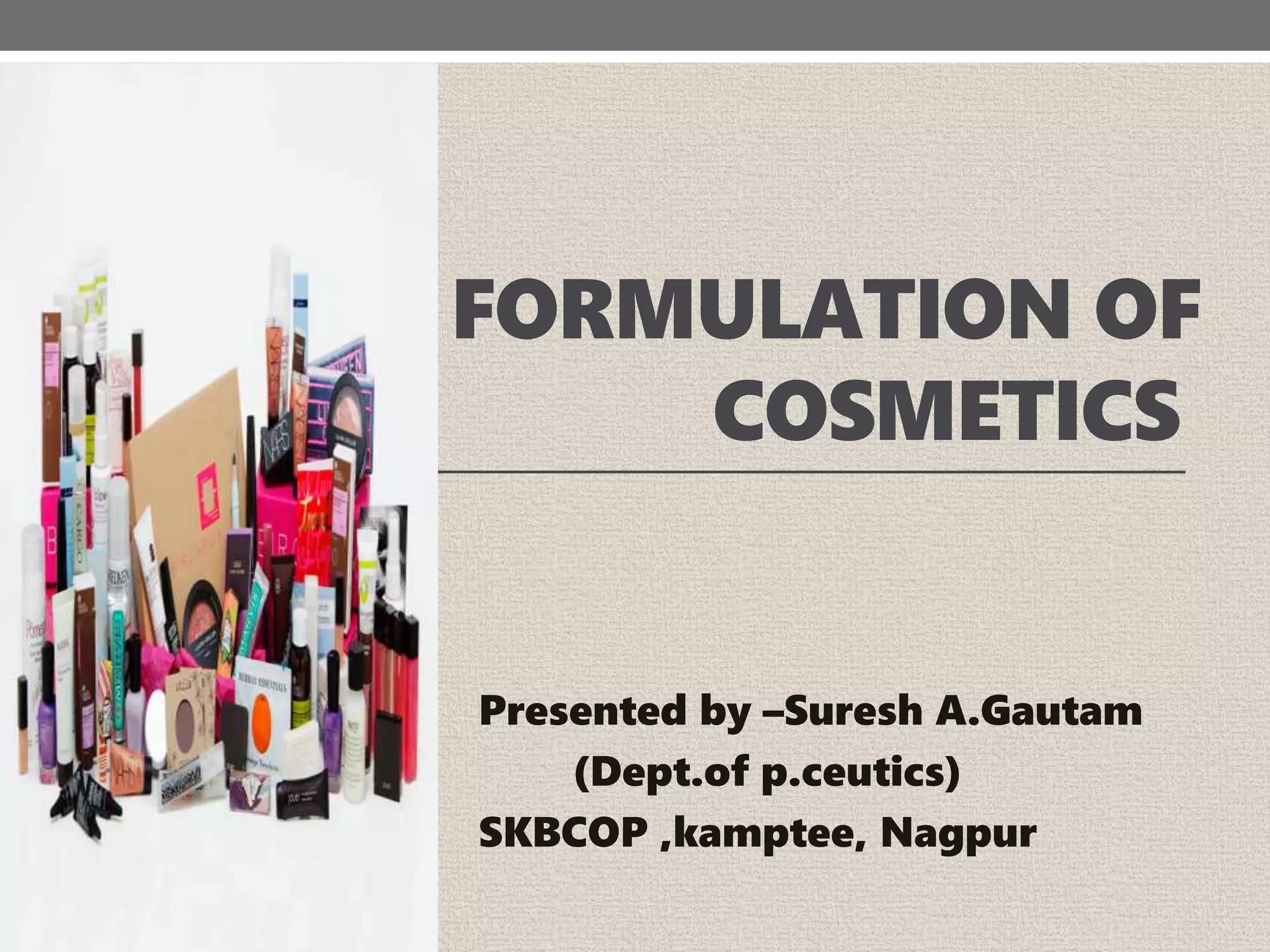
FORMULATION OF
COSMETICS
Presented by –Suresh A.Gautam
(Dept.of p.ceutics)
SKBCOP ,kamptee, Nagpur
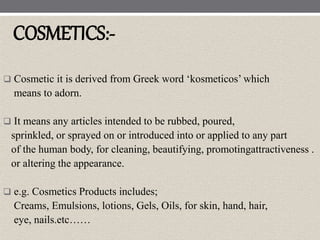
COSMETICS:-
 Cosmetic it is derived from Greek word ‘kosmeticos’ which
means to adorn.
 It means any articles intended to be rubbed, poured,
sprinkled, or sprayed on or introduced into or applied to any part
of the human body, for cleaning, beautifying, promotingattractiveness .
or altering the appearance.
 e.g. Cosmetics Products includes;
Creams, Emulsions, lotions, Gels, Oils, for skin, hand, hair,
eye, nails.etc……
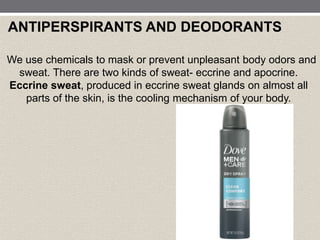
ANTIPERSPIRANTS AND DEODORANTS
We use chemicals to mask or prevent unpleasant body odors and
sweat. There are two kinds of sweat- eccrine and apocrine.
Eccrine sweat, produced in eccrine sweat glands on almost all
parts of the skin, is the cooling mechanism of your body.
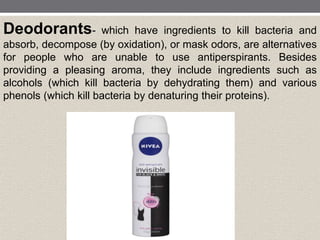
Deodorants- which have ingredients to kill bacteria and
absorb, decompose (by oxidation), or mask odors, are alternatives
for people who are unable to use antiperspirants. Besides
providing a pleasing aroma, they include ingredients such as
alcohols (which kill bacteria by dehydrating them) and various
phenols (which kill bacteria by denaturing their proteins).
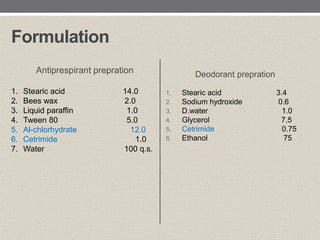
Formulation
Antiprespirant prepration Deodorant prepration
1. Stearic acid 3.4
2. Sodium hydroxide 0.6
3. D.water 1.0
4. Glycerol 7.5
5. Cetrimide 0.75
6. Ethanol 75
1. Stearic acid 14.0
2. Bees wax 2.0
3. Liquid paraffin 1.0
4. Tween 80 5.0
5. Al-chlorhydrate 12.0
6. Cetrimide 1.0
7. Water 100 q.s.
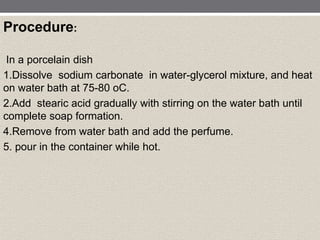
Procedure:
In a porcelain dish
1.Dissolve sodium carbonate in water-glycerol mixture, and heat
on water bath at 75-80 oC.
2.Add stearic acid gradually with stirring on the water bath until
complete soap formation.
4.Remove from water bath and add the perfume.
5. pour in the container while hot.
Sunscreen-
Depending upon the length and frequency of
exposure to sunlight, the human body may exhibit
beneficial and harmful effects. a moderate exposure
to sunlight particularly in winter pleases human
beings, stimulate blood circulation and formation
hemoglobin. Sun light also activates 7-
dehydrocholesterol(pro-vitamin D3) present in the
epidermis to form vitamin D which is important for
absorption of calcium from the intestine.
Sunscreen-
• The sunscreen cream formulations with high sun protection
factor (SPF) and satisfied characteristics.
• The actives were anisotriazine (an organic UV filter) and
titanium dioxide (an inorganic UV filter).
• The samples were determined for in vitro SPF, physical
appearance, pH, and viscosity.
• Moreover, the sunscreen creams were compared for SPF
with those of their counterparts containing either
anisotriazine or titanium dioxide at the identical
concentrations.
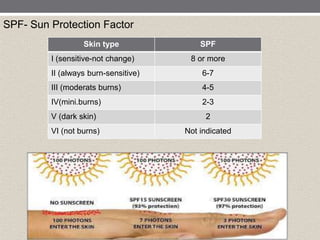
SPF- Sun Protection Factor
Skin type SPF
I (sensitive-not change) 8 or more
II (always burn-sensitive) 6-7
III (moderats burns) 4-5
IV(mini.burns) 2-3
V (dark skin) 2
VI (not burns) Not indicated
• Anthranilates (o-aminobenzoates , methyl menthyl etc.)
• P-aminobenzoic acid & it’s derivative (ethyl isobutyl glyceryl
ester etc.)
• Azoles (2-acetyl-bromoindazole etc.)
• Cinnamic acid derivatives (menthyl &benzyl esters)
• Coumarin derivatives (7-hydroxy-7-methyl)
• Dibenzalacetonen & benzal-acetophenone
• Dihydroxy cinnamic acid derivatives (umbeliferon)
• Dihydroxy naphtholic acid
• Hydrocarbons
• Napthosulphonade
• Quinine salt
• Quinolone derivative
• Salicylate (Phenyl, Benzyl)
1. An ideal sunscreen should absorb in the range of 290-
320nm .
2. It should allow full transmission of radiation
3. It should non volatile
4. Suitable solubility
5. Capable of retaining its sunscreen property for several
hours.
6. Stable under condition of use
7. Should not stain.
Formulas
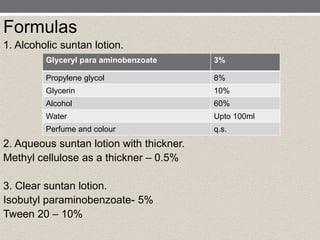
1. Alcoholic suntan lotion.
2. Aqueous suntan lotion with thickner.
Methyl cellulose as a thickner – 0.5%
3. Clear suntan lotion.
Isobutyl paraminobenzoate- 5%
Tween 20 – 10%
Glyceryl para aminobenzoate 3%
Propylene glycol 8%
Glycerin 10%
Alcohol 60%
Water Upto 100ml
Perfume and colour q.s.
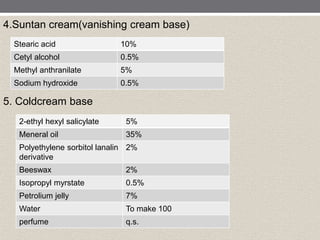
4.Suntan cream(vanishing cream base)
5. Coldcream base
Stearic acid 10%
Cetyl alcohol 0.5%
Methyl anthranilate 5%
Sodium hydroxide 0.5%
2-ethyl hexyl salicylate 5%
Meneral oil 35%
Polyethylene sorbitol lanalin
derivative
2%
Beeswax 2%
Isopropyl myrstate 0.5%
Petrolium jelly 7%
Water To make 100
perfume q.s.
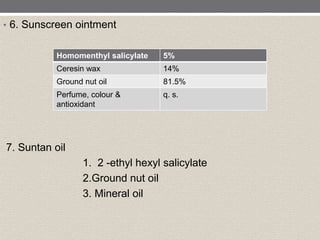
• 6. Sunscreen ointment
7. Suntan oil
1. 2 -ethyl hexyl salicylate
2.Ground nut oil
3. Mineral oil
Homomenthyl salicylate 5%
Ceresin wax 14%
Ground nut oil 81.5%
Perfume, colour &
antioxidant
q. s.
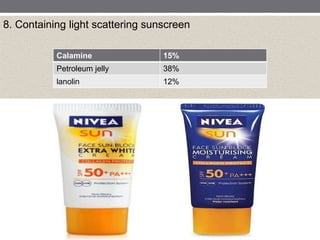
8. Containing light scattering sunscreen
Calamine 15%
Petroleum jelly 38%
lanolin 12%
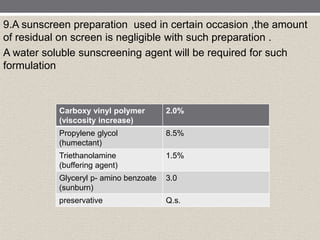
9.A sunscreen preparation used in certain occasion ,the amount
of residual on screen is negligible with such preparation .
A water soluble sunscreening agent will be required for such
formulation
Carboxy vinyl polymer
(viscosity increase)
2.0%
Propylene glycol
(humectant)
8.5%
Triethanolamine
(buffering agent)
1.5%
Glyceryl p- amino benzoate
(sunburn)
3.0
preservative Q.s.
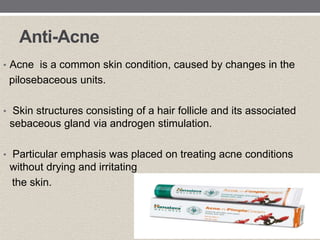
Anti-Acne
• Acne is a common skin condition, caused by changes in the
pilosebaceous units.
• Skin structures consisting of a hair follicle and its associated
sebaceous gland via androgen stimulation.
• Particular emphasis was placed on treating acne conditions
without drying and irritating
the skin.
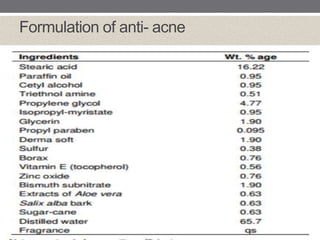
Formulation of anti- acne
Pigmentation cream
Skin pigmentary abnormalities are seen as aesthetically
unfavorable and haveled to the development of cosmetic and
therapeutic treatment modalities of varying efficacy.
Hence, several putative depigmenting agents aimed at modulating
skin pigmentation are currently being researched or sold in
commercially available products.
This includes direct inhibition of tyrosina seandrelated
melanogenic enzymes,regulation of melanocyte homeostasis,
alteration of constitutive and facultative pigmentation and down-
regulation of melanosome transfer to the keratinocytes.
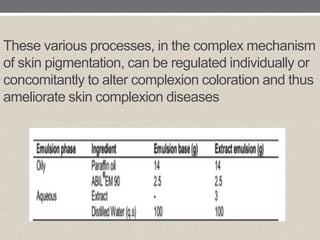
These various processes, in the complex mechanism
of skin pigmentation, can be regulated individually or
concomitantly to alter complexion coloration and thus
ameliorate skin complexion diseases
THANK YOU…..

cosmatics

  • 1.
    FORMULATION OF COSMETICS Presented by–Suresh A.Gautam (Dept.of p.ceutics) SKBCOP ,kamptee, Nagpur
  • 2.
    COSMETICS:-  Cosmetic itis derived from Greek word ‘kosmeticos’ which means to adorn.  It means any articles intended to be rubbed, poured, sprinkled, or sprayed on or introduced into or applied to any part of the human body, for cleaning, beautifying, promotingattractiveness . or altering the appearance.  e.g. Cosmetics Products includes; Creams, Emulsions, lotions, Gels, Oils, for skin, hand, hair, eye, nails.etc……
  • 3.
    ANTIPERSPIRANTS AND DEODORANTS Weuse chemicals to mask or prevent unpleasant body odors and sweat. There are two kinds of sweat- eccrine and apocrine. Eccrine sweat, produced in eccrine sweat glands on almost all parts of the skin, is the cooling mechanism of your body.
  • 4.
    Deodorants- which haveingredients to kill bacteria and absorb, decompose (by oxidation), or mask odors, are alternatives for people who are unable to use antiperspirants. Besides providing a pleasing aroma, they include ingredients such as alcohols (which kill bacteria by dehydrating them) and various phenols (which kill bacteria by denaturing their proteins).
  • 5.
    Formulation Antiprespirant prepration Deodorantprepration 1. Stearic acid 3.4 2. Sodium hydroxide 0.6 3. D.water 1.0 4. Glycerol 7.5 5. Cetrimide 0.75 6. Ethanol 75 1. Stearic acid 14.0 2. Bees wax 2.0 3. Liquid paraffin 1.0 4. Tween 80 5.0 5. Al-chlorhydrate 12.0 6. Cetrimide 1.0 7. Water 100 q.s.
  • 6.
    Procedure: In a porcelaindish 1.Dissolve sodium carbonate in water-glycerol mixture, and heat on water bath at 75-80 oC. 2.Add stearic acid gradually with stirring on the water bath until complete soap formation. 4.Remove from water bath and add the perfume. 5. pour in the container while hot.
  • 7.
    Sunscreen- Depending upon thelength and frequency of exposure to sunlight, the human body may exhibit beneficial and harmful effects. a moderate exposure to sunlight particularly in winter pleases human beings, stimulate blood circulation and formation hemoglobin. Sun light also activates 7- dehydrocholesterol(pro-vitamin D3) present in the epidermis to form vitamin D which is important for absorption of calcium from the intestine.
  • 8.
    Sunscreen- • The sunscreencream formulations with high sun protection factor (SPF) and satisfied characteristics. • The actives were anisotriazine (an organic UV filter) and titanium dioxide (an inorganic UV filter). • The samples were determined for in vitro SPF, physical appearance, pH, and viscosity. • Moreover, the sunscreen creams were compared for SPF with those of their counterparts containing either anisotriazine or titanium dioxide at the identical concentrations.
  • 9.
    SPF- Sun ProtectionFactor Skin type SPF I (sensitive-not change) 8 or more II (always burn-sensitive) 6-7 III (moderats burns) 4-5 IV(mini.burns) 2-3 V (dark skin) 2 VI (not burns) Not indicated
  • 10.
    • Anthranilates (o-aminobenzoates, methyl menthyl etc.) • P-aminobenzoic acid & it’s derivative (ethyl isobutyl glyceryl ester etc.) • Azoles (2-acetyl-bromoindazole etc.) • Cinnamic acid derivatives (menthyl &benzyl esters) • Coumarin derivatives (7-hydroxy-7-methyl) • Dibenzalacetonen & benzal-acetophenone • Dihydroxy cinnamic acid derivatives (umbeliferon) • Dihydroxy naphtholic acid • Hydrocarbons • Napthosulphonade • Quinine salt • Quinolone derivative • Salicylate (Phenyl, Benzyl)
  • 11.
    1. An idealsunscreen should absorb in the range of 290- 320nm . 2. It should allow full transmission of radiation 3. It should non volatile 4. Suitable solubility 5. Capable of retaining its sunscreen property for several hours. 6. Stable under condition of use 7. Should not stain.
  • 12.
    Formulas 1. Alcoholic suntanlotion. 2. Aqueous suntan lotion with thickner. Methyl cellulose as a thickner – 0.5% 3. Clear suntan lotion. Isobutyl paraminobenzoate- 5% Tween 20 – 10% Glyceryl para aminobenzoate 3% Propylene glycol 8% Glycerin 10% Alcohol 60% Water Upto 100ml Perfume and colour q.s.
  • 13.
    4.Suntan cream(vanishing creambase) 5. Coldcream base Stearic acid 10% Cetyl alcohol 0.5% Methyl anthranilate 5% Sodium hydroxide 0.5% 2-ethyl hexyl salicylate 5% Meneral oil 35% Polyethylene sorbitol lanalin derivative 2% Beeswax 2% Isopropyl myrstate 0.5% Petrolium jelly 7% Water To make 100 perfume q.s.
  • 14.
    • 6. Sunscreenointment 7. Suntan oil 1. 2 -ethyl hexyl salicylate 2.Ground nut oil 3. Mineral oil Homomenthyl salicylate 5% Ceresin wax 14% Ground nut oil 81.5% Perfume, colour & antioxidant q. s.
  • 15.
    8. Containing lightscattering sunscreen Calamine 15% Petroleum jelly 38% lanolin 12%
  • 16.
    9.A sunscreen preparationused in certain occasion ,the amount of residual on screen is negligible with such preparation . A water soluble sunscreening agent will be required for such formulation Carboxy vinyl polymer (viscosity increase) 2.0% Propylene glycol (humectant) 8.5% Triethanolamine (buffering agent) 1.5% Glyceryl p- amino benzoate (sunburn) 3.0 preservative Q.s.
  • 17.
    Anti-Acne • Acne isa common skin condition, caused by changes in the pilosebaceous units. • Skin structures consisting of a hair follicle and its associated sebaceous gland via androgen stimulation. • Particular emphasis was placed on treating acne conditions without drying and irritating the skin.
  • 18.
  • 19.
    Pigmentation cream Skin pigmentaryabnormalities are seen as aesthetically unfavorable and haveled to the development of cosmetic and therapeutic treatment modalities of varying efficacy. Hence, several putative depigmenting agents aimed at modulating skin pigmentation are currently being researched or sold in commercially available products. This includes direct inhibition of tyrosina seandrelated melanogenic enzymes,regulation of melanocyte homeostasis, alteration of constitutive and facultative pigmentation and down- regulation of melanosome transfer to the keratinocytes.
  • 20.
    These various processes,in the complex mechanism of skin pigmentation, can be regulated individually or concomitantly to alter complexion coloration and thus ameliorate skin complexion diseases
  • 21.