CORRUPTION
IN
INDIAN SOCIETY
Corruption
 Andini Nurul Prasetyani
 Irnu Suryohadi
 Winda Eko Aji
XI IPA 3
corruption
What is corruption?
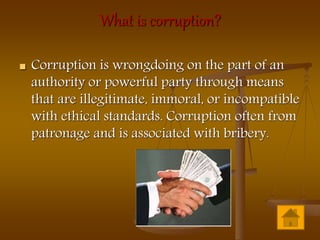
 Corruption is wrongdoing on the part of an
authority or powerful party through means
that are illegitimate, immoral, or incompatible
with ethical standards. Corruption often from
patronage and is associated with bribery.
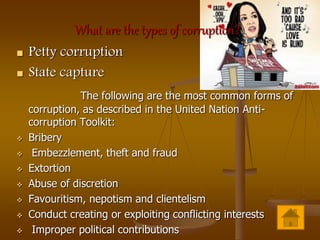
What are the types of corruption?
 Petty corruption
 State capture
The following are the most common forms of
corruption, as described in the United Nation Anti-
corruption Toolkit:
 Bribery
 Embezzlement, theft and fraud
 Extortion
 Abuse of discretion
 Favouritism, nepotism and clientelism
 Conduct creating or exploiting conflicting interests
 Improper political contributions
What are the common characteristics of corruption?
 1.Gap between group and individual interest
 2. Two or more parties since one can hardly be
corrupt with one’s own self
 3. Consenting adults that have a common
understanding
 4. Benefit furtherance
 5. Existence of power that could be grabbed,
usurped, entrusted or otherwise available
 6. Misuseof the power that often drives a wedge
between intended and stated positions, for
unintended benefits
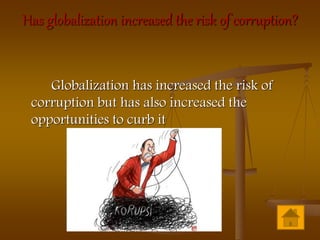
Has globalization increased the risk of corruption?
Globalization has increased the risk of
corruption but has also increased the
opportunities to curb it
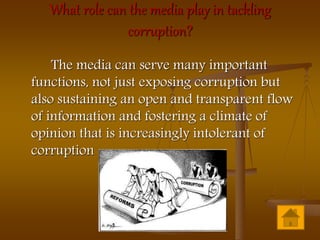
What role can the media play in tackling
corruption?
The media can serve many important
functions, not just exposing corruption but
also sustaining an open and transparent flow
of information and fostering a climate of
opinion that is increasingly intolerant of
corruption
What should governments do to make anti-corruption
agencies effective?
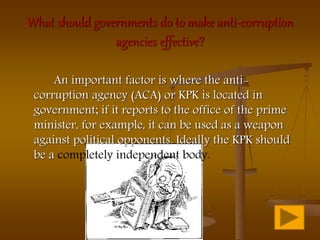
An important factor is where the anti-
corruption agency (ACA) or KPK is located in
government; if it reports to the office of the prime
minister, for example, it can be used as a weapon
against political opponents. Ideally the KPK should
be a completely independent body.
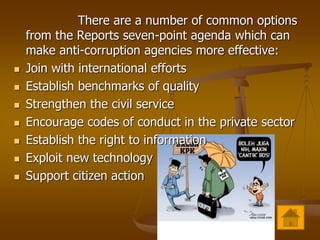
There are a number of common options
from the Reports seven-point agenda which can
make anti-corruption agencies more effective:
 Join with international efforts
 Establish benchmarks of quality
 Strengthen the civil service
 Encourage codes of conduct in the private sector
 Establish the right to information
 Exploit new technology
 Support citizen action
CONSEQUENCES OF CORRUPTION
 Loss of National wealth
 Hindrance and obstruction in development
 Backwardness
 Poverty
 Authority and power in wrong hands
 Brain drain
 Rise in terrorism and crimes
 Rise in suicide cases
 Psychological and social disorders
CURES FOR CORRUPTION IN
INDIA
 Value education
 Effective and regular vigilance
 Responsible citizen
 Effective leadership and administration
 Strong Media support( through films, ads , serials)
 Strong Legislation
 Social organisation
SUGGESTIONS
 Lokpal Bill Implementation (Introduced since 1968).
 Anti-corruption police and courts.
 Vigorous punishments
 Anti- corruption websites.
 Anti- corruption Organizations.
 Self determination of not to give bribe.
 Awareness and campaigns through medias, social
networking sites, road shows etc.
CONCLUSION
India is a fast developing country in the world
where our systems are weak. So there is always a chance of
corruption. Who is responsible for this? What action should
be taken? What we must keep in mind is “ Nothing is
Impossible”. If we join our hands together there can be an
end to this deep rooted evil. The only thing is it takes time. A
little progress everyday leads to a big result one
day………..may be tomorrow. Be Good and Do Good.
Corruption in india
Corruption in india

Corruption in india

  • 1.
  • 2.
    Corruption  Andini NurulPrasetyani  Irnu Suryohadi  Winda Eko Aji XI IPA 3
  • 3.
  • 4.
    What is corruption? Corruption is wrongdoing on the part of an authority or powerful party through means that are illegitimate, immoral, or incompatible with ethical standards. Corruption often from patronage and is associated with bribery.
  • 5.
    What are thetypes of corruption?  Petty corruption  State capture The following are the most common forms of corruption, as described in the United Nation Anti- corruption Toolkit:  Bribery  Embezzlement, theft and fraud  Extortion  Abuse of discretion  Favouritism, nepotism and clientelism  Conduct creating or exploiting conflicting interests  Improper political contributions
  • 6.
    What are thecommon characteristics of corruption?  1.Gap between group and individual interest  2. Two or more parties since one can hardly be corrupt with one’s own self  3. Consenting adults that have a common understanding  4. Benefit furtherance  5. Existence of power that could be grabbed, usurped, entrusted or otherwise available  6. Misuseof the power that often drives a wedge between intended and stated positions, for unintended benefits
  • 7.
    Has globalization increasedthe risk of corruption? Globalization has increased the risk of corruption but has also increased the opportunities to curb it
  • 8.
    What role canthe media play in tackling corruption? The media can serve many important functions, not just exposing corruption but also sustaining an open and transparent flow of information and fostering a climate of opinion that is increasingly intolerant of corruption
  • 9.
    What should governmentsdo to make anti-corruption agencies effective? An important factor is where the anti- corruption agency (ACA) or KPK is located in government; if it reports to the office of the prime minister, for example, it can be used as a weapon against political opponents. Ideally the KPK should be a completely independent body.
  • 10.
    There are anumber of common options from the Reports seven-point agenda which can make anti-corruption agencies more effective:  Join with international efforts  Establish benchmarks of quality  Strengthen the civil service  Encourage codes of conduct in the private sector  Establish the right to information  Exploit new technology  Support citizen action
  • 11.
    CONSEQUENCES OF CORRUPTION Loss of National wealth  Hindrance and obstruction in development  Backwardness  Poverty  Authority and power in wrong hands  Brain drain  Rise in terrorism and crimes  Rise in suicide cases  Psychological and social disorders
  • 12.
    CURES FOR CORRUPTIONIN INDIA  Value education  Effective and regular vigilance  Responsible citizen  Effective leadership and administration  Strong Media support( through films, ads , serials)  Strong Legislation  Social organisation
  • 13.
    SUGGESTIONS  Lokpal BillImplementation (Introduced since 1968).  Anti-corruption police and courts.  Vigorous punishments  Anti- corruption websites.  Anti- corruption Organizations.  Self determination of not to give bribe.  Awareness and campaigns through medias, social networking sites, road shows etc.
  • 14.
    CONCLUSION India is afast developing country in the world where our systems are weak. So there is always a chance of corruption. Who is responsible for this? What action should be taken? What we must keep in mind is “ Nothing is Impossible”. If we join our hands together there can be an end to this deep rooted evil. The only thing is it takes time. A little progress everyday leads to a big result one day………..may be tomorrow. Be Good and Do Good.