Proceedings of Indian Geotechnical Conference
December 15-17,2011, Kochi (Paper No. A-350)
CORRELATION BETWEEN CBR AND INDEX PROPERTIES OF SOIL
T.Datta, Assistant Prof., C.E.Dept.,Meghnad Saha Institute of Technology,Kolkata,E-mail: meettufan@yahoo.co.in
B.C.Chottopadhyay, Prof., C.E.Dept, Meghnad Saha Institute of Technology, Kolkata, E-mail : ccbikash@yahoo.com
ABSTRACT: Value of CBR is often required for geotechnical solutions of engineering road structures. For area
development projects using fillings requires placement of such fillings in proper order for high strength and low
compressibility. Huge quantity of filling material is used for construction of sub grade and CBR value for all such fills is
very important parameter and need to be assessed. But due to high cost and time requirement for such testing it generally
becomes difficult to map the variation in their value along the alignment. Correlations of CBR from different index
properties have been made by different researchers. However the validity and applicability of such correlation need to be
established for their acceptances in general practice. The predicted and tested values of CBR of various soils have been
used to check the applicability and limitations of available methods and are presented in this paper.
INTRODUCTION
Large scale road constructions are taking place over the
length and breadth of India due to adoption of highly
intensified activities in road construction like Pradhan
Mantri Gram Sadak Yojana (PMGSY) and Golden
Quadrilateral Project etc. Almost the entire road network
consists of flexible pavements. For the design of flexible
pavement, CBR value is one of the important parameters.
Flexible pavement design in India was standardized in 1970
by the IRC which gives design curves from which the
thickness of different pavement layers for a given traffic
load and CBR value can be found. For the design of
flexible pavement, throughout the whole road, soil samples
at a certain distance are taken for the determination of CBR
value of soil sub grade. On the basis of these result, the
whole road is designed. However values obtained from tests
on soil samples collected from limited numbers of location
cannot be the representative value of the whole road.
Because throughout the road, such soils may have large
variations in their engineering properties due to variety of
reasons. So it is always difficult for transportation engineers
to obtain representative CBR values for use in design of
flexible pavement. This can be avoided only if large
numbers of soil samples are taken at a very short interval
throughout the road and consequently the number of CBR
tests will be large. CBR value can be measured directly in
the laboratory in accordance with IS 2720 part 16 on soil
samples acquired from site. Laboratory test takes at least
four days to measure the CBR value for each soil sample.
Though the procedure for evaluation of CBR is simple but
it is time consuming and costly because of the laborious
laboratory work involved. This would result in serious
delay in the progress of the project since in most situations
the materials for earthwork construction come from highly
variable sources. Any delay in the construction inevitably
leads to escalation of project cost. So it is not really
possible to take large numbers of samples. Not only for
design but after construction at the time of checking quality
also it may become very problematic. Since in the present
scenario quality control becomes very important, so during
and after construction to check the quality of the prepared
sub grade by comparing the in-situ value of CBR of
constructed sub grade and design value of CBR , a huge
time is necessary. But practically it is impossible to put
enormous time into this aspect. So for proper design, time
and cost point of view it is very much essential to correlate
CBR of soils with easily determinable parameters. Some
correlations have been presented in this field in recent
period but reliability of these methods needs substantial
verifications. In this paper attempt has been made to check
the efficacy of the suggested correlations with tested values
to suggest a proper method and correlation in practice.
AVAILABLE CORRELATIONS:
Attempts have been made by several research workers to
develop suitable correlation between CBR value of
compacted soils at Optimum Moisture Content (OMC) and
result of some simple field tests [Venkatraman et. el (1995),
Kumar et. el. (2000) , Karunaprema and Edirisinghe
(2002)] or different simple soil characteristics . In this
section some of the available correlation between CBR
value and simple soil properties are described.
(a) Correlations based on Liquid Limit and Gradation
Vinod and Cletus (2008) correlated the value of CBR with
Liquid Limit(LL) and gradation characteristics of soils.
Based on result of experimental study on lateritic soils they
suggested a correlation
CBR = - 0.889 (WLM) + 45.616 .........................(1)
Where WLM is modified Liquid Limit and is given by
WLM = LL (1 - C/100) ................................(2)
Where LL is Liquid Limit on soil passing 425 micron sieve
(in percent) and C is fraction of soil coarser than 425
micron (percent)
131
T. Datta, & B.C.Chattopadhyay
Patel and Desai ( 2010) proposed a correlation between
Plasticity Index (PI), Maximum Dry Density (MDD) and
Optimum Moisture Content (OMC)
CBR(SOAKED)=43.907-0.093(PI)-18.78 (MDD) -0.3081(OMC) ..(3)
Where , MDD is in gm/cc
(b) Correlation based on Optimum Moisture Content
(OMC) and Maximum Dry Density (MDD)
Roy et el (2009) proposed a method to predict value of
soaked CBR in terms of the Optimum Moisture Content
(OMC) and Maximum Dry Density (MDD) of a soil. They
used the following relationship
Log (CBR)= Log ( d max/ w)-Log (OMC) ....................................(4)
Where , d max and w are in same unit
TABLE 1: Input Parameter from Roy, Chattopadhyay and
Roy (2009)
LL PI OMC MDD
CBR
(SOAKED)
25 7 12 1.844 18.3
23.5 8.5 14 1.768 10.88
23 8 11.5 1.89 15.1
28.5 11.5 14.5 1.827 7.3
31.5 13.5 14.5 1.794 5.6
26.5 11.5 18 1.71 5
27 11 16.4 1.79 5.9
31 14 15.6 1.81 8.5
33 13 14.3 1.787 7.3
31 19 16.5 1.89 7
35 17 17.6 1.82 6.5
36 17 16 1.7 5.5
37 17 17.8 1.53 3.0
36 14.5 17 1.75 4.0
40.5 21 17 1.65 2.38
37 15.5 21.4 1.55 3.14
44.5 21.5 21.9 1.69 4.12
43 21 19 1.68 4.0
42 21 19.9 1.52 3.28
47 26 19 1.702 2.65
36.5 14.5 16 1.70 4.85
40 19 18.5 1.651 4.41
48 26 15.5 1.722 3.9
43 25 19 1.692 3.36
43 26 19.7 1.66 3.0
37 19.1 16.5 1.706 3.2
44.4 22.4 18.6 1.76 3.75
39 20.5 20.85 1.63 2.4
Relative Importance of different factors affecting CBR
It has been seen in the former section that correlations have
been developed for CBR from different input parameters.
Reliability of any prediction depends primarily on the
relative importance of the factor in controlling the
magnitude of the output. In search of the best correlation
for CBR the most important parameter influencing the
value of CBR is first identified. The most important input
variable influencing the value of CBR was studied by Kaur
et. el. (2011) following an innovative technique. They have
indicated that plasticity index followed by the Liquid Limit
is the most important parameter. Other parameters like
maximum dry density, fine fraction, sand fraction etc have
lesser but almost equal impact on the result.
ANALYSIS OF THE AVAILABLE METHODS:
In view of this, an analytic work was undertaken by the
writers to seek the validity of the available correlations for
predicting CBR value on the basis of plasticity
characteristics. For this purpose the tested value of CBR in
soaked condition reported by Roy, Chattopadhyay and Roy
(2009) were used. The results of CBR value along with
Liquid Limit, Plastic Limit and compaction characteristics
are given in Table 1.
The CBR values were then evaluated from available
correlations given by Vinod and Cletus (2008) (Eqn.1) and
Patel and Desai ( 2010) (Eqn.3) using soil properties
reported by Roy, Chattopadhyay and Roy (2009). These
predicted values were then compared with experimental
values reported by Roy, Chattopadhyay and Roy (2009).
COMPARISON OF TEST RESULT:
The predicted values and experimental values of CBR are
given in Table 2.
TABLE 2: Predicted and Experimental values of CBR
Predicted
CBR by
Eqn.1
Predicted
CBR by
Eqn.3
Experimental
values of
CBR
23.4 4.93 18.3
24.7 5.60 10.88
25.2 4.13 15.1
20.3 4.06 7.3
17.6 4.49 5.6
22.1 5.18 5
21.6 4.21 5.9
18.1 3.81 8.5
16.3 4.73 7.3
18.1 1.56 7
14.5 2.72 6.5
13.6 5.47 5.5
12.7 8.11 3.0
13.6 4.46 4.0
9.6 5.73 2.38
12.7 6.76 3.14
6.1 3.42 4.12
7.4 4.55 4.0
8.3 7.28 3.28
3.8 3.67 2.65
13.2 5.70 4.85
10.1 5.43 4.41
2.9 4.37 3.9
7.4 3.95 3.36
7.4 4.24 3.0
12.7 5.01 3.2
6.1 3.04 3.75
10.9 4.97 2.4
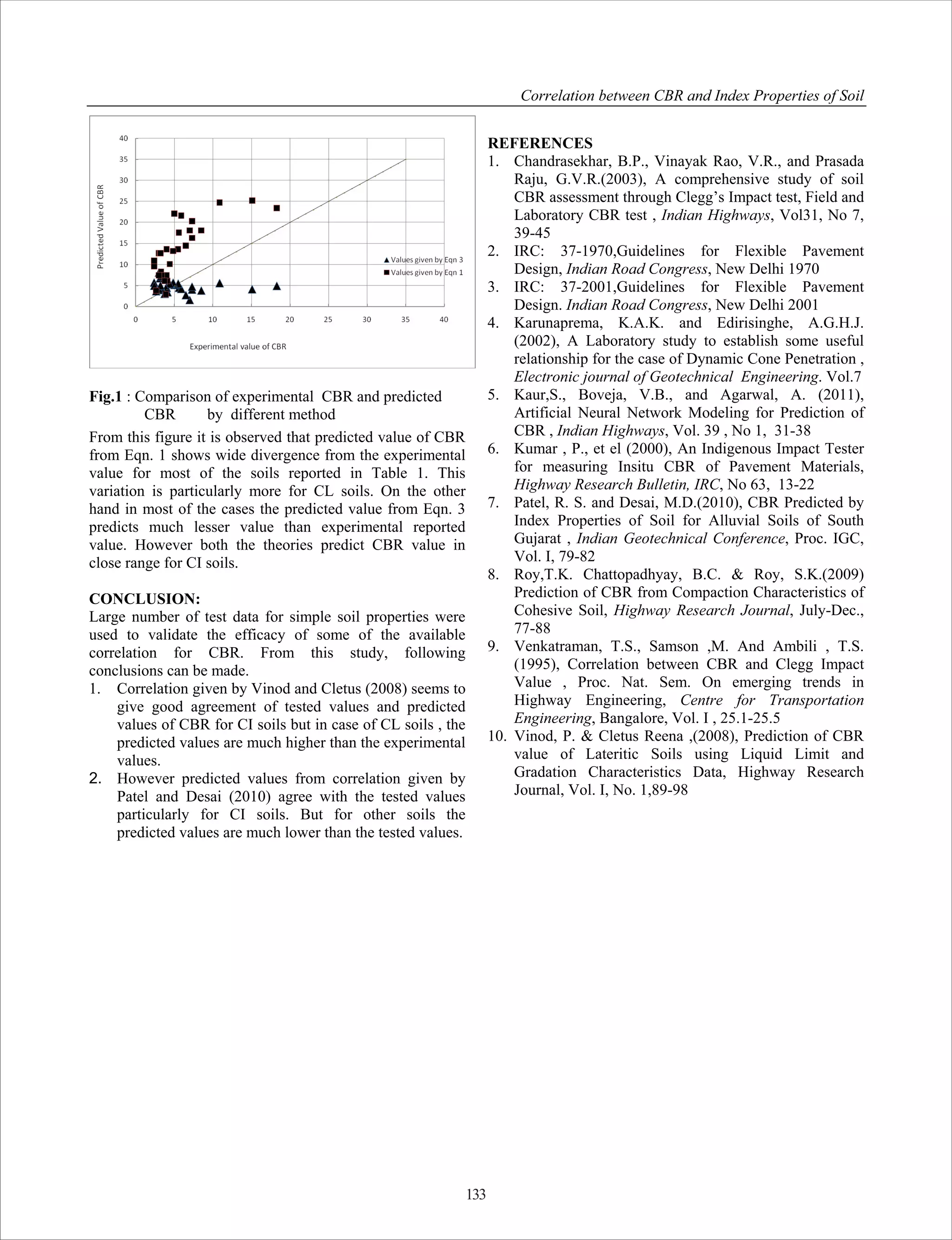
These values are further plotted in Fig. 1.
132
Correlation between CBR and Index Properties of Soil
Fig.1 : Comparison of experimental CBR and predicted
CBR by different method
From this figure it is observed that predicted value of CBR
from Eqn. 1 shows wide divergence from the experimental
value for most of the soils reported in Table 1. This
variation is particularly more for CL soils. On the other
hand in most of the cases the predicted value from Eqn. 3
predicts much lesser value than experimental reported
value. However both the theories predict CBR value in
close range for CI soils.
CONCLUSION:
Large number of test data for simple soil properties were
used to validate the efficacy of some of the available
correlation for CBR. From this study, following
conclusions can be made.
1. Correlation given by Vinod and Cletus (2008) seems to
give good agreement of tested values and predicted
values of CBR for CI soils but in case of CL soils , the
predicted values are much higher than the experimental
values.
2. However predicted values from correlation given by
Patel and Desai (2010) agree with the tested values
particularly for CI soils. But for other soils the
predicted values are much lower than the tested values.
REFERENCES
1. Chandrasekhar, B.P., Vinayak Rao, V.R., and Prasada
Raju, G.V.R.(2003), A comprehensive study of soil
CBR assessment through Clegg’s Impact test, Field and
Laboratory CBR test , Indian Highways, Vol31, No 7,
39-45
2. IRC: 37-1970,Guidelines for Flexible Pavement
Design, Indian Road Congress, New Delhi 1970
3. IRC: 37-2001,Guidelines for Flexible Pavement
Design. Indian Road Congress, New Delhi 2001
4. Karunaprema, K.A.K. and Edirisinghe, A.G.H.J.
(2002), A Laboratory study to establish some useful
relationship for the case of Dynamic Cone Penetration ,
Electronic journal of Geotechnical Engineering. Vol.7
5. Kaur,S., Boveja, V.B., and Agarwal, A. (2011),
Artificial Neural Network Modeling for Prediction of
CBR , Indian Highways, Vol. 39 , No 1, 31-38
6. Kumar , P., et el (2000), An Indigenous Impact Tester
for measuring Insitu CBR of Pavement Materials,
Highway Research Bulletin, IRC, No 63, 13-22
7. Patel, R. S. and Desai, M.D.(2010), CBR Predicted by
Index Properties of Soil for Alluvial Soils of South
Gujarat , Indian Geotechnical Conference, Proc. IGC,
Vol. I, 79-82
8. Roy,T.K. Chattopadhyay, B.C. & Roy, S.K.(2009)
Prediction of CBR from Compaction Characteristics of
Cohesive Soil, Highway Research Journal, July-Dec.,
77-88
9. Venkatraman, T.S., Samson ,M. And Ambili , T.S.
(1995), Correlation between CBR and Clegg Impact
Value , Proc. Nat. Sem. On emerging trends in
Highway Engineering, Centre for Transportation
Engineering, Bangalore, Vol. I , 25.1-25.5
10. Vinod, P. & Cletus Reena ,(2008), Prediction of CBR
value of Lateritic Soils using Liquid Limit and
Gradation Characteristics Data, Highway Research
Journal, Vol. I, No. 1,89-98
133

Correlation between cbr and index propertys of soil

  • 1.
    Proceedings of IndianGeotechnical Conference December 15-17,2011, Kochi (Paper No. A-350) CORRELATION BETWEEN CBR AND INDEX PROPERTIES OF SOIL T.Datta, Assistant Prof., C.E.Dept.,Meghnad Saha Institute of Technology,Kolkata,E-mail: meettufan@yahoo.co.in B.C.Chottopadhyay, Prof., C.E.Dept, Meghnad Saha Institute of Technology, Kolkata, E-mail : ccbikash@yahoo.com ABSTRACT: Value of CBR is often required for geotechnical solutions of engineering road structures. For area development projects using fillings requires placement of such fillings in proper order for high strength and low compressibility. Huge quantity of filling material is used for construction of sub grade and CBR value for all such fills is very important parameter and need to be assessed. But due to high cost and time requirement for such testing it generally becomes difficult to map the variation in their value along the alignment. Correlations of CBR from different index properties have been made by different researchers. However the validity and applicability of such correlation need to be established for their acceptances in general practice. The predicted and tested values of CBR of various soils have been used to check the applicability and limitations of available methods and are presented in this paper. INTRODUCTION Large scale road constructions are taking place over the length and breadth of India due to adoption of highly intensified activities in road construction like Pradhan Mantri Gram Sadak Yojana (PMGSY) and Golden Quadrilateral Project etc. Almost the entire road network consists of flexible pavements. For the design of flexible pavement, CBR value is one of the important parameters. Flexible pavement design in India was standardized in 1970 by the IRC which gives design curves from which the thickness of different pavement layers for a given traffic load and CBR value can be found. For the design of flexible pavement, throughout the whole road, soil samples at a certain distance are taken for the determination of CBR value of soil sub grade. On the basis of these result, the whole road is designed. However values obtained from tests on soil samples collected from limited numbers of location cannot be the representative value of the whole road. Because throughout the road, such soils may have large variations in their engineering properties due to variety of reasons. So it is always difficult for transportation engineers to obtain representative CBR values for use in design of flexible pavement. This can be avoided only if large numbers of soil samples are taken at a very short interval throughout the road and consequently the number of CBR tests will be large. CBR value can be measured directly in the laboratory in accordance with IS 2720 part 16 on soil samples acquired from site. Laboratory test takes at least four days to measure the CBR value for each soil sample. Though the procedure for evaluation of CBR is simple but it is time consuming and costly because of the laborious laboratory work involved. This would result in serious delay in the progress of the project since in most situations the materials for earthwork construction come from highly variable sources. Any delay in the construction inevitably leads to escalation of project cost. So it is not really possible to take large numbers of samples. Not only for design but after construction at the time of checking quality also it may become very problematic. Since in the present scenario quality control becomes very important, so during and after construction to check the quality of the prepared sub grade by comparing the in-situ value of CBR of constructed sub grade and design value of CBR , a huge time is necessary. But practically it is impossible to put enormous time into this aspect. So for proper design, time and cost point of view it is very much essential to correlate CBR of soils with easily determinable parameters. Some correlations have been presented in this field in recent period but reliability of these methods needs substantial verifications. In this paper attempt has been made to check the efficacy of the suggested correlations with tested values to suggest a proper method and correlation in practice. AVAILABLE CORRELATIONS: Attempts have been made by several research workers to develop suitable correlation between CBR value of compacted soils at Optimum Moisture Content (OMC) and result of some simple field tests [Venkatraman et. el (1995), Kumar et. el. (2000) , Karunaprema and Edirisinghe (2002)] or different simple soil characteristics . In this section some of the available correlation between CBR value and simple soil properties are described. (a) Correlations based on Liquid Limit and Gradation Vinod and Cletus (2008) correlated the value of CBR with Liquid Limit(LL) and gradation characteristics of soils. Based on result of experimental study on lateritic soils they suggested a correlation CBR = - 0.889 (WLM) + 45.616 .........................(1) Where WLM is modified Liquid Limit and is given by WLM = LL (1 - C/100) ................................(2) Where LL is Liquid Limit on soil passing 425 micron sieve (in percent) and C is fraction of soil coarser than 425 micron (percent) 131
  • 2.
    T. Datta, &B.C.Chattopadhyay Patel and Desai ( 2010) proposed a correlation between Plasticity Index (PI), Maximum Dry Density (MDD) and Optimum Moisture Content (OMC) CBR(SOAKED)=43.907-0.093(PI)-18.78 (MDD) -0.3081(OMC) ..(3) Where , MDD is in gm/cc (b) Correlation based on Optimum Moisture Content (OMC) and Maximum Dry Density (MDD) Roy et el (2009) proposed a method to predict value of soaked CBR in terms of the Optimum Moisture Content (OMC) and Maximum Dry Density (MDD) of a soil. They used the following relationship Log (CBR)= Log ( d max/ w)-Log (OMC) ....................................(4) Where , d max and w are in same unit TABLE 1: Input Parameter from Roy, Chattopadhyay and Roy (2009) LL PI OMC MDD CBR (SOAKED) 25 7 12 1.844 18.3 23.5 8.5 14 1.768 10.88 23 8 11.5 1.89 15.1 28.5 11.5 14.5 1.827 7.3 31.5 13.5 14.5 1.794 5.6 26.5 11.5 18 1.71 5 27 11 16.4 1.79 5.9 31 14 15.6 1.81 8.5 33 13 14.3 1.787 7.3 31 19 16.5 1.89 7 35 17 17.6 1.82 6.5 36 17 16 1.7 5.5 37 17 17.8 1.53 3.0 36 14.5 17 1.75 4.0 40.5 21 17 1.65 2.38 37 15.5 21.4 1.55 3.14 44.5 21.5 21.9 1.69 4.12 43 21 19 1.68 4.0 42 21 19.9 1.52 3.28 47 26 19 1.702 2.65 36.5 14.5 16 1.70 4.85 40 19 18.5 1.651 4.41 48 26 15.5 1.722 3.9 43 25 19 1.692 3.36 43 26 19.7 1.66 3.0 37 19.1 16.5 1.706 3.2 44.4 22.4 18.6 1.76 3.75 39 20.5 20.85 1.63 2.4 Relative Importance of different factors affecting CBR It has been seen in the former section that correlations have been developed for CBR from different input parameters. Reliability of any prediction depends primarily on the relative importance of the factor in controlling the magnitude of the output. In search of the best correlation for CBR the most important parameter influencing the value of CBR is first identified. The most important input variable influencing the value of CBR was studied by Kaur et. el. (2011) following an innovative technique. They have indicated that plasticity index followed by the Liquid Limit is the most important parameter. Other parameters like maximum dry density, fine fraction, sand fraction etc have lesser but almost equal impact on the result. ANALYSIS OF THE AVAILABLE METHODS: In view of this, an analytic work was undertaken by the writers to seek the validity of the available correlations for predicting CBR value on the basis of plasticity characteristics. For this purpose the tested value of CBR in soaked condition reported by Roy, Chattopadhyay and Roy (2009) were used. The results of CBR value along with Liquid Limit, Plastic Limit and compaction characteristics are given in Table 1. The CBR values were then evaluated from available correlations given by Vinod and Cletus (2008) (Eqn.1) and Patel and Desai ( 2010) (Eqn.3) using soil properties reported by Roy, Chattopadhyay and Roy (2009). These predicted values were then compared with experimental values reported by Roy, Chattopadhyay and Roy (2009). COMPARISON OF TEST RESULT: The predicted values and experimental values of CBR are given in Table 2. TABLE 2: Predicted and Experimental values of CBR Predicted CBR by Eqn.1 Predicted CBR by Eqn.3 Experimental values of CBR 23.4 4.93 18.3 24.7 5.60 10.88 25.2 4.13 15.1 20.3 4.06 7.3 17.6 4.49 5.6 22.1 5.18 5 21.6 4.21 5.9 18.1 3.81 8.5 16.3 4.73 7.3 18.1 1.56 7 14.5 2.72 6.5 13.6 5.47 5.5 12.7 8.11 3.0 13.6 4.46 4.0 9.6 5.73 2.38 12.7 6.76 3.14 6.1 3.42 4.12 7.4 4.55 4.0 8.3 7.28 3.28 3.8 3.67 2.65 13.2 5.70 4.85 10.1 5.43 4.41 2.9 4.37 3.9 7.4 3.95 3.36 7.4 4.24 3.0 12.7 5.01 3.2 6.1 3.04 3.75 10.9 4.97 2.4 These values are further plotted in Fig. 1. 132
  • 3.
    Correlation between CBRand Index Properties of Soil Fig.1 : Comparison of experimental CBR and predicted CBR by different method From this figure it is observed that predicted value of CBR from Eqn. 1 shows wide divergence from the experimental value for most of the soils reported in Table 1. This variation is particularly more for CL soils. On the other hand in most of the cases the predicted value from Eqn. 3 predicts much lesser value than experimental reported value. However both the theories predict CBR value in close range for CI soils. CONCLUSION: Large number of test data for simple soil properties were used to validate the efficacy of some of the available correlation for CBR. From this study, following conclusions can be made. 1. Correlation given by Vinod and Cletus (2008) seems to give good agreement of tested values and predicted values of CBR for CI soils but in case of CL soils , the predicted values are much higher than the experimental values. 2. However predicted values from correlation given by Patel and Desai (2010) agree with the tested values particularly for CI soils. But for other soils the predicted values are much lower than the tested values. REFERENCES 1. Chandrasekhar, B.P., Vinayak Rao, V.R., and Prasada Raju, G.V.R.(2003), A comprehensive study of soil CBR assessment through Clegg’s Impact test, Field and Laboratory CBR test , Indian Highways, Vol31, No 7, 39-45 2. IRC: 37-1970,Guidelines for Flexible Pavement Design, Indian Road Congress, New Delhi 1970 3. IRC: 37-2001,Guidelines for Flexible Pavement Design. Indian Road Congress, New Delhi 2001 4. Karunaprema, K.A.K. and Edirisinghe, A.G.H.J. (2002), A Laboratory study to establish some useful relationship for the case of Dynamic Cone Penetration , Electronic journal of Geotechnical Engineering. Vol.7 5. Kaur,S., Boveja, V.B., and Agarwal, A. (2011), Artificial Neural Network Modeling for Prediction of CBR , Indian Highways, Vol. 39 , No 1, 31-38 6. Kumar , P., et el (2000), An Indigenous Impact Tester for measuring Insitu CBR of Pavement Materials, Highway Research Bulletin, IRC, No 63, 13-22 7. Patel, R. S. and Desai, M.D.(2010), CBR Predicted by Index Properties of Soil for Alluvial Soils of South Gujarat , Indian Geotechnical Conference, Proc. IGC, Vol. I, 79-82 8. Roy,T.K. Chattopadhyay, B.C. & Roy, S.K.(2009) Prediction of CBR from Compaction Characteristics of Cohesive Soil, Highway Research Journal, July-Dec., 77-88 9. Venkatraman, T.S., Samson ,M. And Ambili , T.S. (1995), Correlation between CBR and Clegg Impact Value , Proc. Nat. Sem. On emerging trends in Highway Engineering, Centre for Transportation Engineering, Bangalore, Vol. I , 25.1-25.5 10. Vinod, P. & Cletus Reena ,(2008), Prediction of CBR value of Lateritic Soils using Liquid Limit and Gradation Characteristics Data, Highway Research Journal, Vol. I, No. 1,89-98 133