International Research Journal of Engineering and Technology (IRJET) e-ISSN: 2395-0056
Volume: 06 Issue: 04 | Apr 2019 www.irjet.net p-ISSN: 2395-0072
© 2019, IRJET | Impact Factor value: 7.211 | ISO 9001:2008 Certified Journal | Page 4029
PREDICTION OF CBR VALUE FROM INDEX PROPERTIES OF SOIL
GouriPriya1, Arya KS2, Eldhose M Manjummekudiyil 3,Unni A4, Vinayak S Menon5
1 Final Year student, Dept. of Civil Engineering, Mar Athanasius College of Engineering, Kerala, India
2 Final Year student, Dept. of Civil Engineering, Mar Athanasius College of Engineering, Kerala, India
3Professor, Dept. of Civil Engineering, Mar Athanasius college of Engineering , Kerala, India
---------------------------------------------------------------------***---------------------------------------------------------------------
Abstract - Prediction is vital tool in engineering used to
take right decisions. Therefore it is very important for
engineers to quickly predict the behavior of geo-materials
used in the infrastructure. California Bearing Ratio (CBR) test
is a common laboratory test, performed to evaluate the shear
strength and stiffness modulus of sub-grade for the design of
pavement, which takes minimum 4 days to complete the test.
Therefore it is vital to develop the models forquickassessment
of CBR value. This is study is an attempt to develop valid
models to determine the CBR value from the index properties
of the soil which are quicker to estimate from the standard
method of testing. The models may be based on liquid limit,
plastic limit, plasticity index, coefficient of uniformity,
optimum moisture content, maximum dry density.
Key Words: : Prediction, California Bearing Ratio, Liquid
Limit, Plasticity index, Plastic Limit, Coefficient of
Uniformity, Maximum Dry Density.
1.INTRODUCTION ( Size 11 , cambria font)
The CBR test is the most widespread method of determining
the bearing strength of pavement materials and is
fundamental to pavement design practice in most countries.
The CBR test can be conducted on re-molded or on soil in
place. The samples may be tested at their natural or at re-
molded moisture content (un-soaked CBR), or they may be
soaked by immersing in water for a specified period of time
(four days) in order to simulate highly unfavorablemoisture
conditions of soil type.
Civil engineers always encounter difficulties in obtaining
representative CBR values for design of pavement. A CBR
value is affected by the type of soil and different soil
properties. An attempt has been made to correlate the CBR
with simple soil properties. It can be an alternative method
for the time consuming tests. These tests are much
economical and rapid than CBR test.
To determine the shear strength and stiffness modulus of
sub-grade to be used in design of pavement, California
Bearing Ratio (CBR) is performed on sub-grade material.
CBR value can be directly assessed by California Bearing
Ratio test. CBR test is laborious and tedious. It usually takes
4 days to complete a test. So for quick assessment of CBR
value it is required to correlate the CBR value with the
quickly assessable properties of soils.
Many researches had been carried out to show the effect of
soil types and characteristics on CBR values.
A number of attempts have been made to correlateCBRwith
soil index properties. Among them, Black 1962 had
developed a method of estimatingtheCBRvalueforcohesive
soil. He had obtained the correlations between CBR and
plasticity index for various values of liquidityindex.Agarwal
and Ghanekar 1970 had tried to develop a correlation
between CBR values and either liquid limit, plastic limit or
plasticity index. However they failed it find any significant
correlation between them. Instead they found an improved
correlation when they include the OMC and liquid limit.
CBR = 2-16log (OMC) + 0.07LL
OMC – Optimum moisture content, LL – Liquid limit
Yildirim and Gunaydin 2011 proposed following
correlation for CBR soaked value with index properties of
fine grained soils.
CBR = 0.62OMC + 58.9MDD + 0.11LL +0.53PL – 126.18
1.1 MLRA
Multiple linear regression analysis (MLRA) has been carried
out by considering soaked CBR value as the dependent
variable and the rest of soil properties as independent
variable. Coefficient of uniformity, plastic limit, plasticity
index, liquid limit, Optimum moisturecontent,Maximum dry
density are the soil index properties chosen. The standard
statistical software Microsoft excel is used in the present
case.
International Research Journal of Engineering and Technology (IRJET) e-ISSN: 2395-0056
Volume: 06 Issue: 04 | Apr 2019 www.irjet.net p-ISSN: 2395-0072
© 2019, IRJET | Impact Factor value: 7.211 | ISO 9001:2008 Certified Journal | Page 4030
2. METHODOLOGY
The main objective of this project is to developa correlation
between CBRs values and the basic index properties of the
soil. To achieve the objectives of the research study, soil
samples of varying geotechnical characteristics were
collected from different parts of Ernakulam. Total 5 number
of samples were collected from different project sites.
SIEVE ANALYSIS
↓
ATTERBERG’S LIMIT TEST
↓
STANDARD PROCTOR TEST
↓
CBR (soaked) TEST
2.1 PROCEDURE ADOPTED
Based on the test results from the soil tests different
relationships will be established between CBR soakedvalue,
OMC, MDD, Liquid limit and plastic limit
All the soil samples will be tested as per ASTM standards
[xix-xxii]. The samples of soilsaretestedforestablishmentof
correlations.
Table -1: Criteria Of Pellinen
Criteria
R2
Excellent >0.9
Good
0.7-0.86
Fair
0.4-0.67
Poor
0.2-0.39
Very Poor
<0.2
The strength of these relationships will be checked basedon
the (R2 value) criteria proposed by pellinen. (table 1.1). The
low R2 value indicates high scatters inthedata andvery poor
strength in he relationship and vice versa.
A multiple regression analysis will be then trying to find an
equation satisfying the test results and the goodness of fit
statistics will be checked accordingtotheconceptual criteria
proposed by pellinen. Multiple Linear regression estimates
the coefficients of the equation. To check the validity of
developed correlations (separately for fine and coarse),
experimental values of CBRs is plotted against predicted
values of CBRs (using developed equations). Percentage
error from 45degree line (equality line) will be calculated.
Validity of the correlations from literature is also checked
and compared with the models developed in the present
study.
3. TEST RESULTS
All the 5 soil samples were tested as per ASTM standards.
Sieve analysis of the soil samples showed that soil samples
can be classified as fine grained and coarse grained soil
samples. Among these soil samples percentageofgravel was
ranging from 15-38%, sand 7-17% and fines 0.45-5%.
Atterberg’s limit test results of the soil samples showed that
liquid limit is in a range of 24-32%, the plastic limit is in the
range of 16-28%, and plasticity index is in the range of 1.9-
9.9%. soil samples were classifiedasperUSCS.Sampleswere
classified as well graded sand, poorly graded gravel sand,
gap graded silt sand, gap graded clayeygravel withsandand
low plasticity lean clay soil. From standard proctor test
results it was observed thattheoptimummoisturecontentis
in the range of 16-22% and maximum dry density in a range
of 1.62-2.55. Soaked CBR value was found ranging between
4-7.5%.
4. ANALYSIS PROCEDURE
4.1 DEVELOPMENT OF PREDICTION MODELS
To fulfill the objectives of the study, the results out of
laboratory experiments carried out were studied and were
analyzed statistically. To build up a relation between CBR
value and Index properties, regression models are used
through Microsoft Excel software. In this study regression
models were developed for estimating CBR value interms of
index properties. In the regression analysis the exact nature
and form of mathematical equation is obtained and the
regression coefficient is used for prediction.
International Research Journal of Engineering and Technology (IRJET) e-ISSN: 2395-0056
Volume: 06 Issue: 04 | Apr 2019 www.irjet.net p-ISSN: 2395-0072
© 2019, IRJET | Impact Factor value: 7.211 | ISO 9001:2008 Certified Journal | Page 4031
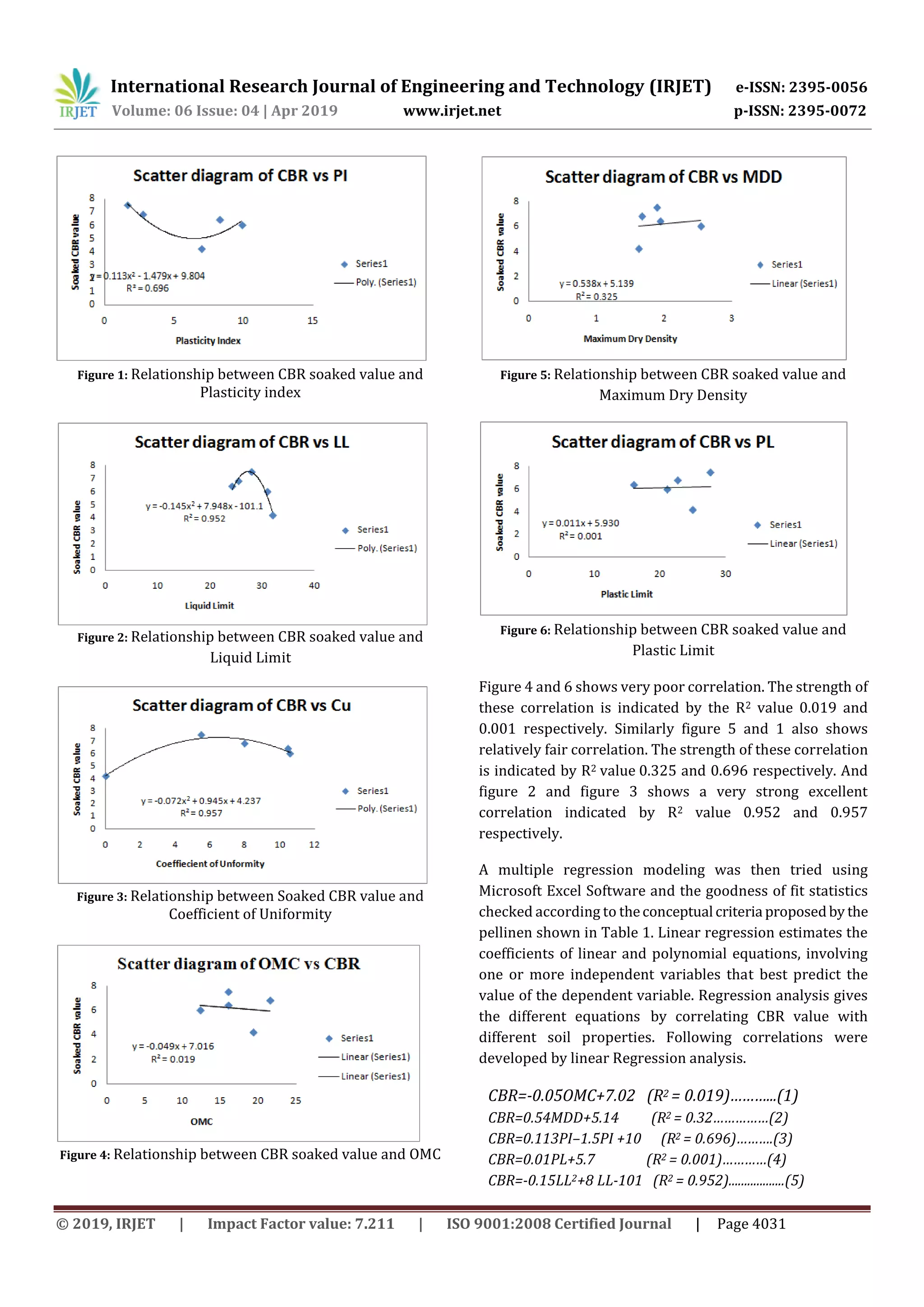
Figure 1: Relationship between CBR soaked value and
Plasticity index
Figure 2: Relationship between CBR soaked value and
Liquid Limit
Figure 3: Relationship between Soaked CBR value and
Coefficient of Uniformity
Figure 4: Relationship between CBR soaked value and OMC
Figure 5: Relationship between CBR soaked value and
Maximum Dry Density
Figure 6: Relationship between CBR soaked value and
Plastic Limit
Figure 4 and 6 shows very poor correlation. The strength of
these correlation is indicated by the R2 value 0.019 and
0.001 respectively. Similarly figure 5 and 1 also shows
relatively fair correlation. The strength of these correlation
is indicated by R2 value 0.325 and 0.696 respectively. And
figure 2 and figure 3 shows a very strong excellent
correlation indicated by R2 value 0.952 and 0.957
respectively.
A multiple regression modeling was then tried using
Microsoft Excel Software and the goodness of fit statistics
checked according to theconceptual criteria proposedby the
pellinen shown in Table 1. Linear regression estimates the
coefficients of linear and polynomial equations, involving
one or more independent variables that best predict the
value of the dependent variable. Regression analysis gives
the different equations by correlating CBR value with
different soil properties. Following correlations were
developed by linear Regression analysis.
CBR=-0.05OMC+7.02 (R2 = 0.019)………...(1)
CBR=0.54MDD+5.14 (R2 = 0.32……………(2)
CBR=0.113PI–1.5PI +10 (R2 = 0.696)……….(3)
CBR=0.01PL+5.7 (R2 = 0.001)…………(4)
CBR=-0.15LL2+8 LL-101 (R2 = 0.952)..................(5)
International Research Journal of Engineering and Technology (IRJET) e-ISSN: 2395-0056
Volume: 06 Issue: 04 | Apr 2019 www.irjet.net p-ISSN: 2395-0072
© 2019, IRJET | Impact Factor value: 7.211 | ISO 9001:2008 Certified Journal | Page 4032
CBR=-0.07Cu2+0.95Cu+4.2 (R2= 0.957)……….......(6)
CBR=2.6MDD–0.4PI+3.3 (R2=0.69)………….(7)
Since the regression coefficient is very low and the strength
of the correlation is very poor (eq1 & 4) it is easytoconclude
that the variation in the index properties namely OMC and
PL have no much influence on CBR Value. And hence the
equation (1) and (4) is omitted.
In multiple regression analysis, hence the index properties
considered are only MDD, PI, LL, and Cu. And the equation
obtained is,
CBR=4MDD–0.3PI–0.4L–0.15Cu+11 (R2 =1)…...(8)
Where CBR is the Soaked California Bearing Ratio value (%)
MDD is Maximum dry density (g/cc), PI is Plasticity Index
(%), PL is Plastic Limit (%), LL is the Liquid Limit (%), Cu is
the Coefficient of Uniformity
5. VALIDITY OF DEVELOPED MODELS
Validity of developed models are checked by plotting
Experimental values of CBR against Predicted value of these
CBR by developed equations. Percentage error from the
equality line can be calculated by given formula,
Percentage error = ……………(9)
Where, A1 = Actual value, P1 = Predicted value, n = Number of
values
Predictive model R2
Percentage Error
-0.07Cu2
+0.95Cu+4.2 0.957 ±2.2%
-0.15LL2
+8LL-101 0.952 ±6%
4MDD–0.3PI–0.4LI–
0.15Cu+11
1 ±3%
2.6MDD-0.4PI+3.3 0.69 ±2%
VALIDITY CHECKING
Validity of correlation from the literature review is also
checked for the same set of samples and compared with the
models developed in the present study. Based on the
percentage error found, it is easy to arrive at a predictive
model for determining the soaked CBR value using index
properties.
Figure 7: Validity Checking of equation 8
Because of the involvement of more than one variable in the
predictive models the accuratepredictionofthevaluesof the
soaked CBR becomes generally difficult. However, the
predictive model presented in the present study are simple
and can be effectively used for the prediction of the soaked
CBR values with reasonable accuracy.
CONCLUSION
A number of soil samples were collectedfromdifferentparts
of Ernakulam District, Kerala to develop predictive models
for locally available soils. These models are proposed after
checking their strength based on R2 value and validity on
real scale data. Simplified predictive curves are also
presented to determine the soaked CBR value for soils from
linear/polynomial multiple regression models proposed in
the present study. Soaked California bearing ratio is a
function of maximum dry density, liquid limit, coefficient of
uniformity and plasticity index.
From the greatest R2 Value and least percentage error, it is
clear that a strong correlation exist in the equation (8),
hence the valid prediction model is,
CBR=4MDD–0.3PI–0.4LL–0.15Cu +11
Models presented in the present study can be used to an
extend, for the preliminary prediction of soaked CBR value
for locally available soils of Ernakulam.However, such
models can’t be the replacement of actual tests.
REFERENCES
[1] W.P.M. Black. “A Method of estimating the CBR of
cohesive soils from plasticity Data”, Geotechnique.Vol.12,
271 – 271, 1962.
[2] K. B. Agarwal , K. D. Ghanekar. “Prediction of CBR values
from plasticity characteristics of soil”.
International Research Journal of Engineering and Technology (IRJET) e-ISSN: 2395-0056
Volume: 06 Issue: 04 | Apr 2019 www.irjet.net p-ISSN: 2395-0072
© 2019, IRJET | Impact Factor value: 7.211 | ISO 9001:2008 Certified Journal | Page 4033
[3] B. Yildirim, O. Gunaydin. “Estimation of CBR by soft
computing systems”. Expert systems with Applications,
Elsevier, 38, 6381 – 6391, 2011
[4] S. A. Nugroho, and R. N. Sri.”Canadian Journal on
Environmental”, Construction and Engineering Vol. 3, No.1,
January 2012.
[5] Dr. K.R. Arora, “Soil mechanics and Foundation
Engineering”, Standard Publishers Distributors.
[6] IS 2720 Part 4 (1975) Grain Analysis
[7] IS 2720 Part 5 (1970) Determination of Liquid Limit and
Plastic Limit.
[8] IS 2720 Part 6 (1974) Determination of Dry Density and
Optimum Moisture Content.
[9] IS 2720 Part 16 (1979) Determination of California
Bearing Ratio.
[10] Prediction of CBR from index properties, Available at
https://www.researchgate.net.

IRJET- Prediction of Cbr Value from Index Properties Of Soil

  • 1.
    International Research Journalof Engineering and Technology (IRJET) e-ISSN: 2395-0056 Volume: 06 Issue: 04 | Apr 2019 www.irjet.net p-ISSN: 2395-0072 © 2019, IRJET | Impact Factor value: 7.211 | ISO 9001:2008 Certified Journal | Page 4029 PREDICTION OF CBR VALUE FROM INDEX PROPERTIES OF SOIL GouriPriya1, Arya KS2, Eldhose M Manjummekudiyil 3,Unni A4, Vinayak S Menon5 1 Final Year student, Dept. of Civil Engineering, Mar Athanasius College of Engineering, Kerala, India 2 Final Year student, Dept. of Civil Engineering, Mar Athanasius College of Engineering, Kerala, India 3Professor, Dept. of Civil Engineering, Mar Athanasius college of Engineering , Kerala, India ---------------------------------------------------------------------***--------------------------------------------------------------------- Abstract - Prediction is vital tool in engineering used to take right decisions. Therefore it is very important for engineers to quickly predict the behavior of geo-materials used in the infrastructure. California Bearing Ratio (CBR) test is a common laboratory test, performed to evaluate the shear strength and stiffness modulus of sub-grade for the design of pavement, which takes minimum 4 days to complete the test. Therefore it is vital to develop the models forquickassessment of CBR value. This is study is an attempt to develop valid models to determine the CBR value from the index properties of the soil which are quicker to estimate from the standard method of testing. The models may be based on liquid limit, plastic limit, plasticity index, coefficient of uniformity, optimum moisture content, maximum dry density. Key Words: : Prediction, California Bearing Ratio, Liquid Limit, Plasticity index, Plastic Limit, Coefficient of Uniformity, Maximum Dry Density. 1.INTRODUCTION ( Size 11 , cambria font) The CBR test is the most widespread method of determining the bearing strength of pavement materials and is fundamental to pavement design practice in most countries. The CBR test can be conducted on re-molded or on soil in place. The samples may be tested at their natural or at re- molded moisture content (un-soaked CBR), or they may be soaked by immersing in water for a specified period of time (four days) in order to simulate highly unfavorablemoisture conditions of soil type. Civil engineers always encounter difficulties in obtaining representative CBR values for design of pavement. A CBR value is affected by the type of soil and different soil properties. An attempt has been made to correlate the CBR with simple soil properties. It can be an alternative method for the time consuming tests. These tests are much economical and rapid than CBR test. To determine the shear strength and stiffness modulus of sub-grade to be used in design of pavement, California Bearing Ratio (CBR) is performed on sub-grade material. CBR value can be directly assessed by California Bearing Ratio test. CBR test is laborious and tedious. It usually takes 4 days to complete a test. So for quick assessment of CBR value it is required to correlate the CBR value with the quickly assessable properties of soils. Many researches had been carried out to show the effect of soil types and characteristics on CBR values. A number of attempts have been made to correlateCBRwith soil index properties. Among them, Black 1962 had developed a method of estimatingtheCBRvalueforcohesive soil. He had obtained the correlations between CBR and plasticity index for various values of liquidityindex.Agarwal and Ghanekar 1970 had tried to develop a correlation between CBR values and either liquid limit, plastic limit or plasticity index. However they failed it find any significant correlation between them. Instead they found an improved correlation when they include the OMC and liquid limit. CBR = 2-16log (OMC) + 0.07LL OMC – Optimum moisture content, LL – Liquid limit Yildirim and Gunaydin 2011 proposed following correlation for CBR soaked value with index properties of fine grained soils. CBR = 0.62OMC + 58.9MDD + 0.11LL +0.53PL – 126.18 1.1 MLRA Multiple linear regression analysis (MLRA) has been carried out by considering soaked CBR value as the dependent variable and the rest of soil properties as independent variable. Coefficient of uniformity, plastic limit, plasticity index, liquid limit, Optimum moisturecontent,Maximum dry density are the soil index properties chosen. The standard statistical software Microsoft excel is used in the present case.
  • 2.
    International Research Journalof Engineering and Technology (IRJET) e-ISSN: 2395-0056 Volume: 06 Issue: 04 | Apr 2019 www.irjet.net p-ISSN: 2395-0072 © 2019, IRJET | Impact Factor value: 7.211 | ISO 9001:2008 Certified Journal | Page 4030 2. METHODOLOGY The main objective of this project is to developa correlation between CBRs values and the basic index properties of the soil. To achieve the objectives of the research study, soil samples of varying geotechnical characteristics were collected from different parts of Ernakulam. Total 5 number of samples were collected from different project sites. SIEVE ANALYSIS ↓ ATTERBERG’S LIMIT TEST ↓ STANDARD PROCTOR TEST ↓ CBR (soaked) TEST 2.1 PROCEDURE ADOPTED Based on the test results from the soil tests different relationships will be established between CBR soakedvalue, OMC, MDD, Liquid limit and plastic limit All the soil samples will be tested as per ASTM standards [xix-xxii]. The samples of soilsaretestedforestablishmentof correlations. Table -1: Criteria Of Pellinen Criteria R2 Excellent >0.9 Good 0.7-0.86 Fair 0.4-0.67 Poor 0.2-0.39 Very Poor <0.2 The strength of these relationships will be checked basedon the (R2 value) criteria proposed by pellinen. (table 1.1). The low R2 value indicates high scatters inthedata andvery poor strength in he relationship and vice versa. A multiple regression analysis will be then trying to find an equation satisfying the test results and the goodness of fit statistics will be checked accordingtotheconceptual criteria proposed by pellinen. Multiple Linear regression estimates the coefficients of the equation. To check the validity of developed correlations (separately for fine and coarse), experimental values of CBRs is plotted against predicted values of CBRs (using developed equations). Percentage error from 45degree line (equality line) will be calculated. Validity of the correlations from literature is also checked and compared with the models developed in the present study. 3. TEST RESULTS All the 5 soil samples were tested as per ASTM standards. Sieve analysis of the soil samples showed that soil samples can be classified as fine grained and coarse grained soil samples. Among these soil samples percentageofgravel was ranging from 15-38%, sand 7-17% and fines 0.45-5%. Atterberg’s limit test results of the soil samples showed that liquid limit is in a range of 24-32%, the plastic limit is in the range of 16-28%, and plasticity index is in the range of 1.9- 9.9%. soil samples were classifiedasperUSCS.Sampleswere classified as well graded sand, poorly graded gravel sand, gap graded silt sand, gap graded clayeygravel withsandand low plasticity lean clay soil. From standard proctor test results it was observed thattheoptimummoisturecontentis in the range of 16-22% and maximum dry density in a range of 1.62-2.55. Soaked CBR value was found ranging between 4-7.5%. 4. ANALYSIS PROCEDURE 4.1 DEVELOPMENT OF PREDICTION MODELS To fulfill the objectives of the study, the results out of laboratory experiments carried out were studied and were analyzed statistically. To build up a relation between CBR value and Index properties, regression models are used through Microsoft Excel software. In this study regression models were developed for estimating CBR value interms of index properties. In the regression analysis the exact nature and form of mathematical equation is obtained and the regression coefficient is used for prediction.
  • 3.
    International Research Journalof Engineering and Technology (IRJET) e-ISSN: 2395-0056 Volume: 06 Issue: 04 | Apr 2019 www.irjet.net p-ISSN: 2395-0072 © 2019, IRJET | Impact Factor value: 7.211 | ISO 9001:2008 Certified Journal | Page 4031 Figure 1: Relationship between CBR soaked value and Plasticity index Figure 2: Relationship between CBR soaked value and Liquid Limit Figure 3: Relationship between Soaked CBR value and Coefficient of Uniformity Figure 4: Relationship between CBR soaked value and OMC Figure 5: Relationship between CBR soaked value and Maximum Dry Density Figure 6: Relationship between CBR soaked value and Plastic Limit Figure 4 and 6 shows very poor correlation. The strength of these correlation is indicated by the R2 value 0.019 and 0.001 respectively. Similarly figure 5 and 1 also shows relatively fair correlation. The strength of these correlation is indicated by R2 value 0.325 and 0.696 respectively. And figure 2 and figure 3 shows a very strong excellent correlation indicated by R2 value 0.952 and 0.957 respectively. A multiple regression modeling was then tried using Microsoft Excel Software and the goodness of fit statistics checked according to theconceptual criteria proposedby the pellinen shown in Table 1. Linear regression estimates the coefficients of linear and polynomial equations, involving one or more independent variables that best predict the value of the dependent variable. Regression analysis gives the different equations by correlating CBR value with different soil properties. Following correlations were developed by linear Regression analysis. CBR=-0.05OMC+7.02 (R2 = 0.019)………...(1) CBR=0.54MDD+5.14 (R2 = 0.32……………(2) CBR=0.113PI–1.5PI +10 (R2 = 0.696)……….(3) CBR=0.01PL+5.7 (R2 = 0.001)…………(4) CBR=-0.15LL2+8 LL-101 (R2 = 0.952)..................(5)
  • 4.
    International Research Journalof Engineering and Technology (IRJET) e-ISSN: 2395-0056 Volume: 06 Issue: 04 | Apr 2019 www.irjet.net p-ISSN: 2395-0072 © 2019, IRJET | Impact Factor value: 7.211 | ISO 9001:2008 Certified Journal | Page 4032 CBR=-0.07Cu2+0.95Cu+4.2 (R2= 0.957)……….......(6) CBR=2.6MDD–0.4PI+3.3 (R2=0.69)………….(7) Since the regression coefficient is very low and the strength of the correlation is very poor (eq1 & 4) it is easytoconclude that the variation in the index properties namely OMC and PL have no much influence on CBR Value. And hence the equation (1) and (4) is omitted. In multiple regression analysis, hence the index properties considered are only MDD, PI, LL, and Cu. And the equation obtained is, CBR=4MDD–0.3PI–0.4L–0.15Cu+11 (R2 =1)…...(8) Where CBR is the Soaked California Bearing Ratio value (%) MDD is Maximum dry density (g/cc), PI is Plasticity Index (%), PL is Plastic Limit (%), LL is the Liquid Limit (%), Cu is the Coefficient of Uniformity 5. VALIDITY OF DEVELOPED MODELS Validity of developed models are checked by plotting Experimental values of CBR against Predicted value of these CBR by developed equations. Percentage error from the equality line can be calculated by given formula, Percentage error = ……………(9) Where, A1 = Actual value, P1 = Predicted value, n = Number of values Predictive model R2 Percentage Error -0.07Cu2 +0.95Cu+4.2 0.957 ±2.2% -0.15LL2 +8LL-101 0.952 ±6% 4MDD–0.3PI–0.4LI– 0.15Cu+11 1 ±3% 2.6MDD-0.4PI+3.3 0.69 ±2% VALIDITY CHECKING Validity of correlation from the literature review is also checked for the same set of samples and compared with the models developed in the present study. Based on the percentage error found, it is easy to arrive at a predictive model for determining the soaked CBR value using index properties. Figure 7: Validity Checking of equation 8 Because of the involvement of more than one variable in the predictive models the accuratepredictionofthevaluesof the soaked CBR becomes generally difficult. However, the predictive model presented in the present study are simple and can be effectively used for the prediction of the soaked CBR values with reasonable accuracy. CONCLUSION A number of soil samples were collectedfromdifferentparts of Ernakulam District, Kerala to develop predictive models for locally available soils. These models are proposed after checking their strength based on R2 value and validity on real scale data. Simplified predictive curves are also presented to determine the soaked CBR value for soils from linear/polynomial multiple regression models proposed in the present study. Soaked California bearing ratio is a function of maximum dry density, liquid limit, coefficient of uniformity and plasticity index. From the greatest R2 Value and least percentage error, it is clear that a strong correlation exist in the equation (8), hence the valid prediction model is, CBR=4MDD–0.3PI–0.4LL–0.15Cu +11 Models presented in the present study can be used to an extend, for the preliminary prediction of soaked CBR value for locally available soils of Ernakulam.However, such models can’t be the replacement of actual tests. REFERENCES [1] W.P.M. Black. “A Method of estimating the CBR of cohesive soils from plasticity Data”, Geotechnique.Vol.12, 271 – 271, 1962. [2] K. B. Agarwal , K. D. Ghanekar. “Prediction of CBR values from plasticity characteristics of soil”.
  • 5.
    International Research Journalof Engineering and Technology (IRJET) e-ISSN: 2395-0056 Volume: 06 Issue: 04 | Apr 2019 www.irjet.net p-ISSN: 2395-0072 © 2019, IRJET | Impact Factor value: 7.211 | ISO 9001:2008 Certified Journal | Page 4033 [3] B. Yildirim, O. Gunaydin. “Estimation of CBR by soft computing systems”. Expert systems with Applications, Elsevier, 38, 6381 – 6391, 2011 [4] S. A. Nugroho, and R. N. Sri.”Canadian Journal on Environmental”, Construction and Engineering Vol. 3, No.1, January 2012. [5] Dr. K.R. Arora, “Soil mechanics and Foundation Engineering”, Standard Publishers Distributors. [6] IS 2720 Part 4 (1975) Grain Analysis [7] IS 2720 Part 5 (1970) Determination of Liquid Limit and Plastic Limit. [8] IS 2720 Part 6 (1974) Determination of Dry Density and Optimum Moisture Content. [9] IS 2720 Part 16 (1979) Determination of California Bearing Ratio. [10] Prediction of CBR from index properties, Available at https://www.researchgate.net.