


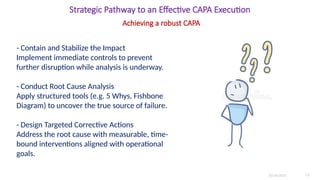
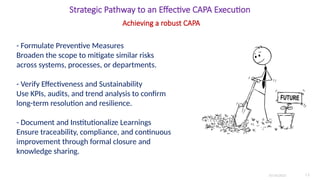


Corrective and Preventive Actions (CAPA) – Overview CAPA is a structured quality management approach used to identify, address, and prevent issues within processes, products, or systems. It’s essential for compliance with standards ✅ Corrective Actions (CA) These are reactive measures taken after a problem has occurred. - Purpose: Eliminate the root cause of an existing non-conformity or failure. - Process: - Identify and document the issue. - Perform root cause analysis (e.g., 5 Whys, Fishbone Diagram). - Implement corrective measures. - Verify effectiveness through data and audits. Example: A product defect is discovered during inspection. The team investigates and finds a calibration error in the equipment. The equipment is recalibrated and the process updated. 🔍 Preventive Actions (PA) These are proactive measures taken to avoid potential problems before they occur. - Purpose: Identify risks and eliminate causes of possible non-conformities. - Process: - Analyze trends, audit findings, or risk assessments. - Forecast potential failures. - Develop and implement preventive strategies. - Monitor effectiveness over time. Example: Trend analysis shows increasing variation in packaging weight. Before it becomes a defect, the process is adjusted and staff retrained. 📊 CAPA Integration CAPA is often embedded within broader frameworks like: - PDCA (Plan-Do-Check-Act) - FMEA (Failure Mode and Effects Analysis) - Risk-Based Thinking in ISO 9001:2015


