1

Corporate Information Security

Corporate security

Jarno Niemelä Jargon@iki.fi
2

We Do Not Live In The Internet
●

Fire

●

Burglary

●

Employees stealing from company

●

Key person becomes unavailable

●

Water damage

●

Terrorist/Activist attack

●

Competitor spying

●

Confidential information leaks to press

Jarno Niemelä Jargon@iki.fi
3

Topics For The Day
●

Employee safety and security

●

Building security

●

Alarms and monitoring

●

Building safety

●

Storage of valuables

●

Risk management

Jarno Niemelä Jargon@iki.fi
4

Employees
●

The most important asset

●

But also the greatest risk

●

●

●

Employee skills, efficiency and morale determine
how your company does
Good personnel management is the most important
thing when running a company
The basic principle is to keep the good people in
and bad people out

Jarno Niemelä Jargon@iki.fi
5

Employees As Resource
●

From company point of view employees are
–
–

Workforce

–

Most important assent

–
●

Information storages

Greatest security risk

Key employees are critical resources
–

Someone who knows something that no one else does

–

Without key person some process is impossible

–

Prevent this by distributing information and having
backup persons for each task

Jarno Niemelä Jargon@iki.fi
6

Employees As a Security Risk
●

Unhappy people work poorly, and may leave
–

●

Employees leak information, intentionally or not
–

●

Treat people well, have fair policies
Training,where to talk, what to talk, whom to talk

Employees stealing company property
–
–

●

Happy and motivated people are unlikely to steal
Increase risk of getting caught, conduct inventories

Keep track what and how your employees do
–

Is there reasons for them to be unhappy?

Jarno Niemelä Jargon@iki.fi
7

Hiring people
●

Look for the right person for the right task
–
–

Is not overqualified

–
●

Is qualified and motivated for the for the job
Fits with the people you already have

Make sure you know who you hire
–

Do a proper interview, and also one with the team

–

Check the background and references

–

Test the skills of potential applicants

–

Personality tests, what do they tell?

Jarno Niemelä Jargon@iki.fi
8

Checking Background
●

Do you know anyone who knows the applicant?

●

Check that personal information is correct

●

Check for criminal record

●

If working with money, check credit status

●

Drivers license, traffic violations

●

Education and diplomas

●

Health, medication and treatments

●

Don't play spy, don't Google. This sort of
information must be obtained by official channels

Jarno Niemelä Jargon@iki.fi
9

Training And Paperwork
●

Very few are incompetent because they want to
–
–

Make sure that NDAs and other paperwork are done

–

Additional training when position changes

–
●

Introductory training when new employee comes

Tasks, policies, security and safety issues

Keep employees skills fresh with training
–

People feel that their skills and value in the profession is
maintained

–

Employees with up to date skills are more efficient

–

Well trained employees also reduce security risks

Jarno Niemelä Jargon@iki.fi
10

Keeping People
●

Now that you have good people, you'll want to keep
them that way
–

Even the best and most motivated people can become
'bad' if managed improperly

–

In personnel security the most important things don't
actually have much to do with the 'security' part

–

The best way to keep people 'good' is good people
management

–

Especially in YT industry this is very often forgotten,
laying off even a few persons hurts the company morale,
and personnel productivity long time!

Jarno Niemelä Jargon@iki.fi
11

Employee Leaving
●

Everyone leaves sooner or later
–
–

●

'Hostile' leaving when leaving to competitor, laid off
'Benign' when retiring or changing field

Know what to do when an employee leaves
–

Skills transfer to replacement

–

Gather back keys, laptops, documents, equipment

–

Disable accounts, change passwords

–

Any sensitive processes that need to be modified?

–

Has the employee signed NDA? Better review it

Jarno Niemelä Jargon@iki.fi
12

Building security
●

Building security is about making sure that the
building is safe for all company assets
–
–

Equipment

–
●

People
Information

Building security is mostly about common sense
–

Good floor plan and passive security is much easier and
cheaper than best alarms and guards

Jarno Niemelä Jargon@iki.fi
13

Office layout
●

Divide office areas into access zones
–
–

Public areas: Reception,public meeting rooms

–

Office area: Outsiders are allowed only when escorted

–
●

Outside the office: Company entrance, fences

Critical areas: Data centers, network cabinets, finance

Zone access control controls who gets in
–

No extra control inside the zone

–

All routes from zone to another zone must be known

–

There should be extra time/effort needed to get from one zone
to another

Jarno Niemelä Jargon@iki.fi
14

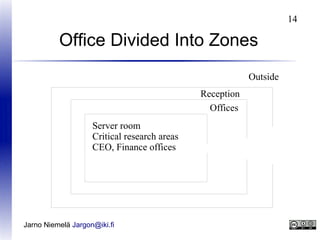
Office Divided Into Zones
Outside
Reception
Offices
Server room
Critical research areas
CEO, Finance offices

Jarno Niemelä Jargon@iki.fi
15

Doors
●

What is the purpose of a door
–
–

Noise dampening

–
●

Access prevention
Fire door

Is the door good enough?
–

Door strength

–

Lock strength

–

Hinges

–

Fire isolation (how long the door holds a fire)

Jarno Niemelä Jargon@iki.fi
16

Walls And Windows
●

Windows, an easy access to burglar or maybe not
–
–

●

Can windows be broken so that it wont be noticed?
First and second floor windows should be laminated

Walls
–
–

●

What time and equipment is needed to cut trough
What is on the other side of the wall?

Check the area outside the office
–

Keep the yard clean and don't give tools for attackers

–

If possible try to prevent anyone using vehicles in attacking
the building, use decorations that are heavy

Jarno Niemelä Jargon@iki.fi
17

Access control
●

Let the good people in, keep the bad people out
–
–

●

Access control allows more accurate control than keys
Employees need to accept the control, DONT ABUSE IT

Access control works at the zone borders
–
–

●

Doesn't care what people do at the zones
Who has been at the zone at any given time

Access control needs to be done properly
–

Easy to use, suspicion on anyone who cant open door

–

The control logs need to be stored securely

–

Reliable, is system keeps failing people will ignore it

Jarno Niemelä Jargon@iki.fi
18

Alarms
●

Alarms activate at exceptional situations
–
–

●

Window broken, door forced, movement at night, fire, gas
Located at the zone borders and inside zones

Each threat needs correct alarm sensor
–
–

Motion detectors, pressure sensors

–
●

Physical open/break sensors
Fire alarms, gas detectors, moisture sensors

Alarms are useless by themselves
–

When alarm goes off, there must be a reaction

–

Audible alarms at outer zones, and silent at inside

Jarno Niemelä Jargon@iki.fi
19

Monitoring
●

Know whats going on, use cameras
–
–

●

Recording cameras help investigate what happened
Actively monitored detect intrusions and guide guards

Make sure that cameras are of some use
–
–

Keep the area well lit and situate cameras well

–

●

Secure or offside storage for video data
Put signs that the area is monitored, cameras are good
deterrent

Know what you are allowed to record and where
–

Personal privacy laws are very strong in Finland

Jarno Niemelä Jargon@iki.fi
20

Guards, Guards
●

There are many types of guards
–
–

Guard that visits the site when making rounds

–
●

Guard that is located at the site
Guard that is alerted when alarm goes off

Different types have different reaction time
–
–

●

Guard from remote location needs transit time
Local guard can respond more quickly, but is expensive

Optimize the value of property against the expense of
protection

Jarno Niemelä Jargon@iki.fi
21

Fire
●

If possible prevent fires
–
–

●

Find out possible ignition sources, make them safe
Neatness counts, all extra material must be removed

If fire breaks out, the building should contain it
–
–

Zone should isolate the fire as well as possible

–
●

The office needs to be divided into fire zones
Fire doors closed, no extra holes in the walls, fire breaks

But remember, the purpose is only to buy time
–

To get people into safety

–

For fire brigade to arrive to put the fire out

Jarno Niemelä Jargon@iki.fi
22

FIRE, Get The People Out!
●

If fire breaks out make sure that people get out
–
–

Doors in the escape route must have emergency opener

–

Make sure that escape routes are not blocked

–

There must be at least two routes from each zone

–
●

Fire escape routes must be well marked

The routes should be instinctive

People must be trained how to get out
–

Make sure evacuation responsibilities are assigned

–

Also have people responsible for first aid, guiding fire brigade
and other emergency tasks

Jarno Niemelä Jargon@iki.fi
23

Extinguishing Fire
●

For small fires, fire blankets and hand extinguishers
–

●

When people reach for the extinguisher they don't check the
type. So place correct extinguishers at the correct places

Make sure that fire extinguishers are of proper type
–

Water sprinklers are good for general use, but wreak havoc on
paper and electronics

–

For electronics there are specialized gas extinguishers, but
many of them replace air. So people must be able to leave if
they activate

–

There are also extinguishers that can be places inside
machinery and devices

Jarno Niemelä Jargon@iki.fi
24

Heat, Water And Air
●

Is the air conditioning sufficient?
–

●

Are server rooms and other areas properly cooled?
–

●

If it's too hot or there's not enough air people cannot
concentrate
Too hot will cause servers to crash

Find out where pipes go and where water goes when
pipes break
–

More than one server room has been destroyed because
there were water pipes at its ceiling

–

It's good idea to situate critical systems away from any piping

Jarno Niemelä Jargon@iki.fi
25

Physical data security
●

Backups, backups, backups
–

How do you store local backups?

–

How long they survive fire or water
● Who has access to them?
Having off site backups is a very good idea

–

More than one small company has gone bust as thief
also took the backups
Who has physical access to servers?

●

●

●

If the server cannot be cracked theres always the
server hard-drive...

Jarno Niemelä Jargon@iki.fi
26

Document handling
●

Document life cycle: Create, use, destroy
–

When a document is created it should be classified
●
●

Customer/contractor/partner confidential

●

Confidential

●

●

Public

Restricted

Documents must be handled by to their level
●

●

Care should be taken on storage and handling of high level
documents
For consistency only important documents should have
high level. Don't mark everything classified!

Jarno Niemelä Jargon@iki.fi
27

Destroying documents
●

When document is not used anymore it must be
destroyed
–

All confidential documents must be shredded

–

Document shredding companies should not be trusted
with most critical documents

–

Also disks, hard-drives and other medias

–

People must be trained, and shredding should be
convenient so that people do it

–

Sometimes have a look at waster paper bins at the
company, there are sometimes rather interesting
documents there :)

Jarno Niemelä Jargon@iki.fi
28

Storage Of Valuables
●

Know what you have that needs protection
–
–

Backups

–
●

Critical documents
Money and other valuables

Know from what you want to protect from
–

Protection from fire or from burglar needs different protection.
Theres no such thing as just 'safe'

–

Don't just buy something that just looks secure

–

A fire proof safe may look big and impressive but will open
less than in a minute with a crowbar

Jarno Niemelä Jargon@iki.fi
29

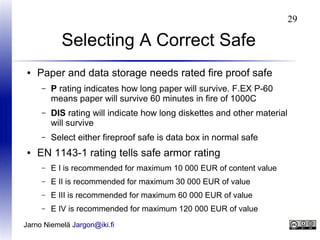
Selecting A Correct Safe
●

Paper and data storage needs rated fire proof safe
–

–

DIS rating will indicate how long diskettes and other material
will survive

–
●

P rating indicates how long paper will survive. F.EX P-60
means paper will survive 60 minutes in fire of 1000C

Select either fireproof safe is data box in normal safe

EN 1143-1 rating tells safe armor rating
–

E I is recommended for maximum 10 000 EUR of content value

–

E II is recommended for maximum 30 000 EUR of value

–

E III is recommended for maximum 60 000 EUR of value

–

E IV is recommended for maximum 120 000 EUR of value

Jarno Niemelä Jargon@iki.fi
30

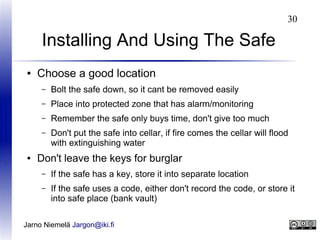
Installing And Using The Safe
●

Choose a good location
–
–

Place into protected zone that has alarm/monitoring

–

Remember the safe only buys time, don't give too much

–

●

Bolt the safe down, so it cant be removed easily

Don't put the safe into cellar, if fire comes the cellar will flood
with extinguishing water

Don't leave the keys for burglar
–

If the safe has a key, store it into separate location

–

If the safe uses a code, either don't record the code, or store it
into safe place (bank vault)

Jarno Niemelä Jargon@iki.fi
31

What you cannot prevent insure
●

●

Sometimes, shit happens, so make sure you have
insurances
But even with best insurances the accident costs
more than the insurance company pays
–

Equipment

–

Time

–

Production

–

Missed sales and oppoturnities

Jarno Niemelä Jargon@iki.fi
32

Risk Management
●

Risk Management is the process of understanding
what risks company has
–

Risk= Probability of threat * Damage

–

Risk Management is
●
●
●
●

Finding out what threats there are
Estimating probability of threat realizing
Estimating the damage caused by a threat
Analyzing the risks that were deducted from the
gathered information

Jarno Niemelä Jargon@iki.fi
33

Finding Out Risks
●

Identify risk areas
–

●

Know what the company does and how

Do vulnerability analysis for each business area
–
–

●

●

Think what can go wrong and how
Analyze past history, brainstorm, play what if

Estimate the damage caused by vulnerabilities you
found
Make a risk matrix
–

Calculate each risk, and see what have high scores

Jarno Niemelä Jargon@iki.fi
34

Tools For Vulnerability Analysis
●

Questionnaire method
–
–

●

Set of questions, from which the result can be derived
Level of success depends very much on questions

Fault tree analysis (FTA)
–

A tree where threat or result is at top and causes at
branches
●

●

What needs to fail for the event to happen

Event tree analysis (ETA)
–

Starts from single failure, maps what else needs to fail
and combines probabilities for event chains

Jarno Niemelä Jargon@iki.fi
35

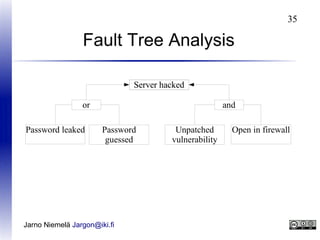
Fault Tree Analysis
Server hacked
or
Password leaked

and
Password
guessed

Jarno Niemelä Jargon@iki.fi

Unpatched
vulnerability

Open in firewall
36

Process Of Risk Management
●

For each risk found decide how to manage it
–

Ignore it

–

Preventing is more expensive than damages
Reduce the probability of threat

–

Better process control, security measures
Limit the damage

–

Minimize the loss caused when risk realizes
Have recovery process

●

●

●

●

Minimize the downtime and loss of production

Jarno Niemelä Jargon@iki.fi
37

Conclusion
●

I'm not an expert on this and neither are you
–

●

Get an expert to check the building,fire and other safety

There are many laws that govern this field
–

But don't think that doing things at the level required by
law is enough

–

The laws are there to protect others from your company

–

Laws don't protect you from yourself (at least not much)

Jarno Niemelä Jargon@iki.fi
38

References
●

●

●

●

Security Basics
http://www.csoonline.com/article/486621/security-basics
The business of resilience
http://www.demos.co.uk/files/thebusinessofresilience.pdf
Laki turvallisuus-selvityksistä
http://www.finlex.fi/fi/laki/ajantasa/2002/20020177
PK-yrityksen riskienhallinta
–

●

http://www.pk-rh.com/

Suomen Pelastusalan Keskusjärjestö
–

http://www.spek.fi

Jarno Niemelä Jargon@iki.fi

Corporate security

  • 1.
    1 Corporate Information Security Corporatesecurity Jarno Niemelä Jargon@iki.fi
  • 2.
    2 We Do NotLive In The Internet ● Fire ● Burglary ● Employees stealing from company ● Key person becomes unavailable ● Water damage ● Terrorist/Activist attack ● Competitor spying ● Confidential information leaks to press Jarno Niemelä Jargon@iki.fi
  • 3.
    3 Topics For TheDay ● Employee safety and security ● Building security ● Alarms and monitoring ● Building safety ● Storage of valuables ● Risk management Jarno Niemelä Jargon@iki.fi
  • 4.
    4 Employees ● The most importantasset ● But also the greatest risk ● ● ● Employee skills, efficiency and morale determine how your company does Good personnel management is the most important thing when running a company The basic principle is to keep the good people in and bad people out Jarno Niemelä Jargon@iki.fi
  • 5.
    5 Employees As Resource ● Fromcompany point of view employees are – – Workforce – Most important assent – ● Information storages Greatest security risk Key employees are critical resources – Someone who knows something that no one else does – Without key person some process is impossible – Prevent this by distributing information and having backup persons for each task Jarno Niemelä Jargon@iki.fi
  • 6.
    6 Employees As aSecurity Risk ● Unhappy people work poorly, and may leave – ● Employees leak information, intentionally or not – ● Treat people well, have fair policies Training,where to talk, what to talk, whom to talk Employees stealing company property – – ● Happy and motivated people are unlikely to steal Increase risk of getting caught, conduct inventories Keep track what and how your employees do – Is there reasons for them to be unhappy? Jarno Niemelä Jargon@iki.fi
  • 7.
    7 Hiring people ● Look forthe right person for the right task – – Is not overqualified – ● Is qualified and motivated for the for the job Fits with the people you already have Make sure you know who you hire – Do a proper interview, and also one with the team – Check the background and references – Test the skills of potential applicants – Personality tests, what do they tell? Jarno Niemelä Jargon@iki.fi
  • 8.
    8 Checking Background ● Do youknow anyone who knows the applicant? ● Check that personal information is correct ● Check for criminal record ● If working with money, check credit status ● Drivers license, traffic violations ● Education and diplomas ● Health, medication and treatments ● Don't play spy, don't Google. This sort of information must be obtained by official channels Jarno Niemelä Jargon@iki.fi
  • 9.
    9 Training And Paperwork ● Veryfew are incompetent because they want to – – Make sure that NDAs and other paperwork are done – Additional training when position changes – ● Introductory training when new employee comes Tasks, policies, security and safety issues Keep employees skills fresh with training – People feel that their skills and value in the profession is maintained – Employees with up to date skills are more efficient – Well trained employees also reduce security risks Jarno Niemelä Jargon@iki.fi
  • 10.
    10 Keeping People ● Now thatyou have good people, you'll want to keep them that way – Even the best and most motivated people can become 'bad' if managed improperly – In personnel security the most important things don't actually have much to do with the 'security' part – The best way to keep people 'good' is good people management – Especially in YT industry this is very often forgotten, laying off even a few persons hurts the company morale, and personnel productivity long time! Jarno Niemelä Jargon@iki.fi
  • 11.
    11 Employee Leaving ● Everyone leavessooner or later – – ● 'Hostile' leaving when leaving to competitor, laid off 'Benign' when retiring or changing field Know what to do when an employee leaves – Skills transfer to replacement – Gather back keys, laptops, documents, equipment – Disable accounts, change passwords – Any sensitive processes that need to be modified? – Has the employee signed NDA? Better review it Jarno Niemelä Jargon@iki.fi
  • 12.
    12 Building security ● Building securityis about making sure that the building is safe for all company assets – – Equipment – ● People Information Building security is mostly about common sense – Good floor plan and passive security is much easier and cheaper than best alarms and guards Jarno Niemelä Jargon@iki.fi
  • 13.
    13 Office layout ● Divide officeareas into access zones – – Public areas: Reception,public meeting rooms – Office area: Outsiders are allowed only when escorted – ● Outside the office: Company entrance, fences Critical areas: Data centers, network cabinets, finance Zone access control controls who gets in – No extra control inside the zone – All routes from zone to another zone must be known – There should be extra time/effort needed to get from one zone to another Jarno Niemelä Jargon@iki.fi
  • 14.
    14 Office Divided IntoZones Outside Reception Offices Server room Critical research areas CEO, Finance offices Jarno Niemelä Jargon@iki.fi
  • 15.
    15 Doors ● What is thepurpose of a door – – Noise dampening – ● Access prevention Fire door Is the door good enough? – Door strength – Lock strength – Hinges – Fire isolation (how long the door holds a fire) Jarno Niemelä Jargon@iki.fi
  • 16.
    16 Walls And Windows ● Windows,an easy access to burglar or maybe not – – ● Can windows be broken so that it wont be noticed? First and second floor windows should be laminated Walls – – ● What time and equipment is needed to cut trough What is on the other side of the wall? Check the area outside the office – Keep the yard clean and don't give tools for attackers – If possible try to prevent anyone using vehicles in attacking the building, use decorations that are heavy Jarno Niemelä Jargon@iki.fi
  • 17.
    17 Access control ● Let thegood people in, keep the bad people out – – ● Access control allows more accurate control than keys Employees need to accept the control, DONT ABUSE IT Access control works at the zone borders – – ● Doesn't care what people do at the zones Who has been at the zone at any given time Access control needs to be done properly – Easy to use, suspicion on anyone who cant open door – The control logs need to be stored securely – Reliable, is system keeps failing people will ignore it Jarno Niemelä Jargon@iki.fi
  • 18.
    18 Alarms ● Alarms activate atexceptional situations – – ● Window broken, door forced, movement at night, fire, gas Located at the zone borders and inside zones Each threat needs correct alarm sensor – – Motion detectors, pressure sensors – ● Physical open/break sensors Fire alarms, gas detectors, moisture sensors Alarms are useless by themselves – When alarm goes off, there must be a reaction – Audible alarms at outer zones, and silent at inside Jarno Niemelä Jargon@iki.fi
  • 19.
    19 Monitoring ● Know whats goingon, use cameras – – ● Recording cameras help investigate what happened Actively monitored detect intrusions and guide guards Make sure that cameras are of some use – – Keep the area well lit and situate cameras well – ● Secure or offside storage for video data Put signs that the area is monitored, cameras are good deterrent Know what you are allowed to record and where – Personal privacy laws are very strong in Finland Jarno Niemelä Jargon@iki.fi
  • 20.
    20 Guards, Guards ● There aremany types of guards – – Guard that visits the site when making rounds – ● Guard that is located at the site Guard that is alerted when alarm goes off Different types have different reaction time – – ● Guard from remote location needs transit time Local guard can respond more quickly, but is expensive Optimize the value of property against the expense of protection Jarno Niemelä Jargon@iki.fi
  • 21.
    21 Fire ● If possible preventfires – – ● Find out possible ignition sources, make them safe Neatness counts, all extra material must be removed If fire breaks out, the building should contain it – – Zone should isolate the fire as well as possible – ● The office needs to be divided into fire zones Fire doors closed, no extra holes in the walls, fire breaks But remember, the purpose is only to buy time – To get people into safety – For fire brigade to arrive to put the fire out Jarno Niemelä Jargon@iki.fi
  • 22.
    22 FIRE, Get ThePeople Out! ● If fire breaks out make sure that people get out – – Doors in the escape route must have emergency opener – Make sure that escape routes are not blocked – There must be at least two routes from each zone – ● Fire escape routes must be well marked The routes should be instinctive People must be trained how to get out – Make sure evacuation responsibilities are assigned – Also have people responsible for first aid, guiding fire brigade and other emergency tasks Jarno Niemelä Jargon@iki.fi
  • 23.
    23 Extinguishing Fire ● For smallfires, fire blankets and hand extinguishers – ● When people reach for the extinguisher they don't check the type. So place correct extinguishers at the correct places Make sure that fire extinguishers are of proper type – Water sprinklers are good for general use, but wreak havoc on paper and electronics – For electronics there are specialized gas extinguishers, but many of them replace air. So people must be able to leave if they activate – There are also extinguishers that can be places inside machinery and devices Jarno Niemelä Jargon@iki.fi
  • 24.
    24 Heat, Water AndAir ● Is the air conditioning sufficient? – ● Are server rooms and other areas properly cooled? – ● If it's too hot or there's not enough air people cannot concentrate Too hot will cause servers to crash Find out where pipes go and where water goes when pipes break – More than one server room has been destroyed because there were water pipes at its ceiling – It's good idea to situate critical systems away from any piping Jarno Niemelä Jargon@iki.fi
  • 25.
    25 Physical data security ● Backups,backups, backups – How do you store local backups? – How long they survive fire or water ● Who has access to them? Having off site backups is a very good idea – More than one small company has gone bust as thief also took the backups Who has physical access to servers? ● ● ● If the server cannot be cracked theres always the server hard-drive... Jarno Niemelä Jargon@iki.fi
  • 26.
    26 Document handling ● Document lifecycle: Create, use, destroy – When a document is created it should be classified ● ● Customer/contractor/partner confidential ● Confidential ● ● Public Restricted Documents must be handled by to their level ● ● Care should be taken on storage and handling of high level documents For consistency only important documents should have high level. Don't mark everything classified! Jarno Niemelä Jargon@iki.fi
  • 27.
    27 Destroying documents ● When documentis not used anymore it must be destroyed – All confidential documents must be shredded – Document shredding companies should not be trusted with most critical documents – Also disks, hard-drives and other medias – People must be trained, and shredding should be convenient so that people do it – Sometimes have a look at waster paper bins at the company, there are sometimes rather interesting documents there :) Jarno Niemelä Jargon@iki.fi
  • 28.
    28 Storage Of Valuables ● Knowwhat you have that needs protection – – Backups – ● Critical documents Money and other valuables Know from what you want to protect from – Protection from fire or from burglar needs different protection. Theres no such thing as just 'safe' – Don't just buy something that just looks secure – A fire proof safe may look big and impressive but will open less than in a minute with a crowbar Jarno Niemelä Jargon@iki.fi
  • 29.
    29 Selecting A CorrectSafe ● Paper and data storage needs rated fire proof safe – – DIS rating will indicate how long diskettes and other material will survive – ● P rating indicates how long paper will survive. F.EX P-60 means paper will survive 60 minutes in fire of 1000C Select either fireproof safe is data box in normal safe EN 1143-1 rating tells safe armor rating – E I is recommended for maximum 10 000 EUR of content value – E II is recommended for maximum 30 000 EUR of value – E III is recommended for maximum 60 000 EUR of value – E IV is recommended for maximum 120 000 EUR of value Jarno Niemelä Jargon@iki.fi
  • 30.
    30 Installing And UsingThe Safe ● Choose a good location – – Place into protected zone that has alarm/monitoring – Remember the safe only buys time, don't give too much – ● Bolt the safe down, so it cant be removed easily Don't put the safe into cellar, if fire comes the cellar will flood with extinguishing water Don't leave the keys for burglar – If the safe has a key, store it into separate location – If the safe uses a code, either don't record the code, or store it into safe place (bank vault) Jarno Niemelä Jargon@iki.fi
  • 31.
    31 What you cannotprevent insure ● ● Sometimes, shit happens, so make sure you have insurances But even with best insurances the accident costs more than the insurance company pays – Equipment – Time – Production – Missed sales and oppoturnities Jarno Niemelä Jargon@iki.fi
  • 32.
    32 Risk Management ● Risk Managementis the process of understanding what risks company has – Risk= Probability of threat * Damage – Risk Management is ● ● ● ● Finding out what threats there are Estimating probability of threat realizing Estimating the damage caused by a threat Analyzing the risks that were deducted from the gathered information Jarno Niemelä Jargon@iki.fi
  • 33.
    33 Finding Out Risks ● Identifyrisk areas – ● Know what the company does and how Do vulnerability analysis for each business area – – ● ● Think what can go wrong and how Analyze past history, brainstorm, play what if Estimate the damage caused by vulnerabilities you found Make a risk matrix – Calculate each risk, and see what have high scores Jarno Niemelä Jargon@iki.fi
  • 34.
    34 Tools For VulnerabilityAnalysis ● Questionnaire method – – ● Set of questions, from which the result can be derived Level of success depends very much on questions Fault tree analysis (FTA) – A tree where threat or result is at top and causes at branches ● ● What needs to fail for the event to happen Event tree analysis (ETA) – Starts from single failure, maps what else needs to fail and combines probabilities for event chains Jarno Niemelä Jargon@iki.fi
  • 35.
    35 Fault Tree Analysis Serverhacked or Password leaked and Password guessed Jarno Niemelä Jargon@iki.fi Unpatched vulnerability Open in firewall
  • 36.
    36 Process Of RiskManagement ● For each risk found decide how to manage it – Ignore it – Preventing is more expensive than damages Reduce the probability of threat – Better process control, security measures Limit the damage – Minimize the loss caused when risk realizes Have recovery process ● ● ● ● Minimize the downtime and loss of production Jarno Niemelä Jargon@iki.fi
  • 37.
    37 Conclusion ● I'm not anexpert on this and neither are you – ● Get an expert to check the building,fire and other safety There are many laws that govern this field – But don't think that doing things at the level required by law is enough – The laws are there to protect others from your company – Laws don't protect you from yourself (at least not much) Jarno Niemelä Jargon@iki.fi
  • 38.
    38 References ● ● ● ● Security Basics http://www.csoonline.com/article/486621/security-basics The businessof resilience http://www.demos.co.uk/files/thebusinessofresilience.pdf Laki turvallisuus-selvityksistä http://www.finlex.fi/fi/laki/ajantasa/2002/20020177 PK-yrityksen riskienhallinta – ● http://www.pk-rh.com/ Suomen Pelastusalan Keskusjärjestö – http://www.spek.fi Jarno Niemelä Jargon@iki.fi