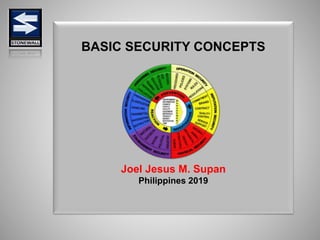
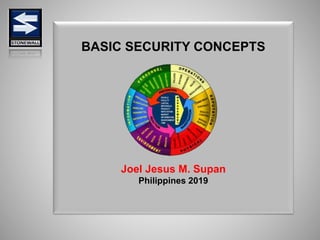


BASIC SECURITY CONCEPTS
Joel Jesus M. Supan
Philippines 2019
This Presentation and Organizational Security Culture
Development Program was created and developed by
Joel Jesus M. Supan.
All rights reserved, this is protected by the Philippine
Law on Intellectual Property. No part of this presentation
shall be reproduced in any form or by any means,
electronic, mechanical, photocopying, recording or
otherwise, without the written permission of the author
and creator.
Philippine Copyright©2019
WARNING
DESIRED OUTCOME
For the audience to be familiar with
the Basic Concepts of Security
what it is, its rationale
and how to achieve it.
1. Security Defined
2. Client Objectives
3. Client Resources
4. Hazards that Threaten a Company
5. Security Requirements of a Company
6. Principles of Security
7. Aspect of Security and their Elements
8. Threat Differentiation
9. Security Systems Integration
10.Other Security Learning Needs and Concepts
BASIC SECURITY TOPIC
OUTLINE
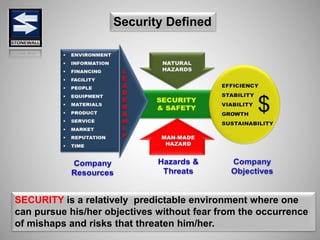
SECURITY is a relatively predictable environment where one
can pursue his/her objectives without fear from the occurrence
of mishaps and risks that threaten him/her.
Security Defined
MORE SECURITY AS DEFINITIONS
… can be applied to the conditions of the internal affairs
of a home or as country.
… proof of ones investment to a Organizational such as
bond, stocks and debentures.
…connotes stability, freedom from danger or harm,
anxiety, assurance, pledge, etc.
… means by which a sense of security is obtained
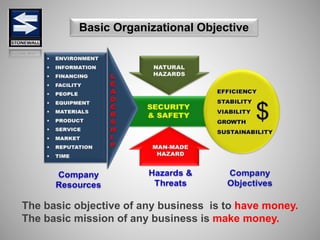
Basic Organizational Objective
The basic objective of any business is to have money.
The basic mission of any business is make money.
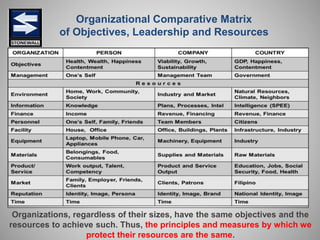
Organizations, regardless of their sizes, have the same objectives and the
resources to achieve such. Thus, the principles and measures by which we
protect their resources are the same.
Organizational Comparative Matrix
of Objectives, Leadership and Resources
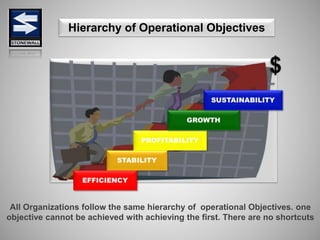
Hierarchy of Operational Objectives
All Organizations follow the same hierarchy of operational Objectives. one
objective cannot be achieved with achieving the first. There are no shortcuts
Organizational Resources
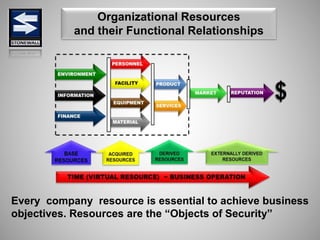
and their Functional Relationships
Every company resource is essential to achieve business
objectives. Resources are the “Objects of Security”
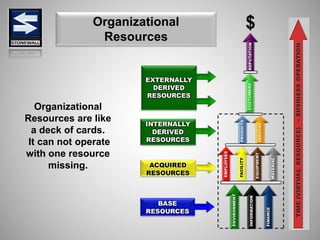
Organizational
Resources
Organizational
Resources are like
a deck of cards.
It can not operate
with one resource
missing.
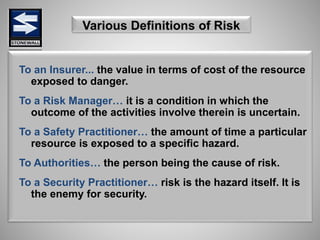
Various Definitions of Risk
To an Insurer... the value in terms of cost of the resource
exposed to danger.
To a Risk Manager… it is a condition in which the
outcome of the activities involve therein is uncertain.
To a Safety Practitioner… the amount of time a particular
resource is exposed to a specific hazard.
To Authorities… the person being the cause of risk.
To a Security Practitioner… risk is the hazard itself. It is
the enemy for security.
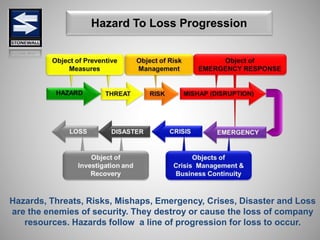
Hazard To Loss Progression
Hazards, Threats, Risks, Mishaps, Emergency, Crises, Disaster and Loss
are the enemies of security. They destroy or cause the loss of company
resources. Hazards follow a line of progression for loss to occur.
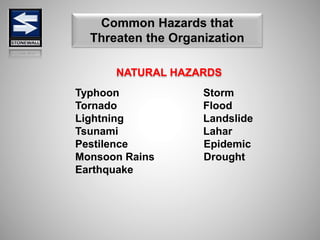
NATURAL HAZARDS
Typhoon Storm
Tornado Flood
Lightning Landslide
Tsunami Lahar
Pestilence Epidemic
Monsoon Rains Drought
Earthquake
Common Hazards that
Threaten the Organization
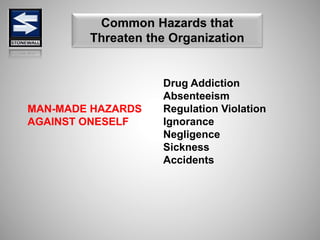
MAN-MADE HAZARDS
AGAINST ONESELF
Drug Addiction
Absenteeism
Regulation Violation
Ignorance
Negligence
Sickness
Accidents
Common Hazards that
Threaten the Organization
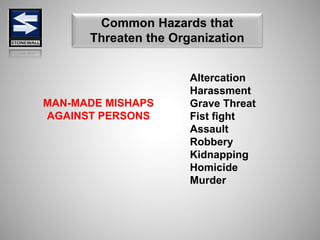
MAN-MADE MISHAPS
AGAINST PERSONS
Altercation
Harassment
Grave Threat
Fist fight
Assault
Robbery
Kidnapping
Homicide
Murder
Common Hazards that
Threaten the Organization
WHITE-COLLAR
CRIMES
Tardiness
Fraud
Theft of Info
Piracy
Discrimination
Disclosure of
Information
Common Hazards that
Threaten the Organization
Social Unrest
Strikes
Riots
Activism
Rebellion
War
Common Hazards that
Threaten the Organization
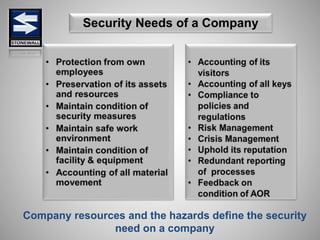
Security Needs of a Company
Company resources and the hazards define the security
need on a company
How to Achieve
Organizational Security
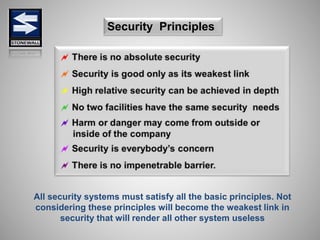
Security Principles
All security systems must satisfy all the basic principles. Not
considering these principles will become the weakest link in
security that will render all other system useless
Security Principles
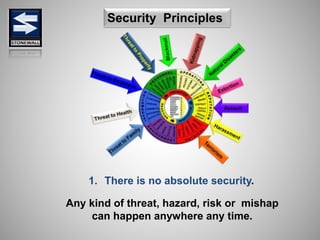
1. There is no absolute security.
Any kind of threat, hazard, risk or mishap
can happen anywhere any time.
Security Principles
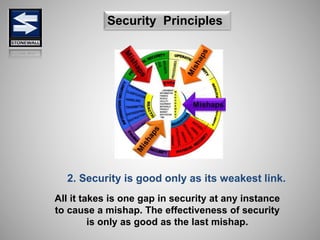
2. Security is good only as its weakest link.
All it takes is one gap in security at any instance
to cause a mishap. The effectiveness of security
is only as good as the last mishap.
Security Principles
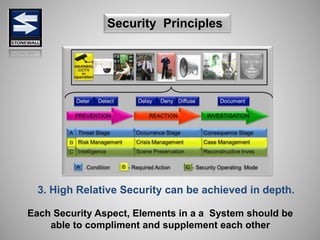
3. High Relative Security can be achieved in depth.
Each Security Aspect, Elements in a a System should be
able to compliment and supplement each other
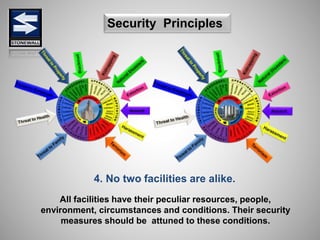
4. No two facilities are alike.
Security Principles
All facilities have their peculiar resources, people,
environment, circumstances and conditions. Their security
measures should be attuned to these conditions.
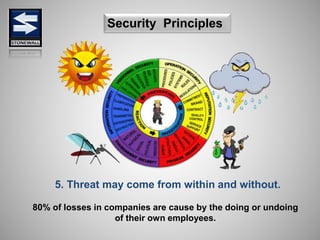
5. Threat may come from within and without.
Security Principles
80% of losses in companies are cause by the doing or undoing
of their own employees.
Security Principles
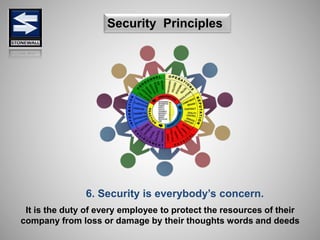
6. Security is everybody’s concern.
It is the duty of every employee to protect the resources of their
company from loss or damage by their thoughts words and deeds
Aspects of Security
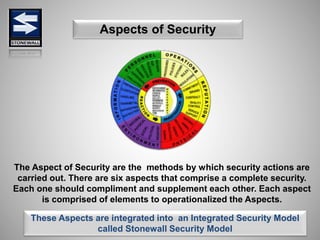
The Aspect of Security are the methods by which security actions are
carried out. There are six aspects that comprise a complete security.
Each one should compliment and supplement each other. Each aspect
is comprised of elements to operationalized the Aspects.
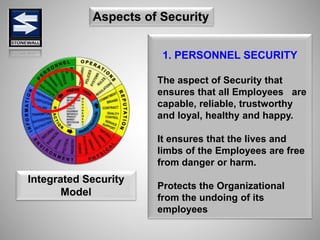
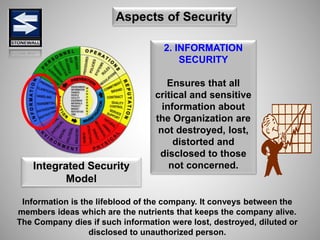
These Aspects are integrated into an Integrated Security Model
called Stonewall Security Model
1. PERSONNEL SECURITY
The aspect of Security that
ensures that all Employees are
capable, reliable, trustworthy
and loyal, healthy and happy.
It ensures that the lives and
limbs of the Employees are free
from danger or harm.
Protects the Organizational
from the undoing of its
employees
Integrated Security
Model
Aspects of Security
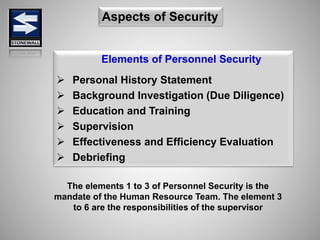
Elements of Personnel Security
 Personal History Statement
 Background Investigation (Due Diligence)
 Education and Training
 Supervision
 Effectiveness and Efficiency Evaluation
 Debriefing
Aspects of Security
The elements 1 to 3 of Personnel Security is the
mandate of the Human Resource Team. The element 3
to 6 are the responsibilities of the supervisor
2. INFORMATION
SECURITY
Ensures that all
critical and sensitive
information about
the Organization are
not destroyed, lost,
distorted and
disclosed to those
not concerned.Integrated Security
Model
Aspects of Security
Information is the lifeblood of the company. It conveys between the
members ideas which are the nutrients that keeps the company alive.
The Company dies if such information were lost, destroyed, diluted or
disclosed to unauthorized person.
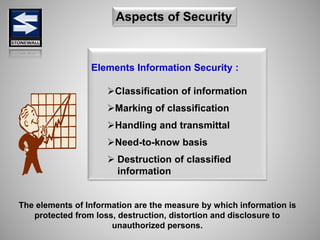
Elements Information Security :
Classification of information
Marking of classification
Handling and transmittal
Need-to-know basis
 Destruction of classified
information
Aspects of Security
The elements of Information are the measure by which information is
protected from loss, destruction, distortion and disclosure to
unauthorized persons.
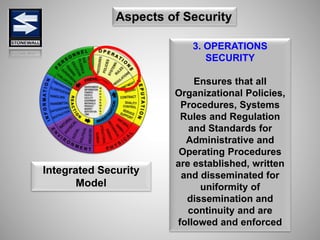
3. OPERATIONS
SECURITY
Ensures that all
Organizational Policies,
Procedures, Systems
Rules and Regulation
and Standards for
Administrative and
Operating Procedures
are established, written
and disseminated for
uniformity of
dissemination and
continuity and are
followed and enforced
Integrated Security
Model
Aspects of Security
Elements of Operations Security :
Organizational Policies
Organizational Regulations
Systems and Processes
Publication and Dissemination
Instruments and forms for enforcement
Appropriate documentation
Timely Disposition of issues
Aspects of Security
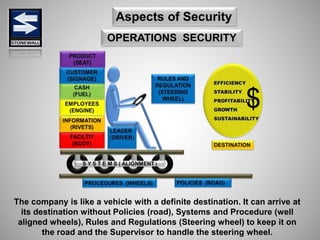
OPERATIONS SECURITY
Aspects of Security
The company is like a vehicle with a definite destination. It can arrive at
its destination without Policies (road), Systems and Procedure (well
aligned wheels), Rules and Regulations (Steering wheel) to keep it on
the road and the Supervisor to handle the steering wheel.
$
Requisites for Effective Enforcement
Be:
Education – disseminate what, why and how
Engineering – provide physical support
Enforcement – engage every member in enforcement
- Be fast
- Be firm
- Be Friendly
Aspects of Security
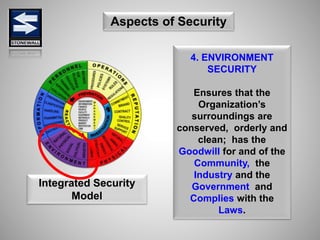
4. ENVIRONMENT
SECURITY
Ensures that the
Organization’s
surroundings are
conserved, orderly and
clean; has the
Goodwill for and of the
Community, the
Industry and the
Government and
Complies with the
Laws.
Integrated Security
Model
Aspects of Security
Elements of Environment Security
Physical Environment - Cleanliness and orderliness
Natural Environment - Conservation and Protection
Social Environment - Community Relation & CSR
Political - Legal and Regulatory
- Liaison with local government
agencies, compliance to
law, rules and regulations
 Industry Environment - Rapport with and support of
the Industry
Aspects of Security
The company cannot sustain its existence with ensure the its
environment is protected
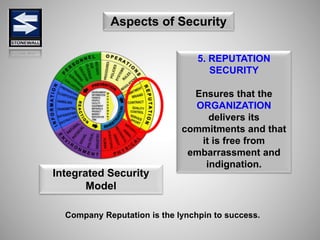
5. REPUTATION
SECURITY
Ensures that the
ORGANIZATION
delivers its
commitments and that
it is free from
embarrassment and
indignation.
Integrated Security
Model
Aspects of Security
Company Reputation is the lynchpin to success.
Elements Reputation Security:
•Straight forward commitment
•Quality Control
•Contracts
•Service Level Agreement
•After Sales Service
•Customer Relations
Aspects of Security
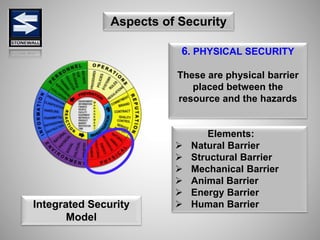
6. PHYSICAL SECURITY
These are physical barrier
placed between the
resource and the hazards
Integrated Security
Model
Aspects of Security
Elements:
 Natural Barrier
 Structural Barrier
 Mechanical Barrier
 Animal Barrier
 Energy Barrier
 Human Barrier
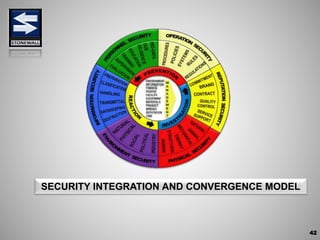
SECURITY INTEGRATION AND CONVERGENCE MODEL
42
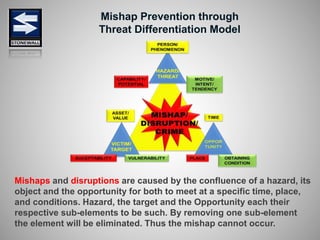
Mishaps and disruptions are caused by the confluence of a hazard, its
object and the opportunity for both to meet at a specific time, place,
and conditions. Hazard, the target and the Opportunity each their
respective sub-elements to be such. By removing one sub-element
the element will be eliminated. Thus the mishap cannot occur.
Mishap Prevention through
Threat Differentiation Model
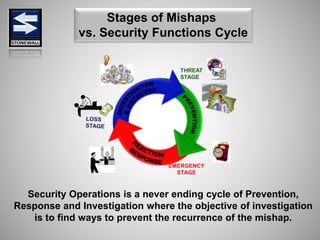
Stages of Mishaps
vs. Security Functions Cycle
Security Operations is a never ending cycle of Prevention,
Response and Investigation where the objective of investigation
is to find ways to prevent the recurrence of the mishap.
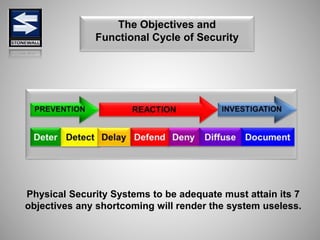
The Objectives and
Functional Cycle of Security
Physical Security Systems to be adequate must attain its 7
objectives any shortcoming will render the system useless.
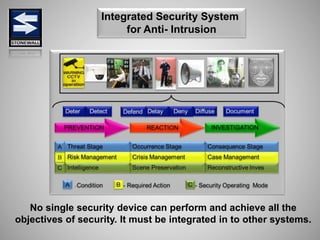
Integrated Security System
for Anti- Intrusion
Defend
No single security device can perform and achieve all the
objectives of security. It must be integrated in to other systems.
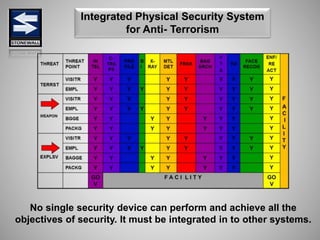
Integrated Physical Security System
for Anti- Terrorism
No single security device can perform and achieve all the
objectives of security. It must be integrated in to other systems.
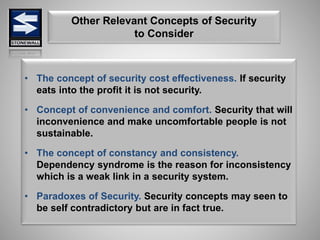
Other Relevant Concepts of Security
to Consider
• The concept of security cost effectiveness. If security
eats into the profit it is not security.
• Concept of convenience and comfort. Security that will
inconvenience and make uncomfortable people is not
sustainable.
• The concept of constancy and consistency.
Dependency syndrome is the reason for inconsistency
which is a weak link in a security system.
• Paradoxes of Security. Security concepts may seen to
be self contradictory but are in fact true.
1. For every advantage there is a disadvantage.
2. No single security means can prevent all types of threats.
3. The more effective security is, the harder it is to justify.
4. The value of security only realized when it is lost.
5. Security is as good only as the last breach.
6. The more you spend on security the farther you stray
from your goal because the goal is to make money.
Paradoxes of Security
The paradoxes if security are not to be ignored for
efficiency and effectiveness.
OTHER SECURITY LEARNING NEEDS
1. Security Policies Development
2. Enterprise-wide Risk Management
3. Security Program Development
4. Crisis Contingency and Business
Continuity Planning
5. Personal Security
The cognitive knowledge of security is not sufficient
security for a company
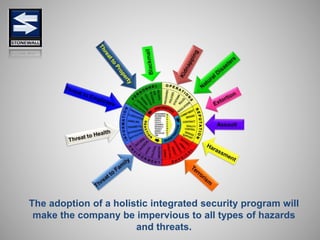
The adoption of a holistic integrated security program will
make the company be impervious to all types of hazards
and threats.
BASIC SECURITY CONCEPTS
Joel Jesus M. Supan
Philippines 2019
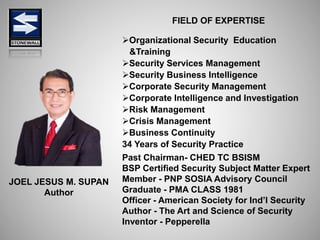
JOEL JESUS M. SUPAN
Author
FIELD OF EXPERTISE
Organizational Security Education
&Training
Security Services Management
Security Business Intelligence
Corporate Security Management
Corporate Intelligence and Investigation
Risk Management
Crisis Management
Business Continuity
34 Years of Security Practice
Past Chairman- CHED TC BSISM
BSP Certified Security Subject Matter Expert
Member - PNP SOSIA Advisory Council
Graduate - PMA CLASS 1981
Officer - American Society for Ind’l Security
Author - The Art and Science of Security
Inventor - Pepperella
STONEWALL SECURITY
CONCEPTS AND CONSULTING
SERVICES
63 Magnolia Street
Roxas Dist., Quezon City
Telephone Number 371-4864
Cell Phone No: 09178892154
Email Address: stonewall.sec81@yahoo.com
Website: www.stone-security.com
Thank you!

Basic Security Concepts JMSupan 2019 Edition

  • 1.
    BASIC SECURITY CONCEPTS JoelJesus M. Supan Philippines 2019
  • 2.
    This Presentation andOrganizational Security Culture Development Program was created and developed by Joel Jesus M. Supan. All rights reserved, this is protected by the Philippine Law on Intellectual Property. No part of this presentation shall be reproduced in any form or by any means, electronic, mechanical, photocopying, recording or otherwise, without the written permission of the author and creator. Philippine Copyright©2019 WARNING
  • 3.
    DESIRED OUTCOME For theaudience to be familiar with the Basic Concepts of Security what it is, its rationale and how to achieve it.
  • 4.
    1. Security Defined 2.Client Objectives 3. Client Resources 4. Hazards that Threaten a Company 5. Security Requirements of a Company 6. Principles of Security 7. Aspect of Security and their Elements 8. Threat Differentiation 9. Security Systems Integration 10.Other Security Learning Needs and Concepts BASIC SECURITY TOPIC OUTLINE
  • 5.
    SECURITY is arelatively predictable environment where one can pursue his/her objectives without fear from the occurrence of mishaps and risks that threaten him/her. Security Defined
  • 6.
    MORE SECURITY ASDEFINITIONS … can be applied to the conditions of the internal affairs of a home or as country. … proof of ones investment to a Organizational such as bond, stocks and debentures. …connotes stability, freedom from danger or harm, anxiety, assurance, pledge, etc. … means by which a sense of security is obtained
  • 7.
    Basic Organizational Objective Thebasic objective of any business is to have money. The basic mission of any business is make money.
  • 8.
    Organizations, regardless oftheir sizes, have the same objectives and the resources to achieve such. Thus, the principles and measures by which we protect their resources are the same. Organizational Comparative Matrix of Objectives, Leadership and Resources
  • 9.
    Hierarchy of OperationalObjectives All Organizations follow the same hierarchy of operational Objectives. one objective cannot be achieved with achieving the first. There are no shortcuts
  • 10.
    Organizational Resources and theirFunctional Relationships Every company resource is essential to achieve business objectives. Resources are the “Objects of Security”
  • 11.
    Organizational Resources Organizational Resources are like adeck of cards. It can not operate with one resource missing.
  • 12.
    Various Definitions ofRisk To an Insurer... the value in terms of cost of the resource exposed to danger. To a Risk Manager… it is a condition in which the outcome of the activities involve therein is uncertain. To a Safety Practitioner… the amount of time a particular resource is exposed to a specific hazard. To Authorities… the person being the cause of risk. To a Security Practitioner… risk is the hazard itself. It is the enemy for security.
  • 13.
    Hazard To LossProgression Hazards, Threats, Risks, Mishaps, Emergency, Crises, Disaster and Loss are the enemies of security. They destroy or cause the loss of company resources. Hazards follow a line of progression for loss to occur.
  • 14.
    NATURAL HAZARDS Typhoon Storm TornadoFlood Lightning Landslide Tsunami Lahar Pestilence Epidemic Monsoon Rains Drought Earthquake Common Hazards that Threaten the Organization
  • 15.
    MAN-MADE HAZARDS AGAINST ONESELF DrugAddiction Absenteeism Regulation Violation Ignorance Negligence Sickness Accidents Common Hazards that Threaten the Organization
  • 16.
    MAN-MADE MISHAPS AGAINST PERSONS Altercation Harassment GraveThreat Fist fight Assault Robbery Kidnapping Homicide Murder Common Hazards that Threaten the Organization
  • 17.
    WHITE-COLLAR CRIMES Tardiness Fraud Theft of Info Piracy Discrimination Disclosureof Information Common Hazards that Threaten the Organization
  • 18.
  • 19.
    Security Needs ofa Company Company resources and the hazards define the security need on a company
  • 20.
  • 21.
    Security Principles All securitysystems must satisfy all the basic principles. Not considering these principles will become the weakest link in security that will render all other system useless
  • 22.
    Security Principles 1. Thereis no absolute security. Any kind of threat, hazard, risk or mishap can happen anywhere any time.
  • 23.
    Security Principles 2. Securityis good only as its weakest link. All it takes is one gap in security at any instance to cause a mishap. The effectiveness of security is only as good as the last mishap.
  • 24.
    Security Principles 3. HighRelative Security can be achieved in depth. Each Security Aspect, Elements in a a System should be able to compliment and supplement each other
  • 25.
    4. No twofacilities are alike. Security Principles All facilities have their peculiar resources, people, environment, circumstances and conditions. Their security measures should be attuned to these conditions.
  • 26.
    5. Threat maycome from within and without. Security Principles 80% of losses in companies are cause by the doing or undoing of their own employees.
  • 27.
    Security Principles 6. Securityis everybody’s concern. It is the duty of every employee to protect the resources of their company from loss or damage by their thoughts words and deeds
  • 28.
    Aspects of Security TheAspect of Security are the methods by which security actions are carried out. There are six aspects that comprise a complete security. Each one should compliment and supplement each other. Each aspect is comprised of elements to operationalized the Aspects. These Aspects are integrated into an Integrated Security Model called Stonewall Security Model
  • 29.
    1. PERSONNEL SECURITY Theaspect of Security that ensures that all Employees are capable, reliable, trustworthy and loyal, healthy and happy. It ensures that the lives and limbs of the Employees are free from danger or harm. Protects the Organizational from the undoing of its employees Integrated Security Model Aspects of Security
  • 30.
    Elements of PersonnelSecurity  Personal History Statement  Background Investigation (Due Diligence)  Education and Training  Supervision  Effectiveness and Efficiency Evaluation  Debriefing Aspects of Security The elements 1 to 3 of Personnel Security is the mandate of the Human Resource Team. The element 3 to 6 are the responsibilities of the supervisor
  • 31.
    2. INFORMATION SECURITY Ensures thatall critical and sensitive information about the Organization are not destroyed, lost, distorted and disclosed to those not concerned.Integrated Security Model Aspects of Security Information is the lifeblood of the company. It conveys between the members ideas which are the nutrients that keeps the company alive. The Company dies if such information were lost, destroyed, diluted or disclosed to unauthorized person.
  • 32.
    Elements Information Security: Classification of information Marking of classification Handling and transmittal Need-to-know basis  Destruction of classified information Aspects of Security The elements of Information are the measure by which information is protected from loss, destruction, distortion and disclosure to unauthorized persons.
  • 33.
    3. OPERATIONS SECURITY Ensures thatall Organizational Policies, Procedures, Systems Rules and Regulation and Standards for Administrative and Operating Procedures are established, written and disseminated for uniformity of dissemination and continuity and are followed and enforced Integrated Security Model Aspects of Security
  • 34.
    Elements of OperationsSecurity : Organizational Policies Organizational Regulations Systems and Processes Publication and Dissemination Instruments and forms for enforcement Appropriate documentation Timely Disposition of issues Aspects of Security
  • 35.
    OPERATIONS SECURITY Aspects ofSecurity The company is like a vehicle with a definite destination. It can arrive at its destination without Policies (road), Systems and Procedure (well aligned wheels), Rules and Regulations (Steering wheel) to keep it on the road and the Supervisor to handle the steering wheel. $
  • 36.
    Requisites for EffectiveEnforcement Be: Education – disseminate what, why and how Engineering – provide physical support Enforcement – engage every member in enforcement - Be fast - Be firm - Be Friendly Aspects of Security
  • 37.
    4. ENVIRONMENT SECURITY Ensures thatthe Organization’s surroundings are conserved, orderly and clean; has the Goodwill for and of the Community, the Industry and the Government and Complies with the Laws. Integrated Security Model Aspects of Security
  • 38.
    Elements of EnvironmentSecurity Physical Environment - Cleanliness and orderliness Natural Environment - Conservation and Protection Social Environment - Community Relation & CSR Political - Legal and Regulatory - Liaison with local government agencies, compliance to law, rules and regulations  Industry Environment - Rapport with and support of the Industry Aspects of Security The company cannot sustain its existence with ensure the its environment is protected
  • 39.
    5. REPUTATION SECURITY Ensures thatthe ORGANIZATION delivers its commitments and that it is free from embarrassment and indignation. Integrated Security Model Aspects of Security Company Reputation is the lynchpin to success.
  • 40.
    Elements Reputation Security: •Straightforward commitment •Quality Control •Contracts •Service Level Agreement •After Sales Service •Customer Relations Aspects of Security
  • 41.
    6. PHYSICAL SECURITY Theseare physical barrier placed between the resource and the hazards Integrated Security Model Aspects of Security Elements:  Natural Barrier  Structural Barrier  Mechanical Barrier  Animal Barrier  Energy Barrier  Human Barrier
  • 42.
    SECURITY INTEGRATION ANDCONVERGENCE MODEL 42
  • 43.
    Mishaps and disruptionsare caused by the confluence of a hazard, its object and the opportunity for both to meet at a specific time, place, and conditions. Hazard, the target and the Opportunity each their respective sub-elements to be such. By removing one sub-element the element will be eliminated. Thus the mishap cannot occur. Mishap Prevention through Threat Differentiation Model
  • 44.
    Stages of Mishaps vs.Security Functions Cycle Security Operations is a never ending cycle of Prevention, Response and Investigation where the objective of investigation is to find ways to prevent the recurrence of the mishap.
  • 45.
    The Objectives and FunctionalCycle of Security Physical Security Systems to be adequate must attain its 7 objectives any shortcoming will render the system useless.
  • 46.
    Integrated Security System forAnti- Intrusion Defend No single security device can perform and achieve all the objectives of security. It must be integrated in to other systems.
  • 47.
    Integrated Physical SecuritySystem for Anti- Terrorism No single security device can perform and achieve all the objectives of security. It must be integrated in to other systems.
  • 48.
    Other Relevant Conceptsof Security to Consider • The concept of security cost effectiveness. If security eats into the profit it is not security. • Concept of convenience and comfort. Security that will inconvenience and make uncomfortable people is not sustainable. • The concept of constancy and consistency. Dependency syndrome is the reason for inconsistency which is a weak link in a security system. • Paradoxes of Security. Security concepts may seen to be self contradictory but are in fact true.
  • 49.
    1. For everyadvantage there is a disadvantage. 2. No single security means can prevent all types of threats. 3. The more effective security is, the harder it is to justify. 4. The value of security only realized when it is lost. 5. Security is as good only as the last breach. 6. The more you spend on security the farther you stray from your goal because the goal is to make money. Paradoxes of Security The paradoxes if security are not to be ignored for efficiency and effectiveness.
  • 50.
    OTHER SECURITY LEARNINGNEEDS 1. Security Policies Development 2. Enterprise-wide Risk Management 3. Security Program Development 4. Crisis Contingency and Business Continuity Planning 5. Personal Security The cognitive knowledge of security is not sufficient security for a company
  • 51.
    The adoption ofa holistic integrated security program will make the company be impervious to all types of hazards and threats.
  • 52.
    BASIC SECURITY CONCEPTS JoelJesus M. Supan Philippines 2019
  • 53.
    JOEL JESUS M.SUPAN Author FIELD OF EXPERTISE Organizational Security Education &Training Security Services Management Security Business Intelligence Corporate Security Management Corporate Intelligence and Investigation Risk Management Crisis Management Business Continuity 34 Years of Security Practice Past Chairman- CHED TC BSISM BSP Certified Security Subject Matter Expert Member - PNP SOSIA Advisory Council Graduate - PMA CLASS 1981 Officer - American Society for Ind’l Security Author - The Art and Science of Security Inventor - Pepperella
  • 54.
    STONEWALL SECURITY CONCEPTS ANDCONSULTING SERVICES 63 Magnolia Street Roxas Dist., Quezon City Telephone Number 371-4864 Cell Phone No: 09178892154 Email Address: stonewall.sec81@yahoo.com Website: www.stone-security.com
  • 55.

Editor's Notes

  • #25 Much of the effectiveness of any security /prevention or reaction is timeliness.
  • #47 Much of the effectiveness of any security /prevention or reaction is timeliness.