BY : Dr GAURAV MATHUR
 Slender Gram-positive rods, pleomorphic; easily
decolousised;
 0.6-0.8μ diameter and 3-6 μ length;
 Irregular swelling at one or both ends (‘club
 shaped’);
 Non-capsulate, Non-sporing and nonmotile
 Granules containing polymetaphosphate are seen
in the cells;
 Take up bluish purple color against lightly stained
cytoplasm, when stained with Loeffler’s Methylene
Blue, and hence called ‘Metachromatic granules’;
 • Also called, ‘volutin granules’ or ‘Babes Ernst
 granules’;
 • They are often situated at poles- ‘polar bodies
 Special stains for demonstrating the granules :
 – Albert’s stain
 – Neisser’s stain
 – Ponder’s stain
 • The bacilli are arranged in
 pairs, palisades or small
 groups; the bacilli lie at
 various angles to each other,
 resembling the letters, V or L;
 • This is called,
“Chinese letter
 pattern” or “cuneiform
 pattern”;
 • Blood agar
 • Loeffler’s serum slope
 • Tellurite blood agar
 • Tinsdale’s medium (cystine added to
tellurite containing agar)
 • Blood agar : small,
 granular and gray with
 irregular edges;
 Hemolysis may or may not present;
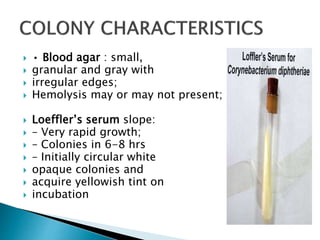
 Loeffler’s serum slope:
 – Very rapid growth;
 – Colonies in 6-8 hrs
 – Initially circular white
 opaque colonies and
 acquire yellowish tint on
 incubation
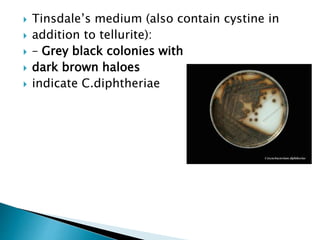
 Tinsdale’s medium (also contain cystine in
 addition to tellurite):
 – Grey black colonies with
 dark brown haloes
 indicate C.diphtheriae
 • Ferment- glucose, galactose, maltose and
 dextrose; but not lactose, sucrose, mannitol;
 • Proteolytic activity is absent;
 • Do not hydrolyse urea;
 • Do not form phosphatase;
 • Produce cystinase (halo on Tinsdale’s
medium)
 The pathognomonic effects are due to the Toxin
Toxin is a protein
Two fragments, A and B;
 Fragment B : binds to a cell surface receptor
 and helps in transport of toxin into the cell;
 • After entering the cell, A subunit is released ;
 • A subunit catalyses the transfer of ‘adenosine
diphosphate ribose (ADPR)’
 • ADPR binds with the elongation factor EF 2
 • “ADPR-EF2” complex is inactive protein
 synthesis stops abruptly necrotising and
 neurotoxic effects of the toxin;
 • Commonest site of infection: Upper
respiratory tract (fauces, larynx,nose)
 • Ocassionally, other cutaneous or
 mucocutaneous areas ( otitic/conjunctival/
 genitovulval/vaginal/ prepucial/skin)
 • Faucial diphtheria is the commonest type;
 • Sore throat is frequently the presenting
 symptom;
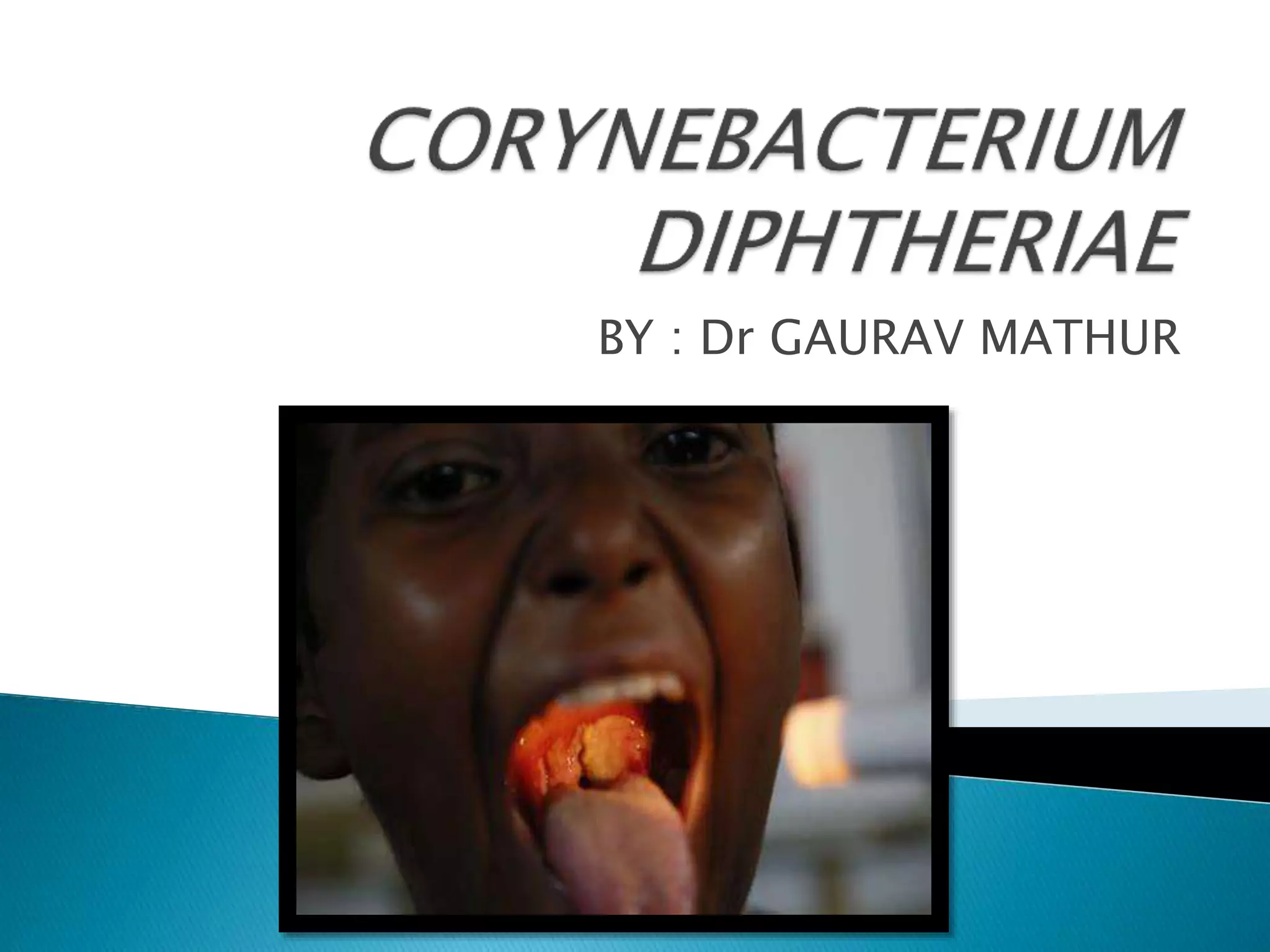
 • The toxin causes local necrotic changes;
 • The resulting fibrinous exudate, together
with
the epithelial cells, leucocytes, erythrocytes
and bacteria constitute : “pseudomembrane”
 • Any effort to remove it will tear off
capillaries
beneath it and cause bleeding;
 • Mechanical complications are due to
pseudomembrane and systemic effects are
due to the toxin
 • The toxin is absorbed systemically and
damages heart muscle, liver, adrenals etc.
 Nontoxigenic strains can also produce local
disease but systemic effects are absent
 • Incubation period : usually 3-4 days;
 • Acute infection : in the form of –
 – Membranous tonsillitis
 – Nasal infection
 – Laryngeal infection
 – Skin infection –uncommon
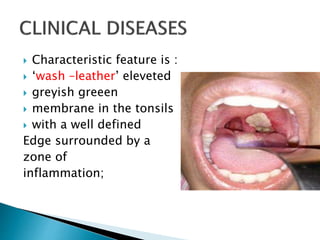
 Characteristic feature is :
 ‘wash –leather’ eleveted
 greyish greeen
 membrane in the tonsils
 with a well defined
Edge surrounded by a
zone of
inflammation;
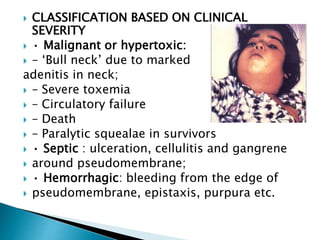
 CLASSIFICATION BASED ON CLINICAL
SEVERITY
 • Malignant or hypertoxic:
 – ‘Bull neck’ due to marked
adenitis in neck;
 – Severe toxemia
 – Circulatory failure
 – Death
 – Paralytic squealae in survivors
 • Septic : ulceration, cellulitis and gangrene
 around pseudomembrane;
 • Hemorrhagic: bleeding from the edge of
 pseudomembrane, epistaxis, purpura etc.
 • Asphyxia : due to mechanical obstruction
 Emergency tracheostomy may be necessary;
 • Acute circulatory failure
 • Myocarditis
 • Postdiphtheritic paralysis-
 palatine(soft palate) and ciliary ( eye
muscles)
 nerves
 Recovery – spontaneous and complete
 • Septic : pneumonia and otitis media
 • Specimens :
 – Swabs from – nose, throat or other
suspected
 lesions;
 • Smear examination: Gram stain
 – shows beaded rods in typical arrangement;
 corynebacteria normally found in throat;
 – Albert’s stain or Neisser’s stain is useful for
demonstrating the granules
 • Inoculate on :
 – Loeffler’s serum slope
 – Tellurite blood agar or Tinsdale medium
 – Blood agar
 • In vivo methods:
 – Subcutaneous test
 – Intracutaneous test
 • In vitro methods:
 – Elek’s gel precipitation test
 – Tissue culture test
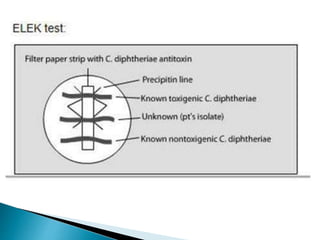
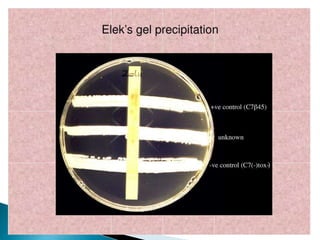
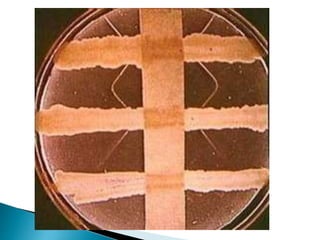
 • In vitro test;
 • A rectangular strip of filter paper is
saturated
 with the diphtheria antitoxin(1000 units/ml);
 • This strip is placed on : agar plate with 20%
 horse serum, while the medium is setting;
 • The cultures to be tested are streaked at
right
 angles to the filter paper strip
 Mainly a disease of childhood(pediatrics) in
endemicareas – uncommon below 1st year; peaks
at 5.
 • In nature, C.diphtheriae occurs in the
respiratory tract, in the wounds or in the skin of
the infected
 persons or carriers;
 • Transmission is by-
 – Droplet dissemination from cases or carriers
 – Direct contact
 – Occasionally, fomites
 ACTIVE IMMUNISATION
 Two preparations of toxoid are available:
 – Formol toxoid
 – Adsorbed toxoid
 • Formal toxoid : prepared by incubating the
 toxin with formalin for 3-4 weeks;
 • Adsorbed toxoid : purified toxoid is adsorbed
 onto an adjuvant, either aluminium phosphate
 or aluminium hydroxide; this is more
 immunogenic;
 • Adsorbed toxoid –given as IM injections
 • Recommended vaccines:
 – As a trivalent preperation : DPT (adsorbed
 Diphtheria/Pertusis/Tetanus)
 – Adsorbed Diphtheria/Tetanus (DT)
 – Adsorbed low dose diphtheria vaccine for
adults (d)
 – Adsorbed Tetanus/low dose diphtheria
vaccine(Td)
 for adults;
 – A quadraple vaccine containing
DPT+inactivated
 polio vaccine is also available;
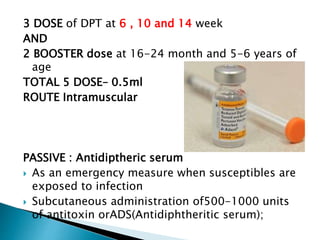
3 DOSE of DPT at 6 , 10 and 14 week
AND
2 BOOSTER dose at 16-24 month and 5-6 years of
age
TOTAL 5 DOSE– 0.5ml
ROUTE Intramuscular
PASSIVE : Antidiptheric serum
 As an emergency measure when susceptibles are
exposed to infection
 Subcutaneous administration of500-1000 units
of antitoxin orADS(Antidiphtheritic serum);
 • Specific measure : prompt administration of
antitoxin to neutralize the circulating toxin;
 • Antibiotics : Penicillin or Erythromycin for
14 days;
 • Complete bed rest;
 • Supportive therapy and treatment of
complications
 • Erythromycin: for treatment of carriers
THANK YOU
SEE YOU IN NEXT CLASS

CORNYBACTERIUM.pptx

  • 1.
    BY : DrGAURAV MATHUR
  • 2.
     Slender Gram-positiverods, pleomorphic; easily decolousised;  0.6-0.8μ diameter and 3-6 μ length;  Irregular swelling at one or both ends (‘club  shaped’);  Non-capsulate, Non-sporing and nonmotile  Granules containing polymetaphosphate are seen in the cells;  Take up bluish purple color against lightly stained cytoplasm, when stained with Loeffler’s Methylene Blue, and hence called ‘Metachromatic granules’;  • Also called, ‘volutin granules’ or ‘Babes Ernst  granules’;  • They are often situated at poles- ‘polar bodies
  • 3.
     Special stainsfor demonstrating the granules :  – Albert’s stain  – Neisser’s stain  – Ponder’s stain  • The bacilli are arranged in  pairs, palisades or small  groups; the bacilli lie at  various angles to each other,  resembling the letters, V or L;  • This is called, “Chinese letter  pattern” or “cuneiform  pattern”;
  • 4.
     • Bloodagar  • Loeffler’s serum slope  • Tellurite blood agar  • Tinsdale’s medium (cystine added to tellurite containing agar)
  • 5.
     • Bloodagar : small,  granular and gray with  irregular edges;  Hemolysis may or may not present;  Loeffler’s serum slope:  – Very rapid growth;  – Colonies in 6-8 hrs  – Initially circular white  opaque colonies and  acquire yellowish tint on  incubation
  • 6.
     Tinsdale’s medium(also contain cystine in  addition to tellurite):  – Grey black colonies with  dark brown haloes  indicate C.diphtheriae
  • 7.
     • Ferment-glucose, galactose, maltose and  dextrose; but not lactose, sucrose, mannitol;  • Proteolytic activity is absent;  • Do not hydrolyse urea;  • Do not form phosphatase;  • Produce cystinase (halo on Tinsdale’s medium)
  • 8.
     The pathognomoniceffects are due to the Toxin Toxin is a protein Two fragments, A and B;  Fragment B : binds to a cell surface receptor  and helps in transport of toxin into the cell;  • After entering the cell, A subunit is released ;  • A subunit catalyses the transfer of ‘adenosine diphosphate ribose (ADPR)’  • ADPR binds with the elongation factor EF 2  • “ADPR-EF2” complex is inactive protein  synthesis stops abruptly necrotising and  neurotoxic effects of the toxin;
  • 9.
     • Commonestsite of infection: Upper respiratory tract (fauces, larynx,nose)  • Ocassionally, other cutaneous or  mucocutaneous areas ( otitic/conjunctival/  genitovulval/vaginal/ prepucial/skin)  • Faucial diphtheria is the commonest type;  • Sore throat is frequently the presenting  symptom;
  • 10.
     • Thetoxin causes local necrotic changes;  • The resulting fibrinous exudate, together with the epithelial cells, leucocytes, erythrocytes and bacteria constitute : “pseudomembrane”  • Any effort to remove it will tear off capillaries beneath it and cause bleeding;  • Mechanical complications are due to pseudomembrane and systemic effects are due to the toxin
  • 11.
     • Thetoxin is absorbed systemically and damages heart muscle, liver, adrenals etc.  Nontoxigenic strains can also produce local disease but systemic effects are absent  • Incubation period : usually 3-4 days;  • Acute infection : in the form of –  – Membranous tonsillitis  – Nasal infection  – Laryngeal infection  – Skin infection –uncommon
  • 12.
     Characteristic featureis :  ‘wash –leather’ eleveted  greyish greeen  membrane in the tonsils  with a well defined Edge surrounded by a zone of inflammation;
  • 13.
     CLASSIFICATION BASEDON CLINICAL SEVERITY  • Malignant or hypertoxic:  – ‘Bull neck’ due to marked adenitis in neck;  – Severe toxemia  – Circulatory failure  – Death  – Paralytic squealae in survivors  • Septic : ulceration, cellulitis and gangrene  around pseudomembrane;  • Hemorrhagic: bleeding from the edge of  pseudomembrane, epistaxis, purpura etc.
  • 14.
     • Asphyxia: due to mechanical obstruction  Emergency tracheostomy may be necessary;  • Acute circulatory failure  • Myocarditis  • Postdiphtheritic paralysis-  palatine(soft palate) and ciliary ( eye muscles)  nerves  Recovery – spontaneous and complete  • Septic : pneumonia and otitis media
  • 15.
     • Specimens:  – Swabs from – nose, throat or other suspected  lesions;  • Smear examination: Gram stain  – shows beaded rods in typical arrangement;  corynebacteria normally found in throat;  – Albert’s stain or Neisser’s stain is useful for demonstrating the granules
  • 16.
     • Inoculateon :  – Loeffler’s serum slope  – Tellurite blood agar or Tinsdale medium  – Blood agar  • In vivo methods:  – Subcutaneous test  – Intracutaneous test  • In vitro methods:  – Elek’s gel precipitation test  – Tissue culture test
  • 17.
     • Invitro test;  • A rectangular strip of filter paper is saturated  with the diphtheria antitoxin(1000 units/ml);  • This strip is placed on : agar plate with 20%  horse serum, while the medium is setting;  • The cultures to be tested are streaked at right  angles to the filter paper strip
  • 21.
     Mainly adisease of childhood(pediatrics) in endemicareas – uncommon below 1st year; peaks at 5.  • In nature, C.diphtheriae occurs in the respiratory tract, in the wounds or in the skin of the infected  persons or carriers;  • Transmission is by-  – Droplet dissemination from cases or carriers  – Direct contact  – Occasionally, fomites
  • 22.
     ACTIVE IMMUNISATION Two preparations of toxoid are available:  – Formol toxoid  – Adsorbed toxoid  • Formal toxoid : prepared by incubating the  toxin with formalin for 3-4 weeks;  • Adsorbed toxoid : purified toxoid is adsorbed  onto an adjuvant, either aluminium phosphate  or aluminium hydroxide; this is more  immunogenic;
  • 23.
     • Adsorbedtoxoid –given as IM injections  • Recommended vaccines:  – As a trivalent preperation : DPT (adsorbed  Diphtheria/Pertusis/Tetanus)  – Adsorbed Diphtheria/Tetanus (DT)  – Adsorbed low dose diphtheria vaccine for adults (d)  – Adsorbed Tetanus/low dose diphtheria vaccine(Td)  for adults;  – A quadraple vaccine containing DPT+inactivated  polio vaccine is also available;
  • 24.
    3 DOSE ofDPT at 6 , 10 and 14 week AND 2 BOOSTER dose at 16-24 month and 5-6 years of age TOTAL 5 DOSE– 0.5ml ROUTE Intramuscular PASSIVE : Antidiptheric serum  As an emergency measure when susceptibles are exposed to infection  Subcutaneous administration of500-1000 units of antitoxin orADS(Antidiphtheritic serum);
  • 25.
     • Specificmeasure : prompt administration of antitoxin to neutralize the circulating toxin;  • Antibiotics : Penicillin or Erythromycin for 14 days;  • Complete bed rest;  • Supportive therapy and treatment of complications  • Erythromycin: for treatment of carriers
  • 26.
    THANK YOU SEE YOUIN NEXT CLASS