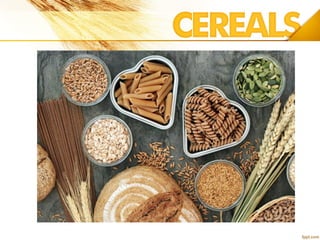
CEREAL is akind of grain used to
make human and animal food. These
grains are processed into a wide
variety of products including breads,
cakes, desserts, and other meals.
3.
TYPES OF GRAINS
Grain(Cereal) foods can be broken up
into four main groups.
1. BREADS – wholemeal, wholegrain,
white rye, pita, lavash, naan,
focaccia, crispbreads, damper.
2. BREAKFAST CEREALS – Ready-to-
eat, high fiber (wholegrain) oats,
porridge, muesli, whole-wheat
biscuits.
TYPES OF CEREALS
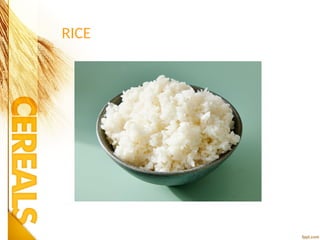
1.RICE – the most common and
popular cereal used as staple food
in tropical and temperate countries
and restaurants all over the world.
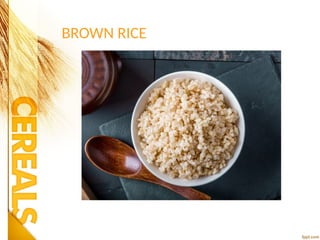
2. BROWN RICE – a variety of rice rich
in the Vitamin B group particularly
thiamine, riboflavin, niacin, and
minerals like iron, potassium,
phosphorous and magnesium.
6.
TYPES OF CEREALS
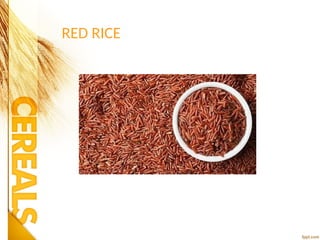
3.RED RICE -variety of rice usually
eaten unhulled or partially hulled,
and has a red husk, rather than
the more common brown
because of its anthocyanin
content. Red rice has a nutty
flavor and has a higher nutritional
value compared to polished rice.
7.
TYPES OF CEREALS
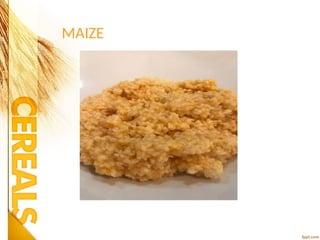
4.Maize - the staple cereal in
Africa and South American
continents and is used as
animal feed worldwide.
Cornflakes is the flaked form
of maize.
8.
TYPES OF CEREALS
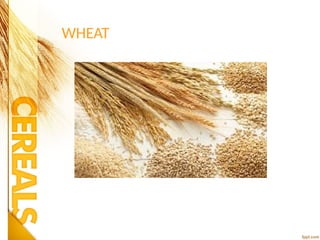
5.Wheat - a prime cereal consumed
in temperate zones like Australia,
North America, Europe, and New
Zealand. It is a major ingredient in
bread, biscuits, pastries, porridge,
cakes, crackers, pancakes, muesli,
pies, cookies, rolls, muffins,
doughnuts, gravy, and some
breakfast cereals.
9.
TYPES OF CEREALS
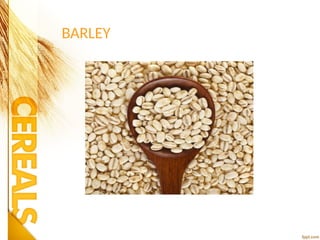
6.Barley- a popular and highly
nutritious cereal grown for
malting. It is also a popular
livestock food in lands that are
incapable of growing wheat
due to financial or climatic
conditions.
10.
TYPES OF CEREALS
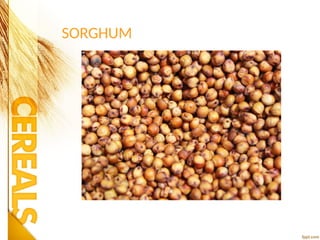
7.Sorghum - cereal
consumed in Africa and Asia
and is also considered a good
livestock feed.
11.
TYPES OF CEREALS
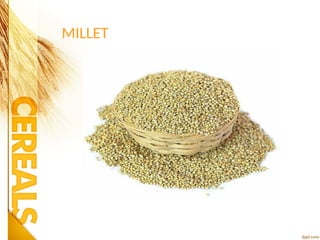
8.Millet- porridge made from
millet grown in Africa and Asia
and is extremely popular in
China, Germany, and Russia. It
is also used in alcoholic
beverages and sometimes used
as bird and animal feed.
12.
TYPES OF CEREALS
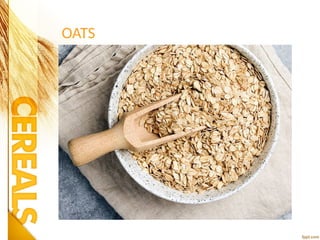
9.Oats - staple cereal in
Scotland; also used as livestock
feed.
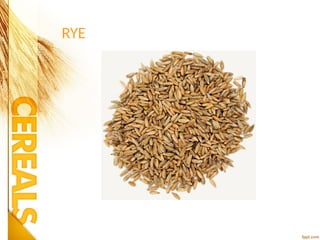
10. Rye - an important cereal
grown in cold climates used to
make bread beer, whiskeys,
vodka, and also used as animal
fodder.
COMPOSITION AND NUTRIENTVALUE OF CEREAL GRAINS
Cereals belong to the complex
carbohydrates food group and are rich
sources of minerals, vitamins,
carbohydrates, oils, proteins, and fats.
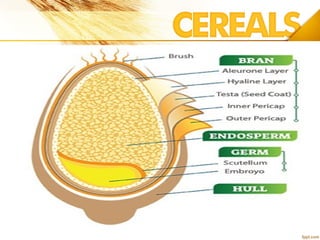
Whole cereal grains have an outer bran
coat, a starchy endosperm, and a germ.
24.
COMPOSITION AND NUTRIENTVALUE OF CEREAL GRAINS
1. Bran layers of the kernel that makes up 5%
of its composition. It is rich in fiber and
minerals. This layer contains high amounts of
thiamine and riboflavin.
2. Aleurone this layer lies just below the bran
and is exposed during the refining process
when the bran layer is removed. This layer is
rich in phosphorous, proteins, fat, and thiamin.
25.
COMPOSITION AND NUTRIENTVALUE OF CEREAL GRAINS
3. Endosperm - large central part of the
kernel with a high percentage of starch and
protein and low in vitamin or mineral
content but is unfortunately lost during
processing.
4. Germ- the structure at the rear part of
the kernel rich in protein, fat, minerals, and
vitamins during the germination process.
27.
HEALTH BENEFITS OFCEREALS
• Source of Energy
• High Mineral Content
• Prevents Cancer
• Prevents constipation and color disorders
• Maintains blood sugar level
• Provides Proteins
• Source of Vitamins
28.
HOW TO SERVECEREALS
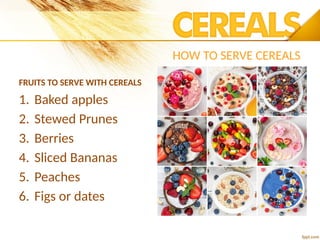
FRUITS TO SERVE WITH CEREALS
1. Baked apples
2. Stewed Prunes
3. Berries
4. Sliced Bananas
5. Peaches
6. Figs or dates
29.
STARCH
• STARCH isa carbohydrate extracted from agricultural
raw materials which is present in every day food and
non-food applications. It is the most important
carbohydrate in the human diet. Starchy foods are
good source of energy and the main source of a
range of nutrients in our diet. As well as starch they
contain fiber, calcium, iron and B Vitamins.
30.
TYPES OF STARCHYFOODS
1. RICE AND GRAINS – excellent choices of
starchy food that gives us energy, give food
value for money and low in fat.
2. BREAD – whole grain, whole meal and brown
breads give energy and contain B vitamins,
Vitamin E, fiber and a wide range of minerals
while white bread has less fiber than whole
grain, whole meal or brown breads.
31.
TYPES OF STARCHYFOODS
3. POTATOES – good source of energy, fiber,
vitamins, and potassium whether boiled, baked,
mashed or roasted with only a small amount of
fat.
4. PASTA – consist of dough made from durum
wheat and water, and contains iron and B
vitamins as well as a small amount of sodium
(salt).
33.
STORING CEREALS
• Cerealsand flour may be kept for
several months but unless there is a
cool, dry place for storing them, they
should be purchased only in amounts
that can be used in a few days.
34.
• Products madefrom whole grain are
more subject to spoilage than
refined products because whole
products contain germ which is high
in fat and, when it becomes rancid,
offers suitable material for the
development of eggs laid by insects.
35.
• Cereal productsare liable to spoilage by
becoming wormy or rancid.
• They should be purchased from stores
with strict sanitary standards and stored
in closed glass jars and keep from
infection by insects.
36.
METHOD OF STORINGSTARCH AND CEREALS
• FIFO (First In, First Out) in storing food is very
important. Though it is a long-time method in
store-keeping where the first food stored
should be the first food to be out from the
storage it is high time to make it a habit or put
into practice. Write the expiry date, date
received and date of storage to the food
package and regularly check the expiration
date.
37.
INGREDIENTS OF STARCHAND CEREALS DISHES
1. GRAIN STARCHES – contain high relatively high
percentage of fats and proteins, which can thicken
sauces, look opaque, and matte-liked. These
starches also tend to have a distinctive cereal taste
once cooked. Two most common forms of grain
starches used in cooking are wheat flour and
cornstarch. Cornstarch is a more efficient thickener
than wheat flour because it is almost pure starch.
39.
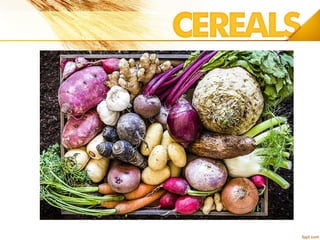
2. ROOT ANDTUBER STARCHES – root starches
also have less forward flavors once cooked.
Sauces thickened with these starches are more
translucent and glossy, and they have a silkier
mouthfeel.
41.
METHODS OF COOKINGGRAINS, STARCH, AND CEREAL DISHES
Methods of Cooking Rice
1. Boiling
2. Absorption Method
3. Simmering/Steaming
4. Rice Cooker
5. Risotto
6. Pilaf
42.
PILAF RECIPE
• methodin which rice is cooked in a
seasoned broth. In some cases, the rice
may attain its brown or golden color by
first being sautéed lightly in oil before the
addition of broth, cooked onion, other
vegetables, as well as a mix of spices.
43.
1. In amedium saucepan, heat oil or butter and finely
diced onion (½ cup of onion per cup of rice) until
translucent.
2. Add rice to the pan and stir until each grain is
coated with oil and shiny (pearling). If you desire,
you can slightly toast the rice before moving on to
the next step.
44.
3. Add thevegetable stock or chicken stock for extra
flavor. The amount of liquid you add depends on the
type of rice you are cooking because different rice types
absorb different amounts of liquid.
4. Add salt to season.
5. Bring the liquid to a simmer, turn the heat to low,
and cover.
45.
6. Cook therice on the stovetop until it is tender (you
can also put the covered pot in a 350 oven if you need
stove space). The time needed to cook the rice depends
upon the rice you are using.
7. It is important to uncover the rice and fluff it with a
fork to allow steam to escape once the rice is tender to
prevent overcooked rice. If you need to keep it warm,
replace the cover after most of the steam is gone.
46.
8. Adding abay leaf when you pour in the liquid
imparts added flavor.
9. Add different vegetables at the beginning like bell
peppers, carrots, celery, garlic, shallots, or scallions cut
as small as, or smaller than, the onion.
10. . Toss the finished rice with other ingredients like
peas, raisins, spinach, chopped nuts, etc. You may want
to add raw or cooked separately.
11. For added richness, stir extra butter in to the
finished rice while it is still hot.
47.
COOKING CORNSTARCH/CORN FLOUR
Cornstarchis a fine, powdery flour ground
from the endosperm or white heart of the corn
kernel. Both cornstarch and flour are starches,
but cornstarch is pure starch while flour
contains gluten which reduces the thickening
power of flour. Without gluten, cornstarch has
twice the thickening power of flour.
48.
• Cornstarch thickenswith a satiny smoothness
and glossy appearance and adds no taste of its
own to mask the flavor of foods.
• Recipes thickened with cornstarch have a
brighter, more translucent appearance than
those thickened with flour. Cornstarch also
blends more easily with liquids than flour
because it does not absorb liquid until it is
cooked and does not cause lumps.
49.
USES OF CORNSTARCH
•1. It is often used in Oriental recipes because it results
in a lighter, clearer gravy with glossy appearances.
• 2. It is helpful in making custards, flans, cheesecakes,
quiche, and other egg dishes because it prevents eggs
from curdling.
• 3. It causes heat to be transmitted more evenly
throughout the dish and can be used to make a glaze.
• 4. It is also used to flour pieces of meat for added
crispiness when browning.
• 5. It is best used to thicken dairy-based sauces.
50.
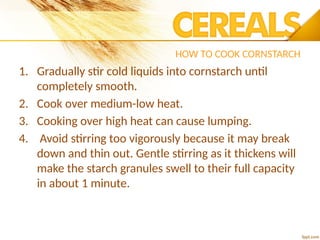
HOW TO COOKCORNSTARCH
1. Gradually stir cold liquids into cornstarch until
completely smooth.
2. Cook over medium-low heat.
3. Cooking over high heat can cause lumping.
4. Avoid stirring too vigorously because it may break
down and thin out. Gentle stirring as it thickens will
make the starch granules swell to their full capacity
in about 1 minute.
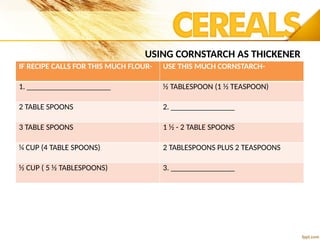
USING CORNSTARCH ASTHICKENER
IF RECIPE CALLS FOR THIS MUCH FLOUR- USE THIS MUCH CORNSTARCH-
1. _____________________ ½ TABLESPOON (1 ½ TEASPOON)
2 TABLE SPOONS 2. ________________
3 TABLE SPOONS 1 ½ - 2 TABLE SPOONS
¼ CUP (4 TABLE SPOONS) 2 TABLESPOONS PLUS 2 TEASPOONS
½ CUP ( 5 ½ TABLESPOONS) 3. ________________
53.
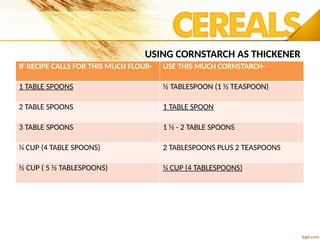
USING CORNSTARCH ASTHICKENER
IF RECIPE CALLS FOR THIS MUCH FLOUR- USE THIS MUCH CORNSTARCH-
1 TABLE SPOONS ½ TABLESPOON (1 ½ TEASPOON)
2 TABLE SPOONS 1 TABLE SPOON
3 TABLE SPOONS 1 ½ - 2 TABLE SPOONS
¼ CUP (4 TABLE SPOONS) 2 TABLESPOONS PLUS 2 TEASPOONS
½ CUP ( 5 ½ TABLESPOONS) ¼ CUP (4 TABLESPOONS)
54.
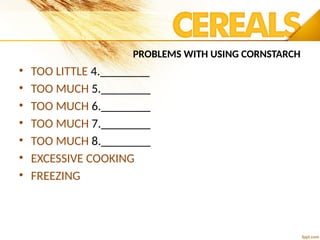
PROBLEMS WITH USINGCORNSTARCH
• TOO LITTLE 4.________
• TOO MUCH 5.________
• TOO MUCH 6.________
• TOO MUCH 7.________
• TOO MUCH 8.________
• EXCESSIVE COOKING
• FREEZING
55.
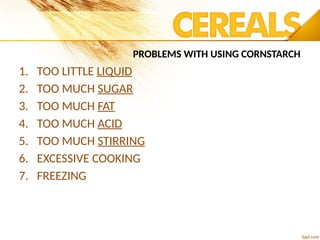
PROBLEMS WITH USINGCORNSTARCH
1. TOO LITTLE LIQUID
2. TOO MUCH SUGAR
3. TOO MUCH FAT
4. TOO MUCH ACID
5. TOO MUCH STIRRING
6. EXCESSIVE COOKING
7. FREEZING
56.
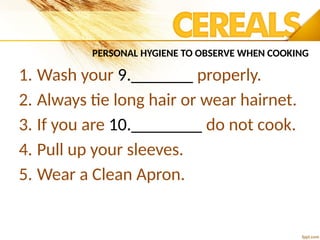
PERSONAL HYGIENE TOOBSERVE WHEN COOKING
1. Wash your 9._______ properly.
2. Always tie long hair or wear hairnet.
3. If you are 10.________ do not cook.
4. Pull up your sleeves.
5. Wear a Clean Apron.
57.
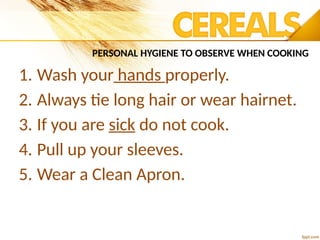
PERSONAL HYGIENE TOOBSERVE WHEN COOKING
1. Wash your hands properly.
2. Always tie long hair or wear hairnet.
3. If you are sick do not cook.
4. Pull up your sleeves.
5. Wear a Clean Apron.