CORE TEST OF CONCRETE
PREPARED BY
AMRIT PANDEY
(PUL078BCE023)
CORE TEST
The core test of concrete is a procedure used to assess the
compressive strength and quality of hardened concrete in situ (in place). It
involves drilling and extracting cylindrical cores from the concrete structure
using a diamond-tipped core drill. These cores, typically 4 inches in diameter and
varying in length based on the structure's thickness, are then subjected to
compressive strength testing in a laboratory.
WHY CORE TEST ?????
WHY CORE TEST ?????
1.Compressive Strength Evaluation:
Determine the in-place compressive
strength of concrete, which is crucial for assessing structural capacity and safety.
WHY CORE TEST ?????
2.Quality Assessment:
Evaluate concrete quality by examining factors such
as uniformity, homogeneity, and the presence of defects like voids, cracks, or
improper consolidation.
WHY CORE TEST ?????
3.Thickness Verification:
Confirm the actual thickness of concrete members,
especially when as-built dimensions are needed for structural analysis or
retrofitting.
WHY CORE TEST ?????
4.Investigation of Distress:
Investigate the causes of distress, such as cracks or
spalling, by examining core samples to determine underlying issues like poor
concrete quality, inadequate reinforcement, or environmental exposure.
PROCEDURE OF CORE TESTING
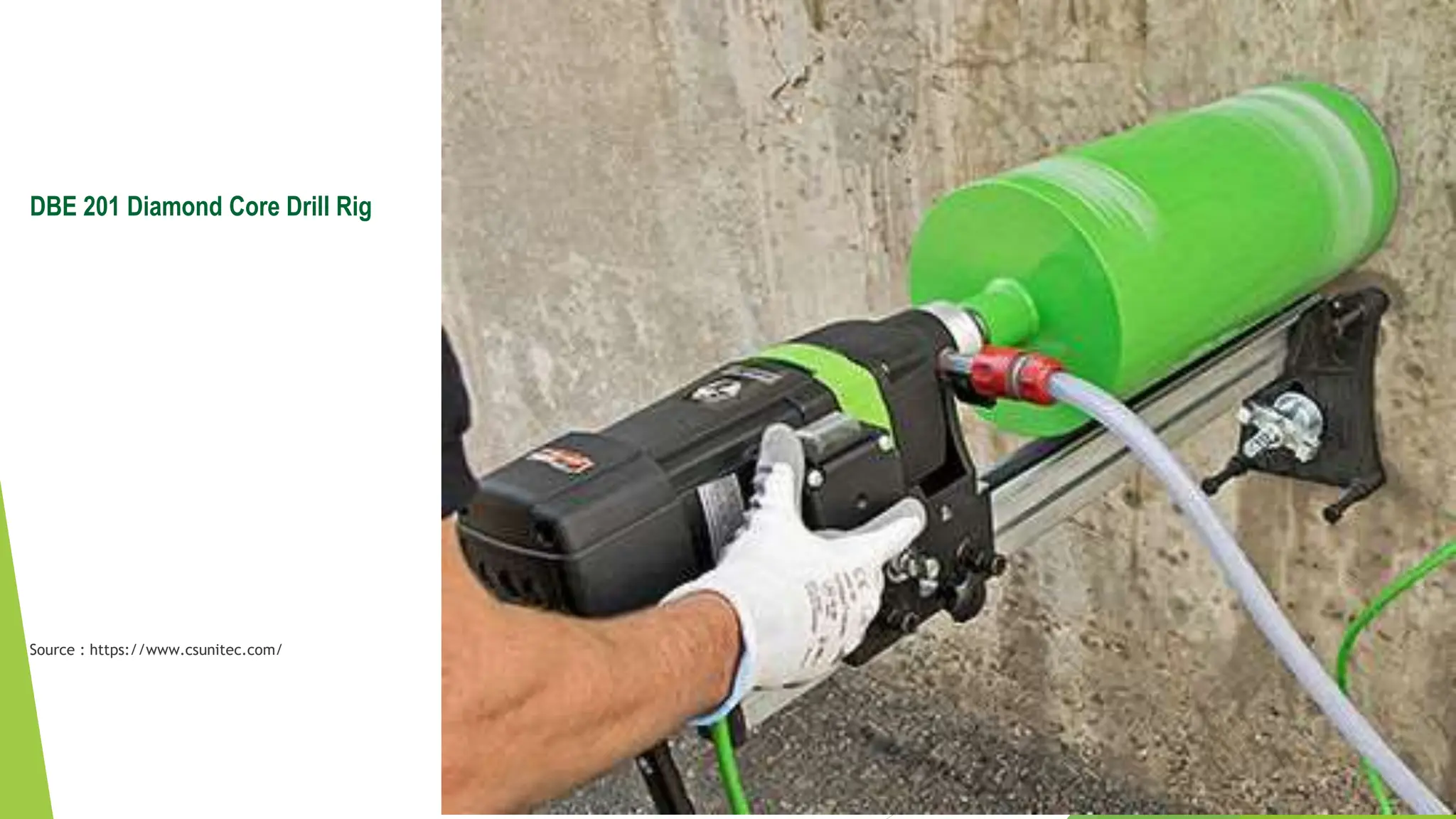
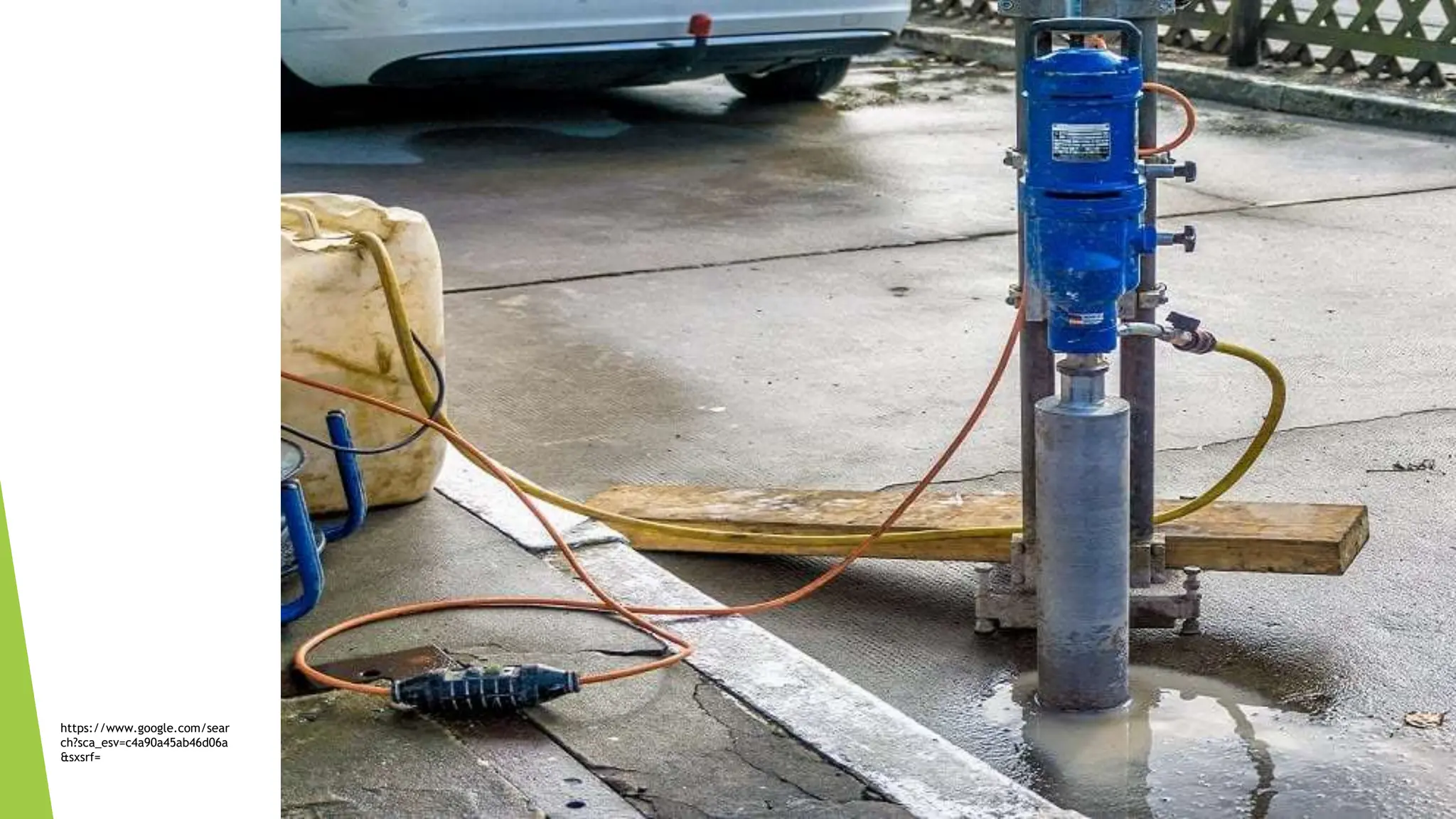
1.Core Drilling:
Use a diamond-tipped core drill to extract
cylindrical cores from the concrete structure. Cores are
typically drilled perpendicular to the surface and are
carefully handled to avoid damage.
DBE 201 Diamond Core Drill Rig
Source : https://www.csunitec.com/
PROCEDURE OF CORE TESTING
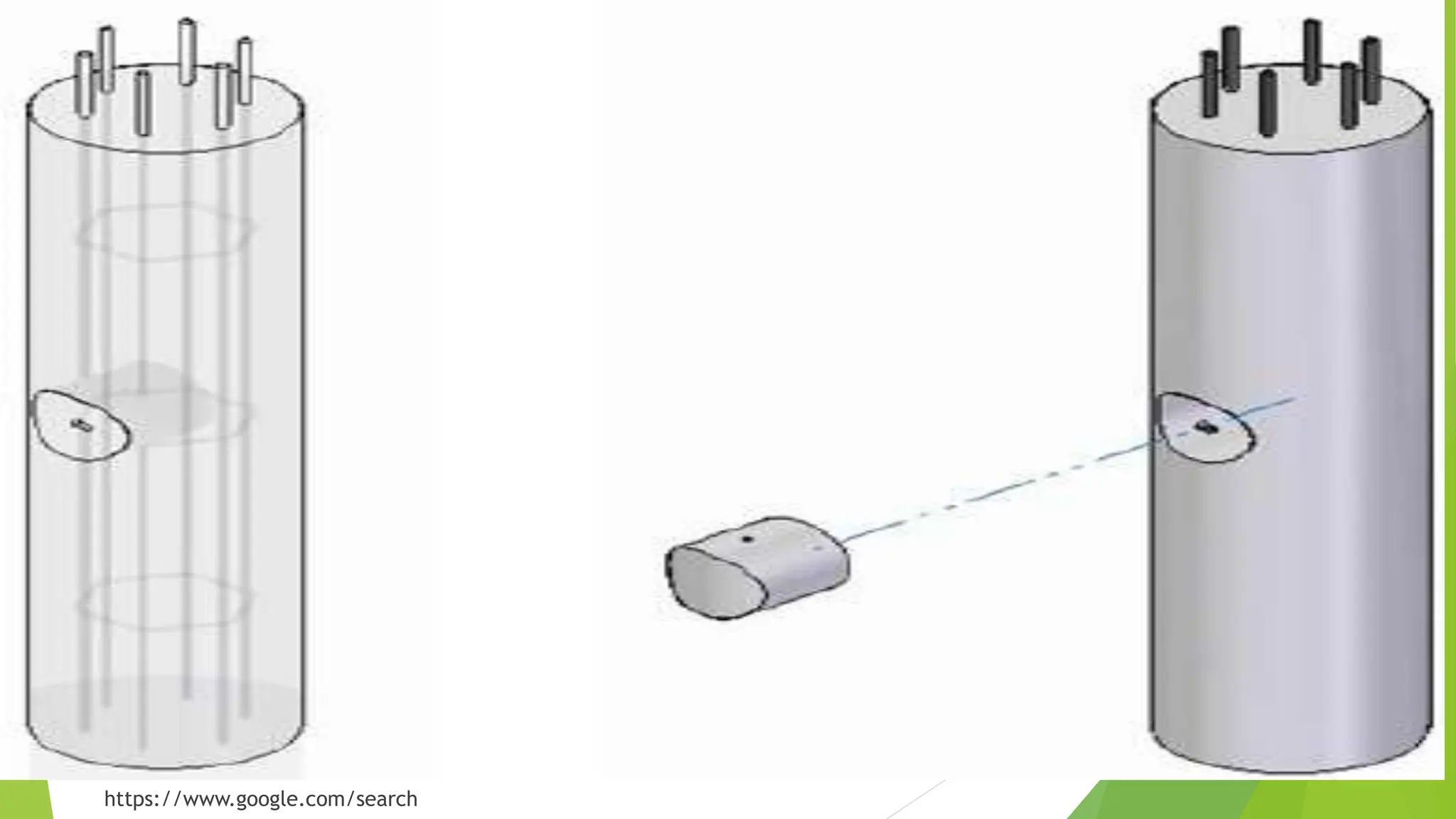
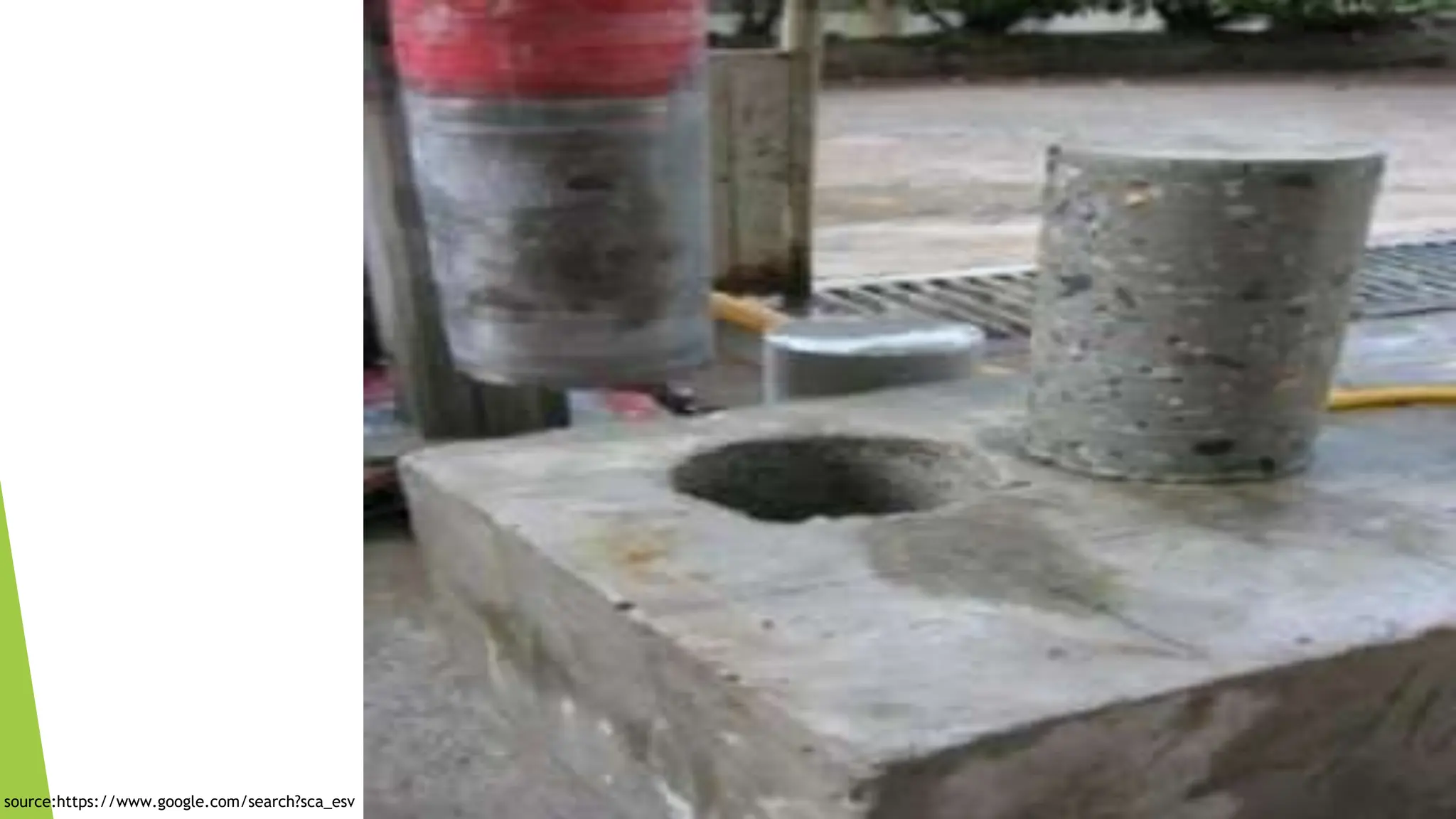
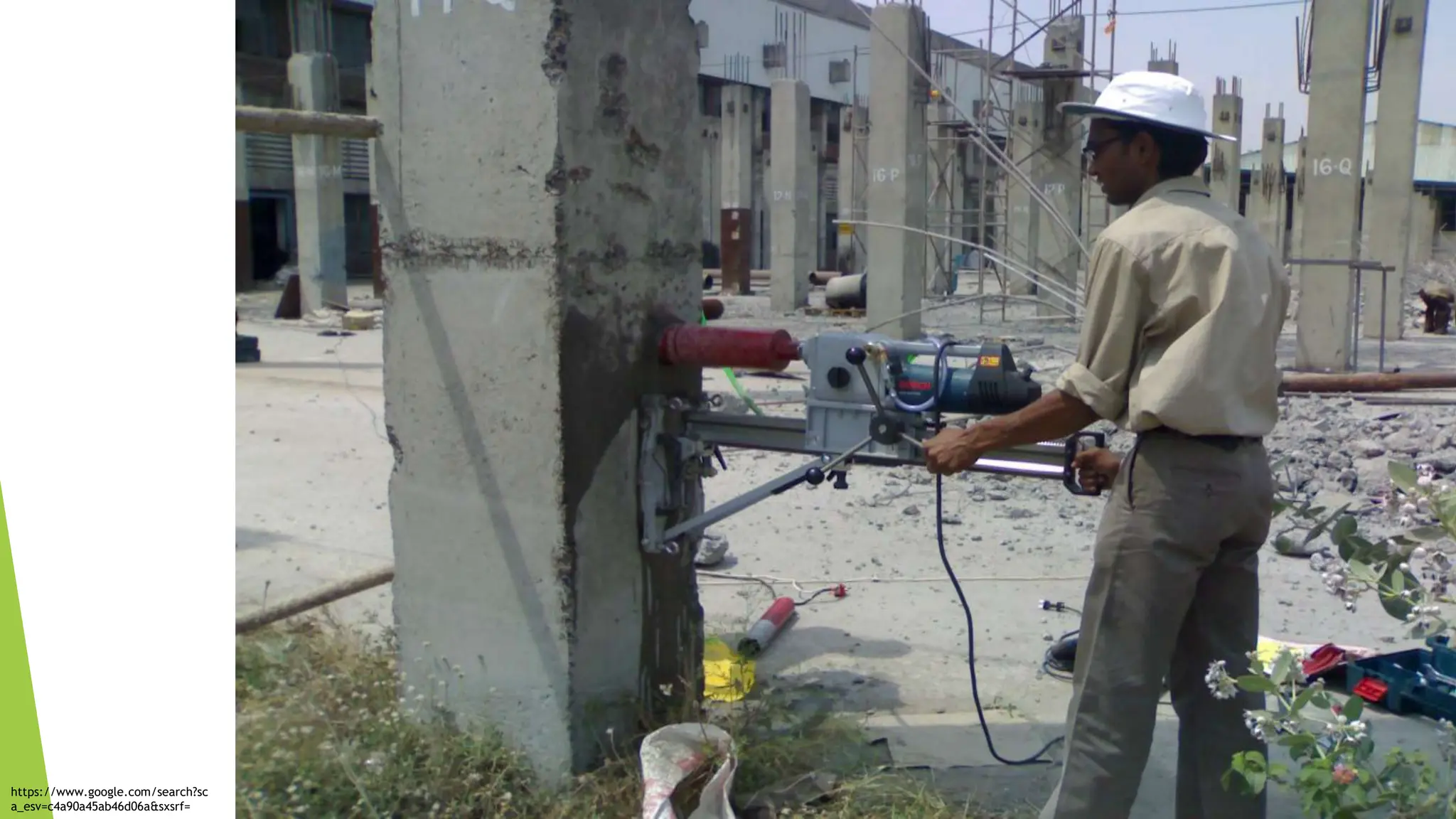
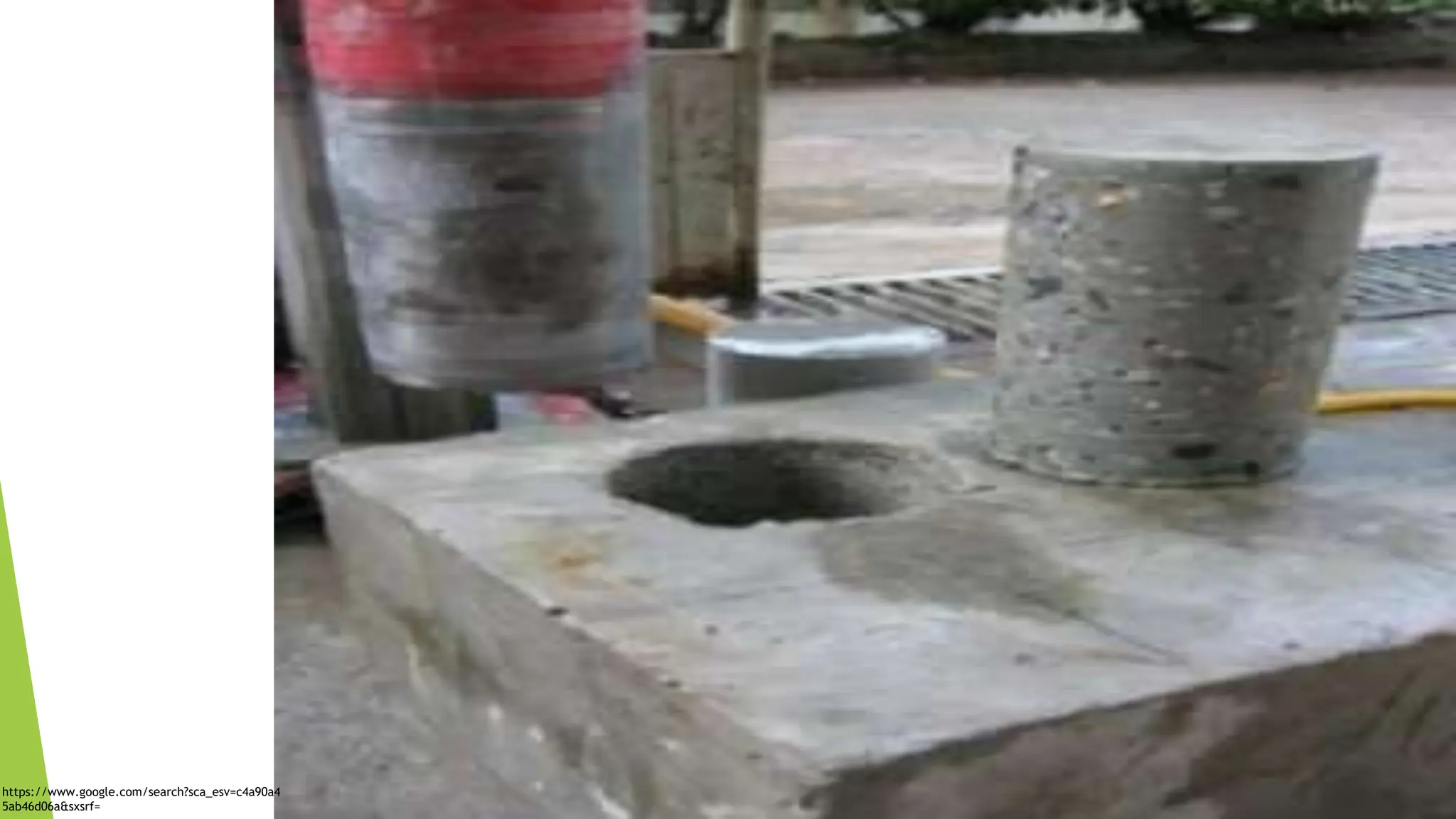
2.Core Extraction:
Carefully remove the core samples without
causing significant disturbance to the surrounding concrete.
https://www.google.com/search
source:https://www.google.com/search?sca_esv
PROCEDURE OF CORE TESTING
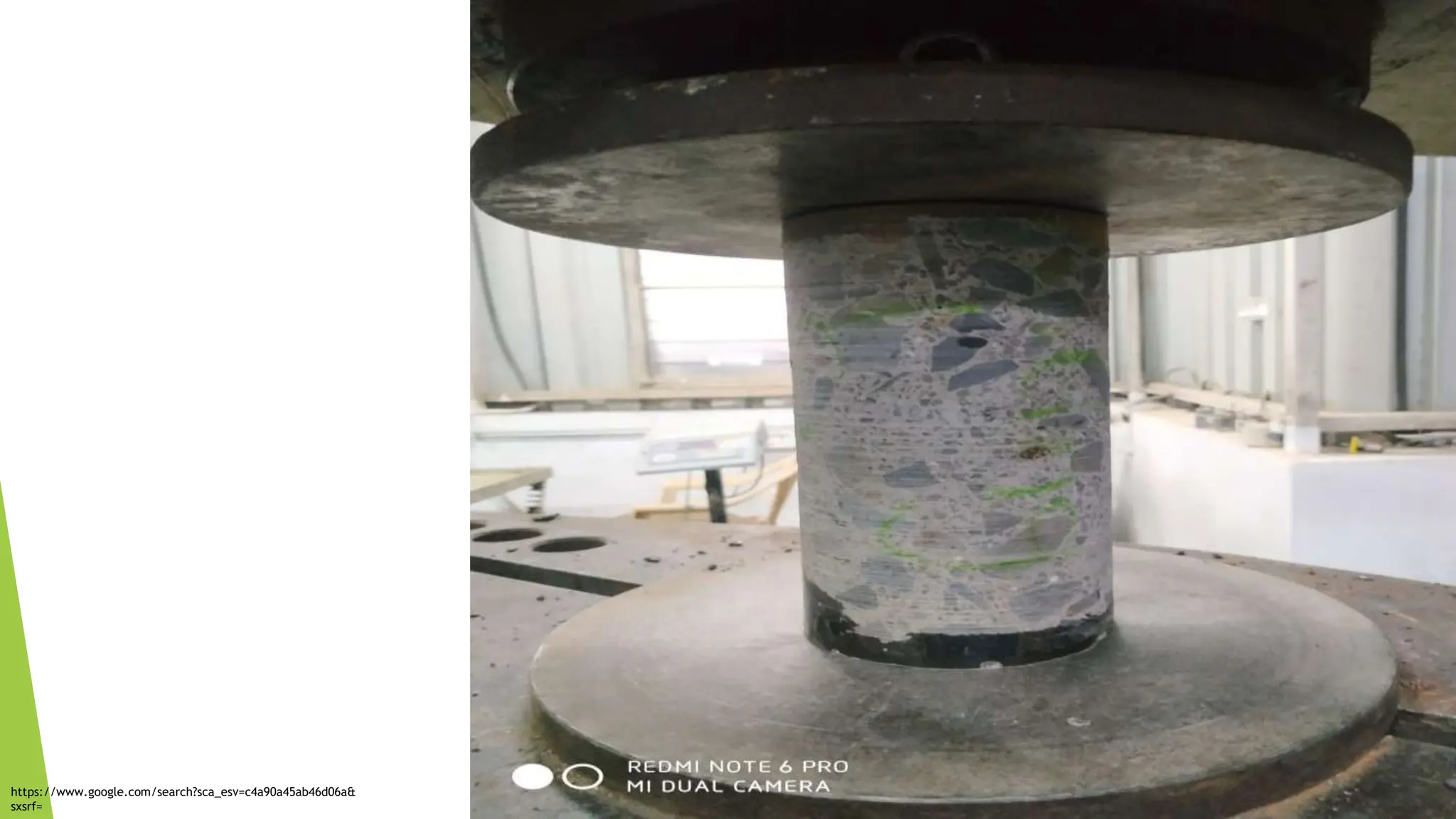
3.Testing:
Transport the cores to a laboratory for
compressive strength testing using standardized procedures.
Cores may also undergo petrographic analysis, chloride ion
content testing, or other tests depending on project
requirements.
TESTING
According to the Indian Standard (IS)
516:1959, concrete core tests for compressive strength
should follow some guidelines .
GUIDELINES
GUIDELINES
1. Core diameter
The core's diameter should be at least three times the
maximum size of the concrete's coarse aggregate, and at
least twice the maximum size of the coarse aggregate in the
core sample. The preferred diameter is at least 75 mm, but
not less than 50 mm.
2.Length to diameter ratio
For compressive strength testing, the length to diameter
ratio should be between 0.90:1 and 1.10:1 when comparing
against a 1:1 specimen (cube).
GUIDELINES
3.Core capping
Use epoxy material to cap the core. The caps should be as
thin as possible, but no thicker than 5 mm on average.
Before capping, make sure the core's surface is clean, dry,
and free of loose particles , smooth ,flat surfaces
perpendicular to the longitudinal axis.
GUIDELINES
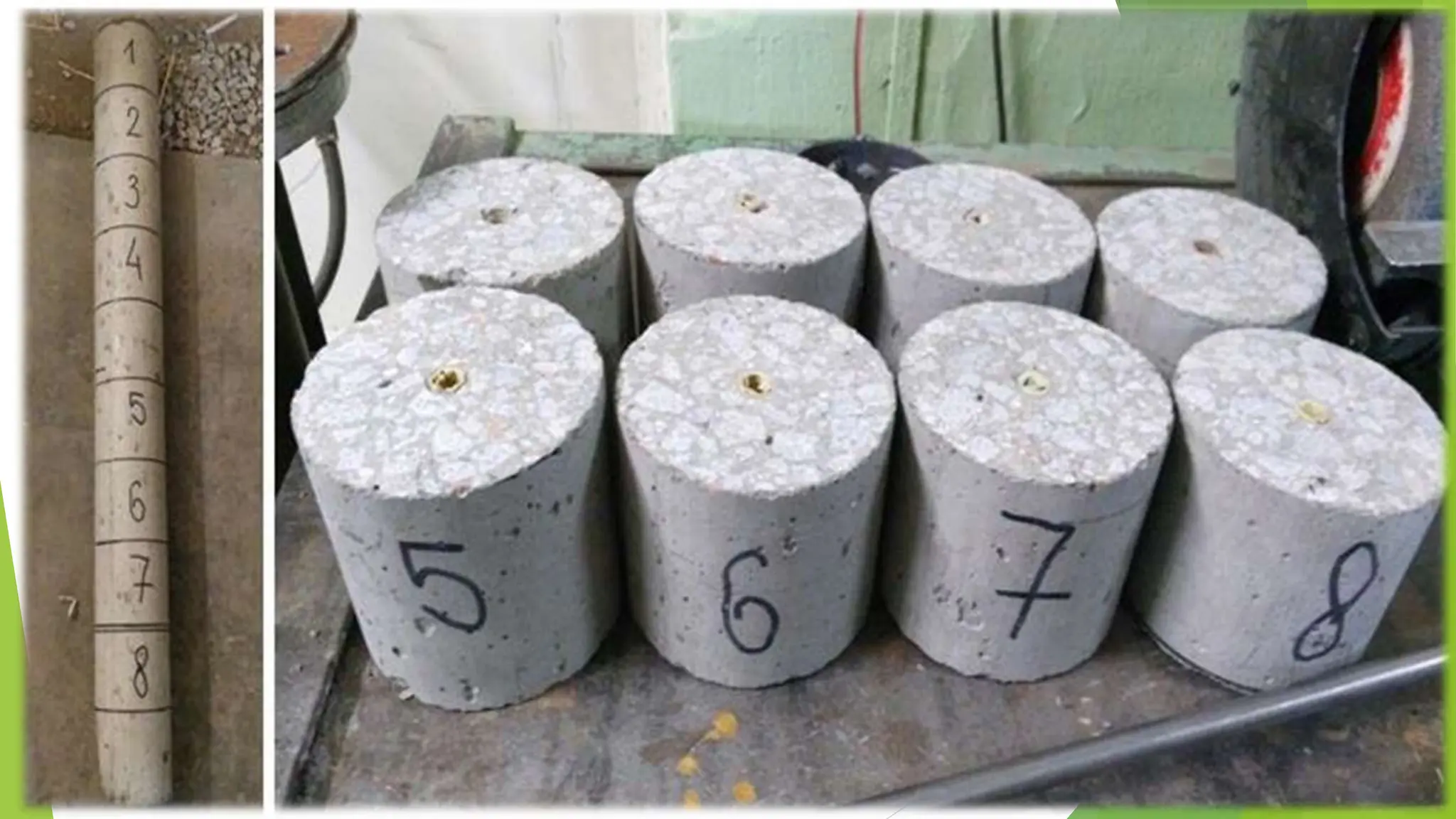
4.Core preparation
Place the core specimen with the collar and plate in moist
air with a temperature of 27± 2°C and a relative humidity of
at least 90%. Remove the plate and collar when the mortar is
hard enough to handle without damage.
GUIDELINES
4.Number of cores
Test at least three cores.
GUIDELINES
5.Concrete strength
Concrete needs 28 days to reach a hardened state. According
to IS 456:2000, the concrete in the member represented by a
core test is acceptable if the average equivalent cube
strength of the core is at least 85% of the cube strength of
the specified concrete grade, but no individual core can be
weaker than 75%.
PROCEDURE OF CORE TESTING
4.Calculation of Compressive Strength:
The compressive strength 𝑓𝑐 is calculated using
the formula:
𝑓𝑐=𝑃/𝐴
where 𝑃 is the maximum load applied to the specimen and 𝐴
is the cross-sectional area of the core.
PROCEDURE OF CORE TESTING
5.REPORTING :
After calculating the compressive strength test
from the core sample it is then compared with the result
came from the sample specimen of cube and cylinder of
same grade. And it will be acceptable according to the IS
456:2000 ,if it strength is at least 85% the equivalent
strength of cube .
Individual core strength cannot be less than 75% of the equ.
Cube strength.
https://www.google.com/sear
ch?sca_esv=c4a90a45ab46d06a
&sxsrf=
https://www.google.com/search?sc
a_esv=c4a90a45ab46d06a&sxsrf=
https://www.google.com/search?sca_esv=c4a90a4
5ab46d06a&sxsrf=
https://www.google.com/search?sca_esv=c4a90a45ab46d06a&
sxsrf=
REFERENCES
1. https://chatgpt.com/
2. https://law.resource.org/pub/in/bis/S03/is.516.1959.pdf
3. https://backend.delhimetrorail.com/documents/1284/Coretest050421.pdf
NO QUERIES……..
ANY QUERIES????????

CORE TEST OF CONCRETE ALL PROCEDURE FROM FIELD TO LAB.pptx

  • 1.
    CORE TEST OFCONCRETE PREPARED BY AMRIT PANDEY (PUL078BCE023)
  • 2.
    CORE TEST The coretest of concrete is a procedure used to assess the compressive strength and quality of hardened concrete in situ (in place). It involves drilling and extracting cylindrical cores from the concrete structure using a diamond-tipped core drill. These cores, typically 4 inches in diameter and varying in length based on the structure's thickness, are then subjected to compressive strength testing in a laboratory.
  • 3.
  • 4.
    WHY CORE TEST????? 1.Compressive Strength Evaluation: Determine the in-place compressive strength of concrete, which is crucial for assessing structural capacity and safety.
  • 5.
    WHY CORE TEST????? 2.Quality Assessment: Evaluate concrete quality by examining factors such as uniformity, homogeneity, and the presence of defects like voids, cracks, or improper consolidation.
  • 6.
    WHY CORE TEST????? 3.Thickness Verification: Confirm the actual thickness of concrete members, especially when as-built dimensions are needed for structural analysis or retrofitting.
  • 7.
    WHY CORE TEST????? 4.Investigation of Distress: Investigate the causes of distress, such as cracks or spalling, by examining core samples to determine underlying issues like poor concrete quality, inadequate reinforcement, or environmental exposure.
  • 8.
  • 9.
    PROCEDURE OF CORETESTING 1.Core Drilling: Use a diamond-tipped core drill to extract cylindrical cores from the concrete structure. Cores are typically drilled perpendicular to the surface and are carefully handled to avoid damage.
  • 10.
    DBE 201 DiamondCore Drill Rig Source : https://www.csunitec.com/
  • 11.
    PROCEDURE OF CORETESTING 2.Core Extraction: Carefully remove the core samples without causing significant disturbance to the surrounding concrete.
  • 12.
  • 13.
  • 14.
    PROCEDURE OF CORETESTING 3.Testing: Transport the cores to a laboratory for compressive strength testing using standardized procedures. Cores may also undergo petrographic analysis, chloride ion content testing, or other tests depending on project requirements.
  • 15.
    TESTING According to theIndian Standard (IS) 516:1959, concrete core tests for compressive strength should follow some guidelines .
  • 16.
  • 17.
    GUIDELINES 1. Core diameter Thecore's diameter should be at least three times the maximum size of the concrete's coarse aggregate, and at least twice the maximum size of the coarse aggregate in the core sample. The preferred diameter is at least 75 mm, but not less than 50 mm.
  • 18.
    2.Length to diameterratio For compressive strength testing, the length to diameter ratio should be between 0.90:1 and 1.10:1 when comparing against a 1:1 specimen (cube).
  • 19.
    GUIDELINES 3.Core capping Use epoxymaterial to cap the core. The caps should be as thin as possible, but no thicker than 5 mm on average. Before capping, make sure the core's surface is clean, dry, and free of loose particles , smooth ,flat surfaces perpendicular to the longitudinal axis.
  • 20.
    GUIDELINES 4.Core preparation Place thecore specimen with the collar and plate in moist air with a temperature of 27± 2°C and a relative humidity of at least 90%. Remove the plate and collar when the mortar is hard enough to handle without damage.
  • 21.
    GUIDELINES 4.Number of cores Testat least three cores.
  • 23.
    GUIDELINES 5.Concrete strength Concrete needs28 days to reach a hardened state. According to IS 456:2000, the concrete in the member represented by a core test is acceptable if the average equivalent cube strength of the core is at least 85% of the cube strength of the specified concrete grade, but no individual core can be weaker than 75%.
  • 24.
    PROCEDURE OF CORETESTING 4.Calculation of Compressive Strength: The compressive strength 𝑓𝑐 is calculated using the formula: 𝑓𝑐=𝑃/𝐴 where 𝑃 is the maximum load applied to the specimen and 𝐴 is the cross-sectional area of the core.
  • 25.
    PROCEDURE OF CORETESTING 5.REPORTING : After calculating the compressive strength test from the core sample it is then compared with the result came from the sample specimen of cube and cylinder of same grade. And it will be acceptable according to the IS 456:2000 ,if it strength is at least 85% the equivalent strength of cube . Individual core strength cannot be less than 75% of the equ. Cube strength.
  • 26.
  • 27.
  • 28.
  • 30.
  • 31.
    REFERENCES 1. https://chatgpt.com/ 2. https://law.resource.org/pub/in/bis/S03/is.516.1959.pdf 3.https://backend.delhimetrorail.com/documents/1284/Coretest050421.pdf
  • 32.
  • 33.