What is NDT?
 Powerful technique for evaluating exiting concrete
  structures with regard to their strength and durability apart
  from assessment and control of quality of hardened
  concrete without or partial damage to the concrete.

 Concrete is not loaded to the failure, therefore, the
  strength inferred or estimated can not be expected to yield
  absolute value of strength.

 NDT measures some other properties of concrete from
  which an estimate of its strength , durability and elastic
  properties are obtained.
                                                           1
WHY NDT INVESTIGATION IS REQUIRED
               IN POST ENGINEERING?
 It is required to assess the quality control exercised by the
  agency at the time of concreting and precaution can be taken if
  found unsatisfactory.
 Environmental, manmade or natural impact may deteriorate
  the concrete very fast in sustained loading condition.
 Ongoing corrosion activity can be trapped and stopped further.
 To evaluate structural strength at present and use it to increase
  the load carrying capacity or reduce load to prevent collapse.
 Gives master print for repair and retrofitting work to be carried
  out.
 To predict residual life of the structure for future planning.
 To get idea about extent of the damage occurred to the
  structure due to a particular cause.
                                                                2
HOW NDT INVESTIGATION HELPS IN ASSESSMENT?
 Rebound Hammer Test: To estimate strength and hardness
  of the concrete in the cover region (IS: 13311 Part II)
 UPV Test: To measure homogeneity, uniformity,
  compactibility and presence of crack or void, thus representing
  durability of concrete (IS: 13311 Part I).
 Core Test: To evaluate in situ compressive strength of
  concrete (Represents real and actual picture of concrete) IS
  516 & ASTM C42/41)
 Corrosion Assessment: Half Cell Potential (ASTM C876-
  9), Resistivity and RCPT (ASTM C1202), to know about
  extent and rate of ongoing corrosion activity.
 Bar Locater and Cover Meter: To know the structural
  strength and protection to the reinforcement by cover concrete.
 Carbonation: To evaluate extent of carbonation for strength
                                                               3
  and corrosion estimation.
Mechanism of Rebound Hammer
REBOUND HAMMER
• OBJECTIVES
• To assess quality of the concrete in relation to the standard
requirements
• To estimate compressive strength of concrete with the help of
suitable correlations between rebound index & compressive
strength
• To delineate regions of poor quality or deteriorated concrete
in a structure
• To assess quality of one element of the concrete in relation to
another
REBOUND HAMMER
 FACTORS AFFECTING THE TEST RESULTS

• Type of Cement
• Type of Aggregate
• Surface Condition and Moisture Content of
  Concrete
• Curing and Age of Concrete
• Carbonation of Concrete Surface
ULTRASONIC PULSE VELOCITY
    OBJECTIVES
 To assess uniformity and homogeneity of concrete

 To assess quality of concrete in relation to standard requirements
 Detection of the presence & approximate extent of cracks, voids &
other imperfection in concrete
 Measurement of changes occurring with time in the properties of the
  concrete
 Correlation of pulse velocity & strength as a measure of concrete
quality
 Determination of the dynamic modulus of elasticity & Poisson's
ratio of the concrete
ULTRASONIC PULSE VELOCITY
   FACTORS AFFECTING TEST RESULTS
 Surface Conditions and Moisture Content of Concrete
              UPV α Moisture content
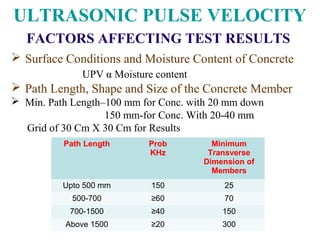
 Path Length, Shape and Size of the Concrete Member
 Min. Path Length–100 mm for Conc. with 20 mm down
                   150 mm-for Conc. With 20-40 mm
  Grid of 30 Cm X 30 Cm for Results
          Path Length      Prob          Minimum
                           KHz          Transverse
                                       Dimension of
                                         Members
          Upto 500 mm       150            25
            500-700         ≥60            70
           700-1500         ≥40            150
          Above 1500        ≥20            300
ULTRASONIC PULSE VELOCITY
 FACTORS AFFECTING TEST RESULTS

 Temperature of Concrete
   50 – 300 Ideal
   300 – 600 (Reduction in UPV upto 5%)
   Below 50 (Increase upto 7.5%)

 Stress level in Concrete
   At higher stress UPV reduces due to development of microcracks
   Significant effect is observed when stress is higher than 60% of
  its ultimate.

 Reinforcing Bars
   UPV of R/f is 1.2 to 1.9 times than normal concrete
ULTRASONIC PULSE VELOCITY
EVALUATION OF DYNAMIC MODULUS OF ELASTICITY


                      Ed = ρf(μ)v2
 Where ρ is density of concrete in Kg/m3,
 v is pulse velocity in m/sec,

                    f(μ) = (1+ μ)(1-2μ)/(1- μ)
where μ is dynamic poisson’s ratio of concrete

                     Es = 1.25Ed-19
          Es is static modulus of elasticity
Methods of Conduct of UPV Test
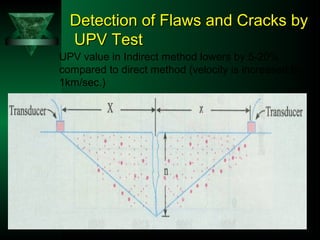
Detection of Flaws and Cracks by
  UPV Test
UPV value in Indirect method lowers by 5-20%
compared to direct method (velocity is increased by
1km/sec.)
ULTRASONIC PULSE VELOCITY
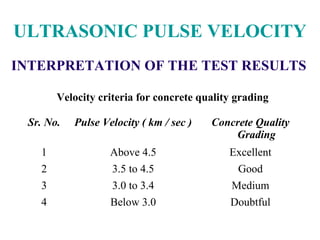
INTERPRETATION OF THE TEST RESULTS

       Velocity criteria for concrete quality grading

 Sr. No.   Pulse Velocity ( km / sec )   Concrete Quality
                                             Grading
   1               Above 4.5                Excellent
   2               3.5 to 4.5                Good
   3               3.0 to 3.4               Medium
   4               Below 3.0                Doubtful
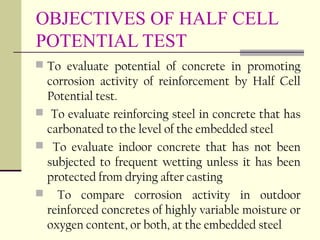
OBJECTIVES OF HALF CELL
POTENTIAL TEST
 To evaluate potential of concrete in promoting
 corrosion activity of reinforcement by Half Cell
 Potential test.
 To evaluate reinforcing steel in concrete that has
 carbonated to the level of the embedded steel
 To evaluate indoor concrete that has not been
 subjected to frequent wetting unless it has been
 protected from drying after casting
 To compare corrosion activity in outdoor
 reinforced concretes of highly variable moisture or
 oxygen content, or both, at the embedded steel
Mechanism of Chloride Attack

   Ingress of Cl- and O2 , Formation of OH-

   Preferential migration of Cl- to neutralize Fe++
    formed within the pit and formation of FeCl2.

   Hydrolysis of FeCl2 and acid formation ( HCl )
    which accelerates further attack on metal.

   Intensive localized corrosion within the pit
    leading to failure.
Corrosion Mechanism
    Corrosion of Steel in Concrete is an Electrochemical
    process.
 In Steel, one part becomes anode and other part
 becomes cathode connected by electrolyte in the form of
 pore water in the hardened cement paste.
 Positively charged Fe++ at the anode passes into
 solution.
 Negatively charged free electrons e- passes through the
 steel into cathode where they are absorbed by the
 constituents of the electrolyte and combine with water &
 oxygen to from hydroxyl ions (OH)-.
 (OH)- travel through the electrolyte and combine with the
 ferrous ions to form ferric hydroxide and by further
 oxidation converted to rust.
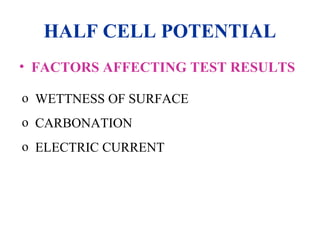
HALF CELL POTENTIAL
• FACTORS AFFECTING TEST RESULTS

o WETTNESS OF SURFACE
o CARBONATION
o ELECTRIC CURRENT
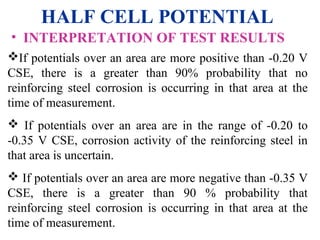
HALF CELL POTENTIAL
• INTERPRETATION OF TEST RESULTS
If potentials over an area are more positive than -0.20 V
CSE, there is a greater than 90% probability that no
reinforcing steel corrosion is occurring in that area at the
time of measurement.
 If potentials over an area are in the range of -0.20 to
-0.35 V CSE, corrosion activity of the reinforcing steel in
that area is uncertain.
 If potentials over an area are more negative than -0.35 V
CSE, there is a greater than 90 % probability that
reinforcing steel corrosion is occurring in that area at the
time of measurement.
CONCRETE CORE
• OBJECTIVES
 To assess the compressive strength of concrete on
samples by cutting core with help of suitable correlation
between L/D ratio.
 To assess the quality of concrete in relation to
standard requirements.
PROFOMETER REBAR
             DETECTION
   The measuring method is based on the eddy current principle
    with pulse induction. The basic unit can perform the functions
    such as: (i) locating rebars, (ii) measuring concrete cover, (iii)
    storing individual cover values and statistical evaluation, and
    (iv) determining the bar diameter. It measures more accurately
    cover in the range of 60 mm – 150 mm, and bar diameter in the
    range of 10 – 26 mm with bar spacing in the range of 70 mm –
    200 mm.
   The instrument has Neighboring bar correction and 2-Layer
    correction facility. Neighboring bar correction mainly used for
    determination of the bar diameter in close spaced parallel bar
    arrangements. 2-Layer Correction mode helps in congested
    standard orthogonal bar arrangements. The congested bars
    induce a too strong measuring signal which can be corrected.
OBJECTIVES OF PROFOMETER
    REBAR DETECTION

 Formeasurement of concrete cover.
 To find the diameter of bars in the
 concrete.
 To find the spacing between the bars.

Ndt

  • 1.
    What is NDT? Powerful technique for evaluating exiting concrete structures with regard to their strength and durability apart from assessment and control of quality of hardened concrete without or partial damage to the concrete.  Concrete is not loaded to the failure, therefore, the strength inferred or estimated can not be expected to yield absolute value of strength.  NDT measures some other properties of concrete from which an estimate of its strength , durability and elastic properties are obtained. 1
  • 2.
    WHY NDT INVESTIGATIONIS REQUIRED IN POST ENGINEERING?  It is required to assess the quality control exercised by the agency at the time of concreting and precaution can be taken if found unsatisfactory.  Environmental, manmade or natural impact may deteriorate the concrete very fast in sustained loading condition.  Ongoing corrosion activity can be trapped and stopped further.  To evaluate structural strength at present and use it to increase the load carrying capacity or reduce load to prevent collapse.  Gives master print for repair and retrofitting work to be carried out.  To predict residual life of the structure for future planning.  To get idea about extent of the damage occurred to the structure due to a particular cause. 2
  • 3.
    HOW NDT INVESTIGATIONHELPS IN ASSESSMENT?  Rebound Hammer Test: To estimate strength and hardness of the concrete in the cover region (IS: 13311 Part II)  UPV Test: To measure homogeneity, uniformity, compactibility and presence of crack or void, thus representing durability of concrete (IS: 13311 Part I).  Core Test: To evaluate in situ compressive strength of concrete (Represents real and actual picture of concrete) IS 516 & ASTM C42/41)  Corrosion Assessment: Half Cell Potential (ASTM C876- 9), Resistivity and RCPT (ASTM C1202), to know about extent and rate of ongoing corrosion activity.  Bar Locater and Cover Meter: To know the structural strength and protection to the reinforcement by cover concrete.  Carbonation: To evaluate extent of carbonation for strength 3 and corrosion estimation.
  • 4.
  • 5.
    REBOUND HAMMER • OBJECTIVES •To assess quality of the concrete in relation to the standard requirements • To estimate compressive strength of concrete with the help of suitable correlations between rebound index & compressive strength • To delineate regions of poor quality or deteriorated concrete in a structure • To assess quality of one element of the concrete in relation to another
  • 6.
    REBOUND HAMMER FACTORSAFFECTING THE TEST RESULTS • Type of Cement • Type of Aggregate • Surface Condition and Moisture Content of Concrete • Curing and Age of Concrete • Carbonation of Concrete Surface
  • 7.
    ULTRASONIC PULSE VELOCITY  OBJECTIVES  To assess uniformity and homogeneity of concrete  To assess quality of concrete in relation to standard requirements  Detection of the presence & approximate extent of cracks, voids & other imperfection in concrete  Measurement of changes occurring with time in the properties of the concrete  Correlation of pulse velocity & strength as a measure of concrete quality  Determination of the dynamic modulus of elasticity & Poisson's ratio of the concrete
  • 8.
    ULTRASONIC PULSE VELOCITY FACTORS AFFECTING TEST RESULTS  Surface Conditions and Moisture Content of Concrete UPV α Moisture content  Path Length, Shape and Size of the Concrete Member  Min. Path Length–100 mm for Conc. with 20 mm down 150 mm-for Conc. With 20-40 mm Grid of 30 Cm X 30 Cm for Results Path Length Prob Minimum KHz Transverse Dimension of Members Upto 500 mm 150 25 500-700 ≥60 70 700-1500 ≥40 150 Above 1500 ≥20 300
  • 9.
    ULTRASONIC PULSE VELOCITY FACTORS AFFECTING TEST RESULTS  Temperature of Concrete 50 – 300 Ideal 300 – 600 (Reduction in UPV upto 5%) Below 50 (Increase upto 7.5%)  Stress level in Concrete At higher stress UPV reduces due to development of microcracks Significant effect is observed when stress is higher than 60% of its ultimate.  Reinforcing Bars UPV of R/f is 1.2 to 1.9 times than normal concrete
  • 10.
    ULTRASONIC PULSE VELOCITY EVALUATIONOF DYNAMIC MODULUS OF ELASTICITY Ed = ρf(μ)v2  Where ρ is density of concrete in Kg/m3,  v is pulse velocity in m/sec, f(μ) = (1+ μ)(1-2μ)/(1- μ) where μ is dynamic poisson’s ratio of concrete Es = 1.25Ed-19 Es is static modulus of elasticity
  • 11.
    Methods of Conductof UPV Test
  • 12.
    Detection of Flawsand Cracks by UPV Test UPV value in Indirect method lowers by 5-20% compared to direct method (velocity is increased by 1km/sec.)
  • 13.
    ULTRASONIC PULSE VELOCITY INTERPRETATIONOF THE TEST RESULTS Velocity criteria for concrete quality grading Sr. No. Pulse Velocity ( km / sec ) Concrete Quality Grading 1 Above 4.5 Excellent 2 3.5 to 4.5 Good 3 3.0 to 3.4 Medium 4 Below 3.0 Doubtful
  • 14.
    OBJECTIVES OF HALFCELL POTENTIAL TEST  To evaluate potential of concrete in promoting corrosion activity of reinforcement by Half Cell Potential test.  To evaluate reinforcing steel in concrete that has carbonated to the level of the embedded steel  To evaluate indoor concrete that has not been subjected to frequent wetting unless it has been protected from drying after casting  To compare corrosion activity in outdoor reinforced concretes of highly variable moisture or oxygen content, or both, at the embedded steel
  • 15.
    Mechanism of ChlorideAttack  Ingress of Cl- and O2 , Formation of OH-  Preferential migration of Cl- to neutralize Fe++ formed within the pit and formation of FeCl2.  Hydrolysis of FeCl2 and acid formation ( HCl ) which accelerates further attack on metal.  Intensive localized corrosion within the pit leading to failure.
  • 16.
    Corrosion Mechanism  Corrosion of Steel in Concrete is an Electrochemical process.  In Steel, one part becomes anode and other part becomes cathode connected by electrolyte in the form of pore water in the hardened cement paste.  Positively charged Fe++ at the anode passes into solution.  Negatively charged free electrons e- passes through the steel into cathode where they are absorbed by the constituents of the electrolyte and combine with water & oxygen to from hydroxyl ions (OH)-.  (OH)- travel through the electrolyte and combine with the ferrous ions to form ferric hydroxide and by further oxidation converted to rust.
  • 17.
    HALF CELL POTENTIAL •FACTORS AFFECTING TEST RESULTS o WETTNESS OF SURFACE o CARBONATION o ELECTRIC CURRENT
  • 18.
    HALF CELL POTENTIAL •INTERPRETATION OF TEST RESULTS If potentials over an area are more positive than -0.20 V CSE, there is a greater than 90% probability that no reinforcing steel corrosion is occurring in that area at the time of measurement.  If potentials over an area are in the range of -0.20 to -0.35 V CSE, corrosion activity of the reinforcing steel in that area is uncertain.  If potentials over an area are more negative than -0.35 V CSE, there is a greater than 90 % probability that reinforcing steel corrosion is occurring in that area at the time of measurement.
  • 19.
    CONCRETE CORE • OBJECTIVES To assess the compressive strength of concrete on samples by cutting core with help of suitable correlation between L/D ratio.  To assess the quality of concrete in relation to standard requirements.
  • 20.
    PROFOMETER REBAR DETECTION  The measuring method is based on the eddy current principle with pulse induction. The basic unit can perform the functions such as: (i) locating rebars, (ii) measuring concrete cover, (iii) storing individual cover values and statistical evaluation, and (iv) determining the bar diameter. It measures more accurately cover in the range of 60 mm – 150 mm, and bar diameter in the range of 10 – 26 mm with bar spacing in the range of 70 mm – 200 mm.  The instrument has Neighboring bar correction and 2-Layer correction facility. Neighboring bar correction mainly used for determination of the bar diameter in close spaced parallel bar arrangements. 2-Layer Correction mode helps in congested standard orthogonal bar arrangements. The congested bars induce a too strong measuring signal which can be corrected.
  • 21.
    OBJECTIVES OF PROFOMETER REBAR DETECTION  Formeasurement of concrete cover.  To find the diameter of bars in the concrete.  To find the spacing between the bars.