TOPIC:CORE RECOVERY
PRESENTED BY:NARENDRA LAMBA
INTRODUCTION
DRILLING METHODS
• Rotary core drilling
• Rotary open hole drilling
• Percussion boring with cable tools
Percussion “down hole
hammer”(jackhammer)
• Probing
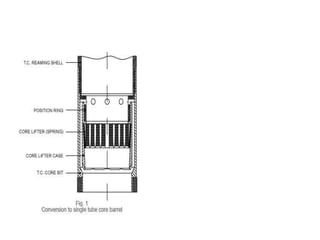
ROTARY CORE DRILLING
• A tube is armed at its base with teeth of a
material harder than the rock to be drilled,is
rotated and pushed downward , a circular
annulus will be cut out of the rock and a
cylindrical core will pass into the tube.
• Commonly the teeth consists of diamond set
into a metal matrix to form core bit.
• Flushing is provided
MEASUREMENT OF CORE RECOVERY
These are the parameters of core recovery
Total core recovery:
TCR =Total length of core recovered × 100
/Drilled length
Solid core recovery:
SCR=Total length of core in pieces > core
diameter × 100/ Drilled length
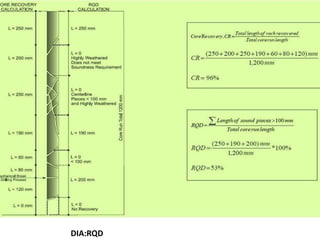
RQD
• Rock Quality Designation (RQD) is a modified
core recovery percentage in which the lengths
of all sound rock core pieces over 100 mm in
length are summed and divided by the length
of the core run. Pieces of core that are not
hard and sound should not be included in the
RQD evaluation even if they are at least 100
mm in length.
DIA:RQD
Technical factors affecting core
recovery
• (i) Bent inner tube so that: (a) the core will not travel up the tube and will be
subject to grinding; (b) it rotates with the outer tube again disturbing and grinding
the core; and (c) it fails to seat properly in the outer barrel resulting in total core
loss
• (ii) Failure of back-end bearing resulting in: (a) loss of core due to grinding; and (b)
grinding of core leaving flat faces
• (iii) Bent outer tube of core barrel resulting in: (a) failure of the inner tube to latch
in and thus loss of core; and (b) less than full diameter cores
• (iv) core spring missing, displaced, damaged, worn or not lubricated
• (v) badly worn or damaged crowns
• (vi) diamonds inside kerf damaged, worn or displaced causing core to jam in inner
tube
• (vii) worn stabilisers
• (viii) vibration induced by poor equipment, insecure rig mountings and hole
deviation
• (ix) blocked waterways (x) inadequate flow/pressure of flushing medium and
unsuitable flushing medium
Geological factors affecting core
recovery
• (i) soft friable ground due to alteration, weathering or leaching
• (ii) unconsolidated materials
• (iii) broken ground with clay infill
• (iv) soluble components removed by unsuitable flushing medium
• (v) low intersection angles with rock discontinuities (cleavage, open
bedding, joints, schistosity, foliation, etc.), particularly joints
following the core axis, and cleavage disking leading to a ‘rasher of
bacon’ effect in the inner tube
• (vi) high frequency of discontinuities per metre
• (vii) unexpected fault zones
• (viii) secondary porosity or vug development due to karstic solution
or dolomitisation or hydration of anhydrite
• S(ix) cavities induced by karstic weathering along joints and faults
and also mining (stopes and caved zones)

Core recovery

  • 1.
  • 2.
  • 3.
    DRILLING METHODS • Rotarycore drilling • Rotary open hole drilling • Percussion boring with cable tools Percussion “down hole hammer”(jackhammer) • Probing
  • 4.
    ROTARY CORE DRILLING •A tube is armed at its base with teeth of a material harder than the rock to be drilled,is rotated and pushed downward , a circular annulus will be cut out of the rock and a cylindrical core will pass into the tube. • Commonly the teeth consists of diamond set into a metal matrix to form core bit. • Flushing is provided
  • 6.
    MEASUREMENT OF CORERECOVERY These are the parameters of core recovery Total core recovery: TCR =Total length of core recovered × 100 /Drilled length Solid core recovery: SCR=Total length of core in pieces > core diameter × 100/ Drilled length
  • 7.
    RQD • Rock QualityDesignation (RQD) is a modified core recovery percentage in which the lengths of all sound rock core pieces over 100 mm in length are summed and divided by the length of the core run. Pieces of core that are not hard and sound should not be included in the RQD evaluation even if they are at least 100 mm in length.
  • 8.
  • 9.
    Technical factors affectingcore recovery • (i) Bent inner tube so that: (a) the core will not travel up the tube and will be subject to grinding; (b) it rotates with the outer tube again disturbing and grinding the core; and (c) it fails to seat properly in the outer barrel resulting in total core loss • (ii) Failure of back-end bearing resulting in: (a) loss of core due to grinding; and (b) grinding of core leaving flat faces • (iii) Bent outer tube of core barrel resulting in: (a) failure of the inner tube to latch in and thus loss of core; and (b) less than full diameter cores • (iv) core spring missing, displaced, damaged, worn or not lubricated • (v) badly worn or damaged crowns • (vi) diamonds inside kerf damaged, worn or displaced causing core to jam in inner tube • (vii) worn stabilisers • (viii) vibration induced by poor equipment, insecure rig mountings and hole deviation • (ix) blocked waterways (x) inadequate flow/pressure of flushing medium and unsuitable flushing medium
  • 10.
    Geological factors affectingcore recovery • (i) soft friable ground due to alteration, weathering or leaching • (ii) unconsolidated materials • (iii) broken ground with clay infill • (iv) soluble components removed by unsuitable flushing medium • (v) low intersection angles with rock discontinuities (cleavage, open bedding, joints, schistosity, foliation, etc.), particularly joints following the core axis, and cleavage disking leading to a ‘rasher of bacon’ effect in the inner tube • (vi) high frequency of discontinuities per metre • (vii) unexpected fault zones • (viii) secondary porosity or vug development due to karstic solution or dolomitisation or hydration of anhydrite • S(ix) cavities induced by karstic weathering along joints and faults and also mining (stopes and caved zones)