 BACKGROUND
 FUNDAMENTALS
-Chingshom N
Zeom
Rock mechanics engineering is the branch of engineering concerned
with mechanical properties of rock and application of this knowledge in
dealing with engineering problems of rock materials.
Concerned, with the response of rock to the field of its environment.
Applied in both surface excavation as well as underground.
It has important role in mine planning and design viz.
•selection of mining methods
•optimum slope angle
•design of support system
•drilling and blasting parameters.
BLASTING
 Rock Blasting is one of the key areas that directly influences the
productivity of mines
 Damage should be minimal
 Well fragmented rocks facilitates handling, transportation & crushing.
 proper blasting techniques involve usage of effective explosives, right
drill holes, spacing, etc.
GROUND VIBRATION STUDY
To carry out effective blasting and reduce damage to surrounding
environment and structures.
 Many underground mines have problems of stope design, ground
control and support systems.
 Analysis of the stability of existing pillars so as to avoid possible
impending failure
 To achieve safer designs of future stopes and pillar
 Geotechnical study & usage of various instruments and close
monitoring, stability of crown and rib pillars could be achieved
 Design of stope & pillar
 Slope stability
investigations
Design of pillars, stopes, ground control, support system
The major sources of instability of underground working
are—
a) adverse geological structure;
b) Excessively high rock stress while mining is at great
depth;
c) Weathering or swelling of rock;
d) Excessive ground water pressure.
Feasibility study for selecting underground mining
methods require the rock mechanics data, such as, in situ
stress, physio-mechanical and elastic properties of rock and
rock mass strength.
 Higher demand for opencast mining- large volumes of ore and
better ways available for waste handling, low gestation period
and quick return on investments.
 Therefore investigations are carried out at the start-up of the
project in order to avoid any further unexpected consequences.
 Design of ultimate pit slope angles, working bench height,
bench slope angles, blast design parameters
For designing and stability evaluation the stresses and/or deformation in the
structure resulting from external or body load the ability of structure to
withstand the stress or deformation, need to be determined.
The difficulties in designing a structure in rock are that state of stress and
mechanical properties of subsurface rock is unknown.
The factors to deal with while designing a structure in rock are:
 Safe and durable
 Minimum time of construction
 In situ stress should be carried out at initial stage, so that modification at
later stage could be avoided.
 For economics of mining it is necessary to exploit the entire deposit
keeping size and number of pillars, barriers to the minimum.
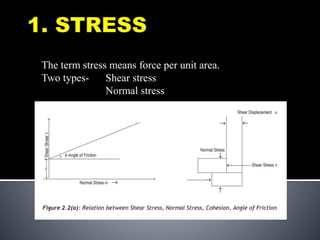
The term stress means force per unit area.
Two types- Shear stress
Normal stress
 Strain is the deformation caused by stress; in length, area, or
volume.
 Yield occurs when there is a departure from elastic behaviour.
 Yield stress is the stress at which permanent deformation
appears.
 Brittle fracture is when there is sudden loss of strength with
little or no permanent deformation.
 Ductile deformation occurs when rock may sustain further
permanent deformation without loosing load carrying capacity
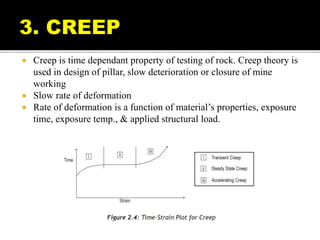
 Creep is time dependant property of testing of rock. Creep theory is
used in design of pillar, slow deterioration or closure of mine
working
 Slow rate of deformation
 Rate of deformation is a function of material’s properties, exposure
time, exposure temp., & applied structural load.
 Many materials that are linearly elastic at low
stress level deviate if they are put under higher
stress or at prolonged loading system
 The theory of elasticity can be used to make
approximation of the stresses, strains and
deformations in the structure under the given
loading condition
 For the purpose of design and to evaluate the stability
of underground structure, mechanical properties of
the rock must be known.
 The mechanical properties are tensile strength,
compressive strength, shear strength, creep or time
properties and strain or deformation properties
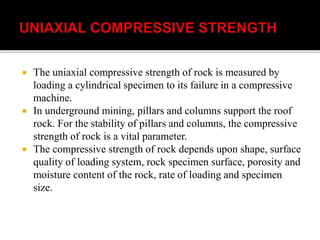
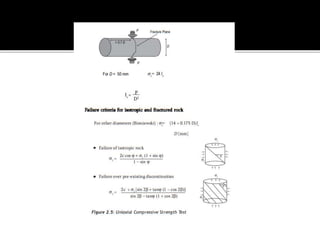
 The uniaxial compressive strength of rock is measured by
loading a cylindrical specimen to its failure in a compressive
machine.
 In underground mining, pillars and columns support the roof
rock. For the stability of pillars and columns, the compressive
strength of rock is a vital parameter.
 The compressive strength of rock depends upon shape, surface
quality of loading system, rock specimen surface, porosity and
moisture content of the rock, rate of loading and specimen
size.
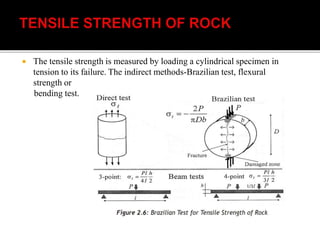
 The tensile strength is measured by loading a cylindrical specimen in
tension to its failure. The indirect methods-Brazilian test, flexural
strength or
bending test.
The triaxial compressive and shear strength is required for calculating the
bearing capacity of foundation rock for surface structure and in determining the
strength of mine pillar and other parts of underground structure. It depends on:
 Effect of the Pore Pressure
 Angle of Repose: dip of the slope relative to the horizontal plane when
material on the slope face is on the verge of sliding.
 Porosity or Void Fraction
 Permeability
 Shrinkage Limit: water content where further loss of moisture will not
result in any more volume reduction.
 Plastic Limit: water content where soil transitions take place between
brittle and plastic behavior.
 Liquid Limit: water content at which a soil changes from plastic to liquid
behaviour.
THANK YOU

Rock mechanics

  • 1.
  • 2.
    Rock mechanics engineeringis the branch of engineering concerned with mechanical properties of rock and application of this knowledge in dealing with engineering problems of rock materials. Concerned, with the response of rock to the field of its environment. Applied in both surface excavation as well as underground. It has important role in mine planning and design viz. •selection of mining methods •optimum slope angle •design of support system •drilling and blasting parameters.
  • 3.
    BLASTING  Rock Blastingis one of the key areas that directly influences the productivity of mines  Damage should be minimal  Well fragmented rocks facilitates handling, transportation & crushing.  proper blasting techniques involve usage of effective explosives, right drill holes, spacing, etc. GROUND VIBRATION STUDY To carry out effective blasting and reduce damage to surrounding environment and structures.
  • 4.
     Many undergroundmines have problems of stope design, ground control and support systems.  Analysis of the stability of existing pillars so as to avoid possible impending failure  To achieve safer designs of future stopes and pillar  Geotechnical study & usage of various instruments and close monitoring, stability of crown and rib pillars could be achieved
  • 5.
     Design ofstope & pillar  Slope stability investigations
  • 6.
    Design of pillars,stopes, ground control, support system The major sources of instability of underground working are— a) adverse geological structure; b) Excessively high rock stress while mining is at great depth; c) Weathering or swelling of rock; d) Excessive ground water pressure. Feasibility study for selecting underground mining methods require the rock mechanics data, such as, in situ stress, physio-mechanical and elastic properties of rock and rock mass strength.
  • 7.
     Higher demandfor opencast mining- large volumes of ore and better ways available for waste handling, low gestation period and quick return on investments.  Therefore investigations are carried out at the start-up of the project in order to avoid any further unexpected consequences.  Design of ultimate pit slope angles, working bench height, bench slope angles, blast design parameters
  • 8.
    For designing andstability evaluation the stresses and/or deformation in the structure resulting from external or body load the ability of structure to withstand the stress or deformation, need to be determined. The difficulties in designing a structure in rock are that state of stress and mechanical properties of subsurface rock is unknown. The factors to deal with while designing a structure in rock are:  Safe and durable  Minimum time of construction  In situ stress should be carried out at initial stage, so that modification at later stage could be avoided.  For economics of mining it is necessary to exploit the entire deposit keeping size and number of pillars, barriers to the minimum.
  • 9.
    The term stressmeans force per unit area. Two types- Shear stress Normal stress
  • 10.
     Strain isthe deformation caused by stress; in length, area, or volume.  Yield occurs when there is a departure from elastic behaviour.  Yield stress is the stress at which permanent deformation appears.  Brittle fracture is when there is sudden loss of strength with little or no permanent deformation.  Ductile deformation occurs when rock may sustain further permanent deformation without loosing load carrying capacity
  • 11.
     Creep istime dependant property of testing of rock. Creep theory is used in design of pillar, slow deterioration or closure of mine working  Slow rate of deformation  Rate of deformation is a function of material’s properties, exposure time, exposure temp., & applied structural load.
  • 12.
     Many materialsthat are linearly elastic at low stress level deviate if they are put under higher stress or at prolonged loading system  The theory of elasticity can be used to make approximation of the stresses, strains and deformations in the structure under the given loading condition
  • 13.
     For thepurpose of design and to evaluate the stability of underground structure, mechanical properties of the rock must be known.  The mechanical properties are tensile strength, compressive strength, shear strength, creep or time properties and strain or deformation properties
  • 14.
     The uniaxialcompressive strength of rock is measured by loading a cylindrical specimen to its failure in a compressive machine.  In underground mining, pillars and columns support the roof rock. For the stability of pillars and columns, the compressive strength of rock is a vital parameter.  The compressive strength of rock depends upon shape, surface quality of loading system, rock specimen surface, porosity and moisture content of the rock, rate of loading and specimen size.
  • 16.
     The tensilestrength is measured by loading a cylindrical specimen in tension to its failure. The indirect methods-Brazilian test, flexural strength or bending test.
  • 17.
    The triaxial compressiveand shear strength is required for calculating the bearing capacity of foundation rock for surface structure and in determining the strength of mine pillar and other parts of underground structure. It depends on:  Effect of the Pore Pressure  Angle of Repose: dip of the slope relative to the horizontal plane when material on the slope face is on the verge of sliding.  Porosity or Void Fraction  Permeability  Shrinkage Limit: water content where further loss of moisture will not result in any more volume reduction.  Plastic Limit: water content where soil transitions take place between brittle and plastic behavior.  Liquid Limit: water content at which a soil changes from plastic to liquid behaviour.
  • 18.