Soil Exploration
Presented to 2013 Session on May 14 2015
Topics Covered
 Introduction
 Methods of investigation
 Methods of boring
 Soil samplers and sampling
 Location and number of pits and borings
 Penetrometer tests
 Borehole logs
 Geophysical methods
Introduction
 Soil exploration is a part of site investigation.
 Site investigation, in general deals with
determining in general, the suitability of the
site for the proposed construction.
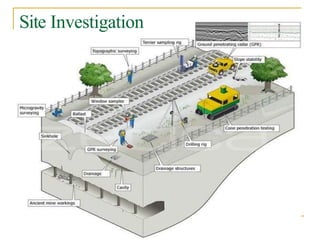
Site Investigation
Introduction (Cont’d)…
WHAT?
 Attempt at understanding the subsurface conditions
such as:
 Soil and rock profile
 Gelogical features of the region
 Position and variation of ground water table
 Physical properties of soil and rock
 Contamination, if any
 General data of adjacent structures, hydrological data,
topography, soil maps, seismicity, etc.
Introduction (Cont’d)…
WHY?
 To determine the type of foundation required
for the proposed project at the site, i.e. shallow
foundation or deep foundation.
 To make recommendations regarding the safe
bearing capacity or pile load capacity.
 Ultimately, it is the subsoil that provides the
ultimate support for the structures.
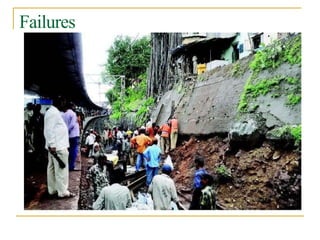
Failures
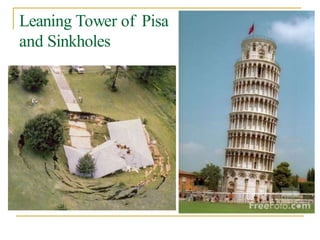
Leaning Tower of Pisa
and Sinkholes
Introduction (Cont’d)…
HOW?
 The three important aspect are planning,
execution and report writing.
 Planning
 To minimize cost of explorations and yet give
reliable data.
 Decide on quantity and quality depending on type,
size and importance of project and whether
investigation is preliminary or detailed.
Introduction (Cont’d)…
 Execution:
 Collection of disturbed and/or
undisturbed samples of
subsurface strata from field.
 Conducting in-situ tests of
subsurface material and
obtaining properties directly or
indirectly.
 Study of ground water
conditions and collection of
sample for chemical analysis.
 Geophysical exploration, if
necessary.
 Laboratory testing on samples
Introduction (Cont’d)…
 Report writing:
 Description of site conditions – topographic
features, hydraulic conditions, existing structures,
etc. supplemented by plans/drawings.
 Description of nature, type and importance of
proposed construction
 Description of field and lab tests carried out.
 Analysis and discussion of data collected
 Preparation of charts, tables, graphs, etc.
 Calculations performed
 Recommendations
Introduction (Cont’d)…
A complete site investigation will consist of:
 Preliminary work
 Collecting general information and already existing data
such as study of geologic , seismic maps, etc. at or near
site.
 Study site history – if previously used as quarry,
agricultural land, industrial unit, etc.
 Site Reconnaissance: Actual site inspection.
 To judge general suitability
 Decide exploration techniques
Introduction (Cont’d)…
 Exploration
 Preliminary Investigations: Exploratory borings or shallow
test pits, representative sampling, geophysical
investigations, etc
 Detailed Investigations: Deep boreholes, extensive
sampling, in-situ testing, lab testing, etc.
 Depth and spacing: In general, depth of investigation
should be such that any/all strata that are likely to
experience settlement or failure due to loading. Spacing
depends upon degree of variation of surface topography
and subsurface strata in horizontal direction. Refer to Alam
Singh.
Methods of Investigation
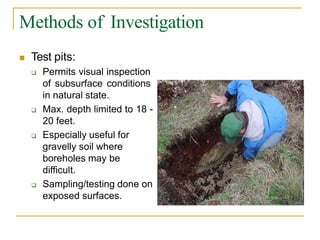
 Test pits:
 Permits visual inspection
of subsurface conditions
in natural state.
 Max. depth limited to 18 -
20 feet.
 Especially useful for
gravelly soil where
boreholes may be
difficult.
 Sampling/testing done on
exposed surfaces.
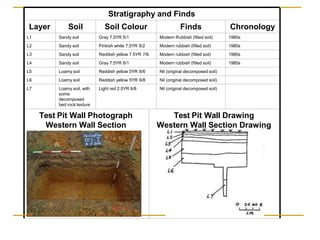
Stratigraphy and Finds
Layer Soil Soil Colour Finds Chronology
L1 Sandy soil Gray 7.5YR 5/1 Modern Rubbish (filled soil) 1980s
L2 Sandy soil Pinkish white 7.5YR 8/2 Modern rubbish (filled soil) 1980s
L3 Sandy soil Reddish yellow 7.5YR 7/6 Modern rubbish (filled soil) 1980s
L4 Sandy soil Gray 7.5YR 6/1 Modern rubbish (filled soil) 1980s
L5 Loamy soil Reddish yellow 5YR 6/6 Nil (original decomposed soil)
L6 Loamy soil Reddish yellow 5YR 6/8 Nil (original decomposed soil)
L7 Loamy soil, with
some
decomposed
bed rock texture
Light red 2.5YR 6/8 Nil (original decomposed soil)
Test Pit Wall Photograph
Western Wall Section
Test Pit Wall Drawing
Western Wall Section Drawing
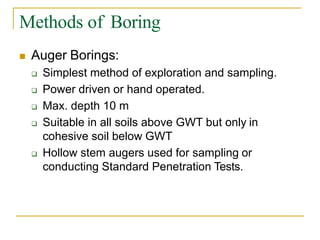
Methods of Boring
 Auger Borings:
 Simplest method of exploration and sampling.
 Power driven or hand operated.
 Max. depth 10 m
 Suitable in all soils above GWT but only in
cohesive soil below GWT
 Hollow stem augers used for sampling or
conducting Standard Penetration Tests.
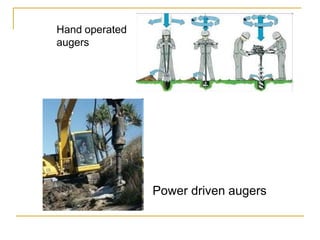
Hand operated
augers
Power driven augers
Methods of Boring
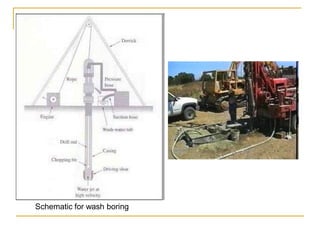
 Wash Boring:
 A casing is driven with a drop hammer. A hollowdrill
rod with chopping bit is inserted inside the casing.
 Soil is loosened and removed from the borehole using
water or a drilling mud jetted under pressure.
 The water is jetted in the hole through the bottom of a
wash pipe and leaves the hole along with the loose
soil, from the annual space between the hole and
wash pipe.
 The water reaches the ground level where the soil in
suspension is allowed to settle and mud is re-
circulated.
Methods of Boring
Another example of wash boring is called mud rotary
drilling (soil) or core drilling (rock).
 Mud rotary
 Hollow drill rods with a drill bit is rotated into the soil.
Drilling mud is continuously pumped into the hole. The bit
grinds the soil and the return flow brings the cuttings to the
surface.
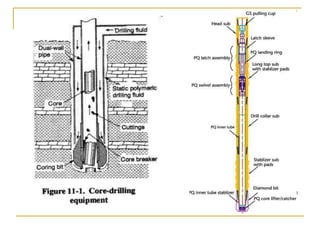
 Core drilling
 Used for obtaining rock cores.
 A core barrel is fitted with a drill bit is attached to hollow drill
rods.
 Examples: diamond coring, calyx or shot core drilling
Schematic for wash boring
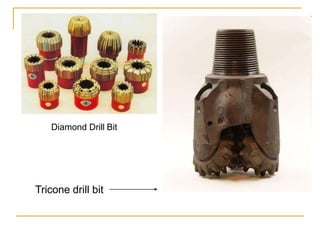
Diamond Drill Bit
Tricone drill bit
Methods of Investigation
 Percussion drilling
 Grinding the soil by repeated lifting and dropping
of heavy chisels or drilling bits.
 Water is added to form slurry of cuttings.
 Slurry removed by bailers or pumps.
 In general, a machine used to drill holes is
called a drill rig (generally power driven, but
may be hand driven).
 A winch is provided to raise and lower the
drilling tools into the hole.
Methods of Investigation
 Probing or sounding methods:
 Drive a pipe or rod into the soil.
 Measure the resistance offered by the soil. Ex.
CPT, SPT
 Geophysical methods:
 Seismic refraction method
 Electrical resistivity method.

Soil exploration

  • 1.
    Soil Exploration Presented to2013 Session on May 14 2015
  • 2.
    Topics Covered  Introduction Methods of investigation  Methods of boring  Soil samplers and sampling  Location and number of pits and borings  Penetrometer tests  Borehole logs  Geophysical methods
  • 3.
    Introduction  Soil explorationis a part of site investigation.  Site investigation, in general deals with determining in general, the suitability of the site for the proposed construction.
  • 4.
  • 5.
    Introduction (Cont’d)… WHAT?  Attemptat understanding the subsurface conditions such as:  Soil and rock profile  Gelogical features of the region  Position and variation of ground water table  Physical properties of soil and rock  Contamination, if any  General data of adjacent structures, hydrological data, topography, soil maps, seismicity, etc.
  • 6.
    Introduction (Cont’d)… WHY?  Todetermine the type of foundation required for the proposed project at the site, i.e. shallow foundation or deep foundation.  To make recommendations regarding the safe bearing capacity or pile load capacity.  Ultimately, it is the subsoil that provides the ultimate support for the structures.
  • 7.
  • 8.
    Leaning Tower ofPisa and Sinkholes
  • 9.
    Introduction (Cont’d)… HOW?  Thethree important aspect are planning, execution and report writing.  Planning  To minimize cost of explorations and yet give reliable data.  Decide on quantity and quality depending on type, size and importance of project and whether investigation is preliminary or detailed.
  • 10.
    Introduction (Cont’d)…  Execution: Collection of disturbed and/or undisturbed samples of subsurface strata from field.  Conducting in-situ tests of subsurface material and obtaining properties directly or indirectly.  Study of ground water conditions and collection of sample for chemical analysis.  Geophysical exploration, if necessary.  Laboratory testing on samples
  • 11.
    Introduction (Cont’d)…  Reportwriting:  Description of site conditions – topographic features, hydraulic conditions, existing structures, etc. supplemented by plans/drawings.  Description of nature, type and importance of proposed construction  Description of field and lab tests carried out.  Analysis and discussion of data collected  Preparation of charts, tables, graphs, etc.  Calculations performed  Recommendations
  • 12.
    Introduction (Cont’d)… A completesite investigation will consist of:  Preliminary work  Collecting general information and already existing data such as study of geologic , seismic maps, etc. at or near site.  Study site history – if previously used as quarry, agricultural land, industrial unit, etc.  Site Reconnaissance: Actual site inspection.  To judge general suitability  Decide exploration techniques
  • 13.
    Introduction (Cont’d)…  Exploration Preliminary Investigations: Exploratory borings or shallow test pits, representative sampling, geophysical investigations, etc  Detailed Investigations: Deep boreholes, extensive sampling, in-situ testing, lab testing, etc.  Depth and spacing: In general, depth of investigation should be such that any/all strata that are likely to experience settlement or failure due to loading. Spacing depends upon degree of variation of surface topography and subsurface strata in horizontal direction. Refer to Alam Singh.
  • 14.
    Methods of Investigation Test pits:  Permits visual inspection of subsurface conditions in natural state.  Max. depth limited to 18 - 20 feet.  Especially useful for gravelly soil where boreholes may be difficult.  Sampling/testing done on exposed surfaces.
  • 15.
    Stratigraphy and Finds LayerSoil Soil Colour Finds Chronology L1 Sandy soil Gray 7.5YR 5/1 Modern Rubbish (filled soil) 1980s L2 Sandy soil Pinkish white 7.5YR 8/2 Modern rubbish (filled soil) 1980s L3 Sandy soil Reddish yellow 7.5YR 7/6 Modern rubbish (filled soil) 1980s L4 Sandy soil Gray 7.5YR 6/1 Modern rubbish (filled soil) 1980s L5 Loamy soil Reddish yellow 5YR 6/6 Nil (original decomposed soil) L6 Loamy soil Reddish yellow 5YR 6/8 Nil (original decomposed soil) L7 Loamy soil, with some decomposed bed rock texture Light red 2.5YR 6/8 Nil (original decomposed soil) Test Pit Wall Photograph Western Wall Section Test Pit Wall Drawing Western Wall Section Drawing
  • 16.
    Methods of Boring Auger Borings:  Simplest method of exploration and sampling.  Power driven or hand operated.  Max. depth 10 m  Suitable in all soils above GWT but only in cohesive soil below GWT  Hollow stem augers used for sampling or conducting Standard Penetration Tests.
  • 17.
  • 18.
    Methods of Boring Wash Boring:  A casing is driven with a drop hammer. A hollowdrill rod with chopping bit is inserted inside the casing.  Soil is loosened and removed from the borehole using water or a drilling mud jetted under pressure.  The water is jetted in the hole through the bottom of a wash pipe and leaves the hole along with the loose soil, from the annual space between the hole and wash pipe.  The water reaches the ground level where the soil in suspension is allowed to settle and mud is re- circulated.
  • 19.
    Methods of Boring Anotherexample of wash boring is called mud rotary drilling (soil) or core drilling (rock).  Mud rotary  Hollow drill rods with a drill bit is rotated into the soil. Drilling mud is continuously pumped into the hole. The bit grinds the soil and the return flow brings the cuttings to the surface.  Core drilling  Used for obtaining rock cores.  A core barrel is fitted with a drill bit is attached to hollow drill rods.  Examples: diamond coring, calyx or shot core drilling
  • 20.
  • 22.
  • 23.
    Methods of Investigation Percussion drilling  Grinding the soil by repeated lifting and dropping of heavy chisels or drilling bits.  Water is added to form slurry of cuttings.  Slurry removed by bailers or pumps.  In general, a machine used to drill holes is called a drill rig (generally power driven, but may be hand driven).  A winch is provided to raise and lower the drilling tools into the hole.
  • 24.
    Methods of Investigation Probing or sounding methods:  Drive a pipe or rod into the soil.  Measure the resistance offered by the soil. Ex. CPT, SPT  Geophysical methods:  Seismic refraction method  Electrical resistivity method.