Module 4: Preliminary Geological Investigations
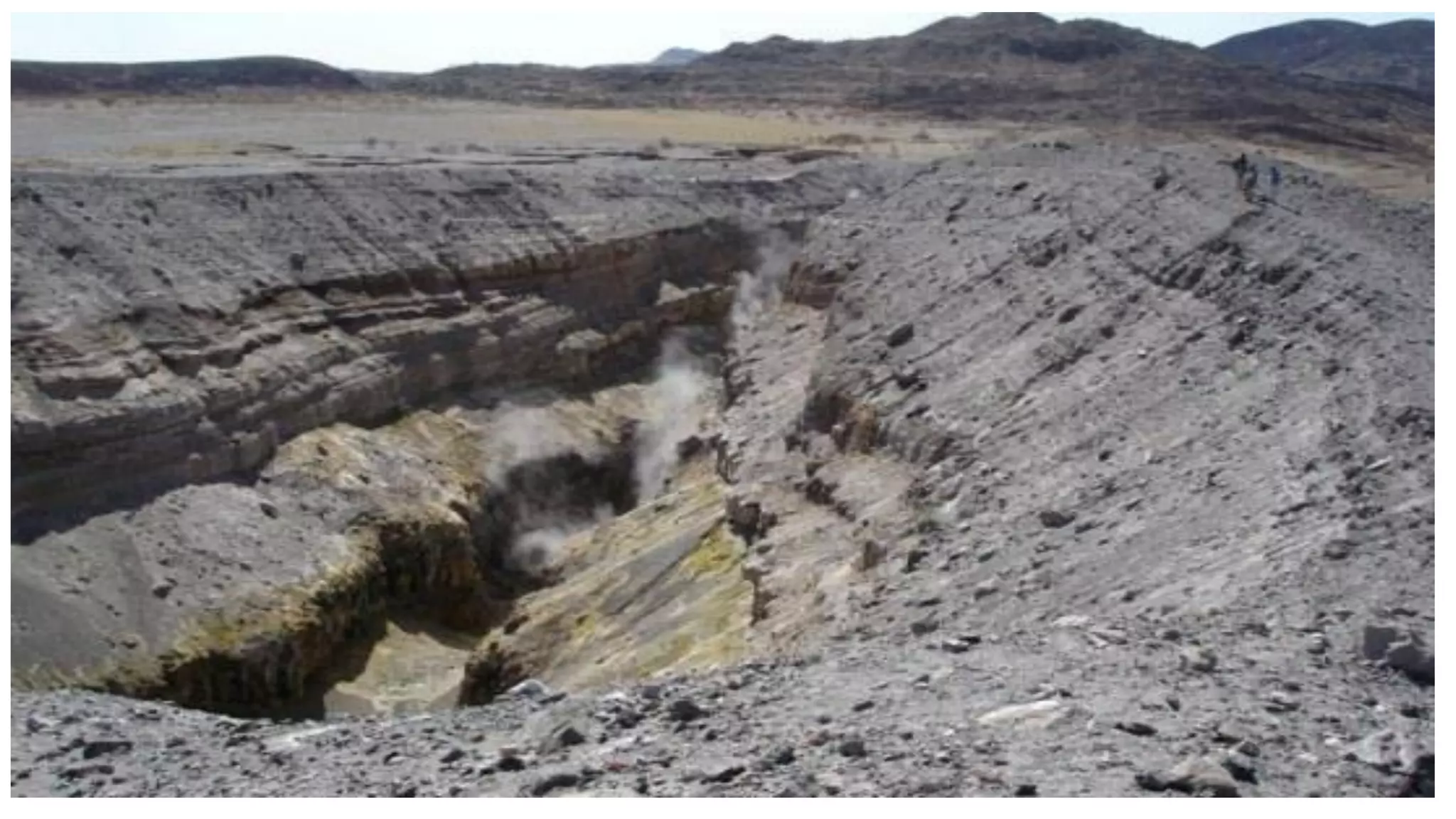
• All important civil engineering projects like dams, reservoirs, tunnels,
roads, bridges and buildings are constructed on rocks or on soils.
• Therefore, essential that the engineer should have the fullest knowledge
possible of the strata or soil through which works of construction are to be
carried out or on which these have to rest.
• When the geological characters of the site or of alignment are not
properly investigated or interpreted, the structures might involve
considerably higher costs.
• Many a dam disasters, foundation failures in buildings, collapse of bridges
and tunnels were, on subsequent study, found to be closely related to
ignorance of geological conditions that existed in and around these
structures
Prepared by-
Prof. Basweshwar S. J.
Objects
The main objects of geological investigations
for most engineering projects are to determine:
• The geological structure of the area;
[Topography]
• The lithology of the area;
[Type of rocks and properties]
• The ground water conditions in the region;
[Water table]
• The seismicity of the region;
[Earthquake and settlement parameters]
Prepared by-
Prof. Basweshwar S. J.
Methods of Geological Investigation
A. Surface Investigations
• Aerial surveys
• Photo geology
• Hydrogeological surveys
• Drainage pattern
• Location and discharge
• Location of wells
• Precipitation
B. Subsurface Explorations
• Direct subsurface explorations
• Drilling, sampling and in-situ testing
• Test pit excavation
• Trenching
• Indirect methods
• Seismic velocity profiling
• Ground Penetrating Radar (GPR)
• Electromagnetic and resistivity surveys
Prepared by-
Prof. Basweshwar S. J.
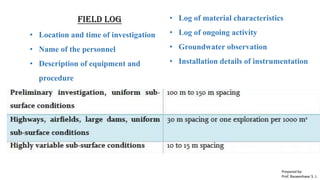
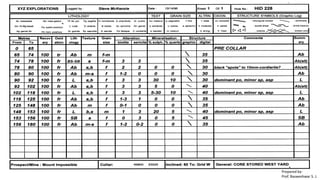
Field Log
• Location and time of investigation
• Name of the personnel
• Description of equipment and
procedure
• Log of material characteristics
• Log of ongoing activity
• Groundwater observation
• Installation details of instrumentation
Prepared by-
Prof. Basweshwar S. J.
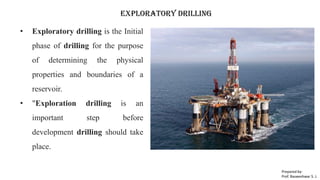
Exploratory drilling
• Exploratory drilling is the Initial
phase of drilling for the purpose
of determining the physical
properties and boundaries of a
reservoir.
• "Exploration drilling is an
important step before
development drilling should take
place.
Prepared by-
Prof. Basweshwar S. J.
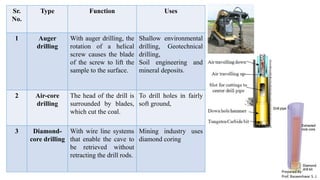
Sr.
No.
Type Function Uses
1 Auger
drilling
With auger drilling, the
rotation of a helical
screw causes the blade
of the screw to lift the
sample to the surface.
Shallow environmental
drilling, Geotechnical
drilling,
Soil engineering and
mineral deposits.
2 Air-core
drilling
The head of the drill is
surrounded by blades,
which cut the coal.
To drill holes in fairly
soft ground,
3 Diamond-
core drilling
With wire line systems
that enable the cave to
be retrieved without
retracting the drill rods.
Mining industry uses
diamond coring
Prepared by-
Prof. Basweshwar S. J.
4 Direct-
push
samples
Direct-push is
done with Selby
tubes, which
advance a drill
string by pushing
or hammering
without rotating
the drill string.
This method is
ideal for very
shallow sampling
in soft material.
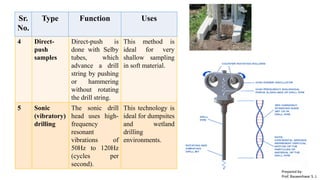
5 Sonic
(vibratory)
drilling
The sonic drill
head uses high-
frequency
resonant
vibrations of
50Hz to 120Hz
(cycles per
second).
This technology is
ideal for dumpsites
and wetland
drilling
environments.
Sr.
No.
Type Function Uses
Prepared by-
Prof. Basweshwar S. J.
Core LOGGING
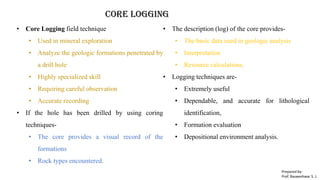
• Core Logging field technique
• Used in mineral exploration
• Analyze the geologic formations penetrated by
a drill hole
• Highly specialized skill
• Requiring careful observation
• Accurate recording
• If the hole has been drilled by using coring
techniques-
• The core provides a visual record of the
formations
• Rock types encountered.
• The description (log) of the core provides-
• The basic data used in geologic analysis
• Interpretation
• Resource calculations.
• Logging techniques are-
• Extremely useful
• Dependable, and accurate for lithological
identification,
• Formation evaluation
• Depositional environment analysis.
Prepared by-
Prof. Basweshwar S. J.
Preservation of cores
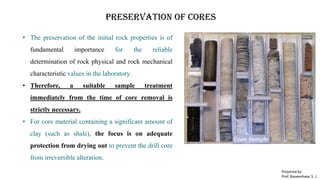
• The preservation of the initial rock properties is of
fundamental importance for the reliable
determination of rock physical and rock mechanical
characteristic values in the laboratory.
• Therefore, a suitable sample treatment
immediately from the time of core removal is
strictly necessary.
• For core material containing a significant amount of
clay (such as shale), the focus is on adequate
protection from drying out to prevent the drill core
from irreversible alteration.
Prepared by-
Prof. Basweshwar S. J.
Core recovery
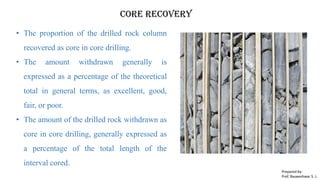
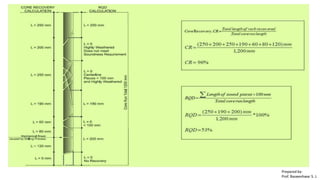
• The proportion of the drilled rock column
recovered as core in core drilling.
• The amount withdrawn generally is
expressed as a percentage of the theoretical
total in general terms, as excellent, good,
fair, or poor.
• The amount of the drilled rock withdrawn as
core in core drilling, generally expressed as
a percentage of the total length of the
interval cored.
Prepared by-
Prof. Basweshwar S. J.
Prepared by-
Prof. Basweshwar S. J.
Prepared by-
Prof. Basweshwar S. J.
Limitation of exploratory drilling method
• Exploration drilling can routinely achieve depths in excess of 1200 m.
• In cases where money is no issue, extreme depths have been achieved,
because there is no requirement to overcome water pressure.
• However, circulation must be maintained to return the drill cuttings to
surface, and more importantly to maintain cooling and lubrication of the
cutting surface.
• Without sufficient lubrication and cooling, the matrix of the drill bit will
soften and the diamonds must remain firmly in the matrix to achieve cutting.
• The force exerted by the weight of the drill rods on the cutting face of the bit
must also be monitored. Prepared by-
Prof. Basweshwar S. J.
Prepared by-
Prof. Basweshwar S. J.

MODULE-4 EG.pdf

  • 2.
    Module 4: PreliminaryGeological Investigations • All important civil engineering projects like dams, reservoirs, tunnels, roads, bridges and buildings are constructed on rocks or on soils. • Therefore, essential that the engineer should have the fullest knowledge possible of the strata or soil through which works of construction are to be carried out or on which these have to rest. • When the geological characters of the site or of alignment are not properly investigated or interpreted, the structures might involve considerably higher costs. • Many a dam disasters, foundation failures in buildings, collapse of bridges and tunnels were, on subsequent study, found to be closely related to ignorance of geological conditions that existed in and around these structures Prepared by- Prof. Basweshwar S. J.
  • 3.
    Objects The main objectsof geological investigations for most engineering projects are to determine: • The geological structure of the area; [Topography] • The lithology of the area; [Type of rocks and properties] • The ground water conditions in the region; [Water table] • The seismicity of the region; [Earthquake and settlement parameters] Prepared by- Prof. Basweshwar S. J.
  • 4.
    Methods of GeologicalInvestigation A. Surface Investigations • Aerial surveys • Photo geology • Hydrogeological surveys • Drainage pattern • Location and discharge • Location of wells • Precipitation B. Subsurface Explorations • Direct subsurface explorations • Drilling, sampling and in-situ testing • Test pit excavation • Trenching • Indirect methods • Seismic velocity profiling • Ground Penetrating Radar (GPR) • Electromagnetic and resistivity surveys Prepared by- Prof. Basweshwar S. J.
  • 5.
    Field Log • Locationand time of investigation • Name of the personnel • Description of equipment and procedure • Log of material characteristics • Log of ongoing activity • Groundwater observation • Installation details of instrumentation Prepared by- Prof. Basweshwar S. J.
  • 6.
    Exploratory drilling • Exploratorydrilling is the Initial phase of drilling for the purpose of determining the physical properties and boundaries of a reservoir. • "Exploration drilling is an important step before development drilling should take place. Prepared by- Prof. Basweshwar S. J.
  • 7.
    Sr. No. Type Function Uses 1Auger drilling With auger drilling, the rotation of a helical screw causes the blade of the screw to lift the sample to the surface. Shallow environmental drilling, Geotechnical drilling, Soil engineering and mineral deposits. 2 Air-core drilling The head of the drill is surrounded by blades, which cut the coal. To drill holes in fairly soft ground, 3 Diamond- core drilling With wire line systems that enable the cave to be retrieved without retracting the drill rods. Mining industry uses diamond coring Prepared by- Prof. Basweshwar S. J.
  • 8.
    4 Direct- push samples Direct-push is donewith Selby tubes, which advance a drill string by pushing or hammering without rotating the drill string. This method is ideal for very shallow sampling in soft material. 5 Sonic (vibratory) drilling The sonic drill head uses high- frequency resonant vibrations of 50Hz to 120Hz (cycles per second). This technology is ideal for dumpsites and wetland drilling environments. Sr. No. Type Function Uses Prepared by- Prof. Basweshwar S. J.
  • 9.
    Core LOGGING • CoreLogging field technique • Used in mineral exploration • Analyze the geologic formations penetrated by a drill hole • Highly specialized skill • Requiring careful observation • Accurate recording • If the hole has been drilled by using coring techniques- • The core provides a visual record of the formations • Rock types encountered. • The description (log) of the core provides- • The basic data used in geologic analysis • Interpretation • Resource calculations. • Logging techniques are- • Extremely useful • Dependable, and accurate for lithological identification, • Formation evaluation • Depositional environment analysis. Prepared by- Prof. Basweshwar S. J.
  • 10.
    Preservation of cores •The preservation of the initial rock properties is of fundamental importance for the reliable determination of rock physical and rock mechanical characteristic values in the laboratory. • Therefore, a suitable sample treatment immediately from the time of core removal is strictly necessary. • For core material containing a significant amount of clay (such as shale), the focus is on adequate protection from drying out to prevent the drill core from irreversible alteration. Prepared by- Prof. Basweshwar S. J.
  • 11.
    Core recovery • Theproportion of the drilled rock column recovered as core in core drilling. • The amount withdrawn generally is expressed as a percentage of the theoretical total in general terms, as excellent, good, fair, or poor. • The amount of the drilled rock withdrawn as core in core drilling, generally expressed as a percentage of the total length of the interval cored. Prepared by- Prof. Basweshwar S. J.
  • 12.
  • 13.
  • 14.
    Limitation of exploratorydrilling method • Exploration drilling can routinely achieve depths in excess of 1200 m. • In cases where money is no issue, extreme depths have been achieved, because there is no requirement to overcome water pressure. • However, circulation must be maintained to return the drill cuttings to surface, and more importantly to maintain cooling and lubrication of the cutting surface. • Without sufficient lubrication and cooling, the matrix of the drill bit will soften and the diamonds must remain firmly in the matrix to achieve cutting. • The force exerted by the weight of the drill rods on the cutting face of the bit must also be monitored. Prepared by- Prof. Basweshwar S. J.
  • 15.